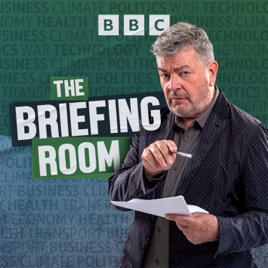
Advertise on podcast: The Briefing Room
Rating
4.8from
This podcast has
398 episodes
Language
EnglishPublisher
BBC Radio 4Explicit
No
Date created
2016/05/06
Latest episode
2026/10/08
Average duration
29 min.
Release period
12 days
Description
David Aaronovitch and a panel of experts and insiders present in-depth explainers on big issues in the news
Unlock The Briefing Room podcast Email contact info,
Listeners & Audience details
Email contact information
Direct podcast contact details

Listeners
Audience numbers & engagement insights

Audience details
Podcast Insights

Podcast episodes
Check latest episodes from The Briefing Room podcast
Why does the Yemen war matter to the world?
2026/10/08
The ceasefire between the Saudi-backed Yemen government and the Houthi rebels is over. As the fighting for control of land and sea intensifies, what are the knock on effects for the rest of the world?
Guests:
Nawal Al-Maghafi, BBC senior international investigations correspondent
Baraa Shiban, researcher and political analyst on Yemen and the Gulf at the defence and security thinktank, RUSI
Dr Elisabeth Kendall, Arabist & Middle East specialist and also The Mistress of Girton College at the University of Cambridge
Frank Gardner, BBC Security Correspondent
Presenter: David Aaronovitch
Producers: Ben Carter, Phoebe Keane and Kirsteen Knight
Editor: Richard Vadon
Sound engineer: James Beard
Production co-ordinator: Maria Ogundele
Are Gen Z movements reshaping politics?
2026/08/27
In May, the Chief Justice of India unwittingly gave a name to a generational protest. He called unemployed young people “cockroaches” and the mass youth movement that had begun in the wake of the sudden cancellation of a national exam took on the title - the Cockroach Janta party.
But India hasn’t been the only country that has seen Gen Z - people aged between 14 and 29 - engaging in mass protests this year. It’s been happening all over the place, from Serbia to Kenya. Different grievances, different circumstances, but the same generation.
So what are the youth revolting about, and are they winning?
Step inside The Briefing Room and together we’ll find out.
Guests:
Dr Nayana Prakash, research affiliate at the Minderoo Centre for Technology and Democracy at the University of Cambridge.
Erica Frantz, associate professor in political science at Michigan State University
Matthew Cebul, lead research fellow at the Nonviolent Action Lab at the Harvard Kennedy School
Production team:
Presenter: David Aaronovitch
Producers: Ben Carter, Emma Close and Kirsteen Knight
Editor: Penny Murphy
Sound engineer: James Beard
Production co-ordinator: Keshia Agyei
How do we prepare for a future water shortage?
2026/08/20
Did you step outside this morning and feel something odd on your face or neck? Its called rain. We’ve hardly had any this summer and the result was the declaration this month of drought status across two thirds of England and almost all of Wales. The reservoirs are low. And the future looks parched: the government estimates that by 2055, England will face a water shortfall of 5 billion litres a day. To put that in context we currently use 14 billion litres.
Why has this happened and how can we fix it? Other than everyone moving to Scotland.
Step inside The Briefing Room and together we’ll find out.
Guests:
Sir John Armitt, chair of The Public Private Partnership Commission
Professor Jim Hall, Professor of Climate and Environmental Risk at Oxford University
Dr Heather Smith, Senior Lecturer in Water Governance at Cranfield University
Production team:
Presenter: David Aaronovitch
Producers: Ben Carter, Bob Howard and Kirsteen Knight
Editor: Penny Murphy
Sound engineer: James Beard
Production co-ordinator: Keshia Agyei
Part 2: How do we reform social care?
2026/08/10
Until recently Baroness Louise Casey was going to deliver her huge review of English social care by 2028. Then the PM changed and so did the date. Now the whole shebang is timed for next summer. Last week we looked at what we mean by social care, who gets it, who provides it and who pays for it. And why our current system is deficient.
This week we find out what the alternatives are, how much they’d cost and who’d pay.
Guests:
Thea Stein, Chief Executive of the Nuffield Trust
Simon Bottery, who leads independent charity The King's Fund's work on adult social care
Sir Andrew Dilnot, the economist who was asked by the government back in 2010 to chair a commission to find a fair and sustainable way of funding adult social care in England
Production team:
Presenter: David Aaronovitch
Producers: Ben Carter, Sally Abrahams and Kirsteen Knight
Editor: Richard Vadon
Sound engineer: James Beard
Production co-ordinators: Siobhan Reed and Maria Ogundele
Part 1: How do we reform social care?
2026/08/06
It’s social care time again. That moment every five years when politicians and civil servants are on the cusp of coming up with a new system to replace the perceived arbitrary and unfair way in which we in the UK pay for the care that many adults need to be able to live a decent life.
Right now Baroness Casey, appointed by Keir Starmer to conduct a urgent review into social care in England with the objective of recommending a new plan, has been asked by Andy Burnham to make it even more urgent and recommend it more quickly.
In this first of two episodes looking at what the review is likely to find and its impact on all of us, we’ll look at what we mean by social care, its history and who gets it.
Guests:
Thea Stein, Chief Executive of the Nuffield Trust
Simon Bottery, who leads independent charity The King's Fund's work on adult social care
Sir Andrew Dilnot, the economist who was asked by the government back in 2010 to chair a commission to find a fair and sustainable way of funding adult social care in England
Production team:
Presenter: David Aaronovitch
Producers: Ben Carter, Sally Abrahams and Kirsteen Knight
Editor: Richard Vadon
Sound engineer: James Beard
Production co-ordinators: Siobhan Reed and Maria Ogundele
Part 2: How's the government doing on immigration?
2026/07/27
According to polls immigration remains near the top - or at the top - of public concerns. And now a new prime minister inherits that popular anxiety. Last week The Briefing Room examined arguably the most visible aspect of the migration question: the small boats, asylum seeking and illegal migration.
This week we look at legal migration, the issue of reliance on overseas workers, changes to indefinite leave to remain and public opinion about migration.
Guests:
Madeleine Sumption, Director of the Migration Observatory at the University of Oxford and author of What is Immigration Policy for?
Dominic Casciani, BBC Home and Legal correspondent
Rob Ford, Professor of Political Science at the University of Manchester
Production team:
Presenter: David Aaronovitch
Producers: Ben Carter and Kirsteen Knight
Editor: Richard Vadon
Sound engineers: Duncan Hannant
Sound mix: James Beard
Production co-ordinators: Siobhan Reed, Maria Ogundele
Part 1: How's the government doing on immigration?
2026/07/23
New PM, old problems. When Labour took office they vowed to tackle the people smuggling gangs behind the small boats crossings, to reduce net inward migration and to act to replace cheap imported labour with better paid indigenous workers. Meanwhile Andy Burnham faces polls showing immigration still sitting near the top - if not the top - of public concerns.
But what are the facts here? What does the record show after two years of this government?
This issues here are so big and complicated that we’re devoting two programmes to them. In this - the first one - we’re going to focus purely on small boats, asylum seekers and illegal immigration.
Guests:
Madeleine Sumption, Director of the Migration Observatory at the University of Oxford and author of What is Immigration Policy for?
Dominic Casciani, BBC Home and Legal correspondent.
Production team:
Presenter: David Aaronovitch
Producers: Ben Carter and Kirsteen Knight
Editor: Richard Vadon
Sound engineers: Duncan Hannant and Andy Garratt
Production co-ordinators: Siobhan Reed, Maria Ogundele
Picture credit: Ben Stansall Via Getty
Will a devolution revolution help boost the economy?
2026/07/16
Power to the people! Or, at any rate power to the mayors! As government prepares for yet another new prime minister it is keenly aware that this one has moving power away from the centre to the English regions as his big idea. His central idea. The argument is that such devolution will lead to more and better economic growth. But how does that actually work? Would you get more growth that way?
Guests:
Jennifer Williams, Northern correspondent at the Financial Times
Tony Travers, Professor in Practice in the LSE Department of Government
Liam Sides, Associate Director in the Cities and Regions team at Oxford Economics
Thomas Pope, Chief Economist at the Institute for Government
Production team
Presenter: David Aaronovitch
Producers: Ben Carter, Nathan Gower and Kirsteen Knight
Editor: Richard Vadon
Sound engineers: Sarah Hockley and Neil Churchill
Production co-ordinators: Siobhan Reed, Maria Ogundele
Relationship recession: Why are fewer people coupling?
2026/07/09
For previous generations, coupling was something only trains did. Then it became a word to describe the business of finding a partner. An important business for the future of the species. But today in the developed world - and even beyond - the data shows that coupling is significantly down. Increasingly, people are just not forming those relationships. There are all kinds of theories out there now about why this is happening, ranging from the intriguing to the improbable. So what do we know about this noncoupling and its implications?
Guests:
Dr Alice Evans, visiting Associate Professor at Stanford and author of the upcoming book The Great Gender Divergence
John Burn-Murdoch, columnist and chief data reporter for the Financial Times
Presenter: David Aaronovitch
Producers: Ben Carter and Kirsteen Knight
Editor: Richard Vadon
Sound engineer: Gareth Jones, Neil Churchill
Production co-ordinator: Siobhan Reed, Maria Ogundele
Image credit: Malte Mueller, Getty Images
Iran: If the war is over...who won?
2026/07/02
Two weeks ago a Memorandum of Understanding was signed between the Americans and the Iranians aiming at ending a bomb, missile-and-drone conflict that has lasted four months. Victory has been claimed by everyone and on behalf of everyone. So is the US/Israeli/Iranian war effectively over bar the seemingly inevitable bombast? If so did anyone win? On what terms? And where does it leave the rest of us?
Guests:
Shashank Joshi, The Economist’s Washington bureau chief
Ali Vaez, Project Director, Iran at the Crisis Group in Washington DC
Suzanne Maloney, VP and director of the Foreign Policy programme at the Brookings Institution
Presenter: David Aaronovitch
Producers: Ben Carter and Kirsteen Knight
Editor: Richard Vadon
Sound engineer: Neil Churchill
Production co-ordinator: Siobhan Reed
Is Russia under pressure from Ukraine?
2026/05/21
The war between Russia and Ukraine has shifted closer to Moscow. In the past week Ukraine has sent drones, made by Ukraine, to Moscow. While many were intercepted, 3 people died when an apartment block was hit. For many Russians the war - or special military operation as President Putin calls it - has been far away. But not any longer. At the same time though, Russia continues to hit cities across Ukraine and civilians continue to die. David Aaronovitch and his guests discuss whether Putin is under greater pressure now and whether the trajectory of this conflict has changed with the use of drone-warfare?
Guests:
Steve Rosenberg, BBC Russia Editor
Christopher Miller, Ukraine Correspondent, The Financial Times
Angela Stent, Senior Fellow at the American Enterprise Institute and former US National Intelligence Officer for Russia and Eurasia
Presenter: David Aaronovitch
Producers: Caroline Bayley and Kirsteen Knight
Production Co-ordinator: Maria Ogundele
Sound Engineer: James Beard
Editor: Richard Vadon
Ten years of The Briefing Room
2026/05/14
It's ten years since the Briefing Room was first transmitted in May 2016. And what a decade it's been. To mark the tenth anniversary the programme looks at the biggest changes at home and abroad since that momentous day in British broadcasting. We’ve had Brexit, a pandemic, the Gaza war, the Russian invasion of Ukraine and Donald Trump - twice. It is hard to remember such a time. So David Aaronovitch's three expert guests will help him answer the question: are we even the same people as we were back then?
Guests:
Anand Menon, Professor of European Politics and Foreign Affairs, King’s College London
Bronwen Maddox, Director and CEO, Chatham House
Meg Russell, Professor of British and Comparative Politics in the Department of Political Science at University College London.
Presenter: David Aaronovitch
Producers: Caroline Bayley, Kirsteen Knight, Sally Abrahams
Production Co-ordinator: Maria Ogundele
Sound engineers: James Beard and Neil Churchill
Editor: Richard Vadon
Are we still going to Mars?
2026/05/07
A month ago the Artemis II crew landed safely in the Pacific Ocean, completing their historic space mission to the far side of the moon. It’s been several decades since the last human mission to the moon - although this time there was no landing. However, the 4 astronauts travelled further from earth than any human ever has so far. David Aaronovitch asks his guests whether space exploration is back in fashion and if so what’s next? And are we any closer to a human mission to Mars and what would we hope to achieve there?
Guests:
Dr Julia Balm, Research Associate, Freeman Air and Space Institute in the School of Security Studies, King’s College London
Professor Andrew Coates, Mullard Space Science Laboratory, University College London
Libby Jackson, Head of Space, Science Museum, London
Presenter: David Aaronovitch
Producers: Caroline Bayley, Sally Abrahams, Kirsteen Knight
Production Co-Ordinator: Maria Ogundele
Sound Engineer: James Beard
Editor: Richard Vadon
Can Europe build digital sovereignty?
2026/04/30
Ask Claude a question, Google a query, order from Amazon, chat with mates on WhatsApp, tune in to Youtube. And where ever you do it from, you’ll never be somehow not in America. Because Britain, like Europe is dependent on US tech and as the AI revolution unfolds, governments are increasingly worried about it.
The new buzz phrase is digital sovereignty. But what does that mean? Is it even feasible? And can the UK and the Europe take back control?
David Aaronovitch talks to:
Stanley Pignal, Europe editor at The Economist
Cecilia Rikap, Associate Professor in Economics and Head of Research at the UCL Institute for Innovation and Public Purpose
Seb Johnson, founder of Scaling Europe, a media company focused on European Tech
Presenter: David Aaronovitch
Producers: Ben Carter, Sally Abrahams, Kirsteen Knight
Production Co-ordinator: Gemma Ashman
Sound engineer: James Beard
Editor: Richard Vadon
What's the conflict in Iran doing to the world economy?
2026/04/23
It’s almost two months since the United States and Israel went to war with Iran. And in spite of a ceasefire the vital Strait of Hormuz through which 20 per cent of the world’s oil and liquefied natural gas passes on tankers, is still effectively closed. The oil price remains high, affecting economies around the world. The most recent assessment from the International Monetary Fund warned that the war could throw the world economy “off course” and a prolongued conflict risked causing a global recession. David Aaronovitch asks what this means for us now and whether an end to the conflict could re-set the world’s economies or have conditions changed for good?
Guests:
Joseph Stiglitz, American economist and recipient of the Nobel Memorial Prize in Economic Sciences and Professor at Columbia University
Duncan Weldon, author and economist
Diana Choyleva, economist and founder of Enodo Economics.
Presenter: David Aaronovitch
Producers: Caroline Bayley, Sally Abrahams, Kirsteen Knight
Production Co-ordinator: Maria Ogundele
Sound engineer: Neil Churchill
Editor: Richard Vadon
Podcast reviews
Read The Briefing Room podcast reviews
phxroy 2021/04/02
Excellent!
Terrific, quick primer on the topic, leaving you with an informed, working knowledge. I always look forward the podcast when I see it in my feed, as I...
avm1406 2021/01/03
5 stars
Outstanding. From diversity of topics to the unique format that moves from one expert providing the in-depth backstory to an engaging dialogue with a ...
AdiKharo 2020/08/22
Brilliant
You end the podcast knowing more than when you started it. And you are engrossed in the topic along the way. Brilliant. Great topics, great interviewe...
lalalahexd 2019/02/01
Nice podcast
Really cool and the guests are well informed!
ab13204 2018/09/24
Excellent
I was glad to discover this podcast. It provides a excellent analysis on a broad range of topics. It is very well presented. Highly recommended!
David G Bober 2018/09/07
The “In Our Time” of current affairs
Always informative, never condescending.
NickAtHome 2018/08/31
Excellent podcast
Rounded, thoughtful analysis of current issues
SamCat777 2017/08/04
Excellent Program
Excellent program. Delivers well informed insight into current affairs.
Podcast sponsorship advertising
Start advertising on The Briefing Room relevant audience podcasts
You may also like to advertise on these Podcasts

4.9265022000
Morning Wire
The Daily Wire

4.518767374
American Scandal
Audible

4.689331209
Get Sleepy: Sleep meditation and stories
Slumber Studios

4.79026375
Life is Short with Justin Long
Audible

4.714107348
Bad Friends
Bobby Lee & Andrew Santino

4.7126170
10 to Life
Annie Elise

4.76755462
Criminology
Emash Digital & Mike Ferguson, Mike Morford
4.87501973
The Dr. John Delony Show
Ramsey Network

4.512577662
RedHanded
RedHanded

4.959762000
Legal AF by MeidasTouch
MeidasTouch Network