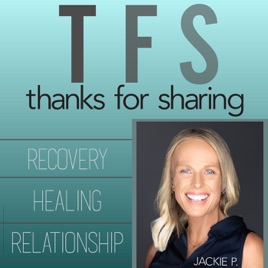
Advertise on podcast: Thanks for Sharing
Rating
4.4from
This podcast has
199 episodes
Language
EnglishPublisher
Jackie PackExplicit
No
Date created
2016/10/26
Latest episode
2026/04/15
Average duration
49 min.
Release period
7 days
Description
This is the place for all things recovery, healing, and relationships. We explore a variety of topics with people in recovery and the professionals who help them through personal stories. This podcast will give you a broad look at the aspects of recovery that make a difference.
Unlock Thanks for Sharing podcast Email contact info,
Listeners & Audience details
Email contact information
Direct podcast contact details

Listeners
Audience numbers & engagement insights

Audience details
Podcast Insights

Podcast episodes
Check latest episodes from Thanks for Sharing podcast
Episode 363: Building Bandwidth in Difficult Relationships
2026/04/15
Why do some people still get to you… even after you’ve done the work?
It’s not just about “triggers.”
And it’s not just about setting boundaries either.
Sometimes it’s:
– being around someone you don’t trust
– navigating tension with someone you love
– watching a relationship change in ways you didn’t expect
– or trying to stay grounded when your past and present are both getting activated
This episode is about something deeper than coping:
How we build the capacity to stay connected to ourselves in relationships that feel complicated, unresolved, or emotionally charged.
Because real healing isn’t:
avoiding people
or just getting through interactions
It’s learning how to:
– regulate instead of endure
– stay grounded without shutting down
– protect yourself without abandoning yourself
If relationships have ever made you question yourself, second-guess your reactions, or feel like you lose access to who you are, this one will land.
Link in bio
Have a question or something you’d like me to talk about in a future episode?
You can call the show and leave a voicemail or send me an email — I love hearing from you, and your feedback helps shape these conversations.
https://thanksforsharingpodcast.my.canva.site/thanks-for-sharing-links
Episode 362: Why We Lie and How to Start Being Honest
2026/04/08
Most people think lying is a choice. But for many people, it doesn’t even pass through conscious thought. It starts in the body.
A flush
A tightening
A sense of threat
And the truth doesn’t feel like an option.
In this episode, I talk about something I often say:
“I came by my dishonesty honestly.”
Not to excuse it—
but to understand it.
Because for many of us:
Truth didn’t always feel safe
Being fully seen felt risky
And connection sometimes depended on what we didn’t say
And for partners?
Dishonesty doesn’t just hurt. It makes you question reality.
Was any of this real?
Have they just been telling me what I want to hear?
Wanting honesty isn’t controlling. It’s about trying to build a relationship on something real.
Here’s what I’ve learned:
As the truth reveals itself, it can be very painful. But it also settles you. It settles your nervous system. Because you’re no longer trying to hold together something that doesn’t quite fit.
If this resonates, this episode is for you.
Link in bio
Comment “truth” if this resonated
Have a question or something you’d like me to talk about in a future episode?
You can call the show and leave a voicemail or send me an email — I love hearing from you, and your feedback helps shape these conversations.
https://thanksforsharingpodcast.my.canva.site/thanks-for-sharing-links
Episode 361: Patriarchy, Relationships, and Healing (Guest Appearance on The Wholeness Network)
2026/04/01
In this episode, I share a conversation I had as a guest on The Wholeness Network, where we talk about patriarchy—not as a buzzword, but as something that quietly shapes how we love, how we show up, and what we believe we’re allowed to need.
This shows up in my work all the time:
• men who were never taught emotional depth but are expected to create connection
• women who carry the weight of relational responsibility
• couples who personalize patterns that are actually bigger than both of them
And here’s the tension:
even when the system shaped us… healing is still personal.
If you’ve ever felt stuck in the same relational patterns and couldn’t quite explain why—this conversation might give you language for that.
Full episode at the link in bio
The Wholeness Network link: https://www.thewholenessnetwork.com/
Have a question or something you’d like me to talk about in a future episode?
You can call the show and leave a voicemail or send me an email — I love hearing from you, and your feedback helps shape these conversations.
https://thanksforsharingpodcast.my.canva.site/thanks-for-sharing-links
Episode 360: When Healing Feels Incomplete
2026/03/25
People don’t leave therapy because it’s not working. Sometimes they leave because it’s getting too close to what matters.
And sometimes… they stay. But still feel like something is missing.
You might:
understand your patterns
have more awareness
even be making progress
…but not actually feel different.
That’s not failure. It’s the difference between insight and integration. In this episode, I talk about:
why “being ready” isn’t enough
why trauma work requires preparation, not just willingness
how going too fast can actually reinforce the problem
why addicts and betrayed partners need different pacing
and why the relationship—not just the model—matters
Healing doesn’t happen just because you go into the trauma.
It happens when your system can stay open long enough for something new to take hold.
If you’ve ever thought:
“I’ve done a lot of work… so why does this still feel incomplete?”
This episode is for you.
Link in bio
Have a question or something you’d like me to talk about in a future episode?
You can call the show and leave a voicemail or send me an email — I love hearing from you, and your feedback helps shape these conversations.
https://thanksforsharingpodcast.my.canva.site/thanks-for-sharing-links
Episode 359: Why does America respond differently to scandals like the Epstein case?
2026/03/18
We keep asking: How could this happen?
But maybe the better question is…
Why are we still surprised?
When the Epstein files resurfaced, I saw a lot of shock, even in professional circles. Names people admired. People who built identities around wisdom, healing, or influence.
I texted my friend Rachel and asked, “Are you surprised?”
Her response:
“I am never surprised when a male spiritual guru, leader, or pastor turns out to be a sexual predator.”
That stopped me. Because I wasn’t surprised either.
But what did surprise me was America’s response.
Why does the conversation here so quickly become political, fragmented, or avoidant?
Why do we focus on individuals instead of systems?
Why do we struggle to hold power accountable—especially when it’s wrapped in wealth, status, or influence?
In this episode, we explore:
Why Americans may respond differently than other countries
The psychology of protecting powerful people
How systems (families, institutions, even nations) often protect themselves first
And why this isn’t just about Epstein—it’s about all of us
Because the real question isn’t just who did what…It’s what do we do when we see it?
Episode now live
Have a question or something you’d like me to talk about in a future episode?
You can call the show and leave a voicemail or send me an email — I love hearing from you, and your feedback helps shape these conversations.
https://thanksforsharingpodcast.my.canva.site/thanks-for-sharing-links
#epsteinfiles #powerandcontrol #traumainformed #psychologypodcast #healingjourney #betrayaltrauma #relationships #mentalhealthawareness #therapistsofinstagram #systemsthinking #culturalpsychology
Episode 358: Why He Shuts Down When Emotions Show Up
2026/03/11
Sometimes relationships fall into a confusing pattern. Things feel connected for a while. Conversations are easier. You feel hopeful. And then emotions show up: hurt, stress, vulnerability, and suddenly the other person shuts down.
Many partners assume this means the person doesn’t care.
But often what’s happening is something different.
In this episode, Jackie talks about a pattern she sees frequently in couples called emotional cycling — when someone can access connection for a time but struggles to sustain it when emotional intensity increases.
The good news is that emotional capacity can be learned. Real intimacy doesn’t happen when emotions are avoided. It happens when two people learn how to face them together.
Listen wherever you get your podcasts.
https://www.speakpipe.com/ThanksForSharing
Have a question or something you’d like me to talk about in a future episode?
You can call the show and leave a voicemail or send me an email — I love hearing from you, and your feedback helps shape these conversations.
https://thanksforsharingpodcast.my.canva.site/thanks-for-sharing-links
#relationshiphealth
#emotionalintelligence
#couplestherapy
#attachmenthealing
#mentalhealthpodcast
#emotionalgrowth
#relationships
#healingrelationships
Episode 357 | Episode 5 in the Pornography Use, Addiction & Healing Series:
2026/03/04
Recovery isn’t dramatic most of the time. It isn’t big breakthroughs. It isn’t intense motivation. It isn’t one powerful decision that fixes everything.
It’s steady. It’s going to bed when you’d rather “steal time.” It’s feeling shame without escaping it. It’s waking up at 3 a.m. and choosing not to spiral. It’s resisting the urge to future-trip and instead staying in this hour. It’s calling your spouse when you want to isolate. It’s saying, “I need to go through this,” instead of numbing it.
Steady isn’t exciting. But steady builds resilience.
And over time, what once felt haunting begins to quiet, not because life is perfect, but because you’re no longer running from yourself.
Episode 357 is live.
If you’re in the middle of the long game… this one is for you.
Have a question or something you’d like me to talk about in a future episode?
You can call the show and leave a voicemail or send me an email — I love hearing from you, and your feedback helps shape these conversations.
https://thanksforsharingpodcast.my.canva.site/thanks-for-sharing-links
Episode 356: Rebuilding After Secrecy: Why Sobriety Alone Doesn’t Fix the Relationship
2026/02/25
What actually happens after sobriety begins?
Many couples believe that once porn or addictive behaviors stop, the relationship should feel better right away. But for many people, that’s when a deeper layer of healing starts — emotional awareness, reconnecting with the authentic self, and learning how to rebuild safety, security, and trust.
In this episode, I talk about what rebuilding really looks like — both individually and relationally.
Sobriety removes secrecy — but reconnection grows through emotional presence, consistency, and learning how to show up differently with each other over time.
If you’re in the stage where recovery has begun but the relationship still feels fragile, this conversation is for you.
Have a question or something you’d like me to talk about in a future episode?
You can call the show and leave a voicemail or send me an email — I love hearing from you, and your feedback helps shape these conversations.
https://thanksforsharingpodcast.my.canva.site/thanks-for-sharing-links
Episode 355: Porn, Compartmentalization, and the Secret Self
2026/02/18
What happens to the self when parts of life begin living in secrecy?
In this episode of the Thanks for Sharing podcast, we move beyond behavior and beyond relationship impact to explore how porn can shape identity, emotional development, and connection.
We talk about:
• how compartmentalization forms in the brain and nervous system
• why dopamine can reinforce a “secret self”
• what young men need to understand about relational risk and resilience
• how partners often sense misalignment long before discovery
• the difference between shame and responsibility
• and how healing begins through development of the authentic self
This episode is part of an ongoing series:
Episode 1 — Regulation & the brain
Episode 2 — Relational impact & betrayal
Episode 3 — Development of the self (this episode)
Have a question or thought? I’ve added a place in my Linktree where you can send a message or leave a voicemail for a future episode. (you can stay anonymous)
Listen now — link in bio.
#ThanksForSharingPodcast #AuthenticSelf #AttachmentHealing #PornRecovery #BetrayalTrauma #TherapyPodcast #MentalHealthEducation #HealingJourney
Episode 354: Porn, Predictability, and Relational Capacity: Porn is often framed as a private habit or a personal struggle. But its impact is rarely private.
2026/02/11
In this episode, we explore how porn reshapes relationships, not just behavior.
We talk about how porn:
quietly reorganizes relationships around absence
impacts the partner’s nervous system and sense of safety
often feels like cheating, even when there’s no physical affair
contributes to loneliness, emotional withdrawal, and loss of self in partners
shapes expectations of intimacy and attitudes toward women
creates predictability that looks like safety—but isn’t
We also explore why time alone doesn’t build security in relationships and why repair, not perfection, actually creates safety.
This conversation isn’t about blame or shame. It’s about understanding why things feel the way they do and what helps people rebuild capacity for intimacy, presence, and connection.
Whether you’re navigating porn use, supporting a partner, or trying to make sense of distance in your relationship, this episode offers language for experiences that are often difficult to name.
Episode 353: What Porn Actually Does to the Brain: Porn isn’t just about sex, it’s about the brain.
2026/02/04
In this episode, we explore why porn is so compelling, why willpower usually fails, and why intelligent, caring people struggle with it even when it conflicts with their values or relationships. This conversation moves beyond shame and into understanding how novelty, dopamine, attachment, and emotional regulation intersect, and why real change starts with compassion, not control.
Episode 352: The world feels divided — but the real damage is happening between us.
2026/01/28
We recorded this episode planning to talk about current events, and the conversation didn't go exactly where we planned, and that's why it matters. Instead, we found ourselves talking about how people are actually living inside all of this, the personal experiences and stories that impact us.
Politics. Gender. Fear. Fatigue. Misunderstanding.
This wasn’t a debate. It was a conversation about what it costs us to stay polarized — and what it might take to repair.
What part of this conversation stayed with you the most?
Where do you feel the divide showing up in your own life — relationships, family, friendships?
Episode 351: When Answers Become a Defense: How Rationalization Keeps Us Comfortable...and Stuck: Most avoidance doesn’t sound defensive.
2026/01/21
It sounds reasonable.
It sounds like:
• “This makes sense.”
• “This is normal.”
• “I already know why I do this.”
In this episode, I explore how rationalization and minimization quietly protect comfort, certainty, and the need to feel right — especially for smart, thoughtful people.
Episode 350: When you try to talk… and somehow you become the problem.
2026/01/13
Defensiveness doesn’t always look like anger.
Sometimes it looks like minimizing, mocking, dismissing, or explaining things away.
In this episode, I talk about:
• why people get defensive
• how avoidance can be loud or quiet
• how to respond without escalating
• and the red flags that mean a boundary has been crossed
If you’ve ever felt shut down for asking a real question, this one’s for you.
Episode 349: Letting the Year Unfold : What if the new year isn’t asking you to decide anything?
2026/01/07
Rachel and I talk about why so many of us feel pressure to know what comes next, and how real change tends to happen without announcements. We explore how moves, family dynamics, and internal shifts quietly reorient us long before we name them.
If you’re entering this year without goals or certainty, this conversation offers permission to slow down.
Listen now.
Podcast reviews
Read Thanks for Sharing podcast reviews
rudy_z1 2019/05/15
Great content-terrible sound quality
This podcast has great content, but they need to focus on better (or more consistent) production values... Some episodes need to be played at max volu...
71 year old guy 2023/05/07
Review again
Reviewing again on Feb 16, 2023: the last two episodes have been particularly meaningful and compelling re my emotional neglect and my anxious attachm...
mrsbay 2023/04/14
Really appreciate the information!
I love how listening to this podcast helps me understand myself, my family, and others I interact with. Mental health knowledge helps me have empathy ...
Ray_The_Apple_Lover 2023/03/30
Great Podcast to change your mindset
I really like this podcast! I listen to many of the podcasts more than once! It is easy to understand, follow and apply.
San Bruno 2022/03/09
Good content. Terrible audio.
This is almost unlistenable which is a terrible shame. The content is very good but I am so distracted by the fact that the audio sounds like she is s...
Bro. J. 2022/01/21
Not just beneficial, it’s rewarding
Jackie has a great, intuitive way of sharing her significant insights into the world of recovery and development. Her way of sharing her knowledge, se...
gracemore777 2021/10/13
It’s 2021 no excuse for horrible sound quality
A toddler could make a better podcast. The subject matter is great but unfortunately it is totally overshadowed by the atrocious sound quality. If the...
Laniejosephine2219 2020/12/02
Going through a difficult time? Episode 196!
Jackie is an amazing therapist and being able to freely receive her insight and knowledge regarding various mental health topics is a gift. Some topic...
Abrogator 2020/03/04
She has the Gift of Gab!
I've heard many of the concepts before, but Jackie has the talent to say things in ways that really hit home and helps me take them to heart. Her ser...
Lagunasunset1 2019/07/25
Excellent. HCP! Yes. We need public health ed about this. more, more, more.
Well, in families HCP create dysfunctional family systems and their pathology is rather contagious. The family system takes on these personality trai...
Podcast sponsorship advertising
Start advertising on Thanks for Sharing relevant audience podcasts
You may also like to advertise on these Podcasts

4.4371061566
The Megyn Kelly Show
SiriusXM

4.888901269
Fearless with Jason Whitlock
Blaze Podcast Network

4.8118931000
Mind Pump: Raw Fitness Truth
Sal Di Stefano, Adam Schafer, Justin Andrews, Doug Egge
4.8102131585
Tara Brach
Tara Brach

4.541561215
Something You Should Know
Mike Carruthers | OmniCast Media

4.513841343
Strictly Anonymous Confessions
Kathy Kay

4.8292781897
Fantasy Footballers - Fantasy Football Podcast
Fantasy Football

4.62382612
Football Weekly
The Guardian

4.45387666
Two Judgey Girls
Two Judgey Girls

3.8258501152
The Viall Files
Nick Viall