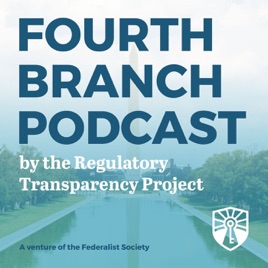
Advertise on podcast: RTP's Fourth Branch Podcast
Rating
4.7from
This podcast has
439 episodes
Language
EnglishPublisher
The Federalist SocietyExplicit
No
Date created
2017/06/12
Latest episode
2026/01/13
Average duration
46 min.
Release period
16 days
Description
The Regulatory Transparency Project is a nonprofit, nonpartisan effort dedicated to fostering discussion and a better understanding of regulatory policies. On RTP’s Fourth Branch Podcast, leading experts discuss the pros and cons of government regulations and explain how they affect everyday life for Americans.
Unlock RTP's Fourth Branch Podcast podcast Email contact info,
Listeners & Audience details
Email contact information
Direct podcast contact details

Listeners
Audience numbers & engagement insights

Audience details
Podcast Insights


Podcast episodes
Check latest episodes from RTP's Fourth Branch Podcast podcast
Tech Roundup Episode 29 - An AI Roundup of 2025 and What Lies Ahead for 2026
2026/01/13
Join tech and legal experts Prof. Kevin Frazier (University of Texas School of Law), Neil Chilson (Abundance Institute), and Charlie Bullock (Institute for Law & AI) for a breakdown of AI legal policy and regulatory developments in 2025 at the state, federal and executive levels, and the future of AI policy in 2026.
A New WOTUS Rule
2025/10/20
What waters are considered “waters of the United States” or WOTUS under the Clean Water Act (CWA)? This question is critical because it determines which waters are regulated under the statute. The EPA and the U.S. Army Corps of Engineers have struggled to develop a definition that can pass legal muster, in large part because they have tried to regulate waters that go beyond their statutory authority. For many years, the courts didn’t provide clarity either. But in 2023, the US Supreme Court in Sackett v. EPA specified what waters are regulated, including to what extent wetlands are covered.
Currently, a new proposed WOTUS rule is being reviewed by the Office of Information and Regulatory Affairs. What should the rule include and what is required for the rule to be consistent with Sackett? The Competitive Enterprise Institute’s Daren Bakst discusses this important issue with Charles Yates, an attorney at the Pacific Legal Foundation who was on the litigation team that represented Chantel and Michael Sacket before the US Supreme Court.
Law for Little Tech: Part 6 - Does the Little Tech Agenda Work for Startups?
2025/10/03
Startups often struggle to balance financial constraints with the pursuit of innovation, raising questions about how they can effectively advocate for themselves within the tech industry. In Washington, D.C. and abroad, various organizations promote the growth of smaller innovators, yet many "little tech" firms still face challenges meeting regulatory requirements. How do regulatory frameworks affect smaller innovators and their ability to compete? What balance should be struck between oversight and innovation? How can policymakers incentivize little tech companies without creating a disadvantage for Big Tech firms or consumers?
Join the Federalist Society’s Regulatory Transparency Project and host Prof. Kevin Frazier for an in-depth discussion of the “Little Tech Agenda” with special guest Kate Tummarello at Engine | Advocacy & Foundation.
Law for Little Tech: Part 5 - The Influence of Sand Hill Road on the Little Tech Agenda
2025/10/03
Over the past 30 years, the United States has experienced rapid technological change. Yet in recent years, innovation appears to have plateaued. The iPhone of four years ago is nearly identical to today’s model, and the internet has changed little over the same period. Little tech companies play a significant role in generating new ideas and technological development. In this episode, experts discuss the financial gains and risks of incentivising little tech innovation and offer policy recommendations that encourage investment in the "littlest tech" firms to drive future breakthroughs.
Join the Federalist Society’s Regulatory Transparency Project and host Prof. Kevin Frazier for an in-depth discussion of the “Little Tech Agenda” with special guest Dave Karpf, Associate Professor at the George Washington University School of Media and Public Affairs.
Law for Little Tech: Part 4 - What are the Gaps in the Little Tech Agenda?
2025/10/03
“Starting small, but aspiring to grow” defines the little tech agenda. Big Tech companies often depend on smaller innovators for key components of manufacturing and new technologies. With this dependence on little tech, what are the “gaps” in its agenda? The U.S. has technological capital waiting to be unlocked by small innovators. What steps can be taken to address this gap and channel little tech's efforts towards our national interests? Can we strike a balance between Big Tech and little tech to further the goals of the United States’ technological development?
Join the Federalist Society’s Regulatory Transparency Project and host Prof. Kevin Frazier for an in-depth discussion of the “Little Tech Agenda” with special guest Sam Hammond, Foundation of American Innovation.
Law For Little Tech: Part 3 - Is Big Tech Bad Tech?
2025/09/19
What priorities should shape U.S. innovation policy at the national level? Historically, the federal government has adopted a "light touch" approach, with legislation often focused on reducing barriers so that smaller entrepreneurs can prioritize innovation over regulatory compliance. Big tech companies often hold a competitive advantage including resources, capital, and political influence that small-scale entrepreneurs lack. How can policymakers design legislation that ensures fair competition between Big Tech and little tech? Do acquisitions of little tech companies by Big tech promote innovation or constrain the development of emerging ideas? How can policymakers foster innovation for smaller scale initiatives through legislation, competition regulation, and support for emerging firms?
Join the Federalist Society’s Regulatory Transparency Project and host Prof. Kevin Frazier for an in-depth discussion of the “Little Tech Agenda” with special guest Jennifer Huddleston, Senior Fellow in Technology Policy at the Cato Institute.
Law For Little Tech: Part 2 - Examining the Little Tech Agenda's Approach to Regulations
2025/09/12
Over the past 25 years, the rapid growth of Big Tech has raised questions about competition, innovation, and the ability of smaller startups to thrive. At the same time, regulatory approaches can create uncertainty that affects entrepreneurs in different ways. With Congress hesitant to act decisively, the debate continues: how can policymakers strike a balance that encourages innovation, ensures fair competition, and protects consumers? And when it comes to regulation should the path forward involve more, or less?
Join the Federalist Society's Regulatory Transparency Project for the 2nd episode of Law for Little Tech series, featuring special guest Samuel Levine, Senior Fellow at the Berkeley Center for Consumer Law & Economic Justice and led by host Professor Kevin Frazier, AI Innovation & Law Fellow at the University of Texas School of Law.
Law For Little Tech: Part 1 - Breaking Down the Little Tech Agenda
2025/09/05
Smaller, advanced technology entrepreneurs are increasingly shaping the U.S. innovation landscape through what some have called the “Little Tech Agenda.” But what exactly is this agenda, and how might it influence policy debates moving forward?America has long celebrated small-scale innovators, yet questions remain about how regulatory frameworks can support entrepreneurship without stifling growth. Some policymakers argue that new parameters are needed to govern emerging technologies, while others caution that overregulation could hinder the nation’s competitive edge in the global power struggle. If “Little Tech” is critical to America’s future, how far should the United States go to defend and promote its development?Join the Federalist Society’s Regulatory Transparency Project and host Prof. Kevin Frazier for an in-depth discussion of the “Little Tech Agenda” with special guest Collin McCune, Head of Government Affairs at Andreessen Horowitz.
Explainer Episode 91 - OFCCP's Proposed Regulatory Changes
2025/08/25
On July 1st, 2025, the Office of Federal Contract Compliance Programs (OFCCP) released three proposed regulatory changes, two of which would have significant implications for federal contractor’s legal obligations surrounding affirmative action and disability inclusion.
In this episode, experts discuss the history of both the OFCCP and the now revoked Executive order 11246, the scope of the recently proposed regulatory changes, and the potential implications of these changes.
Featuring:
Brett Swearingen, Senior Counsel, Miller Johnson
(Moderator) Linda Chavez, Chairman, Center for Equal Opportunity
Deep Dive 307 - America’s AI Action Plan: Green Lights or Guardrails?
2025/08/14
America’s new AI Action Plan — announced by the White House in July and framed by three pillars of accelerating innovation, building national AI infrastructure, and projecting U.S. leadership abroad — promises more than 90 separate federal actions, from fast-tracking approvals for medical-AI tools to revising international export controls on advanced chips. Supporters hail its light-touch approach, swift development of domestic and foreign deployment of AI, and explicit warnings against “ideological bias” in AI systems. In contrast, some critics say the plan removes guardrails, favors big tech, and is overshadowed by other actions disinvesting in research. How will the Plan impact AI in America?
Join us for a candid discussion that will unpack the Plan’s major levers and ask whether the “innovation-first” framing clarifies or obscures deeper constitutional and economic questions.
Featuring:
Neil Chilson, Head of AI Policy, Abundance Institute
Mario Loyola, Senior Research Fellow, Environmental Policy and Regulation, Center for Energy, Climate, and Environment, The Heritage Foundation
Asad Ramzanali, Director of Artificial Intelligence & Technology Policy, Vanderbilt Policy Accelerator, Vanderbilt University
(Moderator) Kevin Frazier, AI Innovation and Law Fellow, University of Texas School of Law
Tech Roundup Episode 28 - Privacy & Safety: Examining the FSC, Inc. v. Paxton Decision
2025/07/10
On June 27th, the Supreme Court ruled in Free Speech Coalition v. Paxton that Texas’s age-verification law did not violate the First Amendment's Free Speech Clause. Justice Thomas wrote the Court’s opinion, holding that States had a right to protect children from obscenity, even if that meant incidentally burdening adults’ own access to that content. Many are celebrating the 6-3 decision as a victory for the protection of children, as it will cement similar laws in the 21 other states that have implemented them. Yet, as in Justice Kagan's dissent, others worry about Paxton’s implications for Freedom of Speech in the digital age. When does an incidental burden become a substantial violation of adults' First Amendment Rights? What kind of precedent does Paxton set for speech cases going forward?
Featuring:
Ashkhen Kazaryan, Senior Legal Fellow, The Future of Free Speech, Vanderbilt University
Clare Morell, Fellow, Ethics & Public Policy Center
Bailey Sanchez, Deputy Director of U.S. Legislation, FUture of Privacy Forum
[Moderator] Jennifer Huddleston, Senior Fellow, Technology Policy, Cato Institute
Deep Dive Episode 313 - Medicare's New Drug Price Mandate: Healthcare & Innovation Implications
2025/06/23
On January 17, the Biden-Harris Administration added 15 new drugs, including Ozempic, to the list of drugs covered by the Medicare Drug Price Negotiation Program of the Inflation Reduction Act (IRA). Now there are a total of 25 drugs that are covered by the IRA’s requirement that the Department of Health and Human Services (HHS) pays only a “fair price” for selected drugs covered by Medicare Part D. The new prices are set to take effect on January 1, 2027. What implications does this have for patients and for drug research and development?
Join the discussion on the 'fair price' mandate and its impact on pharmaceutical innovation.
Featuring:
Lisa Ouellette, Deane F. Johnson Professor of Law at Stanford Law School
Dan Troy, Managing Director at the Berkeley Research Group
Brad Watts, Senior Vice President at the Global Innovation Policy Center, U.S. Chamber of Commerce
[Moderator] Adam Mossoff, Professor of Law at Antonin Scalia Law School, George Mason University
Deep Dive Episode 312 - Reducing Regulatory Barriers: The Future of Market Competition
2025/06/18
On April 9th, President Trump signed E.O. 14267, Reducing Anti-Competitive Regulatory Barriers, which “commences the process for eliminating anti-competitive regulations to revitalize the American economy.” The order instructs the agency heads to review all regulations that may stifle economic competition or impose restraints on the free market. Many applaud the order, arguing that it addresses an overburdened economy, while others question the necessity of government regulation for ensuring a fair and just market.
What does President Trump’s order mean for the future of the economy and the laws that regulate it?
Featuring
Alden Abbott, Senior Research Fellow, Mercatus Center, George Mason University
Charlie Beller, Counsel to the Assistant Attorney General, Antitrust Division, U.S. Department of Justice (DOJ)
Kathleen Bradish, Vice President and Director of Legal Advocacy, American Antitrust Institute
Moderator: Bilal Sayyed, Senior Adjunct Fellow, TechFreedom
Deep Dive Episode 311 - Can the President Shut Down the Department of Education?
2025/06/16
On March 20, President Trump signed E.O. 14242, Improving Education Outcomes by Empowering Parents, States, and Communities, which directs the Secretary of Education to take steps to “facilitate the closure of the Department of Education and return authority over education to the States and local communities while ensuring the effective and uninterrupted delivery of services, programs, and benefits on which Americans rely.” The subject of intense controversy, EO 14242 raises important questions about executive power, the role of Congress, and the future of federal education programs.
Join us for a discussion about the legal implications of dismantling the Department of Education and the potential consequences for education policy.
Featuring:
Jonathan Butcher, Will Skillman Senior Research Fellow in Education Policy at the Heritage Foundation
Michael J. Petrilli, President of the Thomas B. Fordham Institute
David Randall, Director of Research at the National Association of Scholars
Kent Talbert, Investigative Counsel, U.S. House Committee on Education and the Workforce; former General Counsel to the U.S. Department of Education
Moderator: Robert S. Eitel, President and Co-Founder of the Defense for Freedom Institute; former Senior Counselor to the Secretary of Education from 2017-2020
Deep Dive Episode 310 - Does Privacy Exist in an AI World? (Part I )
2025/06/12
Join us Monday, June 9th, at 12:00pm EST for a timely discussion examining how artificial intelligence is fundamentally upending existing data protection laws and reshaping the debate over privacy protections.
The rise of AI has created a tension between unlocking AI’s transformative potential and protecting personal data. As AI systems require vast amounts of data to function effectively, traditional privacy frameworks face unprecedented challenges. Our panel of experts will address emerging issues in data privacy such as how AI is challenging conventional data privacy best practices, state-level privacy regulations and their impact on AI innovation, sectoral challenges in healthcare, education, and finance, and what a modern privacy framework designed for the AI era might look like.
Featuring:
Pam Dixon- Founder & Executive Director, World Privacy Forum
Kevin Frazier- AI Innovation and Law Fellow, University of Texas School of Law
Jennifer Huddleston- Senior Fellow, Technology Policy, Cato Institute
[Moderator] Ashley Baker- Executive Director, Committee for Justice
Podcast sponsorship advertising
Start advertising on RTP's Fourth Branch Podcast relevant audience podcasts
You may also like to advertise on these Podcasts

0019
Luisteravonturen
Jehee Vertelt

002
Smith Sessions Radio
Mr. Smith
007
ADULTING
Camp Herald
008
Crime Story
Darlan Festa

007
The Club
Ogun Celik
002
Vatsal’s Podcast
Vatsal
4.4371061566
The Megyn Kelly Show
SiriusXM
4.888901269
Fearless with Jason Whitlock
Blaze Podcast Network

4.8118931000
Mind Pump: Raw Fitness Truth
Sal Di Stefano, Adam Schafer, Justin Andrews, Doug Egge
4.8102131585
Tara Brach
Tara Brach