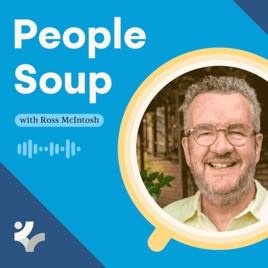
Advertise on podcast: People Soup
Rating
5from
This podcast has
250 episodes
Language
EnglishPublisher
People SoupExplicit
No
Date created
2018/04/01
Latest episode
2026/10/04
Average duration
6 min.
Release period
6 days
Description
More than ever the world of work is a heady mix of people, behaviour, events and challenges. When the blend is right it can be first-rate. Behavioural science & psychology has a lot to offer in terms of recipes, ingredients, seasoning, spices & utensils - welcome to People Soup.
Unlock People Soup podcast Email contact info,
Listeners & Audience details
Email contact information
Direct podcast contact details

Listeners
Audience numbers & engagement insights

Audience details
Podcast Insights


Podcast episodes
Check latest episodes from People Soup podcast
Quick Spoon: What if seeking relief gets in the way of reflection?
2026/10/04
Sometimes the things we reach for to make ourselves feel better can also stop us from finding out what's really going on.
In this Quick Spoon, I reflect on an observation from Dr Ryan Kemp about our culture's focus on the immediate — "now, do it, enjoy it, live for the moment."
That got me thinking about what we do when we've had a difficult experience.
We feel stressed, so we distract ourselves.
We feel frustrated, so we vent.
We feel uncomfortable, so we do something that takes the edge off.
And sometimes that's exactly what we need.
But what if the relief gets in the way of the reflection?
What if we never quite get to ask:
What is this experience trying to tell me?
So here's something to try.
The next time you find yourself looking for some immediate relief, give yourself a little space before you reach for it.
What might I learn if I stayed with this for a little while?
This Quick Spoon comes from my conversation with Dr Ryan Kemp about addiction.
🎧 Listen to the full conversation: When the Future Gets Smaller: Dr Ryan Kemp on Addiction
People Soup: Real conversations about work, leadership, and being human — grounded in behavioural science, with practical ideas you can actually use.
If this episode resonated with you, please consider following People Soup, leaving a rating or review, or sharing it with someone who might find it useful.
Every recommendation helps more people discover practical, evidence-based conversations about work, leadership and being human.
Transcending Addiction by Ryan KempConnect with Ryan on LinkedIn
Here's the People Soup Website.
And you can subscribe to the People Soup YouTube Channel here.
Visit Ross' Website.
Connect with Ross on LinkedIn
People Soup on Instagram which also features plenty of Ross' photos of the Andalusian life.
Quick Spoon: What else might be true?
2026/10/01
We all tell stories to make sense of our experiences.
Your boss says something you don't like.Someone challenges you in a meeting.A colleague doesn't do what you expected.
And almost immediately, we can have a story about what's going on:
"They're being difficult."
"They don't appreciate me."
"They've got it in for me."
In this Quick Spoon, Dr Ryan Kemp talks about how we can construct stories about other people when we've had a negative experience — and how it can sometimes take a little longer to consider our own part in what's happening.
Sometimes our story might be absolutely right.
But Ryan's observation made me think about the value of creating a little space before we settle on our explanation.
Not to blame ourselves.
To be curious.
So here's your Quick Spoon:
The next time you find yourself telling a very convincing story about someone else, pause and ask:
What else might be true here?
People Soup: Real conversations about work, leadership, and being human — grounded in behavioural science, with practical ideas you can actually use.
If this episode resonated with you, please consider following People Soup, leaving a rating or review, or sharing it with someone who might find it useful.
Every recommendation helps more people discover practical, evidence-based conversations about work, leadership and being human.
Transcending Addiction by Ryan KempConnect with Ryan on LinkedIn
Here's the People Soup Website.
And you can subscribe to the People Soup YouTube Channel here.
Visit Ross' Website.
Connect with Ross on LinkedIn
People Soup on Instagram which also features plenty of Ross' photos of the Andalusian life.
Quick Spoon: What are you trying not to feel?
2026/09/29
Sometimes, when something feels difficult, uncomfortable or overwhelming, our instinct is to make the feeling go away.
We distract ourselves.
We work.
We scroll.
We reach for something that changes how we feel.
In this Quick Spoon, Dr Ryan Kemp talks about this in the context of addiction — and about what happens when we aren't willing to stay with an uncomfortable experience for long enough to understand it.
I'm not suggesting that these everyday behaviours are necessarily addictions.
But Ryan's perspective raises an interesting question for all of us:
What am I trying not to feel?
And perhaps, before we rush to make an uncomfortable feeling disappear, there might be something useful to notice.
That's the idea behind this People Soup Quick Spoon.
🎧 This Quick Spoon comes from my conversation with Dr Ryan Kemp, When the Future Gets Smaller: Dr Ryan Kemp on Addiction.
People Soup: Real conversations about work, leadership, and being human — grounded in behavioural science, with practical ideas you can actually use.
If this episode resonated with you, please consider following People Soup, leaving a rating or review, or sharing it with someone who might find it useful.
Every recommendation helps more people discover practical, evidence-based conversations about work, leadership and being human.
Transcending Addiction by Ryan KempConnect with Ryan on LinkedIn
Here's the People Soup Website.
And you can subscribe to the People Soup YouTube Channel here.
Visit Ross' Website.
Connect with Ross on LinkedIn
People Soup on Instagram which also features plenty of Ross' photos of the Andalusian life.
Quick Spoon: The path of least resistance
2026/09/27
What's driving the choices we make at work?
In my conversation with Dr Ryan Kemp, we were talking about addiction and how a person's experience of time can become compressed around the immediate.
Ryan described part of his therapeutic role as helping people with addictions to expand that time horizon — to consider not just the immediate consequences of their actions, but the medium- and longer-term implications.
That got me thinking about something I see quite often in my own work: the path of least resistance.
We avoid the difficult conversation.
We put off the thing we know we need to do.
We go for the quick win.
We choose what's going to make today a little easier.
And sometimes that's absolutely fine.
But sometimes the short-term gain comes at the expense of something that matters more in the longer term.
So here's your Quick Spoon:
Am I choosing this because it's what matters, or because it's the easiest option right now?
A small question that might just help you widen the time horizon before you act.
🎧 This Quick Spoon comes from my conversation with Dr Ryan Kemp, When the future gets smaller: Dr Ryan Kemp on addiction.
People Soup: Real conversations about work, leadership, and being human — grounded in behavioural science, with practical ideas you can actually use.
If this episode resonated with you, please consider following People Soup, leaving a rating or review, or sharing it with someone who might find it useful.
Every recommendation helps more people discover practical, evidence-based conversations about work, leadership and being human.
Transcending Addiction by Ryan KempConnect with Ryan on LinkedIn
Quick Spoon: The pull of the immediate
2026/09/24
How often do we get pulled towards what's going to give us relief or reward right now?
In this Quick Spoon, Dr Ryan Kemp describes how addiction can change someone's experience of time, so that the immediate becomes much more important than what might happen in the future.
I'm not suggesting that ordinary human behaviour is the same as addiction. But Ryan's insight got me thinking about something we can all recognise: the difficult conversation we put off, the easier option we choose, or the short-term reward that gets in the way of something that matters more in the longer term.
So here's the Quick Spoon:
The next time you find yourself choosing the easiest or most rewarding option, pause and ask:
What might matter here if I widened the time horizon a little?This Quick Spoon comes from my conversation with Dr Ryan Kemp about addiction.
🎧 Listen to the full conversation: When the future gets smaller: Dr Ryan Kemp on addiction
People Soup: Real conversations about work, leadership, and being human — grounded in behavioural science, with practical ideas you can actually use.
If this episode resonated with you, please consider following People Soup, leaving a rating or review, or sharing it with someone who might find it useful.
Every recommendation helps more people discover practical, evidence-based conversations about work, leadership and being human.
Transcending Addiction by Ryan KempConnect with Ryan on LinkedIn
When the future gets smaller: Dr Ryan Kemp on addiction
2026/09/22
What can addiction teach us about being human?
In this episode, I'm joined by Dr Ryan Kemp, a clinical psychologist and Director of Therapies at a large NHS Trust. Ryan is also an author and Honorary Professor of Clinical Practice at Brunel, University of London.
Ryan has worked in the field of addiction for more than 20 years. When he was last on People Soup, we talked about his journey into psychology and some of the pivotal moments in his career. This time, I wanted to understand something I'd never really explored with him: why addiction has held his interest for so long.
Ryan has developed a distinctive approach to addiction based on phenomenology — starting with the lived experience of the person.
In this first part of our conversation, we explore:
Why Ryan became interested in addictionWhat phenomenology can tell us about addictionWhy Ryan moved away from describing people experiencing addiction as simply "impulsive"How addiction can change a person's experience of timeWhat happens when the future becomes harder to hold in mind and the immediate becomes increasingly importantThe relationship between addiction and pleasure, reward and reliefWhy Ryan believes dishonesty can begin with the relationship we have with ourselvesThe stories and narratives we construct to make sense of difficult experiencesHow those patterns can affect relationships with other peopleWhat some of these ideas might reveal about ordinary human behaviour and our tendency to choose short-term relief over longer-term consequences
We also begin to explore what this might mean for workplaces and organisations — and that's where we'll pick up the conversation in Part Two.
One of the ideas I'm taking away from this conversation is Ryan's description of addiction as an experience in which time can become compressed into the now.
We don't have to be experiencing addiction to recognise the pull of the immediate. The quick win. The avoidance of an uncomfortable feeling. The path of least resistance. The thing that gives us relief now, even when we know something else might matter more in the longer term.
I'm not suggesting these ordinary behaviours are the same as addiction. But I do think Ryan's perspective gives us an interesting lens through which to examine our own behaviour.
This is Part One of a two-part conversation with Ryan.
People Soup: Real conversations about work, leadership, and being human — grounded in behavioural science, with practical ideas you can actually use.
If this episode resonated with you, please consider following People Soup, leaving a rating or review, or sharing it with someone who might find it useful.
Every recommendation helps more people discover practical, evidence-based conversations about work, leadership and being human.
Transcending Addiction by Ryan KempConnect with Ryan on LinkedIn
Here's the People Soup Website.
And you can subscribe to the People Soup YouTube Channel here.
Visit Ross' Website.
Connect with Ross on LinkedIn
People Soup on Instagram which also features plenty of Ross' photos of the Andalusian life.
Quick Spoon: Recovery isn't the opposite of performance
2026/09/17
We often think about recovery as something we do after the productive work is finished.
But when is the work ever really finished?
In this People Soup Quick Spoon, Dr Amanda Super challenges that assumption:
“Recovery is productive.”
Amanda suggests that self-compassion isn't just something we think about — we need to act on it. And that can include taking care of some of the basics of our physical wellbeing and building opportunities for recovery into the working day.
Ross explores what that might look like in practice.
Recovery doesn't have to mean a week away or a long weekend.
It might be five minutes away from your screen.
A walk around the block.
Some fresh air.
Taking your lunch away from your desk.
Or simply stopping for a moment and taking a breath.
Here's something to try:
Put one small recovery break into your working day this week.
And don't wait until you've earned it.
Treat it as part of the day.
Because recovery isn't the opposite of performance. It can support how we work — and how we experience work.
People Soup: Real conversations about work, leadership, and being human — grounded in behavioural science, with practical ideas you can actually use.
If this episode resonated with you, please consider following People Soup, leaving a rating or review, or sharing it with someone who might find it useful.
Every recommendation helps more people discover practical, evidence-based conversations about work, leadership and being human.
Full episode here - Can you be ambitious and self-compassionate? Dr Amanda Super - People SoupConnect with Amanda on LinkedInAbout Amanda's book - "A Year of Self-Compassion: Finding Care, Connection and Calm in Our Challenging Times"Amanda's website
Here's the People Soup Website.
And you can subscribe to the People Soup YouTube Channel here.
Visit Ross' Website.
Connect with Ross on LinkedIn
People Soup on Instagram which also features plenty of Ross' photos of the Andalusian life.
Quick Spoon: You can be kind to yourself AND ambitious
2026/09/15
Being kind to yourself doesn't mean lowering your standards.
In this People Soup Quick Spoon, Dr Amanda Super challenges the idea that self-compassion and ambition are somehow incompatible.
Amanda shares what she learned from comparing her experience of her Master's degree with her doctorate ten years later, after developing self-compassion.
She was still ambitious. Still driven. Still wanting to achieve.
But she wasn't doing it at the cost of herself.
So perhaps the question isn't whether we should be ambitious or self-compassionate.
Perhaps we can be kind to ourselves AND ambitious.
As Ross reflects:
“Self-compassion doesn't necessarily mean asking less of ourselves. It might mean changing the way we ask it.”
Try this:
Think about something you're currently working hard to achieve.
Ask yourself:
“What would being kind to myself look like in this context?”
And then:
“Can I take one small step towards that?”
This Quick Spoon comes from Ross's conversation with Dr Amanda Super about self-compassion, ambition, boundaries, recovery and being human at work.
#PeopleSoup #QuickSpoon #SelfCompassion #Psychology #Leadership
Quick Spoon: What do I need right now?
2026/09/13
When something difficult happens, we can move very quickly from what's happened to what we're going to do about it.
An email we don't like.Something someone says that gets under our skin.A difficult or overwhelming situation.
And suddenly we're going from 0 to 100 in nanoseconds.
In this People Soup Quick Spoon, Dr Amanda Super offers a remarkably simple question:
“What do I need right now?”
Ross explores what might happen if we create a little space before we react.
The answer might be:
taking a breakseeking some supporthaving a difficult conversationor simply taking a couple of deep breaths before doing anything at all.
Here's something to try:
The next time you notice yourself becoming stressed, frustrated or overwhelmed, pause before you react and ask yourself:
“What do I need right now?”
A small question that might change what happens next.
This Quick Spoon comes from Ross's conversation with Dr Amanda Super about self-compassion, ambition, boundaries, recovery and being human at work.
People Soup: Real conversations about work, leadership, and being human — grounded in behavioural science, with practical ideas you can actually use.
If this episode resonated with you, please consider following People Soup, leaving a rating or review, or sharing it with someone who might find it useful.
Every recommendation helps more people discover practical, evidence-based conversations about work, leadership and being human.
Full episode here - Can you be ambitious and self-compassionate? Dr Amanda Super - People SoupConnect with Amanda on LinkedInAbout Amanda's book - "A Year of Self-Compassion: Finding Care, Connection and Calm in Our Challenging Times"Amanda's website
Here's the People Soup Website.
And you can subscribe to the People Soup YouTube Channel here.
Visit Ross' Website.
Connect with Ross on LinkedIn
People Soup on Instagram which also features plenty of Ross' photos of the Andalusian life.
Quick Spoon: What would you say no to if you cared about yourself?
2026/09/11
We often think of boundaries as something we put in place to manage other people's demands.
But what if a boundary is actually an act of compassion towards ourselves?
In this People Soup Quick Spoon, Dr Amanda Super describes boundary setting as a “radical act of self-compassion”.
She talks about including ourselves in our own circle of compassion, rather than trying to be all things to all people and paying the price ourselves.
Ross also brings in the idea of fierce self-compassion: sometimes compassion isn't about being softer. Sometimes it's about being firmer, protecting ourselves and saying no when we need to.
Here's something to try:
Think of something you're doing that's costing you more than you can afford to give.
Ask yourself:
“If I genuinely cared about myself here, what would I say no to?”
And then notice what gets in the way.
A short reflection from Ross's conversation with Dr Amanda Super about self-compassion, ambition, boundaries, recovery and being human at work.
People Soup: Real conversations about work, leadership, and being human — grounded in behavioural science, with practical ideas you can actually use.
If this episode resonated with you, please consider following People Soup, leaving a rating or review, or sharing it with someone who might find it useful.
Every recommendation helps more people discover practical, evidence-based conversations about work, leadership and being human.
Full episode here - Can you be ambitious and self-compassionate? Dr Amanda Super - People SoupConnect with Amanda on LinkedInAbout Amanda's book - "A Year of Self-Compassion: Finding Care, Connection and Calm in Our Challenging Times"Amanda's website
Here's the People Soup Website.
And you can subscribe to the People Soup YouTube Channel here.
Visit Ross' Website.
Connect with Ross on LinkedIn
People Soup on Instagram which also features plenty of Ross' photos of the Andalusian life.
Quick Spoon - What if you spoke to yourself like a friend?
2026/09/08
When something goes wrong, it's easy to add another layer of difficulty by being hard on ourselves.
What's wrong with me?
I should be able to handle this.
Why can't I cope?
In this People Soup Quick Spoon, Dr Amanda Super recalls a nurse telling her:
“You're being very hard on yourself.”That comment helped Amanda discover self-compassion — and it got me thinking about how differently we sometimes speak to ourselves compared with the way we'd speak to someone we care about.
So here's something to try:
Imagine a close friend is in the same situation as you.
What would you say to them?
How would you speak to them?
What tone would you use?
And then ask yourself:
What would it be like to speak to myself in the same way?
A small exercise — but potentially a useful way to notice how we treat ourselves when things get difficult.
This Quick Spoon comes from my conversation with Dr Amanda Super about self-compassion, ambition, boundaries and being human at work.
Listen to the full conversation on People Soup.
People Soup: Real conversations about work, leadership, and being human — grounded in behavioural science, with practical ideas you can actually use.
If this episode resonated with you, please consider following People Soup, leaving a rating or review, or sharing it with someone who might find it useful.
Every recommendation helps more people discover practical, evidence-based conversations about work, leadership and being human.
Full episode here - Can you be ambitious and self-compassionate? Dr Amanda Super - People SoupConnect with Amanda on LinkedInAbout Amanda's book - "A Year of Self-Compassion: Finding Care, Connection and Calm in Our Challenging Times"Amanda's website
Here's the People Soup Website.
And you can subscribe to the People Soup YouTube Channel here.
Visit Ross' Website.
Connect with Ross on LinkedIn
People Soup on Instagram which also features plenty of Ross' photos of the Andalusian life.
Can you be ambitious and self-compassionate? Dr Amanda Super
2026/09/06
What if being kinder to yourself doesn't make you less ambitious — but helps you work, recover and live more sustainably?
In this episode of People Soup, I talk to Dr Amanda Super, an occupational and coaching psychologist, author and founder of Creating Compassion. Amanda specialises in self-compassion and compassionate leadership, working with organisations across the public, private and not-for-profit sectors.
Amanda's own journey into this work is fascinating.
At 19, she had flunked her A-levels and was struggling with her confidence. Psychological support helped change the trajectory of her life. Years later, when she became seriously unwell and needed major surgery, a nurse pointed out something Amanda hadn't recognised herself:
"You're being very hard on yourself."
That moment led Amanda to discover self-compassion — and ultimately changed both her personal life and professional direction.
In our conversation, we explore:
What self-compassion actually means — and what it doesn't meanWhy we're often caught between threat and drive, with too little access to recovery and soothingHow workplace culture can reinforce perfectionism, productivity and the pressure to keep goingThe three elements of self-compassion: mindfulness, common humanity and self-kindnessWhether it's possible to be ambitious and self-compassionate at the same timeHow self-compassion can help us develop healthier boundariesWhat Amanda means by fierce self-compassionThe costs of constantly criticising ourselvesAmanda's practical RAIN exercise for difficult momentsWhy recovery is productiveAnd why self-compassion might simply give us permission to include ourselves as well as everybody else.
There's also a lovely conversation about Amanda's choice of walk-on music, Here Comes the Sun by The Beatles — a song that reminds her of her grandmother and represents the movement from darkness towards warmth, hope and light.
A practical idea from Amanda
When you notice you're having a strong emotional response to something, pause and ask:
What do I need right now?
Amanda also introduces RAIN:
R — Recognise what's happening
A — Allow the feeling to be present
I — Investigate what's triggered the response
N — Natural awareness
And then, in Amanda's self-compassionate version:
Recognise that anyone would find this difficult, and ask,
How can I be kind to myself right now?
She also leaves us with a simple reminder, recovery can be productive.
People Soup: Real conversations about work, leadership, and being human — grounded in behavioural science, with practical ideas you can actually use.
If this episode resonated with you, please consider following People Soup, leaving a rating or review, or sharing it with someone who might find it useful.
Every recommendation helps more people discover practical, evidence-based conversations about work, leadership and being human.
Connect with Amanda on LinkedInAbout Amanda's book - "A Year of Self-Compassion: Finding Care, Connection and Calm in Our Challenging Times"Amanda's website
Here's the People Soup Website.
And you can subscribe to the People Soup YouTube Channel here.
Visit Ross' Website.
Connect with Ross on LinkedIn
People Soup on Instagram which also features plenty of Ross' photos of the Andalusian life.
Quick Spoon: Give yourself permission to stop
2026/07/31
I'm taking a short break from People Soup during August.
Before I do, I'd like to leave you with one final invitation.
Give yourself permission to stop.
Not forever.
Perhaps for ten minutes.
An afternoon.
Or even a few weeks.
In this final People Soup Quick Spoon before the summer break, Ross McIntosh reflects on what happens when we pause—and what we might notice if we resist the urge to keep going.
Here's something to try
Give yourself permission to stop something. Then simply notice what shows up.
Perhaps it's the urge to stay productive.Perhaps it's the thought: "I should be doing something."Or perhaps you'll notice something you couldn't see because you were too busy carrying on.
People Soup will return in September.
Thank you for listening, watching, sharing and being part of the conversation.
People Soup: Real conversations about work, leadership, and being human — grounded in behavioural science, with practical ideas you can actually use.
If this episode resonated with you, please consider following People Soup, leaving a rating or review, or sharing it with someone who might find it useful.
Every recommendation helps more people discover practical, evidence-based conversations about work, leadership and being human.
Recover on purpose: the holiday matrix - People SoupDownload the holiday matrix here
Here's the People Soup Website.
And you can subscribe to the People Soup YouTube Channel here.
Visit Ross' Website.
Connect with Ross on LinkedIn
People Soup on Instagram which also features plenty of Ross' photos of the Andalusian life.
Quick Spoon: If your holiday had a soundtrack?
2026/07/26
If your holiday had a soundtrack, what would it be?
Music has an extraordinary ability to transport us back to particular moments in our lives.
In this People Soup Quick Spoon, Ross invites you to use that deliberately: choose one song that represents not simply where you're going, but how you'd like to be while you're there.
Curious? Present? Connected?
Here's something to try
Choose one song and play it each morning during your holiday.
Then, months later, when you hear it by chance, pause for a moment.
Perhaps it won't just remind you where you were.
Perhaps it'll remind you who you were.
What song would you choose?
Quick Spoon: The holiday that changed nothing
2026/07/23
Have you ever unpacked your suitcase and, within three days, felt as though you'd never been away?
Recovery isn't simply about taking time away from work. What we do with that time matters too.
In this People Soup Quick Spoon, Ross invites you to think about what you might bring home from your holiday—other than souvenirs and dirty washing.
Perhaps it's reading for ten minutes.
Walking after dinner.
Leaving your phone in another room.
Here's something to try
Before your holiday ends, ask yourself:
What's one thing I'd like to bring back with me other than souvenirs?
Don't just bring home memories.
Bring home one new way of living.
People Soup: Real conversations about work, leadership, and being human — grounded in behavioural science, with practical ideas you can actually use.
If this episode resonated with you, please consider following People Soup, leaving a rating or review, or sharing it with someone who might find it useful.
Every recommendation helps more people discover practical, evidence-based conversations about work, leadership and being human.
Recover on purpose: the holiday matrix - People SoupDownload the holiday matrix here
Here's the People Soup Website.
And you can subscribe to the People Soup YouTube Channel here.
Visit Ross' Website.
Connect with Ross on LinkedIn
People Soup on Instagram which also features plenty of Ross' photos of the Andalusian life.
Podcast reviews
Read People Soup podcast reviews
Kate in Wyo 2021/05/21
Fantastic
People of psychology/behavior/and anyone, if you’re not listening yet, you are in for a treat! The sound quality and format are exceptional. Ross’s ...
IG: vegancoachpraha 2020/02/03
Can't get enough!
Ross' bass tones are a complete joy to listen to, and on top of that the content is over the top. Whether you are a professional psychologist, coach, ...
jello_gelatin 2019/02/27
Quirky, fun, helpful
I’ve only recently discovered this podcast but it’s been a regular companion on my daily commute ever since. Ross’s style is open, fun, and genuine. H...
PodReviewz 2018/06/21
Highly Recommend!!!
This podcast is the perfect mix of knowledge & experience, theory & personal anecdotes, and research & practice. Each episode is thought out without f...
Podcast sponsorship advertising
Start advertising on People Soup relevant audience podcasts
You may also like to advertise on these Podcasts

4.498839908
Morbid
Ash Kelley & Alaina Urquhart

4.6908522
You Can Heal Your Life ™
Hay House

4.41164993
Extratime
Major League Soccer

4.8815227
ArtCurious Podcast
Jennifer Dasal/ArtCurious

4.9328041389
REAL AF with Andy Frisella
Andy Frisella

48972549
20/20
ABC News
4.91361709
The Learning Leader Show With Ryan Hawk
Ryan Hawk

4.92107498
the bossbabe podcast
Natalie Ellis

4.4384811967
The Megyn Kelly Show
SiriusXM

4.947484404
The Shawn Ryan Show
Shawn Ryan