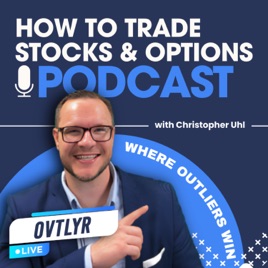
Advertise on podcast: How to Trade Stocks and Options Podcast with OVTLYR Live
Rating
4.3from
This podcast has
1716 episodes
Language
EnglishPublisher
Christopher M. Uhl, CMAExplicit
No
Date created
2018/05/30
Latest episode
2026/10/01
Average duration
32 min.
Release period
1 days
Description
This is the How to Trade Stocks and Options Podcast with OVTLYR Live. Giving you the tools, tips and tricks to help you trade faster and trade smarter with your host, ranked as one of the top 100 people in finance, Christopher M. Uhl, CMA
Unlock How to Trade Stocks and Options Podcast with OVTLYR Live podcast Email contact info,
Listeners & Audience details
Email contact information
Direct podcast contact details

Listeners
Audience numbers & engagement insights

Audience details
Podcast Insights

Podcast episodes
Check latest episodes from How to Trade Stocks and Options Podcast with OVTLYR Live podcast
Entry Timing & Stock Selection | OVTLYR University Lesson 6
2026/10/01
What if the secret to finding winning stocks isn't buying the dip or chasing every breakout? What if it's simply knowing WHEN to buy and WHAT to buy?
In Charlie Class Lesson 6, we're breaking down stock selection and entry timing. You'll learn why some stocks take off while others leave traders stuck holding the bag. More importantly, you'll see how to spot opportunities when the market, sector, and individual stock are all moving in your favor.
Here's what we're covering:
✅ How to identify strong stocks in strong sectors
✅ When to buy breakouts, pullbacks, and continuation trades
✅ Why buying the dip can be a costly mistake
✅ How to use stop-loss orders and manage risk
✅ What overhead resistance means for your next trade
✅ Why market timing matters more than you think
We'll also walk through real stock charts and put these strategies to the test. You'll see how to evaluate a trade, recognize warning signs, and know when it's better to stay on the sidelines.
The goal? Stop forcing trades and start recognizing opportunities when the odds are more favorable.
If you want to become a more disciplined trader and make smarter decisions, this lesson is for you.
Hit subscribe and join the OVTLYR community for more stock market insights and trading lessons. 👉 https://www.youtube.com/@ovtlyrdotcom
#StockTrading #StockMarket #TradingStrategies #StockMarketEducation #TechnicalAnalysis #StockSelection #RiskManagement #OVTLYR
7 Bullish Options Strategies Ranked - Only One Gets My Money
2026/10/01
Are you looking to save time, make money, and start winning with less risk? Then head to https://www.ovtlyr.com.Learn more about OVTLYR: https://youtu.be/TUCbD5KovlcThere are dozens of ways to trade options, but not every options strategy makes sense for every trader.In this video, we compare 7 popular options strategies and look at their profit potential, likelihood of profit, margin requirements, risk, and how each one actually behaves. The goal isn't to tell you that one strategy is right for everyone. It's to understand what you're actually getting when you choose a long call, short put, covered call, spread, butterfly, or deep in-the-money option.We start with the out-of-the-money long call, which can offer unlimited profit potential with a relatively small upfront cost. The problem is that the option has to move far enough, and quickly enough, to become profitable. That's why an OTM call can behave more like a lottery ticket than an investment.Next is the short put, or cash-secured put. Instead of buying insurance, you're effectively selling it. You collect premium and have a higher likelihood of profit, but your potential profit is limited while the downside risk can be substantially larger.A short put spread, also known as a bull put spread, adds protection to the short put. Your maximum loss becomes limited, but so does your potential profit. We look at how the credit received, strike prices, margin requirement, and risk-to-reward relationship all change when you add that protection.Then there's the covered call, where you own 100 shares of stock and sell a call against those shares. Selling the call can reduce your break-even price and generate income, but there's a major tradeoff: if the stock rockets higher, your upside is capped.The put broken wing butterfly takes things in a completely different direction. It can provide a high likelihood of profit with a potentially large payoff, but that large payoff is highly dependent on where the stock finishes at expiration. Understanding expiration risk is critical with this type of options strategy.Finally, we get to the options strategy that I actually use: deep in-the-money long calls.An out-of-the-money call might have a low upfront cost, but it has to work much harder to become profitable. A deep ITM call, particularly around an 80 delta, behaves much more like the underlying stock while still providing leverage and requiring substantially less capital than buying 100 shares outright.That's the distinction I care about most. An OTM option can be a lottery ticket. A deep ITM option can be used as a leveraged investment.✅ 7 options strategies compared side by side✅ Long calls, short puts, and cash-secured puts✅ Bull put spreads and covered calls✅ Put broken wing butterflies and call ratio backspreads✅ Deep ITM calls, 80 delta, leverage, and capital efficiencyIf you've ever wondered which options strategy is right for you, this video gives you a practical look at seven different approaches and the tradeoffs behind each one. The cheapest option isn't necessarily the best option, and the strategy with the highest potential return isn't necessarily the strategy with the best risk profile.Subscribe to OVTLYR for disciplined trading strategies that actually make sense. 👉 https://www.youtube.com/@ovtlyrdotcom#OptionsTrading #OptionsStrategies #CallOptions #DeepITM #OptionsTradingStrategy #OVTLYR #StockOptions #CoveredCalls #CashSecuredPut #BullPutSpread #Delta #Leverage #StockMarket #SwingTradingHere's how we plan to DOMINATE the US Investing Championship for 2026You can see our step by step trading plan developed by a team of over 20 quants for FREE by clicking here: https://www.ovtlyr.com/usicplan
Selling Puts Is Easy Until One Starts Losing, Here's the Exit - Professional Investor Reacts
2026/09/30
Are you looking to save time, make money, and start winning with less risk? Then head to https://www.ovtlyr.com.
Learn more about OVTLYR: https://youtu.be/TUCbD5Kovlc
Selling puts can look like easy money… until the trade goes against you.
In this video, we break down the real risks of short puts, the options wheel, leverage, and why a high win rate can still leave you with massive losses. The big lesson? Winning often is not the same thing as making money.
We walk through real examples of selling puts, calculating break-even, understanding risk multiples, and knowing when a losing trade needs to be closed instead of endlessly rolled.
✅ Why selling puts creates open-ended downside risk
✅ How the options wheel can turn against you
✅ Why an 84% win rate can still produce huge losses
✅ How to use a multiple of your credit as an exit rule
✅ What convexity means for long vs. short options
✅ Why trends and risk management matter when trading options
The goal here isn’t to make options trading sound complicated. It’s about seeing what can actually happen when a trade starts moving against you, and understanding the risk before the losses get out of control.
If you trade options, sell puts, use the wheel, or are learning options strategies, this is one conversation you don’t want to miss.
👉 https://www.youtube.com/@ovtlyrdotcom
📌 Video: https://youtu.be/b520WnvEg3Y?si=cHZxghGSANUUl3z4
#OptionsTrading #SellingPuts #OptionsTradingStrategy #StockMarket #Trading #Options #RiskManagement #ShortPuts #OptionsWheel #OVTLYR
Here's how we plan to DOMINATE the US Investing Championship for 2026
You can see our step by step trading plan developed by a team of over 20 quants for FREE by clicking here: https://www.ovtlyr.com/usicplan
STOP Gambling on MU Earnings – Do This Instead
2026/09/30
Are you looking to save time, make money, and start winning with less risk? Then head to https://www.ovtlyr.com.Learn more about OVTLYR: https://youtu.be/TUCbD5KovlcStop gambling on Micron earnings and start using the information the market gives you.Micron (MU) is running up into earnings, and this is exactly where many traders get tempted to buy calls, buy puts, or pile into the stock hoping to catch a huge post-earnings move. The problem is simple: you don't know which direction the stock will move. Great earnings can send a stock lower, terrible earnings can send it higher, and the volatility can create enormous risk either way.This is what I call catalyst risk.Earnings can completely reset the market's expectations for a stock. Fear and greed change, institutions reposition, and prices can move violently in a matter of minutes. The temptation is to be the trader who catches the huge gap after earnings, but taking that risk before you know the outcome isn't necessary.Micron provides a perfect example. The stock previously ran up into earnings, peaked, and then eventually suffered a 41% peak-to-trough decline. Now we're seeing another pre-earnings run, creating the exact kind of situation where retail traders can start chasing the stock because they don't want to miss the next big move.Historical earnings data referenced in this video makes the problem even more interesting. Across more than 31,000 corporate earnings reports, the average 30-day return showed essentially no historical edge from simply trading earnings. Positive and negative gaps largely cancel each other out, while the risk remains significant.By combining the at-the-money call and put prices, you can estimate the expected move for the stock. In the Micron example, the options were pricing roughly a $69 move in either direction, or around a 6.5% move. That's a massive amount of uncertainty to accept simply for the possibility of being right about earnings.And buying both a call and a put doesn't automatically solve the problem.After earnings, implied volatility can collapse, creating what's known as an earnings volatility crush. Your options can lose a substantial amount of value even if the stock barely moves. In the example discussed here, an options position could lose more than 50% simply from the volatility coming out of the contracts.So what's the alternative?That's where the Gap and Go strategy comes in. If a stock gaps up 5% or more after earnings and continues holding above the low of the gap candle, you may be looking at a potential Gap and Go setup. If the stock closes below that level, it becomes a Gap and Crap, which is an important warning that the post-earnings move is failing.The key is that you don't have to predict the earnings result.Let earnings happen. Let the stock gap. Then watch what price actually does.✅ Micron (MU) earnings and pre-earnings stock moves✅ Catalyst risk and why earnings can move stocks violently✅ Options expected move and the earnings straddle✅ Implied volatility crush and why options can lose value after earnings✅ Gap and Go vs. Gap and Crap trading strategyIf you've ever bought a stock or options contract right before earnings because you wanted to catch the big move, this lesson is worth watching. You don't have to gamble on the outcome. Sometimes the smarter trade is simply waiting for the market to reveal what happened, then riding the move that actually develops.Subscribe to OVTLYR for disciplined trading strategies that actually make sense. 👉 https://www.youtube.com/@ovtlyrdotcom#Micron #MU #MicronStock #Earnings #EarningsTrading #OptionsTrading #GapAndGo #StockMarket #SwingTrading #OVTLYR #VolatilityCrush #TradingStrategy #CatalystRisk #TechnicalAnalysisHere's how we plan to DOMINATE the US Investing Championship for 2026You can see our step by step trading plan developed by a team of over 20 quants for FREE by clicking here: https://www.ovtlyr.com/usicplan
Technical Structure & Stage Analysis | OVTLYR University Lesson 5
2026/09/29
Are you looking to save time, make money, and start winning with less risk? Then head to https://www.ovtlyr.com.
Learn more about OVTLYR: https://youtu.be/TUCbD5Kovlc
If you want to understand how traders read a chart, this Charlie Class lesson gets practical. We’re breaking down technical structure, trend analysis, market cycles, and tools that can help you make smarter decisions instead of guessing what happens next.
You’ll see chart examples and learn how price action connects with psychology, support, resistance, breakouts, breakdowns, and trend strength.
Inside this lesson:
✅ How support and resistance reveal areas of demand and supply
✅ How higher highs and higher lows identify rising trends
✅ How moving averages reveal market direction
✅ The difference between SMA and EMA
✅ Why 10, 20, and 50 EMAs create confluence
✅ How to measure relative strength against the S&P 500
✅ Long vs. short positions explained
✅ How the four stages of the market cycle appear on charts
We also dive into TradingView, chart types, candlesticks, and the psychology behind Stage 1, Stage 2, Stage 3, and Stage 4 markets. From Tesla and Microsoft to other examples, you’ll see why market cycles, trend structure, and emotion matter.
If you’re serious about stock market education, analysis, and becoming a trader, this lesson gives you a lot to work with.
👉 https://www.youtube.com/@ovtlyrdotcom
#StockMarket #Trading #TechnicalAnalysis #Investing #StockTrading #MarketCycle #TradingView
Here's how we plan to DOMINATE the US Investing Championship for 2026
You can see our step by step trading plan developed by a team of over 20 quants for FREE by clicking here: https://www.ovtlyr.com/usicplan
5 HIDDEN Market Forces Secretly Sabotaging Your MU & NVDA Trades
2026/09/29
The stock market can be near all-time highs while the majority of stocks are quietly falling apart underneath the surface.
That's the hidden problem this video exposes. Market breadth, concentration risk, and participation can tell you a very different story than the S&P 500 or SPY alone. If you only watch the headline index, you may completely miss what is actually happening to the stocks underneath it.
The first hidden market force is what I call “swimming naked.” A rising tide can lift almost every stock, but a falling tide reveals which stocks were only performing because the broader market was carrying them. Market breadth helps determine whether the market is actually participating in the move or whether a small number of huge companies are doing all the work.
That's where RSP vs. SPY becomes incredibly useful.
SPY is a market-cap-weighted version of the S&P 500, meaning the largest companies have a much bigger influence on its performance. RSP gives each S&P 500 stock roughly equal weight. Comparing the two can reveal concentration risk that is hidden inside the headline market.
If SPY is holding up while RSP is falling, the market may look healthier than it really is. A handful of massive companies can keep the index elevated even while hundreds of other stocks are weakening.
The second hidden force is market participation.
MMFI measures the percentage of S&P 500 stocks trading above their own 50-day moving averages. When that percentage falls, more stocks are moving into downtrends even if SPY itself doesn't appear particularly weak.
OVTLYR provides another way to see this through the Market Breadth data, showing how many stocks across the OVTLYR universe have bullish versus bearish momentum. Looking beneath the index can reveal whether the market has the participation needed to continue moving higher.
Think of the S&P 500 as a general and the individual stocks as its soldiers. A general can look powerful for a while, but if most of the soldiers have already turned and are running the other direction, the situation can change very quickly.
That's why concentration risk matters.
When a small number of mega-cap stocks are responsible for holding up the market while the equal-weight index and market breadth deteriorate, the leaders become increasingly important. If those leaders eventually weaken, the broader market can change very quickly.
The good news is that you don't need complicated analysis to see this. RSP, SPY, MMFI, and OVTLYR Market Breadth can give you a quick snapshot of market health and participation.
The goal isn't to predict exactly when the market will fall. It's to understand whether the market is giving you the broad participation and momentum you want before putting capital to work.
✅ Market breadth and why SPY can hide weakness✅ RSP vs. SPY and concentration risk✅ MMFI and the percentage of stocks above their 50-day moving average✅ OVTLYR Market Breadth and bullish vs. bearish momentum✅ How to tell if the market is actually healthy underneath the surface
If the market is near all-time highs but your stocks keep struggling, there may be a reason. Sometimes the problem isn't your stock selection. The tide itself is changing.
Subscribe to OVTLYR for disciplined trading strategies that actually make sense. 👉 https://www.youtube.com/@ovtlyrdotcom
16 Years of Swing Trading Lessons in 12 Minutes - Professional Investor Reacts
2026/09/28
Are you looking to save time, make money, and start winning with less risk? Then head to https://www.ovtlyr.com.
Learn more about OVTLYR: https://youtu.be/TUCbD5Kovlc
Swing trading sounds simple until the market stops doing what you expect. In this episode of Big Money Bingo Monday, we break down 16 years of swing trading lessons and why the right trading style can make a huge difference in your results and your life.
The conversation dives into the ideas that actually matter when you're trading across longer timeframes:
✅ Why higher timeframes can give you more scalability, but also more randomness and overnight risk
✅ How ATR, volatility, and position sizing work together to control risk
✅ Why technical analysis is fractal across timeframes
✅ How moving averages can identify trend direction without predicting duration or magnitude
✅ Why market regime, sector strength, and momentum matter
✅ Why buying the dip can be dangerous when you don't know where the decline ends
✅ When sitting in cash and waiting can be the smarter move
We also look at market breadth, weak internals, momentum trading, portfolio management, and the psychology behind staying disciplined when the market gets choppy.
If you're building a trading plan that fits your personality, schedule, and risk tolerance, there are plenty of lessons here you can put into practice.
👉 https://www.youtube.com/@ovtlyrdotcom
📌 Video: https://youtu.be/bZ7-iBaI_Xw
#SwingTrading #TradingStrategy #StockMarket #MomentumTrading #TechnicalAnalysis #TradingPsychology #RiskManagement #StockTrading #OVTLYR
Here's how we plan to DOMINATE the US Investing Championship for 2026
You can see our step by step trading plan developed by a team of over 20 quants for FREE by clicking here: https://www.ovtlyr.com/usicplan
Options Hack To Buy $META For 92% Off (From A Billion Dollar Hedge Fund Manager)
2026/09/28
Are you looking to save time, make money, and start winning with less risk? Then head to https://www.ovtlyr.com.Learn more about OVTLYR: https://youtu.be/TUCbD5KovlcWhat if you could get roughly 90% less capital exposure while still capturing much of a stock's movement?That's the idea behind deep in-the-money call options, and Meta (META) provides the real-world example in this video. Instead of spending $75,000 to buy 100 shares of Meta, we look at how an approximately 80 delta call can provide substantial exposure to the stock while requiring dramatically less capital upfront.But there's much more to this strategy than simply buying an option because it is cheaper.The key is understanding delta.Delta tells you how much an option's price should move for approximately every $1 move in the underlying stock. An 80 delta call, for example, should move roughly $0.80 for every $1 move in the stock, while a 20 delta call moves much less.Delta also provides an estimate of the probability that an option will finish in the money at expiration. That makes it an important consideration when comparing deep ITM options, at-the-money options, and out-of-the-money options.Then we get into one of the biggest reasons I prefer deep in-the-money calls: intrinsic value versus extrinsic value.Extrinsic value decays as time passes. Every day that goes by moves that portion of an option's value closer to zero. Out-of-the-money options can be made up entirely of extrinsic value, meaning time decay is working against essentially the entire investment.Deep ITM options are different. A much larger portion of their price comes from intrinsic value, which can significantly reduce the impact of time decay and implied volatility on the overall position.That's where the concept of capital efficiency comes in.Using the Meta example, controlling stock exposure with an 80 delta call can require only a fraction of the capital needed to purchase the shares outright. That leaves more capital available for other trades, while still providing leveraged exposure to the underlying stock.But leverage cuts both ways.Options can magnify gains, but they can also magnify losses. Liquidity matters enormously, especially open interest and bid-ask spreads. An option with poor liquidity can cost you a significant amount simply to enter and exit the position.We also look at convexity, which describes how an option's sensitivity to the underlying stock changes as the stock price moves. An 80 delta option won't necessarily remain an 80 delta option. As the stock moves, the option's delta changes too.That's what makes this strategy so interesting for traders who understand how options actually work.The goal isn't to buy the cheapest option available. It's to choose an option with a risk profile that makes sense for the trade.✅ Deep in-the-money call options and 80 delta✅ How delta works and why it matters✅ Intrinsic value vs. extrinsic value and time decay✅ How options can create capital efficiency✅ Meta (META), leverage, liquidity, open interest, and convexityIf you've ever looked at a $700+ stock and thought, “There's no way I can afford 100 shares,” this strategy is worth understanding. Options can provide another way to gain stock exposure, but choosing the right strike and understanding the risks is critical.Subscribe to OVTLYR for disciplined trading strategies that actually make sense. 👉 https://www.youtube.com/@ovtlyrdotcom#OptionsTrading #CallOptions #DeepITM #META #MetaStock #Delta #TimeDecay #CapitalEfficiency #OptionsStrategy #StockMarket #SwingTrading #OVTLYR #ImpliedVolatility #TradingStrategyHere's how we plan to DOMINATE the US Investing Championship for 2026You can see our step by step trading plan developed by a team of over 20 quants for FREE by clicking here: https://www.ovtlyr.com/usicplan
10 Stocks I’m Watching Before They Become Obvious
2026/09/25
Are you looking to save time, make money, and start winning with less risk? Then head to https://www.ovtlyr.com.Learn more about OVTLYR: https://youtu.be/TUCbD5KovlcHere's how we plan to DOMINATE the US Investing Championship for 2026You can see our step by step trading plan developed by a team of over 20 quants for FREE by clicking here: https://www.ovtlyr.com/usicplanWhich stocks are setting up before next week’s move becomes obvious?In this video, I break down the stocks on my watchlist and show you what I’m looking for before the crowd starts chasing.The goal isn’t to predict which stock goes up next. It’s to identify the setups where the market, sector, and stock are beginning to line up—and know what still needs to happen before a stock actually earns the trade.Stocks discussed:MU, AMD, INTC, QCOM, MRVL, STX, MPOWER, APH, PLTR, META, DDOGI’ll show you the same process I use to separate stocks that simply look interesting from the ones that may actually be worth paying attention to next week.The real advantage isn’t finding the stock after everyone notices it. It’s knowing what to look for before it becomes obvious.
How To Get Paid When You're NOT Trading
2026/09/25
What do you do with your cash when the market keeps chopping sideways and the trades you actually want just aren’t there? For me, sitting in cash beats forcing a bad trade. But that cash doesn’t have to sit completely idle.
In this Ask Me Anything Friday, we get into ways to earn interest on uninvested cash, including SGOV and BOX, and why their charts look so different. Then we tackle the trading questions that can make a real difference when a trend finally shows up:
✅ How much backtesting is enough before you trust a trading idea?
✅ Why I avoid stop orders on options and use a trailing stop to manage a trend
✅ How rolling a winning option can reduce the money still at risk
✅ Why shorting a falling market can turn on you fast
There’s also a look at what’s being built inside OVTLYR, including TradingView charts and plans.
The bigger lesson? You don’t have to manufacture a trade just because the market is open.
Protect your account during the frustrating stretches so you’re ready when a strong trend gives you something worth trading.
Which question should we spend more time on next? Drop it in the comments, and subscribe for more practical trading conversations.
👉 https://www.youtube.com/@ovtlyrdotcom
#SwingTrading #OptionsTrading #TradingStrategy #SGOV #BOX
The HUGE Trading Mistakes That Start After You Win BIG — META
2026/09/25
Are you looking to save time, make money, and start winning with less risk? Then head to https://www.ovtlyr.com.Learn more about OVTLYR: https://youtu.be/TUCbD5KovlcWinning trades feel great. But ironically, a big winning streak can create some of the worst trading mistakes you'll ever make.Meta is ripping higher after breaking through a major order block, and that makes it easy to believe you finally figured the market out. That's exactly where trading psychology becomes dangerous. The market hasn't changed. Your perception of the market has changed.One of the biggest mistakes traders make after a big win is stopping their analysis and starting to tell the market what it should do. You make money, your confidence increases, and suddenly the stock “has to” keep going higher. When the trade eventually pulls back, you stop following the evidence and start hoping the market proves you right.The next mistake is even more subtle: winning makes bad decisions feel smart.A good trade isn't necessarily a trade that made money. A good trade is one where you followed your plan from entry through exit. You can make money on a terrible decision, and you can lose money on an excellent decision. Confusing the outcome with the quality of the decision is one of the fastest ways to develop bad trading habits.Then there's the fear of giving back profits. When a position becomes a big winner, traders often reduce their position simply because they're afraid of losing those gains. That can create the exact opposite of what you want: your biggest winners end up being your smallest positions.We also get into rolling deep in-the-money options as one way to manage that psychology. By rolling a position from a higher delta back toward your original target, you can potentially take partial profits, reduce risk, and maintain your position size rather than constantly cutting your winners.But there's another psychological trap: the Midas effect.After several winning trades, you can start believing you can't lose. That confidence can lead to larger position sizes, earlier entries, and trades that don't follow your system. A winning streak can make you too confident to follow the exact plan that produced the wins in the first place.A losing streak can create the opposite problem. You become too scared to take the next trade, even when your system says to take it. Both emotions lead to the same mistake: abandoning your trading plan.That's why consistency and discipline matter so much. Your job isn't to predict what Meta, AMD, or any other stock is going to do next. Your job is to follow a process with a positive edge, control your risk, and let the results compound over a large number of trades.✅ The biggest trading mistakes that happen after winning big✅ Why winning trades can create dangerous overconfidence✅ Trading psychology, FOMO, greed, and position sizing✅ Rolling deep ITM options to manage risk and profits✅ Why discipline matters more than any individual winning tradeIf you've ever had a great week in the market and suddenly felt like you couldn't lose, this one is worth watching. A losing streak can make you abandon your system, but a winning streak can make you believe you don't need one.Subscribe to OVTLYR for disciplined trading strategies that actually make sense. 👉 https://www.youtube.com/@ovtlyrdotcom#StockMarket #SwingTrading #OVTLYR #TradingPsychology #TradingDiscipline #RiskManagement #TradingStrategy #Meta #META #StockTrading #PositionSizing #OptionsTrading #WinningStreakHere's how we plan to DOMINATE the US Investing Championship for 2026You can see our step by step trading plan developed by a team of over 20 quants for FREE by clicking here: https://www.ovtlyr.com/usicplan
Why Normal Human Thinking Fails | OVTLYR University Lesson 4
2026/09/24
Are you looking to save time, make money, and start winning with less risk? Then head to https://www.ovtlyr.com.
Learn more about OVTLYR: https://youtu.be/TUCbD5Kovlc
Ever looked at a stock chart after a huge move and thought, “That was obvious”? Yeah, that’s the trap. Trading feels easy when you already know how the story ends. Making the decision while the next candle is still unknown is a different game.
In this Charlie Class lesson, we get into the trading psychology that can wreck a good plan. I share how I kept buying gold during a downtrend, convinced it had to turn around, while my options account kept shrinking. The problem wasn’t that I needed another bullish opinion. I needed to look at the evidence in front of me.
Here’s what we dig into:
✅ Why hindsight bias makes winning trades look inevitable
✅ How confirmation bias keeps you stuck in a losing trade
✅ Why your last few trades can distort your next decision
✅ How to use TradingView’s random bar replay to practice without seeing the future
The goal isn’t to predict every stock market move. It’s to build a trading plan, think in probabilities, and know what you’ll do when the evidence changes. Try the replay exercise, write down what you see before the outcome appears, and see how honest your chart reading really is.
Watch the Charlie Class playlist for the full series.
Subscribe for more market breakdowns that help you understand what is really moving the markets. 👉 https://www.youtube.com/@ovtlyrdotcom
#TradingPsychology #StockMarket #TradingMindset #TradingForBeginners #OVTLYR
Here's how we plan to DOMINATE the US Investing Championship for 2026
You can see our step by step trading plan developed by a team of over 20 quants for FREE by clicking here: https://www.ovtlyr.com/usicplan
Cheap Call Options Are A HUGELY Expensive Mistake - MU Example
2026/09/24
Are you looking to save time, make money, and start winning with less risk? Then head to https://www.ovtlyr.com.Learn more about OVTLYR: https://youtu.be/TUCbD5Kovlc
Those cheap call options you're looking at could be one of the most expensive mistakes you make.
Micron (MU) is the example in this video, but the lesson applies to call options on any stock. When you're bullish on a stock, it can be tempting to buy the cheapest calls available, especially when you can buy several contracts for the price of one deep in-the-money option. The problem is that the cheaper option may have a much worse risk profile.
The first thing to understand is delta.
Delta tells you approximately how much an option's price changes for every $1 move in the underlying stock. A 70 or 80 delta call will respond much more like the stock itself than a 20 delta call. Delta also provides an estimate of the probability that the option will finish in the money at expiration.
That's why deep in-the-money call options can be so powerful for stock replacement strategies. They don't have to work nearly as hard for the trade to become profitable because a larger portion of their value comes from intrinsic value.
Then comes the part that catches a lot of traders: time decay.
The cheaper out-of-the-money call may look attractive because the upfront cost is lower, but much more of what you're paying is extrinsic value. Extrinsic value decays as time passes, and by expiration it goes to zero. In the example used here, buying the lower-delta calls can create dramatically more daily time decay even when you're trying to create roughly the same amount of delta exposure.
That's why the more expensive option can actually be the cheaper trade over time.
Break-even price matters too. Your break-even is the strike price plus the premium paid for the option. A deep ITM call can require a smaller percentage move in the underlying stock to reach break-even compared with a far OTM call.
Then there's implied volatility.
When traders expect a huge move, implied volatility can increase the extrinsic value of options. Earnings and other major catalysts can cause option premiums to become extremely expensive. If you buy an option loaded with extrinsic value and implied volatility falls, you can lose money even if the underlying stock doesn't move against you as much as expected.
The big lesson is simple: don't choose an option just because it looks cheap.
Look at delta. Look at intrinsic versus extrinsic value. Look at time decay. Look at break-even. Look at implied volatility. Then decide whether the option actually gives you the risk profile you're looking for.
✅ Why cheap call options can become expensive trades✅ Deep ITM calls, delta, and intrinsic value✅ Time decay and extrinsic value✅ Break-even price and implied volatility✅ Micron (MU) call options and comparing different strikes
If you've ever looked at an out-of-the-money call and thought, “I can buy four of these for the price of one,” this video is worth watching. The number of contracts isn't what matters. The risk profile of the position is what matters.
Subscribe to OVTLYR for disciplined trading strategies that actually make sense. 👉 https://www.youtube.com/@ovtlyrdotcom
#OptionsTrading #CallOptions #StockOptions #MU #Micron #OVTLYR #OptionsStrategy #DeepITM #Delta #TimeDecay #ImpliedVolatility #TradingStrategy #StockMarket
How Options Gamma, Vanna and Charm Flows Move the Markets - Professional Investor Reacts
2026/09/23
Are you looking to save time, make money, and start winning with less risk? Then head to https://www.ovtlyr.com.
Learn more about OVTLYR: https://youtu.be/TUCbD5Kovlc
Ever wondered how options actually move the market behind the scenes? In this deep dive, we break down gamma, Vanna, and Charm and uncover how options dealers and market makers influence price action every day. But this is not just about complicated Greeks. It is about understanding the forces that create volatility, liquidity, and market movement so you can become a smarter trader.
We watch the breakdown together and simplify the concepts that confuse most options traders:
✅ How dealers hedge massive options positions and why their trades can impact the market
✅ Why liquidity and float matter when prices move
✅ How gamma, Vanna, and Charm flows can influence market direction
The goal is simple: take complex options trading concepts and turn them into practical knowledge you can use. Whether you trade stocks, options, or are learning market mechanics, this deep dive will help you see what is really happening beneath the surface.
Options are more than just calls and puts. Understanding dealer flows, volatility, delta hedging, and market structure can give you a major advantage. Join us as we break down the details and learn how the market really works with confidence.
Subscribe for more market breakdowns that help you understand what is really moving the markets. 👉 https://www.youtube.com/@ovtlyrdotcom
📌 Video: https://youtu.be/0oJqC9QK-I0
#OptionsTrading #StockMarket #TradingEducation #OptionsStrategy #Investing #OVTLYR
Here's how we plan to DOMINATE the US Investing Championship for 2026
You can see our step by step trading plan developed by a team of over 20 quants for FREE by clicking here: https://www.ovtlyr.com/usicplan
Where Momentum Shows You To Exit BEFORE Price Does [META Stock]
2026/09/23
Are you looking to save time, make money, and start winning with less risk? Then head to https://www.ovtlyr.com.Learn more about OVTLYR: https://youtu.be/TUCbD5Kovlc
Meta stock looks strong on the surface, but momentum can reveal warning signs before price actually turns. In this video, we look at 5 ways momentum can tell you when to exit a stock before the price does, using Meta (META) stock as the example.
These lessons are not just for Meta. They apply to any stock, at any time, because the goal is not predicting the future. The goal is recognizing when the balance between buyers and sellers is starting to change.
The first warning sign is the last place smart money fought back.
On the Meta chart, repeated rejections from the same area reveal an important level of overhead resistance. These areas, called order blocks or outlier blocks, show where sellers may already be waiting. When price returns to those levels, previous buyers who were trapped may use the opportunity to sell and get back to breakeven.
The second warning sign is the glass ceiling.
A stock can have a strong trend, a great story, and positive momentum, but still run into an area where sellers have repeatedly taken control. The question becomes simple: is there enough buying pressure to break through, or is the stock about to get rejected again?
This is why buying a stock right underneath major resistance can create unnecessary risk. The upside may still exist, but the probability of a difficult trade increases when sellers are clearly positioned above you.
The third warning sign comes from candlestick behavior and tall tales.
Long upper wicks are telling you something important. Buyers pushed price higher, but sellers stepped in and forced the stock back down. When this happens near an order block, the chart is showing that sellers are actively defending that level.
The fourth step is using OVTLYR data as a second set of eyes.
Trading decisions are difficult because emotions can take over. Momentum Alerts, Fear & Greed, order blocks, and market data help provide additional confirmation instead of relying only on hope or a good company story. In Meta’s case, the bullish momentum signal appeared earlier in the move, before price reached the major resistance area.The final question every trader needs to ask is simple:
Would I buy this stock here?
A stock can still go higher, but that doesn't automatically make it a good entry. If there is significant overhead resistance, trapped buyers, and fading momentum, sometimes the best decision is waiting for confirmation. If Meta breaks through the order block and proves buyers are in control, the setup changes completely.✅ 5 warning signs momentum is telling you to exit✅ Meta (META) stock analysis and real chart examples✅ Order blocks, outlier blocks, and overhead resistance✅ How smart money levels create selling pressure✅ OVTLYR Momentum Alerts and using data as a second set of eyes
If you've ever held a stock too long because you hoped it would keep going higher, this lesson can help. The goal isn't to sell every top. The goal is to recognize when the evidence is changing before a small problem becomes a much bigger one.
Subscribe to OVTLYR for disciplined trading strategies that actually make sense. 👉 https://www.youtube.com/@ovtlyrdotcom
#StockMarket #SwingTrading #OVTLYR #META #MetaStock #StockTrading #WhenToSell #OrderBlocks #TechnicalAnalysis #MomentumTrading #TradingStrategy #MarketAnalysis
Podcast reviews
Read How to Trade Stocks and Options Podcast with OVTLYR Live podcast reviews
Naw foo 2023/04/08
Has good advice for general trading
Lots of repetitive advertisements. If you listen to a six minute podcast there are about 2 minutes of advertising.
Namric 2021/09/24
Well rounded
A great mix of beginner, advanced, and general option trading information. Recent find, but started at the beginning, enjoying the transformation fro...
Rfry808 2019/06/02
Holy ads!!!!
My goodness... I think I listed to 15 ads with a 10 second tip...
voltraderdelta 2018/12/10
💯💯💯💯
Ready great content!! Keep up the good work!
Podcast sponsorship advertising
Start advertising on How to Trade Stocks and Options Podcast with OVTLYR Live relevant audience podcasts
You may also like to advertise on these Podcasts

4.7906254
Everything is Fine
Jennifer Romolini and Kim France

4.610742564
Serialously with Annie Elise
Annie Elise & Audioboom Studios

4.41171483
The Outlier Health Podcast
Matt Frazier, Matt Tullman, Isabelle Caputo, and Doug Hay

4.616069353
Giggly Squad
Hannah Berner & Paige DeSorbo

4.8219787
Imperfect Action
Steph Taylor

4.727388583
This Past Weekend w/ Theo Von
Theo Von

4.712974372
The Tim Dillon Show
The Tim Dillon Show

4.115911450
The Tucker Carlson Show
Tucker Carlson Network

4.827973446
Huberman Lab
Scicomm Media

4.240683
To Be The Man
Podcast Heat | Cumulus Podcast Network