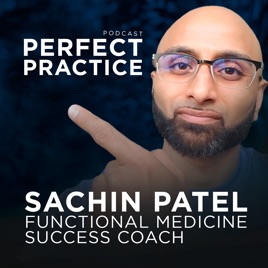
Advertise on podcast: Perfect Practice
Rating
4.8from
This podcast has
100 episodes
Language
EnglishPublisher
Sachin PatelExplicit
No
Date created
2018/07/09
Latest episode
2024/02/14
Average duration
52 min.
Release period
34 days
Description
Perfect Practice is a wellness practitioner's tactical blueprint to building, growing, and scaling their practice.
Unlock Perfect Practice podcast Email contact info,
Listeners & Audience details
Email contact information
Direct podcast contact details

Listeners
Audience numbers & engagement insights

Audience details
Podcast Insights

Podcast episodes
Check latest episodes from Perfect Practice podcast
How Dr. Betty Murray Runs a Seven-Figure Nutrition-Based Practice
2024/02/14
In this episode, Sachin interviews Dr. Betty Murray
Key Takeaways:
[1:02] Sachin introduces Dr. Betty Murray, the CEO and Founder of Living Well Dallas, a functional medicine center. Betty is a nutritionist and researcher who has helped hundreds of people to feel their absolute best, so she has had great success and prosperity.
[2:08] Sachin and Betty will focus on Betty’s methods for success and prosperity to help you succeed and prosper in your practice and life. Sachin welcomes Betty to Perfect Practice.
[2:52] Betty started her practice 20 years ago. In 2004, she did not find many clients for functional medicine. She bootstrapped her business with her part-time job. She didn’t have enough runway to make a lot of mistakes. She had to be more resourceful with her resources.
[4:58] In Betty’s clinic today, there are internal medicine, psychiatry, hormone replacement, clinical nutritionists, life coaches, counselors, and diagnostics. At first, her clinic was fee-for-service, and nobody was using coaching because they didn’t know its value.
[6:40] Betty had to let go of her belief that if she educated someone, they would find value in her program, and instead, create the value proposition and give it to them so they would find value. If the market is not buying your strategy, your strategy is wrong and you need to rearrange it.
[8:44] Always add value for your client first. When you give value to your customers, patients, and clients, you get rewarded. When you’re driving toward a value, and you’re giving people what they need and helping them understand what they need, people will value that.
[9:47] When you’re starting, the narrower you get with what you’re doing, whom you’re serving, and what problem you’re solving, the easier it is to stand out in that market. Don’t go bigger, faster, better and think it’s going to be more money. It’s complex. Betty has to spend more on marketing than others because she has more avatars. She has to spend more time on staff.
[13:45] Sachin says to keep it simple. Betty adds that if you have this burning desire to have a multi-disciplinary team, recognize that you’d better be a good business person or hire a good business person, which requires a runway of cash flow. It’s not a low-paying job.
[14:57] Most of us in healthcare never had business training. Betty had a business degree before she came into healthcare. It’s still a concept until you get it into action. Being a 30,000-hour expert comes from experience, not from a book or an education.
[17:09] The Mosaic of Autoimmunity, by Dr. Yehuda Schoenfeld, is a textbook Betty has been studying. It’s probably the best textbook to explain the underpinnings of autoimmunity. Regardless of who our avatar is, all of us are going to be in the immune system.
[18:07] 10X is Easier than 2X: How World-Class Entrepreneurs Achieve More by Doing Less, by Dan Sullivan is the business-building book Betty recommends. It is easier and more effective to leapfrog from where you are to where you want to go than it is to make small changes.
[18:52] Betty recommends two personal/financial development books: Disruptor: How to Challenge the Status Quo and Unlock Innovation, by Alex Gonzalez, about innovation. The second book is Die with Zero: Getting All You Can from Your Money and Your Life, by Bill Perkins. It’s about not amassing money but using it to do good as you go.
[24:11] Betty tells how she grew her money mindset. As a child, she was determined to work and she falsified her birth certificate to get a job underage. She sees the world as abundant and if she lives in that abundance and does the right things, she will be rewarded for it. She doesn’t hesitate to spend money. He husband is cautious so she asked him to handle the finances.
[25:55] Sachin also has a story about going after what he wanted at a young age. He learned to cut hair by watc
How A Backcountry Trip Can Change Your Life And Practice with Chris Kelly
2024/01/28
In this episode, Sachin interviews Chris Kelly, backcountry outfitter and friend, about the benefits of being in nature with a group, disconnecting from technology and using primal survival knowledge and skills, supporting each other, and growing naturally. Listen in for ways to embrace the natural world and put aside the office for a while.
Key Takeaways:
[1:02] Sachin introduces and welcomes Chris Kelly to the Perfect Practice podcast. Chris is an outfitter and Sachin’s outdoor mentor, friend, and guide in so many ways.
[2:11] Sachin met Chris on a three-day group camping trip in Algonquin. Chris and his brother Kieran involved everyone in meaningful, positive ways. Sachin was so impressed, he brought a group of his friends the following year for another amazing trip.
[3:46] The Time we spend with people is magnified in a backcountry camping experience over multiple days. Sachin learned more on a four-day trip than on a three-day trip.
[4:55] Sachin points out that your business can never grow bigger than you. You’re like the trunk of a tree and your business is a branch coming off of that tree. Grow yourself to grow all the branches of your life, including your business. Part of that process occurs when we disconnect and go back to the essence of who we are.
[6:37] Chris describes the moment on a paddle when the person he was paddling with told him that his trips were transformational. It was an epiphany. People can rewrite their stories. They take down barriers they have put up. They stop telling themselves “I can’t,” knowing “I did.”
[8:41] In the backcountry, there are no services, electronics, or artificial lights. On the first day, you find your footing and it seems to be going in slow motion. In a new environment, you’ve got to pay attention to everything. If you twist your ankle, you’re a liability. The environment brings you new ways of thinking.
[10:16] When you’re out there, you’re a different person, entirely. There’s so much onboarding of these skills that we have from being hunter-gatherers for 99.9% of our existence. You might think portages are scary but you navigate it with ease. It’s amazing how we adapt. You’re breaking an autopilot. You have an intense presence.
[12:02] Taking high school kids to the backcountry for four days removes them from their devices. When they get home, they don’t want to see their phones. You see a shift in their behaviors. In the case of an emergency, Chris had a satellite phone available.
[14:05] Coming back from the first trip, Sachin realized he would rather paddle for three hours than drive for three hours to get home, it was such a magical experience that changes you in so many ways. It makes you tough; it softens you. Sachin describes the magic of seeing the sun for 15 minutes after five cloudy, rainy days.
[17:04] Chris says you build a relationship with nature. It’s a reflection of your relationship with yourself. As people return to the backcountry, they become more themselves. They become more grounded. Families experience great beneficial changes. Everyone’s accomplishing something together. Their stories wash away in community and love. This carries back to life.
[20:31] Sachin shares a reflection learned from the second trip when portaging uphill to the next lake, carrying packs or canoes. Everyone plays a role, big or small, glorious or not glorious.
[23:37] Chris talks of finding power in being humbled and disempowered and ultimately finding fulfillment. Finding wood to build a fire, feeling the heat of the fire, and cooking food on it is primal and satisfying. Everything you put energy into provides energy.
[24:33] One of Sachin’s goals for 2024 is to get his team up there. His wife is hesitant because in the backcountry there are no bathrooms. Some on his team are eagerly looking forward to it. You bond on a backcountry camping trip in a way that you don’t
How To Ethically Grow Your Functional Medicine Practice with Jay Abraham
2024/01/15
In this episode, Sachin interviews Jay Abraham, the Founder and CEO of The Abraham Group, Inc. in Los Angeles, California. Jay attests to the power that practitioners have with the knowledge to remarkably improve the lives of people around them, clients, potential clients, and people who may never become clients. Jay speaks of investing in people first and how that pattern helped him in his career as an entrepreneur, business leader, and consultant. Jay offers ideas that can bring you success in your practice by caring more about the people around you than about your finances. Listen in for an inspiring message from Jay Abraham to improve your life and practice.
Key Takeaways:
[1:02] Sachin introduces and welcomes Jay Abraham to the Perfect Practice podcast. Jay has helped thousands of companies and entrepreneurs around the world generate revenue. Jay invites Yuri to ask him questions that might give clarity and actionable strategy to the audience.
[3:31] Jay thinks that we all have an enormously greater capacity to contribute to transforming people’s lives. We must understand that most people don’t know what we already know. Believe in your ability to contribute your knowledge and in your moral obligation to contribute. Be a positive catalyst in somebody’s life. It’s all about them.
[6:13] Jay’s advice for people starting in the health and wellness space is to know that you have the knowledge and the ability to change someone’s life. You have to get it into their mind in a way that they embrace it, believe it, and want it from you. How will you do that?
[7:40] Depending on the size of your market, local or national, find the lowest common denominator of influencers and offer to reciprocate a trade of services. Jay offers a script to use to give them your services for permanent wellness and healing and to ask them to introduce you to their clientele throughout their life, for a presentation of your services.
[11:00:] Jay tells how this worked for him when he started taking off in his services for entrepreneurs.
[12:25] You could become the recommended provider. Jay offers a way to do this ethically through exchanges of services. First, be the one to invest in others.
[13:07] Jay recommends his program on pre-eminence for Sachin’s listeners. Jay always wants to invest first in others. If you invest in someone and it has a positive payoff, everyone may not turn into a future compensated client, but the numbers will work for you if you make a profound difference and if you choose wisely in terms of their values and respect your methodology.
[16:10] Everyone is not going to do as much with the profound knowledge, the methodologies, techniques, regimens, and protocols you are going to share. Choose people who have the highest probability of doing something with it and seeing the most wonderful outcome. Ask them to nominate people who are struggling. Try it in general and for specific applications.
[20:26] Sachin points out this is a long game. We can’t add value to the lives of people who don’t share the values we do. You can add value to the world with every hour, or you can miss the opportunity to add value to the world with every hour. When you add value, the referrals are much more genuine.
[21:06] Jay says half the people don‘t know what greatness is supposed to look like in health. They’ve never had it or it was so long ago, it’s become hazy. They don’t know what it’s like to sleep through the night and have energy and focus with dramatically reduced stress levels, to have their bodies feel and look better. Give them an impact analysis tied to future pacing.
[24:30] Help someone consider what it would be like not to be tired but to have energy and focus galore.
[25:42] Jay shares a profound exercise to do with people. Ask “Who do you know in your life of your age that you would like to have the energy of?” That becomes the refere
How to really win in practice with Yuri Elkaim
2023/10/31
In this episode, Sachin interviews Yuri Elkaim. Yuri is prolific in the athletic world and the health and entrepreneur space. Sachin met Yuri at a conference that Peter Osborne was hosting. Yuri was onstage and “knocked it out of the park.” Yuri shares many nuggets of advice for the health practitioner who wants to move up to the next level. Listen in for a perspective that may improve your practice.
Key Takeaways:
[1:40] Sachin welcomes Yuri Elkaim to the Perfect Practice podcast. Yuri is a former pro athlete and current entrepreneur in the health and athletic space. Sachin looks forward to today’s conversation with Yuri about business and personality in the health space.
[3:14] Yuri trained, played, and competed in soccer from age 10, to become a pro player. He played professionally in his early 20s. When he was 17, he lost all his hair in six weeks, from an autoimmune disorder, alopecia. Before his hair loss, he had a lot of hair. Going from a full head of hair to bald in senior year was a transition, but his friends accepted it.
[5:12] Developing alopecia was one of the greatest things that happened to Yuri. It opened his eyes to what was going on with his health. Besides Western medical doctors, he was introduced to some amazing alternative practitioners. Nothing worked for his alopecia, but he is grateful for his exposure to these practices.
[5:59] Yuri studied kinesiology and health sciences at the University of Toronto and played pro soccer in France. After Yuri retired from pro soccer around 24, he came back and decided to pursue studies in holistic nutrition. That’s when his life changed. He was being exposed to information he never knew existed. He started applying what he learned.
[6:31] After about two months of cleaning up his diet at the university, Yuri grew back pretty much all his hair. The diet was such a profound change and he had so much more energy. He worked with personal training clients, practicing what he had learned in school. He realized that there were billions of people who didn’t know the holistic nutrition practices he had learned.
[7:29] That set Yuri on a mission. He started writing a book in the back row of nutrition class. Eight years later, he published the New York Times bestseller, The All-Day Energy Diet. Yuri’s passion for wanting to help others came from his own struggle. He struggled for seven years trading time for money as a one-on-one trainer-nutritionist; overworked and underpaid.
[8:18] Yuri had a bigger vision, wanting to help more people. He went online in 2005 and tried to figure it out for himself. It didn’t happen for three years. Then he hired a coach and things started to take off. With mentorship, coaching, and guidance, Yuri started to build a pretty substantial business. He helped half a million people to better health
[8:50] Yuri sold the company 13 years after starting it. During those 13 years, a lot of people had come to Yuri for business advice. He saw a space in the market and he started his current company, Healthpreneur®.about seven years ago. Some amazing health practitioners don’t know how to get their message out.
[9:36] Yuri seeks to help them to build better businesses. His vision is to help a billion people improve their lives in some way, shape, or form. He knew he couldn’t get there, direct to consumer, but he thought if he had these skills and capabilities to help other practitioners build better businesses, virtually, then they could help more people and reach that goal collectively.
[10:22] Yuri truly cares about helping people stand in their power, shine their lights, and become the best version of themselves so they can share with more people. That’s what he is here to do. He works hard because it is so much joy.
[11:34] Yuri discusses practitioners who are not moving forward. There are some mindset blocks common to health professionals that keep them small. One is the
The Challenges with Functional Medicine Testing with Dr. Bryan Walsh
2023/08/13
In this episode, Sachin interviews Dr. Bryan Walsh. Sachin bumped into Dr. Walsh at ECO, the CellCore Conference. After talking, Sachin invited Bryan to be a guest on Perfect Practice. Bryan is extremely passionate about functional medicine. He brings over 25 years of experience in helping us become better clinicians, looking at our patients through a slightly different lens and upgrading our paradigm so we can be of better value to the people we want to serve the most.
Key Takeaways:
[2:12] Sachin welcomes Dr. Bryan Walsh and thanks him for joining the podcast today. Sachin speaks of producing evidence-based treatment driven by awareness. There are more tests coming onto the market and more supplements and more research being done every year.
[3:10] Bryan started as a fitness specialist. He read much about nutrition. Before going to naturopathic school, Bryan went to a functional medicine weekend seminar produced by a lab. He was amazed by all the available tests. That hooked him on functional medicine.
[4:06] Bryan then went to naturopathic school where he met his wife. He learned about many tests and did them all: organic acid test, salivary cortisol test, urinary hormone test, stool test, hair tissue mineral analysis test, you name the test, he did it. But he started hearing gurus say things he knew not to be true and he started questioning the supplements.
[6:14] Bryan asked himself why he was running expensive tests if he didn’t know their scientific validity. The scientific literature is not friendly to these biomarkers and tests. He compares it to testing your home for radon with a bad test. Bryan is trying to raise the bar in the industry for better practitioners and healthier patients for less money, and being more evidence-based.
[8:10] Bryan and his wife run their business while trying to raise the bar in the industry as much as they can. Sachin loves that they are holding the entire industry to a higher standard. You have to feel solid on the tests you order for people. The foundation of our business is the outcomes we produce.
[9:24] Sachin asks, “How do I create a program that is independent of the labs, that produces results every single time that has tons of evidence and ancient wisdom wrapped up into it, and common sense wrapped up into it, and develop a lifestyle-design program that isn’t dependent on lab testing?” Sachin includes Oura rings for his patients so they can measure their progress.
[10:18] Bryan’s view is that a lab test should not give you any new insights into the person, it should just confirm what you already believe to be true. That means going back to your clinical skills, history-taking, symptom questionnaire, and physical exam. Bryan’s not opposed to any test that he knows of, but a test is not a fishing expedition, it’s confirmation of a suspected issue.
[11:28] For example, if a patient has hypoglycemic symptoms, there’s probably something going on. Testing blood glucose and A1C gathers hard data and allows for interventions and tracking progress. If someone has hypothyroid symptoms, run a complete thyroid panel and see where the defect is.
[12:35] Blood chemistry is one of Bryan’s passions. Standard blood chemistry is one of the most studied labs around the world. It’s been scientifically validated over and over. It’s inexpensive for what you get, if you know what you’re doing, have good reference markers, and are up to date on the modern literature on these markers.
[14:02] When you look at the literature on Albumin, old markers have new reasons they might be high or low that have implications for us as practitioners. If you take old tests and combine them with updated research on the markers, they can tell you as a clinician far more than you were using them for in the past.
[14:47] Bryan cites recent research linking high HDL with leaky gut. A high HDL may indicate testing for intestinal permeability
Timeless Practice and Personal Growth Concepts for Functional Medicine Practitioners
2023/06/26
In this episode, Sachin interviews Dr. Peter Osborne, his first mentor. Sachin met Dr. Osborne in California at a conference Dr. Osborne was hosting, called Market Functional Medicine. Sachin went to the event after downloading a lead magnet e-booklet from Dr. Osborne on how to build your practice. Sachin learned about the conference from an email. That conference changed Sachin’s life. It was wonderful for Sachin to hear someone who was a few years ahead of where he wanted to be, so open and willing to share his knowledge, holding nothing back. Sachin got some wonderful advice that he immediately applied to make an instant difference in his practice.
Key Takeaways:
[2:51] Sachin welcomes Dr. Peter Osborne and thanks him for joining the podcast today. Sachin thanks him for being a great role model as a father, husband, practitioner, clinician, and entrepreneur. Sachin elaborates on the connections between being a clinical practitioner and running a business.
[4:23] How has Dr. Osborne found passion to keep tapping into and how has he continued doing it all these years? Dr. Osborne says the passion found him. It came from the lack of knowledge, empathy, and discernment that he saw in medicine in his exposure to medical environments while in chiropractic school.
[6:36] Functional medicine practitioners have to be great clinicians as well as great at business. Hospitals and medical doctors aren’t going to refer patients, so you have to understand business. Less than one percent of people will see a functional medicine practitioner. Let’s change that so we can help more people. Dr. Osborne is passionate about helping people.
[7:37] In Dr. Osborne’s view, if you’re not passionate about helping people you should leave the practice. The way to be successful is to love people and have great empathy, great concern; that you care, and that you’re going to do what it takes. You’re going to spend more than a 20-minute appointment with a person if they start crying and you need that time to help them.
[8:14] One of Dr. Osborne’s mentors taught him to help the people and the money will follow. If you go for the money, you’ll never be happy.
[10:01] It can be challenging to keep up with the literature. There is so much you can learn on the internet from others who have different expertise than you. Your patients have the same access to those interviews as you do. Dedicate time for study. Learn how to learn. Humbly understand that we don’t know what we don’t know. Continue to learn more. You’ll get better.
[11:52] Sachin talks about things he’s learned over the years, like breathwork. Dr. Osborne advises you to get really good at something first before you try to get really great at everything. Dr. Osborne is the master of gluten. That’s what people know about him. The biggest change in his clinical life was understanding that topic better than anyone else.
[13:21] After mastering gluten, Dr. Osborne broadened his horizons. He organizes his week into blocks. Monday through Wednesday is his clinical schedule. On those days, he is not studying extra. Thursdays and Fridays are filled with blocks dedicated to research, writing, interviews, running his business, thinking about his business, and his family, meditation, and exercise.
[14:02] It boils down to just being organized and having intent. Thinking about what it is that you want. So many people want to be successful but they don’t think about what needs to happen for that success to happen. Organization has to be a big part of your thought process. If it’s not, there are too many distractions and shiny objects that will pull you in.
[14:28] A mentor of Dr. Osborne, Craig Ballantyne, said “Stop it! You’re going in too many directions. Just stop. Think about the direction you need to be going. What is the one thing that you can do today that serves your clientele that will increase your revenue? Focus on t
Work Smarter Not Harder with Dave Asprey
2023/05/14
In this episode, Sachin interviews Dave Asprey, a speaker, best-selling author, and biohacking entrepreneur, by video from Costa Rica. Dave shares some of his experiences, including the health challenges that enabled him to invent biohacking to improve his health. Dave discusses states of consciousness, tools for biohacking, tech entrepreneurship, the importance of mentors, how he deals with personal attacks from trolls, and how he has achieved greater equanimity in the face of stress and triggering events. Dave shares hacks he learned that he wrote into his books. Listen in for many more hacks you can use for better health.
Key Takeaways:
[1:03] Sachin welcomes everyone and introduces the guest, Dave Asprey, who speaks on being an entrepreneur. Dave is a long-time entrepreneur and a best-selling author. His newest book is Smarter Not Harder. Sachin recommends you read it. Dave will talk about his experiences and how he can help your functional medicine or holistic health coaching practice.
[1:59] Dave joins the podcast from Costa Rica. Sachin thanks him for joining us. Dave is passionate about helping people feel and do their best. Dave is known as the Father of Biohacking. His definition of biohacking is the art and science of changing the environment around and inside you for full control of your biology.
[2:55] The definition is still basically the same but the domains of the environment around you that you can change are constantly expanding. Some of the biohacks that have the broadest impact are at the cellular level. When your cells start to work better, your capacity for consciousness starts to improve. You have more bandwidth to access hidden parts of reality.
[4:02] Dave speaks of the hidden parts of reality and non-ordinary states of consciousness reached through neurofeedback and breathwork and having science-based and consciousness-based techniques that allow us to access altered states of high performance, including healing, relationships, and feeling inner peace and compassion.
[4:54] The set of tools for biohacking is ever-expanding.
[5:40] Writing didn’t come naturally to Dave. He is a computer coder by training so he knows how to group things logically. He held Google’s first servers when Google was two guys with two computers. He co-founded the Professional Services Group there. He was part of building Salesforce’s architecture when Salesforce had eight employees.
[6:09] Early-stage work requires structured thinking and the ability to teach new knowledge. For five years, Dave ran a program at the University of California starting each day in a tech startup and then teaching working engineers in Silicon Valley for two and a half hours how to build the internet and cloud computing. After dinner, he studied trade journals and wrote his next class.
[6:44] It was stressful, but Dave learned to assimilate information rapidly, translate it, and make it teachable. That made him one of the most powerful people in his company. Teaching is the best way to learn something. If you’re not going to teach, write a book as if you were teaching. When Dave writes, he asks how he would teach it. That forces him to structure his thoughts.
[7:35] Dave is good at building the skeleton of a book and at putting the outer skin on it. The part of writing he doesn’t enjoy is putting the muscles on the skeleton, so he works with a writing partner to flesh it out before putting on the finishing skin.
[8:37] Dave’s first book, The Bulletproof Diet, had managed to break onto The New York Times list. He talks about the tech he used to achieve altered states of consciousness so he could write. The tech and coffee got him into a flow state quickly.
[10:04] Sachin advises opening Smarter Not Harder and finding something to quote on social media, giving Dave credit. Teaching knowledge is the best way to learn it. Dave’s goal as an author is to say something that hasn’t b
The 14 principles of abundance with Sachin Patel
2023/04/06
In this episode, Sachin emphasizes how the abundance mindset works to attract and create abundance in your life, relationships, and businesses. An abundance mindset is key to your happiness and success. Listen in for tips on getting rid of scarcity and negativity and dwelling in joyful abundance.
Key Takeaways:
[1:02] Sachin introduces the topic for today, the abundance mindset. This is one of the most important mindsets to adopt and is crucial and key to your success and happiness and the legacy that you leave behind. Everyone around you, including your kids, is paying attention to your mindset, whether you express abundance or scarcity.
[1:40] Sachin has 14 rules to follow when it comes to abundance. He asks you to pick one, then two, and work your way up to all 14. He promises you will have plenty of opportunities every day to implement all 14 rules. Write them down and be more conscious of whether you are abundant in your thoughts, actions, behaviors, and in your reflection.
[2:17] There is always opportunity for us to find abundance and Sachin has learned that you always find what you’re looking for. So if we seek abundance, we become abundance, we embrace abundance, and we act abundantly, then abundance flows in our direction. Our actions act like an antenna to attract the right people and circumstances into our lives.
[3:00] 1. The difference between an extractor and a multiplier. A multiplier takes an idea and multiplies its value. This is like juicing an orange and planting the seeds. If we carefully pluck the idea from a conversation, we can plant a seed and grow it. An extractor has a scarcity mindset. They try to extract every drop of juice but miss the seed. They are always disappointed.
[5:38] 2. The quantum handshake. Think about how you show up to greet and connect with people. Use what’s culturally appropriate for them and your relationship with the person. Sachin describes handshakes and greetings from Level 0 (dead fish) to Level 3 (firm handshake, left hand on the shoulder, with a compliment). Or give a heart-to-heart hug with a compliment.
[10:06] 3. Leave people and places better than you found them. Clean up after yourself at a restaurant. Clean up your room at a hotel. Make other people’s jobs easier and make them feel appreciated. In a hotel room, leave a generous tip and a thank you note. How would an abundant person act in a situation? They leave people and places better than they found them.
[11:51] 4. Stop playing victim. It’s hard to play victim and have an abundance outlook on life and an abundance of opportunities coming your way. Abundance runs away from victims. Victims never take ownership of what’s happening in their life. As a result of playing victim, energy and abundance do not flow their way.
[13:29] 5. Trust the journey. Sachin’s sister-in-law had a saying, “Everything works out in the end. And if it hasn’t worked out, it’s not the end.” It’s rare when everything goes as planned although we might achieve the outcome. Part of life is trusting the journey. The universe, which is abundant by design, has a plan for you.
[14:49] 6. Never show up empty-handed. Bring a gift when you visit someone’s house, especially for the first time. If you’re car-pooling, show up with snacks. Pay for gas. It says a lot about you when you show up with an abundance mindset. Sachin loves bringing artwork, that will be part of their lives forever.
[16:24] 7. Empty your cup. If our cup is full, there’s no room for creamer. Every day we have to empty our cups a little bit so that others can pour into us; the universe can pour into us. Part of that is having humility.
[17:01] 8. Create a vacuum. Emptying your cup ties into creating a vacuum. Create a vacuum of opportunity so energy comes your way. Clear up your calendar so that you have room for opportunity. Clean up your closet if you want new clothes to flow in your direct
From Root Canals to Root Cause with Dr. Eniko Loud and Sachin Patel
2023/03/26
In this episode, Sachin and Dr. Eniko Loud talk about Dr. Loud’s training, background, and interest in applying functional medicine practices to holistic dental care. Dr. Loud explains there is more to dental care than treating cavities and broken teeth. Sometimes teeth break when there is uneven pressure in the bite. Dr. Loud explains how this happens. She covers what kinds of problems mouth-breathing can cause, why there is so much dental crowding and a functional problem with braces. Listen in for information on holistic and myofunctional dental therapy.
Key Takeaways:
[1:02] Sachin introduces the topic for today: oral health and beyond and introduces his guest Dr. Eniko Loud, a pioneer in the treatment of orofacial conditions. Dr. Loud provides dental care in a very holistic way using functional medicine. She focuses on the whole patient. Sachin shares more about Dr. Loud and how Joe Polish of Genius Network introduced them.
[3:33] Sachin welcomes Dr. Loud to the podcast.
[3:56] Dr. Loud was trained in medicine and dentistry in Europe. She had a passion for seeing the whole person. When she discovered functional medicine, it was a paradigm shift. She decided to get certified in functional medicine. She started making an impact on her patient’s health, with documents and dietary plans. She was excited about showing up for work.
[6:30] Dr. Loud tells how diseases of the body can show up on the tongue seven to 10 years before they show up in the body. She says bad breath is one of the biggest indicators of disease.
[8:11] Dr. Loud explains the patient's experience. The first appointment can take up to two hours. Based on functional medicine, there is a lot of listening and gathering of information. Before the appointment, Dr. Loud reviews records, diet, toxin exposure, and sleep habits. She connects all parts of the patient’s history with their oral health. Patients are amazed.
[9:38] Dr. Loud says this should be the standard of care in dentistry. Dr. Loud is a guide to her patients on their journey. She offers two ways, down the path of disease or the path of health. Most patients choose health. The patient is in the driver’s seat and makes all the decisions. Patients receive a report card after their hygienist appointment showing markers of health.
[12:15] The standard in Dr. Loud’s practice is for patients to have zero bleeding. That is how the patients can measure their success and progress.
[13:03] Bleeding gums might signal malnutrition. A lot of times, it indicates a lack of proper care. Mouth-breathing could be an issue or bacterial overgrowth even if they brush and floss properly. Toothbrush heads or mouth appliances may not be properly sterilized, spreading bacteria. Toothbrushes should be changed after two months. Dr. Loud likes electric toothbrushes.
[15:15] Dr. Loud likes Oral B iO series brushes. Dr. Loud says it rotates and oscillates so it is very effective at removing plaque.
[16:25] To tell if you have a tongue-tie, open your mouth wide and touch the roof of your mouth with your tongue. If you cannot, it is likely you have a tongue-tie. Dr. Loud explains some of the problems a tongue-tie can cause, and how the posture may be affected. Swallowing problems, sleep apnea, and snoring also may result from a tongue-tie.
[19:33] Dr. Loud describes a 3-D scan that can show abnormalities from a tongue tie. An oral surgeon can perform a frenectomy to relieve a tongue-tie.
[20:35] Dr. Loud recommends myofunctional therapy before and after a frenectomy to prepare the muscle for what it will have to do when the release is done.
[22:15] Two different things impact teeth; bacteria and forces. Most patients don’t know they have an overload of forces on their teeth. Dr. Loud explains what can happen when a crown is a few microns too high. This may change the joint position. If the forces are not distributed evenly, some teeth may be overloaded,
Overcoming client objections before they come up with Sachin Patel and Aron Choi
2023/03/12
In this episode, Sachin and Aron discuss what an objection is, why you are getting objections, how to rethink objections, and how to remove that word from your vocabulary and get down to being of value and service to people.
Key Takeaways:
[1:02] Sachin introduces the guest, Aron, one of the Perfect Practice community super coaches. Aron has onboarded many Mentorship and Accelerator clients. Aron is a fellow practitioner. The topic is objections.
[2:40] Aron has sold well over seven figures in the last couple of years. He has taken thousands of calls to help people get onboarded in programs. He had been shy and reserved and it’s been a great growth experience!
[5:38] Aron used to be afraid of confrontation in a sales call. He thought objection was rejection. With experience, he learned to reframe objections as forms of interest in making it happen.
[7:12] If you’re dealing with an adversarial type of conversation, then you’ve probably done something wrong. Objections are really interest in problems you’re trying to solve. Sachin uses the metaphor of a boxing coach in the corner cheering the client on. The goal is to build confidence.
[9:22] Aron differentiates between objections and excuses. Objections are usually at the end of a call before someone moves forward. No amount of objection handling will help someone do what they are not willing to do. You can’t drag a horse across a finish line.
[11:31] Building rapport with the client before the call prepares the client for the call. If you haven’t built rapport, you will face objections. Rapport is what they see from you. Do they have a familiarity with how you think, what you sound like, what you look like, and what you value? When you’re on the call, can you find commonality? Can you be approachable?
[13:16] Do you show up fully ready to listen to someone? Do you show interest in the other person, not as a dollar sign but as a real human being, and that you care about what they’re struggling with and care to connect them with a solution to solve that problem? If you feel it, it will come across on your call. Did you look at the intake form that they filled out?
[15:09] By understanding their circumstances, we’re able to provide a more fitting solution for them.
[16:10] A lot of the value practitioners offer is in the questions you ask to help clients understand that you know what you’re talking about. The questions you ask about their problem show them you have the experience in dealing with that problem to ask the right questions. People understand that you know what you’re talking about. Then the number of objections decreases.
[17:23] Trust is built through the questions you ask. Tell stories of real experiences about the problem they’re coming with. Once they can identify with the stories and experiences, then the trust is there.
[19:22] When Aron uses technical terms only if the client has seen them on a lab test and they’re presenting it. When you explain terms, don’t be overly technical. Making people confused decreases rapport. If someone feels ignorant during a call, that’s not a way to help them where they are. Don’t lose them. Help them stay on track.
[22:47] The moment you identify they’re not a good fit for your process, you stop, because you can’t take them where they want to go. You’ve got to be ethical and make that decision for them. You only want to work with people who are the right fit, as well. Look for the 20% of people who are the right fit for you.
[24:31] Aron uses a metaphor of swimming to see if someone is a good fit. As the conversation progresses, does it seem the client is swimming toward you and you are getting closer? Or are you chasing them in circles? You’re not selling a product, you’re committing to a relationship. Would you want to spend time with that person? Are they coachable and open to learning?
[27:20] Aron shares how v
23 Ways to Market Your Practice in 2023 with Sachin Patel
2023/03/05
Today, Sachin presents a solo episode focusing on your practice marketing success. Take one, two, or three of these ideas, to share your message and expand your reach in 2023.
Key Takeaways:
[1:03] Sachin introduces the theme: 23 things you can do to uplevel your practice, reach more people, have a bigger impact, and make the world healthy, happy, and whole through the outstanding work that you do. Sachin assumes you do meaningful work and you’re passionate about helping people but you struggle to help more people learn about the work you do.
[1:29] No matter how many people you help, you’re always going to feel that way. You’re always reaching for the carrot dangling in front of you. If you’re looking for more ways to help people and looking to make this year more impactful, and you want to make the world, healthy, happy, and whole, then this episode may be helpful for you.
[1:51] Sachin will unpack 23 things, but he wants you to know that these things can be unpacked even further and there is a lot more to each of them. Sachin hopes you will find and take action on one to three of these things that excite you and help you to feel you are getting things done.
[2:27] Find something in your “zone of genius” that allows you to feel like you’re making a difference in people’s lives. Marketing is storytelling; it starts with the story that we tell ourselves before we start telling our story to others. If you struggle with that, Sachin invites you to listen to “Mindset Mastery,” Episode 42 of Perfect Practice, about breaking down limiting beliefs.
[3:10] Of Sachin’s 23 topics, the one that is most important for you to focus on is the one that resonates with you.
[3:25] 1. Have a website that is easy to navigate, that explains what you do, who you are for, how you solve the problem that the client wants to be solved and that you help people in a different way than what they’ve tried before. It should be easy on the eyes and mobile-friendly, and easy to schedule from. It should speak for you. It should have a pixel. Google it.
[5:16] 2. Use social media to share information about your practice, including updates to your services, new programs you launch, testimonials, case studies, educational content, and the life you live as functional medicine practitioners and health coaches. Introduce people to the way you look at the world.
[5:55] 3. Write articles or blog posts about what you do. Blog posts can be great for backlinks, education, and positioning you as an authority. You never know what can come from a great blog post or article you’ve written and who might see it, and what opportunities may open up for you, If you like writing, blogs can be a great way to express yourself. They can go viral, as well.
[6:31] 4. Offer educational workshops, in person or online, about what you do and what problem you solve, and whom you solve it for. You’ll want a punchy title that hooks people in and helps them understand the problem that you solve and how you solve it. Webinars and workshops are great ways to educate people and build trust, share case studies, and offer a discovery call.
[7:12] 5. Partner with other healthcare practitioners such as chiropractors, naturopaths, medical doctors, massage therapists, and personal trainers; there could be plenty of people that you could connect with in your region that can be great referral partners. Do a Google search for the best chiropractor in your town. Email them an offer to meet for coffee and discuss referrals.
[9:52] 6. Attend local health fairs and events to meet potential patients and promote your practice. Having a booth or table at these events gives you exposure to a local audience. You can have a raffle to give away some great prizes. Sachin has had great success at health fairs with a five-pound challenge. You can also sponsor these events to get a lot of exposure.
[11:16] 7. Run targeted ads on
Mastering Your Money Mechanics with April Stroink
2023/02/12
Today, Sachin interviews April Stroink on our money journey as practitioners. They discuss how April came into coaching practitioners on finances after being trained as a financial advisor. April shares how her baby benefitted from health practitioners when medical care was powerless to help her. April talks about how a holistic view of well-being is similar to a holistic view of financial well-being, which she calls “wealthcare,” and how she began coaching practitioners. The conversation covers how little entrepreneurs know about finances, and how they can put together a financial system they can manage with the right team. Listen in for advice on fixing your finances while you still can.
Key Takeaways:
[1:02] Sachin welcomes listeners to Perfect Practice. Today, Sachin is speaking with April Stroink. Sachin introduces April and her work of coaching about money and thanks her for joining the podcast.
[3:24] April describes her work as a “wealthcare” practitioner. Your financial well-being is closely connected to your physical health, mental health, and close relationships. It’s important to understand what’s happening in our finances if we want to get healthy.
[3:51] Finance is one of the pillars of overall good health and well-being. It is one of the major stressors for most people. When the body is under stress it releases cortisol. Stress also impacts sleep. A lack of sleep impacts health. In Canada, where April lives, money stress is the number one reason for relationship breakdown, as well.
[4:57] April was trained as a financial advisor to get people to retirement with a safety net. She was not trained in behavioral finance. Money is emotional and we have biases about it. People behave differently with their money than with other areas of their lives.
[5:56] April worked with clients who told her they were living paycheck-to-paycheck even though they were making a good income. The more they made, the less disposable income they had and they were drowning in debt from student loans and business loans.
[6:26] In 2017, April shifted her practice away from “assets under management” to helping people on the coaching side of things to help people understand their spending behaviors and their emotions around money so they can reach their financial goals.
[6:56] Along the way, April has been very in-tune with her “wealthcare” and healthcare and the health of her family. Her nine-month-old daughter was constantly sick. Antibiotics made her sicker. April tried naturopathic medicine and worked with an ND as part of her healthcare team. Within 48 hours her daughter was like a new child.
[7:54] April’s classical financial training wasn’t serving her clients. She needed a more holistic view to look at the entire picture of their wealthcare, as naturopathic doctors and functional medicine professionals use in treating patients. April’s approach to wealthcare is similar to this healthcare community. So she started to work financially with the community of practitioners.
[9:15] Numbers don’t lie. When you use good data, it takes gives you a solid foundation to work past the emotion of the equation. April asks her clients to step into the Chief Financial Wellness Officer role for their firms. There are three attributes of a CFWO: 1. To be fearless about their numbers, 2. To be curious about their finances, and 3. To be passionate about their numbers.
[11:36] April will show a client the mechanics that work with the cognitive biases around money. She says the biggest thing that she helps clients with is increasing and boosting their confidence when it comes to their numbers and their finances.
[12:57] We have to realize Parkinson’s Law that demand always meets supply. If we have a month to do a task, it will take a month. If we have a week, it will take a week. The same happens with our money. As business owners, we have the axiom that Sales minus Exp
Podcast reviews
Read Perfect Practice podcast reviews
Sarah at ND Pen 2023/05/12
So much wisdom 🪄✨
Sachin has so much heart, generosity, and wisdom to share. This show will improve your business and life simply be listening 🪄✨
Sabrina Runbeck 2023/03/21
Great way to present objection handling
Just listened to "Overcoming client objections before they come up with Sachin Patel and Aron Choi" on Sachin's "Perfect Practice" podcast. Very usefu...
DavidBenn99 2019/11/06
Fantastic and Immediately Actionable
I have been listening to these podcast from the beginning and each one brings you something essential to your practice. From actionable business, clin...
Dr.Jessie 2019/04/02
Pros and Cons of having a Case Fee vs...
Another amazing podcast by my incomparably phenomenal mentor, Sachin Patel. Sachin is gifted with the ability to motivate and shift your thinking abou...
DivaDoc08 2018/10/01
Packed with Value 🙌🏽
So much value in this podcast!! Packed with tangible takeaways to implement right away for anyone wherever they are at in their Practice. I especially...
Docbcs 2018/07/28
Sachin is amazing
Sachin really knows his stuff and is an incredibly caring and genuine individual. It comes across in the podcast
Podcast sponsorship advertising
Start advertising on Perfect Practice relevant audience podcasts
You may also like to advertise on these Podcasts

4.4371061566
The Megyn Kelly Show
SiriusXM

4.888901269
Fearless with Jason Whitlock
Blaze Podcast Network

4.8118931000
Mind Pump: Raw Fitness Truth
Sal Di Stefano, Adam Schafer, Justin Andrews, Doug Egge
4.8102131585
Tara Brach
Tara Brach

4.541561215
Something You Should Know
Mike Carruthers | OmniCast Media

4.513841343
Strictly Anonymous Confessions
Kathy Kay

4.8292781897
Fantasy Footballers - Fantasy Football Podcast
Fantasy Football

4.62382612
Football Weekly
The Guardian

4.45387666
Two Judgey Girls
Two Judgey Girls

3.8258501152
The Viall Files
Nick Viall