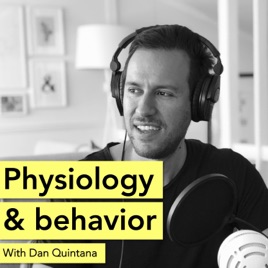
Advertise on podcast: Physiology and Behavior
Rating
4.4from
This podcast has
61 episodes
Language
EnglishPublisher
Dan QuintanaExplicit
No
Date created
2018/07/15
Latest episode
2021/11/15
Average duration
25 min.
Release period
86 days
Description
Dan Quintana is a scientist trying to better understand how our physiology influences behaviour. On this show you'll find a mix of episodes on research that's catching Dan's eye in biological psychology, interviews with other scientists, and Dan sharing his daily research process. See acast.com/privacy for privacy and opt-out information.
Unlock Physiology and Behavior podcast Email contact info,
Listeners & Audience details
Email contact information
Direct podcast contact details

Listeners
Audience numbers & engagement insights

Audience details
Podcast Insights

Podcast episodes
Check latest episodes from Physiology and Behavior podcast
Reproducible science, social media, and responding to reviewer comments
2021/11/15
In this episode I chat with Izelle Labuschagne, who is the founder of the Complete Thesis support group, about reproducible science [3:42], social media for academics [21:20], and responding to reviewer comments [39:25].
See acast.com/privacy for privacy and opt-out information.
Audio paper: How podcasts can benefit scientific communities
2021/01/27
This is the audio version of a paper I recently co-authored in Trends in Cognitive Sciences, titled "How podcasts can benefit scientific communities". I'm reading the preprint version of the article, which is very similar to the published version.
See acast.com/privacy for privacy and opt-out information.
Social media for academics: why and how
2021/01/21
This was a talk I recently did on social media for academics. I cover both why and how academics can use social media to boost their academic careers. The slides are available here.
Enjoy!
See acast.com/privacy for privacy and opt-out information.
Audio paper: An Allostatic Theory of Oxytocin
2020/05/08
This episode is the audio version of our paper, titled "An Allostatic Theory of Oxytocin", that was recently published in Trends in Cognitive Sciences.
Here is the abstract:
Oxytocin has garnered considerable interest for its role in social behavior, as well as for the potential of intranasal administration to treat social difficulties. How- ever, current theoretical models for the role of oxytocin in social behavior pay little consideration to its evolutionary and developmental history. This article aims to broaden our understanding of the role of oxytocin in social behavior by adopting an ethological approach through the lens of Nikolaas Tinbergen’s 'four questions' – how does oxytocin work; how does the role of oxytocin change during development; how does oxytocin enhance survival; and how did the oxytocin system evolve? We argue that oxytocin is most accurately described as an allostatic hormone that modulates both social and non-social behavior by maintaining stability through changing environments.
See acast.com/privacy for privacy and opt-out information.
From the lab to your living room
2020/04/09
This is a virtual talk I recently gave to PhD students at Linköping University on how to better adjust to working from home
The video and the slides from this talk can be found here.
See acast.com/privacy for privacy and opt-out information.
How to make ten pieces of content to share across social platforms from just one idea
2020/02/28
The main hesitation I hear from researchers when it comes to social media is that they've got nothing to share. In this short clip, I show you can you can share ten different bits of information, across different platforms, using just one idea.
Here's the video version of this clip.
See acast.com/privacy for privacy and opt-out information.
The tools you need to start your own podcast
2019/12/04
This podcast episode is about starting your own podcast!
Here are some of the links, services, and products that I mention:
The mega microphone review from Marco ArmentAudio-Technica ATR2100-USB Cardioid Dynamic USB/XLR MicrophoneFireside podcast hostingAcast podcast hostingAnchor podcast hosting Auphonic audio editing Izotope RX audio editing OBS screen recording softwareeCamm screen recording softwareShare video clips previews using Headliner
See acast.com/privacy for privacy and opt-out information.
Improving the precision of oxytocin research | A talk at the University of Copenhagen
2019/11/27
This is a talk a recently gave at the university of Copenhagen in which I discuss ways we can improve the precision of oxytocin research.
Download the slides here.
Here is the talk abstract:
The neuropeptide oxytocin has garnered considerable interest for its role in social behavior and its potential for the treatment of psychiatric illnesses characterised by social dysfunction. However, initial excitement has turned to disappointment with some studies failing to replicate earlier results, which has been attributed to issues surrounding research methods, mechanistic understanding, and theory development. In this talk, I will discuss efforts to improve research design to enhance reproducibility, including precise sample size estimation, synthetic datasets, and ways to test evidence for null models. I will also describe two lines of research aiming to better understand oxytocin signalling mechanisms: i) Research identifying whole brain voxel-by-voxel gene expression patterns of the oxytocin receptor (OXTR) gene and its association with mental states via a large-scale fMRI meta-analysis of 14,371 studies and ii) data from two clinical trials demonstrating that compared to placebo, 8IU intranasal oxytocin (but not 24IU intranasal oxytocin or 1IU intravenous oxytocin) modulates social cognition, pupil diameter, and neural activity. Altogether, these studies provide the first steps towards identifying targets for oxytocin receptor engagement in the human brain and suggest that a lower 8IU intranasal dose might be more efficacious than the conventional 24IU dose. I will close by presenting my new theory of oxytocin’s role in human behaviour, which proposes that oxytocin modulates both social and non-social behaviour to maintain stability in changing environments.
See acast.com/privacy for privacy and opt-out information.
Clinical trial reporting in anorexia nervosa | An interview
2019/10/31
In this episode, Dan shares some audio from a recent interview that he did on his recent paper examining clinical trial reporting in anorexia nervosa studies.
-----
Dan on Twitter and Instagram
See acast.com/privacy for privacy and opt-out information.
Open access | A keynote talk at the NFIF annual meeting
2019/05/27
In this talk, I share how open access benefits society, your research, and science.
Find the slides here.
See acast.com/privacy for privacy and opt-out information.
A pre-registered study on the causal link between intranasal oxytocin and spiritual experiences | Study summary
2019/04/22
A 2018 study that provides mixed support for a causal link between single dose intranasal oxytocin and spiritual experiences
-----
Dan on Twitter and Instagram
See acast.com/privacy for privacy and opt-out information.
Oxytocin-like receptor distributions in birds | Study summary
2019/04/19
A new study provides oxytocin-like receptor distribution maps for the brains of three birds species
-----
Dan on Twitter and Instagram
See acast.com/privacy for privacy and opt-out information.
Podcast reviews
Read Physiology and Behavior podcast reviews
La_petunia 2019/03/28
Nice, quick updates on study results.
Short, sweet, and precise.
Podcast sponsorship advertising
Start advertising on Physiology and Behavior relevant audience podcasts
You may also like to advertise on these Podcasts
4.4371061566
The Megyn Kelly Show
SiriusXM

4.888901269
Fearless with Jason Whitlock
Blaze Podcast Network

4.8118931000
Mind Pump: Raw Fitness Truth
Sal Di Stefano, Adam Schafer, Justin Andrews, Doug Egge
4.8102131585
Tara Brach
Tara Brach

4.541561215
Something You Should Know
Mike Carruthers | OmniCast Media

4.513841343
Strictly Anonymous Confessions
Kathy Kay
4.8292781897
Fantasy Footballers - Fantasy Football Podcast
Fantasy Football
4.62382612
Football Weekly
The Guardian

4.45387666
Two Judgey Girls
Two Judgey Girls

3.8258501152
The Viall Files
Nick Viall