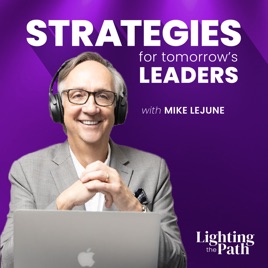
Advertise on podcast: Strategies for Tomorrow's Leaders
Rating
5from
This podcast has
114 episodes
Language
EnglishPublisher
Mike LeJeuneExplicit
No
Date created
2018/08/30
Latest episode
2026/04/21
Average duration
26 min.
Release period
13 days
Description
The show for leaders who care about having an engaged, purpose driven workforce. Gallop surveys show that in today's economy 75% of the workforce feels disengaged. Learn from Interviews with industry leaders who understand the importance of how engaged employees impact culture, drive productivity and ignite their teams.
Unlock Strategies for Tomorrow's Leaders podcast Email contact info,
Listeners & Audience details
Email contact information
Direct podcast contact details

Listeners
Audience numbers & engagement insights

Audience details
Podcast Insights


Podcast episodes
Check latest episodes from Strategies for Tomorrow's Leaders podcast
Why Most Leaders Fail at Change (And What to Do Instead)
2026/04/21
The conversation explores the theme of change management and its impact on individuals and organizations. It delves into the challenges of change, the importance of psychological safety, and the need for effective leadership during change. Naomi Hardy shares her insights on the dynamics of change and the role of leaders in championing change.
Takeaways
Change is an experience that people go through, and understanding the cycles of change can help reduce feelings of isolation and resistance.Psychological safety is crucial in creating an environment where individuals feel safe to think and speak differently, fostering engagement and productivity during change.Effective change management requires a marriage of process and behaviors, with a focus on understanding the impact of change on individuals and the organization.
Chapters
00:00 The Dynamics of Change07:40 Change Leadership and People Management19:40 Unique Challenges in Offshore Work Environments30:53 Psychological Safety and Engagement38:15 Measuring the Impact of Change
Connect with Naomi on LinkedIn:
https://www.linkedin.com/in/naomijhardy/
Learn more about Dunamis:
https://dunamischange.com/
Part II: Why Leaders Avoid Hard Conversations (And What It Costs Them)
2026/03/25
PART 2: Accountability, Trust & Leading Without Control Introduction Accountability isn't something you enforce—it's something that emerges.
In this second half, the conversation shifts to how leaders create environments where people actually take ownership.
Summary Mike and Sue unpack accountability as a result of leadership, not a command. They explore trust, micromanagement, and why leaders must stop stepping into other people's "seats."
Highlights Accountability is a result—not a behavior you force Micromanagement is often disguised as care Leaders must stop "owning" everyone else's work Great leaders ask more questions than they give answers Key Takeaways Clear expectations create accountability Trust is built through systems, not just intention If you're in their seat, they can't grow into it Leadership is about coaching, not controlling Questions unlock more than answers ever will Suggested Next Steps Ask your team: "What does success look like in your role?" Stop solving problems that aren't yours to solve Replace answers with questions in your next meeting Evaluate where you might be unintentionally micromanaging Connect with Sue on LinkedIn:
https://www.linkedin.com/in/suehawkes/
Part I: Why Leaders Avoid Hard Conversations (And What It Costs Them)
2026/03/25
PART 1: Discipline, Delegation & Difficult Conversations Introduction This conversation starts with a simple idea: most leaders don't struggle because they lack knowledge—they struggle because they avoid what's uncomfortable.
In this first half, we unpack discipline, delegation, and why difficult conversations aren't actually the problem.
Summary Mike and Sue explore how discipline really shows up in leadership, why leaders become bottlenecks, and how avoiding conversations creates bigger problems over time. They reframe "difficult conversations" as necessary tools for growth—not conflict to avoid.
Highlights Discipline is consistency, not punishment Leaders often block growth by not delegating Avoiding conversations creates "false harmony" Trust determines how directly you can communicate Key Takeaways Discipline is doing what matters—even when it's uncomfortable If you don't delegate, you become the ceiling Most "difficult conversations" are delayed conversations Clarity is the foundation of commitment and buy-in Leaders must create safety before delivering truth Suggested Next Steps Identify one conversation you've been avoiding Ask: "What am I protecting—myself or the relationship?" Delegate one task this week that you're holding onto Clarify expectations with your team (don't assume alignment) Connect with Sue on LinkedIn
https://www.linkedin.com/in/suehawkes/
Part II: Unrecruitable: How to Build a Team Your Competitors Can't Steal
2026/02/27
What actually makes someone stay?
In Part 2, Mike Lejeune and Jonathan Whistman move from hiring strategy to leadership execution — how to deeply care, coach hard, and build an identity people won't walk away from.
Jonathan shares practical examples of:
Recruiting the spouse Earning the right to have difficult conversations Designing onboarding that shapes identity Creating championship-level rituals inside organizations This conversation goes beyond retention strategies — it's about building people. In This Episode:
How to show people they matter (beyond surface-level care) Why leaders must earn the right to deliver hard feedback How to coach performance tied to personal identity Identity rituals that cement belonging Why champions don't need micromanagement — they need standards Key Takeaways:
People stay where they feel seen and developed. Difficult conversations only work when trust is established. Identity is stronger than compensation. Leaders must raise their benchmark before raising expectations. Next Steps:
Have one deeper conversation this week that goes beyond KPIs. Evaluate your onboarding — does it shape identity? Raise your standard — and communicate it clearly. Connect with Jonathan on LinkedIn:
https://www.linkedin.com/in/jonathanwhistman/
🎁 Special Bonus for Listeners
Jonathan has extended a special offer exclusively for listeners of this episode.
If you purchase a copy of Unrecruitable and message Mike with a photo of you holding the book, Jonathan will personally provide:
Two complimentary tickets to his live, two-day training event in Scottsdale, Arizona.
At this intensive session, you'll learn:
How to conduct a Talent Reveal Interview How to run effective group interviews How to lead executive-level interviews How to implement the Think–Feel–Act audit inside your organization Practical systems for building an unrecruitable team You can bring a member of your leadership team with you — both tickets are courtesy of this podcast. To claim your tickets:
Purchase Unrecruitable on Amazon: https://www.amazon.com/Unrecruitable-Build-Team-Competition-Steal/dp/B0GNKXFTQQ Send a photo of you with the book to Mike. We'll provide next steps for the Scottsdale event.
Part I: Unrecruitable: How to Build a Team Your Competitors Can't Steal
2026/02/27
What makes someone truly unrecruitable?
In Part 1 of this conversation, Mike Lejeune sits down with Jonathan Whistman, CEO of WhoHire and author of Unrecruitable: How to Build a Team Your Competitors Can't Steal.
Jonathan has built and sold companies, authored The Sales Boss, and now helps organizations use data and identity-driven leadership to build high-performance teams that competitors can't poach.
This episode challenges conventional thinking about hiring, retention, and culture.
In This Episode:
Why every business is actually in the human business The biggest mistake leaders make in hiring Why "gut instinct" fails more often than we admit The Think–Feel–Act framework for engineering culture Why identity determines whether someone stays or leaves The real math behind finding top 5% performers Key Takeaways:
Culture doesn't happen accidentally — it can be engineered. If you want different behavior, shape thinking first. Hiring is not an administrative task — it's a half-million-dollar decision. People don't leave jobs. They leave environments that don't fit their identity. Next Steps:
Audit your hiring process — are you using data or gut? Define clearly: What do you want your people to think about your organization? Share this episode with a leader who is struggling with retention. Connect with Jonathan on LinkedIn:
https://www.linkedin.com/in/jonathanwhistman/
🎁 Special Bonus for Listeners
Jonathan has extended a special offer exclusively for listeners of this episode.
If you purchase a copy of Unrecruitable and message Mike with a photo of you holding the book, Jonathan will personally provide:
Two complimentary tickets to his live, two-day training event in Scottsdale, Arizona.
At this intensive session, you'll learn:
How to conduct a Talent Reveal Interview How to run effective group interviews How to lead executive-level interviews How to implement the Think–Feel–Act audit inside your organization Practical systems for building an unrecruitable team You can bring a member of your leadership team with you — both tickets are courtesy of this podcast.
To claim your tickets:
Purchase Unrecruitable. Send a photo of you with the book to Mike. We'll provide next steps for the Scottsdale event.
Part II: How to Hire A-Players and Build a Growth Mindset Team
2026/02/12
Scaling the Right Way: Integrity, Tough Conversations & Eliminating Leadership Noise
What separates leaders who scale sustainably from those who burn out their culture?
In Part 2 of this conversation, Jeremy Jenson shares the deeper leadership evolution behind building a $12M+ organization — and why integrity became the turning point in his journey.
We move beyond strategy and into self-leadership.
In this episode, we explore:
• Why revenue alone is a dangerous focus
• Letting go of high producers who lack integrity
• The power of tough, honest conversations
• Why leaders must eliminate "noise" to stay focused
• Using EOS (Entrepreneurial Operating System) for clarity
• How to give feedback that elevates performance
• Why great leaders motivate through example, not fear
• Building systems that protect your culture
Jeremy also shares a powerful perspective shift:
Success stops being about what you achieve — and starts being about what you help others achieve.
If you're leading a team, scaling a company, or navigating growth, this episode will challenge how you think about clarity, accountability, and long-term success.
If you haven't watched Part 1, start there to understand the foundation of the growth story.
Connect with Jeremy on LinkedIn:
https://www.linkedin.com/in/jeremyjenson/
Part I: How to Hire A-Players and Build a Growth Mindset Team
2026/02/12
How to Build a High-Performance Team That Scales (Without Losing Your Culture)
How do you scale a business from startup to millions in revenue — without losing your culture?
In Part 1 of this conversation, Mike sits down with Jeremy Jenson, CEO of Encore Search Partners, to unpack the foundational principles behind building a high-performance team.
Jeremy shares how he transitioned from running a marketing company to building one of Houston's top executive search firms — and what leaders must understand about scaling the right way.
In this episode, we discuss:
• How Jeremy went from startup to $12M+ in revenue
• The leadership mistakes that slow down growth
• Why loyalty without performance can stall your company
• Raising performance standards ("raising the floor")
• Building a KPI-driven culture without micromanaging
• Why growth mindset is non-negotiable in hiring
• How to attract A-players through content and visibility
If you're a business owner, entrepreneur, or team leader trying to scale your organization, this episode will challenge how you think about accountability, performance, and culture.
👉 In Part 2, we dive into integrity, tough leadership conversations, eliminating "noise," and the real transformation behind sustainable growth.
Connect with Jeremy on LinkedIn:
https://www.linkedin.com/in/jeremyjenson/
Part II: Why Most Leaders Don't Have a Focus Problem — They Have a Time Problem
2026/01/15
Turning Vision Into Action: A Better Way to Execute Part 2 shifts from insight to application. Dan breaks down how leaders can translate long-term vision into focused, repeatable execution — without burning out or losing adaptability.
Summary Dan walks through the structure and mindset of the 12-Week Year, explaining how shorter planning cycles, weekly scorekeeping, and fewer priorities help leaders move faster and smarter. Mike connects the framework to leadership behaviors, strategic thinking, and real-world performance in uncertain environments.
Key Discussion Points Why shrinking timeframes increases energy and focus
How weekly feedback loops improve performance
The danger of treating plans as to-do lists
Why strategic thinking requires protected time
Highlights The 12-Week Year as a leadership mindset
Why five priorities outperform ten
How weekly reviews replace annual frustration
Intensity paired with recovery sustains performance
Key Takeaways Strategy lives in execution, not intention
Shorter cycles create faster learning
Planning is leadership work, not admin work
Focused systems outperform motivated chaos
Suggested Next Steps Define 3–5 priorities for your next 12 weeks
Schedule a weekly 10–15 minute review
Protect time for thinking, not just doing
Connect with Dan Mintz on LinkedIn:
https://www.linkedin.com/in/dan-mintz/
Ready to execute at a higher level? Learn more about Dan and how to Perform Like The Top 1% through 12-Week Execution Cycles: https://12week-breakthrough.com/
Part I: Why Most Leaders Don't Have a Focus Problem — They Have a Time Problem
2026/01/15
Why Leaders Feel Busy — But Still Fall Behind
In Part 1, Mike and Dan explore why capable, driven leaders still struggle to execute — especially in a world defined by speed, uncertainty, and constant change. This episode reframes productivity as a leadership challenge, not a time-management problem.
Summary Dan shares his experience as a CEO who felt stuck on a treadmill — planning, reacting, and falling short despite deep expertise. Together, they unpack why annual and quarterly planning fail to create urgency, how uncertainty amplifies execution gaps, and why feedback is now one of the most critical leadership tools.
Key Discussion Points Why knowledge and effort aren't enough
The illusion of progress created by long planning cycles
How uncertainty affects focus and confidence
Why feedback is tied directly to engagement and retention
Highlights "Busy" doesn't mean effective
Annual thinking delays accountability
Uncertainty demands clarity, not paralysis
Feedback helps people understand their value
Key Takeaways Execution breaks down when timelines are too long
Leaders need shorter cycles to stay grounded
Feedback is no longer optional — it's foundational
Focus creates confidence in uncertain environments
Suggested Next Steps Identify where your plans lose momentum
Reflect on how often you receive or give feedback
Ask: What would change if progress was reviewed weekly instead of yearly?
Connect with Dan Mintz on LinkedIn:
https://www.linkedin.com/in/dan-mintz/
Learn more about Dan and the 12-Week Execution Cycles: https://12week-breakthrough.com/
How Leaders Can Rewire Fear, Uncertainty, and Limiting Beliefs
2025/12/18
What happens when fear, uncertainty, and limiting beliefs start driving leadership decisions?
In this episode of Strategies for Tomorrow's Leaders, we explore how leaders can rewire fear, shift their thinking, and lead themselves more effectively — especially in times of change.
This conversation looks beneath strategy and tactics and focuses on the inner work that shapes how leaders show up. We talk about fear and curiosity, how language rewires the brain, why labels quietly limit growth, and what it really means to lead from awareness instead of reaction.
Rather than pushing motivation or quick fixes, this episode offers grounded insights and practical reflections leaders can apply immediately — at work and in life.
If you're navigating uncertainty, pressure, or self-doubt, this episode will help you slow down, ask better questions, and make decisions from clarity instead of fear.
What You'll Learn in This Episode
Why fear doesn't exist in the present moment — and why that matters for leaders How curiosity helps leaders overcome fear and uncertainty The hidden cost of labels and limiting beliefs in leadership Why the words leaders use shape how they think and decide How self-awareness strengthens leadership confidence and choice About the Guest
Martine Cohen is a transformational life strategist, leadership coach, and award-winning author of No More Layers. Her work focuses on self-leadership, awareness, and helping leaders reclaim personal power from the inside out.
Why This Episode Matters
Leadership isn't just about having answers — it's about understanding what's driving your decisions. This episode helps leaders step out of fear-based patterns and into intentional, values-driven leadership.
Connect with Martine Cohen:
LinkedIn: https://www.linkedin.com/in/martinecohennml/
Email: [email protected]
Building a Business in Uncertain Times: KPIs, Mindset, and Follow-Through
2025/11/24
In a world where the word most leaders use is "uncertain," what does it really take to build something that lasts?
In this episode, Mike talks with Sarah Englade, Founder and CEO of Monarch Talent Solutions, about launching and growing a recruiting firm in 2020—when companies were laying people off, not hiring. Sarah shares how a COVID layoff pushed her to bet on herself, why KPIs and processes are non-negotiable, and how she built a relationship-first recruiting brand in a noisy, skeptical market.
They dig into the mindset shifts that separate entrepreneurs who keep going from those who quietly quit, the role of belief when the numbers aren't there yet, and how time blocking keeps you out of "tension-relieving" activity and focused on what truly moves the ball.
If you're leading a business, a team, or your own career through uncertainty, this conversation gives you practical handles—not theories—you can put to work this week.
Highlights
How a COVID layoff became the catalyst for Sarah to launch Monarch Talent Solutions
The difference between working in KPI-driven environments vs. "no metrics, total chaos"
Why Sarah "lives for KPIs and processes" and how they actually protect culture and standards
The candidate and client follow-through processes that turn transactions into long-term relationships
Building a credible brand without "infomercial" content or constant self-promotion
Using market intel and real conversations to position yourself as a trusted guide
The biggest early hurdle: mindset, not circumstance
How time blocking keeps you out of the swirl and focused on goal-achieving work
Starting each day with the task you least want to do — and why that moves the needle most
Next Steps for Listeners
Audit your KPIs:
Ask yourself, "What are the 3–5 activities that actually drive results for my team or business?" Turn those into visible, trackable KPIs.
Design one follow-through process:
Choose either candidates, clients, or customers and map a simple sequence:
How often will you touch them? Through which channels? What value will you bring each time?
Time block your week:
Take Sarah's playbook and dedicate specific days or blocks to different priorities (e.g., candidates early in the week, business development later).
Start tomorrow with the hard thing:
Before you end your day, write down the one task you're resisting — and commit to tackling it first thing.
Connect with Sarah:
Reach out to Sarah Englade on LinkedIn (https://www.linkedin.com/in/sarah-englade/) or email her at [email protected] if you want to go deeper on recruiting, branding, or building a relationship-first search firm.
Stay in the conversation:
Follow Strategies for Tomorrow's Leaders and share this episode with another entrepreneur or leader who's navigating uncertainty right now
Part II: From Compliance to Commitment - Leading Through Culture, Not Control
2025/11/11
Making Belief Practical—From Hiring to Customer Experience
Introduction:
In Part 2, we get into the how. Matt walks through what belief looks like in action—from hiring people who align with your culture, to defining values in ways people can actually use, to building customer experiences that transform relationships. This is packed with real stories from Apple, Nordstrom, and other brands that got it right, plus Matt's CADET framework that changes how you think about every interaction.
Summary:
We tackle the practical side of building belief-driven cultures. Matt shares how to hire for cultural fit and belief (not just skills), and walks through his experience scaling Apple retail from 10,000 to 25,000 employees without losing their DNA. We dig into why values are meaningless without tangible definitions, the power of storytelling in creating shared understanding, and the CADET framework for customer experience. Matt also explains why incentives must align with desired behaviors, using real examples of what happens when they don't.
Key Highlights:
Apple hired for people who loved the brand and wanted to serve, not for product expertise—then trained them Values need tangible definitions: what does "kindness" look like, sound like, feel like in your specific organization? The CADET framework: Connect, Assess, Deliver, Exceed, Transform—and why you can't skip steps Incentives and behaviors must align, or your culture breaks down (the e-commerce returns example) Key Takeaways:
Hire for belief, train for skill. Look for alignment with your mission and values first, then build competence. Define your values in observable terms. Don't just say "kindness"—describe what it looks like in action and what it doesn't look like. Use storytelling to build culture. Get your team to share transformational experiences, then identify the common threads. Deliver flawlessly before trying to exceed. Master the basics (stated needs) before attempting to wow people with extras. Remove barriers to desired behaviors. If you want certain actions, make sure your incentive structure supports them, not fights them. Next Steps for Listeners:
Pick one of your company values. Can you describe it in specific, observable terms? If not, gather your team and define it together using stories. Review your last few hires. Did you prioritize skills or cultural alignment? What would change if belief came first? Walk through a customer or employee experience using CADET. Where are you trying to "exceed" before you've "delivered"? Connect with Matt on LinkedIn.
The Power of the Pause
2025/11/06
Title: What Happens When Love Enters the Boardroom (Part 2)
Guest: Kelly Hall — Author of Love Works: Transforming the Workplace with Purpose and Authenticity
Intro If Part 1 asked us to bring our whole selves to work, Part 2 asks: How?
Kelly Hall returns to share how she learned to lead from love — through crisis, coaching, and experience. A former finance executive turned leadership expert, Kelly discovered that love and high performance aren't opposites — they're fuel for each other.
Together, she and Mike explore the tools that turn emotion into insight, chaos into clarity, and leadership into a relationship worth following.
What This Part Covers Emotional intelligence and the "second thought" that defines mature leadership.
Why pausing for clarity leads to better decisions than rushing for control.
The shift from "commander" to "coach" — and what that means in real life.
How consent-based decision-making builds trust and buy-in.
The science of love as energy — and why caring deeply drives performance.
Highlights "Your first thought isn't a choice — but your second one is."
"Sometimes the most productive thing you can do is pause."
"Love is power, not weakness."
"When leaders go last, people start to think for themselves."
"Replace delegation with enrollment — don't assign work, invite ownership."
Takeaways Lead last. Listen first.
Create clarity by slowing down before speeding up.
Turn reaction into reflection — pause before you decide.
Empower others to make decisions, not just execute them.
Redefine ego: use it to serve your people, not control them.
Next Step for Listeners In your next meeting, go last. Let the room breathe. Listen without fixing — and notice what shifts when you trust the process more than the plan.
Connect with Kelly Hall.
The Word We're Afraid to Use at Work
2025/11/06
Title: What Happens When Love Enters the Boardroom (Part 1)
Guest: Kelly Hall — Author of Love Works: Transforming the Workplace with Purpose and Authenticity
Intro What happens when a business leader says the word "love" in a boardroom?
Kelly Hall found out firsthand.
After two decades leading global teams in industries where performance ruled, Kelly began exploring what happens when we let emotion — empathy, compassion, and yes, love — belong at work.
In Part 1, Kelly and Mike unpack the tension between results and humanity: why we've been trained to separate who we are from what we do, and how reconnecting the two builds teams that trust, engage, and stay.
What This Part Covers Why "love" still feels taboo in corporate culture — and why that's changing.
Kelly's story of being told to remove the word "love" from a presentation to investors.
The danger of leaving parts of ourselves at the office door.
Mike's moment of authenticity: going from "Michael" to "Mike."
Redefining psychological safety and what it really looks like in action.
Highlights "It's scary to bring your emotions to work — and that's a tragedy."
"The best leaders put their hand on your back, not their thumb on your head."
"Safety doesn't mean comfort. It means you can stretch without fear."
"When leaders show up as their whole selves, it gives everyone else permission to do the same."
Takeaways Real leadership is relational, not positional.
Love is just another word for deep respect and care.
Authenticity isn't a soft skill — it's a performance advantage.
Create spaces where people can make mistakes and still belong.
Growth happens when people feel safe enough to stretch.
Next Step for Listeners Ask yourself: Do people on my team feel safe to tell me the truth — even when it's uncomfortable? This week, lead one conversation from curiosity, not control.
Connect with Kelly Hall.
Part I: From Compliance to Commitment - Leading Through Culture, Not Control
2025/10/22
The Foundation of Belief-Driven Leadership
Introduction: What is culture, really? In this conversation, Matt Marcotte—who's led teams at Apple, Salesforce, and Bergdorf Goodman—helps us move past the buzzwords. We talk about why belief is the difference between teams that comply and teams that commit, why uncertainty makes this more critical than ever, and how leaders can stop trying to be the hero and start creating environments where people bring their best.
Summary: Matt introduces his new book Built on Belief and explains why he pivoted from frameworks to focus on the real competitive advantage: belief. We explore how belief transforms into commitment versus compliance, why leaders feel pressure to have all the answers (and why that's wrong), and the importance of clarity around what your organization actually believes. Matt shares the "heart, head, hands" framework and explains why people feel first, think second, then act—and how leaders need to work with that reality, not against it.
Key Highlights:
Culture comes down to two things: how people act and what they believe Belief is the "magic elixir" for fighting uncertainty in today's business environment The myth of the hero leader: your success is predicated on your people's success, not on having all the answers The "heart, head, hands" framework: humans are wired to feel first, then make sense of it intellectually, then act Key Takeaways:
Start by defining what you believe. Most organizations focus on the "how" and "what" but skip the foundational "why." Commitment is born from conflict. People need agency, voice, and the ability to challenge ideas to truly buy in. Redefine what control means. Great leaders are conductors orchestrating the whole, not soloists playing every instrument. Lead with emotion, not intellect. "I have a dream" beats "I have a plan" every time when building commitment. Put people in choice. Be clear about your mission so people can authentically opt in—or out. Next Steps for Listeners:
Ask yourself: When's the last time I thought about what my organization actually believes? Identify one person on your team and practice looking at a challenge through their eyes. Think about your last big initiative—did you lead with vision (emotion) or plan (intellect)? How did people respond? Connect with Matt on LinkedIn.
Podcast reviews
Read Strategies for Tomorrow's Leaders podcast reviews
Podcast sponsorship advertising
Start advertising on Strategies for Tomorrow's Leaders relevant audience podcasts
You may also like to advertise on these Podcasts
4.4371061566
The Megyn Kelly Show
SiriusXM
4.888901269
Fearless with Jason Whitlock
Blaze Podcast Network
4.8118931000
Mind Pump: Raw Fitness Truth
Sal Di Stefano, Adam Schafer, Justin Andrews, Doug Egge
4.8102131585
Tara Brach
Tara Brach

4.541561215
Something You Should Know
Mike Carruthers | OmniCast Media

4.513841343
Strictly Anonymous Confessions
Kathy Kay

4.8292781897
Fantasy Footballers - Fantasy Football Podcast
Fantasy Football

4.62382612
Football Weekly
The Guardian

4.45387666
Two Judgey Girls
Two Judgey Girls

3.8258501152
The Viall Files
Nick Viall