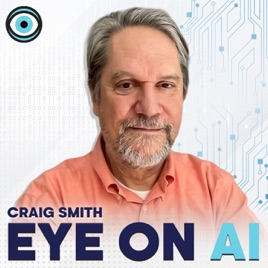
Advertise on podcast: Eye On A.I.
Rating
4.7from
This podcast has
336 episodes
Language
EnglishPublisher
Craig S. SmithExplicit
No
Date created
2018/10/08
Latest episode
2026/04/23
Average duration
54 min.
Release period
5 days
Description
Eye on A.I. is a biweekly podcast, hosted by longtime New York Times correspondent Craig S. Smith. In each episode, Craig will talk to people making a difference in artificial intelligence. The podcast aims to put incremental advances into a broader context and consider the global implications of the developing technology. AI is about to change your world, so pay attention.
Unlock Eye On A.I. podcast Email contact info,
Listeners & Audience details
Email contact information
Direct podcast contact details

Listeners
Audience numbers & engagement insights

Audience details
Podcast Insights



Podcast episodes
Check latest episodes from Eye On A.I. podcast
#337 Debdas Sen: Why AI Without ROI Will Die (Again)
2026/04/23
What does it actually take to prove that AI delivers real value in the industries that keep the world running?
In this episode of Eye on AI, Craig Smith sits down with Debdas Sen, CEO of TCG Digital and Joint Managing Director of Lummus Digital, to explore what serious enterprise AI looks like when it is applied to some of the most complex, high-stakes problems on the planet. Problems like compressing years of catalyst research into weeks, predicting refinery failures before they happen, and accelerating drug development timelines that could determine how long a life-saving medicine takes to reach patients.
Debdas has spent nearly 30 years in data and AI, living through every hype cycle from the data warehousing era of 1997 to today's agentic revolution. He makes a compelling case that the AI community has one defining job right now: prove the ROI, or risk another AI winter.
We also get into what makes TCG Digital's platform mcube™ different. It is not a horizontal tool. It is a domain-first, agentic AI ecosystem built for the kinds of massive, multi-variable problems that horizontal platforms cannot touch. Debdas breaks down how mcube™ bridges legacy enterprise infrastructure with cutting-edge agentic systems, why hybrid modeling beats pure AI in energy and life sciences, and how the platform keeps private enterprise data protected while still drawing on the best of what public LLMs have to offer.
Finally, Debdas shares where he sees the industry heading next, a future where agents from different providers can reason together in a neutral space, where inference and reasoning keep improving, and where the companies that go deepest into domain will pull furthest ahead.
Subscribe for more conversations with the people building the future of AI and emerging technology.
Stay Updated:
Craig Smith on X: https://x.com/craigss
Eye on AI on X: https://x.com/EyeOn_AI
TCG Digital Website: https://www.tcgdigital.com/
TCG Digital on LinkedIn: https://www.linkedin.com/company/tcgdigital/
(00:00) Introduction and Meet Debdas Sen
(01:30) 30 Years in Data and AI: From Data Warehousing to Agentic Systems
(03:02) What TCG Digital Actually Does (04:32) Inside mcube™: How the Platform Works
(10:06) Domain vs Horizontal: Why Specificity Wins in Enterprise AI
(18:29) Catalyst R&D: Collapsing 12 Months of Research Into One
(30:38) Predicting Plant Failures Before They Happen
(36:51) Solving the Trust and Hallucination Problem in Enterprise AI
(44:51) The Six-Layer Architecture of mcube™
(47:05) What Is Genuinely New About Agentic AI
(49:22) What Young People Should Study to Work in Serious AI
(53:14) Velocity to Value: Why ROI Must Be Tracked From Day One
#336 Professor Mausam: Why India Is Losing the AI Race and What It Will Take to Catch Up
2026/04/20
What if the country that produces the world's top AI talent finally figured out how to keep it?
In this episode of Eye on AI, Craig Smith sits down with Professor Mausam, one of India's leading AI researchers, AAAI Fellow, and founding head of the Yardi School of Artificial Intelligence at IIT Delhi, to get an honest and unflinching diagnosis of why India has fallen so far behind the US and China in artificial intelligence and what it will actually take to close that gap.
Mausam breaks down the structural story behind India's deficit. A pipeline of world-class students that gets exported abroad the moment it graduates. A professor shortage so severe that IIT Delhi's entire School of AI has hired only five new faculty members in five years. A government AI mission with the right instincts but not enough speed or boldness. And a brain drain made worse by the very thing India is proud of, its English fluency, which makes its talent the easiest in the world to absorb and the hardest to bring back.
Mausam walks through the full picture. How China built its research dominance not through students but through aggressively repatriating senior researchers with real salaries, real lab resources, and real authority to build research cultures from scratch. Why the AlexNet moment in 2012 was actually an equalizer that gave China's fledgling ecosystem a surprise advantage over more established Western research groups. How India's JEE coaching culture and IIT bottleneck are symptoms of a scarcity of quality institutions rather than a broken exam. What the government's AI mission is getting right on compute, data, and sectoral focus, and where the critical gaps remain. And why Mausam believes that bringing one hundred top professors back to India would do more for the country's AI future than any single government program or funding initiative.
We also get into the harder questions. Whether AI degrees belong at the undergraduate level or should sit on top of a computer science foundation. Why Mausam no longer holds an optimistic view on AI's impact on software jobs and why he thinks Geoff Hinton's point about plumbers has merit. And what it would actually take for a democracy of 1.4 billion people to stop training the world's AI leaders and start keeping them.
Subscribe for more conversations with the researchers, builders, and policymakers shaping the future of artificial intelligence.
Stay Updated:
Craig Smith on X: https://x.com/craigss
Eye on A.I. on X: https://x.com/EyeOn_AI
(00:00) Introduction: India's AI Gap and Professor Mausam's Background
(02:30) Building the Yardi School of AI at IIT Delhi
(07:44) How Far China Has Pulled Ahead in AI Research
(12:55) Why India Could Not Follow China's Playbook
(29:18) The JEE System, Coaching Culture, and the IIT Bottleneck
(30:37) AI Degrees, Job Market Realities, and the Future of Work
(44:18) The Real Problem Is Professors, Not Students
(48:07) Big Tech Labs in India: Helpful but Not at Scale
(51:46) The Government AI Mission: Progress and Gaps
(55:20) The Compute and Data Infrastructure Problem
(59:54) Can India Close the Gap Before It Is Too Late
#335 Sriram Raghavan: Why IBM Is Betting Everything on Small AI Models
2026/04/19
Why IBM Is Betting Everything on Small AI Models
In this episode of Eye on AI, Craig Smith sits down with Sriram Raghavan, Vice President of AI at IBM Research, to explore one of the most important debates in enterprise AI right now. Do you actually need a massive model to get world class results? IBM's answer is no, and Sriram breaks down exactly why.
Sriram explains why IBM chose to train its Granite models directly using reinforcement learning rather than distilling from larger models like most of the industry. The reason goes beyond performance. It comes down to data lineage, safety alignment, and a belief that small, efficient models are the only sustainable path for enterprises running AI across hybrid cloud environments.
We get into the full technical stack behind that bet. How data quality has replaced model size as the real competitive advantage. Why parameter count is becoming the wrong metric entirely. How IBM's inference time scaling techniques allow an 8 billion parameter model to match the performance of GPT-4o and Claude 3.5 on code and math benchmarks. And why IBM is pioneering a new concept called Generative Computing, which treats AI models not as prompt receivers but as programmable computing elements with runtimes, modular LoRA adapters, and proper programming abstractions.
Sriram also shares where IBM Research is headed next, including breakthroughs in continuous learning, agent orchestration, and making unstructured enterprise data actually usable at scale.
Subscribe for more conversations with the people building the future of AI and emerging technology.
Stay Updated:
Craig Smith on X: https://x.com/craigss
Eye on A.I. on X: https://x.com/EyeOn_AI
(00:00) Why IBM Skips Distillation and Trains Small Models Directly
(04:50) Did We Even Need Giant AI Models in the First Place?
(08:12) How Data Quality Became the New Competitive Moat
(11:54) Why Parameter Count Is the Wrong Way to Measure a Model
(15:36) Reinforcement Learning Without Losing Broad Capabilities
(22:05) Inference Time Scaling: Getting Big Model Results From Small Models
(28:12) Generative Computing: Treating AI as a Programming Element
(36:40) Why IBM Open Sources and How Small Models Make It Sustainable
(41:25) The Path to Continuous Learning Without Rewriting Weights
(51:00) IBM's Full Roadmap: Models, Data, and Agents
#334 Abhishek Singh: The $1.2 Billion Plan to Turn India Into an AI Superpower
2026/04/16
What if the country that trained the world's engineers finally decided to keep them?
In this episode of Eye on AI, Craig Smith sits down with Abhishek, the civil servant leading India's $1.2 billion national AI Mission, to explore how one of the world's largest and most diverse nations is mounting a serious challenge to US and Chinese dominance in artificial intelligence.
Abhishek breaks down the honest story behind India's late start. World-class talent, but no research ecosystem to retain it. Digitization without AI-usable data. Compute so scarce that the entire country had fewer than 500 GPUs just two years ago. And a brain drain so severe that the engineers India trained are now running the biggest tech companies in the world, just not from India.
Abhishek walks through exactly how the mission is tackling each of those gaps. A subsidized compute program that gives researchers and startups access to 38,000 GPUs at under a dollar per hour. AI Kosh, a national data platform pulling public and private sector datasets into a single AI-ready repository. Centers of Excellence connecting IITs around domain-specific research in agriculture, healthcare, education and mobility. And a sovereign LLM program, with four models already in development and eight more on the way, built specifically for India's languages, voices and needs.
We also get into the geopolitics. Where India stands as the US and China carve out competing AI spheres of influence. Why Abhishek is pushing for a UN-led governance framework rather than aligning with either bloc. And what it would actually take for a country of 1.4 billion people to not just catch up, but leapfrog.
Subscribe for more conversations with the people shaping the future of AI and emerging technology.
Stay Updated:
Craig Smith on X: https://x.com/craigss
Eye on A.I. on X: https://x.com/EyeOn_AI
(00:00) Introduction and Abhishek's Background
(02:43) What the India AI Mission Is and How It Started
(04:53) The $1.2 Billion Budget and Total AI Investment in India
(06:36) Data Center Build-Out and the Road to 7 Gigawatts
(08:11) AI Kosh: India's National Data Platform
(10:50) Subsidized GPUs and How Researchers Access Compute
(12:41) Brain Drain, Reverse Migration and Retaining Top Talent
(17:24) Centers of Excellence Across IITs and Key Sectors
(19:21) Expanding Fellowships and Training the Next Generation
(20:11) Why India Started Late and What Changed
(21:48) Sovereign LLMs Built for Indian Languages and Needs
(22:42) The Diversity Challenge and Culturally Relevant AI
(23:16) Government Funding for Foundation Model Development
(24:12) The AI Impact Summit and India's Role on the Global Stage
(24:52) India, China, the US and the Battle for AI Governance
(29:37) The UN Framework and India's Third Way
(31:16) India-China Relations and New AI Partnerships
(32:01) How the $1.2 Billion Budget Was Decided
(33:31) Can India Actually Catch Up With the US and China
#333 Adi Kuruganti: Why Your AI Pilot Is Failing and What It Takes to Reach Production
2026/04/15
Most enterprises are excited about agentic AI. But very few are actually deploying it in production.
In this episode of Eye on AI, Craig Smith sits down with Adi Kuruganti, Chief AI and Development Officer at Automation Anywhere, to break down why agentic AI is so hard to get right in the enterprise and what it actually takes to move from a promising pilot to a mission-critical deployment.
Adi explains why the future of enterprise automation is not agentic AI alone, but the combination of deterministic and agentic systems working together, and why companies that treat AI as a technology problem instead of a business outcomes problem are setting themselves up to fail.
They dig into how Automation Anywhere is orchestrating agents across legacy systems, healthcare platforms, and financial services workflows, why governance and compliance are the first questions every enterprise asks, and how their Process Reasoning Engine is continuously improving agent performance using metadata from over 400 million running processes.
The conversation also covers the real timeline to a fully autonomous enterprise, why the POC to production gap is the biggest failure point in enterprise AI today, and what companies that wait too long risk losing to competitors who started the journey earlier.
If you want to understand where enterprise AI actually stands today and what it takes to deploy it responsibly at scale, this episode gives you a clear and grounded perspective.
Subscribe for more conversations with the people building the future of AI and emerging technology.
Stay Updated:
Craig Smith on X: https://x.com/craigss
Eye on A.I. on X: https://x.com/EyeOn_AI
(00:00) Why Enterprises Are Struggling With Agentic AI
(02:39) What Automation Anywhere Does and the APA Category Explained
(08:01) Deterministic vs Agentic AI: Why You Need Both
(10:59) How Human in the Loop Works in Enterprise AI
(17:16) The Mozart Orchestrator and Process Reasoning Engine
(23:50) How AI Is Upgrading and Replacing Classic RPA
(27:31) How Automation Anywhere Works With Enterprise Customers
(31:53) The Biggest Challenges of Scaling Agentic AI
(41:10) The OpenAI Partnership and What It Means
(47:06) Training Staff and Building AI Literacy at Scale
(51:39) Staying Close to Customers as the Technology Shifts
(53:17) Is the Autonomous Enterprise Actually Coming
#332 Dan Faulkner: The Code Is Clean. The App Is Broken. Why AI Development Has an Integrity Problem
2026/04/14
What happens when AI writes code faster than anyone can test it?
In this episode of Eye on AI, Craig Smith sits down with Dan Faulkner, CEO of SmartBear, to explore one of the most underappreciated risks of the AI coding boom. As tools like Claude Code and Codex push software development to unprecedented speed, the systems built to validate that software are being left behind. Dan makes a distinction that every engineering leader needs to hear: clean code passing unit tests is not the same as an application that actually works.
Dan introduces the concept of application integrity, continuous and measurable assurance that your software does everything it was intended to do and nothing it was not. He explains why the gap between what AI builds and what teams actually validate is already creating hidden risk in production, and why that risk compounds the faster you ship.
We also get into the new failure modes that agentic AI is introducing. Slop squatting, instruction inversion, cascading errors. These are not theoretical. They are happening now, at scale, in codebases that no human has fully read.
Dan also walks through SmartBear's autonomy ladder framework and their newest product BearQ, a team of AI agents that explores your application, builds a knowledge graph, authors tests, runs them, and updates everything as your app evolves. The key distinction: it is built to augment human teams, not replace them.
Finally, Dan shares his honest take on the future of software engineering. The fallacy was always that coding was the hard part. The hard part is knowing what to build. That skill is not going anywhere.
Subscribe for more conversations with the people shaping the future of AI and emerging technology.
Stay Updated:
Craig Smith on X: https://x.com/craigss
Eye on A.I. on X: https://x.com/EyeOn_AI
(00:00) Introduction and Dan Faulkner's Background
(01:05) What SmartBear Does: Testing and API Lifecycle Management
(03:27) AI Is Outpacing Application Testing
(07:51) Slop Squatting, Instruction Inversion and New AI Failure Modes
(17:31) Black Boxes, Technical Debt and the Expertise Crisis
(22:00) How to Avoid Self-Validating AI Systems
(24:11) The Autonomy Ladder and BearQ
(31:30) Why Testing Must Be Continuous and Everywhere
(36:31) Infrastructure Risk and Automation Bias
(44:11) The Future of QA and New Specialist Roles
(50:44) How Teams Use SmartBear Tools Today
(58:57) The Future of Software Engineering and Human Roles
#331 Sergey Levine: The Robot Revolution Nobody Is Talking About
2026/04/12
This episode is sponsored by Modulate.
Most voice AI focuses on transcription. Velma takes it further by actually understanding conversations, analyzing tone, timing, stress, and intent using its Ensemble Listening Model architecture.
Explore the live preview: https://preview.modulate.ai/
What does it actually mean to build a foundation model for robots?
In this episode of Eye on AI, Craig Smith sits down with Sergey Levine, co-founder of Physical Intelligence and professor at UC Berkeley, to explore a fundamentally different approach to building robots, one inspired not by programming a single perfect machine, but by training AI on the broadest and most diverse data possible so robots can learn, adapt, and operate in the unpredictable real world.
Sergey explains why the secret to general-purpose robots isn't perfecting one single machine, but training on massive, diverse data from all kinds of robots and even humans. The more variety the model sees, the better it gets. Just like ChatGPT learned from all the text on the internet, robotic foundation models learn from every robot that has ever moved, grabbed, or interacted with the real world.
We also get into the big humanoid robot debate. Are they the future, or is it mostly hype? Sergey gives an honest and technical take on why the form factor conversation is changing now that foundation models exist, and why that actually opens the door for more creativity, not less.
Finally, Sergey shares what he's most excited about next, building a true data flywheel where robots get smarter the more they are deployed, creating a continuous learning cycle that could change everything.
Subscribe for more conversations with the people building the future of AI and emerging technology.
Stay Updated:
Craig Smith on X: https://x.com/craigss
Eye on A.I. on X: https://x.com/EyeOn_AI
(00:00) Introduction: What Are Foundation Models for Robots?
(01:44) Meet Sergey Levine: Physical Intelligence and UC Berkeley
(02:51) Breaking Down Foundation Models for Non-Technical People
(06:46) Why Real World Data Beats Simulation
(15:00) Building a Broad Robotics Foundation From Scratch
(24:00) The Open World Problem in Robotics
(40:00) Generalist vs Specialist Robots: Which Wins?
(47:00) Humanoid Robots: Real Innovation or Just Hype?
(55:10) The Future: Continuous Learning and the Data Flywheel
(56:23) Guilty Pleasure: Sci Fi and Thinking Beyond the Limits
#330 Sebastian Risi: Why AI Should Be Grown, Not Trained
2026/04/06
AI has been trained like software.
But what if it should be grown like life?
In this episode of Eye on AI, Craig Smith sits down with Sebastian Risi, professor and leading researcher in neuroevolution and artificial life, to explore a fundamentally different approach to building intelligence, one inspired by how nature evolves, grows, and adapts.
Sebastian explains why traditional AI systems are limited by fixed architectures and one-time training, and how evolutionary algorithms can create systems that continuously learn, self-organize, and even grow their own neural structures over time.
They dive into concepts like plastic neural networks that keep updating during their lifetime, AI systems that can recover from damage, and models that develop from a single "cell" into complex structures, similar to biological organisms.
The conversation also explores how combining large language models with evolutionary search could unlock more creative and open-ended problem solving, from merging specialized models to building AI systems capable of generating and testing scientific ideas.
If you want to understand where AI is headed beyond today's transformer models, and why the future may look more like living systems than software, this episode offers a clear and thought-provoking perspective.
Subscribe for more conversations with the people building the future of AI and emerging technology.
Stay Updated:
Craig Smith on X: https://x.com/craigss
Eye on A.I. on X: https://x.com/EyeOn_AI
(00:00) Why copy nature's evolution for AI
(01:20) What neuroevolution actually means
(05:52) How evolutionary search replaces gradients
(08:03) Plastic neural networks and continuous learning
(11:53) Growing neural networks like living systems
(18:08) Scaling challenges and limits of growth
(23:16) Can evolving systems replace LLM training
(27:28) Continual learning and model merging
(30:27) Artificial life, self-repair, and resilience
(35:10) AI scientists and evolution with LLMs
#329 Izhar Medalsy: How AI Solves Quantum Computing's Biggest Problem
2026/03/31
Quantum computing has been "5 years away" for decades.
So what's actually holding it back?
In this episode of Eye on AI, Craig Smith sits down with Izhar Medalsy, Co-founder & CEO of Quantum Elements, to break down the real bottleneck in quantum computing today and why the future of the industry may depend more on classical systems and AI than quantum hardware itself.
Izhar explains how digital twins of quantum systems are being used to simulate real hardware, generate massive amounts of training data, and solve one of the biggest challenges in the field: noise and error correction.
They dive into how his team improved Shor's Algorithm from 80% to 99% accuracy on IBM hardware, without changing the hardware itself, and what that means for the future of quantum performance.
The conversation also explores how AI is being used to optimise quantum systems, why classical computing will continue to play a central role in quantum development, and what milestones to watch as the industry moves closer to real-world applications.
If you want to understand where quantum computing actually stands today and what will unlock its next phase, this episode gives you a clear, grounded perspective.
Subscribe for more conversations with the people building the future of AI and emerging technology.
Stay Updated:
Craig Smith on X: https://x.com/craigss
Eye on A.I. on X: https://x.com/EyeOn_AI
(00:00) The 99% Accuracy Breakthrough (Quantum's Turning Point)
(01:03) Why Quantum Hardware Alone Isn't Enough
(03:50) Digital Twins Explained (The Missing Layer)
(08:09) The Real Problem: Noise, Instability & Environment
(15:43) From 80% to 99% on Shor's Algorithm
(26:36) How AI Is Fixing Quantum's Biggest Bottleneck
(33:53) Inside the Platform: From Circuit to Optimization
(40:51) Logical Qubits & Scaling Quantum Systems
(43:34) The Limits of Simulation vs Real Quantum Hardware
(54:29) When Quantum Becomes Useful (Real Timeline)
#328 Kevin Tian: Exploring Doppel's AI-Native Social Engineering Defense Platform
2026/03/27
AI is changing more than just productivity.
It's changing what we can trust.
In this episode, Kevin Tian, Co-founder and CEO of Doppel, breaks down how AI is enabling a new wave of social engineering attacks—from deepfake phone calls to impersonation across LinkedIn, YouTube, and search engines.
The reality is this:
Deepfakes are just one part of a much bigger problem.
Attackers are now operating across multiple channels at once, using AI to manipulate people, not just systems. And as these attacks scale, the real risk isn't just fraud or data loss—it's the erosion of trust in everything we see online.
Kevin explains how Doppel is building an AI-native defense platform to detect, map, and shut down these attacks in real time, and why the future of cybersecurity will be defined by AI vs AI.
If you're thinking about AI, security, or the future of trust online—this conversation is essential.
Stay Updated:
Craig Smith on X: https://x.com/craigss
Eye on A.I. on X: https://x.com/EyeOn_AI
(00:00) AI Deepfakes & The Collapse of Trust
(01:56) Why "Social Engineering" Is Bigger Than Phishing
(05:20) Deepfakes, Misinformation & Multi-Channel Attacks
(09:16) The Rise of Deepfake Phone Calls
(12:43) How Attackers Manipulate AI & Search Results
(14:39) The Origin Story Behind Doppel
(18:55) How Doppel Detects & Stops Attacks in Real Time
(22:55) Can Attackers Misuse AI Defense Tools?
(24:26) How to Tell What's Real vs Fake Online
(28:20) What Is Human Risk Management?
(30:36) AI vs AI: The Future of Cyber Defense
(34:04) What CEOs Must Do About AI Threats
(37:18) Working with Platforms Like YouTube & LinkedIn
(39:52) Can We Ever Fully Stop Deepfakes?
(44:40) How Doppel Works for Enterprises
#327 Baris Gultekin: The Next Phase of AI - Agents That Understand Your Company's Data
2026/03/19
This episode is sponsored by Modulate. Most voice AI focuses on transcription. Velma takes it further by actually understanding conversations, analyzing tone, timing, stress, and intent using its Ensemble Listening Model architecture.
Explore the live preview: https://preview.modulate.ai/
Baris Gultekin, Head of AI at Snowflake, breaks down how enterprise AI is actually being built, deployed, and scaled today. From running AI directly inside governed data environments to enabling natural language access across entire organizations, this conversation explores the shift from experimentation to real-world impact.
You'll learn why Snowflake's core philosophy centers around bringing AI to the data, how data agents are transforming decision-making across teams, and what it takes to build trustworthy AI systems with governance, guardrails, and high-quality retrieval at the core.
Baris also shares how leading companies are already saving thousands of hours through AI-driven automation, why culture and leadership determine AI success, and what the future looks like as agents move from pilots to full-scale production.
If you want to understand where enterprise AI is actually headed and what separates hype from real execution, this episode breaks it down.
(00:00) The Evolution of Snowflake AI
(01:40) Baris Gultekin: Background & AI Mission
(02:59) Why AI Must Run Next to Data
(04:29) Inside Snowflake's AI Infrastructure
(09:08) Model Choice vs Product Layer Strategy
(12:16) Building Trust: Governance, Guardrails & Quality
(16:01) How Enterprise Agents Are Built & Orchestrated
(20:10) AI Adoption Across the Entire Organization
(24:39) Reasoning vs Retrieval: What Matters More
(27:43) Real Use Case: Faster Decision-Making with AI
(31:44) AI as a Co-Pilot for Leaders
(36:52) Preparing Data for AI at Scale
(38:46) What the AI Data Cloud Really Means
#326 Zuzanna Stamirowska: Inside Pathway's Post-Transformer Architecture Designed for Memory and On-the-Fly Learning
2026/03/11
This episode is sponsored by tastytrade.
Trade stocks, options, futures, and crypto in one platform with low commissions and zero commission on stocks and crypto. Built for traders who think in probabilities, tastytrade offers advanced analytics, risk tools, and an AI-powered Search feature.
Learn more at https://tastytrade.com/
This episode dives into why Pathway's Baby Dragon Hatchling (BDH) might mark the beginning of the post-transformer era in AI.
Zuzanna Stamirowska, Pathway's CEO and co‑author of BDH, explains why today's transformer-based LLMs hit a wall on long-horizon reasoning, how memory and synaptic plasticity are built directly into BDH's architecture, and what that means for continual learning, hallucinations, and "generalization over time."
The conversation ranges from complexity science and brain-inspired computation to practical implications for real-world, small-data, and safety‑critical applications.
Stay Updated:
Craig Smith on X: https://x.com/craigss
Eye on A.I. on X: https://x.com/EyeOn_AI
(00:00) The Core Problem: Why Today's AI Lacks Memory
(03:16) Pathway's Mission to Bring Memory Into AI
(04:53) Zuzanna's Background in Complexity Science
(10:30) Why Transformers Reset Like "Groundhog Day"
(14:34) The Brain-Inspired Dragon Hatchling Architecture
(23:59) How the Network Learns and Builds Connections
(37:38) Performance vs Transformers on Language Tasks
(49:37) Productizing the Technology With NVIDIA and AWS
(54:23) Can Memory Solve AI Hallucinations?
#325 Phelim Brady: Why AI's Future Depends on Human Judgement
2026/03/09
AI often looks fully automated. But behind the scenes, a huge amount of human judgment is shaping how these systems actually work.
In this episode, Craig Smith speaks with Phelim Bradley, co-founder and CEO of Prolific, a platform that connects millions of real people with researchers and AI labs to evaluate and improve AI systems.
They explore the hidden human layer behind modern AI, why traditional benchmarks are becoming less reliable, and why AI companies increasingly rely on real human feedback to measure model performance in the real world.
Phelim also explains how demographic differences influence how models are evaluated, why human judgment remains critical even as AI improves, and how the collaboration between humans and AI will shape the next phase of development.
This conversation reveals the human backbone behind today's AI systems.
Stay Updated:
Craig Smith on X: https://x.com/craigss
Eye on A.I. on X: https://x.com/EyeOn_AI
(00:00) Preview and Intro
(02:45) Founding Prolific And Early Pain Points
(06:30) From Mechanical Turk To Representativeness
(09:55) Academic Research And AI Use Cases Split
(13:40) Vetting Real Participants And Fighting Fraud
(17:45) Scale, Community Growth, And Talent Mix
(22:00) High-Complexity Projects Over Commoditised Labeling
(26:40) Measuring Model Persuasion With Live Conversations
(30:20) Demographic-Aware Model Preference Benchmarks
(34:10) The Rise Of Human Evaluation Over Benchmarks
(38:00) Enterprise Model Choice And Continuous Evaluation
(42:00) Why Humans Won't Disappear From The Loop
#324 Sharon Zhou: Inside AMD's Plan to Build Self-Improving AI
2026/02/27
AI is not just getting smarter. It is getting faster by learning how to optimize the hardware it runs on.
In this episode, Sharon Zhou, VP of AI at AMD and former Stanford AI researcher, explains how language models are beginning to write and optimize their own GPU kernel code. We explore what self improving AI actually means, how reinforcement learning is used in post training, and why kernel optimization could be one of the most overlooked scaling levers in modern AI.
Sharon breaks down how GPU efficiency impacts the cost of training and inference, why catastrophic forgetting remains a challenge in continual learning, and how verifiable rewards from hardware profiling can help models improve themselves. The conversation also dives into compute economics, synthetic data, RLHF, and why infrastructure may define the next phase of AI progress.
If you want to understand where AI scaling is really happening beyond bigger models and more data, this episode goes under the hood.
Stay Updated:
Craig Smith on X: https://x.com/craigss
Eye on A.I. on X: https://x.com/EyeOn_AI
(00:00) Preview and Intro
(00:25) Sharon Zhou's Background and Transition to AMD
(02:00) What Is Self-Improving AI?
(04:16) What Is a GPU Kernel and Why It Matters
(07:01) Using AI Agents and Evolutionary Strategies to Write Kernels
(11:31) Just-In-Time Optimization and Continual Learning
(13:59) Self-Improving AI at the Infrastructure Layer
(16:15) Synthetic Data and Models Generating Their Own Training Data
(20:48) AMD's AI Strategy: Research Meets Product
(23:22) Inside the NeurIPS Tutorial on AI-Generated Kernels
(30:59) Reinforcement Learning Beyond RLHF
(39:09) 10x Faster Kernels vs 10x More Compute
(41:50) Will Efficiency Reduce Chip Demand?
(42:18) Beyond Language Models: Diffusion, JEPA, and Robotics
(45:34) Educating the Next Generation of AI Builders
#323 David Ha: Why Model Merging Could Be the Next AI Breakthrough
2026/02/24
This episode is sponsored by tastytrade.
Trade stocks, options, futures, and crypto in one platform with low commissions and zero commission on stocks and crypto. Built for traders who think in probabilities, tastytrade offers advanced analytics, risk tools, and an AI-powered Search feature.
Learn more at https://tastytrade.com/
Artificial intelligence is reaching a turning point. Instead of building bigger and bigger models, what if the real breakthrough comes from letting AI evolve?
In this episode of Eye on AI, David Ha, Co-Founder and CEO of Sakana AI, explains why evolutionary strategies and collective intelligence could reshape the future of machine learning. We explore model merging, multi-agent systems, Monte Carlo tree search, and the AI Scientist framework designed to generate and evaluate new research ideas. The conversation dives into open-ended discovery, quality and diversity in AI systems, world models, and whether artificial intelligence can push beyond the boundaries of human knowledge.
If you're interested in AGI, evolutionary AI, frontier models, AI research automation, or how AI could start discovering science on its own, this episode offers a clear look at where the field may be heading next.
Stay Updated:
Craig Smith on X: https://x.com/craigss
Eye on A.I. on X: https://x.com/EyeOn_AI
(00:00) AI Should Evolve, Not Just Scale
(03:54) David's Journey From Finance to Evolutionary AI
(10:18) Why Gradient Descent Gets Stuck
(18:12) Model Merging and Collective Intelligence
(28:18) Combining Closed Frontier Models
(32:56) Inside the AI Scientist Experiment
(38:11) Parent Selection, Diversity and Innovation
(49:25) Can AI Discover Truly New Knowledge?
(53:05) Why Continual Learning Matter
Podcast reviews
Read Eye On A.I. podcast reviews
987362847 2026/02/27
Ahead of the curve
After each podcast I feel well informed. More than just surface level highlighting of latest developments, it presents case studies on how to think a...
SM405 2025/03/08
Featuring insightful conversations
An insightful podcast that makes complex AI topics accessible and easy to understand. It is a a great listen for anyone interested in the future of te...
Info_Sprinkles 2024/02/07
Fantastic podcast…
Review: bamdiggity!
josepcpea 2023/05/09
Well researched, great quality guests and calm, level headed interviewing
Just what I was looking for.
Fred Aebli 2023/01/20
Top Notch Content and No Frills
When delving into the science and industry driving the evolution of artificial intelligence this is a podcast that you want to subscribe. Craig’s kn...
Awesome McUppercut 2023/03/17
Decent content, editing is terrible
The content itself is okay enough, but the editing of the podcast is quite bad. Random jumps, cut off words, clicks, and moments of silence make it un...
LisaIsHereForIt 2022/01/19
💥Amazing conversations, incredible guests!
Craig and his highly knowledgeable guests take the already fascinating study of AI and bring it to life through engaging and intellectual conversation...
19y.o. learner 2021/07/22
Valuable for me, an AI dilettante.
I’m in college and thinking about pursuing expertise in AI. I just found and want to thank this podcast because this interview (I only listened to one...
vivaboat 2020/06/30
Ai
Excellent programs enhanced by sources on its website.
GradientDescent2 2019/03/22
Nice
good selection of guests - big thinkers
Podcast sponsorship advertising
Start advertising on Eye On A.I. relevant audience podcasts
You may also like to advertise on these Podcasts

4.913875378
Absolutely Not
Dear Media

4.69271090
Astrology Hub Podcast
Astrology Hub

4.51279478
The Eddie Trunk Podcast
SiriusXM

4.8322705
Whence Came You? - Freemasonry discussed and Masonic research for today's Freemason
Robert Johnson

4.79519270
Small Town Dicks
Audio 99

4.928711128
Real Life Ghost Stories
Real Life Ghost Stories

4.512332022
Optimal Finance Daily - Financial Independence and Money Advice
Optimal Living Daily | Diania Merriam

4.23771760
The Smerconish Podcast
SiriusXM
4.9271238
Catalyst with Shayle Kann
Latitude Media

4.73662478
The Rachel Cruze Show
Ramsey Network