1457049580
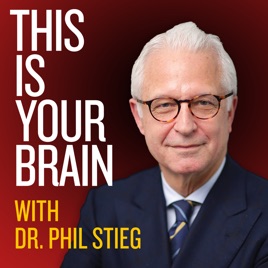
This Is Your Brain With Dr. Phil Stieg

Advertise on podcast: This Is Your Brain With Dr. Phil Stieg

Rating
★★★★★
4.7
from
146 reviews
This podcast has
197 episodes
Language
English
Date created
2019/03/20
Latest episode
2026/10/02
Average duration
28 min.
Release period
14 days

Description

This Is Your Brain With Dr. Phil Stieg provides a fascinating look into the human brain, with each episode asking new questions — and finding new answers — about our most mysterious organ. Together with his expert guests, Dr. Stieg takes us on a journey that reveals unexpected secrets at every turn, and redefines what we know about ourselves and our place in the world. The podcast explores the many fascinating aspects of neuroscience, ranging from how the brain is wired for both sudden bursts of violence and the pervasive inner calm of meditation. Where does confidence come from? How do we remember traumatic events – or do we? How do other animals experience consciousness? Does storytelling change our brains? Take the journey with us as we explore the very foundation of what makes us human.

Unlock This Is Your Brain With Dr. Phil Stieg podcast Email contact info,
Listeners & Audience details

Email contact information

Direct podcast contact details

Listeners

Audience numbers & engagement insights

Audience details

Podcast Insights

Podcast episodes

Check latest episodes from This Is Your Brain With Dr. Phil Stieg podcast


May We Have Your Attention ... and Keep It?
2026/10/02
Do you scroll on your phone for hours but then quit a meaty news story in 15 seconds? Maybe your attention span isn't the problem!   Dr. Ronald Yaros thinks the way to get people to pay attention is better content delivery that's designed to work with their busy lives.   Find out what actually captures and keeps our attention... and why.
Is AI Making Us Dumber?
2026/09/18
Every time AI answers for you, part of your brain may switch off. Theoretical neuroscientist Dr. Vivienne Ming explains why, including a striking claim about GPS use and Alzheimer's risk.  Dr. Ming shares her own fix for using AI. She calls it the nemesis prompt, a technique for turning AI into your harshest critic instead of your biggest fan.  Vivienne joins Dr. Stieg to unpack what it actually takes to come out of the AI age sharper, not dumber.
Profiling The Criminal Mind - James Fitzgerald
2026/09/04
For 17 years, the Unabomber skillfully eluded investigators, leaving behind no fingerprints, DNA, or usable forensic evidence but in the end it was his own words that gave him away.  Dr. Phil Stieg speaks with retired FBI criminal profiler James Fitzgerald, a pioneer of forensic linguistics whose analysis of Ted Kaczynski's writings helped crack one of the most notorious investigations in FBI history. Fitzgerald reveals how investigators constructed a personality profile from the bomber's writings, identified the unusual turn of phrase that became a "linguistic smoking gun," and used patterns in language and behavior to identify this notoriously elusive criminal mind.  Plus, an exclusive glimpse into a family's traumatic moment when they discover their relative is a serial bomber. ### Archival audio courtesy of Videos For Change Productions Excerpt from documentary in progress "Life Or Death" featuring David Kaczynski and Linda Patrik,  Producers Mike Camoin and John Carlson.
A Memory Workout
2026/08/14
Can't remember the fourth item on your grocery list? Nelson Dellis, a professional "memory athlete," can remember 100 things or more (though he still may forget the butter). Hear how Dellis learned to memorize lists so long that he became a five-time USA Memory Champion, and how you can use some of his strategies to improve your own memory. Dellis explains how he uses tricks like the "memory palace" and mnemonic devices to recall lengthy lists with perfect accuracy. In an era when cell phones are making memory superfluous, you can regain some of those lost skills by using his techniques. Plus… those rare folks who can never forget a day in their lives. https://www.nelsondellis.com/  Click here for a transcript and further information on this episode.
"Awestruck!" - Part 2 with Beau Lotto, PhD
2026/07/31
The human brain resists uncertainty — whether it's an approaching tiger or a global pandemic, we've evolved to move from fear and chaos to order and resolution. Dr. Beau Lotto, founder of the Lab of Misfits, explains why the brain takes small steps instead of large leaps, and why we need to teach kids to think more like scientists. Plus... why we react to a pandemic by hoarding toilet paper! https://www.beaulotto.com/ Since this episode was first released in 2021, Dr. Lotto has launched a new project - "Evolvable.Me" "Our interactive AI-powered platform reveals precise, science-backed insights into how you think, relate, and behave – drawn from your responses and real-life conversations." Try it for free at  https://www.evolvable.me/
"Awestruck!" - Part 1 - with Beau Lotto, PhD
2026/07/24
What is awe? It's not wonder, or surprise, or pleasure — it's a state of mind that Dr. Beau Lotto calls "finding the impossible in the common."  Dr. Lotto is a neuroscientist who specializes in perception; he once actually measured awe in the brains of people watching Cirque du Soleil. Learn where awe originates, why it evolved, and even how military leaders might weaponize it. Plus... why Dr. Lotto says babies are born "useless". https://www.beaulotto.com/ Since this episode was first released in 2021, Dr. Lotto has launched a new project - "Evolvable.Me" "Our interactive AI-powered platform reveals precise, science-backed insights into how you think, relate, and behave – drawn from your responses and real-life conversations."   Try it for free at  https://www.evolvable.me/
The Mercurial Genius of Candace Pert
2026/07/10
Candace Pert discovered the opioid receptor, created a drug to stop AIDS in the brain, and identified stress as a cause of disease.  She also inadvertently unleashed the overdose epidemic, got kicked out of the NIH, and was denied credit for much of her work.  Largely forgotten, Pert was a trailblazing yet mercurial neuroscientist. Emmy award winning writer and producer Pamela Ryckman shines a light on Pert's breakthroughs and her fascinating legacy on the podcast.   For a transcript and more information about this episode use this link:  https://bit.ly/4vuMoiG   For more about our guest's book:  https://www.hachettebookgroup.com/contributor/pamela-ryckman/
The Mother of all Brain Changes - Chelsea Conaboy
2026/06/26
New parents - especially moms - experience profound changes in the brain when they are expecting and welcoming a new baby. Health journalist Chelsea Conaboy explains how the caricature of "mommy brain" and its cognitive fog has it all wrong - parenthood actually has a neuroprotective effect, as the brain adapts to meeting the needs of children. It happens to all parents, not just mothers, but it's most dramatic in gestating parents. Plus... how it takes a troop to raise a monkey. For a transcript and further information use this link: https://bit.ly/4ovUTay
Cultivating Confidence
2026/06/12
Where in the brain is that little something that makes top performers feel so confident in their ability? Can that confidence be developed in someone who is naturally more timid? Dr. Nate Zinsser, director of West Point's Performance Psychology Program and author of The Confident Mind, explains how a sense of mastery develops, and why butterflies in your stomach are a signal from the brain when you're about to do something great. Plus… why Ted Lasso wants us all to be a little more like goldfish.   For transcript and further information, use this link:  https://bit.ly/4ocC0cE
Why We Procrastinate -- with Joseph Ferrari
2026/05/28
We all do it - put things off, tell ourselves we'll start tomorrow, and somehow still miss the deadline. But chronic procrastination isn't just a bad habit; it's self-sabotaging behavior that can derail our goals, relationships, and even our health. Psychologist Dr. Joseph Ferrari, a leading expert on procrastination, breaks down the emotional roots of procrastination, debunks the myth that we "work best under pressure," and offers science-backed strategies for change. Plus - meet one of history's most legendary procrastinators: Leonardo da Vinci. Find out how his epic delays shaped the Mona Lisa, and why some believe he never truly finished it.   Thanks for enjoying this archive episode of This Is Your Brain. For a transcript and further background information please use this link.  https://bit.ly/4uDBUgM
"Not Just Another Victim" – Nancy Jarecki's recovery from a stroke
2026/05/15
Nancy Jarecki's stroke could have reduced her to a statistic.  But her determination, humor and style paved a different path to recovery.  For our Season Six Finale we are recognizing Stroke Awareness Month with a very special episode of This Is Your Brain.  This is a story told by Nancy Jarecki, - a businesswoman, wife and mother - whose resilience and good humor while recovering from a serious brain aneurysm was inspiring to all of us who treated her here at New York – Presbyterian Hospital.      What follows is a dramatic, funny and heart-warming story of one woman's journey back from a life-altering experience.    For more information, transcripts, and all episodes, please visit https://thisisyourbrain.com   For more about Weill Cornell Medicine Neurological Surgery, please visit https://neurosurgery.weillcornell.org
"I Think I Look Ugly" – Body Dysmorphia
2026/05/01
Most of us have a bad hair day or we're not happy if we have a little pimple on our face. But that's quite different from the experience of people with body dysmorphic disorder.  (BDD)  More than simple insecurity about one's appearance, BDD is a disorder in which a person's perception of their appearance becomes all-consuming and deeply distressing. Perfectly normal looking people can see themselves as horribly ugly.  Or one minor detail becomes an enormous fixation, like the patient who said they felt they were just one giant pimple with hands and feet.   In this episode, Dr. Phil Stieg speaks with psychiatrist and BDD expert Dr. Katharine Phillips about how altered visual processing in the brain leads individuals to fixate on minor and often imagined flaws, while behaviors like mirror-checking and reassurance seeking reinforce the cycle of negative perception. Dr. Phillips highlights the serious mental health risks associated with this condition and discusses evidence-based treatments that have led many patients to a meaningful recovery. For more information, transcripts, and all episodes, please visit https://thisisyourbrain.com    For more about Weill Cornell Medicine Neurological Surgery, please visit https://neurosurgery.weillcornell.org
I Never Forget a Face
2026/04/17
Imagine a world where everyone looks the same and you can't recognize one person from another – even you own child! It sounds like a frightening episode from the "Twilight Zone", but it's just every day life for people with prosopagnosia, better known as "Face Blindness".   We humans use parts of our brains to see, process and recognize faces that are different from recognizing anything else in our lives, which is not surprising when you consider how important faces are to understanding the situations we are in and the emotions of the people closest to us. In this episode, Dr. Brad Duchaine, a professor of psychological and brain sciences at Dartmouth College and one of the world's experts on face recognition, explains how how the face blind perceive the world, the strategies they use to mange their lives, and the unfortunate people who experience the rare (and almost unpronounceable) condition of "prosopometamorphopsia." Plus, hear how "Super Recognizers" are using the opposite of face blindness to help fight crime.  For more information, transcripts, and all episodes, please visit https://thisisyourbrain.com   For more about Weill Cornell Medicine Neurological Surgery, please visit https://neurosurgery.weillcornell.org
Why We Drink Too Much
2026/04/03
Why do we sometimes drink too much, even when we know the risks? In this episode, surgeon, author, and recovering alcoholic Dr. Charles Knowles joins us to explore the neuroscience of alcohol use and addiction. Drawing from his book "Why We Drink Too Much" and his own lived experience, Dr. Knowles describes how alcohol alters the brain's reward pathways, and how drinking problems exist on a spectrum. Through neuroscience and deeply personal insight, he speaks to alcohol's impact on mental and physical health and gives inspiration to others through sharing his own journey to recovery.    For more information, transcripts, and all episodes, please visit https://thisisyourbrain.com   For more about Weill Cornell Medicine Neurological Surgery, please visit https://neurosurgery.weillcornell.org
Why Wisdom is Necessary
2026/03/20
Although memories fade, hearing declines and our bodies suffer aches and pains, there is one benefit to aging that we can actually gain with each passing  year.  It's called wisdom.  But just because someone is older, it doesn't mean they are wiser.   It takes a certain type of person to learn important lessons from their life experiences.  Dr. Dillip Jeste reveals what he has discovered after studying wisdom for decades, including the neuroscience of the wise brain, emphasizing how cultivating wisdom enhances brain health as well as offering some insights on how to develop and nurture wisdom in yourself, at any age.   In a larger view, Dr. Jeste discusses the importance of wisdom for the health of our society. For more information, transcripts, and all episodes, please visit https://thisisyourbrain.com    For more about Weill Cornell Medicine Neurological Surgery, please visit https://neurosurgery.weillcornell.org

Podcast reviews

Read This Is Your Brain With Dr. Phil Stieg podcast reviews


4.7 out of 5
146 reviews
★★★★★
Dashcam watcher 23 2026/05/24
Fascinating!
I’ve been a listener for six years now, and the segments never fail to fascinate me! I'm always eager for the next episode and only wish they came out...
★★★★★
Cheryl Milone 2026/05/12
Trustworthy and accessible brain science
Dr. Phil Stieg explains how we can protect and understand our brains to improve our quality of life, while bringing warmth, empathy, and real authorit...
★★★★★
Kdiddlz 2025/08/22
Super
Such an interesting concept and very intriguing guests. I not only learn but am stimulated to think!
★★★★★
rosallea 2024/09/08
Fascinating!!!
I enjoy your thoughtful style of conversing with those presenting their research, new ideas, connections and paradigm shifts. And appreciate your fra...
★★★★★
g3423 2023/06/16
learning experience
I learn so much with every episode. Simple a great podcast. Thank you, Doctor.
★★★★★
Wishitate 2021/11/05
I absolutely love this podcast!
Dr. Steig brings curiosity, intellectual rigor, and genuine humanity to all interviews. The experts who come on the show speak well with knowledge, co...
★★★★★
hHelennn 2021/01/30
Finally !
I was so happy to hear the recent episode on menopause and brain health. As I get closer to menopause, I really appreciate hearing about what the medi...
★★★★★
NYC mom_Tribeca 2020/10/28
Marijuana to treat alcohol abuse
Would like to hear an episode on this topic. Now that we know cannabinoids treat ailments because of their interaction with receptors in the human end...
★★★★★
Marcus Aaron 2020/05/09
Informative and Engaging
I thought Dr. Laura Kolbe on the “COVID’s Invisible Bullet” episode was great. My favorite quote from her: “I thought it would be helpful if my pati...
★★★★★
Juna10538 2020/02/18
Relevant and inspiring
“Name one disease prevention doesn’t play a role.” Dr. Stieg. This neurosurgeon, who operates on the most complicated organ known in the universe is a...
check all reviews on apple podcasts

Podcast sponsorship advertising

Start advertising on This Is Your Brain With Dr. Phil Stieg relevant audience podcasts


What do you want to promote?