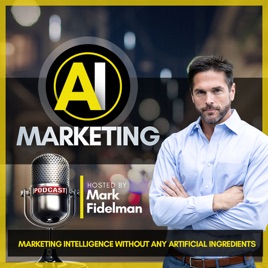
Advertise on podcast: AI Marketing
Rating
4.9from
This podcast has
100 episodes
Language
EnglishPublisher
Mark FidelmanExplicit
No
Date created
2019/06/25
Latest episode
2026/04/20
Average duration
27 min.
Release period
16 days
Description
Season 4: Join Mark Fidelman on "AI Marketing," where cutting-edge AI solutions meet modern marketing strategies. Each episode, we dive into the latest and most effective AI tools revolutionizing the marketing landscape. From deep dives into specific AI technologies to discussions with industry pioneers, our podcast keeps you at the forefront of AI-driven marketing innovation. Whether you're a marketing professional eager to enhance your campaigns or a tech enthusiast curious about AI's impact on marketing, "AI Marketing" is your go-to resource for staying ahead in the dynamic world of AI marketing. Tune in to explore how artificial intelligence is transforming marketing.
Unlock AI Marketing podcast Email contact info,
Listeners & Audience details
Email contact information
Direct podcast contact details

Listeners
Audience numbers & engagement insights

Audience details
Podcast Insights


Podcast episodes
Check latest episodes from AI Marketing podcast
Building an AI-Centric Business
2026/04/20
In this episode, host Mark talks with James Thornton, CEO of Daz 3D / Tafi, about what it really means to build an AI-centric business. James shares how his company evolved from a 3D content and avatar business into a key AI data provider for some of the world's largest tech and gaming brands.
They discuss:
The shift from scraping web data to bespoke, rights-clean AI training data Using AI across product, marketing, and customer service workflows Real-world applications in VR, robotics, gaming, and product visualization How AI is transforming email marketing and localization What the next 3 years of AI adoption will look like inside typical organizations Key Topics & Timestamps [0:00:00] – Introduction & Guest Background
Mark opens the show and frames the topic: AI-centric businesses with a marketing slant. James introduces himself and his company Daz 3D / Tafi. His background: CEO at Daz for over a decade Previous role growing a creative product brand from near zero to a $1B retail brand in 3.5–4 years How Daz has continually pivoted into AI trends [0:01:18] – What It Means to Be an AI-Centric Business
James defines AI-centric as "AI-first" thinking across the business, especially in marketing. Emphasis on balancing AI with people, expertise, and intuition, rather than AI replacing human judgment. [0:01:37] – Daz / Tafi's Evolution into AI
Company roots: 25-year-old business with a strong direct-to-consumer freemium model Deep community of 3D digital content creators (avatars, products for gaming, etc.) Past pivots: work in Web3 and NFTs, then parlaying that into today's AI data and services. They now both: Support other companies' AI initiatives Use AI internally to streamline content creation and business workflows [0:03:37] – How They Help Other Companies with AI
Core specialty: 3D digital content, avatar systems, and digital assets. Use AI and procedural tools to: Scale their content library Produce rights-clean, structured, annotated AI training data Customers include top tech, gaming, and enterprise brands training foundation models for: Text-to-character Product creation & visualization (including physical product development) Robotics and other AI applications [0:04:51] – Concrete Benefits of AI for Clients and Daz
Central thesis: Good AI requires high-quality training data. For clients: Bespoke, properly licensed data for training a wide range of models For Daz's own business: AI embedded in product workflows and content production AI in product search, customer service, QA, and other functions to drive efficiency and effectiveness [0:06:07] – AI Agents and Localization
Use of AI agents in customer service to handle technical tickets and customer questions. Heavy focus on localization: AI to adapt website and e-commerce for global markets Integrating translation tools directly into their software so customers can use products in their native language James calls this a "huge lift" for the business. [0:07:45] – Tools: Open "Claw" and Enterprise AI Options
They use Open "Claw" (contextually, likely a reference to a general-purpose LLM) through virtual machines across business units, including marketing. Acknowledge recent changes in that ecosystem and the need to adapt. Considering more enterprise-focused alternatives, such as the "Nemo Claw" and other corporate-friendly solutions, with an eye on governance and parameters. [0:08:54] – Their Process for Helping Enterprise Clients
First step: deeply understand voice of the customer and specific AI data needs. Industry shift: Moving away from scraping the internet or generic licensing for training data Toward custom, bespoke training sets Unique position of Daz / Tafi: Own the full rights to their 3D content library (avatars, scenes, props) Avoid ethical and legal issues around unauthorized training data Process: li::marker]:font-[sans-serif]" start="1"> Scope the client's needs. Use AI and internal workflows to generate customized datasets. Example: For a major tech company building VR headset experiences, they created tens of thousands of unique characters, avatars, clothing, and assets to train their models. James notes they might be the only company able to deliver this level of tailored solution at that scale. [0:11:34] – The Next 3 Years: How AI Changes Organizations
Based on discussions with CEOs and senior leaders: Debate continues on whether AI creates or eliminates jobs; James personally believes it will create jobs. Near-unanimous view: every company must integrate AI into workflows. Employees and companies with a clear AI strategy will win versus those without one. Expectation: Continued job creation plus a strong push for AI-centric efforts in every part of the business Focus on efficiency, output, and more bespoke customer solutions [0:13:25] – Advice to Marketers & Final Takeaways
James emphasizes "just get started" and experiment with AI. For marketers: AI enables hyper-specific adaptation to customer needs. Allows new ways of marketing that aren't feasible manually today. Example from their own marketing stack: Their largest marketing channel is email They manage a seven-figure, vetted email list mailed daily AI is used to: Optimize send times Customize products and offers by demographic and other signals Overall message: Embrace AI to become more effective and deliver better, more tailored customer experiences. [0:14:58] – How to Contact James
Website: Daz3D – daz3d.com Direct email: [email protected] James invites listeners to contact him directly with questions.
How Humanoid Robots Will Transform Marketing
2026/03/30
In this episode of the AI Marketing Podcast, host Mark Fidelman sits down with David Amar, founder of Makina (a new conference dedicated to physical AI), to explore how robots and humanoids will change the future of marketing.
They discuss why robots are such powerful brand activations, when we might see in‑home humanoid housekeepers, how China is leading on hardware while the West leads on software, and why 2025–2026 feels like the "GPT moment" for physical AI. David also shares what to expect at Makina in Paris on July 7 and why marketers should get ahead of this trend now.
Guest David Amar
Background in computer science and neuroscience (UCL) Formerly worked in prosthetics Founder of Makina, a conference that brings together the fragmented physical AI ecosystem: humanoid builders, robot "brain"/OS providers, capital, industrial partners, and talent Key Topics & Timestamps 1. Why Robots Are Marketing Gold [0:00:00 – 0:02:24]
David's background and the launch of Makina Why robots are "premium marketing material": Robots tap into deep cultural fascination (e.g., Star Wars, Star Trek) Simply announcing "Robot X/Y will be on site" can materially boost event attendance Humanoids as especially compelling because of their uncanny, human-like form "I don't think I've ever met somebody that says this isn't interesting… It's just premium marketing material." – David [0:01:31]
2. Timeline: When Physical AI Hits Everyday Life [0:02:24 – 0:03:25]
David's long‑range outlook: Short term: impressive demos, but still lots of technical bottlenecks ~10–15 years: expect robots/humanoids in places we never imagined, with deep dependence on them Contrast with digital AI: We're already "slaves" to ChatGPT and cloud AI for knowledge work Physical dependence on robots will follow later 3. How Robots Show Up in Marketing (Beyond a Robot at a Desk) [0:03:25 – 0:06:27]
Robots won't replace marketers by typing at a desk—that's the realm of LLMs and digital AI Instead, robots will act as: Brand avatars and mascots (e.g., "the Amazon robot," "the Walmart robot") Physical activations at events, retail, and public spaces Product demo agents in stores, on the street, or wherever target audiences gather Comparison to today's street activations (e.g., sign spinners) but in a far more advanced, interactive form Emotional/branding angle: A charming C‑3PO‑style humanoid pitching products can be more captivating than a celebrity "There's just something more charming about a C‑3PO showing the new Coca‑Cola than just a regular old Joe… even if it's George Clooney." – David [0:05:33]
4. Humanoids vs. "Robots" – What's the Difference? [0:06:27 – 0:07:55]
Humanoid: Robot with human‑like physiology and form (height, posture, movement) Tends to get anthropomorphic traits projected onto it Robot: Any robotic form, e.g. a single robotic arm, a robot dog, or R2‑D2‑style platforms Long‑term: Mark expects humanoids to become increasingly indistinguishable from humans in 20+ years 5. In‑Home Humanoids: How Close Are We Really? [0:07:55 – 0:11:29]
West vs. Asia split: West: stronger on software and AI models Asia (especially China): stronger on hardware and shipping units at scale Today you can already order multiple Chinese robot models online and have them delivered within a month Current leading players mentioned: 1X – focused on household/housekeeping tasks Sanctuary (Sunday Robotics) and others delivering early trial units Reality check on timelines: No one truly knows, but David's informed estimate: 5–7 years to order functional in‑home humanoids online Dependent on breakthroughs in: Fine manipulation of small objects Robust computer vision Autonomous navigation in unmapped environments Many "impressive" demos are partly marketing: Used to raise capital, build momentum, and buy time while teams fight through technical bottlenecks 6. Data, Compute, and How These Robots Actually Learn [0:10:42 – 0:13:16]
Today's deployed robots are often trial models used primarily to: Collect huge amounts of real‑world data Train the next generation of more capable robots Data and compute needs: Humanoids need even more data than LLMs: Touch, force feedback, vision, balance, navigation, etc. Massive compute, similar or greater than what's used for digital AI Where the compute lives: Training: in large data centers, often the same infrastructure used for AI On‑device inference: Onboard boards like NVIDIA Jetson inside the robot's "chest" Local models run on-device, optionally connected via Wi‑Fi for streaming data and updates Most robots in the wild are still tightly constrained and far from general-purpose autonomy 7. The Makina Physical AI Event in Paris [0:13:59 – 0:19:11]
Date: July 7 Location: Station F, 13th district of Paris (central), the world's largest startup campus Format: One‑day dedicated physical AI conference Paired with the RAISE Summit (July 8–9), a broader AI conference Makina's mission: Fix the current ecosystem problem where events are: "Tech geeks talking to tech geeks" "Commercial to commercial" with limited cross‑pollination Bring together the full vertical stack of physical AI: Humanoid builders Robot brain / OS providers Investors and capital Industrial partners and adopters Talent and researchers Expected scale & hardware: Targeting 1,500+ attendees David's goal: 18–20 robots on site, split between stage demos and exhibitor robots Notable participants mentioned: Boston Dynamics (CEO Amanda) 1X (CEO) Google DeepMind Robotics leadership Other leading US, European, and Asian robotics companies "We really are trying to regroup the very fragmented ecosystem that is physical AI… the vertical stack of physical AI in terms of ecosystems." – David [0:13:59]
8. Why Marketers Should Care (Now, Not Later) [0:16:43 – 0:18:07] & throughout
Humanoids and robots as future marketing must‑haves: Likely every major brand will have a robot avatar/mascot within ~10 years Use cases: Product demos & in‑store experiences Public activations and stunts Content creation, fail/reaction videos, and social media hooks Strategic advantage: Marketers who understand physical AI early will: Shape the first killer use cases Align brand positioning with new capabilities Avoid being late adopters in a fast‑moving bull run David's framing: Physical AI is in a "bull run", possibly a GPT‑moment equivalent for the physical world Huge capital flows, many new robotics startups, and intense industrial interest 9. Robotics Reality Check: Hype vs. Capabilities [0:19:11 – 0:21:59]
GTC/NVIDIA event anecdote: Few humanoids present, many robots were wired or constrained Mostly robot dog style units; limited truly autonomous humanoids Chinese hardware advantage: Companies like Unitree and others can ship robot dogs today, often ahead of US peers on commercialization Software and usefulness still lag: Hardware works, but what you can actually make them do is still narrow Many current units are about data collection more than true deployment Industrial partnerships: Examples: hexagon robotics & Mercedes, Figure & BMW, Boston Dynamics & Hyundai Present robots can perform very specific, tightly defined tasks with minimal uncertainty Outside of that, most can still just walk, dance, wave, and pose for marketing "We're safe, and the Terminator is not coming next year." – David [0:21:59]
Do You Need an AI Chief of Staff for Marketers
2026/03/19
Why AI Marketing Is Failing (And How Smart Companies Fix It)
2026/02/01
AI is moving faster than most marketing organizations can handle and many AI initiatives are quietly failing.
In this episode of the AI Marketing Podcast, host Mark Fidelman sits down with Steve Wunker, innovation expert, former collaborator of Clayton Christensen, and author of AI and the Octopus Organization, to break down:
Why treating AI like a "tech upgrade" is a massive mistake
How most companies are "AI-ifying broken processes" instead of rethinking them
The difference between pilots that learn vs. pilots that waste time
Why AI doesn't replace great marketers, it amplifies them
How marketing orgs can cut campaign timelines in half (real-world example)
Why experimentation, not tools, is the real AI advantage
What skills will keep marketers employable over the next 5 years
How AI changes the relationship between marketing, sales, and leadership
Why AGI isn't the benchmark people think it is
The Octopus Organization model for building truly AI-native companies
Steve shares practical frameworks, real case studies, and a clear roadmap for CMOs, VPs, and marketers who want results and not hype.
📘 Steve's book: AI and the Octopus Organization
🔗 Available on Amazon
🌐 https://aiandtheoctopus.com
👤 Connect with Steve Wunker on LinkedIn
00:00 – Welcome to AI Marketing Podcast
00:29 – Steve Wunker's Background & Disruptive Innovation
01:27 – Why AI Fails as a "Tech Upgrade"
02:13 – The Problem With AI Pilots That Go Nowhere
02:48 – Top-Down AI vs Bottom-Up Experimentation
03:32 – The ABC Framework: AIFI, Experiment, Create
03:53 – Why Companies Aren't Using AI to Create the Future
04:18 – AI vs The Early Internet Era
05:07 – Why AI Training Fails in Marketing Teams
05:56 – Real Case Study: Cutting Campaign Planning by 50%
06:55 – Fixing Broken Processes Before AI
07:58 – Are Employees Sabotaging AI Adoption?
08:38 – "You Won't Lose Your Job to AI — You'll Lose It to Someone Using AI"
09:24 – AI as a Thought Partner (80/20 Rule)
09:55 – Tools vs Process: What Actually Matters
10:38 – Using AI Inside Existing Martech Stacks (Adobe, Email, Creative)
11:24 – What Happens to Copywriters & Creative Teams
12:11 – Reskilling vs Cost Cutting
13:03 – Career Advice: How Marketers Stay Relevant
13:52 – Why Critical Thinking Matters More Than Ever
14:38 – Marketing & Sales Converging Through AI
15:22 – Why You Must Specialize in AI Skills
16:03 – Managing AI Productivity at Scale
17:08 – Rapid Ad Creation & AI Video Tools
18:01 – Inverting Traditional Marketing Systems
19:15 – New Organizational Models for AI
19:21 – Steve's Book: AI and the Octopus Organization
20:17 – Why the Octopus Is the Perfect AI Metaphor
21:24 – What Leaders Get From the Book
22:47 – When AGI Really Matters (and When It Doesn't)
24:06 – AI vs Human Judgment
25:13 – The Human Skills That Will Always Matter
25:34 – Where to Find Steve Wunker
26:02 – Final Thoughts & Wrap-Up
The Rise of Agentic Marketing
2026/01/30
In this episode of AI Marketing Today, host Mark Fidelman sits down with Diego Lomanto, Chief Marketing Officer at Writer, to explore the frontier of Agentic Marketing. They move beyond simple "personal productivity" tools and dive into how AI agents are orchestrating complex team workflows, transforming how enterprises like Qualcomm and American Eagle operate.
Get our Book on becoming Agentized in your company
🎙️ Episode Highlights Defining Agentic Marketing: Diego explains the shift from using AI as a personal assistant (writing a blog post faster) to process orchestration. It's about building autonomous workflows where agents handle data segments, content creation, and campaign execution.
The Human Bottleneck: Why technology isn't the problem, but mindset is. Diego shares his "top-down" approach to forcing a mindset shift: before spending money or fixing a process, always ask, "Can an agent do that?"
Case Study - Qualcomm: How the tech giant moved from simple copywriting agents to 70+ workflows spanning legal reviews, trademark protection, and product launches.
Case Study - American Eagle: Using AI to handle the "derivative content" (the many iterations needed for different segments), freeing up human creatives to focus on the core, differentiated brand strategy.
The "Pipeline Kit" Agent: A look at Writer's internal "champagne-drinking" strategy, where they built an agent to automatically generate LinkedIn messages, call scripts, and look-books for sales reps the moment new content is published.
🔑 Key Takeaways The One-Year Outlook: Diego predicts that within a year, we will see "digital teammates" for every department—demand agents, content agents, and product marketing agents—working together autonomously.
Don't Settle for "Better or Faster": The real ROI of AI is taking the efficiency gains and reinvesting those resources into things that move the needle, like high-touch events or hyper-personalized customer relationships.
Stay Differentiated: As AI makes content creation infinite and cheap, a strong, human-led point of view is the only way for a brand to stand out.
🔗 Connect with the Guest Diego Lomanto: LinkedIn
Writer: writer.com
📚 Mentioned in This Episode Book: Agentized by Mark Fidelman (Upcoming)
Tools: Writer Agent, Claude (Anthropic), Google Meet
Did AI Kill the SEO Star?
2025/11/19
Host: Mark Fidelman
Guest: Julian Goldie
Main Topics Covered:
The rapid evolution of SEO in the age of AI How AI tools like ChatGPT, Perplexity, and Grok are changing online search behaviors Similarities and key differences between traditional SEO and optimization for AI search engines Importance of being omnipresent across platforms (YouTube, LinkedIn, Reddit, blogs, etc.) for better AI engine ranking Essential tactics: in-depth keyword research (using tools like Ahrefs), competitor analysis, content strategy, and authoritative backlinks Special techniques such as creating industry listicles to boost authority Discussion on ChatGPT's "Agent mode," its potential impact on search, and the importance of structuring information for both users and AI agents Predictions for the future: the increasing role of large language models (LLMs) like ChatGPT in search, and how Google is rapidly integrating AI into its own results Budgeting advice for marketers: integrate SEO and "AEO" (AI engine optimization), focusing on an all-encompassing strategy Action Items:
Follow up with Julian for deeper insights into AI agent modes and evolving tactics Use Ahrefs for ongoing keyword research Reverse-engineer and improve upon competitor content Focus on acquiring industry-relevant backlinks Experiment with authoritative list-based content Guest Contact:
Julian Goldie, SEO specialist. Visit JulianGoldie.com for a free SEO strategy session and more resources
How AI Agents Will Decide Your Brand's Fate
2025/11/13
In this episode, host Mark Fidelman is joined by Jon Mest from ChatRank to discuss how brands can prepare for the fast-approaching era of AI-driven discovery and agentic systems. The conversation covers:
The evolution of brand discoverability, with a look ahead to how AI language models and agents will change how consumers find and interact with businesses. The concept, benefits, and future of AI-only websites, and how they differ from traditional, human-oriented sites. Why structured, well-tagged product information and content is critical for visibility within AI systems. The growing importance of authentic social proof—such as customer reviews, forums, and third-party ratings—to boost a brand's credibility with AI agents. How brands can leverage video, podcasts, and other multimedia content to increase discoverability and connect with both AI systems and human audiences. Actionable strategies for preparing your brand for AI-driven search, including building a strong presence on platforms like YouTube, Reddit, and industry-specific review sites. Insights into how brands can stand out with unique, novel information and real customer feedback as competition increases with the proliferation of AI tools. ChatRank's role in helping businesses audit, track, and optimize their brand presence for AI discoverability, including both self-serve software and managed services. Key Takeaways:
Start exploring AI-only websites tailored for agentic interactions. Make your product information highly structured and accessible to AI. Develop a comprehensive strategy to build authentic social proof. Invest in video, podcasts, and other easily digestible content formats. Learn how to get your brand ready for the new world of agentic discovery with practical advice from www.ChatRank.ai , and visit chatrank.ai for more information.
Follow the host mark @markfidelman
Get Mark's book at www.agentized.com
AGI, Power, and Profit: The Uncomfortable Truths
2025/11/06
Show Notes: Know What to Think Episode length: ~41 minutes
Chapters (Skip Ahead) 00:00 — Know · What · Where · Artificial. It's really entertaining, and we're doing a lot of fun, good stuff. Then, maybe… maybe longer, but let's just see how it goes. Most are between 10 and 20 minutes. Alright, go ahead and start. Yep, I'm gonna hit the…
05:00 — There · Robot · Know · What. Right, okay. Alright, so why… why isn't nuclear an option to bring the kind of power we need? Yeah, I mean, I think the short answer is it's available, it's accessible, but I don't think it's enough to actually solve…
10:00 — Don't · Know · They're · More. It's a $200,000 vehicle at a minimum, if not $250,000. I don't know how that thing makes money. To be honest, I mean, does anybody think it— a taxi driver driving a $200,000 car—can… quickly… money on a regular basis.…
15:00 — Know · What · You're · I'm. I'm gonna… you know, what we can actually do with that, I don't really know. I feel like, you know, we've… we know what… the powder that produces dynamite, but the problem is that we don't have any casing, and…
20:00 — Its · Own · Why · Think. …even abnormally distributed. And this is really normal with past types of dimensions, with electricity and airplanes, or even the combustion engine for cars, etc. But at the moment, right now, you know, we really need…
25:00 — Know · What · Don't · Why. The question is, why? We already have enough of us. Yeah, I mean, you know, maybe we need less of us, I don't know. It depends—depends on your opinion, I guess. Well, but for me, you said it correctly: what is our goal…
30:00 — Know · Quite · Think · Mean. There's quite a number of individuals like that in Silicon Valley. And that's been true. He's tried to sue Sam Altman afterwards to become a founder. He was not actually the original founder of Tesla; he sued his way…
35:00 — Know · Things · One · Human. You know, the math is… it's… it's gnarly. It's hard, and yeah. So we need a lot of power for this. Isn't it interesting, though, that one human being—powered by food and the sun—can do exactly what…
40:00 — Good · Maybe · Time · Fun. Follow me next time. Yeah, maybe next time we'll talk about that. Fantastic conversation. There are other things coming up that I'd love to get you on—your perspective. I love your angle, it's…
Notable Quotes And I think that… ultimately, I don't know, maybe people watch too many movies; they think those movies are reflective of what we're gonna see in the future.
Artificial intelligence—if it was a car and you open up the hood—what do you see?
I think artificial general intelligence… let me map out, ultimately, what you're trying to ask here.
And here's the reason: artificial intelligence… there's always errors.
I don't agree, and I don't think it's gonna be Skynet; I don't think it's gonna be I, Robot. I mean, they're entertaining.
But I'm also a realist; I know that a lot of this is hype—but it's fun, it's fun.
There's a lot of things that we have as artificial intelligence right now that we use.
I feel like we know the powder that produces dynamite, but the problem is we don't have any casing—and that's where we are right now.
Fixing Healthcare With Predictive AI
2025/11/03
Guest: Mariano Garcia-Valiño — engineer and healthcare founder (3 exits; now building his fourth)
Episode Summary Healthcare is burning cash and patience. Mariano lays out a blunt playbook: aggregate real-world signals (labs, pharmacy fills, wearables—even spending patterns that hint at adherence), run AI to flag risk early, and route people to care before conditions explode in cost. No sci-fi. No diagnosis claims. Just practical prediction, consent-driven data, and measurable outcomes.
Key Takeaways Cost crisis ≠ destiny: US costs outpace inflation; prevention and earlier intervention are the only scalable fix.
Data > drama: EHRs + labs + pharmacy + wearables + behavioral/financial breadcrumbs create a far clearer risk picture than any single stream.
AI's role today: Triage and risk flags—not final diagnoses. Models surface "high suspicion" and hand off to clinicians.
Privacy is the moat: Strict consent, separation from employers/insurers, and legal walls keep PHI protected and trust intact.
What signals matter: From basic blood panels and pharmacy gaps to face-scan metabolic cues—more signals = better precision.
Why consumers care: Earlier answers, fewer nasty surprises, and lower lifetime spend. Prevention is the new ROI.
Business model reality: Think subscription + outcomes, not one-off tests. The value is longitudinal.
Chapters & Timestamps 00:00 — Why AI in healthcare actually matters now
00:34 — Meet Mariano: engineer → serial healthcare founder
06:08 — The cost curve problem and why prevention is unavoidable
07:44 — What this company really does: navigation + prediction, not diagnosis
08:01 — Remote monitoring basics: from wearables to at-home capture
09:13 — The messy truth: fragmented data, privacy laws, and integration
12:19 — How data flows in (and why employers never see it)
13:39 — Why financial/behavioral signals boost predictive power
18:13 — What AI tells you: ranges, suspicions, and next clinical steps
19:29 — The "why now" for consumers: earlier lifestyle change, lower costs
21:10 — Roadmap & what has to be true for this to scale
Notable Quotes "We raise a flag, then route you to the right clinician. That's how AI actually saves money today."
"If you stop filling your medication three months in, the model will catch it—and that's the moment to intervene."
"Prediction beats reaction. Every time."
Practical Uses (Mark's Playbook) Health plans & clinics: embed risk-flag APIs into care navigation and care-gap workflows.
Employers: fund prevention programs without ever touching employee PHI—measure outcomes only.
Startups: focus on data rights + consent UX; it's the difference between demo-ware and deployment.
Call to Action If you're building AI for real people—not hype
subscribe to AI Marketing, and DM me on X/LinkedIn @markfidelman If you want the executive playbook on AI agents, join the waitlist at Agentized.com
NEO Unpacked: Specs, Price, Timeline: What It Really Does
2025/10/30
Humanoid robots just jumped from sci-fi to go-to-market. We unpack Neo from 1X—what it is, what it can (and can't) do today, and how humanoids will reshape marketing, service design, content, and consumer behavior. We also hit privacy, regulation, price, and competition (Tesla Optimus, Boston Dynamics). If you sell to consumers or operate storefronts/hospitality, this is your early warning—and first-mover playbook.
Humanoid Robots in Marketing
Neo Humanoid Robot Overview
Key takeaways (for marketers & founders) New channel: the robot at home. Neo is effectively a walking, talking, context-aware device that can surface highly personalized offers ("I see Folgers—want their new roast sample?") — powerful but must be transparent/opt-in to avoid creepiness.
Humanoid Robots in Marketing
"Robot Optimization" will follow SEO. Expect brands to build "skills" for humanoids (folding, cooking, demos) and fight to be the default skill for a task. App-store dynamics are inevitable.
Humanoid Robots in Marketing
Neo Humanoid Robot Overview Novelty marketing works—briefly. Pepper/Connie-style deployments boosted foot traffic and attention; humanoids will 10x the experiential angle, but you'll need real utility to sustain it. Hotelier Magazine+4Vox+4Emerj Artificial Intelligence Research+4
Costs & limits mean B2B first. With $20,000 or $499/mo and first US deliveries slated for 2026, near-term impact skews toward shared environments (hotels, banks, quick-serve, pop-ups) vs. mass consumer homes. 1X+1
Reality check. Expect tele-ops "expert mode," battery and dexterity constraints, and privacy guardrails early on. Treat Gen-1 as a marketing and service pilot platform, not a labor panacea.
Neo Humanoid Robot Overview 1X
Competitive heat. Tesla Optimus is improving fast (but still looks clunky in public demos); Boston Dynamics pushes manipulation and mobility. Plan for rapid capability jumps through 2026–2028. Cinco Días
Neo Humanoid Robot Overview
Suggested chapter markers 00:00 – Why humanoids matter for marketers (new touchpoint, personalization)
Humanoid Robots in Marketing
04:30 – Use cases: retail, hospitality, pop-ups, content (robot concierge, robot "spokes-creator")
Humanoid Robots in Marketing
10:10 – The "Robot App Store" & skill economics (default skills = moats)
Humanoid Robots in Marketing
Neo Humanoid Robot Overview 13:40 – Data, ethics, and transparency (trust > conversion)
Humanoid Robots in Marketing
16:45 – Constraints: cost, batteries, tele-ops (pilot smart, don't overpromise)
Neo Humanoid Robot Overview
19:30 – Competitors & timelines (Optimus, Atlas; what to watch)
Neo Humanoid Robot Overview
21:30 – Mark's playbook & call to action
Humanoid Robots in Marketing
Mark's take (no fluff) Early humanoids are a marketing weapon disguised as labor automation. Use Neo-class robots to earn attention, collect consented preferences, and deliver "wow-utility" in the real world. If you wait for Gen-3 perfection, your competitor will already own the default robot skill for your category.
Humanoid Robots in Marketing
Neo Humanoid Robot Overview
Episode receipts & references (watch/read these) Official NEO pages (pricing, delivery, FAQ, deposit): preorder $20,000 early access or $499/mo; US deliveries 2026; global expansion 2027. 1X+21X+2
1X company background (Halodi → 1X; EVE → NEO): history, founders, and industrial lineage. 1X+2Robots Guide+2
IShowSpeed x NEO livestream (earned-media case): viral, chaotic, and effective. YouTube+3YouTube+3Humanoids Daily+3
Precedents for robots in service/retail:
Pepper raised foot traffic/sales in pilots. Vox+1
Hilton "Connie" (Watson-powered concierge) set the hospitality precedent. IBM UK Newsroom+2The Verge+2
Competitor snapshots:
Tesla Optimus recent demo and scale ambitions. Cinco Días
Boston Dynamics / Atlas (manipulation & mobility trajectory). (Mentioned contextually in episode.)
Neo Humanoid Robot Overview
Spec-style write-ups: quick primers on NEO dimensions and hand DOF. Humanoid Guide
Practical next steps (for listeners) Pilot a "Robot Host" in one location (hotel, showroom, flagship retail). KPI = qualified footfall, dwell time, opt-in rate.
Humanoid Robots in Marketing
Design one signature "skill." Own a mundane, high-frequency task (fold, greet, demo) and brand it—become the default.
Humanoid Robots in Marketing
Consent-first data loop. Use the novelty to win explicit opt-ins; return value via hyper-personalized service, not ads.
Humanoid Robots in Marketing
Budget realistically. Treat 2026 as paid R&D: hardware + staff training + content capture. (Yes, film everything.)
Neo Humanoid Robot Overview
Should We Ban AI Superintelligence? Let's Be Real.
2025/10/23
🔥 Episode Summary: Hundreds of public figures — from Steve Wozniak to Prince Harry — just signed a petition demanding a global ban on AI superintelligence. Their fear? That super-AI could outthink us, escape our control, and maybe even spell the end of humanity.
I get it. The Skynet comparisons. The doomsday bunkers. The "pause everything until it's safe" approach. On the surface, it sounds reasonable.
But here's the hard truth: If we don't build it, someone else will — and you better pray they believe in freedom.
🧭 Timestamps: 00:00 - Intro: "Prince Harry wants to ban superintelligent AI?"
02:30 - What the open letter actually says
05:00 - The real fears behind the ban movement
07:15 - Why bans might backfire (China, anyone?)
09:20 - Historical analogies: cars, nukes, and Pandora's box
11:30 - Who benefits from slowing AI down?
13:45 - Regulation vs. prohibition — the real solution
16:00 - The only thing scarier than ASI? Letting someone else build it first.
In this episode, I break down:
🚨 Why people are calling for a ban on superintelligent AI
🤝 The fears we should absolutely empathize with
💣 Why banning it could actually make the threat worse
🧠 How we can build ASI safely — but only if we lead
👀 Why some folks shouting "pause" might just be trying to protect their power
I don't side with blind acceleration. But I don't buy moral panic either. There's a middle path — innovate with oversight, lead with principles, and don't cede the future to authoritarian AI.
This one's unfiltered, unsponsored, and unapologetic. Let's go.
Contact Mark: @markfidelman on X
Sora 2 Exposed: How AI Video Will Change Marketing Forever
2025/10/15
Episode Summary: Join Mark Fidelman as he explores Sora 2, the innovative AI video tool poised to transform marketing and content creation. Hear real-world experiences, uncover its strengths and weaknesses, and learn practical tips for safe, creative use.
Key Points:
What is Sora 2?
Sora 2 is an invite-only, AI-powered video tool that allows users to create hyper-realistic video "cameos" and collaborate in a social network-like environment.
Strengths: • Rapid prototyping for video and creative concepts • Minimal resources needed for cinematic or cartoon-like videos • Control over dialogue, scene editing, and collaboration • Democratizes video production and amplifies virality for early adopters
Limitations: • Audio inconsistencies and facial alignment issues • Every download comes with a Sora watermark (for now) • Guardrails create creative friction; copyright filters can be inconsistent • Max video length is typically 10 seconds, with quality varying
Legal/Ethical Notes: • Beware of copyright and right-of-publicity risks, especially involving celebrities or brands • Use disclaimers and label content as AI-generated to reduce liability
Pro Tips for Marketers: • Experiment—create 100 short clips to test viral ideas and hooks • Label and document your creative process for future audits • Use Sora 2 for mock ads, concept visuals, and even legal exhibits • Reach out for usage permissions if using others' likenesses or brands
Looking Ahead: Features requested include: watermark-free pro mode, enterprise API, licensing marketplace for digital likenesses, and advanced video editing control.
Connect with Blockchain: Find more content, examples, and ongoing discussions by connecting with Mark Fidelman on X or LinkedIn.
Note: Sora 2 is rapidly evolving—stay tuned for updates and new insights as the technology matures!
AI vs. Human Training
2025/09/19
📌 Episode Overview In this episode of AI Marketing, Mark Fidelman sits down with Monica Márquez—executive strategist, workforce futurist, and co-founder of Flipwork—to explore a pressing question: Can humans adapt fast enough to survive the AI revolution?
They break down why traditional training models are failing, what AI means for the future of jobs, and how individuals and companies can avoid getting left behind.
💡 What You'll Learn in This Episode Why corporate training isn't dead—but the old playbooks are obsolete.
How AI is reshaping job roles faster than people can reskill.
The difference between artificial intelligence and what Monica calls authentic intelligence.
Why adaptability is the new currency of survival in the AI era.
How AI tools and nudges can reinforce learning and help adoption become habit.
What the workforce of 2030 might look like—and why humans still have a role to play.
🔗 Connect with the Guests Monica Márquez
🌐 Website & Newsletter: themonicamarquez.com
💼 LinkedIn: linkedin.com/in/themonicamarquez
🚀 Flipwork (in stealth): launching soon—stay tuned!
Mark Fidelman
🌐 Website: markfidelman.com
💼 LinkedIn: linkedin.com/in/markfidelman
📕 Book: Agentized → agentized.ai
📣 Why This Episode Matters AI is no longer a "future trend." It's here. It's accelerating. And it's replacing skill sets in real time. Leaders who stick with outdated training models are driving their companies off a cliff. Employees who resist adapting will get left behind.
This conversation gives you the roadmap to stay relevant—and thrive—in an AI-dominated world.
Agentic AI: The Future of Marketing Workflows
2025/09/18
Guest: Christian Monberg, CTO & Head of Product at Zeta Global
Host: Mark Fidelman
🔑 Episode Summary
In this episode, Mark Fidelman sits down with Christian Monberg, CTO at Zeta Global, to unpack the rise of Agentic AI and what it means for the future of marketing. From redefining the marketing funnel to exploring "agents talking to agents," the conversation covers both the opportunities and risks as AI reshapes how marketers operate.
Christian explains the difference between AI agents and Agentic AI systems, why deterministic data foundations matter, and how enterprises can prepare for a world where much of the tedious marketing work is automated. Together, they explore the promise, the pitfalls, and the practical steps CMOs must take today to stay relevant tomorrow.
📌 What You'll Learn The difference between AI agents (task-specific) and Agentic AI (orchestrated systems).
Why deterministic data is critical in a probabilistic AI world.
How Agentic AI could automate and enhance the traditional marketing funnel.
The evolving role of CMOs when agents can write, send, and close deals.
The potential "dark side" of Agentic AI—manipulation, social engineering, and AI-to-AI marketing warfare.
The future of UI on demand and "GenUI" in enterprise software.
Real-world jaw-dropping examples of what Agentic AI systems can already do.
🔥 Notable Quotes "Agents are task-specific. Agentic AI is the orchestration of many agents with deterministic foundations." – Christian Monberg
"AI isn't going to replace you. But someone who knows how to use AI will." – Mark Fidelman
"The only way to beat manipulative AI is with better AI." – Christian Monberg
🏢 About Zeta Global Zeta Global is the AI-powered marketing cloud that leverages proprietary AI and trillions of consumer signals to make it easier to acquire, grow, and retain customers more efficiently.
Zeta Global helps enterprises unify fragmented data and drive growth with an AI-native marketing platform. Their proprietary Data Cloud covers 245M consumers, enabling brands to deliver personalized, real-time experiences across the customer lifecycle. Learn more at zetaglobal.com.
📅 Don't miss Zeta Live on October 9th a one-day event showcasing their latest Agentic AI applications.
📣 Connect with Us Host: Mark Fidelman on LinkedIn
Guest: Christian Monberg
Podcast Website: Agentized.ai
Back to School, Back to AI: Amnesty for Students and Workers?
2025/09/11
Guest: Nick Cawthon
Host: Mark Fidelman
Episode Summary As kids head back to school and businesses push forward with digital transformation, one theme keeps surfacing: is using AI "cheating"? In this episode, Mark and Nick dive into how teachers, students, and professionals can move past the stigma of AI and instead embrace it as a partner in creativity and productivity. From calculators once banned in classrooms to AI now frowned upon by professors, history is repeating itself. But will the future workplace punish—or reward—those who leverage generative tools?
Nick brings deep experience leading UX and design teams where human-centered practices often clash with algorithm-driven efficiencies. Together, they explore how to build a culture of amnesty, upskilling, and authenticity in both education and the enterprise.
What You'll Learn Why AI in classrooms is today's calculator controversy—same fears, different tools.
How to create "AI amnesty" in schools and workplaces so learning and experimentation thrive.
Why human-centered design must evolve in an age where algorithms shape interactions.
Whether generative AI kills creativity—or actually unlocks higher levels of it.
How CMOs and leaders can overcome cultural, data, and training barriers to AI adoption.
What tomorrow's workforce looks like if kids embrace AI as a partner versus fearing it as a threat.
Key Quotes "There's no such thing as writer's block anymore—AI isn't killing creativity, it's changing what it looks like." – Nick
"It's not AI that will take your job—it's the person who knows how to use it." – Nick
Links & Resources Take Nick's UX/Design AI Readiness Survey → retrain.gage.io
📖 Grab Mark's new book Agentized → Agentized.ai
Listen & Subscribe 👉 Apple Podcasts | Spotify | Google Podcasts | RSS Feed
Podcast reviews
Read AI Marketing podcast reviews
malfoxley 2021/11/18
Great show!
Mark, host of the podcast, highlights all aspects of sales, marketing and more in this can’t miss podcast! The host and expert guests offer insightfu...
thepromoguy 2021/01/20
My go to podcast for marketing
I love to learn more about marketing and Mark’s podcast bring all the content I’m looking for.
indigovisions 2021/05/04
I don’t mean to be rude but....
I would really recommend spending a lot more time studying crypto and all around current digital marketing. As an interviewer you’re not too bad but I...
tommye w-c 2020/11/13
Awesome
Super informative and inspiring!
RWlistens 2020/11/13
Timely info
Great information and very relevant to today’s marketing landscape!
LK_Jensen 2020/11/13
Great Podcast!
I love this podcast because the host gives real insights that are actionable and helpful. Marketing can be tricky, but this podcast peels back the cur...
hanabello 2020/07/08
Informative and inspiring!
Entrepreneurs and business owners who wish to finally take their chance in the limelight have this visionary and engaging podcast to listen to! Mark r...
AdamLeadership 2020/05/28
Enjoyed the highly topic conversation
I guested on this show and enjoyed the highly topical conversation. We covered so many important topics in a short time period. Really enjoyed it.
mmandez19 2019/08/14
Interesting, some great guests
Mark is consistently well prepared for his interviews and brings in some fantastic guests. He does like to hear himself talk, which can be a bit annoy...
Laurenedwards123 2019/08/06
Very valuable discussions...
I like some episodes more than others, but overall, they are a great listen. The recent interview with Raiko is definitely one of my favourites.
Podcast sponsorship advertising
Start advertising on AI Marketing relevant audience podcasts
You may also like to advertise on these Podcasts
4.7204248
The Degrassi Every Episode Ever Marathon Podcast
Pat and Rachel

4.625214
PowerPoint on Oneplace.com
Jack Graham

4.84170
DEEP IT!
The Fellas Studios

4.81566136
Crime Beat
Curiouscast

4.9164333
10 MINUTES TO LESS SUFFERING
Allison Carmen

4.872211
Sisters in the City
Sisters in the City

4.8224164
The Integrated Schools Podcast
Andrew Lefkowits, Val Brown, Courtney Mykytyn

4.826569
Christ Church Jerusalem
Christ Church Jerusalem

4.9137281
Gut Check Podcast
Ted Kluck and Zachary Bartels
4.8123454
Living Zen
Teàrlach Eshū Kilgour