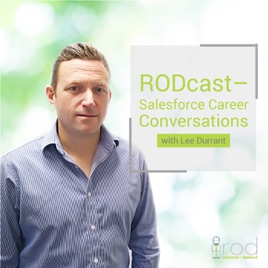
Advertise on podcast: RODcast – Salesforce Career Conversations
This podcast has
20 episodes
Language
EnglishPublisher
Lee DurrantExplicit
No
Date created
2019/08/09
Latest episode
2022/06/21
Average duration
62 min.
Release period
75 days
Description
Salesforce is one of the worlds most successful CRM platforms for accelerating every part of your business that interacts with clients, including sales, marketing, customer service and more. RODcast is the podcast where we chat to some of the most inspirational and successful people in the Salesforce Ecosystem. They share their journey and reveal what it takes to be a salesforce superstar.
Unlock RODcast – Salesforce Career Conversations podcast Email contact info,
Listeners & Audience details
Email contact information
Direct podcast contact details

Listeners
Audience numbers & engagement insights

Audience details
Podcast Insights

Social media
Check RODcast – Salesforce Career Conversations social media presence


Podcast episodes
Check latest episodes from RODcast – Salesforce Career Conversations podcast
Salesforce Career Conversations #18: Peggy Schael
2022/06/21
Episode 18: Peggy Schael Salesforce Career Conversation with ROD. Peggy talks about her career in Salesforce and how she progressed to co-found a training platform to help others to become certified.
Lee: Hello, it's Lee Durrant here again with another episode of RODcast, where, as you know by now, we dive into people's Salesforce careers to find you, hopefully, little nuggets of inspiration that might help you in your Salesforce career. I'm really pleased to say that joining me today on the podcast is Peggy Schael who is the co-founder of WeLearnSalesforce. Hi Peggy.
Peggy: Hi Lee, nice to meet you, and thanks so much for having me here.
Lee: I'm really, really thankful that you've agreed to join. I think I saw what you do on LinkedIn and thought it's quite interesting. We'll see if we can have a quick chat and share some of your story or even all of your story with people that are listening and want to be inspired perhaps as to what happened in your career and how you got to where you are and what you're doing, and maybe how that can help them as well. I was looking with interest. Maybe a little overview for us first and then we'll go back to the beginning if you like. Do you mind just telling us a little bit about what you do right now and then we'll rewind?
Peggy: Yes, yes, of course. I'm more than happy to share my story and I have to add, this is my very first podcast, so please be gentle on me.
Lee: That's okay. I won't ask anything too tough but yes, you fire away.
Peggy: As you introduced, I'm Peggy Schael and I am a Salesforce trainer and have been a Salesforce trainer for many years now, and a bit over, I think two years ago, we founded WeLearnSalesforce, our online Salesforce learning platform where you can go and watch video tutorials and get Salesforce certified or do a Salesforce certification training and prepare for the certification and all of that is provided in video tutorial format. You can watch pretty much any time from anywhere you are. That's where I am right now.
Lee: Where you are right now, brilliant. I'd be interested to find out how you got into it but maybe before that, what were you doing pre-Salesforce? What was your career up to that? I had a look obviously I could see a bit of HR recruitment in there back in the day.
Peggy: Yes exactly. It's probably not what you expect, someone being in the Salesforce trainer role. I pretty much stumbled into Salesforce. It's one of the stories I've already shared and how I got into Salesforce. I worked for various management consulting companies before I moved into Salesforce. They were mainly roles around event management and human resources and recruitment and staffing, and then a little bit of project management. Pretty much roles that had to do with working with people and getting things organised. Mostly what we called back-office jobs where you would just really work behind the scenes and get people out there.
It had literally nothing to do with technology or in IT and CRM systems, maybe Excel spreadsheets, but certainly, nothing to do with CRM systems or anything like that. I thought this is pretty much where I'll be working for the rest of my life. Then what happened was that my partner and I, we moved back to Australia. We lived in Australia before and then decided to go back to Australia. We left our jobs, we left everything behind, and moved to Australia. Then I had to look for a new job in Australia, specifically in Sydney. I was looking around and then I came across yet another consulting company.
They had a job opening for a Salesforce project manager, and I thought, "Okay, I have a bit of project management experience," but Salesforce, I had no idea what Salesforce was.
Lee: Peggy, just a rough idea when this was?
Peggy: This was in 2013.
Salesforce Career Conversations #17: Dave Atkins
2022/06/01
Episode 17: Dave Atkins Salesforce Career Conversation with ROD. Dave has worked in IT since 2003 and moved into Salesforce in 2017. Dave shares his story as both a candidate and employer in the technology space and why money shouldn't be the main motivator when it comes to your career.
Lee Durrant: Hello, it's Lee Durrant here with another episode of RODcast where, as you know by now, we dive into people's Salesforce careers to find you little nuggets of inspiration that might help you in your Salesforce career. I'm pleased to say that joining me today is Dave Atkins, who I've known for a long, long time. Hi, Dave.
Dave Atkins: Morning Lee, are you well?
Lee: Good, good, good. Thank you so much for agreeing to share your Salesforce career with us or your career before Salesforce as well, and then obviously, any little tips you've got along the way will be brilliant. I was thinking perhaps you can, I know you and I go back a long way, perhaps you can give us a high-level intro about you and then before we dive into where it all began, and then bring us up to date. A little intro would be great.
Dave: Sure, yes. Okay, where it all began? Well, I came through a software background, usual sort of development and design way back in the day. I was introduced back in the mid-'90s, to something called CRM. Now, I'd never heard of it. Nobody else appeared to have heard of it, and it was something entirely new. It took some time for that to, shall we say, come to fruition and it was quite weird, really because the first real introduction to Salesforce I had, I was working for a software company, and they wanted to try out CRM. I did a bit of research and came across this thing called Salesforce, which was in its very, very early stages then.
Lee: Yes, if you're talking mid-'90s, they didn't start til '99.
Dave: It was '99. Yes, '99 they started. I think this by then was probably about 2000, 2001 something like that. Strange thing was that one of my colleagues in my present company said the same thing and he described it as when Salesforce was nothing more than a glorified address book which was way, way back.
We adopted that and obviously, in those days, you didn't have the infrastructure around it that you have today so everything we did, we did ourselves, we found that it was very customisable and it worked well, it worked well as a sales tool. Something that we could track customers on, track their purchases, and their prospects but it was a very, very simple system then. I just moved on through.
Dave: This was a company called GAVS. Which I think you may remember.
Lee: I remember GAVS.
Dave: That's right and I was working with them and really, it was an internal system we needed to use something to track sales. That's how I got my first taste of CRM and of Salesforce.
Lee: It fell on to you that it's to be that person to get it to work?
Dave: Yes, I was literally chief cook and bottle washer. Everything, I had to do. We did it ourselves and obviously coming from a software background, it was interesting for me to do that and interesting for me to become involved in the business side of it. How we use CRM.
Lee: As I said before to you, I'm going to go off on tangents here, but I looked at your profile even though I've known you for a long time and I kind of know your profile well because obviously we've worked together for so many years in terms of me either recruiting for you or finding new jobs so I know your profile. More often than not you refer to yourself as a project manager.
Dave: Yes.
Lee: T hat leads to my first question that is a bit off-topic in terms of your career anyway. If you're called a project manager but you're doing what you did with Salesforce,
Salesforce Career Conversations #16: David Massey
2022/05/10
Episode 16: David Massey Salesforce Career Conversation with ROD. David talks about how he found his way into Salesforce. Originally a Salesperson at a travel company, he was one of the unlucky ones having to figure out a new career due to the impact of covid. In less than two years, David has become a Salesforce Certified Consultant and now helps others to obtain their own certs.
Lee Durrant: Hello, it's Lee Durrant here, with another episode of RODcast. We dive into people's Salesforce careers to find you little nuggets of inspiration that might help you in your Salesforce career. I'm pleased to say that joining me today is Dave Massey, who is-- I've lost count, but multiple certified Salesforce consultant and author of davejmassey.com, a website designed to help you learn Salesforce.
Hi, Dave, have I introduced you right there, mate? Is it author? Are we going to go with that?
David Massey: Yes, we'll go with author and thanks for having me, Lee. It's a pleasure to speak to you.
Lee: No, you too. We haven't spoken before, which, frankly for me, is a bit rare on this podcast because I've played it safe. I normally just talk to people that I know, but I couldn't help, like probably a lot of people in the Salesforce ecosystem, couldn't help noticing what you're up to and thought, from a selfish point of view, it'd be great to get you on our podcast and talk about your relatively short journey so far in Salesforce and the very quick rise to being a little bit of an influencer.
If you don't mind, perhaps giving us a very quick overview of who you are, then we can talk about, I guess, what's happened to you in the last few years if that's all right?
David: Yes, that's perfect. Where I am now is I'm an eight-time certified Salesforce consultant, working for a company called ThirdEye Consulting based out of London. Literally, two years and a week ago, I was actually a travel agent. It was only the 30th of March, I actually discovered Salesforce 2020, so the 30th of March 2020 was the first time I saw it. Prior to that, I'd worked in sales and service for a good 10, 15 years, selling everything you can think of from cars, to windows, to vacuum cleaners, to TVs, broadband, the works. Sold all of it and I found myself working in the travel industry.
I've been really successful. I'd been in it again, for about seven years at that point. I was doing really well with my sales team and when I say travel agents, technically, it's like a tour operator. Everything was custom built, everything was tailor-made, flights, hotels, transfers, trips, seven or eight week holidays, so something quite bespoke.
Again, was doing really, really well. Then COVID hit and as COVID hit, as most people know, in the travel industry, it is essentially minimum wage and then you earn all your money through commission. That's just the nature of the beast in sales, as you know. Yes, I walked into the office after COVID had hit and was just faced with the fact that I'd lost 50% of my commission overnight and all the other commission was going into a holding pot.
It couldn't really be touched, because it needed to be there to obviously keep everything going. It was a bit of a shock to walk into that. I'm married, I've got two kids, we've got a house, a mortgage, I've got a big dog that eats more than me. It was one of them where I had to look around and think, "Right, what am I going to do?"
Lee: You were made redundant, were you? Or what happened?
David: No, I wasn't made redundant. Literally, I just had to work full time through it, working from home because again, particular with the travel industries, it wasn't a case of, "Oh, right. Well, COVID shut down, lockdown, nobody does anything." Because we still had to manage all the flights, the hotels. Again,
Salesforce Career Conversations #15: Charlie Cowan
2022/04/19
Episode 15: Charlie Cowan Salesforce Career Conversation with ROD. Charlie is an Enterprise Tech AE and published Author of "How to sell Tech". Listen to Charlie talk about his career journey, with a surprise master class in selling pipe cleaners. Charlie has sold both Salesforce professional services and products, and talks about why empathy is important within his role.
Lee Durrant: Hi, I'm Lee Durrant. In this episode of RODcast, we're speaking with Charlie Cowan about his Salesforce career to date and any little tips or nuggets he's learned over the years, particularly as a now published author of sales books, I think plural. Let's just dive straight in and say hi, Charlie. How are you doing, mate?
Charlie Cowan: Hi there, Lee. I'm good, thank you. Thank you for having me on.
Lee: Thanks for agreeing to do it. Obviously, you and I have known each other for quite a long time in this Salesforce ecosystem. I did notice your recent news about publishing a software sales book. I thought it might be good to get you on and have a chat for people that are listening about, I suppose, your journey in Salesforce and how you got into it, and all the way through to this point now where you're a published author of sales books, which is brilliant.
Charlie: I'd be happy to share that journey. Hopefully, it's useful either for people that are in sales, but also people that are not in sales and more in either the consulting ranks or interested in what it might take to get into sales.
Lee: Yes, absolutely. It's a growing part of the Salesforce ecosystem, of course, but even the wider cloud software space, I would imagine. It'd be quite interesting to dig into that. If you're happy to maybe give us a little overview of yourself and then we can dive into how it all began, if you like. Fire away, tell us what you're doing.
Charlie: I'm an enterprise tech AE. I've worked in cloud sales pretty much since I started working. '99 seems a long time ago now, but when I left The Agricultural College, which is what I studied in, and just through pure coincidence, the town that I was studying in, which is a town called Cirencester, also had a number of tech companies that got set up there. I was lucky enough to get a job in one, pretty much straight out of uni. I did a quick transition from agriculture into technology. Then I've stayed on that path the whole way through, sometimes selling the tech, sometimes selling services. I spent my career in that space.
Lee: Like a lot of people I speak to, it wasn't necessarily your plan to get into tech, then. Obviously, the agricultural thing that was-- You had a totally different life plan.
Charlie: It was pure coincidence and a little bit of luck. While I was at uni, I was also working in my evenings in a local pub. To get from uni to that pub, I used to drive through a little industrial estate in Cirencester. I used to go past this building there, and it had a little car park at the back of it. There was some nice cars in that car park. There was a Lamborghini Diablo, there was a Ferrari 355. There was some good stuff going on. One day, on my way to work, I had a little bit of time before my shift started. I parked up and I went and knocked on the door.
I spoke to the receptionist, and I was like, "What on earth do you do here?"
Charlie: She said, "Oh, we're a business-only ISP." I said, "I've got absolutely no idea what that means but can I have a job?" I didn't even really ask for a specific type of job. I didn't really know what kind of jobs were available. She put me in touch with the sales director there, a guy called Johnny. I popped in a week later to have an interview with him, and had some initial chats about what I wanted to do and what interested me. I was just like, "I'm a student. Obviously, I want a big telly.
Salesforce Career Conversations #14: Richard Pay
2021/12/13
Episode 14: Richard Pay Salesforce Career Conversation with ROD. Listen to Richard talk about his inspiring career journey and how he bounced back following redundancy in the automative sector to carve out a new career within Salesforce.
[Below is a transcript for your benefit. Please excuse any typos.]
Lee Durrant: Hello, and welcome to this episode of broadcast with me, Lee Durrant and joining me today is Theresa Durrant. Today we talk to Richard Pay about his career in Salesforce so far. Richard had a very successful 30-year career in sales. Unfortunately, being made redundant in his 50s, not sure what to do or where to turn. He now works as a senior consultant for one of Salesforce's biggest partners in the world. How'd he do it? He explains all in this episode.
Hi, Richard Pay. Welcome to the latest edition of RODCast. Thanks so much for joining us. How are you doing?
Richard Pay: Great, thank you. It's nice to meet you face to face finally. Thanks for having me.
Lee: Yes. The three of us are going to have a chat about your career to date, well in Salesforce, but also before that. I think we should kick off with you giving us a bit of a, I suppose overview, of your career up to the point you decided, a fancy bit of Salesforce stuff.
Richard: I think overview is a good point because there are 30 odd years of it. Yes, I'll try and summarise it. I did a degree in geography and cartography. Cartography is a dying art, isn't it? For people that don't know, it's making maps basically. In those days, you used to draw them with pen and ink and scribing tools and that sort of stuff. I did that and, very long story, but I didn't go into that particular sphere because I was about to go off on a project, mapping Iraq. I got the job and then they told me that the first Iraq-Iran wars kicked off again. It was on a big hydroelectric project, so I was surveying that. The project got canceled in one of those funny turns in your life; I've had quite a few of these. Rather randomly, I didn't go down the route of being a cartographer or surveyor, but I still love that kind of scene. I love all maps and all that stuff.
Theresa: That is like me. There's something fascinating about maps, yes.
Richard: When I drive around in the car, I'm looking at hills and terminal moraines and all that good stuff. Anyway, all good. I did a degree in that, but I didn't pursue that career. Rather randomly again, I got into the automotive business. I had a basic training, if you like, a sort of a management trainee in a car company down in Devon, Cornwall, that sort of area.
I did that and that kind of kicked off a career in automotive and, I, over the last 30 years basically, I've been involved in that world of automotive. I've gone from a used car salesman, if you like, through to being involved in what they call used car remarketing, which is the wholesaling of vehicles out from leasing companies or rental companies into the secondary market, which is usually dealers and that sort of stuff.
More recently that's become quite techie. It used to be done through car auctions, and then for lots of reasons, like everything frankly, it's all gone on, not all, but it's gone online. I got myself involved in the online piece and basically selling platforms around the online remarketing bit. I got into tech that way, but I have always been a business development guy. That's my thing. I'm not a techie person. Probably speak something about that later on, but I am not a techie person at all.
I come out in a cold sweat whenever in meetings, people say, "Well, what's the percentage of sales that you did last week as opposed to the week before?" I'm one of those people that go, "Oh right," don't really get that. I'm not a mathematician guy at all. I did that and effectively did that for quite a long ...
Salesforce Roundtable: Counter Offers
2021/07/15
Salesforce Roundtable: Counter Offers
Lee Durrant: Hello, and welcome to another episode of RODcast with me, Lee Durrant, and my cohost, Teresa Durrant. Today we're talking to three Salesforce industry legends about the topic of counter-offers. I'm not sure if you've ever resigned from a role only to be counter-offered, or perhaps you've owned a business, and you have counter-offered someone that's looked to resign from your business. It's a hot topic. As of recording this, it's July 2021, we're coming out the back of COVID, but it certainly seems to be very rife at the moment in the Salesforce ecosystem. Counter-offers is a hot topic.
I thought it'd be great to get the opinions of Penny Townsend, Vera Loftis, and Ben McCarthy, who's also known as Salesforce Ben. They've all got some great opinions on all sides of counter-offers, whether they have previously been in a situation where they've been counter-offered themselves, or in situations where somebody's resigned from their business, and they have or have not decided to counter-offer them, and how it went. A great podcast to listen to if you're in that process yourself. Some really good views from the guys. Hope you enjoy.
Lee: Let's welcome our guests on this podcast today. We have with us, Penny Townsend. Hello, Penny.
Penny Townsend: Hi, Lee. Hi, everyone.
Teresa Durrant: Hello.
Lee: Third time you've been with us. Thank you very much. Equally, Vera, it's your third time, I think, with us on this podcast. Hello to you.
Vera Loftis: Hello. I'm hoping third time's a charm.
Lee: They've always been charming. We've got as well, first time with us, but probably his millionth podcast, we've got Ben McCarthy, also known as Salesforce Ben. Hi, Ben. How are you doing, mate?
Ben McCarthy: Hello. Yes, very well. Thanks a lot for the invite. Pleasure to be here.
Lee: Thanks for coming on. This is, as I mentioned in the introduction, a particular conversation about counter-offers. I think it's rife, possibly everywhere, but it's definitely rife at the moment in the Salesforce market.
I don't know if you guys are aware of this because I appreciate you're in the middle of it, but as recruiters, we have noticed because we're in the middle of COVID still or coming out the end of it, it's just been absolutely crazy in terms of people wanting to leave for whatever reason. We'll touch base on that and then basically being counter-offered crazy money to stay where they are. I've never known it's so bad. Maybe it's a good thing, I don't know, but that's why we're talking. Teresa, looks like you want to say something?
Teresa: No, no, no, I was just going to say, yes, absolutely. We know that there's a skill shortage at the moment, and perhaps we can touch base on some of those reasons that we think that's happening aside from, obviously, Brexit having a huge impact on that. Also, I think COVID, where perhaps some skills that were in the UK have now gone back home to various countries across Europe, we've found quite a big impact on that. Just to touch base on why we think that this might be quite a big phenomenon at the moment with the counter-offers going on. Perhaps we'll throw it over to you guys since you're probably hiring or looking to hire at the moment.
Lee: What do you think? Vera, do you want to go first?
Vera: Yes, happy to.
Lee: What's your take on possibly why it's happening?
Vera: It's one of those things. I think, coming out of lockdown, everybody's now starting to breathe again, and people are starting to look. People who were probably not super satisfied in their job, that's probably exacerbated by having to work from home and COVID. Now that it feels like the world is opening up,
Salesforce Career Conversations #13: Rohit Kumar
2021/06/17
Episode 13: Rohit Kumar Salesforce Career Conversation with ROD. Listen to Rohit talk about his career journey, to become one of only a handfull of Salesforce CTOs currently in India.
[Below is a transcript for your benefit. Please excuse any typos.]
Lee Durrant: Hiya. It's Lee Durrant here. Welcome to another RODcast. I'm joined with Theresa again today. Today we're interviewing Rohit Kumar, who is a Salesforce Certified Technical Architect based out in India. He's one of only five CTAs in India which is quite interesting, I think. We get to chat with him about his career. Hope you can bear with us.
Lee: Welcome to Rohit Kumar. Thanks very much for joining us. How are you?
Rohit Kumar: I'm doing well. Thanks for having me. How about you?
Lee: Yes, we're good. Teresa is with me.
Theresa Durrant: Hello.
Rohit: Hi.
Theresa: Good to meet you.
Rohit: Same here.
Theresa: Excellent.
Rohit: Hope you're safe.
Theresa: We're very safe.
Lee: We should say again for people listening in that this is May 2021, so still very much in the middle of COVID, and I totally appreciate, Rohit, where you are it's awful at the moment. For people listening, that's where we are. We're very safe here, but how about you over there, mate? How's it going?
Rohit: I think it's going good. The situation is definitely not good and government is trying its level best to see what best they can do for everyone. We are in total curfew as we speak. I'm very hopeful that the situation would improve in the next couple of weeks. Fingers crossed. Let's see how the upcoming weeks would be.
Lee: Whereabouts are you, Rohit? Whereabouts are you in India?
Rohit: I am in a city called Bangalore. It's in the south of India and is primarily referred to as one of the IT capitals of the world. Most large organisations, product-based companies or any companies into advisory, consulting, are primarily headquartered or will have a bigger branch in Bangalore, India.
Lee: Fantastic. Before we go into the questions about your career and how you got to where you are at the moment, I was reading today that India has got the largest worldwide concentration of Salesforce technical talent, which I didn't know. It made sense, but it's one interesting stat.
Rohit: One of the advantages we've got is that India has one of the largest talent pools and is also one of the largest countries with many Salesforce consultants and developers, so we see a good amount of opportunity within the country. A lot of organisations has invested either in Salesforce as part of their digital transformation journey or an implementation partner based in India. Ample amount of opportunity as well for the talent in India.
Theresa: Fantastic.
Lee: I think we'll start at the beginning of your career then if that's okay and you can talk us through-- I suppose we haven't started the right way here. If you can just introduce yourself in terms of who you are, what you do so that people will know.
Rohit: Yes, definitely.
Lee: Obviously, we'll share your LinkedIn profile for people that want to have a look at it after this but yes, if you introduce yourself.
Rohit: I'll start from where am I today and how did I start.
Theresa: Yes, perfect.
Rohit: Hi, everyone. I'm Rohit. I'm CTO for Venerate Solutions and one of the board members. I'm also one among very few Salesforce Certified Marketing [unintelligible 00:04:08]. From a career perspective, in the early days of my career, I was primarily engaged more into development of India's first nanosatellite. I was primarily writing real-time operating systems and was involved in the hard...
Salesforce Career Conversations #12: Goolshun Belut
2021/05/19
Episode 12: Goolshun Belut Salesforce Career Conversation with ROD. Listen to Goolshun talk about his career journey, from working at Carphone Warehouse to now running his own Saleforce consulting company, including the toughest Salesforce project of his career.
[Below is a transcript for your benefit. Please excuse any typos.]
Lee: Welcome, Goolshun Belut. Did I say that right, mate?
Goolshun Belut: Yes, that is correct.
Lee: Good you asked him before the recording. Welcome to the podcast, mate. Very nice to have you. Theresa is also here with us.
Theresa: Hello.
Goolshun: Thanks both for having me. Pleasure speaking to you after such a long time.
Lee: I know. It has been a while. I don't know how long, but I think it's got to be a good few years and probably one of the last world tours, but been a long time. You've done a lot since we last spoke, and we will get to that, obviously. I don't know whether you've listened to any of these before, but we'd like to go back to the beginning of your Salesforce career if you like, and then.
Goolshun: Back to the origins, right?
Theresa: Yes, absolutely.
Lee: If you can remember that far back, mate. Then we'll go back to where we are today, and what the future looks like, and all that sort of stuff and the journey you've been on through this. Without further ado, I'll let Theresa ask the first couple of questions, and then we'll just jump in.
Theresa: Oh, okay, fantastic. I suppose the biggest question or the most important question, I should probably say, is how did you get into Salesforce in the first place?
Goolshun: That's a million-dollar question, that one. I never planned to go into Salesforce at all. It's just while I was finishing my degree at university, and we had one module around CRM. I think it was saying we had to interview Carphone Warehouse about their own CRM system, but I've never imagined that I'll be working on CRM for my whole career. I think during the last year of my degree, I had a temp job at a company called Truphone. I think they were implementing the Salesforce CRM at that time. I had a basic job at Truphone. My job was literally putting SIM cards into a phone and testing them, and then shipping them. That was quite a mundane task; I was frustrated, and I told people how frustrated I was; I had more talent. One of the directors called me into the office. I thought I was going to lose a job today at that time.
Lee: Really?
Goolshun: Yes, because I was already here looking for a job, and I had a temp job, and I was venting at the office. They called me in the office, and they said, "Okay, what do you not like about this job?" I said, "I could do more stuff." He asked me to bring my CV to his office the next day, and he said, "There's something called Salesforce. It's a CRM system. We would like you to try it out and see if you can work with it. If you can work with it, then you have a job." I had two weeks of heavy Googling. Back in the days, there was no Trailhead; there was no heavy training. It was the initial days of even the certifications, so yes, and more Googling.
Lee: Sorry, mate. Sorry to interrupt you. Where are we?
Goolshun: That was 2010 probably. Just 2010 or 2009. Just approximately about that time.
Theresa: Sorry, carry on.
Lee: I'm just curious how long ago that was. Another question. What were you studying? What was the degree in?
Goolshun: Funny enough, my degree was a bit odd. I was studying multimedia computing, but the whole idea of my degree was to do with filmmaking, multimedia side, and creative side with a couple of modules about IT. I did study computer sciences during my A-levels, which helped a lot,
Salesforce Career Conversations #11: Vera Loftis
2021/02/24
Salesforce Career Conversations #11: Vera Loftis
Episode 11: Vera Loftis talks to Lee and Theresa about her Salesforce career growing up in Bluewolf and her next exciting venture with Solution Junkies.
Lee Durrant: Hello, it's Lee Durrant here again with the new episode of RODcast. I'm joined by my co-host, Theresa. In this episode, we spend time with Vera Loftis, who is Salesforce royalty, so you're in for a bit of a treat.
She talks us through her career at Bluewolf, where she rose to be the managing director of the UK Bluewolf before they were acquired, and how she's getting on now through COVID. Her plans for the future with her new company and what she thinks will happen in the ecosystem.
Vera Loftis: Hi. Thanks for having me.
Lee: Thanks for saying yes. I'm honoured.
Lee: I should tell everybody, we're still in the middle of the COVID thing, we're in the middle of lockdown, so this is a chat about your career in Salesforce, which will inspire a lot of people. It'll also have a COVID-related lockdown theme to it too.
Let's talk about your career if you don't mind, up until COVID. What we normally ask is how you got into Salesforce.
Vera: Of course, and I'm probably interesting in that I fell into it. It's the easiest way to describe it. When I was in school, I thought I was going to be this very glamorous marketer PR person. All of my internships in college, I had internships with publishing companies doing PR. I did marketing for a magazine, and it all seemed fairly glamorous at the time. When I got out of school, I was a marketing coordinator for a not-for-profit, which was slightly less glamorous, I'll be honest. It's quite funny because, at the time, I didn't realise not-for-profits work in a very lean environment.
I was young, and I wanted to do all of this ambitious stuff. When I started the role, it was described to me that this is marketing plus. I was like, "Marketing plus? That sounds interesting." What they meant by marketing plus was marketing plus customer service. We ran an alumni club in New York, and there was a part of the appeal for being a member of the club. It had a tiny hotel, I think, 12 rooms - half of my job was giving people tours of the hotel, and answering the call when they ran out of towels, and things like that.
It got to a point where I thought, "I've probably delivered enough towels. I don't think I'm doing the marketing as such." I was just looking for a change. At that point in time, I didn't know where to go from there. I was an English major in school, so I already was confused about what I wanted to do when I grew up. Then when this marketing job didn't pan out to be exactly what I was hoping for, I just started looking around randomly. I was lucky in that my cousin was a consultant, not necessarily in the Salesforce space.
He worked for Anderson at the time, but he said to me, "You should get into consulting." I went to a school where consulting was something that the smart kids did, so I had never considered myself part of that tier of hires.
He broke it down for me; he was like, "Consulting is just problem-solving. It's somebody who can get into what people need, can get people to open up about how they need to operate, and then try to help them do that in a better way. We had a couple of conversations about it, and I thought, "You know what? I'm just going to go for it."
He had put me in touch with Bluewolf. I interviewed at that time with Eric, and I remember I was so scared because I thought there would be all of these consulting questions. I had read online that they were going to ask me all of these strange things. To be fair, he did ask me one, which was how many ping pong balls I thought there were in America? I had prepared for how many tennis balls were on an aerop...
Salesforce Career Conversations #10: Helle Justesen
2020/07/23
Salesforce Career Conversations #10: Helle Justesen
Episode 10: Helle Justensen talks to Lee and Theresa about Salesforce Change Management and Digital Transformation. Plus provides her tips for remaining positive during a pandemic.
[This interview with Helle has been transcribed for your benefit. Please ignore any rogue typos. Thank You.]
Lee Durrant: Hi, and welcome to RODcast with me Lee Durrant, joined today with Theresa as well. We're both going to be interviewing Helle Justesen today, who is in the Salesforce ecosystem, but this one's more about her experience as a transformational change specialist and a business and life coach and how she sees the future after COVID-19 and all of the lockdown issues we've been all going through. Well, this has been recorded in the middle of lockdown, but I think hopefully you'll all see some positive messages there from Helle about how life might change, but also how the Salesforce ecosystem will potentially thrive in the future, so I hope you enjoy it.
Lee: Hi, Helle. Welcome to the podcast. How are you?
Helle Justesen: I'm fine. Thank you. How are you?
Lee: I'm okay. Theresa is with us as well as you know.
Theresa: Hello.
Helle: Hi. Theresa, how are you?
Theresa: I'm good. Thank you very much. I'm looking forward to this day when - I don't want to use the word normal - but looking forward to the day when we can actually be a lot more social with people and not feel like you got to keep your closest people at arm's distance. Looking forward to those times. [chuckles]
Lee: Before we dive into it, are you okay just to give us a little introduction of yourself in terms of… Just introduce yourself if that's okay.
Helle: Yes, [laughs] of course. My name is Helle, Helle Justesen, and I am 43 years old. I want to put that in there because I'm proud of my age. I'm still alive, so that's good.
[laughter]
Helle: I have a feeling that we don't celebrate the fact that we get to get older enough. That's one of the things that…
Theresa: Yes, I love that, and it's the wisdom that comes with it. Why not shout about it? Absolutely.
Helle: Yes, exactly, and the fact that you get another year to do the crazy things that you want to do. I'm a transformation change specialist with a background in a bit of management consultancy, and I've worked in a multitude of different industries and things like that. The thing is there's always these similarities between each industry and everybody thinks that they're unique, but to be fair, we're really not. [laughs] We're all creatures of habits. That's one of the things that you can always take with you when you're on your life journey and things like that.
I'm very much a holistic person as well. I see us as living a life not necessarily having a career. I think sometimes that when people face a crisis and a crisis can be losing a job, which a lot of people are in that situation right now, or going through a divorce, which also a lot of people are facing right now.
[laughter]
Helle: Because of being at home with the family and things are coming out right now as well.
Lee: Theresa's laughing quite heartily at that one. It's a bit worrying.
Theresa: [laughs] You're so worried.
Helle: The thing is, with that, it's instead of seeing it as a tearful goodbye to something, then seeing it as an opportunity to actually go out and do the things that you've always dreamed about doing. Sometimes a crisis needs to happen for us to actually wake up and change what we're doing. It's the same thing with illness as well. It's like if you've gone down a road where you've been living an unhealthy lifestyle, then something needs to wake you up for you to actually alter th...
Salesforce Roundtable Covid-19
2020/04/23
Salesforce Roundtable: Covid-19
Listen to some of the brightest minds within the Salesforce ecosystem talk about the impact of Covid-19 on them, how they are utilising their time during lockdown and predictions on what the future of Salesforce may look like. Also they give tips on how you can utilise your time for when you are backing looking for Salesforce jobs after the lockdown is lifted.
Lee Durrant:
So, hi, guys. Thanks for joining us. We're obviously humbled that you gave us your time, and we're really grateful for that, so thank you very much. I guess we'll pick one and we'll just go for some introductions if that's all right?
Lee:
So, Vera, as you're top on our screen, would you like to introduce yourself first?
Vera Loftis:
Absolutely. Hi. Vera Loftis, I run the Capita Salesforce practise, but I've been in the ecosystem for over a decade now. So many, many different forms, but always Salesforce focused.
Theresa:
Thank you. We've got Simon. Do you want to go ahead?
Simon Thompson:
Yeah, thank you. Yeah. Simon Thompson, CEO and co-founder of Improved Apps. I've been working around the Salesforce ecosystem for 13 years, since 2007. I worked at Salesforce for six of those years before founding Improved Apps. And we're helping customers drive adoption of Salesforce.
Theresa:
Lovely. Thank you.
Lee:
Gemma do you want to go next?
Gemma Blezard:
Sure. Gemma Blezard. I founded Ladies Be Architects during my time at Bluewolf, when I was working with Vera. Recently broken away to start my own advisory consultancy business, focusing on architects. And I've been working with Salesforce for 12 years.
Theresa:
Fantastic. And then we've got Toby.
Toby Heath:
Hi there. Hi everyone. My name is Tony Heath. I've recently been working at Heathrow, previous to that it was Gatwick, and previous to that was a company called SITA who were based out in Geneva. I've been working in the Salesforce space for about eight years now, on and off in different guises. Yeah, that's me really.
Theresa:
Thank you.
Lee:
Brilliant. Thank you. And last but not least, Penny and your Muppet. Do you mind introducing yourself?
Penny:
Yeah. Hi guys. Yeah, my colleague. Times are getting desperate for colleagues. So I'm Penny, I'm the Chief Operating Officer of Pracedo, and like the other guys, I've been around doing Salesforce for ages, so about 12 or 13 years, and I've been the customer at other consultancies and the ISVs, so a little bit of most of the space.
Theresa:
Fantastic. Thank you very much guys.
Lee:
Yeah, okay. Well we'll just dive straight in. I know I sent you some questions that we're curious about, and obviously I want to thank you all for doing this and thanks to Gemma as well for being there when the idea hit us both. We thought it'd be a good idea then just go through some questions about how you're all handling the current situation and obviously what you think might happen in the future, so that people can hopefully see some light at the end of the tunnel.
Lee:
So the first point I think we'd like to cover, and I think I might start with...
Lee:
Who shall we start with, Jenny?
Lee:
Okay, well actually, Gemma, because your situation is quite interesting, I mean all your situations are very unique, but how has the current COVID-19 situation affected you in that you've just started a new business, and all that sort of stuff?
Gemma Blezard:
Sure.
Salesforce Career Conversations #9: Andrew Hart
2020/03/19
Salesforce Career Converstions #9: Andrew Hart
Episode 9: Andrew Hart talks to Lee about his 2.5 year journey from zero Salesforce certs to #202 CTA of around 302 (last time he checked).
[This interview with Andrew Hart has been transcribed for your benefit. Please ignore any rogue typos. Thank You.]
Lee: So, Andrew Hart, hello. Thank you for taking the time to speak to us. How are things going?
Andrew Hart: Yeah, thanks, Lee. Things are going well, thank you. Busy as ever with work and family and everything else that we have in our lives, but well, healthy.
Lee: Good. That's good in this current time. So I am... Ordinarily, I would go on about giving an intro for you, but why don't you do it yourself? Tell everybody mainly I suppose what you're doing now, and then we can rewind time and go back to the beginning. Okay?
Andrew Hart: Yeah. Of course. So I am Andrew Hart. I'm a Salesforce Certified Technical Architect. I'm the lead Technical Architect for the Accenture Salesforce group in the UK. I always describe my role as having three pillars. A bit of pre-sales, so using the CTA cert to get in front of customers quite often, helping shape and sell projects.
Andrew Hart: Delivery, so helping to deliver the projects, and in my case, that's usually around delivery assurance or high-level support or engagement at the sort of technical executive level. The final bit is team development, so looking after those who I consider in my care, and that's the technical team for the most part—so looking out from hiring, upward to training and enablement support when they're on projects and just general set of ears and a brain if they need it and feel that my brain can help them on their projects.
Lee: There's a lot to what you're doing obviously. It's been a wild ride I think, correct me if I'm wrong, going back to the beginning. When I say the beginning, I kind of mean slightly before Salesforce. Again, please tell me if I'm mistaken here, but is it fair to say that your background didn't necessarily lend to being what people would associate with a CTA, sort of a Technical Architect? Am I right with that?
Andrew Hart: Well, I mean, I've been a consultant my whole... More or less my entire working life, and I think as a consultant, you play several different roles, project to project, customer to customer.
Andrew Hart: I've never been... You know, I'm not a classic TA path if you think computer science degree, software engineering, product development type background, but I've always been technically leaning. But I very much feel that technology is an enabler for solving problems, or it should be business-led, and that starts with conversations.
Andrew Hart: I've always approached my role in that way. I encourage TAs that I work with to work in that way as well. We are never... In the consultancy space anyway, we're never just building an academic, technical solution. It's always solving business problems, and it can't be lead by technology.
Andrew Hart: In Salesforce, you see this in their go-to-market as well. It's all about business benefits, and it's KPIs in either service or sales or whatever other clouds they're pitching. It's never just about “look at this cool tech”. It's always about looking at the problems it can solve, and I've approached my career that way.
Andrew Hart: I acted on some advice I was given maybe 15 years ago from a manager I had at the time within Oracle, which was, you know, we can offshore development, we can offshore testing, we can offshore a lot of things. We'll never offshore someone looking in the customer's eyes and asking what their problems are. There always needs to be someone to have those conversations.
Andrew Hart: I wouldn't say that radically changed how I app...
Podcast reviews
Read RODcast – Salesforce Career Conversations podcast reviews
Podcast sponsorship advertising
Start advertising on RODcast – Salesforce Career Conversations relevant audience podcasts
You may also like to advertise on these Podcasts
006
The Joe Gaither Show on BCCentral
MTM Media Group LLC
006
The Joe Gaither Show on The Zou On SI
MTM Media Group LLC
004
The Joe Gaither Show on CowbellCountry
MTM Media Group LLC
007
Join The Conversation With Coach Kurinn Wright
Kurinn Wright
00100
KRLD Difference Makers
Audacy
004
The Joe Gaither Show on RoyalsCentral
MTM Media Group LLC
0064
Pengantar Tidur
Febrianto Adi Saputro
0064
Desvela2 por el Gaming Podcast
Moy Sensei

0014
Call Up - Where Faith meets Sport & Life
Sports Chaplaincy South Africa
0032
Sercan Anlatıyor
Sercan Solmaz