1478344170
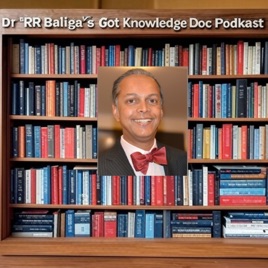
Dr RR Baliga's "Got Knowledge Doc" Podkast

Advertise on podcast: Dr RR Baliga's "Got Knowledge Doc" Podkast

Rating
★★★★★
5
from
6 reviews
This podcast has
1086 episodes
Language
English
Explicit
No
Date created
2019/08/29
Latest episode
2026/10/17
Average duration
3 min.
Release period
1 days

Description

"Got Knowledge Doc" Podkast with Dr. RR Baliga The "Got Knowledge Doc" Podkast, hosted by Dr. Ragavendra R. Baliga, is a knowledge-driven platform designed for physicians and healthcare providers seeking to stay at the forefront of medical science and innovation. With a distinguished career in cardiovascular medicine and academic leadership, Dr. Baliga engages with leading experts to explore cutting-edge research, emerging technologies, and transformative insights in medicine and beyond. Each episode delves into topics such as cardiology, precision medicine, artificial intelligence in healthcare, epigenetics, and medical ethics—making complex advancements accessible and relevant to clinical practice. Importantly, this podcast is purely educational and does not provide medical advice or clinical opinions. Join Dr. Baliga and his esteemed guests as they navigate the evolving landscape of medical knowledge, empowering healthcare professionals with evidence-based insights that shape the future of patient care.

Unlock Dr RR Baliga's "Got Knowledge Doc" Podkast podcast Email contact info,
Listeners & Audience details

Email contact information

Direct podcast contact details

Listeners

Audience numbers & engagement insights

Audience details

Podcast Insights

Podcast episodes

Check latest episodes from Dr RR Baliga's "Got Knowledge Doc" Podkast podcast


🏆 People, Prices & Policy: The 2026 Economics Nobel Explained
2026/10/17
🏆 What can physicians learn from the 2026 Economics Nobel? Robert E. Hall and Michael Woodford transformed macroeconomics by looking beneath the headline numbers—to the decisions and expectations of households and businesses. 🧠 The lesson feels remarkably clinical: diagnose before you treat. A downturn caused by weak demand is not the same as one caused by a supply shock—and may require a different response.   💡 Same symptom ≠ same solution. Perhaps economics and medicine share more than we think.
💪 Protein, Portions & Perspective: How Much Is Enough for South Asians?
2026/10/16
🥗 Protein in India: Myths, Meals & Muscle Are claims of widespread protein deficiency overlooking calories and food quality? Anura Kurpad and Harshpal Singh Sachdev's newspaper article examines this debate. 💪 Its calorie-based estimates translate to ~45 g/day for active adults and up to 60 g/day for older inactive adults at 2,000 kcal/day—examples, not universal targets. 🍛 The takeaway: adequate energy, varied foods and individual assessment. 🎙️ Dr RR Baliga's Podkast for the Kurious Doc. Where Curiosity Meets Clarity! #Protein #Nutrition #HealthyAging
⚖️ GZMK vs GZMB: The T-Cell Balance That May Define Healthy Aging
2026/10/15
🧬 Can your T cells reveal how well you're aging? A remarkable Immunity study integrated 2,609 people and >12 million cells across 8 cohorts. Researchers identified divergent CD8+ effector-memory T-cell trajectories: a higher GZMK+/GZMB+ ratio tracked healthier aging, while GZMB+ cells were linked to inflammation, poorer health and mortality. Single-cell analyses of global cohorts outline determinants of immune aging and link the ratio of GZMK+ to GZMB+ Tem cells to health trajectories.pdf 💡 The intriguing possibility: biological aging may be captured not simply by how many years we've lived—but by the balance of our immune cells. 🎙️ Dr RR Baliga's Podkast for the Kurious Doc.
62.5% 5-year all-cause mortality in symptomatic Peripheral Arterial Disease
2026/10/14
🦵 PAD is not simply a disease of the legs—it is systemic atherosclerosis with profound cardiovascular and human consequences. 📊 Symptomatic PAD: 62.5% 5-year all-cause mortality. 🌍 >316 million adults affected globally. 🚶 Yet mobility, pain, independence and mental health are too often overshadowed by patency and amputation. 💡 The Lancet's message is simple: count what matters to patients. 🫀 Recognize PAD. Treat systemic risk. Preserve lives—and livelihoods. #PAD #Atherosclerosis #Cardiology #VascularMedicine
🔍 Great Doctors Series: Vesalius—The Doctor Who Dared to Look
2026/10/13
🫀 What happens when a young doctor stops trusting the textbook—and looks for himself? Meet Andreas Vesalius (1514–1564), whose human dissections exposed errors inherited from Galen's animal anatomy. 🔍 At just 28, he published the magnificent De Humani Corporis Fabrica (1543), helping transform anatomy into a science grounded in direct observation. 📖 His enduring lesson for medicine: respect authority—but verify with evidence. 🔬 🎙️ Another episode of my Great Doctors Series—Where Curiosity Meets Clarity!
🧠 Menopause, Molecules & Memory: Is the Brain Sending a Warning?
2026/10/12
🧠 Menopause, Molecules & Memory Could menopause be a "stress test" for the brain? 🔬 Researchers identified 16 brain-related blood proteins elevated after menopause. The signature tracked with higher FSH and lower estradiol, while inflammatory cytokines were especially elevated in women reporting night sweats. 🩸 Intriguingly, several of the same proteins were elevated in older women with cognitive decline or dementia. 💡 Menopause may offer a critical midlife window to identify brain vulnerability—and perhaps intervene early. ⚠️ Promising, but preliminary: larger longitudinal studies are needed.
🐾 Why Big Dogs Age Faster: An Epigenetic Answer
2026/10/11
🐕 Bigger Dogs, Faster Clocks, Shorter Lives? A fascinating Science study analyzed 1,640 DNA methylomes from 894 dogs. 🧬 Epigenetic age predicted mortality, with each additional year of residual biological age associated with a 15% higher mortality hazard. Most strikingly, larger dogs showed 31% stronger age-related transposable-element demethylation, especially involving evolutionarily young LINE1 elements. 💡 Large dogs may not simply die earlier—their molecular aging appears compressed and accelerated. A powerful natural model for understanding longevity, genomic instability, and human geroscience.
2026 Nobel Chemistry Prize: ⚗️ Tiny Tilt, Giant Shift: How Chemistry Chooses a Side
2026/10/10
🏆🧬 Tiny Tilt, Giant Shift: How Chemistry Chooses a Side Why does life favor one molecular "hand"? The 2026 Chemistry Nobel honors Henri Kagan and Kenso Soai for showing how tiny chiral imbalances can become dramatically amplified. ⚗️ In Soai's landmark experiment, just 2% enantiomeric excess became 87%—and later autocatalytic reactions reached 99.99%. 💊 Why physicians should care: stereochemistry can determine whether a drug works at all—think L-DOPA. A tiny molecular bias can become biological destiny. 🔬✨
🛡️ Beyond Cholesterol: GIMAP6, Vascular Defense & Atherosclerosis
2026/10/09
🧬 Can atherosclerosis become lethal even without high cholesterol? A fascinating Cell study identifies GIMAP6 as an immune–vascular safeguard. Loss of GIMAP6 disrupts endothelial integrity and activates a mitoROS → PPARγ → CD36 pathway, driving macrophage lipid uptake, foam cells, inflammation, atherosclerosis, MI and heart failure—even without hyperlipidemia. ❤️ Human hypomorphic GIMAP6 variants also tracked with premature cardiovascular disease. 💡 Take-home: LDL matters enormously—but susceptibility within the vessel wall matters too.
Beyond Breast Cancer 🩻❤️: When a Mammogram Warns the Heart
2026/10/08
🩻 Could a mammogram also offer a window into cardiovascular risk? ❤️ Breast arterial calcification (BAC), once largely dismissed as incidental, is increasingly recognized as a cardiovascular risk signal. Greater BAC burden has been associated with adverse outcomes, including stroke and heart failure. Maryland now requires BAC notification on routine mammograms. 💡 The practical message: see BAC → think cardiovascular risk assessment. ⚠️ But BAC ≠ coronary artery calcium, and we still lack randomized evidence that BAC-directed intervention improves outcomes. Perhaps the mammogram is becoming a two-for-one screening opportunity.
🌿➡️🧠 From Algae to the Brain: Optogenetics Wins the 2026 Nobel
2026/10/07
🏆💡 From algae to the brain—a Nobel journey! The 2026 Nobel Prize in Physiology or Medicine honors Karl Deisseroth, Peter Hegemann & Georg Nagel for discoveries involving light-gated ion channels and optogenetics. 🌿 Channelrhodopsin in algae ➡️ 💡 Blue light opens the channel ➡️ ⚡ Ions flow ➡️ 🧠 Neurons can be precisely controlled Optogenetics gave neuroscience something extraordinary: the ability to manipulate defined neural circuits with remarkable temporal precision. Algae → Light → Ions → Neurons. Sometimes transformative science begins in unexpected places. 🔬✨
💊 Great Doctors Series: Paracelsus—When Poison Becomes Medicine & the Birth of Toxicology
2026/10/06
☠️ Only the dose makes the poison. Meet Paracelsus (1493–1541)—physician, alchemist, provocateur, and a father of toxicology. ⚗️ He challenged Galen and Avicenna, championed observation over unquestioned authority, brought chemistry and minerals into therapeutics, studied miners' diseases, and emphasized cleaner wound care. 🩺 His most enduring insight was beautifully simple: toxicity depends on dose. 💊 🎙️ Great Doctors Series: Paracelsus—The Dose, the Poison & the Revolution Where Curiosity Meets Clarity!
Missed by Stockholm, Remembered by Science magazine
2026/10/05
🏅 Six breakthroughs. Zero Nobels. Medicine transformed. Why do some discoveries that fundamentally reshape biology never receive science's most famous prize? 🧬🧠 From Avery showing that DNA carries hereditary information, to Milner redefining memory, Till & McCulloch establishing stem cells, Pawson decoding cell signaling, Barres revealing the active biology of glia, and the Human Genome Project—these are discoveries whose influence far exceeds any medal. 🔬 💡 Great science doesn't need Stockholm's stamp to change the world. Six biology breakthroughs that should have won a Nobel Prize—but didn't _ Science _ AAAS.pdf
Survodutide Strikes Twice: Weight Down, Glycemia Down 📉
2026/10/04
🔥 The 25% Effect: Retatrutide Redefines Weight Loss
2026/10/03
In TRIUMPH-1, once-weekly retatrutide produced mean weight loss of up to 25% at 80 weeks—but the story extends beyond the scale. ⚖️ 🦵 Less knee osteoarthritis pain 😴 Fewer obstructive sleep apnea events ❤️ Improved cardiometabolic measures 🩸 89–93% with prediabetes reverted to normoglycemia A triple GIP/GLP-1/glucagon receptor agonist may reshape how we think about obesity: not simply kilograms lost, but disease burden reduced. 💡 ⚠️ Gastrointestinal adverse effects remain important.

Podcast reviews

Read Dr RR Baliga's "Got Knowledge Doc" Podkast podcast reviews


5 out of 5
6 reviews
★★★★★
mochachip05 2021/01/14
Great for board prep
This is an incredible resource for board review and general IM knowledge podcast. I wish all IM interns listened to this. I regularly listen to this o...
check all reviews on apple podcasts

Podcast sponsorship advertising

Start advertising on Dr RR Baliga's "Got Knowledge Doc" Podkast relevant audience podcasts


What do you want to promote?