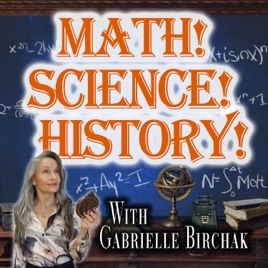
Math! Science! History!

Advertise on podcast: Math! Science! History!

Rating
4.7
from
14 reviews
This podcast has
214 episodes
Language
Explicit
No
Date created
2019/09/25
Latest episode
2026/04/22
Average duration
17 min.
Release period
3 days

Description

Why do some scientific breakthroughs look different up close than they do in our textbooks? How did math quietly shape the modern world? Math! Science! History! explores the human side of discovery, including the rivalries, the failed attempts, the bold ideas, and the marginalized voices behind the equations and experiments that changed science, technology, and everyday life. Hosted by Gabrielle Birchak, who holds degrees in mathematics and journalism, the show connects codebreaking, astronomy, probability, physics, and innovation to the world we live in today. If you enjoy science stories, historical investigations, and clear math grounded in context, clarity, and research, this show is for you. New episodes twice weekly. Visit www.MathScienceHistory.com for more information.

Unlock Math! Science! History! podcast Email contact info,
Listeners & Audience details

Email contact information

Direct podcast contact details

Listeners

Audience numbers & engagement insights

Audience details

Podcast Insights

Social media

Check Math! Science! History! social media presence


Podcast episodes

Check latest episodes from Math! Science! History! podcast


How AI Quietly Drives Climate Change
2026/04/22
In this Earth Day episode, I pull back the curtain on the hidden environmental cost of our digital lives. From streaming videos and sending emails to the explosive growth of artificial intelligence, I explore how the internet, often perceived as clean and intangible, is powered by massive, energy-hungry infrastructure that relies heavily on fossil fuels. I walk through the surprising math behind data centers, AI energy consumption, and e-waste, while challenging the narrative that tech is inherently sustainable. This episode isn't about guilt, it's about awareness, accountability, and asking better questions about the future we're building. What You'll Learn Why the internet produces 2–4% of global carbon emissions, rivaling the aviation industry How data centers consume massive amounts of electricity, enough to power millions of homes The hidden carbon cost of everyday actions like streaming, emailing, and searching online The environmental trade-offs of moving our lives online Whether AI is actually helping fight climate change, or making it worse What policies and systemic changes could meaningfully reduce tech's environmental impact How to think critically about digital consumption without falling into guilt-based thinking Quote from the Podcast "The invisibility of digital pollution is not a coincidence, it's a product of very deliberate branding." 🔗 Explore more on our website: mathsciencehistory.com 📚 To buy my book Hypatia: The Sum of Her Life on Amazon, visit https://a.co/d/g3OuP9h    🎧 Enjoying the Podcast? ☕ Support the Show: Coffee!! PayPal Leave a review! It helps more people discover the show! Share this episode with friends & fellow history buffs! Subscribe on your favorite podcast platform Check out our merch: https://www.mathsciencehistory.com/the-store Music: All music from Pixabay is public domain and has no Copyright and no rights reserved. Selections from The Little Prince by Lloyd Rodgers Until next time, carpe diem!
more
MOMENTUM! Earth Day and Common Ground
2026/04/20
In this Earth Day Week episode, I explore how momentum, whether in social movements, politics, or personal relationships, starts with communication, not agreement. Drawing from the origins of the first Earth Day, I highlight how bipartisan collaboration sparked a movement that engaged 20 million Americans. You'll learn how structured dialogue reduces polarization, why understanding values is the real bridge to empathy, and how consistent communication builds trust and momentum over time. This episode reveals the math of common ground and how two perspectives together solve complex problems better than one alone. 3 Things You'll Learn Why communication across disagreement is a proven strategy to reduce hostility and increase empathy. How finding common ground works like solving simultaneous equations in math, revealing shared solutions. The importance of consistent, repeated dialogue in building trust and sustaining momentum for change. Resources Earth Day history and 20 million participants: Earth Day History APA on healing political divides: Healing the Political Divide (APA) Stanford on empathy and polarization: Stanford Research on Empathy and Respect University of Rochester megastudy on reducing partisan animosity: Research-backed Ways to Bridge America's Political Divide UC Berkeley on limits of brief dialogue: Can Conversations Reduce Political Conflict?\u00A0  🔗 Explore more on our website: mathsciencehistory.com 📚 To buy my book Hypatia: The Sum of Her Life on Amazon, visit https://a.co/d/g3OuP9h  🎧 Enjoying the Podcast? 🔗 Explore more on our website: mathsciencehistory.com ☕ Support the Show: Coffee!! PayPal Leave a review! It helps more people discover the show! Share this episode with friends & fellow history buffs! Subscribe on your favorite podcast platform Check out our merch: https://www.mathsciencehistory.com/the-store Music: All music is Public Domain Mark 1.0 Universal and has no Copyright and no rights reserved. Selections from Violin Machine: A Deconstruction of the Bach Concerto by Lloyd Rodgers Until next time, carpe diem!
more
FLASHCARDS! How to Leave a Legacy
2026/04/17
Today's episode explores how you can intentionally build a meaningful legacy by learning from Rosalind Franklin, the scientist whose meticulous work uncovered the DNA double helix. Listeners will discover why precision and patience are essential in creating lasting impact, how to stay motivated when recognition is delayed, and how legacy is less about immediate fame and more about what you enable others to achieve. Tune in to gain practical insights on crafting a legacy that endures beyond your lifetime. Three Takeaways! Why Precision and Patience Matter: How careful, thoughtful work creates a foundation for lasting influence. Staying Motivated When Recognition Is Delayed: Understanding that value isn't always immediately visible. Legacy as What You Make Possible for Others: How your actions today can ripple forward and empower future generations.  🔗 Explore more on our website: mathsciencehistory.com 📚 To buy my book Hypatia: The Sum of Her Life on Amazon, visit https://a.co/d/g3OuP9h  🎧 Enjoying the Podcast? 🔗 Explore more on our website: mathsciencehistory.com ☕ Support the Show: Coffee!! PayPal Leave a review! It helps more people discover the show! Share this episode with friends & fellow history buffs! Subscribe on your favorite podcast platform Check out our merch: https://www.mathsciencehistory.com/the-store Music: All music is public domain and has no Copyright and no rights reserved. On Matters of Consequence from The Little Prince by Lloyd Rodgers Until next time, carpe diem!
more
Rosalind Franklin: The Half-Life of Recognition
2026/04/15
What happens when the person who does the most essential work never gets the credit? In this episode of Math, Science, History, I tell the story of Rosalind Franklin, the brilliant, exacting chemist whose X-ray diffraction image, Photo 51, revealed the double helix structure of DNA. From the basement of King's College London to the Nobel Prize ceremony she never attended, this episode traces how recognition fades, gets redistributed, and sometimes takes seventy years to settle. It's a story about science, yes, but also about who gets to be remembered, and why the quiet ones doing the actual work so often disappear from history before history knows it has a debt to pay. What You'll Learn ·         How Rosalind Franklin used X-ray crystallography to capture Photo 51, and what she derived from that single image ·         How Watson and Crick accessed Franklin's data without her knowledge, and what it meant for the published record ·         Why Franklin never shared in the 1962 Nobel Prize, and the ongoing debate about what would have happened had she lived Quote from the Episode "Rosalind Franklin knew the shape of DNA from its shadow. We know the shape of this problem from its data. The question this podcast really asks is whether knowing is enough.", Gabrielle Birchak Episode Resources Dr. Rosalind Franklin, Rosalind Franklin University The Story Behind Photograph 51, King's College London From the Archive: Rosalind Franklin's Famous Photo 51, UKRI Women Are Credited Less in Science Than Men, Nature Natalie Portman to Star as Rosalind Franklin in Photograph 51 Science Museum of Virginia, Rosalind Franklin   🔗 Explore more on our website: mathsciencehistory.com 📚 To buy my book Hypatia: The Sum of Her Life on Amazon, visit https://a.co/d/g3OuP9h 🎧 Enjoying the Podcast? ☕ Support the Show: Coffee!! PayPal Leave a review! It helps more people discover the show! Share this episode with friends & fellow history buffs! Subscribe on your favorite podcast platform Check out our merch: https://www.mathsciencehistory.com/the-store Music: All music is public domain and has no Copyright and no rights reserved. Selections from The Little Prince by Lloyd Rodgers Until next time, carpe diem!
more
MOMENTUM! How to Stop Paying the Hidden Brain Tax
2026/04/13
In this episode of Monday Momentum, I tackle the silent force that stalls your week before it even starts: overthinking. Drawing on groundbreaking cognitive research, including a Princeton study that found financial stress can drop mental performance by the equivalent of a 13-point IQ loss, and Bluma Zeigarnik's landmark 1927 findings on unfinished tasks, I reveal why mental drag is the hidden tax on your time, focus, and forward motion. More importantly, I shows you exactly how to break the loop: because momentum doesn't begin with perfect clarity, it begins with initiation. Even five minutes of action can be enough to shift your entire week. 🎓 THREE THINGS YOU'LL LEARN The neuroscience of overthinking, why financial stress and mental loops can drain your brain as much as losing an entire night of sleep, and what research says about the cognitive cost of worry. The Zeigarnik and Ovsiankina effects, how unfinished tasks hijack your mental bandwidth, and why starting,even for just five minutes,is the most powerful thing you can do to build momentum. Three practical steps to stop the loop this week, how to name your thought spiral, convert worry into one visible action, and use the five-minute launch to break through avoidance and build unstoppable forward motion. 🔗 Explore more on our website: mathsciencehistory.com 📚 To buy my book Hypatia: The Sum of Her Life on Amazon, visit https://a.co/d/g3OuP9h  🎧 Enjoying the Podcast? 🔗 Explore more on our website: mathsciencehistory.com ☕ Support the Show: Coffee!! PayPal Leave a review! It helps more people discover the show! Share this episode with friends & fellow history buffs! Subscribe on your favorite podcast platform Check out our merch: https://www.mathsciencehistory.com/the-store Music: All music is Public Domain Mark 1.0 Universal and has no Copyright and no rights reserved. Selections from Violin Machine: A Deconstruction of the Bach Concerto by Lloyd Rodgers Until next time, carpe diem!
more
FLASHCARDS! Beat Tax Anxiety: Cognitive Tips to Reduce Stress
2026/04/10
Tax season can feel overwhelming, even for people who enjoy working with numbers. In this Flashcards Friday episode, Gabrielle breaks down the science behind why taxes trigger stress and offers three practical, math-inspired strategies to make the process more manageable. By understanding how your brain processes complexity and anxiety, you can approach taxes with clarity, structure, and a stronger sense of control. What You'll Learn How working memory overload contributes to tax season overwhelm, and how to reduce it A simple Bayesian-style approach to managing financial anxiety with real evidence How reframing taxes as part of a larger historical and personal narrative can reduce stress and increase motivation  📣 Calls to Action Subscribe to Math! Science! History! so you never miss a Flashcards Friday Share this episode with someone who is feeling overwhelmed this tax season Leave a review on your favorite podcast platform to help others discover the show Visit your website for more math-meets-life insights and episode resources 🔗 Explore more on our website: mathsciencehistory.com 📚 To buy my book Hypatia: The Sum of Her Life on Amazon, visit https://a.co/d/g3OuP9h 🎧 Enjoying the Podcast? 🔗 Explore more on our website: mathsciencehistory.com ☕ Support the Show: Coffee!! PayPal Leave a review! It helps more people discover the show! Share this episode with friends & fellow history buffs! Subscribe on your favorite podcast platform Check out our merch: https://www.mathsciencehistory.com/the-store Music: All music is public domain and has no Copyright and no rights reserved. Selections from The Little Prince by Lloyd Rodgers Until next time, carpe diem!
more
The History of Taxes: From Ancient Civilizations to Modern Income Tax
2026/04/08
Taxes feel like a modern invention, tied to governments, elections, and April deadlines, but their story stretches back over five thousand years. In this episode of Math! Science! History!, Gabrielle traces the origins of taxation from ancient Mesopotamian clay tablets and Egyptian grain levies to Roman tax farmers, medieval tithes, and the birth of the modern income tax. Along the way, she explores how taxation has always been more than economics, it is a reflection of power, fairness, and the cost of belonging to a society. What You'll Learn How taxation began in ancient Mesopotamia as a system tied to temples and survival Why ancient Egypt created one of the first structured tax systems How Athens and Rome approached taxation very differently, and what that reveals about politics The role of feudalism and the church in shaping medieval taxation Why the Magna Carta transformed the idea of taxation and consent How and why the modern income tax was introduced in Britain and the United States The origin of tax withholding and why it changed everything What "top marginal tax rate" actually means (and why it matters) How war, especially mass conscription, drove some of the highest tax rates in history Why debates about "fair share" have remained unchanged for thousands of years Quote from the Episode "Who decides what you owe, and what does it cost to belong to a society?" Episode Resources History of Taxation (Britannica): https://www.britannica.com/topic/taxation/History-of-taxation Brief History of the IRS: IRS history timeline | Internal Revenue Service The 16th Amendment (U.S. National Archives): https://www.archives.gov/milestone-documents/16th-amendment UK Parliament: History of Income Tax: https://www.parliament.uk/about/living-heritage/transformingsociety/private-lives/taxation/overview/incometax/ Historical Income Tax Rates and Brackets, 1862-2025 Magna Carta Overview: Magna Carta - Summary, Facts & Rights | HISTORY 🔗 Explore more on our website: mathsciencehistory.com 📚 To buy my book Hypatia: The Sum of Her Life on Amazon, visit https://a.co/d/g3OuP9h 🎧 Enjoying the Podcast? ☕ Support the Show: Coffee!! PayPal Leave a review! It helps more people discover the show! Share this episode with friends & fellow history buffs! Subscribe on your favorite podcast platform Check out our merch: https://www.mathsciencehistory.com/the-store Music: All music is public domain and has no Copyright and no rights reserved. Selections from The Little Prince by Lloyd Rodgers Dulcimer Dance by Arizona Guide from Pixabay Beata – Dark Pagan by Claude Houde from Pixabay All the Things by Abydos_Music from Pixabay Apathias-dark-ambient by Vlad Bakutov from Pixabay SFX – Horse Galloping – coconut shells by alanmcki on Freesound Until next time, carpe diem!
more
MOMENTUM! Move Forward with Mentorship!
2026/04/06
In this week's Monday Momentum, I explore how mentorship creates forward motion in both your career and your life. Inspired by the Maria Gaetana Agnesi episode, I discuss how seeking guidance and giving guidance in parallel acts like a flywheel, building momentum that carries projects, learning, and personal growth forward. I share actionable tips for finding a mentor, mentoring others, and observing the momentum that emerges when support flows in both directions. Resources & Research: Less than half of professionals report having a mentor, yet those with mentors are much more likely to advance and feel engaged at work (Gallup) Mentored employees are promoted up to five times more often, and mentors themselves can see promotions up to six times more often (Mentorloop) Mentorship improves job satisfaction and organizational commitment Organizations with mentoring programs experience higher engagement and retention (Chronus) Long-term mentoring correlates with higher lifetime earnings, educational attainment, and leadership development (After School Alliance)    🔗 Explore more on our website: mathsciencehistory.com 📚 To buy my book Hypatia: The Sum of Her Life on Amazon, visit https://a.co/d/g3OuP9h   🎧 Enjoying the Podcast? 🔗 Explore more on our website: mathsciencehistory.com ☕ Support the Show: Coffee!! PayPal Leave a review! It helps more people discover the show! Share this episode with friends & fellow history buffs! Subscribe on your favorite podcast platform Check out our merch: https://www.mathsciencehistory.com/the-store Music: All music is public domain and has no Copyright and no rights reserved. Selections from Violin Machine by Lloyd Rodgers Until next time, carpe diem!
more
FLASHCARDS! Six Gates of Access: Why Resources Exist But Women Can't Reach Them
2026/04/03
In this episode of Flashcards Friday, I break down a powerful diagnostic framework, the Six Gates of Access, that reveals why resources like healthcare, education, legal help, and business funding can exist on paper while remaining completely out of reach for millions of women. Moving far beyond the question of whether help exists, I map each gate, Awareness, Eligibility, Friction, Capacity, Continuity, and Safety, across four real-world scenarios: maternal health, advanced education, entrepreneurship, and workplace discrimination, giving listeners a practical tool to identify exactly which barrier is blocking progress and what to do about it. Learn about:  The Six Gates of Access framework, a diagnostic model that explains why "a resource exists" and "a resource is reachable" are two very different things, and how any single failing gate can make an entire system inaccessible. How the gates show up differently depending on whether you're seeking prenatal care, a college degree, a small business loan, or legal help for workplace discrimination, same model, entirely different doorways. Actionable gate-opening strategies, specific, real-world workarounds for each gate so you can stop asking "what's wrong with me?" and start asking "which gate is this, and how do I push through it?" 🔗 Explore more on our website: mathsciencehistory.com 📚 To buy my book Hypatia: The Sum of Her Life on Amazon, visit https://a.co/d/g3OuP9h  🎧 Enjoying the Podcast? 🔗 Explore more on our website: mathsciencehistory.com ☕ Support the Show: Coffee!! PayPal Leave a review! It helps more people discover the show! Share this episode with friends & fellow history buffs! Subscribe on your favorite podcast platform Check out my merch: https://www.mathsciencehistory.com/the-store Music: All music is public domain and has no Copyright and no rights reserved. On Matters of Consequence from The Little Prince by Lloyd Rodgers  Until next time, carpe diem!  - Gabrielle  
more
Maria Agnesi: Calculus Pioneer and Charity Leader
2026/03/31
This episode of Math! Science! History! uncovers the true story of Maria Gaetana Agnesi, the 18th-century mathematician mislabeled the "Witch of Agnesi." In this episode I explore her groundbreaking textbook, the social pressures she faced, and her later life of charity. Episode Overview Visit Milan's intellectual salons where young Agnesi dazzled as a polyglot prodigy, only to channel her brilliance into Instituzioni analitiche, a pioneering calculus textbook for Italian youth. Discover how she rejected fame for charity, leading a hospital for the poor and dying among those she served, showing that her legacy was teaching and compassion, not witchcraft. Three Things Listeners Will Learn Agnesi's "Witch" curve was a mistranslation of versiera; her real impact was systematizing calculus for students. Despite family ambitions and societal constraints, she authored the first advanced math text by a woman, aided by mentors like Rampinelli. In her later years, she ran a Milan hospital and chose to be close to the women she cared after. 🔗 Explore more on our website: https://www.MathScienceHistory.com 📚 To buy my book Hypatia: The Sum of Her Life on Amazon, visit https://a.co/d/g3OuP9h 🎧 Enjoying the Podcast? ☕ Support the Show: Coffee!! PayPal Leave a review! It helps more people discover the show! Share this episode with friends & fellow history buffs! Subscribe on your favorite podcast platform Check out our merch: https://www.mathsciencehistory.com/the-store Music: All music is public domain and has no Copyright and no rights reserved. Selections from The Little Prince by Lloyd Rodgers Little Prelude for the Luth - by Laurent Buczek from Pixabay The Venture by aidanpinsent from Pixabay Unconditional by aidanpinsent from Pixabay Until next time, carpe diem!
more
FLASHCARDS! How Diversity Drives Scientific Breakthroughs
2026/03/27
In this Flashcard Friday episode of Math! Science! History!, we spotlight three groundbreaking scientists whose outsider perspectives didn't just add diversity to their fields, they fundamentally changed what science could discover. From Flossie Wong-Staal's molecular work that cracked the mystery of HIV and transformed AIDS treatment, to Omar Yaghi's Nobel Prize-winning invention of metal-organic frameworks that opened a new era of chemistry by design, to Mario Molina's courageous atmospheric research that led to the Montreal Protocol and the slow recovery of Earth's ozone layer, this episode reveals the powerful and undeniable connection between diverse scientific participation and world-changing progress. These aren't just inspiring stories, they're a blueprint for why inclusion isn't optional in science; it's essential. 5 Things Listeners Will Learn How Flossie Wong-Staal helped clone and sequence the HIV genome, making blood screening, transmission prevention, and antiretroviral drug development possible, saving millions of lives. What reticular chemistry is and why Omar Yaghi's metal-organic frameworks represent a revolutionary shift from discovering materials to deliberately designing them, with applications in carbon capture, clean energy, and water purification. How Mario Molina proved that CFCs were destroying the ozone layer, and how his politically unwelcome findings directly led to the Montreal Protocol, one of the most successful environmental treaties in history. Why diverse scientific perspectives accelerate discovery, including how different training, cultural backgrounds, and intellectual traditions help science identify errors faster and reach more robust solutions. The real cost of discrimination in science, not just to individuals, but to the pace of discovery, the accuracy of evidence, and the problems humanity can solve. Resources & Further Reading ·         🔬 Flossie Wong-Staal ·         ⚗️ Omar Yaghi & the 2025 Nobel Prize in Chemistry, Nobel Prize Official Announcement | Yaghi Research Group, UC Berkeley ·         🌍 Mario Molina & the Montreal Protocol, UNEP: Montreal Protocol Overview ·         📚 Reticular Chemistry, Yaghi Lab Introduction to MOFs 💬 Enjoyed this episode? Leave us a review on Apple Podcasts, it helps more curious minds find the show! And share this episode with a student, teacher, or science lover in your life.  🔗 Explore more on our website: mathsciencehistory.com 📚 To buy my book Hypatia: The Sum of Her Life on Amazon, visit https://a.co/d/g3OuP9h  🎧 Enjoying the Podcast? 🔗 Explore more on our website: mathsciencehistory.com ☕ Support the Show: Coffee!! PayPal Leave a review! It helps more people discover the show! Share this episode with friends & fellow history buffs! Subscribe on your favorite podcast platform Check out our merch: https://www.mathsciencehistory.com/the-store Music: All music is public domain and has no Copyright and no rights reserved. Selections from The Little Prince by Lloyd Rodgers Until next time, carpe diem!
more
The Math of Matilda
2026/03/24
This episode reframes the Matilda Effect not as a simple story of stolen credit, but as a mathematical and institutional process in which small biases compound over time. Drawing on sociology of science, network theory, and citation dynamics, the script explains how cumulative advantage systems, like preferential attachment and the Matthew Effect, amplify early visibility into lasting historical recognition, even without overt wrongdoing. It shows how peer review, authorship norms, invisible labor, and archival practices inherit and reinforce these dynamics, making later corrections ineffective. Ultimately, the episode argues that the Matilda Effect persists because recognition itself behaves mathematically, and that changing history requires deliberate intervention at the points where credit is first assigned, cited, preserved, and taught. What you'll learn: The Matilda Effect isn't about stolen ideas, it's about systems that compound bias. Small disadvantages early in a career can snowball into permanent historical erasure. Recognition follows mathematical rules like cumulative advantage and preferential attachment. Peer review doesn't reset inequality, it inherits it. Essential scientific labor often disappears because it doesn't generate "credit." Archives and citations decide what history remembers, and what it forgets. Delayed recognition isn't neutral; in cumulative systems, timing is everything. Where we cite, credit, and preserve work today shapes tomorrow's history. Even small acts of recognition matter, because they compound. 🔗 Explore more on our website: mathsciencehistory.com 📚 To buy my book Hypatia: The Sum of Her Life on Amazon, visit https://a.co/d/g3OuP9h  🎧 Enjoying the Podcast? ☕ Support the Show: Coffee!! PayPal Leave a review! It helps more people discover the show! Share this episode with friends & fellow history buffs! Subscribe on your favorite podcast platform Music: Shopping with Mom by Gabrielle Birchak. All other music is public domain and has no Copyright and no rights reserved. Until next time, carpe diem!
more
FLASHCARDS! Dr. Yvonne Sylvain: Haiti's First Female Doctor
2026/03/20
In this Flashcard Friday episode of Math! Science! History!®, host Gabrielle Birchak celebrates Women's History Month and Podcasthon by spotlighting Dr. Yvonne Sylvain, Haiti's first female physician. Born in 1907 into a family of intellectuals and resistance fighters, Dr. Sylvain shattered barriers to become a pioneer in obstetrics, gynecology, and cancer screening. Her story reveals a Haiti rarely seen in today's headlines: a nation rich in brilliance, where educated professionals built real systems of care, and where political instability repeatedly threatened to dismantle them. This episode is paired with a companion interview with Angie Maldonado, founder of Espwa Means Hope, a U.S.-based 501(c)(3) nonprofit working in rural Haiti to empower families through maternal health care, education, and job creation. 'What the Doctor Ordered': 3 Things You'll Learn 1. Haiti Has Always Had Brilliant Builders, Not Just Crises Dr. Sylvain's life dismantles the narrative that Haiti has always been defined by instability. She attended medical school, trained at Columbia University, became a medical professor, and introduced cervical cancer screening via the Pap smear to Haiti, all in an era when women were rarely admitted to medical schools anywhere in the world. 2. Maternal Health Is the Foundation of a Functioning Society Sylvain specialized in obstetrics and gynecology because she understood that healthy pregnancies and preventive women's health care are not extras, they are the biological and social foundation of generational continuity. Her advocacy for deep X-ray, radium treatment, and cancer screening in Haiti was ahead of her time. 3. Political Disruption Doesn't Destroy Expertise, It Just Keeps Interrupting It From the U.S. occupation of Haiti to the Duvalier dictatorship, Dr. Sylvain's career was repeatedly shaped by forces outside medicine. She worked with the WHO, consulted across Africa and Central America, and still returned to lay the groundwork for Haiti's Frères Community Hospital. Her story is a masterclass in professional persistence under adverse conditions. Related Episodes 🎙️ Listen to Gabrielle's companion interview with Angie Maldonado, founder of Espwa Means Hope, available in your podcast feed. To donate to Espwa Means Hope, please visit https://www.EspwaMeansHopeHaiti.org  🔗 Explore more on our website: mathsciencehistory.com 📚 To buy my book Hypatia: The Sum of Her Life on Amazon, visit https://a.co/d/g3OuP9h  🌍 Let's Connect! Bluesky: https://bsky.app/profile/mathsciencehistory.bsky.social Instagram: https://www.instagram.com/math.science.history Facebook: https://www.facebook.com/mathsciencehistory  LinkedIn: https://www.linkedin.com/company/math-science-history/  Threads: https://www.threads.com/@math.science.history  Mastodon: https://[email protected] YouTube: Math! Science! History! - YouTube Pinterest: https://www.pinterest.com/mathsciencehistory  🎧 Enjoying the Podcast? 🔗 Explore more on our website: mathsciencehistory.com ☕ Support the Show: Coffee!! PayPal Leave a review! It helps more people discover the show! Share this episode with friends & fellow history buffs! Subscribe on your favorite podcast platform Check out our merch: https://www.mathsciencehistory.com/the-store Music: All music is public domain and has no Copyright and no rights reserved. On Matters of Consequence by Lloyd Rodgers Sacred Garden by Guilherme Bernardes from Pixabay Unworthy by Guilherme Bernardes from Pixabay Until next time, carpe diem!  
more
Annie Jump Cannon: The Census Taker of the Sky
2026/03/19
She looked at starlight and said, I can organize that, and then she did! For Women's History Month, host Gabrielle Birchak profiles Annie Jump Cannon (1863–1941), the American astronomer who took a chaotic universe and filed it into something the world could actually study. Cannon was one of the Harvard Computers, a group of women hired at Harvard College Observatory to analyze photographic glass plates of the night sky, and she became the fastest, most prolific stellar classifier in history. Over her lifetime, she manually classified over 350,000 stars, more than any person before or since. In this episode, Gabrielle breaks down the Harvard Spectral Classification System, OBAFGKM, the sequence Cannon refined and that astronomers worldwide still use today. You'll learn what each letter means, what colors and temperatures they represent, where our own sun sits in the sequence (spoiler: it's a G2 star), and why Cannon's seemingly quiet classification work was actually one of the most powerful scientific acts of the early twentieth century. Classification, Gabrielle argues, isn't boring, it's the infrastructure that turned starlight into data and beautiful objects into the science of astrophysics. This episode also reflects on the human side of Cannon's story: the fact that she was nearly deaf for most of her career, that she was a suffragist, that she produced one of the most monumental data catalogs in scientific history, the nine-volume Henry Draper Catalogue, and that despite her extraordinary achievements, her system was named the Harvard Classification System, not the Cannon System. Her work endured. Her system stayed. That's the real legacy. Key Topics Covered: Who Annie Jump Cannon was and why she matters for Women's History Month The Harvard Computers and their role at Harvard College Observatory The OBAFGKM stellar spectral classification sequence, explained color by color and temperature by temperature The Henry Draper Catalogue: 225,300 stars classified across nine volumes, 1918–1924 Why classification isn't clerical work, it's the foundation of science Cannon's recognition, awards, and the Annie Jump Cannon Award, still given annually by the American Astronomical Society FEMINIST MNEMONIC (GABRIELLE'S VERSION) Obviously Bold, A Feminist Generation Keeps Marching. O – B – A – F – G – K – M RESOURCES & LINKS About Annie Jump Cannon Annie Jump Cannon Biography, National Women's History Museum Annie Jump Cannon: Star Classifier, Sky & Telescope Annie Jump Cannon, Space.com The Harvard Computers Project PHaEDRA: Transcribing the Work of the Harvard Computers, Smithsonian Digital Volunteers The Henry Draper Catalogue The Henry Draper Catalogue, Internet Archive (original volumes, free) Stellar Classification Harvard Spectral Classification, Annie Jump Cannon and the Creation of Stellar Classification (Princeton Astronomy) The Annie Jump Cannon Award Annie Jump Cannon Award in Astronomy, American Astronomical Society 2025 Recipient: Maya Fishbach (University of Toronto), gravitational-wave astrophysics & cosmology 2024 Recipient: Jennifer Bergner (UC Berkeley), astrochemistry and planetary formation Recommended Reading The Glass Universe: How the Ladies of the Harvard Observatory Took the Measure of the Stars by Dava Sobel, Penguin Random House | Amazon 🔗 Explore more on our website: mathsciencehistory.com 📚 To buy my book Hypatia: The Sum of Her Life on Amazon, visit https://a.co/d/g3OuP9h 🌍 Let's Connect! Bluesky: https://bsky.app/profile/mathsciencehistory.bsky.social Instagram: https://www.instagram.com/math.science.history Facebook: https://www.facebook.com/mathsciencehistory  LinkedIn: https://www.linkedin.com/company/math-science-history/  Threads: https://www.threads.com/@math.science.history  Mastodon: https://[email protected] YouTube: Math! Science! History! - YouTube Pinterest: https://www.pinterest.com/mathsciencehistory  🎧 Enjoying the Podcast? ☕ Support the Show: Coffee!! PayPal Leave a review! It helps more people discover the show! Share this episode with friends & fellow history buffs! Subscribe on your favorite podcast platform Check out our merch: https://www.mathsciencehistory.com/the-store Music: All music is public domain and has no Copyright and no rights reserved. Selections from The Little Prince by Lloyd Rodgers. Calm Piano - by Breakz Studios from Pixabay   Until next time, carpe diem!
more
SPECIAL: Podcasthon and Espwa Means Hope
2026/03/17
It's Podcasthon Week! In this special Women's History Month and Podcasthon episode of Math! Science! History!, I Gabrielle Birchak interviews Angie Maldonado, founder of Espwa Means Hope, a U.S.-based 501(c)(3) nonprofit working in rural, mountainous Haiti. Angie shares the story that sparked Espwa's mission, the stark realities behind maternal and infant mortality, and what "progress" looks like when the goal is as fundamental as keeping mothers and babies alive. You will hear how Espwa built programs around what the community needed, from mobile prenatal education and nutrition support to job creation through a women-led sewing program, and why their "First 1,000 Days" model focuses on nutrition and learning from pregnancy through age two. Angie also explains the current barriers to sustaining healthcare and education in Haiti, especially the impact of gang violence and instability, and how people outside Haiti can make tangible differences through monthly giving. Support Espwa Means Hope: EspwaMeansHopeHaiti.org For more info on Podcasthon, please visit: Podcasthon.org 🔗 Explore more on our website: mathsciencehistory.com   🌍 Let's Connect! Bluesky: https://bsky.app/profile/mathsciencehistory.bsky.social Instagram: https://www.instagram.com/math.science.history Facebook: https://www.facebook.com/mathsciencehistory  LinkedIn: https://www.linkedin.com/company/math-science-history/  Threads: https://www.threads.com/@math.science.history  Mastodon: https://[email protected] YouTube: Math! Science! History! - YouTube Pinterest: https://www.pinterest.com/mathsciencehistory  🎧 Enjoying the Podcast? ☕ Support the Show: Coffee!! PayPal Leave a review! It helps more people discover the show! Share this episode with friends & fellow history buffs! Subscribe on your favorite podcast platform Check out our merch: https://www.mathsciencehistory.com/the-store Music: All music is public domain and has no Copyright and no rights reserved. Selections from The Little Prince by Lloyd Rodgers All music from Pixabay is public domain Music by Harmony of Heaven from Pixabay Music by Yurii Suprunenko from Pixabay Music by Clavier Clavier from Pixabay Music by Yurii Suprunenko from Pixabay Music by Universfield from Pixabay Until next time, carpe diem!
more

Podcast reviews

Read Math! Science! History! podcast reviews


4.7 out of 5
14 reviews
profg1 2024/11/07
More than a diversion
When I first started listening to MSH I recommended it to my students, not so much for them, but to introduce their children, nieces, or nephews to ma...
more
Rico J! 2022/04/06
Mind Bending
For those of us that can reach beyond our own imaginings comes an exciting way to learn the intricacies of science, math and history. What a brilliant...
more
jbirkman 2021/02/24
MathScienceHistory
The depth of her research comes through in every episode presented with passion and care.
check all reviews on apple podcasts

Podcast sponsorship advertising

Start advertising on Math! Science! History! & sponsor relevant audience podcasts


What do you want to promote?

Ad Format

Campaign Budget

Business Details