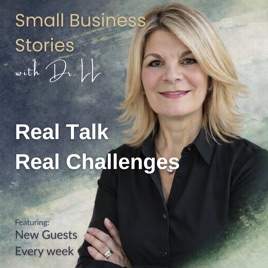
Advertise on podcast: Small Business Stories
Rating
4.8from
This podcast has
200 episodes
Language
EnglishPublisher
Loralyn Mears, PhDExplicit
No
Date created
2019/10/10
Latest episode
2026/10/07
Average duration
34 min.
Release period
3 days
Description
Welcome to Small Business Stories, the podcast where we celebrate the real-life journeys of small business owners. We dig into inspiring tales of triumphs, challenges, and the tough lessons we learned along the way. Each episode is packed with relatable anecdotes and practical tips that you can use to fuel your own entrepreneurial dreams. Whether you're just starting out or looking to grow your business, you'll find motivation and insight in every story. Tune in and get ready to be inspired by the heart and hustle of small business owners just like you! We say it like it is - no filters. Being an SMB owner isn't easy, but we're compelled to do it.
Unlock Small Business Stories podcast Email contact info,
Listeners & Audience details
Email contact information
Direct podcast contact details

Listeners
Audience numbers & engagement insights

Audience details
Podcast Insights



Podcast episodes
Check latest episodes from Small Business Stories podcast
Why Higher Sales Aren't Fixing Your Cash Flow with Matan Bar CEO Xero US
2026/10/07
S6:E87
Overall, small business sales are growing. So why do so many owners still feeling the squeeze?
The answer is hiding underneath the headline.
Matan Bar, CEO of Xero U.S., joins Dr. LL to unpack what Xero's U.S. Small Business Insights data reveals when you look beyond one encouraging number: sales may be improving, but businesses are also contending with rising costs, longer waits for payment, geographic differences, and a financial picture that varies dramatically depending on what kind of business you actually operate.
This isn't simply a conversation about accounting.
It's about interpretation.
If people don't trust the numbers, they can't confidently make decisions from them.
If a headline accurately reports one measure while obscuring several others, the conclusion can still be wrong.
And if AI can slice, summarize, and visualize enormous amounts of data, the ability to understand what that information actually means becomes more important, not less.
Loralyn Mears, PhD, aka "Dr. LL," brings you thoughtful conversations with entrepreneurs and small business leaders navigating visibility, leadership, and growth. Thank you for being here.
👤 Guest Matan Bar
CEO, Xero U.S.
Small business technology, payments, financial operations, and AI
⚠️ Core Problems Discussed • Why improving sales don't necessarily indicate improving business health
• Longer payment cycles and the pressure they create on small-business cash flow
• The tension between businesses wanting to get paid quickly while preserving their own cash as long as possible
• How outdated payment systems add unnecessary friction
• Why national averages obscure substantial geographic and industry differences
• Whether AI will widen the productivity gap between large and small businesses
• The risk of having more data without correctly interpreting what it means
🥡 Practical Takeaways • Business health requires looking beyond sales to cash flow, costs, payment timing, and the circumstances of the individual business.
• Faster payment technology can benefit both sides by allowing payers to hold cash longer while still delivering payment on time.
• Geographic differences may reflect the industry mix and business characteristics inside each region rather than geography alone.
• Small businesses may adopt AI differently from enterprises because limited budgets force them to focus on demonstrated value.
• Matan believes AI ultimately has the potential to give small businesses capabilities once reserved for much larger companies.
• Better dashboards don't automatically produce better decisions; interpretation remains essential.
• For financial decisions where accuracy matters enormously, Matan argues for keeping knowledgeable humans in the loop.
⏱️ Timestamps 02:25 The encouraging small-business headline and what it misses
05:02 Are small businesses actually underperforming?
07:48 New businesses, AI, and changing economic averages
11:49 Why businesses are waiting longer to get paid
14:10 The overlooked problem of non-payment
17:20 Are generous payment terms hurting small businesses?
23:27 Why faster payments can actually mean holding cash longer
24:19 State-by-state differences hidden inside national averages
29:14 Could AI create a productivity divide?
30:15 Why Matan thinks AI will level the playing field
34:41 Dr. LL introduces misinterpretation risk
36:11 Matan on "accountable intelligence" and human judgment
39:09 What Matan wishes every small business owner knew
🔖 Who This Episode Is For Small business owners, entrepreneurs, advisors, accountants, and leaders trying to make sense of what economic headlines, financial data, and AI actually mean for the decisions they need to make.
At STEERus, Data Distortion is one expression of misinterpretation risk: information can be factually correct while the conclusion drawn from it is incomplete or wrong. Increasing the volume of information doesn't solve that problem; businesses need clearer signals and better interpretation.
Subscribe and share Small Business Stories for grounded conversations about entrepreneurship, visibility, leadership, AI, and what business owners are actually experiencing behind the headlines.
✅ Subscribe for weekly conversations on entrepreneurship
🔁 Share this episode with someone who needs to be heard
Follow STEERus on social media:
YouTube: https://www.youtube.com/@DrLLSmallBusiness
Instagram: https://instagram.com/steerus
LinkedIn: https://www.linkedin.com/company/steerus
Twitter: https://x.com/steerus_io
#entrepreneurship #smallbusiness #podcast #CEO #cashflow #money #finance
You Might Enjoy: On Purpose with Jay Shetty
2026/10/07
Introducing MIKAYLA NOGUEIRA EXCLUSIVE: The Story She’s Finally Ready to Tell from On Purpose with Jay Shetty.
Follow the show: On Purpose with Jay Shetty
Jay sits down with beauty creator Mikayla Nogueira to go beyond the online persona and share the real story behind her rise. Mikayla opens up about the struggles that shaped her before finding success, the viral moment that changed her life overnight, and the painful reality of a marriage impacted by addiction and divorce. She also shares how she found her way forward, reconnected with her high school first love, and launched her own beauty brand with Sephora.
With Love and Gratitude,
Jay Shetty
Built-in protections for teens.
JAY'S DAILY WISDOM DELIVERED STRAIGHT TO YOUR INBOX
Join 900,000+ readers discovering how small daily shifts create big life change with my free newsletter. Subscribe here: https://news.jayshetty.me/subscribe
Check out our Apple subscription to unlock bonus content of On Purpose! https://lnk.to/JayShettyPodcast
What We Discuss:
00:00 Introduction
00:45 Why Share Your Story Now?
01:31 Beyond The Influencer Persona
02:46 Childhood Memories That Shaped Her
03:45 Bullying & Discovering Makeup At Age 10
05:24 The Insecurities Behind the Confidence
06:48 Expressing Her True Self Online
08:55 The Origin Of Her Passion For Makeup
11:18 Work Ethic And Thinking Big
12:37 Creating Her Very First YouTube Video
13:58 Presenting A 50-Page Business Plan
16:30 Returning To Her Hometown & Donating Makeup
18:00 Getting Hired At Ulta Beauty
23:52 Letting Go of the Future She Planned
28:10 Losing Her Job and Finding a New Path
31:34 The First Viral Video
37:08 Manifesting Success & Building A Content Engine
41:53 Experiencing Her First Cancellation
45:25 Reflecting on Past Controversies
48:56 The Mental Health Toll of Rapid Growth
52:54 The Boston Accent
56:48 Meeting Her Ex-Husband Cody
59:41 Navigating Addiction In A Relationship
01:04:08 Dating An Influencer & Dating An Addict
01:05:56 Marriage Through Addiction and Relapse
01:13:00 A Harrowing Late-Night Emergency
01:18:11 Making the Decision to Divorce
01:33:53 The Path To Divorce
01:40:46 Finally A Fresh Start
01:46:45 Reconnecting With High School First Love, Zach
01:52:21 Building Her Beauty Brand (POV)
01:57:30 Looking Back
01:59:34 Mikayla On Final Five
Episode Resources:
Facebook | https://www.facebook.com/share/1C43BCLCFi/?mibextid=wwXIfr
TikTok | https://www.tiktok.com/@mikaylanogueira
Instagram | https://www.instagram.com/mikaylajmakeup
Learn more about your ad choices. Visit podcastchoices.com/adchoices
DISCLAIMER: Please note, this is an independent podcast episode not affiliated with, endorsed by, or produced in conjunction with the host podcast feed or any of its media entities. The views and opinions expressed in this episode are solely those of the creators and guests. For any concerns, please reach out to [email protected].
How an Overlooked Service Business & Dirty Job Makes Money with Mark Regan
2026/10/02
S6:E86
The businesses people overlook may be the ones worth examining. Especially those ew - yucky - services! Entrepreneurship culture gives enormous attention to innovation, technology, and businesses that sound impressive. Mark Regan built something very different: a recurring-revenue company around a simple problem many people do not want to solve themselves.
In this episode of Small Business Stories, Mark and Dr. LL unpack what it actually takes to turn an unglamorous idea into a durable service business from pricing and route density to customer retention, franchising, and the unexpected challenge of getting AI to understand what kind of business you actually are.
If people don't understand what you do, they may underestimate its value.
If AI doesn't understand what you do, you may never surface when someone is looking for it.
Loralyn Mears, PhD, aka "Dr. LL," brings you thoughtful conversations with entrepreneurs and small business leaders navigating visibility, leadership, and growth. Thank you for being here.
👤 Guest Mark Regan
Co-founder, Poop Away
Service-business operations, recurring revenue, customer retention, and franchising
⚠️ Core Problems • Looking past viable businesses because they lack status or glamour
• Mistaking revenue for profitability without understanding the operating math
• Getting categorized incorrectly when a business crosses traditional industry boundaries
🥡 Practical Takeaways • Start with a problem people genuinely want solved.
• Recurring revenue only works when the operating economics work.
• Customer trust can become a competitive advantage even in a seemingly transactional service.
• In the AI-search era, business categorization is becoming part of business strategy.
⏱️ Timestamps 03:15 — "Who would pay for that?" becomes a business
07:35 — The operating mistakes Mark wishes they had avoided
11:29 — Customer service as a retention strategy
21:16 — The operator mindset required for franchising
23:27 — Misinterpretation risk meets AI search
🔖 Who This Episode Is For Entrepreneurs searching for realistic business opportunities, service-business owners trying to build recurring revenue, and founders whose businesses do not fit comfortably inside one familiar category.
At STEERus, we study what happens when the value is real, but the signals people and machines use to interpret that value are not clear enough.
Subscribe to Small Business Stories for more real-world conversations about what it actually takes to build, operate, and sustain a business and share this episode with an entrepreneur who may be overlooking the opportunity right in front of them.
✅ Subscribe for weekly conversations on entrepreneurship
🔁 Share this episode with someone who needs to be heard
Follow STEERus on social media:
YouTube: https://www.youtube.com/@DrLLSmallBusiness
Instagram: https://instagram.com/steerus
LinkedIn: https://www.linkedin.com/company/steerus
Twitter: https://x.com/steerus_io
#entrepreneurship #smallbusiness #podcast #dogs
The Ripple Effect of Intentional Leadership with Lisa Even
2026/09/30
S6:E85
People experience your leadership long before you make a formal leadership decision.
It's in how you enter a room. How you react when you're stressed. Whether you acknowledge someone. The story you tell. The difficult interaction you choose not to pass along to the next person.
Lisa Even calls it the ripple effect: everything we say and do creates one, whether we're consciously choosing it or not.
In this episode, Lisa and Dr. LL explore intentional leadership, workplace culture, experimentation, small moments of human connection, and why impact doesn't have to be enormous to become meaningful.
If people don't trust what version of you is going to walk into the room, they start preparing for you.
If employees repeatedly experience something different from the leadership values an organization claims, those interactions become more credible than the words.
And if we're unaware of the signals we're continually sending, other people are left to interpret them for themselves.
Loralyn Mears, PhD, aka "Dr. LL," brings you thoughtful conversations with entrepreneurs and small business leaders navigating visibility, leadership, and growth. Thank you for being here.
👤 Guest Lisa Even
Founder, Lisa Even International
Leadership, workplace culture, intentional impact, and keynote speaking
⚠️ Core Problems Discussed • How stress and chaos affect the energy leaders bring into interactions
• Why employees remember small experiences that leaders may barely notice
• The difficulty of influencing people when you may never see the downstream outcome
• Leading different people as individuals rather than using one leadership approach for everyone
• Perfectionism preventing leaders and entrepreneurs from testing new approaches
• Passivity creating outcomes leaders never consciously chose
• Assuming meaningful impact requires a grand gesture
🥡 Practical Takeaways • Everything you say and do creates a ripple, even when you never see where it travels.
• Stories can make abstract leadership principles easier for people to remember and apply.
• Small experiments give entrepreneurs permission to learn without needing perfection.
• Different employees may require different questions, communication styles, and approaches.
• Intentional leadership doesn't guarantee outcomes, but it makes those outcomes less accidental.
• Small interactions can become disproportionately memorable.
• Think of your energy like weather: people may already be preparing themselves for what you bring into the room.
⏱️ Timestamps 01:34 What "ripple effect" actually means
04:08 The coffee-shop encounter that illustrates how behavior travels
07:15 Choosing your impact even when you never see the result
09:32 How to gently interrupt someone's negative ripple
15:53 Why Lisa treats business like a laboratory
17:21 Different people require different leadership experiments
18:35 Intentional versus accidental leadership
19:56 What happens when leaders become passive about outcomes
23:24 Mr. Dale and the tiny interaction Lisa's family remembered
26:32 Lisa's "weather" experiment for leaders
🔖 Who This Episode Is For Leaders, managers, entrepreneurs, and business owners who want to create stronger relationships and healthier cultures without turning leadership into another overwhelming initiative.
At STEERus, we see Accidental Signaling as a recurring source of misinterpretation risk. Organizations carefully manage what they intend to communicate, but trust is often formed through hundreds of smaller signals nobody thought to manage at all.
Subscribe and share Small Business Stories for grounded conversations about entrepreneurship, leadership, visibility, trust, and building businesses people can understand.
✅ Subscribe for weekly conversations on entrepreneurship
🔁 Share this episode with someone who needs to be heard
Follow STEERus on social media:
YouTube: https://www.youtube.com/@DrLLSmallBusiness
Instagram: https://instagram.com/steerus
LinkedIn: https://www.linkedin.com/company/steerus
Twitter: https://x.com/steerus_io
#entrepreneurship #smallbusiness #podcast #leadership #personalbranding
How to Become an Expert in Your Field with Katrena Friel
2026/09/26
S6:E84
It has never been easier to look like an expert. That may be precisely why genuine expertise matters more.
AI can help produce polished content, sophisticated branding, books, social posts, and an increasingly convincing professional presence. But none of those things automatically demonstrate depth, judgment, experience, or the ability to create results.
In this episode, Katrena Friel, founder of Becoming the Expert, joins Dr. LL to explore the increasingly important difference between being visible and being trusted. In my opinion, Katrena is AMAZING. She speaks her truth and knows her subject.
If people don't trust the evidence behind your expertise, reach alone won't create authority.
If your personal brand requires you to perform someone you're not, consistency eventually becomes exhausting.
And if AI makes everyone sound increasingly polished, the messy, specific, deeply human evidence of real expertise may become even more important.
Loralyn Mears, PhD, aka "Dr. LL," brings you thoughtful conversations with entrepreneurs and small business leaders navigating visibility, leadership, and growth. Thank you for being here.
👤 Guest Katrena Friel
Founder, Becoming the Expert
Expert positioning, personal branding, business ecosystems, and entrepreneurship
⚠️ Core Problems Discussed • Mistaking influence or reach for genuine authority
• Building audiences that don't translate into meaningful business
• Using AI to create polished content without substantive expertise underneath it
• Chasing automation and low-touch products when clients may want direct access to expertise
• Becoming indistinguishable inside increasingly similar AI-generated content
• Building multiple revenue streams that fragment rather than reinforce a core business
• Performing a personal brand that doesn't feel authentic
🥡 Practical Takeaways • Authority is deeper than visibility; evidence and substance matter.
• Social media can support due diligence without needing to become the entire business strategy.
• A book can function as positioning even when it isn't primarily a revenue generator.
• Multiple offers work better when they're expressions of one underlying philosophy.
• Authenticity doesn't mean eliminating strategy; Katrena describes it as strategically "editing" distractions without becoming someone else.
• AI can save enormous amounts of time without needing to replace the human voice or expertise itself.
• Longevity comes from refining durable expertise rather than continually chasing the next shiny object.
⏱️ Timestamps 01:18 Influence versus authority
02:31 Visibility isn't the same as being trusted
04:45 "Cardboard cutouts" and performed expertise
07:15 Why Katrena believes high-touch expertise is returning
11:49 AI and Dr. LL's "sea of sameness"
15:05 Building multiple revenue streams from expertise
19:32 Personal branding without becoming a persona
25:10 Can we still trust content in an AI-generated world?
29:48 Seven revenue streams but one philosophy
32:34 Where authority building actually begins
🔖 Who This Episode Is For Experienced consultants, coaches, speakers, founders, and subject-matter experts trying to turn what they genuinely know into a clearer, more sustainable business.
At STEERus, we see Authority Theater as an emerging misinterpretation risk: the digital signals associated with expertise are becoming easier to reproduce while the underlying substance remains much harder to manufacture. Visibility works best when the signals people and AI encounter accurately represent the expertise behind them.
Subscribe and share Small Business Stories for thoughtful conversations about entrepreneurship, visibility, leadership, AI, and building businesses people can understand and trust.
✅ Subscribe for weekly conversations on entrepreneurship
🔁 Share this episode with someone who needs to be heard
Follow STEERus on social media:
YouTube: https://www.youtube.com/@DrLLSmallBusiness
nstagram: https://instagram.com/steerus
LinkedIn: https://www.linkedin.com/company/steerus
Twitter: https://x.com/steerus_io
#entrepreneurship #smallbusiness #podcast #AI #mentorship
Why Your Small Business Isn't Scaling with Joseph Shalaby
2026/09/23
S6:E83
How do you know when persistence is serving the business? Or at what point does attachment to what you've built prevent you from seeing it clearly?
Joseph Shalaby knows something about operating through uncertainty. As founder of eMortgage Capital, he has built within an industry shaped by economic cycles, regulation, changing consumer expectations, and a persistent trust problem.
But this conversation goes well beyond mortgages.
Joseph and Dr. LL explore what ownership means from buying a home to building a company and the responsibility that comes with both. They discuss financial literacy, entrepreneurship, faith, service, consistency, and one of the most uncomfortable questions an owner can confront:
Is what I've built actually working?
If people don't trust your industry, credentials alone may not change their perception.
If owners don't trust—or confront—the evidence inside their own businesses, they can mistake persistence for progress.
And when what we believe becomes stronger than what the evidence shows, misinterpretation can begin with us.
Loralyn Mears, PhD, aka "Dr. LL," brings you thoughtful conversations with entrepreneurs and small business leaders navigating visibility, leadership, and growth. Thank you for being here.
👤 Guest Joseph Shalaby
Founder, eMortgage Capital
Mortgage lending, entrepreneurship, financial literacy, and business growth
⚠️ Core Problems Discussed • Homeownership feeling increasingly out of reach for many consumers
• The long-standing trust and perception problem surrounding the mortgage industry
• Entrepreneurs becoming emotionally attached to companies that may no longer support their goals
• Scaling while facing regulatory, operational, and financial complexity
• Building consistency when results and market conditions aren't predictable
• Separating personal identity from objective business performance
• Using faith and service as guiding principles through uncertainty
🥡 Practical Takeaways • Financial literacy can reveal options that assumptions hide.
• Growth requires more than determination; infrastructure, resources, and repeatable systems matter.
• Ask measurable questions: Are you profitable? Growing? Retaining talent? Creating value?
• Past investment doesn't automatically justify continuing the same model.
• Trust has to be rebuilt through evidence, particularly in industries carrying historical skepticism.
• Consistency and adaptation aren't opposites.
• Service can provide a durable organizing principle beyond short-term revenue.
⏱️ Timestamps 04:39 Financial literacy and the possibility of homeownership
06:11 Why Joseph sees ownership as more than an asset
10:52 Innovation and building for growth
13:14 Why the mortgage industry has a perception problem
15:39 Faith as Joseph's foundation through volatility
17:11 "I'm just a servant": Joseph's philosophy of service
18:35 The questions struggling owners need to confront
20:09 What Joseph wants his legacy to mean
21:41 Education as the first step toward changing financial trajectory
🔖 Who This Episode Is For Entrepreneurs navigating uncertainty, founders struggling to separate their identity from the company they've built, and business owners thinking seriously about what sustainable growth requires.
At STEERus, we see Ownership Blind Spot as one way misinterpretation risk begins inside the business. When identity, history, and investment overpower contradictory evidence, the signals owners send outward can stop matching the reality customers, employees, partners, and increasingly AI encounter.
Subscribe and share Small Business Stories for grounded conversations about entrepreneurship, visibility, leadership, AI, and the realities behind building something that lasts.
✅ Subscribe for weekly conversations on entrepreneurship
🔁 Share this episode with someone who needs to be heard
Follow STEERus on social media:
YouTube: https://www.youtube.com/@DrLLSmallBusiness
Instagram: https://instagram.com/steerus
LinkedIn: https://www.linkedin.com/company/steerus
Twitter: https://x.com/steerus_io
#entrepreneurship #smallbusiness #podcast #businessgrowth #scaling #finance
Why You're Wasting Money on Google Ads with Andy Janaitis
2026/09/18
S6:E82
Better Data, Better Decisions with Andy Janaitis What if your advertising dashboard says you're succeeding but your bank account says otherwise?
That's not necessarily a marketing problem.
It may be an interpretation problem.
Queue up this episode of Small Business Stories with Andy Janaitis, founder of PPC Pitbulls, for a grounded look at what increasingly automated advertising requires from small businesses: better data, clearer objectives, and enough human judgment to know whether the algorithm is optimizing the right thing.
Andy began his career in data science, where he learned an enduring lesson: sophisticated models cannot rescue bad inputs. Today, he sees the same problem playing out inside Google Ads, Meta, CRMs, e-commerce platforms, and increasingly AI.
A platform can report a conversion without that conversion becoming meaningful revenue. A business can optimize for cheap clicks and attract the lowest-quality traffic. Two systems can report different versions of the same result. And a founder can spend tens of thousands of dollars before realizing the metric everyone celebrated wasn't measuring what mattered.
If people don't trust the numbers, they can't confidently act on them. If leadership misunderstands what a metric actually represents, better technology can accelerate the wrong decision. And if AI interprets an incomplete picture of the business, "mostly right" may still be wrong enough to make the right customer effectively invisible.
Loralyn Mears, PhD, aka "Dr. LL," brings you thoughtful conversations with entrepreneurs and small business leaders navigating visibility, leadership, and growth. Thank you for being here.
👤 Guest Andy Janaitis
Founder, PPC Pitbulls
Data scientist turned PPC strategist specializing in paid advertising performance
⚠️ Core Problems • Starting with an advertising tactic instead of a business objective
• Optimizing for cheap traffic rather than valuable customers
• Feeding automated systems incomplete or incorrect conversion signals
• Trusting platform dashboards without examining what the numbers actually represent
• Different systems producing conflicting versions of performance
• Attribution becoming more complicated across AI search, organic search, social, and paid channels
• DIY AI advertising removing too much human judgment from the process
🥡 Practical Takeaways • Start with the outcome: what does the business actually need the advertising to accomplish?
• Cheap clicks aren't necessarily good clicks; algorithms optimize for what you ask them to optimize.
• Validate what a "conversion" actually represents before treating it as success.
• Establish one source of truth for the business outcome that matters.
• Revenue and profit are not interchangeable measures of advertising success.
• Omnichannel attribution is complicated, but small businesses don't need perfect modeling before they begin measuring.
• Automation works best when strong data signals are paired with human oversight.
• AI-generated understanding that is mostly correct can still miss the nuance that differentiates the right customer from the wrong one.
⏱️ Timestamps 01:10 Why "we need ads" is the wrong starting point
03:12 How PPC shifted from manual targeting to automation
04:51 When to trust the algorithm and when not to
07:13 Why advertising automation lives or dies on data
09:38 Rebuilding trust after businesses have been burned by agencies
13:24 Garbage in, garbage out: Andy's data-science lesson
16:07 Amplifying weak signals with more marketing
17:24 The metrics that actually matter
20:36 What's a realistic return on ad spend?
23:33 AI search, omnichannel discovery, and attribution
26:17 Why DIY AI still needs business strategy
29:09 The 20% AI gets wrong
🔖 Who This Episode Is For Founders and small business owners who want to understand whether their advertising is producing real business value rather than simply producing attractive dashboard metrics.
At STEERus, we see False Signal Confidence as an increasingly consequential form of misinterpretation risk. A signal doesn't become trustworthy simply because it is measurable and once AI begins acting on a misunderstood signal, the error can become faster, cheaper, and easier to scale.
Subscribe and share Small Business Stories for grounded conversations about entrepreneurship, visibility, leadership, AI, and making better business decisions.
✅ Subscribe for weekly conversations on entrepreneurship
🔁 Share this episode with someone who needs to be heard
Follow STEERus on social media:
YouTube: https://www.youtube.com/@DrLLSmallBusiness
Instagram: https://instagram.com/steerus
LinkedIn: https://www.linkedin.com/company/steerus
Twitter: https://x.com/steerus_io
#entrepreneurship #smallbusiness #podcast #advertising #ppc #Googleads
Why Your Marketing Isn't Working with John Elbing
2026/09/16
S6:E81
Businesses usually think about marketing from the inside out.
Here's what we do. Here's why we're good. Here are our features. Here are our credentials.
John Elbing thinks we should turn the entire thing around.
As founder of Standpoint and creator of the Storybuilding approach, John helps businesses see themselves through the customer's eyes. His starting point is deceptively simple: before customers care about your company, they need to recognize that your company understands them.
That conversation takes an especially interesting turn when John and Dr. LL explore what happens when AI becomes another interpreter standing between a business and its customer.
John shares the example of a company that surfaced correctly when queried through ChatGPT but was then described as expensive, despite having no pricing information on its website. After they changed the company's digital messaging, the characterization changed.
That is misinterpretation risk happening in the wild.
If people don't trust you, more promotion doesn't necessarily solve the problem.
If people don't understand you, more content may simply amplify the confusion.
And if AI doesn't interpret your signals correctly, your business may never reach the customer who was looking for exactly what you provide.
👤 Guest John Elbing
Founder, Standpoint
Creator of Storybuilding
Marketing strategist focused on customer-centered communication
⚠️ Core Problems Founder-centric rather than customer-centric messaging Trying to appeal to everyone Explaining features before establishing relevance Confusing differentiation with cleverness AI-generated content that strips away authentic voice Spending more on promotion before diagnosing an interpretation problem 🥡 Practical Takeaways Recognition comes before persuasion: customers first need to see themselves in your message. Niching enables self-selection and can reduce wasted sales and marketing effort. Customers need to understand what you do quickly. Differentiation can come from understanding what customers actually care about—not simply claiming superior quality. AI can help refine thinking, but it cannot substitute for understanding the customer. Customer interpretation ultimately matters more than the message the company believes it delivered. ⏱️ Timestamps 03:16 Why businesses resist narrowing their audience
04:25 Recognition: getting customers to say "that's me"
08:09 The curse of proximity
10:32 Clarity versus cleverness
12:24 AI search and business interpretation
14:42 Recognition, perception and projection
16:55 Storybuilding versus storytelling
19:46 The consequences of marketing misinterpretation
21:41 AI slop and disappearing authenticity
25:04 Interpretation versus promotion
26:28 Dr. LL's interpretation-promotion-connection triangle
🔖 Who This Episode Is For Business owners, founders, marketers and consultants who suspect that their problem isn't simply reaching more people—it's helping the right people understand them.
At STEERus, this is the heart of misinterpretation risk: what a business intends to communicate and what humans or AI systems actually understand are not necessarily the same thing. Closing that gap creates signal clarity.
Subscribe and share Small Business Stories for grounded conversations about entrepreneurship, visibility, leadership, AI and the realities of building a business people can understand and trust.
✅ Subscribe for weekly conversations on entrepreneurship
🔁 Share this episode with someone who needs to be heard
Follow STEERus on social media:
YouTube: https://www.youtube.com/@DrLLSmallBusiness
Instagram: https://instagram.com/steerus
LinkedIn: https://www.linkedin.com/company/steerus
Twitter: https://x.com/steerus_io
#entrepreneurship #smallbusiness #podcast #marketing #digitalmarketing
Should AI Replace Humans in Customer Service? Guest Nathan Strum has Thoughts
2026/09/14
S6:E80
AI, Empathy & Why Humans Still Matter with Nathan Strum
AI can answer the phone. It can schedule appointments. It can listen to sales calls, extract insights and eliminate tedious administrative work.
But can it make someone who has just lost their cat genuinely feel heard?
Nathan Strum doesn't think so.
For more than 20 years, his company Abbey Connect has built its reputation around human receptionists. About a year ago, Nathan faced the same decision confronting millions of business owners: how do you embrace AI without destroying the human experience that made the business valuable in the first place?
He didn't reject AI. Quite the opposite.
Nathan calls the technology a game changer and believes businesses that ignore it are doing themselves a disservice. But Abbey Connect has approached implementation by asking where technology can support people rather than automatically replace them.
If people don't trust how AI is being introduced, efficiency alone isn't enough.
If employees fear that every new AI tool is ultimately designed to eliminate their jobs, customers may eventually feel the effects of that distrust.
And if customers believe they're interacting with a caring human when they're actually interacting with software engineered to simulate empathy, the business introduces an entirely different trust problem.
👤 Guest Nathan Strum
Founder, Abbey Connect
Customer service, human receptionist services, culture and AI integration
⚠️ Core Problems Treating human replacement as the default objective of AI adoption Confusing simulated empathy with human connection Introducing automation without communicating with employees Automating the customer experience without considering customer preferences Focusing exclusively on AI-related job losses while overlooking small businesses growing because of AI Preserving culture while transforming a long-established business 🥡 Practical Takeaways AI adoption doesn't have to equal headcount reduction. Start with the humans and identify where technology can remove friction from their work. Some complex processes become economically possible for small businesses because AI can supplement human capabilities. Transparency matters when customers interact with AI. Human empathy still carries a signal technology cannot perfectly reproduce: another person actually understands what you're experiencing. Employee trust comes before customer trust. Nathan believes AI may ultimately allow humans to spend more time with one another—not less. ⏱️ Timestamps 01:32 Why the telephone and humans still matter
04:41 Culture as the foundation of customer service
08:04 AI, solopreneurship and the future of small business
09:24 Bringing AI into a human-first company
11:54 What genuine empathy actually looks like
12:46 Can AI ever replicate empathy?
14:00 Starting AI transformation with humans
15:15 "Nobody lost their job"
16:00 Could AI actually bring humans closer together?
16:45 Trust and the first principle of AI adoption
18:21 Nathan's "Stop Firing Humans" campaign
🔖 Who This Episode Is For Founders and small business leaders who know they need to use AI but don't believe becoming more technologically capable requires becoming less human.
At STEERus, this connects to a recurring Efficiency-Trust Tradeoff. Misinterpretation risk can emerge when a business optimizes an experience so aggressively that customers begin receiving a different signal than leadership intended: you're a transaction to process rather than a person to understand.
Subscribe and share Small Business Stories for thoughtful conversations about entrepreneurship, AI, leadership, trust and building businesses people can understand.
✅ Subscribe for weekly conversations on entrepreneurship
🔁 Share this episode with someone who needs to be heard
Follow STEERus on social media:
YouTube: https://www.youtube.com/@DrLLSmallBusiness
Instagram: https://instagram.com/steerus
LinkedIn: https://www.linkedin.com/company/steerus
Twitter: https://x.com/steerus_io
#entrepreneurship #smallbusiness #podcast #AI #customerservice
Why Your Google Ads Aren't Working Anymore with John Sanders
2026/09/10
S6:E79
Why More Traffic Doesn't Mean More Business with John Sanders
Your advertising may be doing exactly what you asked it to do. That doesn't mean it's helping your business.
John Coleman Sanders has spent 16 years working with Google Ads, and he says the platform has undergone some of its most significant changes in just the past year. AI is interpreting intent, old strategies are becoming obsolete, and businesses have less control over precisely when and where their ads appear.
But John's bigger message isn't about mastering Google's latest feature.
It's about understanding whether those clicks ever become business.
If people click but don't understand the offer, more traffic won't solve the problem.
If your website says something different from what you believe it says, Google can interpret your business incorrectly.
If leads arrive but 80% disappear because your back-end process isn't working, the ad isn't the primary failure.
And if people don't trust what they encounter after clicking, paying to send more people there only magnifies the problem.
👤 Guest John Coleman Sanders
Founder, RevKey
Google Ads, paid acquisition and measurable business growth
⚠️ Core Problems Rising advertising costs without corresponding business results AI changing how Google interprets searches and intent Websites inadvertently communicating the wrong positioning Traffic arriving before the business is ready to convert it Companies mistaking clicks for results Constant campaign changes preventing Google's systems from learning Disconnects among advertising, website, offer and follow-up 🥡 Practical Takeaways Start with the business outcome, not the advertising metric. Google's interpretation of your business increasingly depends on signals beyond the keyword you're buying. A website needs to be ready before paid traffic arrives. The sales and follow-up system must also be ready. Don't continually reset AI-driven campaigns before enough data accumulates. A 10% click-through rate is meaningless if nobody takes the action the business needs. More marketing can amplify an underlying positioning or conversion problem rather than solve it. ⏱️ Timestamps 02:25 The biggest Google Ads changes John has seen in 16 years
05:43 When AI misunderstands what a business actually offers
08:00 Why clicks don't necessarily produce business
17:42 The messaging mismatch behind failed advertising
19:29 Why John will tell businesses they aren't ready for ads
21:59 Getting beyond vanity metrics
23:45 Why you shouldn't constantly change AI-driven campaigns
25:15 Interpretation problem or traffic problem?
27:23 The metric John ultimately cares about
🔖 Who This Episode Is For Entrepreneurs and small business owners who are paying for traffic but aren't seeing enough revenue from it, especially those wondering whether to spend even more on advertising.
At STEERus, this connects to a recurring Signal-to-Sale Gap. Misinterpretation risk doesn't end when someone discovers a business. If an ad creates one expectation, a website creates another and the experience supplies still another, increased visibility can actually scale confusion rather than eliminate it.
Subscribe and share Small Business Stories for grounded conversations about entrepreneurship, visibility, leadership and growth.
✅ Subscribe for weekly conversations on entrepreneurship
🔁 Share this episode with someone who needs to be heard
Follow STEERus on social media:
YouTube: https://www.youtube.com/@DrLLSmallBusiness
Instagram: https://instagram.com/steerus
LinkedIn: https://www.linkedin.com/company/steerus
Twitter: https://x.com/steerus_io
#entrepreneurship #smallbusiness #podcast #GoogleAds #advertising #digitalmarketing
Why AI Won't Fix a Broken Business with Tullio Siragusa
2026/09/07
S6:E78
AI doesn't arrive inside a business as a neutral cure for everything that isn't working.
It encounters the decision structures, silos, leadership behaviors, customer experience and culture that are already there and then it can make them move considerably faster.
That's the tension at the center of this episode of Small Business Stories with Tullio Siragusa, founder of Inventrica Advisory.
Tullio works at the intersection of artificial intelligence, leadership and organizational transformation. His argument is refreshingly human: don't automate away the very qualities that made people value your business in the first place.
If customers don't trust the experience you give them, more automation won't manufacture trust.
If employees don't have sufficient autonomy to make decisions, adding faster technology won't necessarily produce better decisions.
And if what your business promises externally doesn't match what people experience internally, AI can amplify that contradiction at scale.
That's where this conversation intersects directly with Dr. LL's work on misinterpretation risk and Decision Integrity: the signals a business sends aren't created by marketing alone. They're created by how the business actually behaves.
👤 Guest Tullio Siragusa
Founder, Inventrica Advisory
AI transformation, leadership, organizational design and decision architecture
⚠️ Core Problems Organizations automating processes that were already dysfunctional Legacy command-and-control structures slowing AI adoption Silos preventing collaboration and decision flow Confusing employee activity with actual progress AI exposing leadership and communication weaknesses Customer-service automation removing human agency External brand promises conflicting with internal organizational reality 🥡 Practical Takeaways AI can enable what an organization already does well, but it can also expose what isn't working. Tullio identifies friction as the enemy of business; diagnose friction before adding technology. Collaboration, autonomy and information flow matter more in an AI-accelerated environment. Don't mistake being busy or adding technology for meaningful transformation. Tullio identifies four human needs behind engaged cultures: belonging, meaning, impact and becoming. As automation increases, leaders should invest more deeply in empathy and purpose. Customer experience reflects internal organizational design more than many leaders realize. Before refining external messaging, ask whether the organization actually practices what it promises. ⏱️ Timestamps 01:19 Where businesses are in the AI adoption cycle
03:16 AI reveals what kind of company you really are
06:30 Why AI amplifies organizational dysfunction
08:31 Friction, silos and Tullio's Empath IQ framework
10:26 Busy isn't the same as making progress
14:36 The leadership skills an AI economy requires
18:31 AI exposes leadership weaknesses
21:42 Empathy and purpose won't go out of style
25:04 The question every CEO should ask before scaling AI
🔖 Who This Episode Is For Founders, CEOs and leaders implementing AI who suspect that the hardest part of transformation isn't choosing the technology—it's preparing the organization using it.
At STEERus, we see the resulting Promise-Practice Gap as a form of misinterpretation risk. When marketing says one thing while employees, customers, systems and digital evidence demonstrate another, outsiders receive conflicting signals about what the organization actually is. AI doesn't create that contradiction, but it can make the contradiction harder to hide.
Subscribe and share Small Business Stories for thoughtful conversations about leadership, AI, trust and building businesses people can understand and believe.
✅ Subscribe for weekly conversations on entrepreneurship
🔁 Share this episode with someone who needs to be heard
Follow STEERus on social media:
YouTube: https://www.youtube.com/@DrLLSmallBusiness
Instagram: https://instagram.com/steerus
LinkedIn: https://www.linkedin.com/company/steerus
Twitter: https://x.com/steerus_io
#entrepreneurship #smallbusiness #podcast #AIsearch #digitalmarketing
How to Get Startup Funding with Vijay Rajendran
2026/09/04
S6:E77
A funding round can transform a company. It can also change who controls it, how it's expected to grow and even whether the founder remains CEO.
So perhaps the first fundraising question shouldn't be How do I get the money?
It should be:
Do I actually want what comes with it?
Queue up this episode of Small Business Stories with Vijay Rajendran, founder of Startup System and author of The Funding Framework, for a grounded look inside startup fundraising in 2026.
Vijay describes a market where more capital is concentrating in fewer companies, AI commands extraordinary investor attention, and founders outside the hottest categories may wonder whether funding is even accessible.
His response is refreshingly grounded: most businesses shouldn't be pursuing institutional capital in the first place.
If investors don't trust you, a beautiful pitch deck won't solve the underlying problem.
If your business doesn't fit an investor's thesis, more outreach doesn't necessarily create better odds.
And if the narrative surrounding your company doesn't accurately convey its opportunity, two founders presenting fundamentally similar businesses can produce dramatically different investor reactions.
Fundraising, Vijay argues, is ultimately a trust-building exercise.
👤 Guest Vijay Rajendran
Founder, Startup System
Author, The Funding Framework
Instructor of leadership and change management for startup founders at UC Berkeley
⚠️ Core Problems Venture capital increasingly concentrating among fewer companies Founders assuming fundraising is necessary Choosing money based primarily on valuation or prestige Underestimating how much autonomy institutional capital can change First-time founders being unprepared to work with boards Treating fundraising like pitching rather than relationship building Failing to align with investors whose thesis actually fits the business 🥡 Practical Takeaways Customer revenue may be more valuable than investor capital. Determine whether your business is actually suited for institutional funding. The quality and compatibility of the investor can matter more than check size or valuation. Recruit board members with the rigor you'd apply to an important executive hire. Don't treat your board as either a rubber stamp or a tribunal. Narrative, momentum and market dynamics influence investor decisions alongside fundamentals. Vijay's Funding Framework moves through storytelling → organization → outreach → closing. Once investors enter the company, the founder's role and obligations change. ⏱️ Timestamps 01:20 AI's effect on the 2026 venture-capital landscape
09:25 Why 99% of businesses shouldn't think about VC
14:11 Funding itself as a market signal
17:28 Why the "best" investor isn't necessarily the biggest check
20:04 What founders misunderstand about boards
26:44 How narrative and momentum influence investment decisions
28:16 Vijay's four-part Funding Framework
30:32 When NOT to raise capital
🔖 Who This Episode Is For Founders considering outside capital, first-time startup CEOs, entrepreneurs preparing for institutional investors and anyone trying to understand what actually happens after the pitch deck.
At STEERus, this conversation connects to a recurring misinterpretation problem: highly visible signals can become proxies for underlying value. Funding, awards, follower counts, credentials and even AI visibility can strengthen credibility but problems begin when the proxy becomes easier to see than the substance it's supposed to represent.
Subscribe and share Small Business Stories for thoughtful conversations about the decisions, signals and relationships shaping businesses in 2026.
✅ Subscribe for weekly conversations on entrepreneurship
🔁 Share this episode with someone who needs to be heard
Follow STEERus on social media:
YouTube: https://www.youtube.com/@DrLLSmallBusiness
Instagram: https://instagram.com/steerus
LinkedIn: https://www.linkedin.com/company/steerus
Twitter: https://x.com/steerus_io
#entrepreneurship #smallbusiness #podcast
Small Business Cybersecurity: What You Don't See Can Hurt You with Last Pass CEO Karim Toubba
2026/09/02
S6:E76
Security is ultimately a promise of trust. So what happens when that trust gets broken?
Karim Toubba has had to answer that question in circumstances few CEOs would choose.
He joined LastPass as their CEO only months before the company experienced a significant and highly publicized 2022 security breach. In this candid conversation, Karim acknowledges that LastPass initially communicated too slowly and explains the systemic changes, transparency, investment and cultural work required afterward.
Queue up this episode of Small Business Stories for a conversation that goes well beyond passwords.
Because the threat itself is changing.
Karim says AI is producing a meaningful productivity advantage for small businesses, but it is simultaneously allowing malicious websites and other threats to be generated at much greater velocity. Employees are also adopting AI applications faster than many organizations can establish policies around what data those applications should be allowed to access.
If people don't trust you, reassuring them that you're trustworthy isn't enough.
If customers cannot see credible evidence supporting what you say, they'll increasingly turn to third-party communities and other sources to interpret your credibility for themselves.
And if inaccurate or incomplete information about your organization remains unchallenged, the external interpretation of your company can begin separating from the reality inside it.
That's where Karim's cybersecurity experience intersects powerfully with Dr. LL's work on misinterpretation risk.
👤 Guest Karim Toubba
CEO, LastPass
Cybersecurity executive with nearly three decades of industry experience
⚠️ Core Problems Credential theft remaining a major attack vector Password fatigue and poor security habits Trust erosion after a public organizational failure Employees adopting unsanctioned SaaS and AI applications Sensitive information being uploaded into AI systems AI accelerating the volume and sophistication of malicious sites Organizations confusing a security product with a secure culture 🥡 Practical Takeaways Make security easier to practice; complexity undermines adoption. Passkeys and biometrics can reduce dependence on traditional passwords. Treat every piece of information uploaded to an outside platform as something that could potentially become exposed. Understand both what AI tools employees are using and how they're using them. Cybersecurity requires technology, investment and culture not merely software. After trust is damaged, acknowledge what went wrong and provide evidence of what changed. Participate in third-party conversations about your company rather than assuming your owned communications control the narrative. Begin thinking beyond human identity: AI agents will also require identities, permissions and access controls. ⏱️ Timestamps 03:20 Passkeys, biometrics and the future beyond passwords
08:14 Rebuilding trust after the LastPass breach
13:00 What Karim says LastPass got wrong about communication
20:03 Dr. LL's Invisibility Decoder lens and hidden digital risks
21:45 AI adoption and the new small-business security problem
23:53 AI is dramatically accelerating malicious websites
27:36 Leading a company with a perpetual target on its back
36:01 How do customers distinguish security from reassurance?
🔖 Who This Episode Is For Entrepreneurs, SMB leaders and executives trying to balance AI adoption, cybersecurity, employee behavior and customer trust without becoming paralyzed by the complexity.
At STEERus, we see a related Trust Blind Spot across industries: organizations frequently assess their credibility from what they know internally while customers, search systems and AI interpret them from the evidence available externally. Trust cannot simply be asserted. The signals supporting it have to be visible, consistent and credible.
Subscribe and share Small Business Stories for thoughtful conversations with leaders navigating the increasingly complicated relationship between technology, trust and business growth.
✅ Subscribe for weekly conversations on entrepreneurship
🔁 Share this episode with someone who needs to be heard
Follow STEERus on social media:
YouTube: https://www.youtube.com/@DrLLSmallBusiness
Instagram: https://instagram.com/steerus
LinkedIn: https://www.linkedin.com/company/steerus
Twitter: https://x.com/steerus_io
#entrepreneurship #smallbusiness #podcast #cybersecurity #riskmanagement #ai #password
The Founder Trap: Why Your Business Isn't Growing Even When You're Working Harder with Charles Gaudet
2026/09/01
S6:E75
What if getting more customers actually made your business worse?
That's the paradox Charles Gaudet sees repeatedly.
A founder builds a business through hard work, referrals and personal relationships. Success arrives. More customers come in. Employees are hired.
Yet instead of gaining freedom, the founder becomes the hub through which nearly everything still has to pass.
Queue up this episode of Small Business Stories as Charles Gaudet, CEO of Predictable Profits, explains what he calls the Founder's Trap and why adding more leads, sales or people can deepen it instead of solving it.
Charles describes the founder not as someone sitting neatly at the top of an organizational chart, but stuck in the middle of it: chief rainmaker, best closer, decision-maker, client contact and firefighter.
And that leads to a larger diagnostic problem.
If people don't trust your business to operate without you, growth becomes harder to sustain.
If buyers don't understand your unique advantage, more traffic won't necessarily improve conversion.
And if you misdiagnose the problem, AI can efficiently give you an answer to the wrong question.
That last point creates an especially interesting intersection with Dr. LL's work on misinterpretation risk: sometimes the signal isn't unclear because the answer is bad. It's unclear because we've misunderstood the problem we're trying to solve.
👤 Guest Charles Gaudet
CEO, Predictable Profits
Business growth advisor and creator of the Founder's Trap framework
⚠️ Core Problems Founders becoming indispensable to daily operations More sales creating more work rather than more freedom Confusing fast growth with predictable growth Chasing "shiny penny" strategies and AI tools Hiring people and then micromanaging them Diagnosing symptoms instead of underlying constraints Messaging that doesn't connect with the right buyer 🥡 Practical Takeaways Growth isn't always about doing more. At certain stages, it requires doing less but doing it in the right order. Don't assume "more leads" is the answer simply because lead generation is the visible problem. Hire people who are better than you at the role you're hiring them to perform. Sustainable businesses require systems, appropriate KPIs and the right people in the right seats. Move beyond a theoretical ICP as real customer data accumulates. Ask what unique advantage you provide not merely what makes you unique. AI is a tool. Without sufficient context to ask the right question, its answer can reinforce a faulty diagnosis. Identify and remove constraints before spending more money trying to force additional growth. ⏱️ Timestamps 01:13 Hard work, fast growth and the myths founders inherit
03:27 What the Founder's Trap actually looks like
10:37 Why founders struggle to let go
14:03 The danger of "shiny penny" strategies
25:23 AI, expertise and asking the wrong question
29:25 Message-market match and the "super consumer"
32:06 Stop turning up the spigot—find the kink in the hose
🔖 Who This Episode Is For Founder-led businesses that have achieved traction but are finding that each new level of growth creates more complexity, more founder involvement and less freedom.
At STEERus, we see an adjacent problem in Symptom Fixing: businesses frequently describe the problem they can see rather than the condition actually creating it. That distinction matters even more as AI becomes a decision partner, because AI can accelerate an incorrect diagnosis just as efficiently as a correct one. Clearer inputs begin with clearer understanding.
Subscribe and share Small Business Stories for grounded conversations with entrepreneurs and advisors about what actually happens after the business starts succeeding.
FYI Charles Guadet (here) and John Abrams (former guest) are describing two sides of the same founder problem. John asks, "Can the business survive without you?" Charles asks, "Can the business grow without everything flowing through you?"
✅ Subscribe for weekly conversations on entrepreneurship
🔁 Share this episode with someone who needs to be heard
Follow STEERus on social media:
YouTube: https://www.youtube.com/@DrLLSmallBusiness
Instagram: https://instagram.com/steerus
LinkedIn: https://www.linkedin.com/company/steerus
Twitter: https://x.com/steerus_io
#entrepreneurship #smallbusiness #podcast #businessgrowth
How to Plan Your Business Exit When Your Kids Don't Want to Take Over with John Abrams
2026/08/28
S6:E74
What happens to your business when you aren't there anymore?
For millions of founders, where more than half of all small businesses in the USA today are owned and operated by people over 50, that question is moving from theoretical to urgent.
John Abrams says many owners assume they'll eventually pass the company to their children, sell it to an outside buyer or perhaps accept an offer from private equity.
But there's another possibility:
The people who helped build the business can own its future.
Queue up this episode of Small Business Stories for a thoughtful conversation with John Abrams, founder of South Mountain Company and author of From Founder to Future, about employee ownership, founder succession, trust and building a company capable of surviving its creator.
John's own succession wasn't improvised. South Mountain became employee-owned decades before John eventually stepped away from leadership in 2022. He describes years of intentional leadership development, difficult conversations and even a failed six-month sabbatical that exposed just how unprepared the organization initially was to function without him.
If people don't trust the organization without its founder, the succession isn't complete.
And John's story offers a larger leadership lesson: the ultimate evidence that you've built an enduring organization may be what happens when you finally stop running it.
👤 Guest John Abrams
Co-founder, Abrams + Angell
Founder and former CEO, South Mountain Company
Author, From Founder to Future: A Business Roadmap to Impact, Longevity, and Employee Ownership
⚠️ Core Problems Aging founders without succession plans Children who don't want to inherit the family business Selling companies without considering what happens afterward Founder dependence Transferring ownership without building an ownership culture Leaders shielding employees from problems instead of involving them 🥡 Practical Takeaways Employee ownership can preserve jobs, institutional knowledge and the mission of a company. Ownership changes behavior—but ownership culture takes time to develop. Succession should begin years before the founder intends to leave. Organizational health depends partly on the willingness to discuss uncomfortable issues. Don't protect employees from every difficult reality; bring their "hearts and minds" into solving problems. Take a sabbatical before you think you're ready. The weaknesses it exposes are valuable information. Building something that continues without you isn't losing your legacy—it may be completing it. ⏱️ Timestamps 02:27 The massive small-business succession challenge
05:18 How John discovered employee ownership
09:27 Employees staying for 30-year careers
12:17 Letting go without losing the company's soul
16:19 What succession taught John about trust
17:09 The leadership mistake he learned after the 2008 crash
19:48 The sabbatical that failed spectacularly
🔖 Who This Episode Is For Founders, family-business owners, business advisors and leaders thinking seriously about ownership, succession and what they want their company to become after they leave.
At STEERus, John's story connects to a pattern we see repeatedly: a founder can build tremendous personal credibility while leaving too little independent signal behind for the organization itself. If the business cannot be understood, trusted or operated without the founder, founder dependence eventually becomes misinterpretation risk.
Subscribe and share Small Business Stories for candid conversations about building businesses that mean something and making decisions that help them endure.
✅ Subscribe for weekly conversations on entrepreneurship
🔁 Share this episode with someone who needs to be heard
Follow STEERus on social media:
YouTube: https://www.youtube.com/@DrLLSmallBusiness
Instagram: https://instagram.com/steerus
LinkedIn: https://www.linkedin.com/company/steerus
Twitter: https://x.com/steerus_io
#leadership #entrepreneurship #smallbusiness #podcast
Podcast reviews
Read Small Business Stories podcast reviews
MatthewStafford 2025/05/26
Smart Host, Real Value
Grateful to have been on this show. Loralyn was sharp, prepared, and genuinely focused on creating value for the audience. No fluff, just real convers...
Jennifer's iTunes 2021/04/13
Great Interviewer, Great Podcast
Short, informative and entertaining!
danistarz 2021/03/27
Awesome time w/ Grit Daily & Loralyn!
It was fantastic to e-meet with Grit Daily’s podcast host Loralyn Mears Phd. She was so engaging, and enthusiastic about the whole interview process a...
Podcast sponsorship advertising
Start advertising on Small Business Stories relevant audience podcasts
You may also like to advertise on these Podcasts
4.711457387
Matt and Shane's Secret Podcast
Matt McCusker & Shane Gillis

4.82492177
Smosh Reads Reddit Stories
Smosh
4.975128744
Small Town Murder
James Pietragallo, Jimmie Whisman
4.71271593
Bulwark Takes
The Bulwark

4.8583398
Didn't I Just Feed You
Stacie Billis and Meghan Splawn

4.4503509
Warfare
History Hit

4.8296511978
Fantasy Footballers - Fantasy Football Podcast
Fantasy Football

4.712826544
True Crime All The Time
Emash Digital

4.8159981996
Watch What Crappens
Ben Mandelker & Ronnie Karam
4.638701156
Modern Wisdom
Chris Williamson