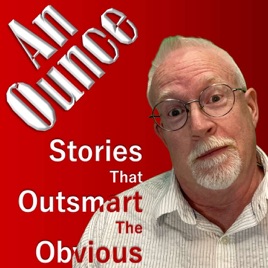
Advertise on podcast: An Ounce - For Your Consideration
Rating
5from
This podcast has
434 episodes
Language
EnglishPublisher
Jim FugateExplicit
No
Date created
2019/10/30
Latest episode
2026/04/22
Average duration
7 min.
Release period
7 days
Description
Discover hidden stories from history—bite-sized, clever tales that challenge what you thought you knew. At An Ounce, we uncover the little moments that quietly changed everything, surprising truths, and fascinating facts you won’t hear elsewhere.I’m Jim Fugate—retired firefighter, lifelong learner, and an outside-the-box thinker who loves sharing history’s hidden gems. These quick, engaging stories don’t take themselves too seriously, won’t steal your precious time, and might just make you feel a little bit smarter.I hope you’ll join a community of curious minds who enjoy a fresh take on history—where conversation is always open and everyone’s invited.
Unlock An Ounce - For Your Consideration podcast Email contact info,
Listeners & Audience details
Email contact information
Direct podcast contact details

Listeners
Audience numbers & engagement insights

Audience details
Podcast Insights

Podcast episodes
Check latest episodes from An Ounce - For Your Consideration podcast
The Olympic Marathon That Was Official… But Wasn’t True
2026/04/22
The 1904 Olympic marathon in St. Louis may be the strangest race in history—featuring cheating, poison, chaos, and a winner who could barely stand. And yet… it was official.
________________________________________
This wasn’t just a bizarre race—it was a breakdown of what “official” really means.
Runners collapsed in extreme heat. One took a car. Another was chased off the course by dogs. The eventual winner was given strychnine and brandy just to keep moving.
And yet… the result stood.
In this episode of An Ounce, we examine the 1904 Olympic marathon—not just for what happened, but for what it reveals about systems, rules, and the gap between what’s recorded… and what’s real.
If you value clear, honest storytelling about history, human behavior, and the limits of “official” truth—subscribe and follow along.
________________________________________
🔗 CHAPTERS (timestamps – estimated)
0:00 The 1904 Olympic Marathon Muddle
0:28 This Was the Olympics
0:46 Conditions of the Race
1:30 Things Start to Go Wrong
2:25 Enter Thomas Hicks
2:54 Poison as Strategy
3:33 The Finish
3:56 What Was Actually Measured?
5:30 An Ounce
________________________________________
📚 REFERENCES (plain URLs as requested)
• Olympic history overview (1904 marathon):
https://www.olympics.com/en/news/st-louis-1904-marathon-one-of-the-strangest-olympic-races
• Smithsonian Magazine summary of the race:
https://www.smithsonianmag.com/history/1904-olympic-marathon-was-one-of-the-strangest-ever-14910747/
• Detailed breakdown of Thomas Hicks and race conditions:
https://www.racingpast.ca/john_contents.php?id=147
• Britannica overview of early Olympic Games:
https://www.britannica.com/event/St-Louis-1904-Olympic-Games
________________________________________
Credits:
Music: Frame Dragging by The Grey Room/Density & Time via YouTube Music Library
You Could Be Executed for a Dream — The Truth About Salem’s Spectral Evidence
2026/04/15
Spectral evidence, Salem witch trials, dream accusations, historical justice failure—this rather shocking but true story reveals how people were condemned based on experiences that couldn’t be proven, tested, or challenged.
In 1692, during the Salem witch trials, people weren’t just accused of crimes—they were accused of actions that supposedly took place in dreams. Courts accepted these claims as credible, and lives were lost as a result.
This episode of An Ounce explores how a system can function exactly as intended… and still arrive at the wrong outcome when it accepts the wrong kind of evidence.
If you value clear, thoughtful storytelling that challenges how we think about truth, certainty, and human behavior, consider subscribing and sharing this with someone who enjoys looking at history from a different angle.
________________________________________
🧭 CHAPTERS
00:00 – Your name is spoken
00:24 – The accusation
00:38 – No evidence, no defense
00:53 – What is spectral evidence?
01:34 – The shift in logic
02:08 – The system at work
02:51 – The spread of accusations
03:26 – The outcome
03:50 – So here’s an ounce
________________________________________
📚 REFERENCES (Plain URLs + Context)
• Salem Witch Trials overview (Britannica – trials, procedures, outcomes)
https://www.britannica.com/event/Salem-witch-trials
• National Endowment for the Humanities – trial records and context
https://www.neh.gov/article/records-salem-witch-trials
• University of Virginia Salem Witch Trials Documentary Archive (primary sources)
https://salem.lib.virginia.edu/
________________________________________
Credits
Music: Owls by Lish Grooves via YouTube Music Library
They Saw Titanic’s Distress Signals… and Did Nothing
2026/04/14
Titanic distress signals were seen from a nearby ship—but no rescue came. Why didn’t they act? This true story reveals how uncertainty, not distance, changed everything.
________________________________________
On April 14th, 1912, the RMS Titanic struck an iceberg and began to sink.
Less than twenty miles away, another ship—the SS Californian—was stopped in the ice.
Its crew saw the rockets.
They watched for hours.
And they did nothing.
In this episode of An Ounce, we explore one of the most unsettling aspects of the Titanic disaster—not what people missed, but what they saw… and didn’t understand.
This is not a story about negligence.
It’s a story about uncertainty.
Because sometimes, the difference between noticing something… and acting on it… isn’t distance or darkness.
It’s doubt.
________________________________________
If you value clear, honest storytelling about real events and the patterns behind them, consider subscribing—and share this with someone who appreciates history that makes you think.
________________________________________
👉 It Made Sense at the Time — Why Smart Decisions Fail
(Connects directly to interpretation, hindsight, and uncertainty)
________________________________________
#Titanic #History #TrueStory #MaritimeHistory #DecisionMaking
________________________________________
🧭 CHAPTERS
00:00 They watched it happen
00:14 The Titanic didn’t sink alone
00:37 A different world at night
01:06 The ship in the distance
01:26 The rockets begin
01:42 Why no one acted
01:50 The signals without meaning
02:35 The ship disappears
02:50 What they never saw
03:16 An Ounce
________________________________________
🔗 REFERENCES
• Britannica – RMS Titanic: overview and sinking details
https://www.britannica.com/topic/Titanic
• Britannica – SS Californian: role during Titanic disaster
https://www.britannica.com/topic/Californian
• U.S. Senate Inquiry into the Titanic Disaster (1912)
https://www.titanicinquiry.org
• UK Wreck Commissioner’s Inquiry Report (1912)
https://www.titanicinquiry.org/BOTInq/BOTReport/botRep01.php
• NOAA / Maritime historical summaries on Titanic
https://oceanservice.noaa.gov
Credits
Music: Night Snow by Asher Fulero via YouTube Music Library
The Same Water | But Not the Same Story
2026/04/01
Water, flash floods, desert storms, and human perspective—this story explores how the same event can bring life, loss, and everything in between. One flow. Different outcomes.
By late afternoon, the heat had driven most people indoors. In a dry desert valley, a storm forms in the mountains—unseen, unnoticed. What follows is not just a flood, but a pattern: the same water, experienced in completely different ways.
Some receive relief.
Some face tragedy.
Some never notice at all.
This episode of An Ounce explores how proximity, timing, and perspective shape what events mean—and why the same moment can carry entirely different consequences.
If you enjoy thoughtful storytelling about risk, perspective, and the hidden patterns behind everyday events, consider subscribing and sharing.
________________________________________
🎧 Watch another episode:
👉 The Killer Fog of London (how the same environment affected people very differently)
[Insert your actual episode URL here]
________________________________________
👍 If this made you think:
Like, subscribe, and share it with someone who sees the world a little differently.
________________________________________
🔖 Hashtags:
#AnOunce #Storytelling #FlashFlood #HumanBehavior #Perspective #DesertLife #Risk #LifeLessons
________________________________________
⏱️ CHAPTERS (ESTIMATED)
00:00 The Same Water
00:25 A Storm Builds
01:10 Rain
02:04 The Flood Arrives
02:51 Relief
03:28 The Arroyo
07:30 Aftermath / The System
05:20 The Pattern
06:06 An Ounce
________________________________________
🔗 REFERENCES (PLAIN TEXT)
• General flash flood behavior and desert hydrology (USGS):
https://www.usgs.gov/special-topics/water-science-school/science/flash-floods
• National Weather Service – Flash Flood Safety and Formation:
https://www.weather.gov/safety/flood-flash
• Desert climate and rainfall variability (NOAA):
https://www.climate.gov/news-features/understanding-climate/climate-deserts
(Note: This episode uses a plausible composite scenario based on real-world flash flood behavior rather than a single documented event.)
Credits
Music: Loves Aftermath and Heartbeat of the wind by Asher Fulero via YouTube music library
Yungay Avalanche 1970 | The Mountain That Buried a City
2026/03/25
The 1970 Yungay avalanche began high on Mount Huascarán in Peru and reached the city below in just minutes. Triggered by a massive earthquake, the collapse of ice, rock, and mud buried Yungay and killed thousands in one of the deadliest natural disasters in the history of the Western Hemisphere.
In this episode of An Ounce, we look at the Yungay disaster, the 1970 Peru earthquake, the mountain warnings that came before it, and the brutal truth that some disasters feel sudden only because earlier warnings were ignored.
Sometimes catastrophe looks like a surprise.
But sometimes it’s a pattern no one wanted to see clearly.
If you enjoy thoughtful explorations of history, risk, disaster, and human behavior, subscribe and come along.
You may also enjoy this related episode:
The Warnings We Forgot — Even Though They Were Written in Stone
[insert URL]
________________________________________
CHAPTERS
00:00 An Entire City Disappeared
00:23 The Result
00:52 The Mountain Above
01:52 The Earthquake
02:24 Three Kilometers of Falling Mountain
03:40 The First Sign
04:30 When the Mountain Threw Stones
05:11 Cemetery Hill
06:11 A City Buried
07:22 Cut Off From the World
08:03 Relocation
08:58 The Warning We Forgot
10:12 An Ounce
________________________________________
REFERENCES
USGS – Geological Aspects of the May 31, 1970 Peru Earthquake
https://www.usgs.gov/publications/geological-aspects-may-31-1970-peru-earthquake
USGS – Catastrophic Landslides of the 20th Century
https://www.usgs.gov/programs/landslide-hazards/science/catastrophic-landslides-20th-century-worldwide
USGS – Earthquake History (May 31, 1970 Peru)
https://earthquake.usgs.gov/learn/today/index.php?day=31&month=5
Encyclopaedia Britannica – Ancash Earthquake of 1970
https://www.britannica.com/event/Ancash-earthquake-of-1970
NOAA National Centers for Environmental Information – 1970 Huascarán Avalanche
https://www.ncei.noaa.gov/access/metadata/landing-page/bin/iso?id=gov.noaa.ngdc.mgg.photos%3A7
Wikipedia – Yungay flood of 1970
https://es.wikipedia.org/wiki/Aluvi%C3%B3n_de_Yungay_de_1970
Colquioc District Municpality - On This Day in 1970 - Yungay, Ancash
https://www.gob.pe/institucion/municolquioc/noticias/500683-un-dia-como-hoy-en-1970-yungay-ancash
Credits – Music: Spirit of Fire by Jesse Gallagher via YouTube Audio Library
The Most Obvious Problem Is Often the Wrong One
2026/03/18
Why do people keep solving the wrong problem? In this episode of An Ounce, a real emergency response story at an international airport reveals a common pattern: the most obvious problem often isn’t the real one. What looks urgent can be a symptom, while the real cause hides underneath.
A man falls in an airport. Blood everywhere. It looks simple.
But something doesn’t fit.
What follows reveals a pattern that appears everywhere... in medicine, in workplaces, in politics, and in everyday life. Symptoms demand attention. They’re loud, dramatic, and urgent. But the deeper causes of problems are often quieter and harder to see.
Learning to recognize that difference may change the way you look at problems entirely.
If this story stayed with you, you might know someone else who would appreciate it.
Subscribe for more thoughtful stories exploring patterns hidden in history, science, and human behavior.
#AnOunce #CriticalThinking #ProblemSolving
________________________________________
Chapters (Estimated)
0:00 The Most Obvious Problem/Airport Emergency Call
0:38 Something Didn’t Fit
0:50 The Real Problem Revealed
1:14 Symptoms vs Causes
1:35 How Problems Get Simplified
2:53 How to Recognize the Pattern
3:32 When Urgency Is Real
4:33 So Here’s An Ounce
________________________________________
References
Root Cause Analysis — Institute for Healthcare Improvement
https://www.ihi.org/resources/Pages/Tools/RootCauseAnalysis.aspx
The Five Whys Method — Lean Enterprise Institute
https://www.lean.org/lexicon/5-whys/
Systems Thinking Overview — MIT Sloan School of Management
https://mitsloan.mit.edu/ideas-made-to-matter/systems-thinking-explained
NTSB Investigation Process — National Transportation Safety Board
https://www.ntsb.gov/investigations/process/Pages/default.aspx
Harvard Business Review — “What Problem Are You Trying to Solve?”
https://hbr.org/2017/01/what-problem-are-you-trying-to-solve
Stroke symptoms and FAST recognition — American Heart Association
https://www.heart.org/en/about-us/heart-attack-and-stroke-symptoms
Scalp lacerations and bleeding — CommonSpirit Health
https://www.commonspirit.org/conditions-treatments/cuts-on-the-scalp
Your Primal Instinct Is Being Exploited
2026/03/14
Clickbait psychology, dopamine loops, phantom phone vibrations, and the attention economy all trace back to one ancient survival instinct: the rustle in the grass.
The same evolutionary wiring that kept our ancestors alive now drives compulsive scrolling, notification checking, and variable reward behavior. Your brain treats uncertainty like unfinished business — and modern platforms know it.
Why do phantom vibrations feel real?
Why does anticipation hit harder than resolution?
Why does “just one more scroll” feel reasonable?
From evolutionary psychology to intermittent reinforcement, from yellow journalism to modern algorithms, this episode examines how curiosity built us — and how engineered uncertainty can quietly pull us.
Curiosity built us. Compulsion can undo us.
The difference is whether you’re exploring — or being pulled.
If you appreciate calm, unsensational explorations of psychology, human behavior, and the hidden patterns shaping modern life, you’re welcome to stay awhile.
#Psychology #HumanBehavior #Clickbait #AttentionEconomy #Dopamine #ModernLife #evolution
CHAPTER / TIMESTAMP
00:00 — OPEN: The Rustle in the Grass
01:07 — The Modern Rustle (Clickbait & Notifications)
01:54 — What’s Actually Happening
03:14 — This Pattern Isn’t New
04:23 — When it Tilt’s
05:56 — The Scale Problem
06:27 — AN OUNCE
RECOMMENDED “YOU MIGHT ALSO LIKE” EPISODES
1)The Warnings We Forgot — Even Though They Were Written in Stone
A quiet examination of tsunami warning stones in Japan — and what happens when memory fades and certainty replaces caution. https://youtu.be/yxxa1_-nBSo
2) It Made Sense at the Time — Why Smart Decisions Fail
If you were drawn to how ancient wiring shapes modern behavior, this episode explores how reasonable decisions quietly drift into failure — and why hindsight makes everything look obvious. https://youtu.be/UJZ214F3VAU
ADDITIONAL READING AND REFERENCE
1. Dopamine & Reward Prediction
Schultz, W. (1997) Dopamine neurons and reward prediction
https://www.sciencedirect.com/science/article/pii/S0896627397001801
Supports anticipation spikes and reward prediction error.
________________________________________
2. Phantom Vibration Syndrome
Rothberg et al. (2010) Phantom vibration syndrome
https://www.ncbi.nlm.nih.gov/pmc/articles/PMC2940970/
Supports phantom buzz reference in script.
________________________________________
3. Intermittent Reinforcement — Operant Conditioning
Overview of B.F. Skinner’s work
https://www.simplypsychology.org/operant-conditioning.html
Supports variable reward comparison.
________________________________________
4. Yellow Journalism — Historical Precedent
Library of Congress Overview
https://www.loc.gov/collections/chronicling-america/articles-and-essays/yellow-journalism/
Supports engineered outrage headlines.
________________________________________
5. Persuasive Technology & Behavior Design
B.J. Fogg Behavior Model
https://www.behaviormodel.org/
Supports engineered uncertainty loops.
Why 4 – 1 Sometimes Equals 6
2026/03/14
Why 4 – 1 sometimes equals 6 sounds impossible—but research in economics, behavioral science, and social capital suggests generosity, trust, and reputation can influence financial outcomes in surprising ways.
Most of us assume prosperity follows a simple rule: save more, give less. Arithmetic says keeping money should always leave you with more.
But decades of economic research suggest something unexpected: A counterintuitive Life Lesson - households that give more often end up earning more later.
Is generosity secretly a financial strategy?
Or is something deeper happening in the systems we live in?
In this episode of An Ounce, we explore a strange equation—why giving away one dollar can sometimes lead to more than you started with. Not through magic or prosperity myths, but through the hidden mechanics of trust, reputation, networks, and opportunity.
Sometimes the equation isn’t wrong.
Sometimes the equation is just bigger than we thought.
If you enjoy exploring counterintuitive ideas, behavioral economics, and the hidden patterns behind everyday assumptions, you’ll feel right at home here.
This episode explores ideas connected to behavioral economics, social capital, generosity research, trust, reputation, and the ways human systems shape opportunity and prosperity over time.
________________________________________
👍 If you enjoy thoughtful history, surprising ideas, and intellectual puzzles like this one, consider subscribing.
Every episode of An Ounce explores a small idea that reveals a bigger truth.
________________________________________
CHAPTERS / TIMESTAMPS
00:00 Ordinary Rock Bottom
00:45 The Math Everyone Understands
00:55 Two Brothers, Two Strategies
01:36 Testing the Assumption
02:22 The Strange Equation: 4 – 1 = 6 / Why It’s Not a Guarantee
03:07 The Expanded Equation
04:40 Returning to the Brothers
05:28 An Ounce
________________________________________
RECOMMENDED EPISODE (cross-promotion)
Recommended viewing:
You’ve Been Lied To! The Truth Behind History’s Biggest Myths
Many of the ideas in this episode connect to the way confident beliefs spread—even when the underlying assumptions are wrong. https://youtu.be/JpHTMQV-XPQ
________________________________________
REFERENCES
Arthur C. Brooks – research on generosity and prosperity
https://www.aei.org/profile/arthur-c-brooks/
American Enterprise Institute research archive
https://www.aei.org/
Study on charitable giving and household income patterns
https://www.philanthropyroundtable.org/
Discussion of social capital and economic outcomes
https://www.brookings.edu/
4 minus 1 equals 6, generosity paradox, economics of generosity, social capital wealth, trust reputation opportunity economics, arthur brooks giving research, generosity and prosperity, human systems economics, why generosity matters, economics explanation generosity
It Made Perfect Sense | Dangerously Common Things From Yesterday
2026/03/14
Lawn darts. Radium face cream. Cocaine in soda. Bloodletting. Leaded gasoline.
History is full of confident ideas that seemed safe — until consequences caught up.
Why do smart people, trusted experts, and entire generations embrace ideas that later look reckless?
This episode explores historical medical mistakes, dangerous consumer products, industrial-era optimism, radioactive beauty treatments, early pharmaceuticals like heroin and lithium soda, and cultural norms that once felt completely responsible.
They weren’t foolish.
They were informed — with the information they had.
Bloodletting was science.
Radium was modern.
Lead solved engine knock.
DDT worked brilliantly — at first.
Progress often succeeds before it reveals its price.
This isn’t about mocking the past.
It’s about recognizing a pattern.
👍 Like, subscribe, and tell us what past practice surprises you most.
#History #MedicalHistory #UnintendedConsequences #IndustrialAge #HumanNature #anounce
CHAPTER / TIMESTAMPS
00:00 — Introduction
00:52 — Seemed Like a Good Idea
01:23 — Medicine Knew Best
03:03 — The Atomic Glow Era
03:58 — Industrial Age Optimism
04:49 — The Pattern
05:11 — AN OUNCE
ADDITIONAL READING AND REFERENCES
(Radium Consumer Products – U.S. National Library of Medicine
https://www.nlm.nih.gov/exhibition/radium/
Bloodletting in Medical History – National Institutes of Health
https://www.ncbi.nlm.nih.gov/pmc/articles/PMC1122608/
Heroin Introduced by Bayer (1898) – Smithsonian Magazine
https://www.smithsonianmag.com/history/heroin-marketed-as-nonaddictive-180963855/
Lithium in 7UP History – Snopes
https://www.snopes.com/fact-check/lithium-laced-7up/
Coca-Cola and Coca Extract – Coca-Cola Company Historical Archive
https://www.coca-colacompany.com/company/history
History of Leaded Gasoline – U.S. Environmental Protection Agency
https://www.epa.gov/air-pollution-transportation/history-leaded-gasoline
DDT History – U.S. Environmental Protection Agency
https://www.epa.gov/ingredients-used-pesticide-products/ddt-brief-history-and-status
Asbestos Overview – Agency for Toxic Substances and Disease Registry
https://www.atsdr.cdc.gov/asbestos/
Oso: The Landslide That Took a Town
2026/02/18
In 2014, a massive landslide struck Oso, Washington. This disaster killed 43 people and erasing an entire community along the Stillaguamish River Valley. This is a true account of an ancient risk that stopped waiting — and broke loose and in 60 seconds, took a town with it.
The Oso landslide was not a mystery... and not an accident in the usual sense. It unfolded over decades, shaped by geology, rainfall, and how humans understand risk over time.
This episode of An Ounce examines what happened, why it happened, and what this disaster reveals about the space between knowing danger exists and recognizing it as real within time.
If you value thoughtful, grounded disaster storytelling without sensationalism, consider subscribing.
👉 For another story about systemic risk, ignored warnings, and the cost of delayed recognition, see “The Big Burn: The Forgotten Firestorm That Changed America.” https://youtu.be/_7flOqnMXIU
📚 References
1. Washington State Department of Natural Resources (DNR)
Geologic assessment, landslide history, and technical analysis of the Oso landslide
https://www.dnr.wa.gov/programs-and-services/geology/geologic-hazards/landslides/oso-landslide
2. U.S. Geological Survey (USGS)
Scientific overview of landslide mechanics, rainfall thresholds, and slope failure
https://www.usgs.gov/centers/pcmsc/science/oso-landslide
3. National Transportation Safety Board (NTSB)
Highway impact, SR-530 analysis, and infrastructure effects
https://www.ntsb.gov/investigations/Pages/HWY14MH009.aspx
4. Washington State Governor’s Independent Review Panel (2015)
Comprehensive review of the Oso landslide, risk communication, and policy context
https://www.governor.wa.gov/sites/default/files/documents/oso_report.pdf
5. Associated Press / Seattle Times reporting (2014–2015)
Contemporaneous reporting on the event, response, and aftermath
https://www.seattletimes.com/seattle-news/oso-mudslide/
________________________________________
⏱ Chapters / Timestamps
00:00 — Orientation: Attention Elsewhere
O1:24 — The Pattern
02:31 — The Hill
03:54 — Normal Life in the Presence of Risk
04:31 — March 22, 2014
06:12 — Can We Learn?
06:45 — An Ounce
The Forgotten Cat of the Space Race
2026/02/11
Everyone remembers the dog who died early in space exploration. Almost no one remembers the Paris alley cat who came home. This is the true story of Félicette — the forgotten cat of the Space Race.
Everyone remembers Laika — the Soviet space dog who never came home.
Almost no one remembers Félicette — a Paris alley cat who rode a rocket launch into space, survived the mission, and quietly disappeared into history.
In 1963, at the height of the Cold War, a small, overlooked nation launched a different kind of spaceflight. No propaganda. No spectacle. Just disciplined space science and a stray cat chosen for her neurological precision.
This is the forgotten story of the Space Race’s most unlikely passenger — and what history chose to remember instead.
If this stayed with you, you probably know someone else who might appreciate it.
________________________________________
Chapters (Timestamps)
00:00 - Spaceflight Testing
01:28 - The Animals Who Went First
02:04 - A Different Animal
03:43 - A Necessary Ending
04:12 - An Ounce
________________________________________
“The Accidentally Invented World”
A companion episode about how progress often comes from unnoticed, uncelebrated moments — and why history remembers the wrong things. https://youtu.be/cx7qyVf5g3k
________________________________________
References (Plain-Text URLs + Context)
French Space Agency (CNES) — Official history of early spaceflight
https://cnes.fr
Astérix Satellite (1965) — France’s first orbital launch
https://nssdc.gsfc.nasa.gov/nmc/spacecraft/display.action?id=1965-096A
Félicette mission summary — Véronique AGI flight
https://www.space.com/15488-french-cat-space-felicette.html
Cold War animal space programs (US & USSR)
https://www.nasa.gov/centers/armstrong/news/FactSheets/FS-014-DFRC.html
Everything Is Under Control — A Special Report
2026/02/04
Everything is under control—or at least that’s what the broadcast says. In this special report, calm anchors deliver absurd news as reality quietly unravels behind them. A satirical look at certainty, reassurance, and collapse.
This episode presents a familiar format behaving exactly as expected… even when the world doesn’t. Potatoes organize. Time pools at airports. An asteroid approaches. AI quietly leaves. Sports continues.
If this stayed with you, you probably know someone else who might appreciate it.
Another great episode on Argument, Disagreement, and contempt. “Why Winning Arguments Can Cost You Everything”: https://youtu.be/qrU64J4jMcI
00:00 Everything Is Under Control
00:27 Local News: The Potatoes Are Organized
01:02 Transportation Alert: Time Is Pooling
01:50 Asteroid Impact: Experts Say “Wait”
02:31 Technology Update: AI Quietly Leaves
03:11 Sports: Civilization Ends, Playoffs Continue
03:46 An Ounce — Submitted for Your Consideration
📚 FURTHER READING & LISTENING — CUT & PASTE (TMI EDITION)
If this episode made you smile—and then pause—here are a few places the ideas brush up against other work. Not answers. Just adjacent thoughts.
Fear, Panic, and Calm Certainty
• The Gift of Fear — why fear exists and why ignoring it can be more dangerous than panic
• Thinking, Fast and Slow — how confidence often outruns understanding
• Daniel Gilbert — research on affective forecasting and why we misjudge future distress
Reassurance Culture & “Everything Will Work Out”
• Four Thousand Weeks — limits of control and the myth of eventual order
• Man's Search for Meaning — meaning without illusion or denial
• The Antidote — happiness via negative thinking
Media, Authority, and Performed Calm
• Amusing Ourselves to Death — how format shapes belief more than content
• The War of the Worlds — authority, format, and belief (not the panic myth)
• The Attention Merchants — certainty as a product
Cognitive Bias, Normalcy, and “This Is Fine”
• The Black Swan — rare events and misplaced confidence
• Normal Accidents — complex systems and inevitable failure
• Risk — why societies tolerate obvious dangers
Artificial Intelligence: Limits, Not Apocalypse
• You Look Like a Thing and I Love You — clear, funny demonstrations of AI failure modes
• Gary Marcus — why current AI lacks understanding and grounding
• Artificial Unintelligence — bias, overconfidence, and misplaced trust in AI
• Prediction Machines — what AI actually does well (and what it doesn’t)
Music, Irony, and Cheerful Collapse
• It's the End of the World as We Know It (And I Feel Fine) — by R.E.M., a cheerful apocalypse as cultural reflex
• It's Alright — Mother Mother. reassurance layered over unease
It Made Sense at the Time: Why Smart Decisions Fail
2026/01/30
“It made sense at the time.” We use this phrase to explain bad decisions, failed plans, and historical disasters. But most of the time, it’s true — and that’s what makes failure so hard to see coming.
History is full of choices that look baffling in hindsight and perfectly reasonable in the moment. This episode explores why smart people make decisions that later seem impossible to understand — and how good ideas quietly age into bad outcomes.
By the way, if you’d like more stories like this, you’re always welcome to hang around and binge for a bit.
CHAPTER / TIMESTAMP
________________________________________
00:00 — OPEN:
01:00 — THE PHRASE THE ENDS DISCUSSION
02:18 — THE PATTERN: FIRE
03:10 — THE PATTERN: TITANIC
03:36 — THE PATTERN: Financial Bubbles
04:38 — THE PATTERN REPEATS
05:12 — HINDSIGHT
06:17 — AVOIDING FAILURE MODE
06:58 — TAKING IT PERSONAL
07:25 — AN OUNCE
Additional Reading and Reference
1) Hindsight Bias — Foundational
Fischhoff (1975)
Hindsight ≠ Foresight: The Effect of Outcome Knowledge on Judgment Under Uncertainty
https://www.jstor.org/stable/1738364
________________________________________
2) Decision-Making Under Uncertainty — Cognitive Mechanism
Thinking, Fast and Slow — Daniel Kahneman
https://en.wikipedia.org/wiki/Thinking,_Fast_and_Slow
________________________________________
3) Disaster Psychology — Human Behavior Under Threat
Why People Don’t Heed Warnings
https://www.ncbi.nlm.nih.gov/pmc/articles/PMC7153921/
This directly supports:
• Titanic behavior
• evacuation hesitation
• normalcy bias
• risk calibration
________________________________________
4) System Failure — Why Collapse Happens
High Reliability Organizations (Weick & Sutcliffe)
https://www.ncbi.nlm.nih.gov/pmc/articles/PMC1765804/
________________________________________
5) Psychological Pattern Support
Narrative Fallacy — Taleb
https://fs.blog/narrative-fallacy/
________________________________________
6) Risk Psychology Authority
Risk Perception — Paul Slovic
https://www.researchgate.net/publication/226437543
#DecisionMaking #Psychology #HumanBehavior #Failure #History #Disasters #Hindsight
Deflating a Little Monster That’s a Big Problem
2026/01/21
Most people don’t wake up wanting to despise someone — yet contempt keeps showing up anyway.
In this episode of An Ounce, a small allegorical story reveals how contempt quietly grows, why it feels bigger than it is, and how it loses power when we stop feeding it.
This isn’t a lecture.
It’s a pattern worth noticing.
If you’ve ever wondered how disagreement turns into dismissal — and how easily it can be reversed — this one’s for you.
If it resonates, feel free to share it with someone else who might appreciate it.
Another episode you'll also enjoy How to Disagree: https://youtu.be/qrU64J4jMcI
Chapters:
00:00 – Introduction
00:19 – The Unsettling Conclusion
00:54 – Introducing the Monster
01:48 – Inflated/Deflated
02:32 – They Preferred the Monster
02:56 – Ridiculous?
04:03 – Facing the Annoying Human
05:20 – An Ounce
Further Reading & References
For those interested in the psychology behind contempt, disagreement, and how certainty can quietly overpower understanding:
• The Seven Principles for Making Marriage Work — John Gottman
Groundbreaking research identifying contempt as the strongest predictor of relational breakdown.
• The Righteous Mind — Jonathan Haidt
Explains why people talk past each other — and how moral certainty often outruns understanding.
• Mistakes Were Made (But Not by Me) — Carol Tavris & Elliot Aronson
Why people double down instead of reassessing — and how rehearsal hardens belief.
• Meditations — Marcus Aurelius
A timeless exploration of withholding judgment, resisting contempt, and recognizing shared human frailty.
The Accidentally Invented World — Why Some of the Best Ideas Were Never Planned
2026/01/16
Some of the most indispensable things in our world were discovered not because of a plan, but because someone noticed what kept appearing—and didn’t throw it away. From food preservation to materials to writing itself, this episode explores how outcomes often arrive before explanations, and how attention quietly shapes progress.
Is it invention? Discovery? Happy Accident? Ingenuity? Dumb Luck?
Long before theories, systems, or understanding, people noticed what worked. They kept it. Only later did explanations catch up—if they ever did. This is a calm look at how the world advances not through brilliance alone, but through patience with what doesn’t yet make sense.
If this stayed with you, you probably know someone else who might appreciate it.
A great episode to watch next about what we learn from the legendary John Henry: https://youtu.be/i7Mv_XmjTJM
________________________________________
Suggested Chapters / Timestamps
00:00 — What Wasn’t Planned
01:26 —Noticed -not- understood
02:44 — Remembering
04:56 — A Pattern
06:46 — An Ounce
________________________________________
References & Further Reading
Food Preservation & Fermentation
• Cooked — Michael Pollan
How early food practices reshaped humans long before scientific explanation.
• On Food and Cooking — Harold McGee
Modern science catching up to ancient food practices.
Glass & Materials
• Stuff Matters — Mark Miodownik
How materials behave first—and only later gain meaning and use.
• The Substance of Civilization — Stephen L. Sass
How unintended material properties quietly shaped civilization.
Writing & Symbol Systems
• How Writing Came About — Denise Schmandt-Besserat
Writing as a workaround for memory and accounting—not artistic invention.
How New Ideas & Technologies Actually Emerge
• The Evolution of Technology — George Basalla
Technology evolves through variation and selection, not planning.
• The Nature of Technology — W. Brian Arthur
Why technology grows organically from what already exists.
Podcast reviews
Read An Ounce - For Your Consideration podcast reviews
Jacef 2022/12/12
Great Bite Sized Messages
I love that the stories are so easy to apply to my life. Plus, the length of the episodes are perfect for my short commute to work.
JadefireDev 2022/05/07
An Ounce that is worth a pound
I had the distinct pleasure of meeting James a while back and learned about his podcast then. It sounded interesting and I gave it a listen. After tha...
broolsen 2021/11/03
So glad I found this!
Thank you so much for these beautiful uplifting stories with so much bad going on in the world it is good to hear of beautiful faith building stories ...
Charlottte Ogden 2021/07/31
LOVE THIS
Just after listening to only one storey I already know I will live this. And I'm already thinking of some storeys
My Friend Mesha 2021/04/05
Transporting me!
I love this podcast! Such a great find for transporting me from busy life into slowing down and being captured by story! Love the voice, feeling and t...
Dsylxeic 2020/12/23
Nostalgic
I love this podcast. It reminds me of a family sitting around an AM radio in the 30s.
MoFug8 2020/03/21
Fun Podcast
Love listening to the fun stories Jim shares and how he turns them into life lessons anyone can benefit from
-=Rondiggitty=- 2020/01/15
Fantastic
Jim’s stories are captivating, his voice is pleasant, and the wisdom gleaned is worth every minute. I also appreciate the respect Jim shows for my tim...
Podcast sponsorship advertising
Start advertising on An Ounce - For Your Consideration relevant audience podcasts
You may also like to advertise on these Podcasts
4.4371061566
The Megyn Kelly Show
SiriusXM
4.888901269
Fearless with Jason Whitlock
Blaze Podcast Network
4.8118931000
Mind Pump: Raw Fitness Truth
Sal Di Stefano, Adam Schafer, Justin Andrews, Doug Egge

4.8102131585
Tara Brach
Tara Brach

4.541561215
Something You Should Know
Mike Carruthers | OmniCast Media
4.513841343
Strictly Anonymous Confessions
Kathy Kay
4.8292781897
Fantasy Footballers - Fantasy Football Podcast
Fantasy Football

4.62382612
Football Weekly
The Guardian

4.45387666
Two Judgey Girls
Two Judgey Girls
3.8258501152
The Viall Files
Nick Viall