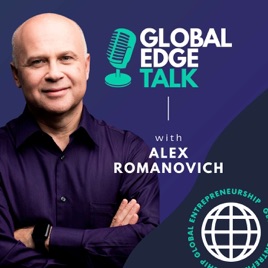
Advertise on podcast: GlobalEdgeTalk
This podcast has
111 episodes
Language
EnglishPublisher
Alex RomanovichExplicit
No
Date created
2020/03/30
Latest episode
2026/09/06
Average duration
31 min.
Release period
16 days
Description
GlobalEdgeTalk is a podcast about Global entrepreneurs, executives, and innovators. In our episodes, we will be combining the best of storytelling with the richness of our guests' experiences in business, market-entry, entrepreneurship, and lifestyle. We strive to inspire, empower and transform entrepreneurs, businessmen, business owners, and all involved and determined around the world. Our episodes feature guests with global experiences, from CEOs of Fortune 500 companies to software developers, from healthcare workers to published authors!
Unlock GlobalEdgeTalk podcast Email contact info,
Listeners & Audience details
Email contact information
Direct podcast contact details

Listeners
Audience numbers & engagement insights

Audience details
Podcast Insights

Podcast episodes
Check latest episodes from GlobalEdgeTalk podcast
From Brooklyn To Cisco: Building Innovation Through Partners
2026/09/06
Send us Fan Mail
Building innovation inside a giant company sounds like a contradiction until you hear how it actually gets done. We sit down with Jason W. Gallo, Vice President of Cisco’s Partner Go-to-Market Acceleration, to trace the path from Brooklyn Tech roots and an engineering mindset to leading transformation across one of the world’s biggest partner ecosystems. Along the way, we get honest about what changes when you climb the ladder: the job stops being “having the answer” and becomes knowing when to let go, delegate, and shape culture without crushing the team’s creativity.
We also dig into the Cisco 360 partner program and why it qualifies as a true corporate maverick move. When you work with about 35,000 channel partners and most revenue flows through the channel, changing governance, incentives, and operating rhythms is not a small tweak. Jason explains why Cisco chose to co-design the new program with partners, even announcing changes before everything was fully finished, and what that kind of openness demands from leaders and from partners who want to stay relevant.
Then we take on the AI question everyone is asking: elimination or opportunity? Jason’s take is direct, practical, and a little uncomfortable. AI may not fully replace humans, but people who use AI well will replace those who don’t. He shares how reskilling looks in the real world, why “playing with ChatGPT” is not the same as understanding AI, and how he used Claude to build and publish a simple app to GitHub after not coding for 20 years.
If you care about partner strategy, go-to-market execution, AI reskilling, or leadership growth in tech, this conversation will give you frameworks you can use immediately. Subscribe, share this with a colleague, and leave a review with the one skill you’re committing to build next.
Support the show
AI That Sounds Right Versus AI You Can Prove
2026/09/03
Send us Fan Mail
Scott Cohen founded Jaxon.AI in Boston to build deterministic, mathematically provable AI verification for insurance, financial services, defense, and life sciences. He got there through an Air Force project where the use case had to work—and where the variability of large language models wasn't sufficient.
In this episode: why LLMs are token predictors that return the highest-probability answer rather than the correct one, why asking the same question twice gets you two answers, and why retrieval-augmented generation and LLM-as-judge are probabilities stacked on probabilities. Scott's alternative is symbolic reasoning — rule engines where a thing either is or isn't. That approach is what DSAIL does.
Also: growing up in a family of inventors behind Sweetheart Cup and the flexi-straw, what training as a chef at the Cambridge School of Culinary Arts taught him about mise en place and running a company, and the costliest hire he ever made — data scientists when he needed builders.
Guest: Scott Cohen, Founder and CEO, Jaxon.AI — jaxon.ai
Recorded 7 July 2026.
Support the show
Photonics Finland Part 2: The Secret Life Of Lenses And Lasers
2026/06/04
Send us Fan Mail
In this special episode recorded at Optics and Photonics Days 2026 in Jyväskylä, Finland, we speak with:
• Tomi Salo — Kvanttinova
• Sesha Manuguri — Dispelix
• Byron Seabolt — Optikos
• Mikko Närhi — Coherent
• Sampo Härkönen — Business Tampere
• Julian Gallego Urrea — Horiba
Together, we explore the technologies quietly powering the future of optics, photonics, quantum systems, AR, and advanced manufacturing.
Our guests explain how Finland built one of the planet's most concentrated photonics ecosystems through patience and infrastructure, how quantum research connects to real market partners, and what it takes to solve the complex waveguide challenges for next-generation AR glasses.
We also discuss automated optical metrology for volume production, high-power industrial fiber lasers, regional talent engines for advanced chip design, and the precision measurement instruments like spectroscopy that underpin both academic research and quality control.
Whether you’re interested in optics, lasers, quantum technology, AR hardware, or Nordic deep tech innovation, this episode offers a practical look at the people and companies building the foundations of tomorrow’s technology.
Support the show
Photonics Finland Part 1: From Lasers to Products
2026/06/04
Send us Fan Mail
In this special episode recorded at Optics and Photonics Days 2026 in Jyväskylä, Finland, we speak with:
• Juha Purmonen — Photonics Finland
• Matti Pesonen — Noptel
• Julia Matthes — Laser 2000
• Derrick Defever — TactoTek
• Pierre Brochard — Silentsys
• Oliver Grass — Assemblify
Together, we explore the technologies quietly powering the future of AI, quantum systems, lidar, sensing, and advanced manufacturing.
Our guests explain how Finland built one of Europe's strongest photonics ecosystems, how laser-based measurement systems perform in challenging environments, what it takes to commercialize photonics technologies, and why ultra-low-noise lasers are becoming essential for next-generation quantum applications.
We also discuss smart surfaces with embedded electronics, supply chains for deep-tech hardware, manufacturing at scale, certification challenges, and the realities of turning cutting-edge research into successful products.
Whether you're interested in photonics, optics, lasers, quantum technology, AI infrastructure, or hardware innovation, this episode offers a practical look at the people and companies building the foundations of tomorrow's technology.
Support the show
What Happens When A Country Treats Quantum Like Infrastructure
2026/05/07
Send us Fan Mail
Quantum computing is moving from lab experiments to scalable machines. This episode explores the "unglamorous" ingredients of this transition: infrastructure, specialized engineering, and the national strategies turning breakthroughs into products.
Guests in this episode:
Mikko Möttönen (QMill)George Schwartz (Global Quantum Intelligence)Katri Raevuori (Business Finland)Sirpa Salmi (Kvanttinova)Santeri Ojala (Business Finland)Key topics:
The Technical Stack: From superconducting qubits to autonomous processing units—mapping the direction of hardware in plain language.Manufacturing Capacity: How pilot lines and shared clean rooms allow startups to prototype faster without massive capital investment.Ecosystem Density: Why collaboration across semiconductors and quantum technologies is creating a unique national advantage.The Talent Pipeline: Addressing the workforce shortage and how to build pathways for the next generation of engineers.Cybersecurity: A sober look at "harvest now, decrypt later" risks and the urgent need for post-quantum cryptography.Whether you're building in the space or curious about the future of deep tech, this is your guide to the quantum ecosystem.
Support the show
What If Tariff Money Stayed In Your City
2026/05/07
Send us Fan Mail
Tariffs do not feel abstract when you are the one trying to get a container released from the port. We sit down with Liz Picarazzi, founder and CEO of Citibin, to trace the full arc from a Brooklyn streetscape problem to a real manufacturing company selling rat-proof, weather-resistant trash and parcel enclosures across the US. What starts as an “eyesore” story quickly becomes a practical lesson in product-market fit, modular design, and how customer demand can drive new lines, including a steel, bear-resistant version built for regions far beyond New York City.
From there, we get into the supply chain decisions most people only debate in headlines. Liz explains why she moved production to Asia after struggling to consistently hit price, quality, and lead time in early US manufacturing attempts, and why the goal was never “cheapest” but “most reliable partner.” We also unpack the chaos of changing tariff rates, Section 232 aluminum and steel tariffs, what happens when the rate shifts with little notice, and why a transparent tariff surcharge can be simpler than constantly rewriting your pricing.
Finally, we talk about reshoring without slogans. Liz shares why she is building a US manufacturing base in Indiana, what makes domestic production expensive, and how trade education and workforce skills shape what is even possible. If you run a small business in manufacturing, importing, e-commerce, or product design, this conversation offers a clear-eyed playbook for diversification and risk management. Subscribe, share this with a builder in your life, and leave a review with your take: should the consumer be the one paying for tariff uncertainty?
Support the show
Finland's Quantum Revolution: Inside the APS Summit
2026/05/06
Send us Fan Mail
This episode, recorded in collaboration with Katri Raevuori (Business Finland), at the APS March Meeting, explores why Finland is a global hub for quantum and deep tech.
Guests in this episode:
Sirpa Salmi (Kvanttinova)Harry Smith (SemiQon)David Gunnarsson (Bluefors)Galina Leväsluoto (IQM)Dominic Lennon (QuantrolOx)Bilge Can Yildiz (Arctic Instruments)Tommi Hakulinen (Vexlum)We discuss:
Ecosystem: Why collaboration between research and industry is the key to faster prototyping.Scaling Hardware: Overcoming the challenges of cryogenics and instrumentation.Talent & Culture: What it’s like for international experts to build a career in Finland.Future Tech: The role of automation and lasers in stabilizing quantum systems.Whether you're an engineer, a researcher, or just curious about deep tech, this is your grounded guide to the market.
Support the show
Goodbye Duty Free Shopping Hello Customs Entry Fees
2026/04/15
Send us Fan Mail
A landmark Supreme Court decision on IEEPA has redefined the tariff landscape, ending broad emergency powers and forcing a shift to Section 122. For importers and manufacturers, this means a renewed focus on managing landed costs and navigating the legal scramble for tariff refunds.
In this episode, we break down:
Tariff Refunds & Compliance: The complexity of passing savings to end-users and the critical need for a "paper trail" in trade finance.The End of De Minimis: How the removal of duty-free exemptions is reshaping e-commerce and small-parcel logistics.AI in Customs Enforcement: Using automation for supply chain mapping, valuation detection, and building an audit-ready "golden folder."Practical Defense: Why pairing AI with expert oversight is now essential for legal tariff engineering and HTS classification.Stay ahead of 2026 trade turbulence. Subscribe for expert insights on scaling global operations and mastering customs compliance.
Support the show
From Remote Finland To Global Markets: Founders Solving Transit, Industry And Climate
2026/04/15
Send us Fan Mail
Joensuu is a small city in eastern Finland, close to the Russian border, and it keeps producing founders who think and build globally. Kasey Snyder steps in as guest host, bringing you conversations recorded at SOHJO with entrepreneurs proving that distance is not a disadvantage when the work is real. Across transit, manufacturing, robotics, retail, and climate tech, the common thread is practical innovation that can travel from the Nordics to North America.
This episode features conversations with:
Juho Häme, Co-Founder, EinbusJani Akkila, CEO, Process Genius, and Jani Toropainen, CEO, MecmetalGeorge-Cosmin Porusniuc, Co-Founder, Henki RoboticsJoona Kotilainen, Co-Founder, Hiil OyLeo Fadi, Founder & CEO, Vesko OyTomi Haring, CEO, Business JoensuuMiska Ruotsalainen, CEO, FiidbackSami Koskela, CEO, FiltsonIf you care about Nordic startups, applied AI, climate tech, industrial IoT, and the realities of scaling into the US and Canada, press play, subscribe, and share this with a founder or operator who needs fresh ideas.
Support the show
Is AI Making Enterprise Safer Or Scarier
2026/04/15
Send us Fan Mail
Big enterprise customers can feel like the finish line: massive budgets, brand-name logos, and the kind of “we made it” credibility that looks great on a homepage. But we’ve seen the other side too, where the same deal becomes a slow grind of checkpoints, approvals, internal politics, and change resistance that can drain a young company’s time and cash.
Alex Romanovich sits down with Stephanie Anderson to separate enterprise romance from enterprise reality. We talk through what it actually takes to sell into large organizations, why enterprise sales cycles stretch into months, and how the real risk is often the cost of change, not the product itself. From CRM-style rollouts to training and adoption, we get specific about why behavior change is hard and how to plan for it so your enterprise's go-to-market strategy doesn’t collapse after the contract is signed.
We also dig into market entry strategy for companies expanding into the United States: how to build business development structure, run smarter discovery, and use partnerships to move faster than hiring a giant sales team. Then we shift to AI in the enterprise, including Stephanie’s recent AI certification and the ROAD methodology (requirements, operationalizing data, analytics, deployment). Finally, we face the uncomfortable question: is AI a threat to jobs and institutional knowledge, or a chance to build better systems without breaking what already works?
If you’re targeting enterprise customers, building a B2B sales motion, or planning responsible AI implementation, this conversation will help you stress-test your readiness. Subscribe for more Global Edge Talk, share this with a founder or sales leader, and leave a review with your biggest enterprise challenge.
Support the show
The Best Way To Scale A Tech Company Is To Stop Selling Hours
2026/04/15
Send us Fan Mail
The old way to grow an IT services firm is brutally straightforward: hire more people, ship more projects, track bench percentages, and hope margins hold. But that model starts to feel like a trap the moment “people” becomes your biggest constraint. I’m joined by tech industry veteran Igor Kruglyak to unpack the pivot from services to software products, and why the next wave of leverage is coming from platforms, reusable components, and AI-assisted delivery.
We trace Igor’s path from the early commercial days of computing to web, mobile, and now agentic AI, and we get practical about what actually changes when you build a product. Igor explains how Prime blends the control of custom engineering with repeatable building blocks for mobile-first solutions, especially in document-heavy workflows where PDFs, metadata, and workflow state create the real complexity. That “context layer” becomes the foundation for agentic AI, because an assistant can’t answer safely without knowing whose data it is handling, what process it supports, and what constraints apply.
Compliance runs through the entire conversation, from HIPAA-style expectations to audit-ready records and guardrails for AI. We also dig into how teams are already using tools like Microsoft Copilot and AWS Bedrock, why model swapping matters, and why “orchestration” may replace pure coding as the core skill. Subscribe, share this with a builder who’s rethinking services, and leave a review if you want more conversations like this. What part of your workflow needs a real context layer first?
Support the show
How Rebuilding Ukraine Reveals The Smartest Risks Entrepreneurs Can Take
2026/03/08
Send us Fan Mail
What happens when an entrepreneur stops narrating risk and starts pricing it? We sit down with Bruce Talley to follow a rare arc—from American capital markets to Russian real estate, from building Sochi’s Olympic logistics engine to advising on Ukraine’s reconstruction—and extract a practical playbook for operating in volatile markets. Bruce shares how transparency and owning delivery turned a bootstrapped idea into the largest destination management provider for Olympic broadcasters, and why that same discipline translates to rebuilding a country at war.
We explore the surprising stability of Ukraine’s housing markets, the enduring shift of people and capital toward Kyiv, Lviv, and Odesa, and why modular construction is the lever for speed, quality, and sustainability. Bruce breaks down how to de-risk entries: secure titles, assume delays, line up exits, and layer political and war-risk insurance. He maps the sectors where courage meets capital—housing, agriculture, minerals, and a fast-evolving defense tech ecosystem—and explains why the risk discount is out of sync with on-the-ground realities.
Along the way, we spotlight human resilience and policy innovation: weddings in Odesa under air alerts, entrepreneurs in Zhytomyr planning new trade, Estonia’s “adopt a region” model, and Ukraine’s rapid digital transformation that streamlines company formation and services for millions. For founders and operators, this is a field guide to building trust, moving faster than bureaucracy, and identifying value where headlines mislead. If you’re deciding when to show up and what to build, this conversation offers a confident, concrete starting point.
If this resonated, follow the show, share it with a friend who builds in tough markets, and leave a quick review—what opportunity would you pursue first?
Support the show
AI Can Ace The Test, But Who’s Grading The Soul?
2026/03/08
Send us Fan Mail
What happens when the former CMO behind the Grammys decides prestige isn’t enough and builds an AI platform designed to make people think better, not just faster? We sit down with Evan Greene to unpack the leap from Disney, Sony, and the Recording Academy to Kwieri, a human-in-the-loop learning system that blends the speed of AI with the judgment of real mentors.
Evan explains why over-reliance on AI fuels confident wrongness, positivity bias, and a slow erosion of critical thinking—then shows how collaborative guidance flips the script. We walk through concrete use cases: professors and TAs joining students in real time to refine prompts, validate outputs, and turn shortcuts into skills; a career coaching company pairing its AI agent with live coaches to scale wisdom without losing trust; and a university rolling Query into teacher training before campus-wide deployment. Along the way, Evan reveals how his turnaround work at the Grammys taught him to build pride, ownership, and high-performance teams—capabilities that translate directly to startup scrappiness and product-market fit.
This is also a story of resilience and clarity. Living with myasthenia gravis pushed Evan to focus on what matters and to lead with empathy. That lens informs a central belief: collaboration is the cornerstone of mastery, and humans should remain at the center of cognition and decision-making. If you’re a student wondering how to stand out in AI-driven hiring, an educator seeking tools that promote accountability without banning technology, or a leader deciding where to place human judgment in automated workflows, you’ll find a practical, urgent roadmap here.
If this conversation sparks new ideas, follow the show, share it with a friend, and leave a quick review—what’s the one place you think human oversight most improves AI?
Support the show
Legacy Rules, New Intelligence
2026/03/05
Send us Fan Mail
Your core systems might be old, but the logic inside them still runs your business. We break down how to modernize those foundations without losing the rules that protect revenue, compliance, and reliability. With guest Ankit Shah of Netweb Software, we unpack what AI truly does well—rapid code analysis, business rule extraction, dependency mapping—and where human judgment remains non‑negotiable: understanding intent, setting policy, and approving change.
We start by reframing modernization as risk reduction, not just code migration. Instead of “lift and shift,” we advocate a risk‑first approach that identifies operational bottlenecks, compliance gaps, and talent risks before choosing the right pilot. From there, AI becomes the accelerator, compressing months of discovery into days and making it feasible to build a living catalog of business rules that everyone can read—engineering, audit, product, and operations alike.
Then we get specific. In manufacturing, inventory management, and production planning are prime candidates for business rules rejuvenation, especially where legacy assumptions about lead times and batch sizes no longer hold. In healthcare, patient‑centric data flows and medication logic demand rigorous compliance; AI can surface undocumented exceptions while clinicians and governance teams decide what to change. We also explore continuous improvement: AI as a control tower that monitors rule drift, runs what‑if scenarios, and maintains documentation, while humans approve deployments and uphold accountability.
Whether you lead a global enterprise or an SME, the path is the same: start with risk, pick a focused pilot, let AI handle the heavy lifting, and reserve human expertise for intent and compliance. If you’re ready to turn opaque legacy logic into clear, governed, and adaptable systems, this conversation gives you the playbook. Enjoyed the episode? Follow the show, share it with a colleague who’s wrestling with legacy tech, and leave us a review with your top modernization challenge.
Support the show
AI Readiness In Healthcare, Without The Hype
2026/01/26
Send us Fan Mail
The pressure to “do AI” in healthcare is real, but shipping a model isn’t the same as changing care. With Dr. Saima Anis—physician turned public health leader and enterprise IT strategist—we unpack how hospitals can adopt agentic AI responsibly while actually making clinicians’ jobs easier. We start with the human questions a good diagnostician asks: where is the pain, who does it hurt, and what outcome matters? From there, we build the case for culture, literacy, and trust as the groundwork that makes any system stick.
We break down governance without the jargon: data lineage and quality, explainable models, stage-by-stage audits, and human override by design. Dr. Anis clarifies why agentic AI is not a chatbot or an RPA script; it’s a domain-trained, continuously learning framework that can draft notes, synthesize evidence, and propose structured differentials—if and only if it is integrated into real workflows with clear guardrails. We explore how to reduce cognitive burden for physicians, where to start with repetitive tasks, and how to prevent drift and hallucinations when agents collaborate.
Leaders will hear specific pitfalls from 2025 to avoid—vendor lock-in, FOMO-driven deployments, and loyalty to failing pilots—and practical habits to adopt in 2026: stakeholder alignment before tooling, measurable outcomes, and transparent audit trails. We also talk candidly about leading as a woman in a male-dominated field, sustaining momentum under pressure, and why innovation is not synonymous with AI but with creative problem solving that delivers value. If you’re planning a rollout or rescuing one, this conversation offers a pragmatic playbook to move from hype to helpful.
Enjoyed the conversation? Follow, share with a colleague who’s wrestling with AI strategy, and leave a review with your top takeaway.
Support the show
Podcast reviews
Read GlobalEdgeTalk podcast reviews
Podcast sponsorship advertising
Start advertising on GlobalEdgeTalk relevant audience podcasts
You may also like to advertise on these Podcasts

4.8159901996
Watch What Crappens
Ben Mandelker & Ronnie Karam

4.638601153
Modern Wisdom
Chris Williamson

4.66151303
True Crime with Kendall Rae
Mile Higher Media & Audioboom Studios
4.73393774
The Ancients
History Hit
4.89065306
The Why Files: Operation Podcast
The Why Files: Operation Podcast

51088171
Middle Children
Jessie Jolles and Chris Burns

4.9264932000
Morning Wire
The Daily Wire

4.518760369
American Scandal
Audible

4.689261200
Get Sleepy: Sleep meditation and stories
Slumber Studios

4.79026375
Life is Short with Justin Long
Audible