1507431906
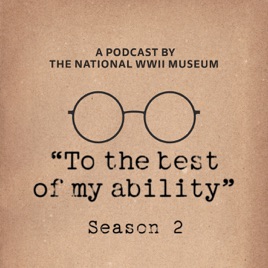
"To the Best of My Ability"

Advertise on podcast: "To the Best of My Ability"

Rating
★★★★★
4.8
from
113 reviews
This podcast has
22 episodes
Language
English
Explicit
No
Date created
2020/04/10
Latest episode
2021/11/23
Average duration
25 min.
Release period
52 days

Description

Season 3 As the international situation deteriorates, FDR faces multiple challenges: readying the country for war across two oceans, facing down the threats from Nazi Germany and Imperial Japan, and attempting to rally political support at home. Americans are not convinced of the foreign threat. Many are still isolationists, seeking to let the world solve its own problems while America stands aloof. Public opinion seems to be changing, but it's a gradual process. Will FDR be able to master these multiple crises? Will the American people rally behind him? Will the nation prepare in time to face one of the gravest threats in its history—or will all of FDR's efforts be too late? Join The National WWII Museum for Season 3 of this limited series podcast as we explore America's road to Pearl Harbor as seen through the eyes of President Franklin D. Roosevelt.

Unlock "To the Best of My Ability" podcast Email contact info,
Listeners & Audience details

Email contact information

Direct podcast contact details

Listeners

Audience numbers & engagement insights

Audience details

Podcast Insights

Podcast episodes

Check latest episodes from "To the Best of My Ability" podcast


An Epidemic of World Lawlessness
2021/11/23
In 1933, Franklin D. Roosevelt inherits a nation amidst The Great Depression, but around the world, fascist powers gain footholds. FDR begins to shape foreign policy through a series of addresses that connect the American people to the president in an unprecedented way, threading the needle between readying the nation for war and appeasing isolationists. This week’s episode, hosted by Museum Historian Dr. Stephanie Hinnershitz and produced by Digital Content Manager Bert Hidalgo, examines the lead-up to World War II through the lens of American policy as FDR attempts to prepare a nation for war. Referencing the dangers the Axis powers contained and threatened humanity as a whole, the title for this week’s episode comes from FDR’s 1937 speech following reports of brutality by Japanese troops in China.
A Day of Infamy
2021/12/03
President Franklin D. Roosevelt wins his third term bid for president, but a foreign crisis brews in the Pacific. Contending with an isolationist movement in America, he maneuvers policies and naval fleets in preparation for war, all the while convincing the US public the importance of becoming the “arsenal of democracy.” This week’s episode, hosted by Museum Historian Dr. Stephanie Hinnershitz and produced by Digital Content Manager Bert Hidalgo, follows up on Part 1 “An Epidemic of World Lawlessness” where tensions between The Empire of Japan and The United States come to a head. The title for this week’s episode comes from FDR’s famous speech to Congress in 1941, the day after the attack on Pearl Harbor.
Doomed Men on Gallows Hang
2020/11/18
On November 20, 1945, an International Military Tribunal of the victorious Allies began a series of war crimes trials in Nuremberg, Germany, designed to bring prominent Nazis to justice. The very men who had perpetrated some of the most horrific crimes in human history, including the Holocaust and the mass murder of POWs and civilians, now had to stand trial for their deeds. Nuremberg was a fitting site: the very city where Adolf Hitler used to stage the Parteitag, massive Nazi rallies attended by 100,000s of his adoring followers. The trials were a significant turning point for modern international law—a recognition that “following orders” was not a sufficient excuse for brutal and inhuman behavior. 
Aliyah Bet
2020/12/02
Throughout World War II and in the aftermath, persecuted Jews tried to find their way into the British Mandate of Palestine, often deemed illegally by British authorities, as the Royal Navy tried to stop them. On December 14, 1945, the ship Hannah Senesh, carrying 252 refugees, evaded British patrols and beached itself at Nahariya in Palestine. The passengers came ashore via a rope bridge and evaded capture. Large-scale Jewish immigration to Palestine increased regional tensions, which would explode into war in 1948 with the invasion of the newly established State of Israel by its Arab neighbors. Truman was the first US president to be faced with trouble in the Middle East; he would not be the last.
Ezra Weston Loomis Pound
2020/12/17
After more than 20 years living abroad as an expatriate in Italy, poet and Nazi sympathizer Ezra Pound was charged with 19 counts of treason against the United States. During World War II, Pound broadcast pro-Facist propaganda into the US, accepting payment from the Italian government. He expressed support for Hitler and Mussolini, criticized FDR, and blamed the Jews for the outbreak of the war—all staples of Nazi propaganda, Pound was eventually found mentally unfit to stand trial, and was incarcerated at St. Elizabeth’s psychiatric facility for more than 12 years. While institutionalized, he managed to befriend white supremacists and members of the Ku Klux Klan, including John Kasper, a staunch segregationist who was suspected of committing multiple synagogue, church, and school bombings.
Duck and Cover
2021/01/06
By January 5, 1946, President Truman had had enough. He was tired of Stalin’s aggressive behavior, tired of the Soviet Union establishing “police states” in countries it occupied. In a letter to his Secretary of State, James, F. Byrnes, he declared that the United States would not recognize these new Communist governments. Enough was enough. “I’m sick of babying the Soviets,” he stated. This blunt statement set off a chain of events known as the Cold War, a development that brought unprecedented American intervention across the globe. As the Iron Curtain descended on eastern Europe, fears over a new global war with the USSR cast a pallor over every aspect of American life. State-side, suspicions turned into targeting Jewish, Black, and gay Americans suspected of being involved in the Communist Party, setting the stage for an unprecedented era of domestic spying.
Strike Wave
2021/01/19
The strike wave of 1945-1946 was a series of large-scale post-war labor strikes in the United States, spanning numerous industries and public utilities. In the year after V-J Day, more than five million American workers were involved in strikes, including oil workers, the United Auto Workers, and the United Mine Workers. The strikes lasted on average four times longer than those during the war, and even today remain the largest “job actions” strikes in American labor history. Among these events, the Havaco No. 9 Mine disaster resulted in miners going on strike in unprecedented numbers to demand better safety regulations. Separately, meat packers with the AFL-CIO began a massive strike on January 16, 1946. After 10 days, the government seized the plants. 
No Specific and Tangible Evidence
2021/01/26
In a January 25, 1946 telegram, General Douglas MacArthur recommended that Hirohito not face a war crimes trial. The International Military Tribunal for the Far East, also known as the Tokyo War Crimes Tribunal, tried 28 Japanese military and political leaders on 55 separate counts encompassing the waging of aggressive war, murder and conventional war crimes committed against POW’s, civilians, and inhabitants of occupied territories. The defendants included former prime ministers, former foreign ministers, and former military commanders. The emperor was not among them: to MacArthur, he was a valuable symbol of Japanese national unity. As long as he agreed to cooperate, he was useful to the American occupation authorities.
A Dangerous, Costly and Heartbreaking Process
2021/02/10
On February 12, 1946, Isaac Woodard was returning home to North Carolina from Camp Gordon in Augusta, GA on a Greyhound bus. Woodard, a decorated veteran of the Pacific theater, asked the driver if there was time for him to use the restroom while on a scheduled stop. The driver grudgingly agreed, and the trip continued without incident until they reached Batesburg, SC, where the driver called local authorities and had Woodard arrested. What followed was one of the nation’s most heinous hate crimes, and the attack left Woodard permanently blind. Less than two weeks later in Columbia, TN, a second Black veteran who also served in the Pacitic theater, James Stephenson, was the victim of an attempted lynching after shopkeepers called police on him for allegedly disturbing the peace. It wasn’t until well-known figures like Orson Welles and Langston Hughes began to publicly call out these racist attacks committed by law enforcement that President Truman finally began to address some of the racial injustices and violence being committed across the nation, ultimately culminating in the desegregation of the military in 1948.
33 Months
2021/03/17
In the months after the attack on Pearl Harbor, suspicions around Japanese American citizens began to grow, so much so that in February of 1942, FDR signed executive order 9066, which was used to justify the forced removal of more than 120,000 Japanese Americans from their homes and incarcerated them in camps in California, Utah, New Mexico, Arkansas, and other states. Despite a complete lack of any evidence of wrongdoing, these Americans remained incarcerated through the duration of the war, until the last camp closed on March 20, 1946. After 33 months of incarceration, Japanese Americans could return to their homes. Unfortunately for many, they no longer had homes or jobs to return to, and while a series of legislative victories followed in the immediate postwar years, it wasn’t until decades later after the Redress Movement gained momentum that there was any formal apology or reparations paid for what these families endured.
The Threshold of the New World
2020/11/13
History’s greatest war was over, but our story has only just begun. The Truman Presidency not only had to deal with the legacy of the recently concluded war, it also had  to wrestle with new problems at home and abroad: a dangerous international situation, the spread of Communism and Soviet influence, and the pressing need to form a “more perfect union” at home by ensuring equal rights and justice for all. Would the “man from Missouri” rise to the challenge?  Would the United States, and the world, enjoy peace and prosperity, or was World War III in the offing?
It's All Over
2020/05/06
Truman’s first few weeks in office were some of the most tumultuous in Presidential history. As Nazis forces experience blow after blow from Allied forces, fascism in Europe begins to crumble. Before the end of April, both Adolf Hitler and Benito Mussolini are dead. After more than five years of total war, a ceasefire takes effect on May 8, 1945. ”This is a solemn but glorious hour,” Truman declares. “The flags of freedom fly all over Europe."

Podcast reviews

Read "To the Best of My Ability" podcast reviews


4.8 out of 5
113 reviews
★★★★★
smbern1217 2022/01/07
Outstanding!
Well researched, documented, and presented. Please continue to produce new conent.
★★★★★
NatATTACKx 2021/03/24
A Glimpse into History
Incredibly well written and produced podcast making the lessons of WWII accessible to all generations.
★★★★★
RosieRB1986 2021/02/14
Excellent series
I have learned a lot from each episode, but this week’s on Sgt Isaac Woodard brought me to tears. I was not familiar with his story and found myself s...
★★★★★
Pawprints18 2020/07/18
Eye-opening
This series has brought to light events that I didn’t know, particularly about President Truman’s presidency. The oral histories by the veterans give ...
★★★☆☆
Janetellenirwin 2020/08/22
Harry Truman gives us his best
This superb podcast tells the story of we baby boomers parents’; it’s a story they tended not to discuss. The excellent narration and the insights pro...
★★★★★
spicewonder 2020/07/10
Wonderful
Impeccably researched, beautifully written, and eloquently presented, this podcast dives deep into the presidency of Harry S Truman during, and after,...
★★★★★
SJ III 2020/07/05
Well researched and wonderfully presented
A well-earned five star rating for this podcast. The entire team, starting with Dr. Kristen Burton, have done an incredible job of telling the story ...
★★★★★
NLsmith88 2020/06/25
Wonderful Podcast
As someone who loves WWII history I was interested to learn more about President Truman, who I admit I knew next to nothing about. I have enjoyed ever...
★★★★★
BHack02 2020/06/07
Another Great Podcast!
We’re only a couple episodes in thus far, however I’m throughly enjoying the content!!
★★★★★
RRShadow 2020/05/27
History is fun!
Outstanding! It makes you proud to be an American! 🇺🇸
check all reviews on apple podcasts

Podcast sponsorship advertising

Start advertising on "To the Best of My Ability" relevant audience podcasts


What do you want to promote?