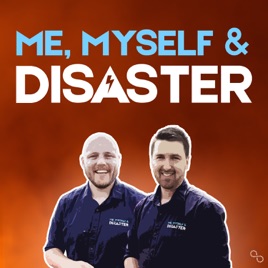
Advertise on podcast: Me, Myself & Disaster
This podcast has
46 episodes
Language
EnglishPublisher
Beyond DisasterExplicit
No
Date created
2020/05/30
Latest episode
2026/07/22
Average duration
51 min.
Release period
75 days
Description
Australia's Leading Disaster Podcast
Unlock Me, Myself & Disaster podcast Email contact info,
Listeners & Audience details
Email contact information
Direct podcast contact details

Listeners
Audience numbers & engagement insights

Audience details
Podcast Insights

Podcast episodes
Check latest episodes from Me, Myself & Disaster podcast
Michael Rowland: The Story Behind The Story
2026/07/22
During the Black Summer bushfires, journalist and former co-host of ABC News Breakfast Michael Rowland spent time on the ground with communities directly impacted by one of Australia’s largest disasters. His experience shaped his perspective about the role of journalism in disasters, the evolving role of media during disaster response and the challenges with misinformation.
Andrew and Josh chat discuss Michael’s book Black Summer, which covers the perspectives of ABC journalists involved in the coverage of the 2019-20 bushfires. The ABC played a significant role in the bushfire crisis with journalists across Australia contributing to rolling news stories and updates – including when evacuation warnings were issued. Michael shares his insights about working for the ABC, the trauma journalists face alongside emergency service workers and volunteers, and the challenges journalists face with the emergence of new technologies including artificial intelligence.
Tune in as we chat with Michael Rowland about his story, on Me, Myself and Disaster.
Black Summer by Michael Rowland
Michael Rowland on LinkedIn
ABC News
Podcast: Sydney's Hidden Radiation
2026/03/30
Ever wondered how we would detect a nuclear disaster in Sydney?
Most people don’t realise that the ground beneath our feet is full of invisible radiation. In this episode, Andrew and Josh speak with researchers at the University of Sydney to discuss how groundbreaking research has mapped natural gamma radiation across Sydney, to build a clear picture of the background environment. This map provides the basis for understanding future changes in the radiation levels – such as during a nuclear disaster.
Researchers Matilda Lawton and Tengiz Ibrayev explain the basics of radiation, how they undertook their study and what this means for disaster managers.
Sydney Morning Herald – Scientists mapped Sydney’s radiation. One busy suburb stands out.
Radioverse Map — Global citizen science radiation map for data upload
University of Sydney – Radiation Research — Research group involved in the studies
ANSTO — Australian Nuclear Science and Technology Organisation — Australia’s nuclear facility for research and safety
The spectrometer device mentioned in this episode is a Radiacode – radiacode.com.
Matilda Lawton – LinkedIn | Twitter
Tengiz Ibraev – LinkedIn | Research Profile
Christian Dimmer: Can we engineer ourselves out of disaster?
2026/02/23
https://youtu.be/MOUV0bPDmA8
As a major city, Tokyo faces one of the highest disaster risks in the world with a 70% probability of being struck by a major earthquake in the next 30 years. In pre-modern Japan, disasters were accepted as a force outside of out control, and subsequently residents had a high level of awareness of disaster risk. Today, with emergency management agencies established and large engineering projects in place, catastrophes are seen as manageable by experts and authorities, leading to disengagement of citizens with their own resilience.
Associate Professor Christian Dimmer joins the show to discuss this challenge, in light of the 15 year anniversary of the 2011 Tohoku earthquake and tsunami. Christian discusses the concept of a ‘quadruple disaster’, which includes demographic challenges alongside the immediate impacts of the earthquake and tsunami. Christian emphasizes the importance of understanding the historical context of disasters in Japan, the shift in disaster response culture, and the need for community engagement in disaster preparedness and recovery.
Christian is an Associate Professor for Urban Studies at Waseda University in Tokyo. He has a background in urban planning, disaster recovery and community resilience. He earned his PhD in Urban Engineering from The University of Tokyo and has served on the faculties of both the University of Tokyo and Waseda, teaching courses in transition design, sustainable urbanism and theories of public space. Christian is also a co-founder of the Tohoku Planning Forum and the Tokyo chapter of the design-led disaster response organisation Architecture for Humanity, where he has worked to connect civil society, professionals and communities in rebuilding after major disasters.
Links:
Journal article by Christian Dimmer: Tokyo’s Perpetual Resilience Project: Between Local Knowledges and Universal Modernist Concepts
https://www.youtube.com/watch?v=THGcGKKmvXg
Melissa Pexton: Empowering Communities Through Recovery
2025/06/26
Deputy Commissioner of the WA Department of Fire and Emergency Services (DFES) Melissa Pexton shares the recovery story of Fitzroy Crossing, a remote community devastated by tropical cyclone Ellie in 2022 / 2023.
Located 400 kilometers east of Broome, this region faced unprecedented flooding that challenged traditional emergency management approaches.
In this episode, Melissa shares how the recovery process focussed on community empowerment, provided economic opportunities to local Aboriginal businesses and harnessed community leadership. Over 90 Aboriginal businesses were contracted to deliver recovery works, securing more than $90 million in contracts. This strategy not only rebuilt physical infrastructure but also created significant economic opportunities, with local workers trained and employed in reconstruction efforts.
A key lesson from the recovery effort was understanding the community context and allowing local leaders to guide the recovery process. Key insights from the discussion include the critical role of cultural navigation, the need for robust community discussions, and the importance of creating long-term sustainable recovery strategies.
Disaster recovery can be a transformative process that goes far beyond rebuilding infrastructure – join Andrew, Josh and Mel as they discuss the recovery efforts in the Kimberley.
Volunteers clean up flood affected properties in Fitzroy Crossing
How the world empowers informal disaster volunteers
2025/03/24
Communities have always played an important role during disasters. Australia’s growing population, exposure to increasingly frequent and impactful severe weather events and evolving trends in volunteerism are transforming how communities respond to disasters. As natural hazards become more frequent and severe, non-government organisations and grassroots community groups will increasingly seek to – and must – play a role in during response and recovery efforts.
In 2024, Andrew was awarded a Churchill Fellowship to travel to some of the most disaster affected countries and those which have experienced large numbers of community members mobilising to assist. Andrew and Josh visited Japan, Türkiye, Norway, Sweden, Iceland, the UK, US and Chile.
In this episode, Andrew and Josh discuss insights and findings from the trip, and lessons for others considering how to better prepare for informal volunteers.
Download the full report from the Churchill Trust website.
Steve Gibson: From War Zone to Humanitarian Work
2024/09/19
Veteran of the Royal New Zealand Navy Stephen Gibson joins the show this month to share his experience transitioning out of the military into humanitarian work, including in disaster zones across the Middle East.
After 23 years in the Navy where he deployed as a peacekeeper to Yugoslavia and the Solomon Islands, Steve joined the United Nations Relief and Works Agency for Palestine Refugees. Steve quickly discovered that while his experience in the Navy set him up well for his new career – the humanitarian space was very challenging – he faced mortar attack, vehicle bombs, suicide bombers and a high risk of kidnapping – and one location was evacuated to the airport under gunfire.
This episode provides a rare and insightful look into the realities of humanitarian work in some of the world’s most challenging conflict environments, and the personal toll it can take on those dedicated to helping the most vulnerable populations. Steve emphasises the importance of cultural understanding, building relationships with local staff, and maintaining mental health when living and working in these high-stress environments. Steve shares strategies for communicating, negotiating, and positioning the humanitarian role to be able to deliver aid effectively. The discussion also explores the challenges Steve faced in transitioning back to life in New Zealand after his humanitarian deployments, feeling unappreciated and struggling to find work that matched his unique experiences overseas.
Join Andrew, Josh and Steve for this episode on your favourite podcast platform!
From Crisis to Candidacy
2024/08/25
Community organisations are so critical to disaster recovery efforts, and many organisations emerge during and directly after disasters. Following the destructive Marshall Fire in Colorado, one community member co-founded a community organisation to support disaster survivors. Empowered by her experience, she then ran for Public Office and became a Trustee on the Local Council in the town of Superior, Colorado.
Jenn Kaaoush joins Andrew and Josh on the show today to discuss how her experience as a resident impacted by the fire motivated her to become a voice for those impacted by running for public office. When the fire destroyed over 1,000 properties, she sprang into action, co-founding the Superior Rising community organisation to support disaster survivors. Jenn, a former diplomat and fourth-generation Army veteran, shares insights on the importance of communication, empathy and community organising in disaster recovery while reflecting on her own personal growth through the crisis.
This episode offers a unique perspective on disaster recovery, highlighting the power of grassroots community organisations as part of the emergency response and recovery efforts, and the potential for community leaders in disasters to consider taking on a different role to make a difference in their community.
Watch Jenn’s advocacy following the fire on CBS.
Prof Mo Hamza - Why we can't call them 'Climate Refugees'
2024/06/17
As climate change impacts our environment, communities might face a tough choice. Do they stay and accept a lower quality of life, mitigate the effects of climate change, or decide to leave?
This episode explores the complex relationship between climate change, disaster risk reduction, and human mobility. Andrew and Josh speak with Professor Mo Hamza who has been researching people movement for 35 years. Mo provides a clear distinction between disasters and climate change, and how individual vulnerability shapes perceptions and impacts, as well as the challenges of addressing the root causes of vulnerability.
Mo discusses how communities adapt to environmental changes through mobility both domestically and internationally. While international migration comprises a small portion of movement, it raises a range of challenges particularly for people leaving a location suffering environmental degradation. Listen to the episode to understand we can’t call those who move locations as ‘climate refugees’.
Mo Hamza is a Professor of Risk Management and Societal Safety at Lund University in Sweden and has led numerous projects with international development organisations including the World Bank, Asian Development Bank, United Nations agencies, the Swedish Red Cross, the Swedish Civil Contingencies Agency and many others. Mo has consulted across the world with a particular focus on the Middle East.
Learn more about Professor Mo Hamza’s research at Lund University.
Brenden Winder - Beyond the Rubble: The Christchurch Earthquake Recovery
2024/05/16
When disaster manager Brenden Winder arrived in Christchurch after the earthquake, he found a city with destroyed buildings, chimneys fallen to the ground and windows blown in. The devastation was confronting. As aftershocks continued, rescue crews worked around the clock to pull people from the rubble.
In this episode, Andrew and Josh are joined in Christchurch by Brenden Winder, Head of Civil Defence and Emergency Management at Christchurch City Council. Brenden shares his story working as part of the massive recovery effort following the 2010 and 2011 earthquakes which struck the city. The conversation explores key aspects of coordinating the recovery, such as community involvement in decision making, housing and infrastructure planning, and navigating tensions around the property buybacks. Memorialisation and anniversary events are also discussed. Brendan shares how lessons from Christchurch informed his work providing demolition training to over 100 people after Nepal’s 2015 earthquake.
Brenden started his career in the Royal New Zealand Navy before working for adventure tourism company in Queenstown and then moving into emergency management. When the quake struck, Brenden was deployed to Christchurch and ended up staying to help with the clean up. He now manages all hazards in the city and outside of his day job has also travelled overseas to help other nations recover from major disasters.
Brendan is optimistic about Christchurch’s future resilience and growth. The city is modern, vibrant and more resilient to future earthquakes. Join Andrew and Josh on a walk around Christchurch with Brenden Winder on YouTube.
Dr Debra Parkinson & Steve O'Malley - Addressing Domestic Violence in the Aftermath of Disasters
2024/04/14
Research as far back as 1992 indicates a disturbing trend in Australia, with increased violence and aggression from men towards woman after a disaster. Today Josh and Andrew are exploring this hidden disaster – the rise in domestic violence following a disaster, such as a bushfire or flood.
What can emergency managers to reduce this violent behaviour altogether? Experts Dr Debra Parkinson and Steve O’Malley AFSM from Gender and Disaster Australia join the show to discuss their research and links between disasters and increased violence towards women. They examine how societal expectations of gender roles can exacerbate relationship issues under the pressure of a disaster, and how expectations of masculinity, such as being strong and self-reliant, can discourage seeking help and lead to misdirected coping behaviours.
The panel consider practical steps that can be taken to prepare for and address domestic violence in disaster planning, response and long-term recovery, including through policy, cultural competency training, mental health support and addressing underlying social factors that enable violence against women.
Gender and Disaster Australia (GADAus) is an Australian organisation established to provide evidence-based education, training and resources to address the harmful impacts of gendered expectations in disaster.
Dr Debra Parkinson is Executive Director of GADAus and is a social researcher and globally recognised researcher in the field of gender and disaster. She is an Adjunct Research Fellow at Monash University Disaster Resilience Institute (MUDRI) and has led extensive research, policy and advocacy work in the women’s health sector for over 25 years.
Steve O’Malley AFSM is a Senior Leading Firefighter and the current Manager of Emergency Management sector engagement at Gender and Disaster Australia. He has been an operational firefighter for more than 30 years and is an experienced trainer and passionate presenter on gender, diversity and inclusion and passionate advocate for a more equitable and fairer society for all.
If this episode has raised issues for you, please contact 1800 RESPECT (1800 737 732) in Australia. If you are in NZ contact Shine on 0508 744 633, in the UK contact Refuge’s National Domestic Abuse Helpline 0808 2000 247 or in the United States call 1800 799 7233.
Dr Philip Stone - The Reality of Dark Tourism
2024/02/11
Have you ever visited a location impacted by a disaster, such as Chernobyl, Ukraine or Fukushima, Japan? Dark Tourism involves people visiting sites of death or tragedy, where the extraordinary has occurred.
In this episode, dark tourism expert Dr Philip Stone joins Andrew and Josh to understand the motivations for dark tourism and why people visit disaster sites. Philip explains the history behind dark tourism and examples from around the world. He also shares the challenges of balancing education with sensitivity when memorialising tragic events.
Dr Philip Stone is the Executive Director of the Institute for Dark Tourism Research at the University of Central Lancashire in the UK and has a PhD in Thanatology which involves researching society’s reactions to and perceptions of mortality. He has written several books and published extensively about Dark Tourism and speaks regularly at conferences on the topic, in addition to teaching undergraduate and postgraduate courses in tourism, sociology and management at the University.
Insights and Highlights from Season 3
2024/01/04
Andrew and Josh share the best of Season 3, from guests across the globe.
Steven Goldfinch - Financing Disaster Resilience - The Asian Development Bank
2023/12/13
Money is often said to make the world go round, and targeted investments in strategic projects can indeed wield significant influence, especially when directed towards mitigating disaster risks.
In this episode, Andrew and Josh chat with Steven Goldfinch, Senior Disaster Risk Specialist at the Asian Development Bank (ADB). Steve explains ADB's Strategy 2030, a comprehensive plan aligning the bank's efforts with the pressing needs of the Asia Pacific Region. This includes reducing poverty, adapting to climate change, promoting gender equality, and developing sustainable cities. Steve discusses how the ADB collaborates with nations to integrate disaster risk considerations into infrastructure projects and support low-carbon development. He also highlights ADB's role in providing both pre- and post-disaster financial assistance.
Throughout the conversation, Steve shares insights into how ADB strategically prioritises projects, balancing developmental needs with climate action - a particular challenge in one of the world's most disaster-prone regions. The discussion also covers gender considerations in disaster management, challenges of climate-induced displacement, and tools for assessing long-term climate risks.
In his role, Steve Goldfinch works across the bank, supporting resilient development and recovery. Prior to joining the ADB in 2018, he worked for over a decade with the United Nations in New York, Dhaka and Kampala. Originally from Australia, he holds a master's degree in peace and conflict studies from the University of Sydney and a bachelor's degree in Asian studies and political science.
Join Andrew and Josh as they unlock the bank vault and understand how the ADB are working to reduce the impact of disasters in the Asia Pacific.
Dr Albrecht Beck - Disaster Diplomacy in the Middle East
2023/11/19
Dr Albrecht Beck joins Andrew and Josh to discuss his award-winning disaster diplomacy work facilitating emergency management cooperation between Israel, Palestine, and Jordan - one of the world's most complex regions.
Albrecht shares the challenges of building trust between the nations and how focusing discussions on shared risks from natural hazards such as earthquakes helped establish initial cooperation. Over a decade, the project grew to include joint training, exercises, and developing standard operating procedures.
While political tensions remain high, day-to-day coordination between emergency services continues - showing how disaster management can open lines of communication even where diplomacy has stalled.
This episode provides a rare behind-the-scenes look at the challenges and successes of using disaster resilience as a starting point for building understanding between adversaries in a high-risk, high-conflict area of the world, and offers valuable lessons for other divided regions facing disaster threats.
Dr Albrecht Beck is the Director of Prepared International and a former United Nations staff member. Albrecht started work on the project while working for the United Nations Office for the Coordination of Humanitarian Affairs (OCHA). He has since worked for NATO, lectured at a University and started a consulting firm, Prepared International.
Peter Baines - When Leadership Matters
2023/09/17
Peter Baines shares his leadership experience deployed to the 2004 Indian Ocean Tsunami and starting Australian charity Hands Across the Water.
Podcast reviews
Read Me, Myself & Disaster podcast reviews
Podcast sponsorship advertising
Start advertising on Me, Myself & Disaster relevant audience podcasts
You may also like to advertise on these Podcasts

4.6908522
You Can Heal Your Life ™
Hay House

4.41164993
Extratime
Major League Soccer

4.8815227
ArtCurious Podcast
Jennifer Dasal/ArtCurious

4.9328151393
REAL AF with Andy Frisella
Andy Frisella

49002560
20/20
ABC News
4.91363710
The Learning Leader Show With Ryan Hawk
Ryan Hawk

4.92112500
the bossbabe podcast
Natalie Ellis

4.3385661986
The Megyn Kelly Show
SiriusXM
4.947660408
The Shawn Ryan Show
Shawn Ryan

4.5185359
Who, When, Wow!
Tinkercast | Wondery