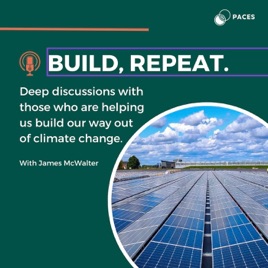
Advertise on podcast: Build, Repeat. (A Paces Podcast)
Rating
5from
This podcast has
160 episodes
Language
EnglishPublisher
PacesExplicit
No
Date created
2020/06/12
Latest episode
2026/10/07
Average duration
34 min.
Release period
33 days
Description
Deep discussions with those who are helping us build our way out of climate change.
Unlock Build, Repeat. (A Paces Podcast) podcast Email contact info,
Listeners & Audience details
Email contact information
Direct podcast contact details

Listeners
Audience numbers & engagement insights

Audience details
Podcast Insights

Podcast episodes
Check latest episodes from Build, Repeat. (A Paces Podcast) podcast
Live from Climate Week: How Redwood Materials Is Turning Old EV Batteries into Speed to Power
2026/10/07
Recorded live at the Paces office during Climate Week NYC, this episode features Claire McConnell, VP of Business Development for Energy Storage at Redwood Materials. James McWalter talks with Claire about how repurposed EV batteries are becoming one of the fastest paths to power for AI data centers.
Claire has worked on batteries for more than 15 years, from cost reduction on the Model S and the early days of Tesla Energy, through electric commercial vehicles at Proterra, to leading storage business development at Redwood. She explains why Redwood launched Redwood Energy: EV packs were coming back with meaningful state of health just as AI data centers hit a wall on grid access. She also explains why Redwood projects that repurposed EV batteries could serve up to half of the North American BESS market by 2030.
In this episode:
Why a 100 MW data center gives up $25–40M in revenue for every month it waits on interconnectionHow storage enables bring-your-own-capacity pathways and fully off-grid solar-plus-storage microgridsRedwood's 63 MWh second-life microgrid powering Crusoe's modular AI data centers at over 99% availabilityHow capacity maintenance agreements take degradation risk off the customerWhy renewables plus storage could become the default path to speed to power, with gas as backupCareer advice for breaking into climate and energy
Paces helps developers find and evaluate the sites most suitable for renewable development. Interested in a call with James, CEO @ Paces?
Coordinating the Decentralized Grid: Michael Grasso on GridRails and the Future of DER Orchestration
2026/08/20
Michael Grasso spent his career building some of the largest residential virtual power plants in the country — from Vistra Corp Solar to Sunrun to Sunnova — before founding GridRails, a software platform built for load-serving entities to bring distributed energy resources online, visualize them, control them, and settle the economics, all through a single system.
James and Michael dig into why only about 20% of the demand-response market has been captured despite roughly 11 million Americans already enrolled, and why Michael sees this as a two-sided problem: utilities lacking the tools to build flexible programs, and consumers uninterested in the rigid offerings they've been given. They talk through how real-time price and demand signals — rather than fixed, regulator-bound programs — could unlock far more participation.
The conversation turns to one of the fastest-moving trends in the industry: the rise of "edge" data centers sited on distribution networks rather than transmission, and what it means to orchestrate flexibility for facilities whose inference-driven load rises and falls throughout the day. They also cover the regulatory tailwinds coming out of FERC Order 2222, why 34 states now have some form of structured VPP program, and why Michael argues that simplifying those programs — not adding more structure — is the real path to scale.
A candid, wide-ranging conversation about coordination, complexity, and what it will actually take to keep the grid working as electrification accelerates.
Paces helps developers find and evaluate the sites most suitable for renewable development. Interested in a call with James, CEO @ Paces?
Quantify what you can, intuit the rest: Engie's distributed development playbook for 2026
2026/05/20
In this episode, James talks with Navya Gundeti, Director of Project Development at Engie North America, where she leads the distributed solar and storage development pipeline.
Navya is operating in a market where five-year plans don't survive the year they were written. OBBBA, tariff whiplash, data center land competition, and reshuffled interconnection queues forced her team to rebuild its strategy in real time. Her case in this episode: rigorous quantification on what you can measure, honest intuition on what you can't, and a bet that the next real unlock for the industry is utilities and advanced computing finally meeting.
Why distributed solar isn't a head-to-head competitor for data center load — but co-ops and munis facing first-time load growth are a real openingCompeting with hyperscalers offering landowners $25K–$100K+ per acre, and why landowner education (not price) is the distributed developer's advantageThe interconnection playbook shift: the right technology partners plus deep utility stakeholder relationships, not "submit and wait"Her hot take: the fusion of AI, quantum computing, and grid intelligence will flip the script.A must-listen for distributed solar and storage developers navigating the OBBBA aftermath, the data center wave, and the next phase of interconnection.
Paces helps developers find and evaluate the sites most suitable for renewable development. Interested in a call with James, CEO @ Paces?
Scaling Distributed Generation Beyond Community Solar with Bill Francis from New Energy Equity
2026/04/14
In this episode, James talks with Bill Francis, Vice President of Emerging Markets at New Energy Equity — a distributed solar developer that has spent over a decade building community solar programs across the country.
Bill joined NEE at the end of 2025 after seven years at Engie, arriving right as the traditional community solar model is showing real strain. Programs are saturating. Development capital is tighter. The ITC safe harbor clock is ticking. His mandate: figure out what comes next — and build it. The case he makes in this episode is that the fundamentals for distributed energy are actually stronger than ever. The branding and program structure just need to change.
Why community solar programs are hitting a wall — and the structures (feed-in tariffs, co-op PPAs, VPP tariffs) that could replace themThe ITC safe harbor cliff at end of 2027: why developers need a three-dimensional strategy on equipment timelines, permitting, and safe harbor right nowThe distributed storage opportunity: why half an acre beats 80 acres — and why electric co-ops are among the most motivated customers for standalone batteriesNEE's development DNA: why being judicious about when and how you de-risk assets matters more than ever when development capital is scarceA must-listen for distributed solar and storage developers thinking through market selection, capital discipline, and what the post-community solar era actually looks like.
Paces helps developers find and evaluate the sites most suitable for renewable development. Interested in a call with James, CEO @ Paces?
A mile deep, not wide: NineDot's case for going all-in on one market with Sam McGarvey
2026/03/31
In this episode, James talks with Sam McGarvey, Director of Origination at NineDot Energy — a developer, owner, and operator of front-of-meter battery storage systems across New York City's five boroughs.
NineDot made a deliberate bet: ignore every other market and go all-in on the single hardest place to build energy storage in the country. That focus has taken them from 3 employees to 84, and toward 400–500 megawatts of distributed storage across New York City by the end of the decade. Sam breaks down what it actually takes to develop in NYC — and why the lessons apply everywhere.
Why NYC's complexity is a feature, not a bug, for a focused developerThe affordability story: 1.3 million NY utility customers behind on bills — and what storage can do about itWhy January 2026 was a turning point: the first time ConEd included distributed storage in its load forecastA must-listen for developers navigating dense markets, complex permitting, and the next phase of distributed storage.
Paces helps developers find and evaluate the sites most suitable for renewable development. Interested in a call with James, CEO @ Paces?
How virtual power plants became a daily grid resource with Matt Plante
2026/03/18
In this episode, James talks with Matt Plante, President of Voltus, about what it actually takes to build a virtual power plant that grid operators call on every single day.
Voltus aggregates distributed energy resources, including industrial loads, batteries, commercial buildings, and now residential assets, into virtual power plants that participate in wholesale electricity markets. Since April 2024, Voltus has been dispatched by a grid operator every single day, a milestone that signals demand flexibility has moved from emergency backup to standard operating procedure. Matt joins James to unpack how the company has grown 10x since their 2021 conversation, what finally made the battery cost curve work, and why the barriers to scale look nothing like the barriers to entry.
James and Matt get into:
Why the shift from no-load-growth to explosive load growth has changed what grid operators will consider, and how fastHow batteries went from not penciling to the fastest-growing DER segment in Voltus's portfolioWhat data centers actually want from demand flexibility programs, and why forcing them to participate would backfireWhy FERC 2222 hasn't delivered and what it actually takes to unlock new states for third-party demand responseThe grid's relationship to distributed resources has fundamentally changed, and this episode is a clear-eyed look at what made that shift happen and what comes next.
Paces helps developers find and evaluate the sites most suitable for renewable development. Interested in a call with James, CEO @ Paces?
Learning from the last grid build-out (and why VPPs are the answer) with Mark Dyson
2026/03/03
The grid has been here before. Between 1960 and 2000, US utilities grew demand 4–5x while cutting real electricity prices by 20%, and the lessons from that era are more relevant than ever.
Mark Dyson is Managing Director of Electricity at RMI, where he's spent nearly two decades working on grid modernization, distributed energy resources, and the policy and market design that holds it all together. Before returning to RMI, he led analytics at Ascend Analytics, giving him a rare vantage point across both the technical and market sides of the energy transition.
In this episode, Mark draws on that history to make the case that data center load growth isn't the crisis it's being framed as — it's a solvable problem, and virtual power plants are a big part of the solution. He breaks down why VPPs are 40–60% cheaper than gas peakers or batteries for meeting new peak demand, and what it actually takes to deploy them at scale.
This episode covers:
- The three lessons from last century's grid growth: embrace new technology, invest proactively in infrastructure, and make the most of existing capacity
- Why virtual power plants are the fastest, most affordable tool for meeting data center demand growth
- Why hyperscalers resist flexible load at the project level — and how paying others to curtail resolves that tension
- Navigating permitting headwinds and the post-OBBBA policy environment
If you're working on the energy transition, Mark's perspective on what history can actually teach us about today's challenges is essential listening.
Learn more about RMI here.
Paces helps developers find and evaluate the sites most suitable for renewable development. Interested in a call with James, CEO @ Paces?
Why grid planning is the hardest problem in energy right now with Derek Stenclik
2026/02/17
In this episode, James talks with Derek Stenclik, Founding Partner at Telos Energy. Derek shares his path into the power sector, starting at GE where he spent nearly a decade working on grid planning, resource adequacy, and early studies on integrating wind and solar at scale, before co-founding Telos to tackle some of the grid’s most complex planning challenges.
The conversation focuses on how utilities and grid operators are navigating an era of unprecedented uncertainty, driven by rapid load growth, shifting resource mixes, and long planning timelines. Derek shares how Telos approaches these challenges through advanced grid modeling, emphasizing the importance of scenario analysis, proactive planning, and better decision-making in the face of volatile forecasts and evolving market rules.
Key topics include:
Why grid modeling and scenario analysis are foundational to the energy transitionManaging explosive load growth from data centers and large new loadsThe evolving role of load flexibility, batteries, and behind-the-meter generationAffordability, cost allocation, and the risk of stranded infrastructureA must-listen for anyone thinking about how reliability, affordability, and speed intersect in today’s power system.
Reach out to Telos Energy by visiting their website.
Paces helps developers find and evaluate the sites most suitable for renewable development. Interested in a call with James, CEO @ Paces?
Bridging the power gap: The fuel-flexible future for data centers with Craig Gordon
2026/01/21
In this episode, James talks with Craig Gordon, Head of Global Policy, Regulatory Affairs, and Business Development at Mainspring Energy. Craig brings deep experience in clean energy—from scaling Invenergy’s wind and solar projects to shaping U.S. energy policy with the American Clean Power Association. Today, he’s helping Mainspring redefine dispatchable generation for a rapidly electrifying world.
They discuss how Mainspring’s linear generator technology offers a modular, dispatchable solution ideal for the growing energy demands of hyperscale data centers. Craig shares insights on the importance of fuel flexibility, how the Inflation Reduction Act has reshaped deployment dynamics, and the policy shifts enabling faster, cleaner energy integration behind the meter.
How Mainspring’s linear generator bridges the gap between renewables and dispatchable generationThe role of fuel-flexibility (natural gas, hydrogen, ammonia) in enabling resilient sitingWhy data center load growth is stressing legacy regulatory frameworksHow recent FERC policy shifts are opening new doors for behind-the-meter innovationA must-listen for developers navigating grid constraints, data center energy needs, and next-gen dispatchable tech.
Paces helps developers find and evaluate the sites most suitable for renewable development. Interested in a call with James, CEO @ Paces?
Fixing the Grid-Data Center Disconnect with Tony Wagler and Alex Oort Alonso
2025/12/03
In this episode, James talks with Tony and Alex from the Paces team about their recent white paper exploring the mismatch between data center growth projections and actual grid planning. Tony, a seasoned power developer, and Alex, a researcher focused on data center flexibility, dive into how speculative load growth is driving transmission investments that may never serve real projects.
They discuss how Paces analyzed over 14 million Texas land parcels to identify where data centers could feasibly be built, incorporating constraints like power access, zoning, water, and community sentiment. The conversation reveals a fundamental disconnect: the grid is being built for data centers that may never exist, while truly viable sites often lack the needed power capacity. By taking a “land-first” approach, Paces offers a bottom-up, data-driven framework to inform smarter, faster, and more collaborative infrastructure decisions.
Why ERCOT (Texas) was the ideal case study for this white paper.The speculative nature of current interconnection requests and its ripple effects.Key site viability criteria: power, topography, ownership, fiber, and water.Why only 17% of viable land near substations in Texas has withdrawal capacity.A must-listen for anyone building in clean energy, this episode offers a practical framework to better align developer needs with grid planning.
Paces helps developers find and evaluate the sites most suitable for renewable development. Interested in a call with James, CEO @ Paces?
From Wall Street to Clean Energy: Investing in the AI-Powered Power Grid with Shanu Mathew
2025/11/20
In this episode, James talks with Shanu Mathew, Senior Vice President at Lazard, where he co-leads a U.S. sustainable equity strategy. With a background in traditional finance and a passion for climate and sustainability, Shanu blends data-driven investing with macro-level insight into energy and technology transitions.
They explore how Shanu’s career evolved from M&A banking to managing portfolios at the intersection of sustainability, power, and AI. The conversation ranges from the transformation of ESG investing, to the macroeconomic impact of AI on energy demand, and how public markets are trying to keep up with private innovation in data infrastructure. Shanu also unpacks what’s real (and what’s hype) in the current AI-capex boom.
The evolution of ESG investing into a bottom-up, alpha-first approachWhy AI is driving unprecedented power demand and reshaping energy marketsThe "chip to grid" value chain and where public market opportunities liePhysical bottlenecks like land, power, and permitting—and how they impact AI deploymentIf you want a deeply informed view on how capital markets are adapting to the climate-tech and AI megatrends, this episode is a must-listen.
Paces helps developers find and evaluate the sites most suitable for renewable development. Interested in a call with James, CEO @ Paces?
Building Clean Data Center Infrastructure with Gabe Messercola
2025/11/04
In this episode, James talks with Gabe Messercola, Director of Data Center Solutions at EDF. Gabe shares his journey from studying environmental policy and working as a rock climbing instructor to building renewable energy projects at Nexamp and leading innovative data center strategies at EDF. With deep experience in asset management and power markets, Gabe now focuses on aligning renewable generation with high-demand loads like data centers and flexible industrial users.
They discuss the evolving relationship between renewables, load growth, and AI-driven data center demand. Gabe explains how EDF is solving curtailment and congestion challenges by co-locating load at underutilized wind and solar sites. He highlights EDF's work with Soluna on a 166 MW behind-the-meter data center and dives into the regulatory, technical, and financial structures enabling this model. The conversation also tackles the critical role of market incentives, competitive retail, and grid flexibility to unlock fast deployment and sustainable scale.
How co-located data centers are unlocking value from stranded renewable assetsThe ERCOT PUN model and its role in hybrid project designThe tension between AI uptime requirements and grid flexibilityWhy competitive retail markets like Texas are leading clean energy innovationThis episode is a must-listen for anyone interested in the intersection of data centers, clean energy, and infrastructure innovation.
Paces helps developers find and evaluate the sites most suitable for renewable development. Interested in a call with James, CEO @ Paces?
Master Planning the Energy Future with Nat Sahlstrom
2025/10/09
In this episode, James talks with Nat Sahlstrom, Chief Energy Officer at Tract, a data center developer enabling the next generation of digital infrastructure. Nat shares his unconventional journey from Seattle’s punk rock scene to leading energy strategy at Amazon and now Tract. With over two decades in energy, he brings deep insight into the intersection of data center growth, power planning, and sustainable infrastructure.
They explore the critical challenges and opportunities facing the energy system in the age of hyperscale AI. Nat discusses his experience building one of the world’s largest corporate renewable portfolios at Amazon and how Tract is addressing the power, land, and social license hurdles confronting data center developers today. He advocates for master-planned campuses as the key to responsible, scalable digital infrastructure and unpacks why the U.S. needs a World War II-level mobilization to meet future load demand.
How hyperscaler energy needs are reshaping utility planning and permitting.The shift from back-office energy functions to front-page headlines.Why social license and stakeholder alignment are critical to infrastructure success.The case for horizontal and vertical integration in data center development.This episode is a must-listen for anyone thinking about where power, policy, and AI converge.
Paces helps developers find and evaluate the sites most suitable for renewable development. Interested in a call with James, CEO @ Paces?
Building Community Trust in Clean Energy with Hilary Clark
2025/07/22
In this episode, James talks with Hilary Clark, Senior Director of Social Licensing at the American Clean Power Association (ACP). With over two decades in permitting and regulatory affairs, Hilary brings deep expertise on how clean energy developers can effectively engage communities and navigate the complex siting landscape in the U.S.
They discuss the evolving challenges in local and state-level permitting for wind, solar, and battery projects. Hilary explains the rise of moratoria and bans, the importance of community trust, and how ACP supports developers through advocacy, policy coordination, and digital tools. The conversation also covers the role of automation in feasibility analysis and the limits of technology in community engagement.
The rise of permitting barriers like local moratoria and zoning bansThe importance of social license and long-term community relationshipsHow ACP leverages advocacy, policy expertise, and AI tools to support membersWhy the human element remains critical despite digital innovationThis episode offers an essential look at the on-the-ground work required to accelerate clean energy deployment across the country.
Paces helps developers find and evaluate the sites most suitable for renewable development. Interested in a call with James, CEO @ Paces?
Orchestrating Power for Data Centers with Brian Janous of Cloverleaf
2025/07/08
In this episode, James talks with Brian Janous, Co-Founder and Chief Commercial Officer at Cloverleaf Infrastructure and former Head of Energy at Microsoft. With 25+ years in the utility space — including a decade leading Microsoft’s cloud energy strategy — Brian shares what it was like to scale power procurement during the hyperscale boom and why he founded Cloverleaf to solve the next frontier: grid-aligned power delivery for data centers.
They explore the transition from fiber-first to power-first infrastructure, the myth of exponential energy growth, and the real reason AI is accelerating demand at an unprecedented pace. Brian unpacks the growing tension between real estate and power developers, the limitations of behind-the-meter hype, and why grid integration remains king.
You’ll also hear insights on:
Why utilities are overwhelmed by “two chucks in a truck” proposalsWhat makes a site actually marketable to hyperscalersThe misunderstood economics of flexible load and data center reliabilityHow Cloverleaf partners to derisk power timelines and unlock investmentWhether you’re a power developer, hyperscaler, or real estate operator, this episode offers a candid look at what it takes to deliver the electrons that fuel AI.
Paces helps developers find and evaluate the sites most suitable for renewable development. Interested in a call with James, CEO @ Paces?
Paces helps developers find and evaluate the sites most suitable for renewable development. Interested in a call with James, CEO @ Paces?
Podcast reviews
Read Build, Repeat. (A Paces Podcast) podcast reviews
Paul6 2022/07/26
Great one
Great podcast for anyone looking to use technology to help solve the climate crisis.
Natalie Perez (Roaming Yogi) 2021/01/21
Great climate podcast!
The conversations on this podcast about decarbonization and clean tech are insightful and thorught-provoking. Highly recommend.
Jmcwc 2021/01/18
Really insightful!
Great to find out about all these cool companies
Podcast sponsorship advertising
Start advertising on Build, Repeat. (A Paces Podcast) relevant audience podcasts
You may also like to advertise on these Podcasts

4.818402000
The Cabral Concept
Dr. Stephen Cabral
4.723151964
Timeless Wisdom with Dennis Prager
Salem Podcast Network
4.629942035
Optimal Living Daily - Personal Development and Self-Improvement
Justin Malik
4.6253542000
The Glenn Beck Program
Mercury Radio Arts

4.838332000
Entrepreneurs on Fire
John Lee Dumas of EOFire
4.814621644
The Big Honker Podcast
Andy Shaver & Jeff Stanfield

4.6313211083
Wow in the World
Tinkercast
4.922981174
Dropping Bombs
Brad Lea: CEO, Entrepreneur, and Host of The Bottom Line
4.861461108
The David Pakman Show
David Pakman
4.922331833
The Ten Minute Bible Hour Podcast
Matt Whitman