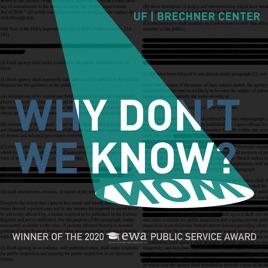
Advertise on podcast: Why Don’t We Know Podcast
Rating
4.9from
This podcast has
21 episodes
Language
EnglishPublisher
whydontweknowExplicit
No
Date created
2020/06/30
Latest episode
2022/06/02
Average duration
33 min.
Release period
55 days
Description
We expect government secrecy from the Pentagon or the CIA — not from our universities and our schools. But in many cases, institutions designed to protect our children are instead hiding critical information. It leaves us asking a lot of questions. One of which is simple … Why Don't We Know? Over the following episodes, we are trying to figure that out.
Unlock Why Don’t We Know Podcast podcast Email contact info,
Listeners & Audience details
Email contact information
Direct podcast contact details

Listeners
Audience numbers & engagement insights

Audience details
Podcast Insights

Podcast episodes
Check latest episodes from Why Don’t We Know Podcast podcast
Special Episode: ’Gag order’ against sexual assault
2022/06/02
In this special episode, taped live at SXSW EDU in Austin, Texas in March, we discuss how schools are bullying young sexual assault accusers into waiving their rights during school investigations into what happened to them. Title IX is supposed to protect students who allege sexual assault, but some schools are requiring their silence, and threatening discipline if they don't comply.
It runs afoul of the law, many experts say, and led attorney Laura Dunn and the non-profit Equal Rights Advocates to pen a letter to the U.S. Department of Education, trying to get the Biden Administration to stop this practice from continuing. Host: Sara Ganim. Guests: Laura Dunn, Kel O'Hara.
EXTRA: Why don't we know where all the lead pipes are?
2021/06/03
In April, President Joe Biden announced an infrastructure plan that includes removing and replacing all of America's lead drinking water pipes. It's an ambitious plan that would help millions of American children, and it was met with a lot of praise. But we couldn't help but wonder if this plan sounded too easy. Because as we've seen on a much smaller scale, sometimes it's really hard to know where all the lead pipes are. Host: Sara Ganim. Guests: Erik Olsen, Alex Stubblefield.
EXTRA: The Human Toll Of Missing Data
2021/04/01
Depending on where you look, you can find a statistic that will tell you any number you want to see about how often students are bullied in school. Why is that? Why are bullying numbers all over the place? And how does it cause students to fall through the cracks? Host: Gabriella Paul. Reporter: McKenna Beery. Guests: Itea Aslanian, Deborah Temkin, Brooke Greier.
Any Other Law
2021/02/23
Why can public institutions of education continue to get away with keeping crucial information from students and parents? In the final episode of season one, we break down the three main reasons - a lack of university willpower, the trainers who keep status quo, and the fear of big data.
EXTRA: Why Don't We Know how many kids are attending virtual learning?
2021/01/27
This was the most disruptive academic year in modern history, and we have collected very little data to help our students recover from it. This Extra episode tackles the question of Why Don't We Know how many students are actually attending virtual learning and which ones fell behind. Host: Sara Ganim. Reporter: Gabriella Paul. Guest: Paige Kowalski.
EXTRA: Attacked
2021/01/20
There is no nationwide tracking mechanism for physical attacks on teachers in American classrooms. But a 2018 survey suggests that more than 210,000 of them are in fact attacked each year. In one school district in New Hampshire, it led the union president to push for statewide change and a new law -- but that came at a personal price.
Misplaced Fear
2021/01/13
From Columbine to Virginia Tech to Sandy Hook to Parkland, we have struggled to answer the question of how to stop gun violence in schools. And the vague and overbroad privacy law, FERPA, has not helped with solutions. In fact, in at least two instances, it prevented red flags from being raised, ultimately costing lives.
When we asked all 50 states for the number of times that guns were brought to school campuses, 14 states told us that the number is too small to share. Fear of violating privacy seems to eclipse even the fear of a school shooting.
"I don't think we're surprised by the information," said Tony Montalto, who lost his daughter at the Parkland High School shooting.
And Ryan Petty, who also lost his daugher added that many schools " still use it as a convenient excuse to not report or inform parents about what's going on in campus."
What the heck is FERPA?
2020/11/30
A step back and a look at the history of FERPA, the privacy act we’ve now spent quite a bit of time dissecting. How did we get here? We start in 1974 at its infancy and then look at two cases at the same university that show the glaring hypocrisy of its current use. Host: Sara Ganim; Reporter: Camille Respess; Guests: Amelia Vance, James Buckley, Lee Hermiston and Clark Kauffman
Education Records
2020/11/16
Students at both public and private universities who are victims of sexual misconduct are being told that they cannot get their own records, a clear and obvious violation and manipulation of a federal law that was meant to ensure just that -- that students can see their own education records.
The law is called FERPA, and it's being abused all over the place.
This episode takes a look at how broken FERPA really is, not just at the university level, but also at K-12 schools all across the country.
From sexual assault, to school yard injuries, to public safety, to political campaign contributions to racial bias, FERPA is being used as a one-word, catch-all answer for any information a school doesn't want to share.
Secret Outcomes
2020/10/28
There are some universities that don't even know how many sexual assault or harassment cases they adjudicate. You read that right. When we asked 50 top universities around the country, a few of them told us that compiling that information would cost thousands of dollars, since they don't already track it. When we started asking why, we found that outcomes of these internal investigations into sexual assault are not easily available in many places. In fact, universities are fighting in court to keep the outcomes secret ... for a reason.
BONUS: Secrecy and the Coronavirus
2020/10/19
This week we're sharing a Bonus Episode of Why Don't We Know, focused on secrecy and data during the pandemic. Government agencies everywhere, not just schools, are using COVID19 as an excuse for not sharing information.
We found some particularly puzzling examples, like at the FBI, where the open records office decided to only accept mail-in requests, not electronic ones.
Other FOIA office phone lines were disconnected. Calls went unreturned. Emails unanswered.
In this episode, we also explore how government agencies are misapplying the Health Insurance and Portability Act. You probably know it as HIPAA.
Our two guests, Carolyne Hartley, a privacy and compliance strategist and expert for HIPAA cases, and Al-Amyn Sumar, a media law attorney who is trying to help news organizations get better data, talk to us about how many officials either don't understand what HIPAA says, or are hoping that the public doesn't understand what it says, and are using it to hide critical information.
“I see it cited on Twitter all the time in all kinds of different contexts where people say, "Well, HIPAA protects this," and actually HIPAA has nothing to do with whatever they're talking about,” Sumar said.
According to Hartley, the confusion over it often boils down to one thing: Politics.
“We're kind of victims of our own freedom,” Hartley said. “In a communist country, you wouldn't have that freedom. The communist government would come in and say, you tell us who's got COVID, who's been diagnosed, give us the names and the people you've been around, and we're going to contact every one of those. In our country where we do exercise the luxury of freedom, unfortunately, that boils down to whether or not the public health authority, or the individual nursing home decides that they want to share that information.”
Up In Flames
2020/10/12
What comes to mind when you think of a college town?
Old brick buildings covered in ivy. Some narrow, tree-lined streets, with little bookstores and coffee shops.
And that’s because the biggest public universities are generally in small towns.
Towns that share few common demographic and geographic features: A lot of them are more than 150 years old. Many in areas that are rural. Often, the towns around them are very dependent on the university economy. And often, even with the financial prop of being a university town, they are still economically depressed.
This situation accentuates a kind of class-system when it comes to campus housing -- students (or parents) who can afford the big, shiny new multi-story off campus apartments, and those who turn to the cheaper option: old converted homes that have been divided up into as many living spaces as possible so they can be rented to students.
Some of these houses are owned by upstanding landlords, but some are not. And many are in towns where there is no vigilant code enforcement.
So for this episode, we thought we’d put ourselves in the shoes of a student or parent who has just a few hours -- not a few weeks -- to search for code inspection reports.
We searched the websites for local municipalities in more than a dozen major college towns, first trying to find out if the safety records are easily available online, then if not, with a phone call follow up to the code inspection office to see how we could get the information.
The results varied greatly.
Podcast reviews
Read Why Don’t We Know Podcast podcast reviews
Elegant Warrior 2020/09/01
Must listen content and host
This podcast is fascinating, smart and well researched. Sara is an exceptional journalist and tells these stories with insight and compassion. Can’t w...
Running Drained 2020/08/10
Real Reporting Presented Well
Sara Ganim is a talented and driven journalist. She’s telling important stories with this project.
Podcast sponsorship advertising
Start advertising on Why Don’t We Know Podcast relevant audience podcasts
You may also like to advertise on these Podcasts
4.530885
The Gentleman From Hell
Maeltopia

3.593199
The Leo & Danny Show
Leo Dottavio & Danny Mullen

4.591411
The Weirdness
GZM Shows

4.82697963
Green Light with Chris Long
Chris Long
4.244791016
Ridiculous History
iHeartPodcasts
4.31783269
The View
ABC News
4.91411102
Fantasy Football Daily
Fantasy Football, Fantasy Points, NFL, Theo Gremminger

4.9201200
So There I Was
Chuck Newton and Pete Harmon

4.61856520
The Audible
Footballguys
4.8215207
Oil and Whiskey with Roadster Shop
ROADSTERSHOP