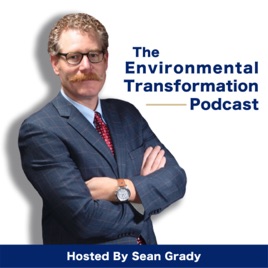
Advertise on podcast: The Environmental Transformation Podcast with Sean Grady
Rating
4.6from
This podcast has
137 episodes
Language
EnglishPublisher
Sean GradyExplicit
No
Date created
2020/07/05
Latest episode
2026/09/22
Average duration
50 min.
Release period
19 days
Description
The Environmental Transformation Podcast explores the future of Sustainability, EHS, the Circular Economy, and Environmental Innovation. Host Sean Grady interviews industry leaders and changemakers about emerging technologies, digital transformation, and the trends reshaping the environmental sector. Stay informed, lead the change, and join the ET Nation on every major platform as we dive into the conversations driving real environmental impact.
Unlock The Environmental Transformation Podcast with Sean Grady podcast Email contact info,
Listeners & Audience details
Email contact information
Direct podcast contact details

Listeners
Audience numbers & engagement insights

Audience details
Podcast Insights

Podcast episodes
Check latest episodes from The Environmental Transformation Podcast with Sean Grady podcast
Circular Indiana's: Battery Recycling EPR and Construction Waste Intiatives with President Pamela Francis
2026/09/22
Indiana's circular economy starts before the recycling bin, with buildings designed for deconstruction and manufacturers recovering their materials.
Circular Indiana board president Pam Francis, vice president of Schott Design, and board member Ken Miller talk with The Environmental Transformation podcast host Sean Grady about keeping products and materials in use longer. They explain the organization's shift from the Indiana Recycling Coalition, the upfront costs of changing business practices and the challenge of keeping recovered materials close to Indiana manufacturers.
The conversation covers AI-powered waste sorting, digital product passports and extended producer responsibility, or EPR. Francis and Miller discuss their focus on batteries, the fire risks that shape that work and the questions surrounding producer-funded collection, consumer costs and convenient drop-off locations.
Francis describes practical changes in commercial interiors, including carpet recycling, furniture reuse and designing spaces that can adapt without sending usable materials to a landfill. Examples include Shaw Industries' carpet take-back model and Sortera's use of AI to separate aluminum alloys, along with discarded tires turned into road barriers and unsold food recovered for animal feed.
The guests also preview the 2026 Circular by Design: Innovation Meets Action conference, scheduled for Oct. 5 at The Heritage Group's Indianapolis venue, The Center, with speakers including Heidi Sanborn and Kent Holm.Conference registration and membership: circularin.orgPodcast, newsletter and updates: seankgrady.com
#CircularEconomy #BatteryRecycling #SustainableDesignCHAPTERS:0:00 Welcome and Guest Introductions2:00 Moving Beyond Traditional Recycling6:00 Measuring Circular Economy Progress8:00 Circular by Design Conference Preview11:00 The Business Barriers to Circularity14:00 AI Sorting and Recycling Infrastructure17:00 Recovering Recyclables From Mixed Waste20:00 Circular Indiana's Battery EPR Plan23:00 Building an EPR Stakeholder Coalition25:00 Battery Fires and Recycling Safety27:00 Sponsor Break30:00 Indiana's Manufacturing Supply Chains34:00 Tires and Food Waste as Raw Materials36:00 Heidi Sanborn and EPR Experience39:00 Kent Holm and Battery Collection Models43:00 Oil Containers and Hazardous Waste45:00 Designing Out Construction Waste49:00 Reusing Carpet, Furniture and Doors51:00 Shaw's Carpet Take-Back Model53:00 Building Deconstruction in Boulder56:00 Waste Industry Partnerships58:00 Sortera and AI Aluminum Sorting1:01:00 Battery EPR and Long-Term Goals1:04:00 Keeping Resources in Use1:07:00 Closing and Conference Reminder
Greenwashing Risk: Verify Before Sustainability Claims Go Public with CEO Helen Neal
2026/09/08
Greenwashing can start when a communications team turns solid sustainability data into an overstated claim, says Helen Neal. The founder of HN Communications, a certified B Corp sustainability communications consultancy, talks with the Environmental Transformation Podcast host Sean Grady about the gap between corporate progress and public credibility. She explains how companies can speak about climate action without exaggerating results or going silent out of fear of scrutiny.Neal details her IMPACT framework: integrity, meaning, proof, action, consistency and transparency. She also explains how Zena, the artificial intelligence platform she developed, reviews websites, press releases and sustainability reports for potential regulatory risks. Rather than rewriting copy, the tool coaches users to identify missing evidence, clarify claims and explain how results were achieved. Neal says it still requires human review and is not a substitute for legal advice.The conversation also covers the pressure on 2030 commitments, why sustainability needs support from the chief executive and how tying bonuses to measurable goals can spread responsibility across a business. Neal makes the case for treating secure supplies, reliable energy and ethical procurement as long-term business priorities rather than simply the right thing to do.She traces her move from corporate work to building a flexible, remote consultancy and explains why she created the Climate Leaders Community for women in sustainability. Her message to boardrooms: use technology to understand the data, but keep telling the human stories behind the work.Contact Helen Neal: [email protected] Helen Neal and HN Communications on LinkedIn.#Greenwashing #SustainabilityCommunications #ClimateLeadershipThanks to our Sponsors: Cascade Environmental, E-Tank, WASTELINQTAGS:Helen Neale, Xena AI, Zena review, HN Comms, green hushing, ESG reporting, environmental advertising, green claims review, corporate accountability, climate risk communication, supply chain resilience, Scope 3 emissions, sustainability governance, responsible marketing, circular economy, climate commitments, sustainable procurement, brand trust, climate tech, environmental podcast
Indiana Partners for Sustainability Conference: Water, PFAS, and Circular Economy with Paul Melillo
2026/09/02
Indiana sustainability strategy is shifting from pollution prevention alone to resource efficiency, circular economy, water reuse and supply chain resilience. Paul Melillo, director of business development and principal at Metric Environmental, explains how the Indiana Partners for Sustainability is making that transition as it prepares for its 29th annual conference Sept. 10 in Indianapolis.Melillo describes the voluntary Partners Pledge, which asks member companies to identify sustainability improvements, attend events and report annual metrics on materials, landfill disposal, recycling and energy use. He makes the economic case in simple terms: businesses pay for waste when they buy materials and again when they dispose of them. Reducing waste can cut costs while improving environmental performance.The discussion also previews the conference program, including keynote speaker Bruno Pigott, executive director of the WateReuse Association, the Governor's Award for Excellence, and concurrent afternoon tracks focused on sustainability success stories and water. Melillo says water demand tied to data centers and major manufacturing developments is likely to be part of the conversation, alongside PFAS and infrastructure planning.Looking beyond the conference, Melillo argues that Indiana businesses need to prepare for more supply chain transparency, product life cycle scrutiny, carbon footprint reporting, water-use disclosure and recycling expectations. The organization supports members through quarterly facility meetings, peer sharing, consulting partners and a recorded library of more than 200 presentations.Learn more at inpartnersforsustainability.org.
How Interchange 360 is Increasing Automotive Plastic Recycling with CEO David Lawes
2026/08/18
Automotive plastic recycling is moving outside the curbside bin as EPR laws push petroleum brands to fund collection systems for used oil and antifreeze containers.David Lawes, CEO of Interchange 360, explains why petroleum packaging needs a separate recovery system and how the organization is building one across the United States. The effort grew from a Canadian model and brings major petroleum producers under a shared compliance structure for petroleum and automotive packaging.Lawes describes a funding model based largely on product volume, with fees collected upstream and incentives paid to existing trucking, collection and recycling businesses rather than a network of Interchange-owned trucks or facilities. He also explains how auto retailers, household hazardous waste sites and other return locations can serve as convenient alternatives to curbside recycling, where residual oil can contaminate broader material streams.The conversation follows the material after collection. Motor oil containers can be shredded, warmed and processed through a centrifuge to remove residual oil, which can be recycled, while the plastic can move into post-consumer markets and potentially back into new motor oil packaging. Lawes says the long-term goal is a tighter circular system, but processing capacity remains a major constraint, especially in states such as Colorado where the program is building infrastructure from a near-zero starting point.Lawes also discusses why consumer behavior often comes down to two factors: clear communication and convenient drop-off options. He points to British Columbia, where the Canadian program has achieved collection and recycling rates above 90%, as evidence that specialized systems can scale when the network is easy to use.Learn more about the Environmental Transformation Podcast at www.seankgrady.com.
#PlasticRecycling #ExtendedProducerResponsibility #CircularEconomyCHAPTERS:0:00 Recycling Challenge and Introduction2:00 Five Oil Brands Build a Shared EPR Model4:00 Why the Canadian Model Was Chosen6:00 Canada and U.S. Program Differences9:00 How Volume Based EPR Funding Works12:00 Incentivizing Existing Recycling Companies15:00 Alternatives to Curbside Collection18:00 Sponsor Break20:00 State by State EPR Compliance24:00 Circularity and Post Consumer Content27:00 Building Processing Capacity From Zero30:00 Cleaning Oil Contaminated HDPE33:00 Other Materials That Need Separate Systems36:00 Convenience Drives Recycling Behavior40:00 Collection Equipment and Retail Incentives42:00 Colorado Targets and Producer Compliance45:00 Developing Colorado Processing Capacity49:00 Building the System for the Long TermTAGS:David Laws recycling, Lawes lubricant recycling, Interchange360 recycling, lubricant container recovery, used oil bottle recycling, petroleum packaging stewardship, alternative collection program, motor oil jug recovery, antifreeze jug disposal, producer responsibility group, Colorado packaging compliance, Washington EPR policy, post consumer resin, HDPE oil bottle processing, circular packaging systems, automotive waste diversion, hazardous waste drop off, recycling incentive model
AI Risk Intelligence Turns Corporate Data Into Action with Eastward CEO Jim Massey
2026/08/04
AI risk intelligence can turn public corporate disclosures into a living view of threats before leaders see them internally. Jim Massey, founder and CEO of Eastward AI, explains how his platform reframes risk as the gap between where an organization stands and where it needs to go. Rather than relying on static spreadsheets and siloed annual reviews, Eastward builds a corporate persona from filings, reports, press releases, industry standards and competitive data, then uses curated agents to identify relevant changes.
Massey describes a private-company example in which the system connected a supplier announcement with a manufacturing fire and flagged exposure affecting roughly 15% of a client's business. He also walks through a beverage-company review that surfaced potential pressure from European drought conditions, tariffs and shipping disruption through the Strait of Hormuz.
The conversation covers Eastward's Reality Check feature, risk cards, citations for generated statements, audit trails, supplier scorecards and visual maps showing how multiple threats connect. Massey explains why people remain responsible for validating context, controls and reports, even when artificial intelligence handles much of the research and document production.
Host Sean Grady also asks how the platform supports sustainability teams, Scope 3 supply-chain reviews, executive decision-making and board reporting. Massey argues that faster, lower-cost assessments can move risk management beyond compliance and toward strategy, while keeping humans accountable for the final call.
Thanks to our Sponsors: WASTELINQ, E-Tank, and Cascade Environmental.
#ArtificialIntelligence #CorporateStrategy #RiskManagement
TAGS:Jim Massy, EastwardAI, Eastward artificial intelligence, risk management technology, corporate risk analytics, executive decision support, continuous risk monitoring, ERM modernization, third party due diligence, supplier risk scoring, materiality assessment automation, ESG risk systems, C suite risk strategy, board risk reporting, human in the loop AI, AI governance for business, regulatory risk alerts, risk taxonomy software, corporate persona modeling, active intelligence platform
Own Your Career - No One Else Will with Author Paul Goudreault
2026/07/14
Career ownership is not optional. Paul Goudreault spent more than 40 years in environmental consulting and engineering, serving as CEO of two multinational firms, before distilling those lessons into a practical book for professionals at every stage.Goudreault, founder of Enorine Partners and author of "Own Your Career: No One Else Will", walks through his ADAPT Career Lifecycle model, a five-stage framework covering the full arc from acquiring foundational skills to transitioning into retirement or reinvention. He and host Sean Grady discuss why most professionals never truly take ownership of their careers, how to identify the right mentor inside and outside your organization, and why your professional brand determines how much freedom you earn at work.
The conversation covers the difference between a coach and a mentor, how AI is reshaping entry-level roles in environmental consulting, the transferability of project management skills across industries, and why relationship-building remains the one thing technology cannot automate. Goudreault also shares career personality types, from the traditionalist to the entrepreneur, and explains how understanding your type helps you choose the right roles and organizations.His second book, "Own the Life You Deserve", is now available in audiobook format. Both titles are available on Amazon by searching Paul Goudreault. Visit SeanKGrady.com to see the entire catalog of episodes to listen to or watch.
#EnvironmentalPodcast #CareerDevelopment #EnvironmentalConsulting
TAGS:career lifecycle model, ADAPT model, career ownership, environmental consulting careers, EHS career advice, career mentorship, professional branding, career development podcast, environmental engineering podcast, project manager career growth, how to find a mentor, career personality types, AI in environmental consulting, career reinvention, work life balance consulting
CHAPTERS:0:00 Introduction and Guest Welcome2:02 Why Paul Goudreault Wrote the Book4:00 The ADAPT Career Lifecycle Model Explained11:20 How to Level Up at Any Career Stage15:40 The Importance of Being Coachable18:45 Building Your Advisory Team25:00 Career Personality Types29:30 Investing in Yourself Throughout Your Career36:30 Staying Current with Technology and AI41:30 Networking as a Long-Term Career Investment44:20 How to Find the Right Mentor48:30 Personal Brand vs. Professional Brand51:30 Dress for Success and First Impressions54:30 Understanding Your Organization's Strategy56:30 Making Your Mark and Leaving a Legacy58:30 Goudreault's Training Program and Book Links
PFAS Regulations, Drinking Water MCLs, and What Comes Next with Eurofins Taryn McKnight
2026/06/30
The U.S. drinking water MCLs for PFAS remain in effect, but court challenges, proposed deadline extensions, and regulatory uncertainty have left public water systems in a difficult position. Taryn McKnight, VP and PFAS Practice Leader for Eurofins Environment Testing, breaks down the current state of PFAS regulation in the United States, including the legal battles over EPA's drinking water standards, the CERCLA hazardous substance designation, and why the proposed rollback of certain PFAS compounds may be less consequential than headlines suggest.Recorded at the Battelle Chlorinated Conference in Dallas-Fort Worth, McKnight and host Sean Grady examine why utilities are caught between monitoring requirements and investment decisions, how biosolids have emerged as a primary concern for state agencies, and what the UCMR5 occurrence data actually shows about which compounds warranted a national primary drinking water regulation. They also discuss the passive receiver problem under CERCLA, congressional efforts to address it, and why legislation has stalled year after year.The conversation also covers the growing public interest in biomonitoring, Eurofins' direct-to-consumer blood testing kits for PFAS exposure, the role of citizen science in building population-level data, and what it would take for microplastics to move from EPA's Contaminant Candidate List to a monitored contaminant under UCMR6.Learn more about Eurofins Environment Testing's PFAS services at eurofinsus.com/pfas.Visit Sean Grady at seankgrady.com to subscribe to the newsletter and support the show.#PFAS #DrinkingWaterRegulation #EnvironmentalPodcastCHAPTERS:0:00 Introduction and Conference Setting2:02 Status of PFAS Drinking Water Regulations4:10 EPA's Proposal to Extend the 2029 Compliance Deadline5:45 Safe Drinking Water Act No-Backsliding Provision7:10 UCMR5 Data and the Case for Rescinding Four Compounds9:20 Biosolids and Wastewater as State-Level Priorities11:05 State Responses to PFAS Regulation12:15 CERCLA Hazardous Substance Designation Challenges13:45 Passive Receivers and Congressional Action17:30 Sponsor Messages20:05 Biomonitoring and Public Awareness of PFAS21:40 Eurofins Blood Testing Kits and Citizen Science22:50 PFAS and the Evolution of Laboratory Testing26:10 Robert Bilott, Dark Waters, and Advocacy Impact30:45 Battelle Conference and What Comes Next31:20 Microplastics, CCL6, and the Path to UCMR634:20 Closing Thoughts and How to Reach Eurofins
Thanks to our Sponsors: Cascade Environmental, E-Tank, and WASTELINQ
Battelle's Chlorinated Conference: PFAS, AI, and What's Next
2026/06/09
Battelle's Chlorinated Conference draws 1,500 environmental professionals from 23 countries, and its division manager explains why PFAS treatment is pushing the industry to its limits.Joe Tarsavage, Division Manager of Environmental Solutions at Battelle, discusses the 30-year history of the Chlorinated Conference, how PFAS contamination has reset treatment standards from two nines to five or six nines of removal, and why that gap is driving rapid innovation across the remediation sector. He also addresses how artificial intelligence is beginning to reshape site investigation, data analysis, and client reporting, and why the industry is only scratching the surface of what that technology can do.Tarsavage details Battelle's expanding conference portfolio, including the upcoming Sediments Conference in Austin in January 2027 and the newly rebranded Battelle Bloom Conference in June 2027, which will broaden the traditional bioremediation platform to include critical minerals and land optimization. He also touches on emerging contaminants now appearing on EPA's CCL 6 list, including microplastics and 6PPD-quinone, and what it will take for laboratories and researchers to develop reliable analytical methods for those compounds.The conversation also covers Battelle's student mentoring program, the value of deliberate mentorship in a field where it no longer happens organically, and what Tarsavage is asking conference participants to help shape for future events.#Battelle #PFAS #EnvironmentalConsulting #remediation #technology
CHAPTERS:0:00 Introduction and Joe Tarsavage's Role at Battelle0:58 History and Growth of the Chlorinated Conference2:55 PFAS as the Dominant Industry Topic5:00 Building the Conference Platform and Steering Committee6:05 AI and Digital Technology in Environmental Work8:50 How Reporting Timelines Have Changed Over 30 Years9:45 Poster Sessions, Student Competition, and Mentoring12:45 What Has Changed Most Over the Conference's 30 Years14:45 Vapor Intrusion, PFAS, and Evolving Regulations16:30 PFAS Treatment Challenges and Innovation17:50 Where Battelle and the Conference Are Headed Next19:35 Emerging Contaminants: Microplastics and 6PPD-Quinone21:15 Battelle's Role in Methods Development22:00 Conference Venue Plans and Future Locations23:45 The Value of Networking at Industry Conferences25:30 Closing RemarksReply
Rohail Khan on Closing C-Suite Deals and Beating the No Decision Trap
2026/05/26
Forty percent of prospects never make a buying decision, and the reason is rarely the competition. Rohail Khan, founder of Avant.AI and executive consultant for Corporate Visions, breaks down why the status quo is the most dangerous competitor in any sales cycle and how to defeat it.
Khan draws on 25 years as a C-suite executive, including roles at Xerox and Bank of America, to explain what CEOs and CFOs actually pay attention to during a pitch and why most sales teams lose the room within the first five minutes. The conversation covers how to use earnings call transcripts to find unconsidered risks, how to escape the commodity trap by shifting from features to financial outcomes, and why "you phrasing" transfers ownership to the buyer in ways that change the entire power dynamic of a pitch.
Host Sean Grady also gets into Daniel Kahneman's prospect theory, the EBITDA pivot, the value wedge, and the three deadly sins of sales messaging. Khan offers specific AI prompt strategies using tools like Perplexity and Gemini to surface insights that clients do not yet know they need.Whether you manage large accounts, prepare executive proposals, or are trying to break through to the C-suite for the first time, this conversation delivers a concrete framework for turning uncertainty into urgency.
Learn more about Corporate Visions at corporatevisions.com. Visit Sean Grady's website at seankgrady.com to sign up for the newsletter.#SalesPodcast #CSuiteStrategy #EnvironmentalTransformation
TAGS:Rohail Khan, Avant AI, Corporate Visions sales training, C-suite selling, executive sales strategy, no decision sales, EBITDA pivot, value wedge, prospect theory, Daniel Kahneman loss aversion, B2B sales podcast, sales training podcast, closing deals, unconsidered needs, sales messaging, commodity trap, Environmental Transformation PodcastCHAPTERS:0:00 Introduction and Rohail Khan's Background2:55 The Elevator Pitch and C-Suite Preparation8:00 Understanding the CEO, CFO, and COO Mindset11:30 Using Earnings Calls for Sales Research15:55 Sponsor Messages16:40 Why No Decision Is the Biggest Competitor19:45 Finding Unconsidered Needs With AI Research25:30 Biggest Preparation Mistakes in Executive Pitches29:30 You Phrasing and the Power Dynamic Shift31:45 The EBITDA Pivot and Avoiding Speeds and Feeds34:30 Breaking Through the Procurement Gatekeeper38:30 The Value Wedge and Defensible Differentiation41:00 Making the Customer the Hero Through Storytelling43:00 Decision-Making Psychology and Managing Risk47:30 Prospect Theory and the Cost of Inaction52:30 Telling Details Versus Superlatives in a Pitch53:45 Reframing Emotional Anchors With Analogies55:30 The Three Deadly Sins of Sales Messaging56:30 How to Connect With Corporate Visions
ToxiMapp: Mapping 1,900 Toxins Near Your Home
2026/05/12
ToxiMapp aggregates over 60 geospatial environmental datasets to show users exactly which toxicants are present in the air, water, and soil near any U.S. address, and the platform's founders say most people have no idea what surrounds them.Deb Hordon, Ph.D., founder and CEO of ToxiMapp, built the platform after moving her infant daughter into two separate communities with cancer clusters. Neither location looked dangerous. One was a picturesque seacoast area between Maine and New Hampshire with expensive real estate and top-rated schools. The data told a different story. Peter Cada, chief environmental scientist at ToxiMapp and an instructor at Duke University's Nicholas School of the Environment, joined to build the underlying data infrastructure, drawing on his prior work contributing to the EPA's EnviroAtlas.The episode covers how ToxiMapp's patent-pending toxin intensity scoring system works across air, water, and land media; why the platform is positioned as a shortcut for Phase I environmental site assessments and NEPA reviews; how partnerships with healthcare providers and diagnostic labs like Mosaic Diagnostics connect environmental exposure data to clinical testing; and what the roadmap looks like as the platform approaches 1,900 tracked toxicants and adds surface water and expanded air quality datasets.The conversation also addresses PFAS contamination, the ethics of publishing environmental data near residential properties, crowdsourcing as a future data collection strategy, and the platform's current pricing model starting at $19.99 per address search.#EnvironmentalHealth #ToxiMapp #toxins #data #mapping #environment #riskmanagement #pfas TAGS:environmental toxins map, toxic neighborhood score, environmental site assessment tool, PFAS tracking, EPA ECHO alternative, EnviroAtlas, Mosaic Diagnostics, cancer cluster, environmental intelligence platform, geospatial environmental data, phase one ESA, brownfield sites, Superfund sites, environmental consulting tools, air water soil contamination, environmental health podcast, GIS environmental analysisLearn more at https://www.toximapp.com/
Thanks to our Sponsors: Cascade Environmental, E-Tank & E-Pump, and WASTELINQ
Microplastics, CCL 6 and EPA Drinking Water Policy with Megan Quinn of Waste Dive
2026/04/28
Microplastics appear on a federal contaminant watchlist for the first time, and the regulatory path forward remains far from certain. Megan Quinn, senior reporter at Waste Dive, breaks down what the EPA's proposed new Contaminant Candidate List 6 actually means for water utilities, landfill operators, and chemical manufacturers, and why the lack of standardized test methods could slow any future regulation significantly.
Quinn explains how the CCL process works, who sits on the newly reshuffled Science Advisory Board, and why the parallel push from the MAHA movement adds political complexity to what is otherwise a science-driven process. The conversation draws on direct parallels to how PFAS moved through the regulatory pipeline over more than a decade, from early CCL listings to drinking water standards to hazardous substance designations, offering a framework for understanding how microplastics and newly listed pharmaceuticals might follow a similar, lengthy trajectory.
The episode also covers the dissolution of the EPA's Office of Research and Development, New Mexico's move to regulate PFAS as a hazardous waste, the Department of War's updated PFAS destruction and disposal guidance, and what the rollback of certain PFAS drinking water standards signals about the current administration's regulatory priorities. The public comment period for the draft CCL 6 closes June 5, 2026.
Megan Quinn covers state and federal recycling policy, PFAS, chemical recycling, environmental justice, and EPA regulatory changes for Waste Dive.
0:00 Introduction and Megan Quinn's Background
1:55 What Is the Contaminant Candidate List 6
5:00 Public Comment Period and Finalization Timeline
6:45 Science Advisory Board Changes Under Trump
8:45 Who Is Affected by CCL 6
10:30 Should Companies Begin Sampling Now
13:00 Lack of Analytical Methods for Microplastics
15:10 EPA Research Capacity and Budget Cuts
17:30 Private Industry's Role in Federal Research
19:15 Public Concerns and Red Flags
21:00 PFAS as a Regulatory Roadmap for Microplastics
25:45 How Waste Dive Covers EPA Announcements
28:00 New Mexico PFAS Rules and PFAS Incineration
30:15 Advice for Stakeholders Watching CCL 6
33:30 Who Is Monitoring for Microplastics Now
34:30 Closing Remarks
Inside the $8 Billion DOE Nuclear Waste Cleanup Program: Steve Moore on Veolia's Federal Services
2026/03/17
The U.S. Department of Energy spends roughly $8 billion annually cleaning up nuclear waste from Manhattan Project-era sites like Hanford, Washington and Oak Ridge, Tennessee. On this episode of the Environmental Transformation Podcast, host Sean Grady sits down with Steve Moore, president and CEO of Veolia Nuclear Solutions Federal Services Group, to discuss the agency's most pressing environmental liabilities and innovative remediation technologies.
Moore describes the scale of the challenge: 56 million gallons of high-level radioactive waste currently stored in above-ground tanks at Hanford alone. He explains how Veolia's patented GeoMelt vitrification technology transforms reactive metals and radioactive waste into stable glass, and discusses the company's operations of two of the largest radioactive waste landfills in the nation.
The conversation covers emerging opportunities to revitalize federal sites as data centers and advanced reactor facilities, the "competetition" model where contractors collaborate on complex projects, and why the nuclear remediation field offers meaningful careers for young professionals seeking challenging environmental work.
Carbon Emission Life Cycle Assessments 101, 102, and 103. Schools in session with John Beath
2026/02/24
Sean Grady interviews John M. Beath, P.E. (TX), LCA-CP, CEO and founder of John Beath Environmental, LLC, on the Environmental Transformation Podcast. Beath explains life cycle assessment (LCA), carbon footprints and how companies evaluate emissions across raw materials, manufacturing, transportation and product use.
In this episode, Beath breaks down LCA basics for beginners, including emission factors, primary vs. secondary data and environmental databases. He also discusses LCA 101, LCA 102 and LCA 103, transparent Excel-based modeling, EV vs. internal combustion trade-offs, grid impacts, charging and temperature effects, EPDs, and why plug-in hybrids can be a practical near-term solution for reducing combustion-related air pollution in daily driving.
Inside CHEMTREC: Chemical Emergency Management Support for First Responders and Shippers
2026/01/27
Host Sean Grady talks with Kevin Lavezzo of CHEMTREC about the side of the chemical world most people never see, but responders rely on when accurate information matters. They unpack what CHEMTREC actually does, including how its Emergency Operations Center triages calls, uses tools like the Emergency Response Guidebook (ERG), and connects callers with product experts.Lavezzo explains a common misconception: first responders can call CHEMTREC for help without paying a fee, and the team will still work to support a response even when company information is incomplete. The conversation also covers how CHEMTREC supports compliance for shippers, manages safety data sheets, provides hazmat and regulatory training, and coordinates parts of incident response through partners.They also dig into real-world challenges, from language barriers and global response complexity to responder skill gaps with monitors and interpreting SDS details, plus emerging trends like lithium-ion battery incidents and severe weather impacts on transportation.
Thanks to our Sponsors: Cascade Environmental, E-Tank & Pump, and WASTELINQ.
How Terracycle is leading the reuse and recycling industry with its Loop platform & expanding the circular economy with CEO Tom Szaky
2026/01/06
TerraCycle CEO and co-founder Tom Szaky returns to the Environmental Transformation Podcast with host Sean Grady for an update on what has changed since his last appearance in episode 20 in 2020. Szaky breaks down why most items are “not recyclable” because of economics, not technology, and why reuse is TerraCycle’s biggest investment through the Loop platform, including what it has taken to scale in France. The conversation also digs into U.S. recycling headwinds, extended producer responsibility, Senate Bill 54 and Senate Bill 343 in California, and why education and “making it fun” can move behavior fast. Szaky also explains TerraCycle’s current Regulation CF raise, the planned Regulation A offering, and where to learn more at www.terracycle.com.
Thanks to our Sponsors: Cascade Environmental, E-Tank, and WASTELINQ
Podcast reviews
Read The Environmental Transformation Podcast with Sean Grady podcast reviews
Below Sea Level 2025/07/08
Excellent Coverage
Sean does an excellent job curating guests with varying backgrounds. This has become a great source for keeping up with the evolving PFAS regulation r...
BERM LLC 2024/09/20
Review
Sean is a natural! Love the topics and the high level of knowledge from his guests! Kudos!
Mp02020 2023/12/06
Engaging!
Many environmental podcasts can be a little dry. Not The Environmental Transformation Podcast. Even with seemingly “borning” topics such as Why get yo...
Sue Bruning 2021/04/13
Love the range of topics!
Shout out to Sean and his all star line up of guests. The Environmental Transformation Podcasts covers a huge range of environmental and sustainabili...
Katz Eng. and Innovations 2021/03/13
The Environmental Transformation Podcast
Great information and perspective concerning individual contributions. I like how it shows that simple changes in our daily routines can have very lar...
Doc Christain 2021/03/03
Podcast for solar junkies.
Cerebral, informative, great give and take, always interesting for PHD to nerd scientists that possesses a heart to learn about reducing The carbon fo...
BowmanClimate 2021/03/01
Knowledgeable, spirited, and inspiring
Sean knowledge and flair for spirited and informative conversation is infectious. He’s a great interviewer who picks engaging topics and guests. Highl...
Tim the Changemaker 2021/02/28
Green is good.
We need to thoroughly and totally shift from “greed is good” - and an economics geared to shareholder r.o.i - to a world in which every business decis...
ZeroWasteSteph 2021/02/28
Love this podcast!
Sean Grady has a knack for finding speakers for all the environmental topics I want to hear about. I really appreciate his down-to-earth, practical ap...
Daniel Overbey 2021/02/25
Great podcast operating in a unique lane
This podcast goes beyond the talking points of environmental regulation and emerging technologies to offer an in-depth, accessible dialog with industr...
Podcast sponsorship advertising
Start advertising on The Environmental Transformation Podcast with Sean Grady relevant audience podcasts
You may also like to advertise on these Podcasts

4.610836573
Serialously with Annie Elise
Annie Elise & Audioboom Studios
4.41171483
The Outlier Health Podcast
Matt Frazier, Matt Tullman, Isabelle Caputo, and Doug Hay

4.616141358
Giggly Squad
Hannah Berner & Paige DeSorbo
4.8219787
Imperfect Action
Steph Taylor
4.727535588
This Past Weekend w/ Theo Von
Theo Von
4.713016375
The Tim Dillon Show
The Tim Dillon Show
4.115971458
The Tucker Carlson Show
Tucker Carlson Network
4.828046452
Huberman Lab
Scicomm Media

4.240683
To Be The Man
Podcast Heat | Cumulus Podcast Network
4.41511432000
The Ben Shapiro Show
The Daily Wire