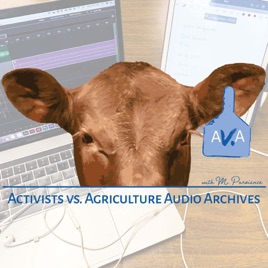
Advertise on podcast: Activists vs. Agriculture
Rating
5from
This podcast has
4 episodes
Language
EnglishPublisher
UnknownExplicit
No
Date created
2020/07/08
Latest episode
2021/03/24
Average duration
-
Release period
49 days
Description
Read our most recent blog posts focused on correcting misinformation in agriculture while inspiring agriculturists to start a conversation with anti-ag activists.
Unlock Activists vs. Agriculture podcast Email contact info,
Listeners & Audience details
Email contact information
Direct podcast contact details

Listeners
Audience numbers & engagement insights

Audience details
Podcast Insights

Social media
Check Activists vs. Agriculture social media presence


Podcast episodes
Check latest episodes from Activists vs. Agriculture podcast
Polis has 99 Problems and All of them Involve MeatOut Day
2021/03/24
This week, I visited with Colorado Livestock Association President Elect Kenny Rogers about CLA's response to Governor Polis' "MeatOut Day" declaration.
As many of you know, March 20 was declared “Meat Out” day in the great state of Colorado by Governor Jared Polis. From what I observed, Polis has a few problems on his hands, and I intend to outline them.
1. Polis is uninformed…I’m not sure who told Governor Polis meat was “bad,” but wow they completely missed the mark. As I’ve stated many times before, eating meatless for dietary or ethical reasons is valid — these are personal preferences and frankly, there’s no way I or anyone else out there can argue these points if someone can’t stomach eating meat, literally or figuratively. However, cutting meat out of a diet because of environmental reasons is absolutely absurd.
I feel like I’m playing a broken record here, but the Environmental Protection Agency (you know, a government funded, unbiased organization) does not blame the livestock industry for major, negative environmental impacts. Other “sources” such as Veg News, Vox, PETA, Cowspiracy (movie), and Joaquin Phoenix use the “cows are destroying the Earth” argument until they’re blue in the face, but reliable sources do not, and I will die on that hill.
I’m not sure where or why Polis got his information, but it’s got no legs to stand on; no valid sources to back up these claims. To me, that’s a problem — and if I was a resident of Colorado, I would have lost a great deal of respect for my governor. If the man can’t see and believe the information from a renowned reliable source, I can’t trust him to be a reliable source.
2. This is a PR nightmare…From a public relations standpoint, this whole MeatOut Day declaration is a spiraling, meaty mess.
Who in their right mind would advise or even give a green light to this public stance or campaign in a state where the livestock industry is very clearly thriving? Colorado is known far and wide for their impact on the beef industry, specifically. Livestock production is ideal for Colorado terrain; the National Western Stock Show calls Colorado home; the National Cattlemen’s Beef Association (NCBA) is headquartered in Colorado — one could almost say cattle were made to live in Colorado.
One could also say the person on Polis’ staff who made the call for him to declare March 20 “MeatOut Day” should lose their job, but I digress.
MeatOut day was a colossal disaster from a public relations standpoint because of the vast support for MeatIN Day, which brings me to Polis’ third and final problem…
3. The success of MeatIN Day…I want you to open up your laptop, tablet, phone, or really anything you can find that has a web browser on it. Type “meat out day Colorado” into the search bar and just ogle at the headlines you see. You’d think you’d see Governor Polis’ official proclamation, maybe a story or two from anti-meat blogs, or maybe even the official MeatOut Day website — but none of these links pop up. No, instead, we see headlines such as “MeatOut, Meat-In events held across Colorado;” “Gov. Polis proclaims Saturday as ‘Meat Out Day:’ spurs ‘Meat In Day’ from other side;” “Colorado agriculture industry rallies against state's MeatOut Day.”
Polis may have thought MeatOut Day would come with some backlash from some Coloradans, but I don’t think he anticipated the national support for MeatIN Day — I doubt he anticipated other Governors (Montana Governor Greg Gianforte and Nebraska Governor Pete Ricketts) to declare March 20 “Montana Meat Day” and “Meat on the Menu Day” and Governor Gianforte to post
Yielding My Passion
2021/03/18
Taylor and Cathryn Kerns and Brian McGuire of Western Heritage Meat Company discuss what they're doing to advocate for the ag industry, as well as the disconnect between agriculture and the public.
Last week, I visited Western Heritage Meat Company in Sheridan, Wyoming to take some photos, get a tour of the new meat processing plant and retail space, and meet with the Western Heritage crew. My visit can be summed up in one word: refreshing.
In October, Activists vs. Agriculture turned one year old. Over the course of a year, my blog reached 32,938 unique visitors spanning across all seven continents — I was overwhelmed. These statistics were reported to me after a month long break I took to focus on WAR’s annual Herd Reference edition and to break ground on my freelancing business’ website, www.walkingpproductions.com.
The Western Heritage Meat Company Team: Taylor, Jack, and Cathryn Kerns; Brian McGuire
I was on cloud nine, I couldn’t believe these numbers. Sure, maybe they weren’t as high as some of the other ag advocates’ blogs out there… but it broke my goal of 10,000 visitors in a year. I thought this milestone would push me to do more, to “top” any of the stunts I’d pulled in the past through my column/blog but instead, I got burned out.
This happened for a number of reasons, the first being that stupid word — which I promise, I will try to never write about again in this blog — COVID.
Many people were affected by the COVID-19 pandemic, and yes, I lost loved ones, contracted the virus myself, had some public speaking gigs I was super excited about canceled, and spent some time in lockdown, unable to fly home to see my Texas family. However, the way COVID-19 affected me the most was in my career as a journalist. Every, single day of my life for the past 365 days I have heard about this virus, wrote about it, proofread articles on it, and scrolled through endless social media posts about it.
I realize it’s a privilege that this was the way a global pandemic affected me the most… but it punched me in the gut when it came to writing. It was all anyone in my anti-ag Facebook groups could talk about, from vaccine arguments to blaming the ag industry for the initial COVID-19 outbreak. Frankly, I quit checking up on my frenemies (friends because they keep me on my toes, enemies because they have the sole mission of destroying mine and most of y’all’s livelihood) due to the fact that nothing new was happening. No one was going to animal rights protests, no one was blaming animal ag for global warming anymore, and honestly, this cause wasn’t at the forefront of their minds anymore with a global pandemic to worry about.
It seems silly to say COVID-19 burnt me out on my small agvocate blog — but it did, and ya’no what? I’m over it… enter the Western Heritage team…
I have a handful of questions I always ask interviewees when I do a profile story. One of these questions is, “why do you do what you do?”
Most agriculturists answer the same way, “agriculture is arguably the most important industry because it feeds the world;” “I’m a fifth-generation farmer/rancher, it’s my legacy;” and my all-time favorite (no sarcasm) “I guess I just like cows,” with a sly grin.
When I asked Brian, Taylor, and Cathryn this question, they had similar answers. However, they hit me with another answer I wasn’t expecting: education.
“We rely so heavily on agriculture within our society to produce everything from the carpet and shoes we wear, to the food we put in our bodies, and yet people demonize them all the time for working
The Age of Agricultural Illiteracy
2020/11/20
Sponsor and Self Promotion:
I recently started my own business, Walking P Productions, which specializes in Web Design as well as graphic design, photography, and writing. To learn more, visit www.walkingpproductions.com or contact me via email at [email protected].
“The surprising number of American adults who think chocolate milk comes from brown cows,” the Washington Post headline read. In November 2020, this headline jumped out to me just as it did the first time I saw it back in 2017.
“Seven percent of all-American adults believe that chocolate milk comes from brown cows, according to a nationally representative online survey commissioned by the Innovation Center of U.S. Dairy,” the story went on.
“If you do the math, that works out to 16.4 million misinformed, milk-drinking people. The equivalent of the population of Pennsylvania (and then some!) does not know that chocolate milk is milk, cocoa, and sugar.”
I suggest you get out your giggles and snide comments now, because the rest of this podcast is nothing to laugh or sneer about.
What is the root of this problem and how can we fix it? Well, the problem starts with agricultural literacy, or, illiteracy for that matter.
According to agfoundationg.org, an agriculturally literate person “understands how the agricultural industry works — not just where food comes from, but who grows it, agriculture’s effect on the economy, environment, technology, lifestyle, and its relationship to livestock.”
In turn, we could define a person who is agriculturally illiterate as the exact opposite: someone who doesn’t understand how the ag industry works beyond picking up a sack of spuds at the grocery store and never thinking twice about the backbreaking work which went into getting those potatoes to the consumer.
Agriculture, as we know in our hearts and concurred by our government at the beginning of the Coronavirus pandemic, is essential. And in my opinion, agricultural literacy is also essential because every single person on the face of the planet HAS to eat, be clothed, and have a roof over their head.
Think about it: if we never told our story, many consumers would just be happy heading to the butcher counter to grab a slab of steaks and never dig deeper “beyond” the beef. Which, not too long ago, was weirdly enough “okay.” However, in recent years we’ve seen the rise of social media coupled with businesses who outwardly condemn livestock production and conventional farming while blatantly lying about the ag industry.
I know, you’ve been reading my column or blog now for a year now and I’m sure I’m starting to sound like a broken record here, but I keep covering this issue because I personally believe there’s not enough emphasis on the importance of agricultural illiteracy.
We MUST inform our consumers about their food because guess what: PETA is, Beyond Beef is, and so is Impossible Foods — you know, the company whose CEO’s mission is to abolish animal agriculture by 2035. These enemies of agriculture are out there, acting like junior high girls spreading rumors and telling half-truths to make themselves look better and deter any consumer from trusting their loyal friend, agriculture, ever again.
I often ask myself how these anti-ags can get away with dispersing non-factual information and it boils down to an ethics issue. Some people tell the truth, whether it’s ugly or not, and some tell lies to make themselves look less ugly.
Case in point: these fake meat companies tell consumers just how “terrible agriculture is for the environment” and throw out inflated statistics from biased and invalid studies to make the consumers fee
All It Takes is Five Minutes
2020/10/29
Hello! This week’s audio file contains comments from not only my dad (as mentioned below) but beef producers JoJo Carrales and Bill Begger. This file is a little more in depth than the blog post and provides some interesting points.
Photo courtesy of Heartbrand Beef
You can accomplish quite a bit in five minutes or less. You can fry an egg, brush your teeth, schedule an appointment, maybe you can run a mile in that time frame — heck, you can even change someone’s outlook on agriculture in that short amount of time.
I know I say this just about every other week, but truly, it takes less than five minutes of your day (or even your week) to advocate for the agricultural industry — and my dad proved this statement a few months ago. Now, I’m not the bragging type, but I think if there’s one thing we should all be allowed to brag on, it’s is our loved ones. Today, I’m going to do just that because I’m incredibly proud of my dad.
At the beginning of August, my family ran out of steak which basically means my dad hit the panic button. He was in Tyler, Texas visiting a church member in the hospital and stopped at Sam’s Club on the way home. While at Sam’s, he found an entire choice rib-eye roll for a decent price. So, Dad put the giant cut of beef in his buggy and went on his merry way.
As he walked down one of the aisles, he said a man saw his buggy, chuckled, then asked him what the rib-eye roll was. Dad explained that a rib-eye roll was a rib roast and he would get about 14 ribeye steaks out of this specific cut of beef.
Dad went on to explain the difference between select, choice, and prime and answered a few of the guy’s questions. He also explained marbling, and even told the guy he prefers beef that’s not lean because lean beef has less flavor.
A worker behind the meat counter overheard my dad and hollered at him, “Hey, we’ve got a prime rib roast down at the end of the aisle for about $0.50 more a pound.”
Dad looked at guy he was originally talking to and said, “If there’s enough, I’ll go grab us both one of these prime ribeye-rolls — I’ll be back.”
Low and behold, there were two prime ribeye-rolls left and Dad grabbed them both — one for him and one for the guy. Dad said right about the time the guy put the giant slab of meat in his buggy, his wife walked up and started laughing. She asked what he was doing, then the guy recounted everything my dad had just told him.
Dad said this guy told his wife, “I’ve sat right here, and this brother has taught me more about meat in five minutes than I’ve ever known. I’ve been buying beef my whole life and I had no clue about all the stuff this guy just told me.”
The guy added that this conversation had changed the way he will buy beef in the future.
The couple then thanked my dad for sharing his knowledge, then told him they were having some guests come over for supper later that weekend.
“I can promise you, that guy told those six friends of his who came over for supper everything I’d just told him,” Dad said.
To hear my dad tell this story takes a while because he’s known for being *slightly* long winded, but he said the whole ordeal in Sam’s Club took about five minutes of his time.
There are 1,440 minutes in a day, meaning 0.3 percent of my dad’s day was spent advocating for the agricultural industry.
There are 10,080 minutes in a week, meaning .05 percent of my dad’s week was spent advocating for the agricultural industry.
My dad changed someone’s opinion forever. He did this by welcoming conversation and answering questions in a civil and warm manner
Podcast sponsorship advertising
Start advertising on Activists vs. Agriculture relevant audience podcasts
You may also like to advertise on these Podcasts

4.819448
The Soho Forum Debates
The Soho Forum Debates
4.816750
The Radical Therapist
Chris Hoff PhD(c), LMFT

4.825226
Dedicated to Disneyland Paris Podcast
Dedicated to Disneyland Paris Team
4.79441533
Epic Real Estate Investing
Matt Theriault
4.843514
Long Shot Leaders with Michael Stein
Michael Stein: Entrepreneur, actor, filmmaker, comedian & self help expert

4.5178173
LaunchLeft
LaunchLeft and Kast Media

420501
Retro Gaming Discussion Show
RGDS Team

511150
Music Matters Media
Music Matters Media

4.924255
The Priestess Perspective
Hot High Priestess

520176
Australia in the World
Darren Lim