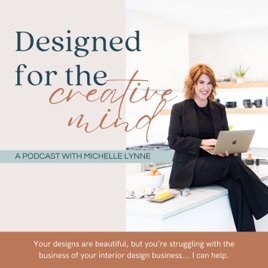
Advertise on podcast: Designed for the Creative Mind™
Rating
4.7from
This podcast has
246 episodes
Language
EnglishPublisher
Michelle LynneExplicit
No
Date created
2020/09/01
Latest episode
2026/10/05
Average duration
33 min.
Release period
8 days
Description
Your designs are beautiful, but you're struggling with the business of your interior design business. Join successful interior design business owner, Michelle Lynne, of ML Interiors Group each Monday morning as she shares the processes she has found useful in growing her own 7-figure design firm, interviews industry related guests, and brings her own team of designers on for lively conversations. If you aren't happy with the performance of your interior design business, are tired of trading your time for money, and know you were made for more, this show is for you.
Unlock Designed for the Creative Mind™ podcast Email contact info,
Listeners & Audience details
Email contact information
Direct podcast contact details

Listeners
Audience numbers & engagement insights

Audience details
Podcast Insights

Podcast episodes
Check latest episodes from Designed for the Creative Mind™ podcast
Ep 246: Nobody Warned Me About This Part: Hiring Would Expose My Own Weaknesses
2026/10/05
Hiring people is supposed to create capacity. But what happens when bringing someone onto your team actually makes your business feel more complicated?
In this episode, Michelle Lynne gets honest about one of the parts of business ownership nobody warned her about: hiring people would force her to confront how much of her business was living inside her own head.
When you've built a business around your own instincts, experience, and standards, it's easy to assume that what feels obvious to you will be obvious to everyone else. But your team can't read your mind—and they shouldn't have to.
Michelle shares the lessons she learned as her design firm grew, including why hiring initially created more work instead of less, how recurring team problems can reveal weaknesses in the business itself, and why delegation requires more than simply handing someone a list of responsibilities.
She also explores the uncomfortable reality that sometimes the problem really is the employee—but you can't fairly determine that until you've looked at the role, the process, your leadership, and the support you've provided.
In this episode, Michelle talks about: Why hiring often begins with addition before it creates subtraction
How a team exposes the parts of your business that have been running on your memory, instinct, and unwritten standards
The difference between describing a task and actually defining what "good" looks like
Why "be more proactive," "use your judgment," and "take care of the client" aren't actually clear standards
The principle: "Every project is different, but the process should be the same."
How undocumented processes turn the owner into the answer to every routine question
Why capable owners can accidentally create dependent employees by solving problems too quickly
The difference between giving someone responsibility and giving them the authority to actually own it
Why offering your perspective is different from taking the work back
How delayed feedback can turn a simple conversation into a much bigger problem
Why caring about your team can sometimes become an excuse for avoiding difficult conversations
How to determine whether you're dealing with a people problem, a role problem, or a leadership/process problem
When you have to accept that someone simply isn't the right fit for the role
Why examining your own leadership doesn't mean taking responsibility for every failed hire
What Michelle does differently today as she leads her design firm
A question to ask yourself If you're frustrated with someone on your team right now, don't start with:
"Is she a good employee or a bad employee?"
Instead, look at the role.
Ask yourself:
What has actually been made clear?
What authority does she have?
What feedback has she received?
What support has been provided?
Does the process actually support the work?
Have I communicated what needs to be communicated?
Have I given her enough room to make decisions?
If you've done those things and the same problem continues, you may finally have the information you need to address the person or the fit with confidence.
Because sometimes the answer is better direction.
Sometimes it's a better role.
And sometimes, uncomfortable as it may be, it's a different person.
The bigger lesson Hiring isn't simply a way to purchase more capacity.
Hiring is a commitment to lead.
When someone joins your company, they're stepping into your clients, your history, your standards, your processes—and all of the assumptions you may not even realize you've made.
Your job as the owner is to make as much of that invisible information visible as you reasonably can.
Standards need to be stated.
Responsibilities need to be clear.
Processes need to be documented.
Feedback needs to happen while it can still be useful.
And authority needs to accompany responsibility.
Because the goal isn't to create a team that thinks exactly like you.
It's to create a business where talented people can make good decisions without needing the owner to be the answer to everything.
Work With Michelle If you're in the middle of a team situation and you're too close to it to tell whether you have a people problem, a role problem, or a leadership problem, private coaching can help you step back, separate the facts from the frustration, and determine what needs to change.
Learn more about working with Michelle here: https://thedesignbakehouse.com/private-coaching
Keep Listening This episode is part of Michelle's series about the parts of business ownership nobody warned us about—the messy, uncomfortable, and surprisingly valuable lessons that come with growing a company.
Because sometimes you don't need another business strategy.
You need to be willing to look at what your business is showing you.
Ep 245: Nobody Warned Me About This Part: When Growing Your Design Firm Changes Your Job
2026/09/28
You started your interior design business because you love design. You wanted to create beautiful spaces, work with clients, and build something of your own.
But somewhere along the way, the business grew… and your job changed.
Suddenly, you're spending less time designing and more time managing people, making financial decisions, building processes, and carrying the responsibility for everything happening inside your firm.
And nobody really warned you that this was part of the deal.
In this first episode of my new series, Nobody Warned Me About This Part, I'm getting honest about what happens when the business you built around your talent starts requiring something entirely different from you.
I'll share my own evolution from doing everything myself at by Michelle Lynn to leading ML Interiors Group, why stepping away from design was both liberating and surprisingly emotional, and what it really means to transition from being the designer to being the business owner.
Because here's the thing: Growth isn't just more clients, bigger projects, or a larger team. It's a transfer of responsibility. And the work doesn't disappear just because someone else is doing the designing.
We'll talk about:
Why the role of the owner changes as an interior design firm grows.
The emotional challenge of stepping away from the creative work that built your reputation.
Why leadership, pricing, processes, and capacity planning are not overhead. They're the work.
The uncomfortable middle stage where you have a team but still feel responsible for every decision.
How staying involved in every detail can unintentionally turn you into the bottleneck.
The difference between having high standards and communicating those standards effectively.
Why hiring more people doesn't automatically create freedom.
How to determine whether you actually want to lead a larger firm or prefer a business that keeps you closer to the design work.
The questions every interior design business owner should ask before pursuing the next level of growth.
The question to consider: If your business doubled over the next two years, how would your daily job change? And would you actually want the life that comes with it?
Because there is no one-size-fits-all definition of success. You get to decide what kind of business you want to build.
Ready for Support? If you're navigating the transition from designer to business owner and need help figuring out your role, your team, or what comes next for your firm, private coaching with Michelle Lynne can help you get clarity and create a business that supports the life you actually want.
Explore Private Coaching with Michelle Lynne at https://thedesignbakehouse.com/private-coaching.
Connect with Michelle Follow Michelle Lynne here at the Designed for the Creative Mind podcast for more honest conversations about the business behind the beautiful designs.
This is the part nobody warned us about. And it's worth talking about.
Ep 244:Do You Actually Want to Own an Interior Design Business?
2026/09/21
Being an interior designer and being an interior design business owner are two very different jobs. Have you actually decided which one you want?
We talk a lot about the dream of owning an interior design firm: creative freedom, choosing your clients, setting your own schedule, and building something that is completely yours.
And those things can absolutely be part of business ownership.
But there's another side of the equation that doesn't always make it into the Instagram caption.
Because when you own the business, you're not just the designer. You're also the salesperson, financial manager, problem solver, technology department, decision-maker, and the person who ultimately has to deal with whatever goes sideways.
In this episode, Michelle Lynne gets very honest about what it actually means to own an interior design business—and asks a question that more designers should be asking:
Do you actually want to own a business, or do you want to be an interior designer?
Neither answer is wrong.
Working for an established design firm can offer the opportunity to focus on the creative work without carrying the full weight of sales, finances, operations, and business risk. And for some designers, that may genuinely be the career they want.
For others, the autonomy and opportunity that comes with ownership are worth the responsibility and uncertainty.
The important thing is knowing which one you're actually choosing—and making that decision based on the life and work you want, rather than what sounds more ambitious or impressive.
In this episode, Michelle talks about: The difference between being an interior designer and being an interior design business owner
Why design is only one part of the job when you own the firm
The reality of being responsible for sales, finances, technology, and problem-solving
Why impressive revenue numbers don't necessarily mean a business is profitable
The personal development that comes with putting yourself—and your work—out there
Rejection, perfectionism, imposter syndrome, and vulnerability as a business owner
The financial risk and uncertainty that come with starting a firm
Why working for another design firm is not a fallback or a failure
What you can learn by working inside an established design business
How to think about ownership versus employment based on the actual life you want
Why you're allowed to change your mind about the path you've chosen
The question to sit with: What do you want your actual days to look like?
If you want to spend most of your time sourcing, designing, presenting, and installing, working inside an established firm may be exactly what you're looking for.
If you want to build something that's yours, make the decisions, take the risk, and reap the rewards—and you're willing to engage with the unglamorous parts of running a business—ownership may be the path for you.
There's no prize for choosing the harder option.
There's no shame in changing your mind.
And there's certainly no reason to build a business simply because everyone around you says that's what successful designers are supposed to do.
Choose the career that actually fits the life you want to live.
Want to work with Michelle? If you're wrestling with whether to start, grow, change, or rethink your interior design business, private coaching gives you the opportunity to look at your specific situation—including your goals, numbers, circumstances, and what you actually want your work and life to look like.
Learn more about private coaching with Michelle Lynne by visiting https://thedesignbakehouse.com/private-coaching
Share this episode Know an interior designer who's trying to figure out whether they actually want to own a business?
Send this episode their way. Sometimes the most useful thing we can give someone isn't permission to make a particular choice—it's a clearer picture of the choice they're actually making.
Ep 243: The Art of Being Principal: Building a Business That Doesn't Need You Every Minute with Katie Decker-Erickson
2026/09/14
What if the real measure of a successful design firm isn't how much the principal can personally accomplish—but how well the business operates when they're not there?
In this episode of The Art of Being Principal, Michelle Lynne and Katie Decker-Erickson have one of their trademark conversations: part business strategy, part leadership lesson, and part "how did we get on this subject?"
They dive into why strong operations are so important for design firms, especially as a business grows beyond the principal doing everything herself. From documenting processes and empowering your team to conducting project postmortems and creating space to step away, they explore what it actually takes to build a firm that can function without you.
And yes, they talk about Fiji.
Michelle shares her "Fiji Factor"—the idea that if she and her lead designer could disappear to Fiji tomorrow, the business should still be able to operate. Katie adds her own twist: processes should be consistent, but not so rigid that there's no room for the unique needs of a luxury client or the lessons you learn along the way.
The conversation also gets into one of the biggest leadership shifts a principal can make: stopping yourself from being the person who solves every problem.
Because when your team has responsibility and the authority to make decisions, something important happens. You get your time back. Your team gets stronger. And the business becomes less dependent on you.
In this episode, Michelle and Katie talk about: Why documented processes are essential—even for small and solo design firms
The "Fiji Factor" and why your business should be able to function without you
Why 90% of your process should stay consistent while leaving room for the other 10%
Charging appropriately for high-maintenance or high-touch clients
How to stop being the person who has to know and solve everything
The difference between responsibility and authority when managing a team
Why hiring for "care" and character can matter more than hiring for every skill on the job description
How to trust your team while still having checks and balances
Why project postmortems should capture what went RIGHT—not just what went wrong
How to recognize when an old process no longer serves your clients or your firm
The importance of auditing your processes, subscriptions, tools, and systems
Why the right tools can save you from working harder just to get the same result
How creating white space in your business gives you room to think, create, and breathe
Why principals need to take real time away from the business
The connection between good operations, sustainability, and actually enjoying your business again
One of the biggest takeaways from the conversation is simple:
Operations may not sound sexy, but they're what give you the freedom to build the business—and the life—you actually want.
Whether you want to grow a seven-figure firm, take six clients a year, spend more time designing, or simply be able to take a vacation without your phone exploding, the goal is the same: build a business that doesn't require you to hold every piece in your head.
And sometimes, the best leadership move you can make is to step back and let your people figure it out.
Because you don't have to know everything.
You don't have to solve everything.
And your business shouldn't need you to do everything.
Connect with Us
You can learn more about Michelle by visiting https://thedesignbakehouse.com/ or following her on IG: https://www.instagram.com/by_michelle_lynne/
You can learn more about Katie by visiting https://successbydesign.coach/ or following her on IG: https://www.instagram.com/successbydesign_coach_podcast/
Want to get on the waitlist for Sidemark 2.0? This software will be THE software to run your entire interior design business. A true all-in-one. https://api.mysidemark.com/widget/form/4Ug6Rgg2uqCX0MydoJ2v?notrack=true
Ep 242: Tended, Pt 4 - When Everyone Else Looks Like They Have It Together
2026/09/07
Have you ever looked around at other interior designers and thought, What do they know that I don't?
They're booked out. Their projects look incredible. Their social media is polished. They seem confident, successful, and completely on top of their business.
Meanwhile, you're staring at a quiet pipeline, difficult clients, late shipments, team issues, or a slow month and wondering if you're doing something terribly wrong.
In this final episode of Tended, Michelle Lynne gets unusually honest about a season when her own business looked successful from the outside—but felt anything but successful on the inside.
After unexpectedly losing two key team members in 2023, navigating the launch of Studio Works and Sidemark, and then experiencing a prolonged slowdown in leads through 2024 and 2025, Michelle found herself questioning everything—including whether she should walk away from her design firm altogether.
And yet, if you had followed ML Interiors Group on social media during that time, you probably would have had no idea.
The projects were still being photographed. The posts were still going out. The business was still moving.
That's the point.
You are comparing your behind-the-scenes to someone else's highlight reel.
And that comparison can lead you to make decisions based on information you don't actually have.
In this episode, Michelle talks about: What it feels like to go through a genuinely difficult season while your business still looks successful from the outside
Why social media gives you an incomplete picture of another designer's business
The danger of assuming that a designer who is "swamped" is necessarily profitable or successful
Why busyness and business success are not the same thing
How industry events and conversations at market can fuel comparison
Why year-end highlight reels can make a slow season feel even worse
How Michelle pulled herself out of the comparison spiral by returning to her own numbers, pipeline, margins, clients, marketing, and team
The difference between learning from another designer and reshaping your business because of what you see them doing
Why slow seasons don't necessarily mean you're falling behind
The reminder that you are not uniquely behind and probably aren't missing some magical secret everyone else has figured out
The big takeaway The version of someone else's business that you can see is always edited.
You don't know their margins. You don't know their client relationships. You don't know whether they're profitable. You don't know what is happening behind the beautiful project photos or the confident conversation at market.
So before you change your positioning, blow up your brand, restructure your services, or decide that everyone else has figured something out that you haven't, come back to your own business.
Look at your actual numbers. Your pipeline. Your margins. Your clients. Your marketing. Your team. Your goals.
Your business needs a North Star—not a comparison.
And perhaps most importantly, remember:
You are not separate from your business.
Tending to yourself isn't the soft work or the extra work. It's part of the work.
Running an interior design firm is hard. You don't have to pretend otherwise.
Ready for support? If this episode—and the entire Tended series—hit a little too close to home, private coaching may be the right next step.
Michelle works with interior designers who want experienced guidance from someone who understands the realities of building and running a design firm.
Learn more about Private Coaching at Design Bakehouse.
Join Michelle at the Northeast Design Conference Michelle will be speaking at the Northeastern Design Conference during the first week of October.
Use code MICHELLE10 for 10% off your registration.
Check the show notes for conference details and registration information.
Ep 241: Tended, Pt 3 - The Word No Has a ROI
2026/08/31
Saying no doesn't come naturally to most people—and it certainly didn't come naturally to Michelle.
In this episode of Tended, Michelle makes the business case for one of the hardest words for interior designers to say: no.
Because every yes has a cost.
Whether it's taking on a client you knew wasn't the right fit, quietly absorbing scope creep, accepting projects you've outgrown, or saying yes to every personal request outside of work, the easy yes often creates a much bigger problem down the road.
Michelle breaks down why designers struggle to say no, what's really underneath those yeses, and how creating stronger structures and boundaries can protect your time, energy, and business.
She also gets personal about the guilt that can come with saying no at home—and why honoring your capacity isn't selfish or neglectful. It can actually be one of the most intentional things you do for yourself, your family, and your business.
In this episode, Michelle talks about: Why saying no is a skill, not a personality trait
The hidden cost of taking on a client you knew wasn't the right fit
How "small" yeses turn into scope creep and unpaid work
Why scope creep is often a communication and structure problem—not a client problem
What happens when your firm outgrows the kinds of projects you used to accept
How scarcity fear can cause you to make today's decisions based on an old version of your business
Why saying no creates space for better-fit clients and projects
The connection between business boundaries and personal boundaries
Why "no" doesn't require an apology or a lengthy explanation
How to practice saying no in low-stakes situations before you need the skill in a high-stakes one
Why the way you feel after a well-held no is valuable data
The big takeaway The yes you give to avoid discomfort today may be creating a much bigger problem for yourself tomorrow.
A well-held no creates space—for the right clients, the right projects, the right pace of growth, and a business you actually want to stay in for the long run.
And remember: "No" is a complete sentence.
Work with Michelle Visit our website at https://thedesignbakehouse.com/private-coaching to learn more about how you can work with Michelle 1-1.
Ep 240: Tended, Pt 2 - The Energy Audit
2026/08/24
You've probably heard all the advice: get more sleep, exercise, drink more water, take a vacation, take better care of yourself.
But what if you're doing some of those things and you're still exhausted?
In this episode of Design for the Creative Mind, Michelle Lynne takes a deeper look at the difference between being tired from working hard and being depleted by the way your business is operating.
Because sometimes the problem isn't that you need more rest. It's that your energy is being spent in places that aren't serving you.
Michelle walks through the hidden energy drains she sees in interior design business owners—from difficult or misaligned clients to social media comparison, overfunctioning as an owner, and the expectation that you should always be available.
She also talks about an important distinction between recovery and restoration. Recovery stops the drain. Restoration actually puts something back in the tank. And as a business owner, you need both.
Most importantly, Michelle gives you a simple exercise you can use this week: an energy audit. Pay attention to what takes your energy and what gives it back. Then use that information the same way you would use any other business data—to make better decisions about where your time, attention, and energy belong.
In this episode, we talk about: The difference between normal tiredness and deeper depletion
Why misalignment can leave you exhausted even when you're getting enough rest
How the wrong clients can drain more than your time—they can drain your confidence and creativity
The comparison spiral created by social media
Why overfunctioning as a business owner keeps you stuck in the day-to-day
The hidden cost of being constantly available to clients and vendors
How setting communication boundaries can actually strengthen client relationships
The difference between recovery and restoration
What Michelle has discovered actually restores her energy
Why unstructured time and "white space" matter for business owners
How to conduct your own one-week energy audit
Why your energy is a business metric worth paying attention to
Your takeaway: You are a business asset. Your energy is one of the most important inputs in your business—and you deserve to know where it's going.
If this conversation hit close to home and you're ready to build a business you can actually sustain, visit thedesignbakehouse.com and click the Coaching tab to learn more about working with Michelle.
Design for the Creative Mind is hosted by Michelle Lynne, founder of The Interior Design Business Bakery.
Ep 239: The Design Besties - Friendship, Collaboration & Designing for a Bigger Purpose
2026/08/18
What happens when four professionals in the design industry meet by chance, become fast friends, and decide to use their collective talents to give back?
Meet the Design Besties: Nikki Watson, Lori Johnson, Robin DelaCruz, and Whitney Atkinson.
What started with a chance meeting at the Vacation Rental Design Summit quickly turned into a daily group text, a genuine friendship, and eventually a nonprofit with a big mission: transforming teachers' lounges into beautiful, restorative spaces that give educators a place to recharge.
In this episode, Michelle sits down with the four creatives behind the Design Besties to talk about how their friendship came together, what makes their collaboration work so well, and why they believe there is always room at the table.
They share the story behind their first teachers' lounge makeover, the emotional response from the teachers, and how that experience turned a passion project into a national mission. The Design Besties are now working toward bringing their work to all 50 states.
In this episode, you'll hear about: How four professionals from different areas of the design industry became the Design Besties
The unexpected project that inspired them to create their nonprofit
Why teachers' lounges became the focus of their service work
How each Bestie brings a different strength to the team
What makes their collaboration work without ego or competition
The importance of creating welcoming spaces and making sure there's always room at the table
How they're working to scale the Design Besties nationally
The power of using your professional skills to serve others
Why adult friendship and genuine community can be such a gift
How designers and brands can get involved through donations, sponsorships, volunteering, and spreading the word
Meet the Design Besties (full bios below)
Rhobin DelaCruz
Interior designer. Creative instigator. Vibe curator. Rhobin has designed for names like GQ, TED, and MTV - but his real flex is helping clients create bold, joy-filled spaces that feel like them (just with better lighting and cuter pillows). Born in SoCal, thriving in NYC, Rhobin mixes West Coast chill with East Coast edge, all wrapped in global inspiration and a love for real estate, storytelling, and saying what everyone else is thinking.
Business name-- Rhobin DelaCruz Designs
Email [email protected]
Insta: @rhobindelacruzdesigns
Website: www.rhobindelacruz.com
Lori Johnson
Lori Johnson is a Dallas-based fine artist whose abstract work blends soft layers of color and texture to explore beauty, transformation, and connection. Featured on Bargain Mansions (HGTV, Magnolia Network, A&E) and sold nationally at HomeGoods and HomeSense, her art invites reflection and emotional connection. Represented at Dallas Market Center through McStudios and Ethan & Associates, Lori collaborates with designers, retailers, and lifestyle brands. She recently partnered with Denim Manor and Wexel Art to launch a line of textile fabrics for interiors, fashion, and home décor.
Business name- Lori Johnson Artist, Collaborator and Creative
Email [email protected]
Insta: @lorijohnsonfineart
Website: www.lorijohnsonfineart.com
Nikki Watson
Nikki Watson is the founder of The Design Quad, Dallas's leading home staging and design firm. What began with $10 borrowed from her mother has grown into the nation's largest-volume staging company, with more than 300 homes staged at once across Dallas–Fort Worth. Her work has been featured on HGTV, A&E, Max, and international outlets. Known for her motto "Create, Inspire, and Serve," Nikki has built service into her brand's DNA, supporting community charities while redefining home staging, design, flooring, and remodeling.
Business name-- The Design Quad
Email [email protected]
Insta: @iamnikkiwatson
Website: www.nikkiwatson.net
Whitney Atkinson
Whitney Atkinson, founder and inventor of WUGS Weighted Rugs and WILLOWS Weighted Outdoor Pillows, is a Gulf Coast native blending function with style. With a background in interior and commercial design, she created the first weighted rug to solve slipping, curling, and outdoor durability. Her weighted pillows also withstand harsh weather while staying beautifully in place. Whitney's innovative products reimagine everyday living by offering solutions that are both practical and design-forward.
Business name- - Founder & Inventor of WUGS & WILLOWS
Email [email protected]
Insta: @whitney_atkinson
Website: www.wugsweightedrugs.com
Want to Get Involved? The Design Besties are looking for schools, brands, designers, donors, and supporters who want to help them bring beautiful, wellness-focused teachers' lounges to communities across the country.
Visit their website to learn more, apply for a school makeover, explore sponsorship opportunities, donate, and follow their work.
Email: [email protected]
Website: thedesignbesties.org
Facebook: The Design Besties
Instagram: @the_designbesties
Check out our latest campaign: Grizzlies Prep Teachers' Lounge Movement
And remember: there's always room at the table.
Ep 238: Tended, Part 1: You Are a Business Asset
2026/08/10
As business owners, we're really good at taking care of everything else.
We protect our clients, our teams, our projects, our cash flow, our systems, and our businesses—but somehow, we put ourselves at the bottom of the list.
In this episode of Tended, Michelle Lynne gets personal about what happens when the person running the business is running on empty. From skipping appointments and sacrificing sleep to giving up movement and carrying the mental load of both business and family, Michelle shares her own struggles with putting self-care into practice.
Because for a business owner, burnout doesn't always look like collapsing. Sometimes it looks like shorter patience, harder decisions, less creativity, resentment toward the business you built, or simply sitting at your desk for hours without actually accomplishing much.
And when you're a sole proprietor or small firm owner, you're often the single point of failure. If you go down, the business goes down with you.
This episode is a reminder that taking care of yourself isn't a distraction from your responsibilities. It's what makes you capable of meeting them.
In this episode, Michelle talks about: Why business owners are often the first to protect everything except themselves
The "oxygen mask" analogy and why it applies so directly to entrepreneurship
What running on empty actually looks like before you reach full-blown burnout
How exhaustion can affect your patience, creativity, decision-making, and relationships
Why sleep isn't a luxury or a badge of honor—and what you're losing when you consistently sacrifice it
Michelle's experience of stopping exercise and realizing that movement was about far more than aesthetics
Why regular movement can be a form of business maintenance
The difference between being busy and actually contributing
How the "first one in, last one out" mentality from corporate life can follow you into entrepreneurship
Why the work will never truly be finished—and why waiting until everything is handled before resting doesn't work
The impact of your relationship with work on your team and your family
Why ambition and health don't have to be opposites
How being rested, fed, and physically cared for can make you a better leader and business owner
A question to take with you If your business systems went down tomorrow, you'd do whatever it took to fix them. When was the last time you applied that same logic to yourself?
You are not a distraction from your business.
You are the person who makes the business possible.
Want support beyond the strategy? Michelle's private coaching works with interior designers on more than just the numbers and business strategy. It's about the owner behind the business, too—creating a business that works within the reality of your life and learning how to lead well while carrying a heavy load.
Learn more about private coaching at The Design Bakehouse.
And if you're sitting at your desk right now staring at your computer but not actually getting anything done, take Michelle's advice: get up. Stretch. Move.
You don't have to earn rest.
You have to tend to yourself.
Ep 237: 5 Reasons You May Not Be Getting Affluent Clients w/ Robyn White
2026/08/03
In this episode of Designed for the Creative Mind, Michelle welcomes back website strategist Robyn White of RDW Design Studio to talk about one of the biggest questions interior designers ask:
"Why aren't I attracting more affluent clients?"
Spoiler alert: it probably isn't your pricing.
Robyn specializes in helping interior designers position themselves to attract premium clientele, and she shares the five biggest reasons your website may be sending the wrong message—even if your work is exceptional.
Together, Michelle and Robyn discuss why affluent clients buy differently, how trust matters more than luxury buzzwords, and why your website should communicate confidence, ease, and expertise long before a consultation ever happens.
If you're ready to elevate your brand, attract better-fit clients, and create an online presence that reflects the level of work you truly do, this episode is packed with practical insights you can implement immediately.
In this episode, you'll learn: Why your website—not your pricing—may be costing you affluent clients.
What "perception misalignment" is and how it quietly drives away premium prospects.
How luxury clients evaluate trust before they ever contact a designer.
Why your messaging should shape perception instead of simply explaining your services.
The importance of speaking to your ideal client instead of trying to appeal to everyone.
How your portfolio can either elevate or dilute your positioning.
The subtle design elements that create a truly premium online experience.
When it's time to invest in a website refresh—and when DIY is perfectly acceptable.
Key Takeaways Affluent clients aren't looking for the cheapest designer—they're looking for the one they trust most.
Your website should communicate:
Confidence
Expertise
Simplicity
Exclusivity
A seamless client experience
The goal isn't to convince people to hire you. It's to create an online presence that makes the right clients feel like you're the obvious choice.
Resources Mentioned Luxury Client Website Appraisal (complimentary personalized website review): https://rdwdesignstudio.com/luxury-client-website-appraisal/
Connect with Robyn on Instagram: @rdwdesignstudio
Connect with Michelle If today's conversation made you rethink your own website, remember that attracting great clients starts long before the consultation. Building the right systems, messaging, and client experience will help you create a business that's not only profitable—but enjoyable to run. Visit our website at https://thedesignbakehouse.com/.
Ep 236: The Human Advantage - Why AI Makes Value-Based Pricing Non-Negotiable for Interior Designers
2026/07/27
Ep 235: The Human Advantage - AI Isn't Your Biggest Threat. The Noise Is.
2026/07/20
Everywhere you look, someone has a new opinion about AI and the future of interior design. One expert says AI will replace designers. Another says it never could. The constant stream of predictions, hot takes, and fear-based headlines can leave even experienced designers questioning their business.
But what if AI isn't actually the problem?
In this episode, Michelle Lynne explores why the biggest threat to your business isn't artificial intelligence—it's allowing industry noise to distract you from strengthening the fundamentals of your own firm. She breaks down what AI has actually changed for clients, what it means for design businesses, and why clarity around your positioning, pricing, and process matters now more than ever.
If you've been feeling anxious about where the industry is headed, this conversation will help you separate fear from fact and refocus on what truly moves your business forward.
In This Episode, You'll Learn: Why AI isn't replacing established interior designers—but it is exposing weaknesses in some business models.
How AI is changing client expectations before they ever contact a designer.
Why education has become an even more valuable part of your sales process.
The biggest pricing mistake designers make when using AI tools.
How to differentiate yourself when AI can generate beautiful concepts in seconds.
The difference between reacting to industry noise and making strategic business decisions.
The questions every designer should ask to evaluate the health of their business.
Key Takeaways AI has changed the client journey. Today's clients often arrive with AI-generated inspiration, stronger opinions, and more visual references than ever before. That doesn't replace your expertise—it simply changes where education happens in the relationship.
Faster work shouldn't mean lower profits. If AI allows you to complete design work more efficiently while you're still charging hourly, you're actually reducing your earning potential. Efficiency increases value—it shouldn't decrease revenue.
Your real competitive advantage isn't your deliverables. AI can generate beautiful presentations, but it can't replace experience, judgment, project management, vendor relationships, or the trust clients place in an expert to guide a complex renovation from beginning to end.
Don't let fear drive your business decisions. Instead of obsessing over industry headlines, evaluate your own business. Strong positioning, profitable pricing, and clear processes will always matter more than the latest AI prediction.
Memorable Quote "Stop letting the industry conversation set your emotional temperature. You're not the thermometer—you should be the thermostat."
Connect with Michelle Lynne If today's episode made you realize your challenge isn't AI—it's gaining clarity around your pricing, positioning, or business model—Michelle's private coaching is designed to help you build a stronger, more profitable design firm. Learn more at The Design Bakehouse.
Enjoyed the Episode? If this conversation resonated with you:
Leave a review wherever you listen to podcasts.
Share this episode with another interior designer who's feeling overwhelmed by all the AI conversation.
Subscribe so you don't miss next week's episode on why hourly pricing has become even more problematic in the age of AI.
Ep 234: The Human Advantage - What You're Actually Selling in the Age of AI
2026/07/13
AI can generate a beautiful mood board in seconds.
But that's not what clients are actually hiring you for.
In this episode, Michelle Lynne kicks off a brand-new series exploring what artificial intelligence really means for interior designers. Spoiler alert: this isn't another conversation about the latest AI tools or which software you should be using.
Instead, Michelle dives into a much bigger question:
What are clients actually paying you for?
If you've been feeling uneasy watching AI create room concepts, layouts, and design inspiration at lightning speed, this episode will help you shift your perspective. Because while technology can generate images, it can't replace your judgment, experience, relationships, project management, or ability to navigate the countless decisions that make a project successful.
This conversation is about moving beyond deliverables and learning to communicate the real value you bring to every project.
In This Episode, We Discuss: Why AI isn't replacing interior designers—it's exposing weak positioning.
The difference between selling deliverables and selling expertise.
The "Deliverable Trap" many designers unknowingly fall into.
What luxury clients are actually paying for when they hire a designer.
Why procurement is one of the most undervalued services in the industry.
How better messaging leads to stronger pricing.
Questions every designer should ask to clarify their true value.
Why this moment is an opportunity—not a threat—for established firms.
Key Takeaway Your clients aren't paying for mood boards.
They're paying for confidence, leadership, problem-solving, experience, and the ability to guide a complex project from start to finish without costly mistakes.
The clearer you become about that value, the less threatened you'll feel by AI—and the easier it becomes to confidently communicate your worth.
Mentioned in This Episode The Art of Being the Principal: Be In the Room — An immersive one-day event for established interior design firm owners focused on operations, sales, marketing, profitability, and leadership.
Private Coaching with Michelle Lynne — Personalized coaching designed to help interior designers strengthen their positioning, pricing, and business strategy.
Sidemark — Marketing, sales, and operations software built specifically for interior designers.
Connect with Michelle If you're ready to build a business that's as strong as the spaces you design, explore Michelle's coaching, resources, and software through the links in the show notes.
If You Enjoyed This Episode If this episode challenged the way you think about your business, share it with another interior designer who needs to hear it.
And if you haven't already, follow the podcast and leave a review. It helps more designers discover the conversations that move our industry forward.
Ep 233: The Art of Being Principal Series - Why Referral-Only Is Holding Your Business Back with Katie Decker-Erickson
2026/07/06
Many interior designers wear "referral-only" like a badge of honor—but what happens when the referrals stop?
In this episode of The Art of Being Principal Series, Michelle Lynne and Katie Decker-Erickson unpack one of the biggest misconceptions in the design industry: that referrals alone are enough to build a sustainable business.
The truth? Referrals are wonderful—but they're not a strategy.
If you want consistent revenue, predictable growth, healthy profit, and the ability to actually step into the role of Principal Designer, your business needs a marketing engine that works even when you're busy serving clients.
Michelle and Katie share candid stories from their own firms, discuss why consistency always beats bursts of activity, and explain how sales, marketing, operations, and financial systems all work together to create a business that supports the life you actually want.
Whether you're trying to grow your firm, build a stronger pipeline, or simply stop wondering where your next project will come from, this episode will help you think differently about marketing—and your role as the leader of your business.
In this episode, we discuss: Why "referral-only" isn't a long-term growth strategy
The real reason marketing should never be the first thing you cut
Building a consistent pipeline instead of riding the referral roller coaster
How blogs, email marketing, Pinterest, SEO, and social media work together
Why repurposing content is smarter than constantly creating new content
The importance of owning your audience through email marketing
Creating systems that support sales instead of relying on memory
How strong operations and financial planning support sustainable growth
Defining success on your own terms—not someone else's Instagram feed
Why the ultimate luxury isn't more money—it's having the freedom to design your life
Memorable Quote "Luxury is having the time to think, read, wander, and romanticize your life."
Resources Mentioned Sidemark CRM & Marketing Platform
Claude AI
ChatGPT
The Other Side of Change: Who We Become When Life Makes Other Plans by Marian Ryan
Join Us in Dallas If this conversation resonates with you, we'd love to see you at Be In The Room: The Art of Being Principal, a one-day immersive experience for established interior design firm owners.
Together, we'll dive deeper into the three pillars every successful firm needs:
Sales & Marketing
Operations
Financials
This isn't another conference filled with theory. It's an intimate day of practical strategy, honest conversations, and real business building alongside other established firm owners.
Learn more HERE.
Ep 232: The Art and Science of Procurement - In-House, Outsourced, and Everything In Between
2026/06/29
Procurement can either elevate the client experience or become the biggest bottleneck in your business. In this candid roundtable discussion, Michelle Lynne sits down with Alicia Taylor of Alicia Taylor Interiors, Ryann Swan of Ryan Swan Design, and Blair Ryan of The Dove Agency to talk about the realities of procurement in interior design firms.
From in-house teams to outsourced solutions, these powerhouse women share how they manage procurement, communicate with clients, charge for their services, and avoid costly mistakes. Whether you're a solo designer or leading a growing team, this conversation will help you create a procurement process that supports both profitability and exceptional client experiences.
In This Episode, We Discuss: The different procurement models designers are using today
The pros and cons of keeping procurement in-house vs. outsourcing
How firm size and market influence procurement decisions
Why clear processes and communication are critical to success
The importance of creating seamless client experiences during procurement
How regular client updates reduce stress and build trust
Common areas where procurement processes break down
The connection between procurement and bookkeeping—and why it matters
Why every designer should be charging a procurement fee
Various ways firms structure procurement and installation fees
How to communicate procurement fees to clients without pushback
Mistakes designers make when scaling procurement operations
The systems and software that keep procurement organized and profitable
Why specialization within your team can reduce costly errors
Key Takeaways: ✨ There is no one-size-fits-all procurement model. The right process depends on your market, team structure, and business goals.
✨ Procurement isn't just "placing orders"—it's an ongoing service that requires communication, problem-solving, and project management.
✨ Consistent client communication is one of the most important elements of a luxury client experience.
✨ If your procurement team and bookkeeping team aren't communicating, you're likely losing money.
✨ Designers should be compensated for procurement work. Failing to charge for procurement means leaving money on the table.
✨ Systems, processes, and clearly defined roles are essential as your business grows.
Memorable Quotes: "It's death by a thousand cuts if procurement and bookkeeping aren't talking." – Blair Ryan
"Designers design. That's where the money is made." – Michelle Lynne
"No one really wants to see how the sausage is made." – Alicia Taylor
Connect with Our Guests: Alicia Taylor Interiors
Instagram: @aliciataylorinteriors
Website: aliciataylor.com
Ryann Swan Design
Instagram: @ryannswan
Website: ryannswandesign.com
The Dove Agency
Instagram: @thedoveagency
Website: thedoveagency.com
Learn more about an upcoming in-person event: The Art of Being the Principal: Be In The Room Event
If you enjoyed this episode, please share it with a fellow designer and leave a review. There are plenty of ugly houses for all of us!
Podcast reviews
Read Designed for the Creative Mind™ podcast reviews
Blessedandlucky 2026/01/22
Real talk for designers
Love Michelle Lynne! This podcast is so helpful to designers who are struggling to figure out how to run a profitable business.
Ahg11 2025/11/12
Thanks for your authenticity
Just finished the episode Lessons from the Edge and wanted to say thanks, again, for making this journey less lonely. I know my Design career is bette...
AlignedDesign 2025/11/06
Great advice!
Real-world advice on how to not just be a better designer, but all around part of a team and making the business work for you!
KElise20 2025/11/06
The Design Business Mastery Queen!
This podcast is full of so many golden nuggets! She shares so much wisdom, tips and insight in the business of interior design! I’ve gained so much fr...
baileewailie 2025/10/29
Best Designer Podcast Out There!!!
Michelle is a phenomenal human being, a talented designer and an excellent teacher. As a landscape, designer, almost 100% of her tips and tricks trans...
mrs_hawkins 2023/11/02
Always just what I need!
I got the honor to hear Michelle during Design Week and became obsessed! She’s exactly what I needed to be encouraged and grow in my business. Every t...
bekahconant 2023/06/28
Real, valuable advise and fun to listen to!
I have been a listener of DFTCM for over a year now and always enjoy listening to Michelle’s business advise for running a design business. She’s real...
Wingnut4772 2023/03/06
Michelle is the Real Deal!
Genuine and down to Earth - just like I like my interior design business podcast hosts. Entertaining AND educational? Yes, please! - Darla Powell, Des...
SeyInteriors 2023/02/20
We rise by lifting others
Michelle practices what she preaches by helping other designers learn, grow, and expand their businesses. Through Designed for the Creative Mind, she ...
Liz Zielke 2022/08/26
Great coaching and lots of encouragement and wisdom
I am so happy to write this review. I know Michelle personally from being on the IDS Board, DFW chapter. She is exactly the same person weather in an ...
Podcast sponsorship advertising
Start advertising on Designed for the Creative Mind™ relevant audience podcasts
You may also like to advertise on these Podcasts

4.917101554
DarrenDaily On-Demand
Darren Hardy LLC

4.9247801444
Unashamed with the Robertson Family
Tread Lively

4.8121071000
Mind Pump: Raw Fitness Truth
Sal Di Stefano, Adam Schafer, Justin Andrews, Doug Egge

4.6652322197
The Charlie Kirk Show
Charlie Kirk

4.7292702000
The Michael Knowles Show
The Daily Wire

4.92476946
The 1000 Hours Outside Podcast
1000 Hours Outside
4.913561961
Wholesaling Inc with Brent Daniels
Find distressed properties for pennies on the dollar and turn them for huge profits!

4.736021306
The Bonfire with Big Jay Oakerson and Robert Kelly
SiriusXM

4.6253432000
The Glenn Beck Program
Mercury Radio Arts

4.6313051080
Wow in the World
Tinkercast