1530251022
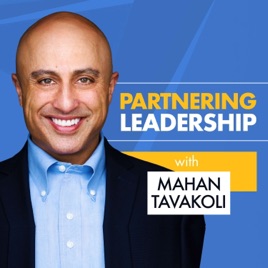
Partnering Leadership

Advertise on podcast: Partnering Leadership

Rating
★★★★★
5
from
32 reviews
This podcast has
448 episodes
Language
English
Explicit
No
Date created
2020/09/02
Latest episode
2026/04/21
Average duration
48 min.
Release period
6 days

Description

Partnering Leadership is a top global podcast designed to help CEOs and senior leaders navigate the complexities of leadership, strategy, culture, and innovation. Hosted by Mahan Tavakoli—a seasoned leadership advisor with over 25 years of experience and recognized as a top thought leader in management—the podcast brings you real-world insights and practical advice to drive meaningful results.Mahan’s experience as a trusted advisor shapes each discussion, driving deeper insights that challenge conventional thinking and uncover innovative approaches. Drawing from his extensive advisory background, Mahan dives into candid conversations with purpose-driven CEOs and global thought leaders, exploring how they overcame their biggest challenges and achieved transformative success. Each episode provides actionable strategies, real-world examples, and proven approaches to help you navigate change, align teams, and drive lasting impact.Hear directly from top experts such as Ram Charan, Ken Blanchard, John Kotter, Stephen M.R. Covey, Hal Elrod, Carmine Gallo, Daniel Burrus, Garry Ridge, Jacob Morgan, Emily Field, Jonah Berger, Barbara Kellerman, Rich Diviney, Andrea Sampson, Ajay Agrawal, Dave Ulrich, Jerry Colonna, Renee Cummings, Brian Johnson, Warren Berger, Gustavo Razzetti, Azeem Azhar, David McRaney, Tim Clark, Jim Detert, Gary Bolles, Greg Satell, Robert Wolcott, Alden Mills, Minter Dial, Greg Wooldridge, Pete Steinberg, Joseph Fuller, Paul Roetzer, Whitney Johnson, Ron Adner, Bob Johansen, Leidy Klotz, Paul Smith, Louis Rosenberg, Rob Sadow, Dan Turchin, Steve Robinson, Park Howell, Mark Crowley, Maz Jobrani, LaTonya Wilkins, Rob Cross, Aiden McCullen, Eduardo Briceno, Jan Rutherford, Stephen Wunker, Charlene Li, Jon Levy, Anu Gupta, John Rossman, David Marquet, Tamsen Webster, Jack Phillips, Vanessa Bohns, Patrick McGinnis, Hakeem Oluseyi, Ed Hess, and Carolyn Dewar as well as renowned leaders like David Rubenstein, Jean Case, Tony Pierce, Linda Rabbitt, Paul Daugherty, Richard Bynum, John Veihmeyer, Howard Ross, Bill Novelli, Tien Wong, Stephanie Linnartz, Chuck Robb, Doug Dennerline, Charlene Drew Jarvis, Robert Rosenberg, Diane Hoskins, Deidre Paknad, David Gardner, and Marty Rodgers, and many more!Their insights, paired with Mahan's expertise, equip you to tackle complex challenges, foster a high-performance culture, and stay ahead in a rapidly evolving world.Listen today to gain the tools, perspectives, and proven strategies that can transform your leadership journey. Available on all major podcast platforms or visit https://partneringleadership.com.  

Unlock Partnering Leadership podcast Email contact info,
Listeners & Audience details

Email contact information

Direct podcast contact details

Listeners

Audience numbers & engagement insights

Audience details

Podcast Insights

Social media

Check Partnering Leadership social media presence


Podcast episodes

Check latest episodes from Partnering Leadership podcast


447 The Octopus Organization: Why Traditional Leadership Breaks in a Complex World with Phil Le-Brun & Jana Werner
2026/04/21
In this episode of Partnering Leadership, Mahan Tavakoli sits down with Phil Le-Brun and Jana Werner, co-authors of The Octopus Organization. Drawing on decades of leadership experience across global organizations, they challenge one of the most deeply embedded assumptions in business: that organizations can still be run like machines. At the heart of the conversation is a stark contrast between what they call “tinman” organizations and “octopus” organizations. Tinman organizations are built for efficiency, predictability, and control. They worked in a more stable world. But today’s environment is fundamentally different. It’s complex, fast-moving, and increasingly shaped by exponential technologies like AI. And in that world, the very structures that once drove performance are now holding organizations back. Le-Brun and Werner don’t stay at the level of theory. They go deep into the patterns that keep leaders stuck, from false alignment at the top to the subtle ways leaders unintentionally kill ownership in their teams. They introduce the idea of “anti-patterns” and hold up a mirror to behaviors that feel normal but quietly undermine adaptability, speed, and innovation. The discussion also pushes into what it actually takes to lead differently. Not slogans, but practical shifts. Moving from control to agency. From certainty to curiosity. From managing activity to enabling value creation. And critically, how leaders can begin making that shift without launching another top-down transformation that ultimately fails. For senior leaders navigating AI, constant disruption, and increasing complexity, this conversation cuts through the noise. It offers a clear lens to diagnose what’s not working and a grounded path to start building organizations that can actually adapt and thrive. Actionable Takeaways You’ll learn why most leadership teams believe they’re aligned, yet create fragmentation and conflict across the organization.Hear how well-intentioned leaders unintentionally train their teams to avoid ownership and default to permission-seeking.You’ll discover the “anti-patterns” that quietly undermine transformation efforts, even in organizations that think they’re evolving.Hear why focusing on efficiency alone, especially with AI, may actually accelerate the wrong outcomes.You’ll learn how to spot whether your organization is still operating like a machine in a world that demands adaptability.Hear how leading organizations are shifting from control-based models to systems that enable distributed decision-making.You’ll discover why most change initiatives fail before they begin and what leaders do differently to create real momentum.Hear how to rethink failure, experimentation, and learning in a way that drives progress rather than fear.You’ll learn where to start if your organization is far from this model and why small, local changes often outperform large transformation plans. Connect with Jana Werner and Phil Le-Brun The Octopus Organization Website Jana Werner LinkedIn Phil Le-Brun LinkedIn Connect with Mahan Tavakoli: Mahan Tavakoli Website  Mahan Tavakoli on LinkedIn  Partnering Leadership Website
446 How Leaders Decide What Matters as AI Reshapes Value and Uncertainty Grows, Mahan Tavakoli interviewed by Vimi Appadoo & Akilesh Deerpalsingh
2026/04/14
This episode offers a different lens on leadership in a time of accelerating change. In this conversation, Mahan Tavakoli is interviewed by Vimi Appadoo and Akilesh Deerpalsingh, senior leaders working closely with CEOs and executive teams in Mauritius through their roles at Dale Carnegie Mauritius and Baker Tilly Mauritius. The discussion emerged as part of a broader set of conversations leading up to a C-suite dialogue with senior leaders in the region. The questions they explore will sound familiar to many leadership teams right now. Not because there is a lack of information or tools, but because there is more than ever. More inputs, more options, and more pressure to act. Which raises a different kind of challenge. How do you decide what actually matters now? Where do you focus when everything feels important? And how do you move forward when the environment keeps shifting? The conversation also touches on a deeper shift that many organizations are still working through. While much of the attention remains on growth and adoption of new technologies, there is a more fundamental question underneath it all. Not just how to grow. But whether value itself is moving. Rather than offering simple answers, this discussion surfaces the kinds of tensions, trade-offs, and decisions leaders are navigating in real time, especially as AI and broader uncertainty reshape how organizations think, operate, and lead. Actionable Takeaways • You’ll hear why many leadership teams are not lacking ideas or tools, but are struggling to decide what actually deserves their focus • Hear how the question leaders are asking is quietly shifting, and why “how do we grow?” may no longer be the most useful starting point • You’ll hear the tension between speed and alignment, and why moving faster can sometimes create more friction, not less • Hear how organizations are experimenting with AI, but still wrestling with what it means to change how they actually operate • You’ll hear why adoption often stalls even when the technology is in place, and what leaders tend to underestimate about the people side of change • Hear how executives are navigating decisions when there is no clear “return to normal,” and why that mindset shift matters • You’ll hear how peer-level conversations can surface different perspectives that don’t emerge inside a single organization • Hear how leaders are thinking about focus, prioritization, and trade-offs in environments where everything feels urgent Connect and learn more: Baker Tilly Mauritius Dale Carnegie Mauritius  Vimi Appadoo LinkedIn  Akilesh Deerpalsingh LinkedIn  For those interested, more details and registration for the C-suite leadership conversation in Mauritius on May 18, 2026 can be found here: https://bit.ly/3O7Enjw Connect with Mahan Tavakoli: Mahan Tavakoli Website  Mahan Tavakoli on LinkedIn  Partnering Leadership Website
445 The Hidden Cost of Change: What Leaders Miss About Loss and Resistance with Amy Jacobson
2026/04/07
Most leaders don’t struggle with strategy. They struggle with how people respond to it. In this episode of Partnering Leadership, Mahan Tavakoli sits down with Amy Jacobson, author of The Emotional Intelligence Advantage: Mastering Change and Difficult Conversations. Amy brings a practical, grounded perspective on emotional intelligence, shaped by her work with leadership teams navigating real organizational challenges, not theoretical models. The conversation goes beyond the usual discussion of EQ as a “nice to have.” Amy reframes emotional intelligence as a learned skill that directly impacts a leader’s ability to drive change, handle resistance, and lead difficult conversations. She challenges a common assumption many leaders hold, that if a change is logical and beneficial, people should naturally get on board. In practice, that’s rarely what happens. A central theme in the discussion is the hidden dimension of change. While leaders focus on what is being gained, employees focus on what they are losing. That gap creates resistance, even when the change itself is sound. Amy breaks down why this happens and how leaders unintentionally make it worse by overselling the positives and ignoring the emotional impact on their teams. The conversation also explores why difficult conversations often fail before they even begin. Leaders walk in prepared to prove a point rather than understand a situation. That approach triggers defensiveness and shuts down productive dialogue. Amy offers a more effective way to approach these moments, one that balances clarity with emotional awareness to drive better outcomes. This is a practical conversation for leaders who want to move beyond frameworks and understand what actually drives behavior inside their organizations. Actionable Takeaways You’ll learn why even the best-designed change initiatives fail when leaders overlook what people feel they are losingHear how emotional intelligence shifts from a “soft skill” to a core leadership capability in driving executionYou’ll learn why some of your most experienced and capable team members resist change the mostHear how leaders unintentionally create resistance by pushing logic before addressing emotionYou’ll learn why self-awareness is often overestimated and how that gap impacts leadership effectivenessHear how to approach difficult conversations in a way that reduces defensiveness and increases ownershipYou’ll learn why preparation for tough conversations often makes them worse, not betterHear how leaders can distinguish between employees who can grow and those who are not ready to changeYou’ll learn why balancing EQ and IQ is not optional, but essential for leadership impact Connect with Amy Jacobson Amy Jacobson Website Amy Jacobson LinkedIn Connect with Mahan Tavakoli: Mahan Tavakoli Website  Mahan Tavakoli on LinkedIn  Partnering Leadership Website
444 Thursday Refresh: Mita Mallick on The Devil Emails at Midnight: What Good Leaders Can Learn From Bad Bosses
2026/04/02
What if the “panic habits” leaders default to are the very things burning out their best people? In this Partnering Leadership episode, Mita Mallick—author of The Devil Emails at Midnight—joins Mahan to unpack practical ways senior leaders can replace performative urgency with clear operating rules that people can trust. You will hear why bad bosses are made, not born, and how pressure from markets, role models, and personal crises can turn ordinary leaders into micromanagers. Mita gets specific about power dynamics. A 4:30 a.m. email from the CEO trains teams to jump, even when the intent is “no rush.” She explains how to set explicit after-hours rules and model them yourself. The goal is to stop the 4 a.m. back-and-forth and restore predictable rhythms for high-stakes work. Calendars signal culture. Mita argues for a deliberate meeting cleanse, real breaks, and protected one-on-ones. You will hear why “we are not AI agents,” why canceling a meeting can be the kindest move you make this week, and how simple touch points create loyalty. Leaders also get a playbook for honest feedback. Mita shares how to create safety, why alumni calls six to twelve months after someone leaves yield the most actionable insight, and how a short journaling habit helps you see patterns in your own behavior before they damage trust. Finally, Mita challenges a core assumption: most work is not life or death. Treating it that way creates burnout. She closes with a frank read on the broken employee–employer contract and a likely shift toward more consultant-style work, which makes clarity, expectations, and operating rules even more important for CEOs and boards. Actionable TakeawaysYou will learn how to set a clear after-hours rule that stops the 4 a.m. reply spiral, including what “urgent” actually means in your context. Hear how to replace micromanagement with outcomes and guardrails when life outside work feels out of control. You will learn why your calendar is your culture, and how a simple meeting cleanse reveals time for deep work and real one-on-ones. Hear how to protect one-on-ones without turning them into therapy. Mita shares a practical cadence and a simple check-in script that builds connection. You will learn a low-cost feedback system: invite coaching, thank in the moment, follow up with changes, and never hunt “who said what.” Hear how to get clearer truth with alumni calls six to twelve months after exit interviews, when the emotion is gone and facts are usable. You will learn to write simple hybrid rules that reduce proximity bias and make global teams feel fair and seen. Hear how to reset leader expectations about urgency and burnout, starting with this line: “Most of our work is not life or death.” You will learn why culture becomes the worst behavior you tolerate and how to intervene when disengagement starts to spiral. Hear how to prepare for a future with looser roles and project-based deployment, and why clarity and operating rules will be your retention edge.   Connect with Mita Mallick Mita Mallick LinkedIn  The Devil Emails at Midnight: What Good Leaders Can Learn from Bad Bosses    Connect with Mahan Tavakoli: Mahan Tavakoli Website  Mahan Tavakoli on LinkedIn  Partnering Leadership Website
443 What Secret Service Interrogators Know About Trust That Most Leaders Miss with Brad Beeler
2026/03/31
Trust sits at the center of every meaningful leadership conversation. Yet many leaders struggle to create the conditions where people feel comfortable sharing what they really think. In this episode of Partnering Leadership, Mahan Tavakoli speaks with Brad Beeler, a former U.S. Secret Service agent and the author of Tell Me Everything: A Secret Service Agent’s Proven Strategies for Earning Trust, Revealing the Truth, and Communicating with Anyone. Drawing on more than two decades of experience conducting investigations, interrogations, and high-stakes conversations, Beeler shares insights that extend far beyond law enforcement and into the daily realities of leadership. Throughout the conversation, Beeler reframes what most people believe about interrogation and influence. Rather than intimidation or pressure, he explains that the most effective approach centers on curiosity, respect, and genuine interest in the other person. Leaders often assume that communication improves when they speak more clearly or assert authority. Beeler argues the opposite: communication improves when leaders listen more deeply and create the psychological safety that encourages others to open up. The discussion explores the subtle signals that shape every interaction long before words are spoken. From body language and first impressions to the role of environment and preparation, Beeler shares practical ways leaders can build trust quickly and authentically. He also highlights the risks of relying too heavily on digital communication, emphasizing how face-to-face interaction allows leaders to read cues, build connection, and understand what others may not explicitly say. Beeler also shares memorable stories from his time in the Secret Service, including moments when leadership required humility, empathy, and the ability to see situations from another person’s perspective. These stories illustrate how principles developed in high-pressure investigative environments translate directly to leadership, negotiation, and organizational communication. For CEOs and senior executives responsible for aligning teams, resolving conflict, and making high-stakes decisions, this conversation offers a fresh perspective on influence and trust. Beeler’s insights reveal why the fundamentals of communication—curiosity, listening, and human connection—remain the most powerful tools leaders have for understanding others and guiding organizations forward. Actionable Takeaways • You’ll learn why curiosity may be the most underrated leadership skill—and how asking better questions unlocks deeper conversations and stronger relationships. • Hear how former Secret Service agents build trust with people who initially have every reason not to talk—and what leaders can apply from those techniques. • You’ll discover why the first moments of any interaction often determine the outcome of the entire conversation. • Hear why the best communicators spend far more time listening than speaking—and how that changes the dynamic of leadership discussions. • You’ll learn how subtle cues like posture, tone, and attention shape trust long before a leader says a word. • Hear how leaders unintentionally shut down communication by shifting conversations back to themselves. • You’ll discover why psychological safety is essential for honest dialogue—and how leaders can establish it quickly. Connect with Brad Beeler Brad Beeler Website Brad Beeler LinkedIn  Connect with Mahan Tavakoli: Mahan Tavakoli Website  Mahan Tavakoli on LinkedIn  Partnering Leadership Website
442 The Soul of Strategy: Why Healing Our Leadership is the Next Frontier of Capitalism with Raj Sisodia
2026/03/24
In this compelling conversation, Raj Sisodia — co-founder of Conscious Capitalism and bestselling author of Firms of Endearment — joins the podcast to discuss his newest work, Healing Leaders. Widely recognized as one of the most influential voices reshaping modern business thinking, Raj brings decades of research, lived experience, and global perspective to a topic that sits at the center of organizational performance: the inner state of the leader. Across the episode, Raj takes listeners on a journey from the origins of Conscious Capitalism to the growing backlash against stakeholder-focused leadership, explaining why this moment requires an even higher level of conviction, courage, and clarity from CEOs and senior executives. He argues that business has unrealized potential — not only to drive results, but to reduce suffering, strengthen communities, and elevate human wellbeing. And he makes the case that this potential cannot be unlocked without leaders who are self-aware, grounded, and healed themselves. Raj also reveals the personal transformation that shaped Healing Leaders — including his unexpected immersion into silent retreats, deep spiritual work in the Himalayas, time with indigenous communities in the Amazon, and a series of insights that reframed how he views purpose, leadership, and responsibility. His stories connect directly to the pressures leaders face today: burnout, cynicism, disconnection, and the widening gap between organizational expectations and human capacity. For CEOs and executives navigating complexity, volatility, and AI-driven change, this episode offers an opportunity to step back and reflect on a different kind of leadership advantage — one rooted not in tactics or frameworks, but in the inner quality of the leader. Raj’s insights challenge long-held assumptions about success, impact, and organizational culture, while opening the door to a richer and more sustainable way to lead. Actionable Takeaways • You’ll learn why Raj sees this moment as a “moral recession” — and why conscious, values-driven leadership is becoming a strategic imperative rather than a philosophical choice. • Hear how to rethink the purpose of business in a way that strengthens performance while reducing the hidden costs that erode trust, engagement, and wellbeing. • You’ll learn what Raj discovered about the link between unhealed leaders and organizational dysfunction — and why the inner world of the leader shapes the outer world of the enterprise. • Hear how to spot the leadership behaviors that signal unresolved trauma or unhealthy drivers, even in high performers or visionary founders. • You’ll learn why personal healing and growth can become competitive advantages — especially when leading through disruption, transformation, or cultural change. • Hear how to challenge profit-only mindsets with data and examples that show why purpose-driven companies outperform over time. • You’ll learn how Raj evaluates the rise of AI through the lens of consciousness — and why the technology will amplify the character and values of its users. • Hear how to incorporate meaningful “disequilibrating experiences” into your own leadership growth strategy, rather than relying solely on traditional development methods. • You’ll learn the seven themes that form the backbone of Healing Leaders — and why they matter now more than any point in recent business history. Connect with Raj Sisodia Raj Sisodia Website Connect with Mahan Tavakoli: Mahan Tavakoli Website  Mahan Tavakoli on LinkedIn  Partnering Leadership Website
441 The AI Ultimatum: What Leaders Must Decide Now with Steve Brown
2026/03/17
In this episode of Partnering Leadership, Mahan Tavakoli sits down with Steve Brown, a leading AI futurist and former executive at organizations including Intel and DeepMind. Brown brings a rare combination of technical depth and leadership perspective, shaped by decades at the forefront of technological change and his work advising leaders around the world on the implications of artificial intelligence. The conversation centers on Brown’s book, The AI Ultimatum, and the core argument behind it: AI is not simply another productivity tool or IT upgrade. It represents a fundamental shift in how intelligence is created, scaled, and applied inside organizations. Leaders who treat AI as incremental technology risk missing the much larger transformation underway. Brown explains why he believes we are entering an “intelligence age,” comparable in scope to the Industrial Revolution, but unfolding at a dramatically faster pace. As the cost of intelligence approaches zero, organizations will face new strategic choices about workforce design, value creation, leadership identity, and ethical responsibility. These choices, Brown argues, cannot be delegated or delayed without consequence. Throughout the episode, Mahan challenges Brown to bridge theory and practice. They explore real organizational examples, from AI agents working alongside humans to scientific breakthroughs like AlphaFold, and examine how leaders can shift from efficiency-driven thinking toward value creation, judgment, and human amplification. This is not a conversation about tools or trends. It is a candid discussion about leadership responsibility in a period of accelerated change, and what CEOs and senior executives must rethink now to ensure their organizations remain relevant, resilient, and human-centered. Actionable Takeaways You’ll learn why delaying AI decisions is itself a leadership choice, and how waiting for clarity can quietly erode organizational value.Hear how the “intelligence age” differs from previous technology shifts, and why its speed changes the role of senior leadership.You’ll learn why AI should be viewed as a digital workforce, not just software, and what that means for strategy, structure, and accountability.Hear how leaders must shift from being the source of answers to guiding exploration, judgment, and learning in uncertain conditions.You’ll learn why cost-cutting is the weakest use of AI, and where leaders should instead focus to create new value.Hear how AI changes the relevance of experience, narrowing gaps while raising expectations for judgment and insight.You’ll learn why ethics, bias, and responsibility do not belong to algorithms, but remain firmly in the domain of leadership.Hear how AI can amplify human capability rather than replace it, when leaders design work intentionally. Connect with Steve Brown Steve Brown Website  Steve Brown LinkedIn The AI Ultimatum: Preparing for a World of Intelligent Machines and Radical Transformation Connect with Mahan Tavakoli: Mahan Tavakoli Website  Mahan Tavakoli on LinkedIn  Partnering Leadership Website
440 The Four Forces of Growth: How to Stop Fixing Problems and Start Scaling Again with Kevin Lawrence
2026/03/10
Growth stalls in organizations far more often than leaders expect. Not because ambition fades, or talent disappears, but because focus drifts. In this episode of Partnering Leadership, Mahan Tavakoli sits down with Kevin Lawrence, a long-time advisor to CEOs and executive teams, to explore why capable organizations lose their growth orientation and how leaders can recognize the warning signs early. Kevin draws on decades of experience in boardrooms and leadership off-sites around the world, as well as insights from his book The Four Forces of Growth. He explains why most organizations become over-indexed on solving problems and optimizing what already exists, while unintentionally starving the very forces that drive future growth. The conversation challenges a deeply held leadership assumption: that fixing problems naturally leads to growth. Together, Mahan and Kevin unpack the distinction between improvement and growth, and why confusing the two leads to stalled momentum even in well-run organizations. Kevin introduces the Four Forces framework as a way for leaders to re-orient themselves amid complexity, noise, and competing priorities, especially as organizations scale. The episode also explores the role of courage and fear in leadership decision-making. Kevin shares why growth requires disciplined experimentation, not reckless bets, and why leaders must actively protect time, attention, and energy for opportunity when problems inevitably dominate the agenda. This is a thoughtful, grounded conversation for CEOs and senior leaders who sense their organizations are busy, capable, and committed, yet not moving forward fast enough and want a clearer way to understand why. Actionable Takeaways You’ll learn why organizations don’t lose ambition as they scale, but often lose orientation.Hear how problem-solving cultures quietly crowd out growth without leaders realizing it.You’ll learn the difference between improving what exists and creating new growth and why confusing the two stalls momentum.Hear how leadership calendars reveal more about growth priorities than strategy documents.You’ll learn why most incentive systems reward improvement but unintentionally punish growth.Hear how courage and fear shape decision-making speed and organizational momentum.You’ll learn what disciplined experimentation looks like and how it differs from reckless risk-taking.Hear how leaders can identify which problems deserve attention and which are costly distractions.You’ll learn why purpose-driven organizations should care deeply about growth as a path to greater impact. Connect with Kevin Lawrence Kevin Lawrence Website Kevin Lawrence LinkedIn The 4 Forces of Growth: Defy the Odds and Keep Your Company Scaling Connect with Mahan Tavakoli: Mahan Tavakoli Website  Mahan Tavakoli on LinkedIn  Partnering Leadership Website
439 Thursday Refresh: Alfredo De Massis on Designing What Lasts: How Great Leaders Reimagine Ownership, Innovation, and Legacy
2026/03/05
What does it take to build something that lasts—not just for years, but across generations? In this episode of Partnering Leadership, Mahan Tavakoli is joined by Alfredo De Massis, a globally recognized expert on family enterprise and author of The Family Business Book: A Roadmap for Entrepreneurial Families to Prosper Across Generations. As one of the most cited scholars in the field and a trusted advisor to multi-generational family businesses around the world, De Massis offers a rare combination of academic rigor and real-world relevance. But don’t expect a conversation limited to family-owned companies. This episode is about how all leaders—especially those responsible for long-term value—can rethink legacy, leadership, and innovation. De Massis argues that great leaders don’t just pass down businesses; they design systems that outlast them. From ownership mindsets to innovation strategy and governance architecture, the conversation provides a blueprint for building organizations that remain relevant and resilient across time. A central theme of the discussion is the distinction between succession planning and legacy design. De Massis challenges the outdated belief that continuity depends on finding the next version of the current leader. Instead, he introduces the concept of the "family galaxy"—a flexible, multi-entity model that allows different generations to thrive in different ways, based on their talents and motivations. He also breaks down the three layers of governance essential for long-term success: business governance, family governance, and the often-overlooked interface between them. For CEOs, board members, and senior executives thinking beyond quarterly results, this conversation delivers both intellectual depth and actionable insight. It’s a masterclass in how to lead with intention—not just for today, but for the future you won’t be around to control. Actionable Takeaways You’ll learn why the best leaders don’t plan succession—they design systems for continued relevance. Hear how to reframe ownership as a responsibility to be developed, not a status to be inherited. Explore the “family galaxy” model—and how to structure a system where multiple generations can create value. Understand how great organizations govern at three levels—and why ignoring the “interface” layer can derail everything. Discover why tradition can be a strategic asset when leaders know how to reinterpret—not resist—it. Learn how emotional dynamics influence strategic decisions in family and legacy enterprises. Find out why leadership earned through credibility—not entitlement—is key to generational success. Get practical insights into how to align governance, ownership, and innovation around shared purpose. Take away powerful questions to evaluate whether your legacy is built to evolve—or simply to endure. Connect with Alfredo De Massis Alfredo De Massis LinkedIn Alfredo De Massis IMD The Family Business Book Connect with Mahan Tavakoli: Mahan Tavakoli Website  Mahan Tavakoli on LinkedIn  Partnering Leadership Website
438 Hope Is the Strategy: What It Means to Lead When You Don’t Have All the Answers with Jen Fisher
2026/03/03
In this episode of Partnering Leadership, Mahan Tavakoli is joined by Jen Fisher, one of the most influential voices shaping how leaders think about work, wellbeing, and human sustainability. Jen is the former Chief Wellbeing Officer at Deloitte, where she spent more than two decades helping leaders confront burnout, redesign work, and rethink what success actually means inside large, complex organizations. The conversation centers on the ideas behind Jen’s book, Hope Is the Strategy, and challenges a deeply held leadership assumption: that hope is soft, naive, or something leaders turn to only when plans fall apart. Instead, Jen reframes hope as a disciplined leadership capability, one that becomes essential when teams feel overwhelmed, uncertain, or quietly disengaged. Drawing on research, lived experience, and her work with senior executives, Jen explains why even the smartest strategies fail when people don’t believe their work will lead to a better future. She explores how leaders unintentionally drain hope through silence, false certainty, or performative wellbeing efforts, and why truth, agency, and credibility matter more than optimism. The discussion also tackles the limits of traditional wellness programs, the growing tension leaders feel amid constant disruption and AI-driven change, and why many organizations are still solving the wrong problems. Throughout the episode, Jen offers a grounded, practical lens on what it really takes to lead human beings, especially when leaders themselves don’t have all the answers. This is a thoughtful, candid conversation for CEOs and senior leaders who sense that something fundamental is missing in how organizations motivate, engage, and move people forward, and who want a more honest way to think about leadership in uncertain times. Actionable Takeaways You’ll learn why hope is not a feeling or slogan, but a leadership capability that requires clarity, agency, and follow-through.Hear how even well-designed strategies break down when leaders can’t articulate how change will improve people’s lives.Discover why silence and false certainty erode trust faster than difficult truths ever will.Hear how leaders can acknowledge burnout and uncertainty without becoming pessimistic or paralyzed.Learn why most corporate wellbeing efforts fail to move the needle, and what they overlook about daily work design.Explore how hope and wellbeing reinforce each other and why neither can be treated as a standalone initiative.Hear why leading humans in an AI-enabled workplace requires skills most organizations never train leaders to develop.Learn how credible hope helps teams move forward even when leaders don’t have clear answers or perfect plans. Connect with the Jen Fisher Jen Fisher LinkedIn Jen Fisher Website Hope Is the Strategy: The Underrated Skill That Transforms Work, Leadership, and Wellbeing Connect with Mahan Tavakoli: Mahan Tavakoli Website  Mahan Tavakoli on LinkedIn  Partnering Leadership Website
437 If AI Keeps Getting Smarter, What’s the Leader’s Real Job Now and Where Human Judgment Still Matters with Andrea Iorio
2026/02/24
As AI accelerates, many leadership conversations focus on tools, efficiency, and productivity. This episode of Partnering Leadership takes a different approach. Host Mahan Tavakoli is joined by Andrea Iorio, a global AI thought leader, former senior executive at Tinder and L’Oréal, and the author of Between You and AI. Andrea brings a rare combination of global operating experience, deep technology fluency, and philosophical clarity to the conversation. Rather than asking how leaders can use AI better, he challenges a more uncomfortable question: what still belongs uniquely to human leadership when machines increasingly outperform us at speed, scale, and analysis. Throughout the discussion, Andrea and Mahan explore why AI is not “coming for jobs,” but for tasks, and how that distinction changes the leadership equation. They examine the risks leaders face when productivity gains mask a deeper erosion of judgment, accountability, and strategic clarity. The conversation surfaces how easy it is for leaders to outsource responsibility to systems that feel objective, confident, and precise. The episode also confronts the hidden consequences of hyper-optimization. While AI can dramatically increase control and efficiency, Andrea argues that leaders must decide where judgment, agency, and human responsibility still matter most. From decision-making and talent development to trust, empathy, and innovation, the discussion highlights the leadership work that cannot be automated without cost. This is a thoughtful, grounded conversation for leaders who sense that AI is reshaping not just work, but the very nature of leadership itself—and who want to stay accountable, relevant, and human in the process. Actionable Takeaways You’ll learn why AI is changing leadership less by replacing people and more by redefining which tasks still require human judgment.Hear how relying on AI for productivity can quietly reduce differentiation when everyone has access to the same tools.Discover why leadership accountability cannot be delegated, even when decisions are automated.You’ll hear how past success can become a liability when leaders stop questioning assumptions that once worked.Learn why AI literacy is not technical mastery, but understanding where data, questions, and outputs can mislead.Hear how hyper-optimization can narrow what organizations notice and weaken learning over time.Understand why the “human-in-the-loop” is about responsibility, not distrust of technology.Explore how leaders can use time saved through automation to strengthen judgment rather than accelerate busywork.Learn what thriving organizations do differently as they design hybrid teams of humans and intelligent systems. Connect with Andrea Iorio Andrea Iorio Website Andrea Iorio LinkedIn Between You and AI: Unlock the Power of Human Skills to Thrive in an AI-Driven WorldConnect with Mahan Tavakoli: Mahan Tavakoli Website  Mahan Tavakoli on LinkedIn  Partnering Leadership Website
436 Closing the Courage Gap: How Leaders Act Bravely in Uncertain Times with Margie Warrell
2026/02/17
In this episode of Partnering Leadership, Mahan Tavakoli is joined by Margie Warrell, a global leadership advisor and the author of The Courage Gap. The conversation goes beyond familiar ideas about confidence and resilience to explore what courage really looks like when leaders are facing uncertainty, fear, and high-stakes decisions. Drawing on her upbringing on a small dairy farm in Australia and decades of work with senior leaders, Margie reframes courage not as bravado or fearlessness, but as a practical leadership capability. One that becomes essential when leaders are navigating disruption, AI-driven change, anxious workforces, and expectations to have answers they simply cannot have. A central theme of the discussion is identity. Margie challenges leaders to stop asking only “What should I do?” and instead ask, “Who do I need to be right now?” She explains why leadership effectiveness often hinges less on technical expertise and more on emotional regulation, values-based decision-making, and the ability to act even when fear is present. The conversation also tackles topics many executives experience but rarely discuss openly, including imposter syndrome, fear of judgment, and the pressure to project certainty. Margie offers grounded insights on why these experiences are common among high performers and how leaders can work with fear rather than being constrained by it. This episode is a thoughtful, practical exploration of what courageous leadership looks like in real organizational contexts, not in theory, but in the moments where leaders are stretched, uncomfortable, and most needed by their teams. Actionable Takeaways You’ll learn why fear isn’t a leadership failure, and how ignoring it can quietly limit decision-making and impact.Hear how asking “Who do I need to be right now?” can bring clarity when priorities feel overwhelming.You’ll discover why imposter syndrome often shows up in capable, experienced leaders, and what actually helps move through it.Hear how courage expands a leader’s range of choices while fear tends to narrow it.You’ll learn why emotional regulation has become one of the most critical leadership skills in uncertain environments.Hear how values can serve as an anchor for leadership decisions when certainty is unavailable.You’ll explore what “one-minute brave” looks like in real leadership moments, not as a slogan, but as a practice.Hear how leaders can stabilize anxiety within their organizations rather than unintentionally amplifying it. Connect with Margie Warrell Margie Warrell Website  Margie Warrell LinkedIn The Courage Gap: 5 Steps to Braver Action Connect with Mahan Tavakoli: Mahan Tavakoli Website  Mahan Tavakoli on LinkedIn  Partnering Leadership Website
435 Love as a Change Strategy: Why Most Change Efforts Fail and What Builds Real Commitment with Mohammad F. Anwar
2026/02/10
In this episode of Partnering Leadership, Mahan Tavakoli sits down with Mohammad Anwar, founder and CEO of Softway and co-author of the book Love as a Change Strategy. Together, they take on one of the most misunderstood ideas in leadership: whether love has any place in driving performance, innovation, and large-scale change. Mohammad’s perspective is not theoretical. He shares a deeply personal leadership story, tracing how a fear-driven, control-oriented approach nearly destroyed his company, and how a fundamental shift in how he treated people helped turn it around. The conversation challenges the assumption that tough leadership and human leadership sit in opposition to each other. The discussion then moves into why so many organizational change efforts fail, despite heavy investments in process, technology, and change management frameworks. Mohammad argues that most leaders don’t actually have a change management problem. They have a change strategy problem, one that overlooks how humans respond to uncertainty, fear, and loss of control. Mahan presses on a question many CEOs wrestle with privately: if fear-based leadership can produce results, why not use it? The answer isn’t moralistic. It’s practical. They explore sustainability, commitment, and the hidden costs leaders don’t see until it’s too late. The episode also tackles AI and transformation through a people-first lens. Rather than framing AI as a threat or a productivity shortcut, Mohammad reframes it as a test of leadership maturity and an opportunity to restore humanity to work, if leaders are willing to change themselves first. Actionable Takeaways You’ll learn why fear can drive short-term performance but quietly undermines long-term results.Hear how most change initiatives fail before they even start because leaders focus on process instead of people.You’ll learn why humans don’t change through checklists, frameworks, or mandates, even when the strategy looks sound.Hear how trust, not urgency or pressure, determines the speed and success of transformation.You’ll learn what “love” actually means in a leadership context, and why it has nothing to do with being soft.Hear how leaders unintentionally create resistance by making decisions first and asking people to follow later.You’ll learn why AI adoption is less about technology readiness and more about human psychology and leadership example.Hear how effectiveness, not efficiency, becomes the real constraint when leading people through change.You’ll learn why the hardest leadership work often starts with changing yourself before asking others to change. Connect with Mohammad Anwar Love As A Strategy Website  Softway Mohammad Anwar LinkedIn Connect with Mahan Tavakoli: Mahan Tavakoli Website  Mahan Tavakoli on LinkedIn  Partnering Leadership Website
434 Thursday Refresh: Greg Shove on Leading Through AI
2026/02/05
In this episode of Partnering Leadership, Mahan Tavakoli is joined by Greg Shove, CEO of Section and a serial entrepreneur with a deep track record of leading transformative growth. Shove’s leadership journey includes multiple successful pivots, and in this conversation, he brings a uniquely grounded perspective on how AI is fundamentally changing the role of leaders and the structure of modern organizations. From board-level decision-making to frontline productivity, he doesn’t just speculate—he shares what he’s doing inside his own company to lead through the change. Greg originally joined Section to turn it from a media startup into a next-gen education company. But when he first used ChatGPT, he knew instantly that business education itself needed to evolve. That insight led to a bold pivot: transforming Section from an online business school into an AI-powered academy focused on accelerating performance and capability at scale. It’s a rare look at what it really takes to lead a high-velocity pivot—one grounded not in hype, but in strategy, execution, and conviction. Throughout the conversation, Greg challenges conventional thinking on AI adoption, leadership credibility, and the future of knowledge work. He breaks down why many leaders are stuck in experimentation mode—and what it takes to move into actual transformation. CEOs and boards will find his views on performance, upskilling, and AI decision support to be especially compelling and uncomfortably timely. If you're tired of surface-level conversations about AI and want to understand what the shift actually looks like inside a company, this episode delivers. Whether you're leading a small team or a global enterprise, Greg's insights on using AI as a leadership advantage—not just a tech upgrade—will spark new thinking and bold action. Actionable Takeaways: You'll learn why Greg believes the greatest leadership returns come not from better execution—but from catching the right wave at the right time. Hear how AI is already matching 90% of the value delivered by human board members—and what that means for your next board meeting. Discover why most corporate training is already obsolete, and how AI can turn learning into personalized, outcome-driven coaching. Hear how Shopify’s CEO linked headcount approvals to AI productivity—and how that kind of thinking will soon become the norm. You'll gain perspective on how to model AI adoption as a leader, and why failing to do so erodes credibility at every level of the organization. Learn Greg’s approach to building AI habits inside leadership teams—and why small, visible systems often matter more than a “transformation plan.” Find out what question every CEO should be asking before making a major decision—and why it might be time to invite AI into the room. Hear why Greg believes business model innovation—not technology—will be the real competitive battleground in the age of AI. Understand the deeper threat AI poses to entry-level jobs and talent pipelines—and why CEOs need to rethink how organizations grow their future leaders. You’ll hear the provocative question Greg uses to challenge his own team—and how it might reshape your own strategy discussions. Connect with Greg Shove: Greg Shove Website Connect with Mahan Tavakoli: Mahan Tavakoli Website  Mahan Tavakoli on LinkedIn  Partnering Leadership Website
433 Negotiating Without Games: The Four Levers That Create Trust and Higher Deal Value With Todd Caponi
2026/02/03
Negotiation and sales are often treated as tactical skills. Something leaders do at the end of the process, armed with tricks, pressure, and leverage. In this conversation, Todd Caponi makes the case that this mindset is outdated—and increasingly damaging for leaders operating in a world of transparency, information abundance, and long-term accountability. Todd draws on his experience as a former Chief Revenue Officer, his deep study of the history of sales and negotiation, and his latest book, Four Levers Negotiating: The Simple, Counterintuitive Way to Higher Deal Values and Lasting Trust, to challenge conventional wisdom about how deals actually get done. His core argument is simple but provocative: people don’t make decisions because they’re convinced. They decide when they can predict outcomes. And most leadership behaviors unintentionally undermine that predictability. The conversation explores why traditional negotiation tactics—holding cards close, creating artificial urgency, treating the deal as the finish line—erode trust precisely when it matters most. Todd explains how many of these practices emerged from a very different economic era and why they fail in today’s interconnected, reputation-driven environment. At the center of the discussion is Todd’s Four Levers framework, which reframes negotiation as a leadership system rather than a personality trait. Instead of games and pressure, the framework focuses on transparency, trade-offs, and shared understanding—creating better decisions for both sides and reducing internal friction across leadership teams. This episode is not about becoming a better negotiator in the traditional sense. It’s about how leaders create trust, predictability, and long-term value—whether they are working with customers, boards, partners, or their own leadership teams. Actionable Takeaways You’ll learn why leaders don’t win decisions by persuading harder—but by helping others predict outcomes more clearly.Hear how treating the deal as an “early milestone,” rather than the finish line, changes how leaders approach trust and accountability.Discover why many pricing and negotiation conflicts inside organizations have less to do with money and more to do with unclear decision logic.Learn how Todd’s Four Levers framework creates flexibility without sacrificing consistency or trust.Hear why fake urgency and short-term pressure often backfire, even when they appear to work in the moment.Explore how transparency speeds up the right decisions while quickly ending the wrong ones.Understand why predictability is an undervalued leadership asset—and how it affects forecasting, resourcing, and alignment.Learn how sharing constraints, rather than hiding them, can turn resistance into partnership. Connect with Todd Caponi Todd Caponi Website Todd Caponi LinkedIn Four Levers Negotiating: The Simple, Counterintuitive Way to Higher Deal Values and Lasting Trust  Connect with Mahan Tavakoli: Mahan Tavakoli Website  Mahan Tavakoli on LinkedIn  Partnering Leadership Website

Podcast reviews

Read Partnering Leadership podcast reviews


5 out of 5
32 reviews
★★★★★
ArlieLP 2023/11/22
So much gold
Mahan's wealth of executive leadership experience, combined with his insightful interviews, provides a unique and valuable perspective on leadership. ...
★★★★★
kahpyt 2023/08/29
Thought provoking and nuanced perspectives
I love this podcast and the variety of guests for the different perspectives and topics but also the nuance that comes with each one. I find myself th...
★★★★★
RichardC827 2022/08/30
Crypto Lover
I had the pleasure of coming and speaking on the show and I must say Mahan did an incredible job. He was well prepared, asked excellent questions, and...
★★★★★
Alex425xyz 2021/11/24
Great insights, great guests!
I listened to the recent episode with Jerry Sachs and it had some great insights into how to make an impact in your community through leadership effor...
★★★★★
Todd Cherches 2021/04/09
One of my very favorite leadership podcasts!
When it comes to leadership, Mahan Tavakoli definitely knows his stuff! And when it comes to engaging and informative conversations with a wide range ...
★★★★★
Coach Kon 2021/04/05
Adding Value through Unique and Authentic Perspectives
Mahan is an amazing facilitator of insights as he brings out the best in his guests for the benefit of his audience. His extensive experience and back...
★★★★★
JK-Jukes 2021/02/25
Always Inspired By Partnering Leadership
Mahan does a masterful job in getting the best out of his guest. His takes on leadership and authenticity always serve to inform and inspire.
★★★★★
Henna Inam 2021/01/22
Learning and inspiration
Just loved my experience both listening to Mahan’s podcast and being interviewed by him. His fantastic listening and questions enables new insights to...
★★★★★
Stellar Conversation 2020/12/28
Relevance that Resonates!
Mahan has that special sauce, you know the one that makes a good thing even better?! I loved his interview with Shannon Huffman Polson so much, I lis...
★★★★★
A Motley Fool 2020/12/02
High-energy, high content.
Mahan brings a passion and many lessons and stories to his interviews; he prepares well for his interviewees, makes them the stars, but the real story...
check all reviews on apple podcasts

Podcast sponsorship advertising

Start advertising on Partnering Leadership relevant audience podcasts


What do you want to promote?