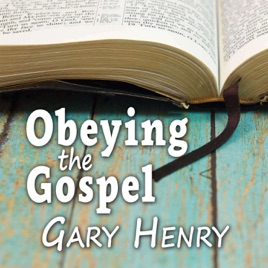
Advertise on podcast: Obeying the Gospel
Rating
5from
This podcast has
31 episodes
Language
EnglishPublisher
Gary HenryExplicit
No
Date created
2020/09/14
Latest episode
2026/10/04
Average duration
4 min.
Release period
1 days
Description
Why become a Christian? And what is actually required when you do? Gary Henry tackles these questions in Obeying the Gospel. Designed for both the skeptic and the saint, these three-minute, daily episodes explore the initial basics of salvation and the lifelong dedication required to keep our promise to God. Discover why the commitment is worth the cost.
Unlock Obeying the Gospel podcast Email contact info,
Listeners & Audience details
Email contact information
Direct podcast contact details

Listeners
Audience numbers & engagement insights

Audience details
Podcast Insights

Podcast episodes
Check latest episodes from Obeying the Gospel podcast
The Washing of Water with the Word (October 4)
2026/10/04
THE WASHING OF WATER WITH THE WORD (OCTOBER 4)
View on Website -- https://wordpoints.com/washing-water-word-october-4/
". . . that he might sanctify her, having cleansed her by the washing of water with the word" (Ephesians 5:26).
TO ACCOMPLISH THE PURPOSES OF CHRIST, THE CHURCH MUST BE “SANCTIFIED.” This word sounds like nothing more than religious lingo to some, but its concept is important and not hard to understand. To be “sanctified” is to be set apart for special use.
For example, I have an iron skillet in which I have never made anything but cornbread. When I bought it long ago, I “set it apart” for that purpose, and it has had to be content to be “different” from my other skillets. To maintain the magnificence of the cornbread that is cooked in it, it simply cannot come into contact with certain other things. (Knowing skillet nature as I do, I am sure my other skillets accuse the cornbread skillet of being self-righteous.)
Now, to be very serious, it was that He might “sanctify” her that Christ gave Himself up for the church. The whole plan by which Christ was able to have a “set apart” people depended on His dying for those people. Not in fifty lifetimes could any of us have kept enough mitzvoth (“commandments”) for even one of our sins to be forgiven. The Messiah had to die for our atonement (Isaiah 53:4-6).
Also in Ephesians 5:26, we see that Christ “cleansed her by the washing of water with the word.” This is a reference to the baptism (immersion in water) in which all who are now in Christ came to be so (Romans 6:3; Galatians 3:27), as a result of hearing the word of the Lord concerning the forgiveness of their sins. Paul makes the point in triplicate in 1 Corinthians 6:11 where, after referring to those whose lives were given to sin, he said, “And such were some of you. But you were washed, you were sanctified, you were justified in the name of the Lord Jesus Christ and by the Spirit of our God.” How, then, does Christ sanctify the church? He does it individually. One day the process will be finished, but only for those who have entered that process individually — in the here and now.
"We note that some seem to think there is a future time when, by some process undefined, Christ will cleanse the present filthy, sinful church. Current imperfections are thus excused. We beg to differ with this traditional interpretation. We do not question the future reception of the church as the bride of Christ (2 Corinthians 11:2,3; Revelation 21:2), but we believe the 'setting apart' and 'cleansing' is now taking place, and has been in process ever since the gospel of Christ was first preached" (Robert F. Turner).
Gary Henry - WordPoints.com + AreYouaChristian.com
For more information, visit http://AreYouaChristian.com
The Church in Philippi (October 3)
2026/10/03
THE CHURCH IN PHILIPPI (OCTOBER 3)
View on Website -- https://wordpoints.com/church-in-philippi-october-3/
"Paul and Timothy, servants of Christ Jesus, To all the saints in Christ Jesus who are at Philippi, with the overseers and deacons" (Philippians 1:1).
IT IS OBVIOUS THAT PAUL HAD A SPECIAL LOVE FOR THE CHRISTIANS IN THE CITY OF PHILIPPI. The church there had begun in unusual circumstances (Acts 16:11-40), and the brethren had kept in touch with Paul, helping and encouraging him generously. In the text above, we have the salutation of a letter that Paul and Timothy sent to that church. Philippians 1:1 is a good snapshot of what a local congregation of Christians was in the days of the New Testament.
THE SAINTS IN CHRIST JESUS WHO ARE AT PHILIPPI. As we noticed yesterday, “saints” is one of the ways the Lord’s people are referred to in the New Testament. The saints were not a special group of Christians; all Christians were saints. But the word “saint” points to something special about the identity and character of Christians: as Christ’s people, they are “sanctified” to Him. That is, they are set apart exclusively for His purposes. Certainly, to be sanctified involves moral purity, but the idea is not limited to that. In every possible way, the saint is to belong uniquely to the Lord and to be held in reserve for use in the accomplishment of His purposes. In Philippi, there were such people. They had obeyed the gospel and received the forgiveness of their past sins. Beginning at that point, they were living as disciples of Christ and doing His work in the city of Philippi. They were the Lord’s church in that place.
WITH THE OVERSEERS AND DEACONS. This text encapsulates what the New Testament teaches about the makeup of the local church. In the Lord’s wisdom, it was simple but very effective. The Christians or “saints” as a whole were led by “overseers” and served by “deacons.” The overseers, known elsewhere as “elders” or “shepherds” (1 Peter 5:1-4), were responsible for the leadership of the congregation, and the “deacons” (or “servants”) were appointed to assist the church in specific ways. A simple plan? Yes. But this was the church in Philippi — and three things resulted: the Lord was glorified, the church was strengthened, and the city heard the gospel.
"A Christian church is a body or collection of persons, voluntarily associated together, professing to believe what Christ teaches, to do what Christ enjoins, to imitate his example, cherish his spirit, and make known his gospel to others" (R. F. Sample).
Gary Henry - WordPoints.com + AreYouaChristian.com
For more information, visit http://AreYouaChristian.com
The Church in Corinth (October 2)
2026/10/02
THE CHURCH IN CORINTH (OCTOBER 2)
View on Website -- https://wordpoints.com/church-in-corinth-october-2/
"To the church of God that is in Corinth, to those sanctified in Christ Jesus, called to be saints together with all those who in every place call upon the name of our Lord Jesus Christ, both their Lord and ours" (1 Corinthians 1:2).
TODAY AND TOMORROW, WE WILL BE LOOKING AT TWO CHURCHES IN THE NEW TESTAMENT. First, we turn our attention to the fascinating group which Paul addressed as “the church of God that is in Corinth.” Together, the two letters that we have from Paul to Corinth take up more pages in the New Testament than we have from him to any other congregation. Notice how he refers to them:
THE CHURCH OF GOD THAT IS IN CORINTH. The “church of God” refers to those whom He has saved. As a church (an assembly or collection of saved ones), the Christians in Corinth belonged to God.
THOSE SANCTIFIED IN CHRIST JESUS, CALLED TO BE SAINTS. To be “sanctified” means to be reserved for a special purpose. In Corinth, then, the Lord had some “saints” — people who had answered the call of the gospel to be dedicated solely to His purposes in Christ.
WITH ALL THOSE WHO IN EVERY PLACE CALL UPON THE NAME OF OUR LORD JESUS CHRIST. The Christians in Corinth were not the only saints in the world. As followers of Jesus, the brothers and sisters there would have felt a kinship to those “in every place” who called upon the name of the Lord, even if they had never met many of those people face to face. And when they engaged in “the work of the Lord” (1 Corinthians 15:58), they would have known that many others were doing the very same work in other localities.
Perhaps the thing that strikes us most dramatically about the Corinthians is that Paul addresses them as “saints” despite the seriousness of their problems. This illustrates how the term “saint” has changed since the first century. In the New Testament, a saint was a person who was “in Christ”; he or she was simply a Christian, one of the Lord’s people. And the defining characteristic of the Lord’s people is not that they have reached a stage of sinless perfection in the here and now, but that, having obeyed the initial terms of the gospel, they are now living under the mercy of God. Forgiven of their past and now having access to God’s grace, they are in the process of being remade into creatures that will be with God in eternity.
"A saint is a creature of vast possibilities, knit into shape by the ruling personality of God" (Oswald Chambers).
Gary Henry - WordPoints.com + AreYouaChristian.com
For more information, visit http://AreYouaChristian.com
A Living Hope (October 1)
2026/10/01
A LIVING HOPE (OCTOBER 1)
View on Website -- https://wordpoints.com/living-hope-october-1/
"Blessed be the God and Father of our Lord Jesus Christ! According to his great mercy, he has caused us to be born again to a living hope through the resurrection of Jesus Christ from the dead" (1 Peter 1:3).
WITH HOPE, ALMOST NO OBSTACLE IS INSURMOUNTABLE, BUT WITHOUT HOPE, IT DOESN’T TAKE MUCH TO DESTROY US. That being true, it should stir us deeply to hear Peter tell us in this text about what has been made possible in Jesus Christ: a living hope.
It is only by God’s “great mercy” that the hope Peter speaks of has become a possibility for sinful people like us. Having rebelled even once against God’s will by doing that which we knew to be wrong, we have forfeited the privilege of fellowship with God. Alienated from Him, not all the righteousness we could exhibit would be enough to reestablish a state of perfect holiness on our part. So when God opened up the door of reconciliation, He did something we did not deserve to have done for us. And mark it well: it was “through the resurrection of Jesus Christ from the dead” that this happened. Everything about the gospel of Christ depends on the fact that His resurrection really did take place historically.
In v.4, Peter continued by saying that the object of our hope is “an inheritance that is imperishable, undefiled, and unfading, kept in heaven for you.” If this is true — and as an eyewitness of Jesus after His resurrection, Peter was in a position to know the facts of the case — it means the Christian’s hope is in an absolutely unique category. There is nothing in this world that won’t have to be given up when we die, and even before we die, there is nothing we can have or do that isn’t perishable, tentative, and subject to disappointment. But unlike all these treasures, our hope in Christ is “pure and undefiled, beyond the reach of change and decay” (NLT).
Finally, Peter says in v.5 that we “by God’s power are being guarded through faith for a salvation ready to be revealed in the last time.” Christ’s resurrection is proof that God can be counted on to help us. His power, through our faith, will guard and keep us until our hope is finally realized. So when discouragement hits us (as it surely will), one thing is to be recalled: the resurrection of Christ.
"If Jesus rose from the dead, then you have to accept all that he said; if he didn’t rise from the dead, then why worry about any of what he said? The issue on which everything hangs is not whether or not you like his teaching but whether or not he rose from the dead" (Timothy Keller).
Gary Henry - WordPoints.com + AreYouaChristian.com
For more information, visit http://AreYouaChristian.com
The Prospect of Persecution (September 30)
2026/09/30
THE PROSPECT OF PERSECUTION (SEPTEMBER 30)
View on Website -- https://wordpoints.com/prospect-of-persecution-september-30/
"Then Haman said to King Ahasuerus, 'There is a certain people scattered abroad and dispersed among the peoples in all the provinces of your kingdom. Their laws are different from those of every other people, and they do not keep the king's laws, so that it is not to the king's profit to tolerate them. If it please the king, let it be decreed that they be destroyed'" (Esther 3:8,9).
ONE OF THE UGLIEST REALITIES OF HUMAN HISTORY IS THE PERSECUTION OF GROUPS OF PEOPLE. Perhaps we shouldn’t be surprised at this, since strife is the first and most obvious result of sin (Gen. 3:12; 4:8; 6:11; etc.). Still, it is a sad fact in this world that discord between groups of people often results in persecution. As we see in the example in Esther, the pretext for persecution is usually the charge that some group has become a threat to “us.” Wanting to get rid of the Jews, Haman knew exactly which argument to make to the king: “It is not to the king’s profit to tolerate them.” In other words, they are a menace to our society, so do away with them.
The group seen as disadvantageous to society may be a religious or ethnic group, or the difference may be racial, ideological, or economic. The particular difference doesn’t matter. All it takes is for one group to acquire enough power that it can look upon another group as being “others” and exercise its power to marginalize them, if not exterminate them altogether. This is simply a fact of the world we live in. Christians are certainly not the only ones who have ever been persecuted, and sadly, they (nominal Christians, at least) have sometimes been the persecutors. But anyplace where Christians are seen as being socially disadvantageous, persecution can happen.
So if you obey the gospel of Christ, you should take seriously the prospect of persecution (Acts 14:21,22). In the United States (at least for the time being), it is not likely that you would be in physical danger, but as Christians become a shrinking segment of the population — and our views become despised by the mainstream culture — it is likely that you will be mocked and demeaned. And it may be that this is, for many of us, the threat we fear most of all. Many people would die for the Lord who would not stand up to the threat of social shame. So let us pray for the courage not only to be put to death for the Lord but also to be detested and made fun of.
"A man who has faith must be prepared not only to be a martyr, but to be a fool" (G. K. Chesterton).
Gary Henry - WordPoints.com + AreYouaChristian.com
For more information, visit http://AreYouaChristian.com
Baptism Is for Believers (September 29)
2026/09/29
BAPTISM IS FOR BELIEVERS (SEPTEMBER 29)
View on Website -- https://wordpoints.com/baptism-believers-september-29/
"Crispus, the ruler of the synagogue, believed in the Lord, together with his entire household. And many of the Corinthians hearing Paul believed and were baptized" (Acts 18:8).
THERE IS IN THE NEW TESTAMENT A STRONG LINK BETWEEN BELIEF AND BAPTISM. I would go so far as to say that the link is inseparable. The only people who were baptized were those who believed in Jesus Christ (Mark 16:15,16) and had repented of the sins they were seeking to be forgiven of (Acts 2:37,38). Their baptism was preceded by the “good confession” (1 Timothy 6:12,13), an oral affirmation that, yes, they were in fact believers in Christ (Romans 10:9,10). As to who was to be baptized, the New Testament is clear.
Without faith, baptism only gets a person wet. It is not a ritualistic act, effective regardless of what is going on in the recipient’s heart. Rather, its efficacy depends on “faith in the powerful working of God” (Colossians 2:12) — the active ingredient is trust in God: dependence on what He has done, and also what He will do.
“Infant baptism” is the act of “baptizing” (not really baptizing but only sprinkling) infants shortly after they are born. This having been done, it is said that the children are now “Christian” children, rather than “unbaptized” or “unchristian.” This is more common in Europe, where most countries have a state church. Birth in one of those countries means that you are a citizen of that country politically, and religiously, you are enrolled in that country’s national church. In such cases, your “baptism” is often a mere formality. A very secular Englishman once told me, “We only go to church twice in life: when we’re hatched and when we’re dispatched.” He made that remark humorously, but even so, he seemed to be glad not to be one of the “unbaptized” in the world. As we have seen, however, in the New Testament, baptism was meaningless without faith.
I hesitate to use an entire page to talk about infant baptism. But unfortunately, there are many misconceptions about baptism in people’s minds — and this is one of the most prevalent. Yet it only takes reading the New Testament to see what baptism was originally: the appeal of a believer for a good conscience (1 Peter 3:21).
"Those who were baptized [in the New Testament] were men and women who were able to make a decision to commit their lives to Jesus. This and other requirements for baptism indicate that baptism is for those old enough to know what they are doing" (Owen Olbricht).
Gary Henry - WordPoints.com + AreYouaChristian.com
For more information, visit http://AreYouaChristian.com
Father, Son, and Holy Spirit (September 28)
2026/09/28
FATHER, SON, AND HOLY SPIRIT (SEPTEMBER 28)
View on Website -- https://wordpoints.com/father-son-holy-spirit-september-28/
"Go therefore and make disciples of all nations, baptizing them in the name of the Father and of the Son and of the Holy Spirit" (Matthew 28:19).
GOD IS ONE, BUT HIS UNITY IS A TRI-UNITY. That is to say, the Father, the Son, and the Holy Spirit are all parts of the oneness of God. While this challenges even our best efforts to understand, it is clearly what the Scriptures reveal about God. We are not free to dispense with the unity of God, but neither are we free to deny that the Father, Son, and Holy Spirit are all parts of the one God.
THE UNITY OF GOD. The first text that comes to mind is probably Moses’ declaration: “Hear, O Israel: The Lord our God, the Lord is one” (Deuteronomy 6:4). But many other texts also affirm this, in both the Old and the New Testaments (Malachi 2:10; 1 Corinthians 8:4-6; etc.). So let us not waver: God — and God alone — is God.
THE COMPLEXITY OF GOD. Even in the Old Testament, God’s personhood was not simple. At Sodom, “the Lord” on the scene that morning rained down fire from “the Lord” still in heaven (Genesis 19:24). This is consistent with the New Testament, where the Father, Son, and Spirit are seen doing different things simultaneously but in different locations, as at Jesus’ baptism (Matthew 3:16,17).
People often attempt analogies to show how God could be three Persons and still be one God, but with deep theological truths, analogy-making is often dangerous. It is best for us to simply affirm what the Scriptures teach. It is our privilege to be the recipients of every bit of information about Himself that God has revealed.
We must courageously accept God’s self-disclosure, even the parts that seem to us not to “fit.” It would be wrong to delete any of it for the sake of logic or harmony. Yet in addition to being courageous, we must also be humble. It is a part of the majesty of God that He is complex beyond our ability to analyze or describe. As tempting as it is to reject complexities our minds can’t handle, we need to humble ourselves — in both wonder and gratitude — before the truth about God. Even in eternity His deep and various nature will be beyond our creaturely understanding. Yet our part will be not to tame Him but to enjoy Him . . . in all His diversity.
"In fact, it is spiritually healthy for us to acknowledge openly that God's very being is far greater than we can ever comprehend. This humbles us before God and draws us to worship him without reservation" (Wayne Grudem).
Gary Henry - WordPoints.com + AreYouaChristian.com
For more information, visit http://AreYouaChristian.com
They Shall See His Face (September 27)
2026/09/27
THEY SHALL SEE HIS FACE (SEPTEMBER 27)
View on Website -- https://wordpoints.com/they-shall-see-his-face-september-27/
"Then the angel showed me the river of the water of life, bright as crystal, flowing from the throne of God and of the Lamb through the middle of the street of the city; also, on either side of the river, the tree of life with its twelve kinds of fruit, yielding its fruit each month. The leaves of the tree were for the healing of the nations. No longer will there be anything accursed, but the throne of God and of the Lamb will be in it, and his servants will worship him. They will see his face, and his name will be on their foreheads" (Revelation 22:1-4).
WE DON’T KNOW WHAT KIND OF INTERACTION ADAM AND EVE HAD WITH GOD IN THE GARDEN PRIOR TO THEIR SIN. It seems they may have had a direct, face-to-face fellowship with Him. But whatever it was, they lost a great deal of their contact with God when, after they decided to reject His rule over them, they were cast out of the Garden. They became alienated from their Creator.
One morning not long ago, I was reading in Exodus 33 where Moses pleaded with God, “Please show me your glory” (v.18). But God said, “You cannot see my face, for man shall not see me and live” (v.20). However, God agreed to hide Moses in a cleft in the rock while He passed by. “Then I will take away my hand, and you shall see my back, but my face shall not be seen” (v.23).
Given the tragic consequences of mankind’s sin, there is no more precious promise in the Scriptures than the promise of what heaven will be like for those who have been redeemed and reconciled to God: “They will see his face” (Revelation 22:4).
Whoever you are and whether you even believe that there is a God who created you, I want to suggest that you long to see the face of God. We all long for God, whether we realize that He is the object of our longings or not. Created in His image, we are hard-wired to need Him — and to need Him deeply. If, as I hope, Adam and Eve will be in heaven (if they are, it will be the result of the sacrifice Christ made to enable their sins to be forgiven), don’t you know they will be thrilled to see the face of the God they foolishly turned their backs on so long ago? And don’t you know that the best part of heaven for them, as for every one of the saved, will be the fact that God’s face is the face of a Friend?
"Deep calleth unto deep, and though polluted and landlocked by the mighty disaster theologians call the Fall, the soul senses its origin and longs to return to its source" (A. W. Tozer).
Gary Henry - WordPoints.com + AreYouaChristian.com
For more information, visit http://AreYouaChristian.com
The Kingdom of Our Lord and of His Christ (September 26)
2026/09/26
THE KINGDOM OF OUR LORD AND OF HIS CHRIST (SEPTEMBER 26)
View on Website -- https://wordpoints.com/kingdom-lord-christ-september-26/
"Then the seventh angel blew his trumpet, and there were loud voices in heaven, saying, 'The kingdom of the world has become the kingdom of our Lord and of his Christ, and he shall reign forever and ever'" (Revelation 11:15).
THIS TEXT CONTAINS ONE OF THE MOST MAJESTIC STATEMENTS IN THE SCRIPTURES. It appears halfway through Revelation, the last book in the Bible, at a point where God’s enemies have been defeated: “the kingdom of the world has become the kingdom of our Lord and of his Christ.” The last half of Revelation recapitulates the story of triumph portrayed in the first “movement” (to put it in musical terms) and climaxes with a fervent expression of eternal hope.
Following the statement of Revelation 11:15, this song of praise is given before God’s throne: “We give thanks to you, Lord God Almighty, who is and who was, for you have taken your great power and begun to reign. The nations raged, but your wrath came, and the time for the dead to be judged, and for rewarding your servants, the prophets and saints, and those who fear your name, both small and great, and for destroying the destroyers of the earth” (vv.17,18). These phrases lead me to believe that the great announcement of God’s victory in Revelation 11:15-19 refers not to His rule over the nations of men right now (though He certainly does rule over them), but to His ultimate victory — a victory that has not yet been finalized.
The outcome of the war, of course, is not in doubt. But since Satan’s power has not yet been completely taken away, Paul could speak of the “end” when Christ “delivers the kingdom to God the Father after destroying every rule and every authority and power. For he must reign until he has put all his enemies under his feet. The last enemy to be destroyed is death” (1 Corinthians 15:24-26).
That triumph is going to take place. But until then, what is our response to the lordship of Christ? He is “longsuffering toward us, not willing that any should perish but that all should come to repentance” (2 Peter 3:9 NKJV). However, He has promised that He will return. When He does, there will be an accounting — a rendering of His judgment upon our decision concerning His kingship. If we need to change our decision, let’s do that. While we can.
"In the day when all men will stand before God, the significant question for each of us will no longer be what we think of Christ, but what he thinks of us" (Elva J. Hoover).
Gary Henry - WordPoints.com + AreYouaChristian.com
For more information, visit http://AreYouaChristian.com
Longing to Put On Our Heavenly Dwelling (September 25)
2026/09/25
LONGING TO PUT ON OUR HEAVENLY DWELLING (SEPTEMBER 25)
View on Website -- https://wordpoints.com/longing-put-on-heavenly-dwelling-september-25/
"For we know that if the tent that is our earthly home is destroyed, we have a building from God, a house not made with hands, eternal in the heavens. For in this tent we groan, longing to put on our heavenly dwelling" (2 Corinthians 5:1,2).
HEAVEN IS A TOPIC THE CHRISTIAN FINDS IT IMPOSSIBLE TO BE INDIFFERENT ABOUT. If he accepts the account of the gospel given in the New Testament, it is a subject he is intensely interested in, because he realizes that eternity with God is what the gospel is primarily about. It’s the reason he became a Christian in the first place, and without that hope, the gospel is a cruel fraud.
Paul spoke of our physical bodies as a “tent” or “tabernacle,” which is a temporary dwelling. And knowing (as we all do in our more honest moments) that this life is hard and heartbreaking, he said, “In this tent we groan, longing to put on our heavenly dwelling.” He looked forward to eternity with a longing that he described as “groaning.” Paul had more than a mild interest in heaven.
Just a few verses later, he said that “while we are at home in the body we are away from the Lord” (v.6). While Paul was obviously willing to stay in this world and work as an evangelist as long as the Lord wanted him to, he did not hesitate to say what his preference was: “Yes, we are of good courage, and we would rather be away from the body and at home with the Lord” (v.8). As he put it in his letter to the Philippians, “My desire is to depart and be with Christ, for that is far better” (Philippians 1:23).
For one thing, our lives in this world wear us out. We grow weary. If we’re as busy as we ought to be, we become “exhausted” in the sense of being “drained” or “depleted.” So one reason the Christian looks forward to heaven so longingly is that it is the rest God has prepared for His people. In the visions which John recorded in Revelation, he said, “And I heard a voice from heaven saying, ‘Write this: Blessed are the dead who die in the Lord from now on.’ ‘Blessed indeed,’ says the Spirit, ‘that they may rest from their labors, for their deeds follow them!’” (Revelation 14:13).
Until we “put on our heavenly dwelling,” however, we press toward the goal (Philippians 3:14). God helped Israel through the wilderness, and He will help us also. If the journey is hard, that will just make our home all the sweeter when we get there.
"The Promised Land always lies on the other side of a wilderness" (Havelock Ellis).
Gary Henry - WordPoints.com + AreYouaChristian.com
For more information, visit http://AreYouaChristian.com
Eternal Glory (September 24)
2026/09/24
ETERNAL GLORY (SEPTEMBER 24)
View on Website -- https://wordpoints.com/eternal-glory-september-24/
"Therefore I endure everything for the sake of the elect, that they also may obtain the salvation that is in Christ Jesus with eternal glory" (2 Timothy 2:10).
BY THE TIME PAUL WROTE HIS SECOND LETTER TO TIMOTHY, HE HAD SUFFERED A GREAT DEAL OVER A PERIOD OF MANY YEARS. And why had he done so? In the text above, he said that his labor had been motivated by a desire to see others “obtain the salvation that is in Christ Jesus with eternal glory.” The glory that awaits, of course, is glorious just because it is God’s glory. In a similar passage in Romans 5:1,2, Paul had said, “Since we have been justified by faith, we have peace with God through our Lord Jesus Christ. Through him we have also obtained access by faith into this grace in which we stand, and we rejoice in hope of the glory of God.”
Contrary to what we often hear today, this “eternal glory” is what the gospel of Christ is primarily about. Yes, those who have this hope in Christ will do all they can to alleviate suffering in the world, but if we downplay — or leave out altogether — the main point of the gospel, we have not shown true love to our neighbor. On this battlefield we call “life,” people do have many needs, and it’s sometimes hard to know what kind of help to render first. But God’s glory is far and away the most important need that anyone has. More attention needs to be paid to the greatness of that need.
The “eternal glory” of which Paul spoke is worth more than anything else we will ever have the privilege of enjoying. That is not to say the joys of this world are trivial, for they are very good. But since we lack in this world the main thing we were created for — full, complete, perfect fellowship with our Creator — any of the joys available to us right now must be classified as lesser joys. Even if we could have them all, they wouldn’t come close to the one thing waiting for the faithful when Christ returns: eternal glory. Paul was not wrong to spend his lifetime working so others might have that. And we are not fools if we can say, as he did, “Brothers, I do not consider that I have made it my own. But one thing I do: forgetting what lies behind and straining forward to what lies ahead, I press on toward the goal for the prize of the upward call of God in Christ Jesus” (Philippians 3:13,14).
"I would not give one moment of heaven for all the joys and riches of the world, even if it lasted for thousands and thousands of years" (Martin Luther).
Gary Henry - WordPoints.com + AreYouaChristian.com
For more information, visit http://AreYouaChristian.com
Individually . . . and Together (September 23)
2026/09/23
INDIVIDUALLY . . . AND TOGETHER (SEPTEMBER 23)
View on Website -- https://wordpoints.com/individually-together-september-23/
"And day by day, attending the temple together and breaking bread in their homes, they received their food with glad and generous hearts, praising God and having favor with all the people. And the Lord added to their number day by day those who were being saved" (Acts 2:46,47).
THE LAST SECTION OF ACTS 2 INDICATES HOW IMPORTANT THE COLLECTIVE ASPECT OF THE GOSPEL WAS TO THE EARLIEST CHRISTIANS IN JERUSALEM. Their “together” activities were not the sum total of their lives in Christ; nevertheless, they entered into this part of the gospel with great engagement and enthusiasm.
Today, religiosity has been cut off from spirituality. Disillusioned by “organized religion,” many wish to be spiritual but not religious. In practical terms, this means they do not “go to church,” preferring to have a relationship with God that is strictly private. Yet in the New Testament, in texts like Acts 2:41-47, we see Christians giving heed to both parts of the faith. To be blunt, we can’t be Christians without doing what they did, which they did under the direction of the apostles.
There is something else that must be said, and I fear to say it, but I believe I must. If we resist the idea of “church” because it is so frustrating and messy, that is probably an indication of how much we stand in need of it. Yes, it certainly would be easier not to have to adjust ourselves to other people, submit to them, and work out the inevitable conflicts that arise. But that is precisely the point. If there is one thing the gospel wants to do, it is to teach us humility — and the local congregation is a big part of what the Lord has designed for that purpose. There are many things about C. S. Lewis that I disagree with, but I have always appreciated the honesty with which he saw that he needed to “go to church.” So if you find the “people” part of Christianity a turnoff, I invite you to contemplate the quotation below. Then look in the mirror and ask yourself why the spiritual-but-not-religious approach is so appealing to you. While you’re doing that, I’ll go look in my mirror too.
"When I first became a Christian . . . I thought that I could do it on my own, by retiring to my rooms and reading theology, and I wouldn’t go to the churches and gospel halls . . . But as I went on I saw the great merit of it. I came up against different people of quite different outlooks and different education, and then gradually my conceit just began peeling off. I realized that the hymns (which were just sixth-rate music) were, nevertheless, being sung with devotion and benefit by an old saint in elastic-side boots in the opposite pew, and then you realize that you aren’t fit to clean those boots" (C. S. Lewis).
Gary Henry - WordPoints.com + AreYouaChristian.com
For more information, visit http://AreYouaChristian.com
Obeying the Gospel Means Trusting in Christ (September 22)
2026/09/22
OBEYING THE GOSPEL MEANS TRUSTING IN CHRIST (SEPTEMBER 22)
View on Website -- https://wordpoints.com/obeying-gospel-means-trusting-christ-september-22/
". . . that we who first trusted in Christ should be to the praise of His glory. In Him you also trusted, after you heard the word of truth, the gospel of your salvation; in whom also, having believed, you were sealed with the Holy Spirit of promise" (Ephesians 1:12,13 NKJV).
IN THE NEW TESTAMENT, THE ACT OF BECOMING A CHRISTIAN IS DESCRIBED IN SEVERAL WAYS, EACH OF THEM INSTRUCTIVE. One of these is “trusting (or hoping) in Christ.” In the NKJV, Paul spoke of the Jews as those “who first trusted in Christ,” and then he said that Gentiles in places like Ephesus had “also trusted.” For today’s meditation, let’s think about what it means to trust in Christ.
If you compare several translations of v.12, you will notice that many render the verb not as “trusted” but as “hoped.” But while the literal meaning of the Greek verb is to “hope before” or to “be the first to hope,” the ideas of hope and trust are so intertwined that “trusted in Christ” is not a bad translation.
Faith, trust, and hope all have to do with intangible (“unseen”) realities, usually because these are in the future. Based on evidence, we believe that certain things are true and that certain things are going to happen. Belief engenders trust, and trust is the thing that makes hope possible. Faith is, as the Hebrew writer described it, ”the assurance of things hoped for” (Hebrews 11:1).
There is no better example of faith than Abraham. “Under utterly hopeless circumstances he hopefully believed . . . being absolutely certain that whatever promise [God] is bound by He is able also to make good” (Romans 4:18-21 Weymouth). So today, when we obey the gospel we trust in Christ. Believing God’s promise of salvation, we stake our lives on the reality of the promise.
If you’re like me, you may have found that trusting Christ is an ongoing work. Yes, we know that Christ has proven His trustworthiness. And yes, when we were baptized we made a commitment to trust Him. But life wears us down, and our trust runs low. So we have to go back, remember the foundations of our faith, and remake our commitment to trust Him. As life unfolds, our decision to trust has to be repeated frequently and fervently. That’s not a lack of faith — it’s how serious commitments always work.
"Relying on God has to begin all over again every day as if nothing had yet been done" (C. S. Lewis).
Gary Henry - WordPoints.com + AreYouaChristian.com
For more information, visit http://AreYouaChristian.com
No Other Name by Which We Must Be Saved (September 21)
2026/09/21
NO OTHER NAME BY WHICH WE MUST BE SAVED (SEPTEMBER 21)
View on Website -- https://wordpoints.com/no-other-name-saved-september-21/
"And there is salvation in no one else, for there is no other name under heaven given among men by which we must be saved" (Acts 4:12).
JESUS WAS BORN WHILE AUGUSTUS CAESAR WAS RULER OF THE ROMAN EMPIRE. Augustus was seventy-six when he died in AD 14 on the afternoon of August 19. Far away in the provincial hinterlands that afternoon, Jesus of Nazareth would have been about eighteen or nineteen. Augustus was succeeded by his stepson Tiberias, who was on the throne later when Jesus, then about thirty-three years old, was sentenced by the Roman governor Pontius Pilate to die by crucifixion just outside the city of Jerusalem.
The era of Augustus and Tiberias (and for quite some time afterward) was an age of boiling religious ferment, a time when many people throughout the empire were wondering about the “salvation of the soul.” Wherever you went, there were orators, teachers, scholars, professors, philosophers, prophets, priests, rabbis, miracle workers, magicians — and even many “messiahs” — who claimed to teach how death could be defeated and eternal life obtained. Every one of them was right, and all the others wrong — or so they claimed — and many of them had devoted disciples.
Into this mix came Jesus, a nobody whose only credential was a rural pedigree from despised Galilee. He claimed, like many others, to teach the only way to salvation, but even His message of being sent by God to die for mankind and then be resurrected, thereby procuring salvation, was a narrative familiar in Greco-Roman mythology. Hearing Jesus, a cynic would have said, “Oh no! Not another dying-and-rising-savior cult. The last thing we need is one more guru claiming to teach the ‘only way’ to eternal life.”
In those days, there were many savior gods in whose “name” salvation was offered, based on their alleged resurrection. Yet Jesus’ resurrection was the only one backed up by multiple eyewitnesses — people who would never have submitted to brutal martyrdom if they knew their story was not true. The apostles, when threatened, never backed down: the gospel is true and “there is no other name under heaven given among men by which we must be saved.” Others may help with lesser troubles, but they knew only Christ can get us to heaven.
"A person may go to heaven without health, without riches, without honors, without learning, without friends; but he can never go there without Christ" (John Dyer).
Gary Henry - WordPoints.com + AreYouaChristian.com
For more information, visit http://AreYouaChristian.com
Keep Yourselves in the Love of God (September 20)
2026/09/20
KEEP YOURSELVES IN THE LOVE OF GOD (SEPTEMBER 20)
View on Website -- https://wordpoints.com/keep-yourselves-love-god-september-20/
"But you, beloved, building yourselves up in your most holy faith and praying in the Holy Spirit, keep yourselves in the love of God, waiting for the mercy of our Lord Jesus Christ that leads to eternal life" (Jude 20,21).
LIVING IN A HARD WORLD, THERE ARE SOME DECISIONS THAT HAVE TO BE MADE. If we have obeyed the gospel of Christ, we must decide to grow strong enough to meet life’s challenges. It is good that we have started the journey, but we need to be doing what Jude recommended: “building yourselves up in your most holy faith.” The apostle Peter wrote that it is by the addition of certain strong virtues to our faith that “there will be richly provided for you an entrance into the eternal kingdom of our Lord and Savior Jesus Christ” (2 Peter 1:5-11), and he said that we must “grow in the grace and knowledge of our Lord and Savior Jesus Christ” (2 Peter 3:18).
KEEP YOURSELVES IN THE LOVE OF GOD. There is a sense in which God’s power must keep us (1 Peter 1:5), but there is also a sense in which we must keep ourselves (2 Peter 1:10). Paul’s advice to young Timothy was this: “Keep a close watch on yourself and on the teaching. Persist in this, for by so doing you will save both yourself and your hearers” (1 Timothy 4:16). It is, above all, in the love of God that we must keep ourselves — determining not to leave its shelter or the commands that flow from it (1 John 2:4-6).
WAITING FOR THE MERCY OF OUR LORD JESUS CHRIST THAT LEADS TO ETERNAL LIFE. As we keep ourselves in the love of God, one thing is always uppermost in our minds: Christ is coming back. Even though the Christian stays busy helping others in the here and now and sharing with them the gospel of salvation, it is not wrong to say that the Christian’s life is one of waiting. And John says, “Everyone who thus hopes in him purifies himself as he is pure” (1 John 3:3).
Life will always have its ups and downs. Although we know God’s purposes will surely be accomplished in the end, what will happen to us between now and then has not been revealed. But regardless of what happens, there is one thing we can always do: we can determine that we will be faithful. We can keep ourselves in the love of God. That is the decision we can — and must — make. And it is not just a one-time decision. It must be made continually.
"God has not called me to be successful; he has called me to be faithful" (Teresa of Calcutta).
Gary Henry - WordPoints.com + AreYouaChristian.com
For more information, visit http://AreYouaChristian.com
Podcast sponsorship advertising
Start advertising on Obeying the Gospel relevant audience podcasts
You may also like to advertise on these Podcasts

4.41511152000
The Ben Shapiro Show
The Daily Wire

4.2155648
TENNIS.com Podcast
TENNIS.com Podcast/Tennis Channel Podcast Network
4.510815766
The Joe Budden Podcast
The Joe Budden Network

4.611607506
The Bulwark Podcast
The Bulwark

4.711453387
Matt and Shane's Secret Podcast
Matt McCusker & Shane Gillis

4.82479176
Smosh Reads Reddit Stories
Smosh

4.975117744
Small Town Murder
James Pietragallo, Jimmie Whisman

4.71263593
Bulwark Takes
The Bulwark

4.8583398
Didn't I Just Feed You
Stacie Billis and Meghan Splawn

4.4503509
Warfare
History Hit