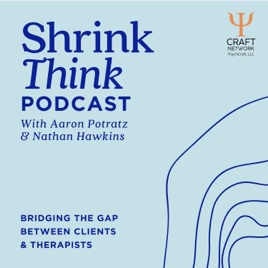
Advertise on podcast: The Shrink Think Podcast
Rating
4.9from
This podcast has
253 episodes
Language
EnglishPublisher
Aaron Potratz & Nathan HawkinsExplicit
No
Date created
2020/09/15
Latest episode
2026/05/20
Average duration
25 min.
Release period
21 days
Description
Welcome to the Shrink Think Podcast hosted by Aaron Potratz and Nathan Hawkins, two licensed counselors. With engaging, informative conversations and light-hearted humor, the Shrink Think Podcast aims to normalize and demystify therapy for those beginning or continuing their mental health journey; in short, to bridge the gap between clients and therapists. Episodes are geared toward simplifying complex therapeutic concepts, exploring personal contributions and needs in relation to therapy, and both informing and empowering individuals to know what to expect from the process and their own therapist.
Unlock The Shrink Think Podcast podcast Email contact info,
Listeners & Audience details
Email contact information
Direct podcast contact details

Listeners
Audience numbers & engagement insights

Audience details
Podcast Insights

Podcast episodes
Check latest episodes from The Shrink Think Podcast podcast
253. Couples Therapy Should Be Balanced
2026/05/20
Couples therapy isn’t about picking sides—it’s about creating balance.
In this episode, Aaron and Nathan break down one of the most misunderstood aspects of couples counseling: what real balance actually looks like in the room.
They explore why couples therapy is not individual therapy times two, and how effective therapy requires attention to three things at once:
Each individual partner
The dynamic between them
The relationship itself
They also unpack:
Why both partners need to feel understood—even when they disagree
How therapist bias (intentional or not) can shape outcomes
When individual sessions can help—and when they create problems
The role of transparency, trust, and avoiding triangulation
Why fairness and emotional safety are critical for real progress
If therapy starts to feel one-sided, something is off. The goal isn’t to prove who’s right—it’s to help both people feel seen, while strengthening the relationship as a whole.
Aaron Potratz & Nathan Hawkins are behavioral health experts, licensed counselors, and clinical supervisors with over 35 years of experience. They each own a private group therapy practice and co-own a third one together. Aaron is also a business consultant for therapists in private practice wanting to start, grow, or expand their business.
*Watch this episode: https://youtu.be/US2LfZpdS0I
*Now on YouTube: @shrink-think
*Sign up for our FREE email course on overcoming fear and insecurity at:
https://www.shrinkthink.com/podcast
Member of the PsychCraft Podcast Network
https://psychcraftnetwork.com/
252. When to Go Back to Therapy
2026/05/13
A lot of people try therapy, do meaningful work, and then eventually step away—because life stabilizes, the “knot” loosens, and it feels like they can take it from there. And honestly, that’s often a healthy outcome.
But then something shifts. A big life event hits (a car accident, a death in the family, a major transition), or something subtler starts repeating—your reactions feel outsized, your coping skills don’t seem to work the way they used to, or you notice an old pattern coming back online. In this episode, Aaron and Nathan talk through the most common signs it might be time to return to therapy—and how to do it without overthinking it.
They normalize the reality that many people cycle in and out of therapy across different seasons of life. Not because therapy “failed,” but because life reveals deeper layers over time. You might be facing a new stressor your system hasn’t learned how to handle yet, or you’ve peeled back another layer of the onion and need an updated version of the skills you already built.
They also address the quiet barriers that keep people from returning: worrying about what your therapist will think, feeling embarrassed that you’re “back again,” or convincing yourself you should be able to figure it out with self-help or AI. Aaron highlights the difference a real therapist can make in the room—especially the ability to notice tone, subtle shifts, and relational patterns that don’t show up in a prompt or a text box.
You’ll also hear practical, relieving guidance:
You don’t have to wait until you’re “stuck in a deep hole” to go back—earlier is often better
Returning doesn’t mean recommitting for years; sometimes you only need a handful of sessions
Going back to a prior therapist can save time because rapport is already there—and they can often help you adapt old tools to a new situation
It’s also normal to choose a new therapist for a different perspective or a different modality (EMDR, IFS, etc.)
If the thought “maybe I should go back” keeps tapping you on the shoulder… that might be the sign
If you’ve done therapy before and you’re wondering whether it’s time to re-enter, this episode gives you a grounded framework: treat it like a tune-up, not a failure—and start with one session.
Aaron Potratz & Nathan Hawkins are behavioral health experts, licensed counselors, and clinical supervisors with over 35 years of experience. They each own a private group therapy practice and co-own a third one together. Aaron is also a business consultant for therapists in private practice wanting to start, grow, or expand their business.
*Watch this episode: https://youtu.be/H4LoFr1P98M
*Now on YouTube: @shrink-think
*Sign up for our FREE email course on overcoming fear and insecurity at:
https://www.shrinkthink.com/podcast
Member of the PsychCraft Podcast Network
https://psychcraftnetwork.com/
251. Envisioning Goals As Who I Want To Be
2026/03/18
251. Envisioning Goals As Who I Want To Be by Aaron Potratz & Nathan Hawkins
250. Skill Issue or Personality Difference
2026/03/11
250. Skill Issue or Personality Difference by Aaron Potratz & Nathan Hawkins
249. How to Use AI in Therapy (Without Replacing It)
2026/03/04
In this episode, Aaron and Nathan continue their two-part conversation on AI and therapy—this time getting practical. Rather than debating whether AI should be used, they start from a clear position: AI cannot replace therapy. But when used wisely, it can support and strengthen the therapeutic process.
They explore how AI can function as a supplement to therapy—helping with normalization, psychoeducation, journaling, symptom tracking, and preparing for sessions—while also naming its clear limitations. You’ll hear why human therapy offers experiential knowledge, co-regulation, and real-time feedback that AI simply cannot replicate, and why screens can never replace being with another regulated human nervous system.
This episode also dives into:
The difference between informational knowledge and experiential healing
When gaining more information helps—and when it actually increases anxiety
How to use AI prompts intentionally to track patterns, not avoid emotions
Ways AI can help you clarify what to bring into therapy
Why skepticism, self-honesty, and boundaries matter when using AI
How journaling, normalization, and skill-building can be enhanced (but not replaced) by AI
If you’re already using AI—or considering it—this episode offers a grounded, human-centered framework for using it without outsourcing your healing.
Aaron Potratz & Nathan Hawkins are behavioral health experts, licensed counselors, and clinical supervisors with over 35 years of experience. They each own a private group therapy practice and co-own a third one together. Aaron is also a business consultant for therapists in private practice wanting to start, grow, or expand their business.
*Watch this episode: https://youtu.be/ayPgXJcvH1o
*Now on YouTube: @shrink-think
*Sign up for our FREE email course on overcoming fear and insecurity at:
https://www.shrinkthink.com/podcast
Member of the PsychCraft Podcast Network
https://psychcraftnetwork.com/
248. Should You Use AI Instead of Therapy
2026/02/25
AI is everywhere right now—and it’s starting to show up in the therapy room, too. In this episode, Aaron and Nathan zoom out and wrestle with a big question that therapists, clients, and everyday humans are increasingly asking: should you use AI alongside therapy… or instead of it?
This is Part 1 of a two-part conversation, focused more on the “big picture” and the philosophical/ethical tension points. We talk about why motivation matters (for both therapists and tech), how AI can become an echo chamber or a challenger depending on what you ask it to be, and why voice, tone, and attachment needs can shape how much we trust a tool. We also explore real-world ways people are already using AI to “double-check” their therapist, make predictions about relationships, and outsource thinking—along with the risks of losing critical thinking and personal responsibility when you hand too much over to a machine.
We close with a practical framing: asking “Should I use AI?” can be like asking, “Should I hand this task to someone else, or is this something I need to do myself?” Next episode, we’ll get more practical about how to use AI wisely without replacing the human parts that actually heal.
Aaron Potratz & Nathan Hawkins are behavioral health experts, licensed counselors, and clinical supervisors with over 35 years of experience. They each own a private group therapy practice and co-own a third one together. Aaron is also a business consultant for therapists in private practice wanting to start, grow, or expand their business.
*Watch this episode: https://youtu.be/uGPQ-EC9tRs
*Now on YouTube: @shrink-think
*Sign up for our FREE email course on overcoming fear and insecurity at:
https://www.shrinkthink.com/podcast
Member of the PsychCraft Podcast Network
https://psychcraftnetwork.com/
247. How Compassion Prevents Burnout
2026/02/19
In this follow-up to our episode on empathy, Aaron and Nathan shift the focus to compassion—what it is, how it’s different from empathy, and why it can be a more sustainable way of helping others without burning out.
Compassion isn’t about getting swept up in someone else’s emotions or rushing them toward change. It’s about feeling for someone while staying grounded, holding both care and perspective at the same time. Using clinical examples, metaphors (including quicksand), and real therapy moments, this episode explores how compassion allows you to stay present, patient, and effective—without fusing, pushing, or losing yourself.
You’ll hear:
The core difference between feeling with someone (empathy) and feeling for someone (compassion)
Why compassion includes intention, pacing, and respect for what someone can tolerate
How helpers can accidentally rush healing—or want change more than the other person
The role of boundaries, groundedness, and patience in real compassion
Why compassion is often quieter, steadier, and more sustainable than empathy
This episode is especially relevant for therapists, helpers, and caregivers—but it’s just as valuable for anyone who wants to support others well without overfunctioning or burning out.
Aaron Potratz & Nathan Hawkins are behavioral health experts, licensed counselors, and clinical supervisors with over 35 years of experience. They each own a private group therapy practice and co-own a third one together. Aaron is also a business consultant for therapists in private practice wanting to start, grow, or expand their business.
*Now on YouTube: @shrink-think
*Sign up for our FREE email course on overcoming fear and insecurity at:
https://www.shrinkthink.com/podcast
Member of the PsychCraft Podcast Network
https://psychcraftnetwork.com/
246. Empathy Can Be Dangerous
2026/02/17
Empathy is one of the most powerful tools in relationships—and in therapy. But if you’re not careful, it can also become one of the fastest paths to emotional exhaustion.
In this episode, Aaron and Nathan kick off a two-part series on empathy vs. compassion, starting with a deep dive into empathy: what it is, why it works, and where it can quietly go sideways—especially for therapists, helpers, and highly attuned people.
You’ll learn:
-Why empathy can feel like being “swept away” into someone else’s emotions
-How empathy reduces loneliness and helps people feel truly seen
-The hidden risks: distress contagion, countertransference, and vicarious activation
-Why too much empathy (without boundaries) can contribute to burnout over time
-How to use empathy intentionally—attune, validate, anchor, and then help movement happen
If you care deeply about people but sometimes feel drained, fused, or overwhelmed by others’ pain, this episode will help you stay connected without getting pulled under.
Aaron Potratz & Nathan Hawkins are behavioral health experts, licensed counselors, and clinical supervisors with over 35 years of experience. They each own a private group therapy practice and co-own a third one together. Aaron is also a business consultant for therapists in private practice wanting to start, grow, or expand their business.
*Watch this episode: https://youtu.be/J22KHvV7WWE
*Now on YouTube: @shrink-think
*Sign up for our FREE email course on overcoming fear and insecurity at:
https://www.shrinkthink.com/podcast
Member of the PsychCraft Podcast Network
https://psychcraftnetwork.com/
245. The Hidden Reason You Can’t Stop Overthinking
2026/02/12
Overthinking isn’t the same thing as “thinking deeply.” In this episode, Aaron and Nathan unpack what overthinking actually is, how it feeds anxiety, and why it often turns small decisions into exhausting, paralyzing spirals.
They break down the overthinking loop (thought → anxiety → more thinking to relieve anxiety → more anxiety), and offer practical questions to interrupt it—like identifying what you’re truly worried about, what outcome you’re trying to control, and whether you’re chasing perfection instead of a workable decision.
You’ll also hear why action is often the antidote (not more analysis), how learning to tolerate discomfort and disappointment changes everything, and how operating from your values—rather than trying to guarantee outcomes—creates more confidence, freedom, and peace.
Aaron Potratz & Nathan Hawkins are behavioral health experts, licensed counselors, and clinical supervisors with over 35 years of experience. They each own a private group therapy practice and co-own a third one together. Aaron is also a business consultant for therapists in private practice wanting to start, grow, or expand their business.
*Now on YouTube: @shrink-think
*Sign up for our FREE email course on overcoming fear and insecurity at:
https://www.shrinkthink.com/podcast
--------------
*Member of the PsychCraft Podcast Network*
https://psychcraftnetwork.com/
244. Transparency, Vulnerability, and Emotions: What Actually Builds Intimacy
2026/02/10
What does it actually mean to be vulnerable? Is it the same as being transparent? And where do emotions fit in?
In this episode of The ShrinkThink Podcast, licensed professional counselors Aaron and Nathan break down the often-confused differences between transparency, vulnerability, and sharing emotions—and why misunderstanding them can quietly block intimacy, connection, and growth in your relationships.
You’ll learn:
-Why being transparent doesn’t automatically create closeness
-How vulnerability invites connection (and risk) in a way transparency doesn’t
-How you can share emotions without being vulnerable—and be vulnerable without sharing emotions
-Why some personality styles (including Enneagram types) default to transparency as protection
-Practical ways to practice transparency, vulnerability, and emotional sharing with safe people
If you’ve ever felt like you’re “open” but still not truly known—or frustrated that emotional conversations don’t seem to deepen relationships—this episode will give you language, clarity, and next steps.
Aaron Potratz & Nathan Hawkins are behavioral health experts, licensed counselors, and clinical supervisors with over 35 years of experience. They each own a private group therapy practice and co-own a third one together. Aaron is also a business consultant for therapists in private practice wanting to start, grow, or expand their business.
*Now on YouTube: @shrink-think
*Sign up for our FREE email course on overcoming fear and insecurity at:
https://www.shrinkthink.com/podcast
--------------
*Member of the PsychCraft Podcast Network*
https://psychcraftnetwork.com/
243. If I’m Nice I’m Safe (People-Pleasing)
2025/09/17
People often think that being “nice” means you will be “safe” in the world, and others won’t hurt you or take advantage of you. Unfortunately, being nice is often a people-pleasing tendency that seeks to pacify what we believe others want at the expense of our needs, honesty, and healthy relationship.
Aaron Potratz & Nathan Hawkins are behavioral health experts, licensed counselors, and clinical supervisors with over 35 years of experience. They each own a private group therapy practice and co-own a third one together. Aaron is also a business consultant for therapists in private practice wanting to start, grow, or expand their business.
*Watch this episode: https://youtu.be/US2LfZpdS0I
*Now on YouTube: @shrink-think
*Sign up for our FREE email course on overcoming fear and insecurity at:
https://www.shrinkthink.com/podcast
--------------
*Member of the PsychCraft Podcast Network*
https://psychcraftnetwork.com/
242. Your World Is A Reflection Of You
2025/09/09
You can’t change the world around you but when YOU change, the world around you begins to adjust. As you get healthier, set better boundaries, and become more peaceful, your world will become calmer, safer, and more positive. Bad things will still happen, because that’s a part of life, but the world around you will always be a reflection of what’s in you.
Aaron Potratz & Nathan Hawkins are behavioral health experts, licensed counselors, and clinical supervisors with over 35 years of experience. They each own a private group therapy practice and co-own a third one together. Aaron is also a business consultant for therapists in private practice wanting to start, grow, or expand their business.
*Watch this episode: https://youtu.be/rfW6A0s1PBQ
*Now on YouTube: @shrink-think
*Sign up for our FREE email course on overcoming fear and insecurity at:
https://www.shrinkthink.com/podcast
--------------
*Member of the PsychCraft Podcast Network*
https://psychcraftnetwork.com/
241. Stop Trying To Be A "Good Client" In Therapy
2025/09/03
Going to therapy is about self-exploration and self-understanding. You learn more about yourself as your therapist reflects you back to yourself. If you’re focused on trying to earn your therapist’s approval by being a “good client,” then you’re missing the point and not getting what you need out of therapy.
Aaron Potratz & Nathan Hawkins are behavioral health experts, licensed counselors, and clinical supervisors with over 35 years of experience. They each own a private group therapy practice and co-own a third one together. Aaron is also a business consultant for therapists in private practice wanting to start, grow, or expand their business.
*Now on YouTube: @shrink-think
*Sign up for our FREE email course on overcoming fear and insecurity at:
https://www.shrinkthink.com/podcast
--------------
*Member of the PsychCraft Podcast Network*
https://psychcraftnetwork.com/
240. The Role of Spirituality in Therapy
2025/08/06
Can psychology and spirituality play nice together? Many people believe they cannot mix but we argue they can - and should. Whether a client wants to involve their spiritual beliefs or not, therapy should make space for it without forcing it upon anyone so this important part of life can be addressed.
Aaron Potratz & Nathan Hawkins are behavioral health experts, licensed counselors, and clinical supervisors with over 35 years of experience. They each own a private group therapy practice and co-own a third one together. Aaron is also a business consultant for therapists in private practice wanting to start, grow, or expand their business.
*Watch this episode: https://youtu.be/5lHC5hMRxTM
*Now on YouTube: @shrink-think
*Sign up for our FREE email course on overcoming fear and insecurity at:
https://www.shrinkthink.com/podcast
--------------
*Member of the PsychCraft Podcast Network*
https://psychcraftnetwork.com/
239. Medication Can Play A Significant Role In Therapy
2025/07/30
Without advocating for or against medication, we address the importance of understanding how it can play a part in the direction therapy goes. As therapists, we don’t need to know as much as prescribers (Primary Care Docs or Psychiatrists) do, but we should be familiar with medication so therapy can include this critical piece of the puzzle.
Aaron Potratz & Nathan Hawkins are behavioral health experts, licensed counselors, and clinical supervisors with over 35 years of experience. They each own a private group therapy practice and co-own a third one together. Aaron is also a business consultant for therapists in private practice wanting to start, grow, or expand their business.
*Watch this episode: https://youtu.be/itDFsJHafXg
*Now on YouTube: @shrink-think
*Sign up for our FREE email course on overcoming fear and insecurity at:
https://www.shrinkthink.com/podcast
--------------
*Member of the PsychCraft Podcast Network*
https://psychcraftnetwork.com/
Podcast reviews
Read The Shrink Think Podcast podcast reviews
Amanda_6 2025/09/24
Real Talk, Real Laughs, and Real Insight
Aaron and Nathan are the perfect combo of funny, wise, and refreshingly honest. The Shrink Think Podcast breaks down big therapy concepts in a way tha...
Kacioke 2025/04/16
Great podcast!
Such a fun podcast to listen to! It is funny and educational, and I’ve learned a lot as someone going to therapy.
dfava25 2023/01/23
Great Podcast!
Love what Aaron and Nathan are doing with this show. Informative, fun, and great conversations. Keep ups the great work guys!
Lgordonb 2022/11/07
These guys are fun!
This is one of those podcasts that can make you feel good. Aaron and Nathan are true experts in their field and give sound insights into being human ...
Angela in Cali 2021/10/13
Fun to listen
Love it! Newbie here! Very conversation and insightful! Nathan and Aaron have great sense of humor that keep you from boredom.
Helen is my name 2021/10/13
Positive and Personal Podcast
I love this podcast because it helps me realized that I need more self care and it is totally okay to have self problem. I also find positivity from l...
J. O. Cheng 2021/10/13
Great podcast!
The podcast is really informative and they really know mental health problems that we all now facing. I have learned a lot about how to deal with anxi...
BrittneyPC 2021/09/15
So informative!
I love this podcast not only for the amazing information but also for how funny it is. Aaron and Nathan crack me up!
AveryB02 2021/09/14
Great podcast
Really helps my mental health during these crazy times!
Mark:pdx 2021/05/10
Great team
Aaron and Nathan are a great team, and complement each other well. Their discussions are well balanced between theory, application, and real world exa...
Podcast sponsorship advertising
Start advertising on The Shrink Think Podcast relevant audience podcasts
You may also like to advertise on these Podcasts

4.815431000
The Todd Herman Show
Radio America

4.723542000
Everything Everywhere Daily
Gary Arndt

4.629932039
Optimal Living Daily - Personal Development and Self-Improvement
Justin Malik

4.716442000
Morning Mindset Christian Daily Devotional Bible study and prayer
Carey Green

4.97401784
Despertando
Dudas Media

4.721551372
Motivation Daily by Motiversity
Motiversity

4.723121942
Timeless Wisdom with Dennis Prager
Salem Podcast Network

4.6221622000
Mark Levin Podcast
Cumulus Podcast Network

4.518252000
The DSR Network
The DSR Network

4.619712863
All Ears English Podcast
Lindsay McMahon and Michelle Kaplan