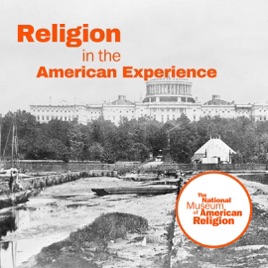
Advertise on podcast: Religion in the American Experience
Rating
4.7from
This podcast has
100 episodes
Language
EnglishPublisher
nationalmuseumofamericanreligionExplicit
No
Date created
2020/10/19
Latest episode
2026/10/02
Average duration
43 min.
Release period
7 days
Description
Learning from scholars and every day Americans about what religion has done to America and what America has done to religion, helping all of us better comprehend and perpetuate the American experiment in self-government, including what is perhaps its greatest innovation and the essence of the American project: religious freedom as defined by the Constitution’s Article VI and First Amendment religion clauses.
Unlock Religion in the American Experience podcast Email contact info,
Listeners & Audience details
Email contact information
Direct podcast contact details

Listeners
Audience numbers & engagement insights

Audience details
Podcast Insights

Podcast episodes
Check latest episodes from Religion in the American Experience podcast
American Religion: Christian Science
2026/10/02
Welcome to another episode of “Religion in the American Experience”, the podcast that equips listeners to be more effective stewards of religion’s beneficial role in the American experiment in self-government. Today we will explore history of Christian Science, a religion founded in the United States in the 19th century.
Season 4, Episode 2p – American Religion: Christian Science
Guest Bio
Michael Hamilton is the Executive Manager of The Mary Baker Eddy Library in Boston, Massachusetts. Mike holds a PhD from the University of Illinois Urbana-Champaign, and his research interests include religion and education, women in religious leadership, and American religious history. He served as a United States Navy chaplain for 20 years.
Podcast Support
Scholarly support provided by Lauren Turek, Associate Professor of History at Trinity University in San Antonio, Texas.
Technical audio and video assistance provided by Randall Stephens, a Professor of American and British Studies at the University of Oslo.
Religion in the American Experience is a podcast of the private, digital-first National Museum of American Religion, which tells the story of how religion has shaped America and how America has shaped religion. This includes the establishment of religious freedom in the United States Constitution’s Article II, Section 1 “Oath or Affirmation” clause; Article VI “no religious Test” clause; and the free exercise and non-establishment clauses in the Bill of Rights.
How Did William Penn Influence the Future United States?
2026/09/25
Welcome to another episode of “Religion in the American Experience”, the podcast that equips listeners to be more effective stewards of religion’s positive role in the American experiment in self-government. Today we will explore William Penn, founder of the Quaker colony of Pennsylvania, and his influence on the future United States.
Season 4, Episode 28 – How Did William Penn Influence the Future United States?
Guest Bio
Andrew Murphy is professor of political science (and department chair) at the University of Michigan. He has a PhD from the University of Wisconsin – Madison. Murphy's research takes up the intersections between politics and religion, in both historical and contemporary contexts. Andrew has engaged deeply with the life, career and political thought of William Penn, and is the author of William Penn: A Life; Liberty, Conscience, and Toleration: The Political Thought of William Penn; and co-editor (with John Smolenski) of The Worlds of William Penn.
Podcast Support
Scholarly support provided by Lauren Turek, Associate Professor of History at Trinity University in San Antonio, Texas.
Technical audio and video assistance provided by Randall Stephens, a Professor of American and British Studies at the University of Oslo.
Religion in the American Experience is a podcast of the private, digital-first National Museum of American Religion, which tells the story of how religion has shaped America and how America has shaped religion. This includes the establishment of religious freedom in the United States Constitution’s Article II, Section 1 “Oath or Affirmation” clause; Article VI “no religious Test” clause; and the free exercise and non-establishment clauses in the Bill of Rights.
Religion and American Medicine - Part 2: The Clinical Encounter
2026/09/23
Welcome to another episode of “Religion in the American Experience”, the podcast that equips listeners to be more effective stewards of religion’s positive role in the American experiment in self-government.
The influence of religion on American medicine is pervasive. This episode is an interview with Dr. Harold Koenig about the history of religion in the clinical encounter.
Season 4, Episode 26 – Religion and American Medicine - Part 2: The Clinical Encounter
Guest Bio
Harold Koenig is on the faculty at Duke University Medical Center as Professor of Psychiatry and Associate Professor of Medicine. He is also an Adjunct Professor in the Department of Medicine at King Abdulaziz University, Jeddah, Saudi Arabia, and is Adjunct Professor in the School of Public Health at Ningxia Medical University, Yinchuan, China. Dr. Koenig is an Associate Editor for the Journal of Religion and Health and is the lead author of the Handbook of Religion and Health, with professors Tyler VanderWeele and John Raymond Peteet.
Show Notes:
https://spiritualityandhealth.duke.edu/
Podcast Support
Scholarly support provided by Lauren Turek, Associate Professor of History at Trinity University in San Antonio, Texas.
Technical audio and video assistance provided by Randall Stephens, a Professor of American and British Studies at the University of Oslo.
Religion in the American Experience is a podcast of the private, digital-first National Museum of American Religion, which tells the story of how religion has shaped America and how America has shaped religion. This includes the establishment of religious freedom in the United States Constitution’s Article II, Section 1 “Oath or Affirmation” clause; Article VI “no religious Test” clause; and the free exercise and non-establishment clauses in the Bill of Rights.
The History of Religions' Treatment of the Earth - Part 1: The Church of Jesus Christ of Latter-day Saints
2026/09/18
Welcome to another episode of “Religion in the American Experience”, the podcast that equips listeners to be more effective stewards of religion’s positive role in the American experiment in self-government.
We are beginning a series exploring the history of religions’ view and treatment of planet earth, considered by many religious traditions as God’s creation. The first episode is about the history of The Church of Jesus Christ of Latter-day Saints and how they view and have engaged with planet earth since their founding in early 18th century New York.
Season 4, Episode 27 – The History of Religions’ Treatment of the Earth – Part 1: The Church of Jesus Christ of Latter-day Saints
Show Notes:
“Caring for the Earth” website that includes doctrinal foundations and current projects: https://www.churchofjesuschrist.org/learn/caring-for-the-earth?lang=eng
Guest Bios
Dr. Matthew C. Godfrey is a general editor of the Joseph Smith Papers and a senior historian in the Church History Department, The Church of Jesus Christ of Latter-day Saints. He holds a PhD in American and public history from Washington State University. Matt has authored or coedited several books, including five volumes in the Joseph Smith Papers, The Earth Will Appear as the Garden of Eden: Essays on Mormon Environmental History, and Religion, Politics, and Sugar: The Mormon Church, the Federal Government, and the Utah-Idaho Sugar Company, 1907-1921. Instagram handle: @matacious.
Dr. George Handley is a humanities professor at Brigham Young University with a research and teaching focus on environmental humanities. He holds a PhD from the University of California, Berkeley, and is the author (co-author Elizabeth M. DeLoughrey) of Caribbean Literature and the Environment: Between Nature and Culture, Home Waters: A Year of Recompenses on the Provo River, and New World Poetics: Nature and the Adamic Imagination of Whitman, Neruda, and Walcott.
Jenica Sedgwick is the sustainability manager for The Church of Jesus Christ of Latter-day Saints. She has a BS in business management strategy from Brigham Young University in 2016.
Podcast Support
Scholarly support provided by Lauren Turek, Associate Professor of History at Trinity University in San Antonio, Texas.
Technical audio and video assistance provided by Randall Stephens, a Professor of American and British Studies at the University of Oslo.
Religion in the American Experience is a podcast of the private, digital-first National Museum of American Religion, which tells the story of how religion has shaped America and how America has shaped religion. This includes the establishment of religious freedom in the United States Constitution’s Article II, Section 1 “Oath or Affirmation” clause; Article VI “no religious Test” clause; and the free exercise and non-establishment clauses in the Bill of Rights.
Religion and the Life, Times, and Work of Katherine Paterson
2026/09/04
Welcome to another episode of “Religion in the American Experience”, the podcast that equips listeners to be more effective stewards of religion’s positive role in the American experiment in self-government.
Today we will be talking with children’s author Katherine Paterson about religion’s role in her life and work.
Season 4, Episode 25 – Religion and the Life, Times, and Work of Katherine Paterson
Guest Bio
Katherine Paterson is the author of more than 40 books, including 18 novels for children and young people. She has twice won the Newbery Medal, for Bridge to Terabithia in 1978 and Jacob Have I Loved in 1981. The Master Puppeteer won the National Book Award in 1977 and The Great Gilly Hopkins won the National Book Award in 1979 and was also a Newbery Honor Book. For the body of her work she received the Hans Christian Andersen Award in 1998, the Astrid Lindgren Memorial Award in 2006, and in 2000 was named a Living Legend by the Library of Congress. She lives in Barre, Vermont and is an Elder in the First Presbyterian Church where her husband John, now deceased, was pastor.
Podcast Support
Scholarly support provided by Dr. Lauren Turek, Associate Professor of History at Trinity University in San Antonio, Texas.
Technical audio and video assistance provided by Dr. Randall Stephens, a Professor of American and British Studies at the University of Oslo.
Religion in the American Experience is a podcast of the private, digital-first National Museum of American Religion, which tells the story of how religion has shaped America and how America has shaped religion. This includes the establishment of religious freedom in the United States Constitution’s Article II, Section 1 “Oath or Affirmation” clause; Article VI “no religious Test” clause; and the free exercise and non-establishment clauses in the Bill of Rights.
Liturgical Jazz and Mid-Twentieth Century Black Catholic America
2026/08/28
Welcome to another episode of “Religion in the American Experience”, the podcast that equips listeners to be more effective stewards of religion’s positive role in the American experiment in self-government.
Today we will be exploring the surprising, fascinating, and little-known story of post-Vatican II liturgical jazz music in mid-twentieth century Black Catholic America.
Season 4, Episode 24 – Liturgical Jazz and Mid-Twentieth Century Black Catholic America
Guest Bio
Deanna Witkowski is a pianist, composer, scholar and author of Mary Lou Williams: Music For The Soul, winner of the 2022 ASCAP Foundation Deems Taylor/Virgil Thomson Award and the 2022 Jazz Journalists Association Award for Biography of the Year. Deanna has taught for Jazz at Lincoln Center and performed Williams’ compositions as a featured guest with the Pittsburgh Symphony Orchestra. In 2024, Witkowski completed her PhD in jazz studies at the University of Pittsburgh and is currently writing her second book based on her doctoral dissertation, “Jazz in the Pews: Experiments in Sunday Worship in the 1960s.”
Show notes:
Mass for Every Season
Mass for the Lenten Season (Stonewall Chorale + DW Trio)--starts at 12:30
Jazz in the Pews
Podcast Support
Scholarly support provided by Dr. Lauren Turek, Associate Professor of History at Trinity University in San Antonio, Texas.
Technical audio and video assistance provided by Dr. Randall Stephens, a Professor of American and British Studies at the University of Oslo.
Religion in the American Experience is a podcast of the private, digital-first National Museum of American Religion, which tells the story of how religion has shaped America and how America has shaped religion. This includes the establishment of religious freedom in the United States Constitution’s Article II, Section 1 “Oath or Affirmation” clause; Article VI “no religious Test” clause; and the free exercise and non-establishment clauses in the Bill of Rights.
Benjamin Franklin's Religion
2026/08/21
Welcome to another episode of “Religion in the American Experience”, the podcast that equips listeners to be more effective stewards of religion’s positive role in the American experiment in self-government.
The country is celebrating America’s 250th – the semiquincentennial – and we are featuring episodes that explore the religion of the principal actors during the country’s founding era. Today we will be talking with Dr. Tommy Kidd about Benjamin Franklin and his religious life and beliefs.
Season 4, Episode 23 – Benjamin Franklin’s Religion
Guest Bio
Thomas S. Kidd is among the most celebrated scholars of religion and the founding of the United States. He serves as Research Professor of Church History at Midwestern Baptist Theological Seminary and is the John and Sharon Yeats Endowed Chair of Baptist Studies. Dr. Kidd has authored numerous books, including Thomas Jefferson: A Biography of Spirit and Flesh, Benjamin Franklin: The Religious Life of a Founding Father, and George Whitefield: America’s Spiritual Founding Father.
Podcast Support
Scholarly support provided by Dr. Lauren Turek, Associate Professor of History at Trinity University in San Antonio, Texas.
Technical audio and video assistance provided by Dr. Randall Stephens, a Professor of American and British Studies at the University of Oslo.
Religion in the American Experience is a podcast of the private, digital-first National Museum of American Religion, which tells the story of how religion has shaped America and how America has shaped religion. This includes the establishment of religious freedom in the United States Constitution’s Article II, Section 1 “Oath or Affirmation” clause; Article VI “no religious Test” clause; and the free exercise and non-establishment clauses in the Bill of Rights.
The Making of U.S.: Lived Religion in America with Matt Nowakowski
2026/08/14
Welcome to another episode of “The Making of US: Lived Religion in America”, a subseries of the podcast “Religion in the American Experience”, which makes each of us more effective stewards of religion’s positive role in the American experiment in self-government.
In this subseries we explore the role religion has played in the lives of everyday Americans, reminding us that while religion exerts a significant influence on the events and movements of the American project, religions primary work and where it has the most influence, is in the everyday lives of adherents.
Season 4, Episode 22 – The Making of U.S.: Lived Religion in America
Today Matt Nowakowski of Minneapolis, Minnesota joins us to share his own religious history.
Veronica Mrnik, Matt's maternal grandmother, immigrated from Czechoslovakia and raised the family through St. Joseph's Church in Cudahy, WI. https://www.nativitycudahy.org/our-parish-history
Matt is associated with the Brothers of the Christian Schools-The Lasallian Brothers. https://www.lasalle.org/en/
Podcast Support
Scholarly support provided by Dr. Lauren Turek, Associate Professor of History at Trinity University in San Antonio, Texas.
Technical audio and video assistance provided by Dr. Randall Stephens, a Professor of American and British Studies at the University of Oslo.
Religion in the American Experience is a podcast of the private, digital-first National Museum of American Religion, which tells the story of how religion has shaped America and how America has shaped religion. This includes the establishment of religious freedom in the United States Constitution’s Article II, Section 1 “Oath or Affirmation” clause; Article VI “no religious Test” clause; and the free exercise and non-establishment clauses in the Bill of Rights.
Religion and American Medicine - Part 1
2026/08/07
The influence of religion on American medicine is pervasive. This episode is an interview with Dr. Jeff Levin about the contents of his book Religion and Medicine: A History of the Encounter Between Humanity’s Two Greatest Institutions.
We believe that understanding this thread in America’s religious fabric will make each of us more effective stewards of religion’s role in the American experiment in self-government.
Season 4, Episode 21 – Religion and American Medicine – Part 1.
Guest Bio
Jeff Levin is an epidemiologist and religious scholar, and holds a distinguished chair at Baylor University, where he is University Professor of Epidemiology and Population Health, Professor of Medical Humanities, Director of the Program on Religion and Population Health at the Institute for Studies of Religion, and Distinguished Senior Fellow at the Institute for Global Human Flourishing. Jeff is the author, editor, or co-editor of over 11 books, including Religion and Medicine: A History of the Encounter Between Humanity’s Two Greatest Institutions.
Podcast Support
Scholarly support provided by Dr. Lauren Turek, Associate Professor of History at Trinity University in San Antonio, Texas.
Technical audio and video assistance provided by Dr. Randall Stephens, a Professor of American and British Studies at the University of Oslo.
Religion in the American Experience is a podcast of the private, digital-first National Museum of American Religion, which tells the story of how religion has shaped America and how America has shaped religion. This includes the establishment of religious freedom in the United States Constitution’s Article II, Section 1 “Oath or Affirmation” clause; Article VI “no religious Test” clause ; and the free exercise and non-establishment clauses in the Bill of Rights.
The Influence of the King James Bible on the American Novel - Part 1
2026/07/31
The influence of the King James Bible on American literature has been vast. This is the first of many episodes that will explore this topic, and it will focus on ways this particular edition of the Bible has shaped the American novel.
We believe that understanding this thread in America’s religious fabric will make each of us more effective stewards of religion’s role in the American experiment in self-government.
Season 4, Episode 20 – The Influence of the King James Bible on the American Novel – Part 1.
Guest Bio
Robert Alter is Professor in the Graduate School and Emeritus Professor of Hebrew and Comparative Literature at the University of California at Berkeley, and author of Pen of Iron: American Prose and the King James Bible. He is a member of the American Academy of Arts and Sciences, the American Philosophical Society, the Council of Scholars of the Library of Congress, and is past president of the Association of Literary Scholars and Critics. His twenty-four published books include two prize-winning volumes on biblical narrative and poetry and award-winning translations of Genesis and of the Five Books of Moses.
Podcast Support
Scholarly support provided by Dr. Lauren Turek, Associate Professor of History at Trinity University in San Antonio, Texas.
Technical audio and video assistance provided by Dr. Randall Stephens, a Professor of American and British Studies at the University of Oslo.
Religion in the American Experience is a podcast of the private, digital-first National Museum of American Religion, which tells the story of how religion has shaped America and how America has shaped religion. This includes the establishment of religious freedom in the United States Constitution’s Article II, Section 1 “Oath or Affirmation” clause; Article VI “no religious Test” clause ; and the free exercise and non-establishment clauses in the Bill of Rights.
How Did John Witherspoon's Sermon Influence the American Revolution?
2026/07/24
This year during America’s 250th anniversary, we are paying particular attention to how religion figured into the people and events of the country’s founding era.
In May of 1776 Presbyterian minister John Witherspoon gave a unique sermon entitled The Dominion of Providence Over the Passions of Men, which created quite a stir. What is in this sermon that would raise eyebrows, who exactly was John Witherspoon, and what influence did the sermon and preacher have on the creation of the United States?
We believe that understanding this thread in America’s religious fabric will make each of us more effective stewards of religion’s role in the American experiment in self-government.
Season 4, Episode 19 – How Did John Witherspoon’s Sermon Influence the American Revolution?
Guest Bio
Gideon Mailer is Professor of History at the University of Minnesota. His research interests include the evolution of liberty, beginning with the ancient Anglo-Scottish constitutional framework and culminating in the establishment of the United States of America. Gideon is the author of The Character of Freedom: The Scottish Enlightenment and American Slavery and John Witherspoon’s American Revolution.
SHOWNOTES:
https://youtu.be/Fa1ad9QCv_s?si=QJPlLRzkVKG9P_se
Podcast Support
Scholarly support provided by Dr. Lauren Turek, Associate Professor of History at Trinity University in San Antonio, Texas.
Technical audio and video assistance provided by Dr. Randall Stephens, a Professor of American and British Studies at the University of Oslo.
Religion in the American Experience is a podcast of the private, digital-first National Museum of American Religion, which tells the story of how religion has shaped America and how America has shaped religion. This includes the establishment of religious freedom in the United States Constitution’s Article II, Section 1 “Oath or Affirmation” clause; Article VI “no religious Test” clause ; and the two Bill of Rights religion clauses.
Bono and His Religion
2026/07/17
Paul David Hewson, also known as Bono, was born in Dublin, Ireland on May 10, 1960. He is the founding member and lead singer of the band U2, formed in 1976, the same year he experienced a Christian conversion. In 1982 he married Alison Stewart, whom he met when he was a teenager. Bono is the recipient of 22 Grammy Awards and in 2005 was, as part of U2, inducted into the Rock and Roll Hall of Fame. In 2004 Bono, together with two others and 11 humanitarian and advocacy organizations, founded the One Campaign, which advocates for the investments needed to create economic opportunities and healthier lives in Africa. This episode will explore the role religion has played in his life and music.
We believe that understanding this particular thread of the American fabric will make each of us more effective stewards of religion’s role in the ongoing American project.
Season 4, Episode 18 – Bono and His Religion
Guest Bio
Chad Seales is Associate Professor of Religious Studies and Holder Designate of the Brian F. Bolton Distinguished Professorship in Secular Studies, at The University of Texas at Austin. He earned a Ph.D. from the University of North Carolina at Chapel Hill. His research addresses the cultural relationship between religion and secularism in American life. He is editor of the Routledge Handbook of Religion and American Culture, and the author of Religion Around Bono: Evangelical Enchantment and Neoliberal Capitalism and The Secular Spectacle: Performing Religion in a Southern Town, and has published articles and book chapters on religious comparison, religion and food, industrial religion, corporate chaplaincy, religion and film, and secularism and secularization in the United States.
SHOWNOTES:
“40” - https://youtu.be/lj8rzXBVmBY?si=Rx9FNJM2ZmuNzhg_
Example of an Episcopal “U2charist” service - https://www.youtube.com/live/1B2KB-72nnA?si=uc8hywKcK_s-sCJO
Podcast Support
Scholarly support provided by Dr. Lauren Turek, Associate Professor of History at Trinity University in San Antonio, Texas.
Technical audio and video assistance provided by Dr. Randall Stephens, a Professor of American and British Studies at the University of Oslo.
Religion in the American Experience is a podcast of the private, digital-first National Museum of American Religion, which tells the story of how religion has shaped America and how America has shaped religion. This includes the establishment of religious freedom in the United States Constitution’s Article II, Section 1; Article VI; and Bill of Rights religion clauses.
Religion and the Life, Times, and Music of Billie Holiday
2026/07/10
Billie Holiday (born Eleanora Fagan Gough) was born on April 7, 1915, in Philadelphia, Pennsylvania and grew up in Baltimore, Maryland. Enduring a turbulent childhood, she started singing in New York City in her teenage years, becoming an exceptionally talented, and then famous, jazz and swing singer in the 1930s and 40s. Billie won four Grammy Awards, all of them posthumously. We would like to investigate the religious influences on Billie Holiday’s life, times, and music.
We believe that understanding this particular thread of the American fabric will make each of us more effective stewards of religion’s role in the ongoing American project.
Season 4, Episode 17 – Religion and the Life, Times, and Music of Billie Holiday
Guest Bio
Tracy Fessenden has agreed to help us with this. Professor Tracy Fessenden is the Steve and Margaret Forster Professor in the School of Historical, Philosophical, and Religious Studies at Arizona State University and Director of Strategic Initiatives in the Center for the Study of Religion and Conflict, where she also directs the Initiative in Spirituality and Public Life. Her work focuses on, among other things but most relevant for our topic today, religion and American literature and the arts and the relationship between religion and the secular in American law, culture, and public life. She is the author of Religion Around Billie Holiday and Culture and Redemption: Religion, the Secular, and American Literature.
It is our hope that by answering this question, each of us will be more effective stewards of religion’s role in the American experiment in self-government.
SHOWNOTES:
https://billieholiday.com/
Billie Holiday - https://en.wikipedia.org/wiki/Billie_Holiday
“Strange Fruit” - https://en.wikipedia.org/wiki/Strange_Fruit
“God Bless the Child” - https://en.wikipedia.org/wiki/God_Bless_the_Child_(Billie_Holiday_song)
House of the Good Shepherd for Colored Gils in Baltimore, Maryland: https://mavcor.yale.edu/mavcor-journal/colored-magdalens-house-good-shepherd-colored-girls-baltimore-ca-1930s
Podcast Support
Scholarly support provided by Dr. Lauren Turek, Associate Professor of History at Trinity University in San Antonio, Texas.
Technical audio and video assistance provided by Dr. Randall Stephens, a Professor of American and British Studies at the University of Oslo.
Religion in the American Experience is a podcast of the private, digital-first National Museum of American Religion, which tells the story of how religion has shaped America and how America has shaped religion. This includes the establishment of religious freedom in the United States Constitution’s Article VI and Bill of Rights religion clauses.
Did They Believe the Revolutionary War Was Biblical and Just?
2026/07/03
As we celebrate America’s 250th, this is a timely question to ask: Was the American Revolutionary war biblical and just – religiously permissible and religiously justifiable – in the minds of the leaders and colonists who fought in and supported it?
It is our hope that by answering this question, each of us will be more effective stewards of religion’s role in the American experiment in self-government.
Season 4, Episode 16 – Was the Revolutionary War Biblical and Just?
Guest Bio
Mark David Hall is professor at the Robertson School of Government at Regent University. He is renown scholar of early America, with expertise in Christianity’s role in the America’s experiment in self-government. Dr. Hall is also widely regarded as a leading student of religious liberty and church-state relations in America and is the author of many books including Proclaim Liberty Through All the Land: How Christianity Has Advanced Freedom and Equality for All Americans and Did America Have a Christian Founding?: Separating Modern Myth from Historical Truth.
SHOWNOTES:
https://www.markdavidhall.org/
Podcast Support
Scholarly support provided by Dr. Lauren Turek, Associate Professor of History at Trinity University in San Antonio, Texas.
Technical audio and video assistance provided by Dr. Randall Stephens, a Professor of American and British Studies at the University of Oslo.
Religion in the American Experience is a podcast of the private, digital-first National Museum of American Religion, which tells the story of how religion has shaped America and how America has shaped religion. This includes the establishment of religious freedom in the United States Constitution’s Article VI and Bill of Rights religion clauses.
Religion and the American Revolution
2026/06/26
During America’s 250th anniversary year we are discussing how religion shaped the founding of the United States. This episode explores religion and the American revolution.
It is our hope that by understanding this particular topic, each of us will become more effective stewards of religion’s role in the American experiment in self-government.
Season 4, Episode 15 – Religion and the American Revolution
Guest Bio
Our guest today is Kate Carté, a Professor of History at Southern Methodist University who specializes in early American and Atlantic history and is author of Religion and the American Revolution: An Imperial History. Kate has been a Charles A. Ryskamp Fellow of the American Council of Learned Societies, an affiliate fellow of the Center for the Study of Religion at Princeton University, a Franklin Fellow of the American Philosophical Society, and a Barra Postdoctoral Fellow at the McNeil Center for Early American Studies.
Podcast Support
Scholarly support provided by Dr. Lauren Turek, Associate Professor of History at Trinity University in San Antonio, Texas.
Technical audio and video assistance provided by Dr. Randall Stephens, a Professor of American and British Studies at the University of Oslo.
Religion in the American Experience is a podcast of the private, digital-first National Museum of American Religion, which tells the story of how religion has shaped America and how America has shaped religion. This includes the establishment of religious freedom in the United States Constitution’s Article VI and Bill of Rights religion clauses.
Podcast reviews
Read Religion in the American Experience podcast reviews
pywils 2026/04/22
A hidden gem
Chris is a knowledgeable host and the guests are generally great.
iwendt 2025/10/29
Embracing America’s rich religious history
Christopher brings such a wide range of experts to explore America’s rich religious history. Together they explore how many religious groups have infl...
Religion Podcast 2024/01/12
Religion in the American Experience
What an extraordinary podcast… It takes such a difficult and challenging topic, and then finds ways to communicate its content that are easier to unde...
opbdman 2023/12/08
A phenomenal podcast
The pod covers an extremely vital topic to Americans, the historical role religion has played - for good and for bad - in forming the identity of this...
Junglebeast 2023/12/07
NAMR is doing great things
These podcasts are very in-depth and help anyone from an expert to a curious beginner understand the role of religion on our country.
washpostfourthirty 2023/12/06
Important addition to NMAR’s memorable episodes
This interview offers a fascinating account of how being introduced to religion as a child could influence an entire life. Daniel Walker Howe is one o...
Hyjhfdfgjkm 2023/12/05
Insightful and needed
This podcast takes a deep but accessible dive into the role religion plays in America. It is a needed and welcome resource. I find the episodes well o...
Procrasticurious 2023/12/02
Important Resource for Understanding Religion from All Perspectives
This podcast deals with some of the most important issues facing America today and provides the most current, balanced, solid scholarship on the role ...
Little Chummy 2023/12/01
Enlightening
These podcasts provide insightful windows into a tapestry of topics revolving around religion in America. You can’t help but come away with an enhanc...
P. Goldberg 2023/11/30
Excellent and important podcast
This is an indispensable offering to everyone who recognizes the central role that religion has played in the history of the country and wants to dive...
Podcast sponsorship advertising
Start advertising on Religion in the American Experience relevant audience podcasts
You may also like to advertise on these Podcasts
4.818382000
The Cabral Concept
Dr. Stephen Cabral
4.8104492000
Steve Deace Show
Blaze Podcast Network

4.816561992
Juicebox Podcast: Type 1 Diabetes
Scott Benner

4.662822000
The Dr. Laura Podcast
Dr. Laura Schlessinger & SiriusXM

4.723612000
Everything Everywhere Daily
Gary Arndt

4.97391794
Despertando
Dudas Media

4.619752871
All Ears English Podcast
Lindsay McMahon and Michelle Kaplan
4.831561350
The Late-Round Fantasy Football Podcast
iHeartPodcasts

4.6312821077
Wow in the World
Tinkercast

4.819462000
Football Ramble
Stak