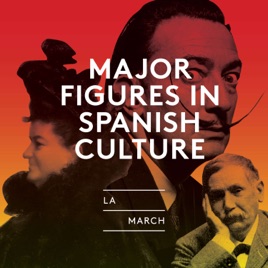
Advertise on podcast: Major Figures in Spanish Culture
Rating
5from
This podcast has
14 episodes
Language
EnglishPublisher
Fundación Juan MarchExplicit
No
Date created
2020/11/12
Latest episode
2023/11/08
Average duration
30 min.
Release period
97 days
Description
Renowned experts profile prominent figures that have contributed in a decisive way to the advancement of Spanish culture.
Unlock Major Figures in Spanish Culture podcast Email contact info,
Listeners & Audience details
Email contact information
Direct podcast contact details

Listeners
Audience numbers & engagement insights

Audience details
Podcast Insights

Podcast episodes
Check latest episodes from Major Figures in Spanish Culture podcast
13. Tomás Luis de Victoria
2023/11/08
Owen L. Rees, a professor of Music at the University of Oxford and a Fellow in Music and Organist (Director of Music) at The Queen's College, University of Oxford, speaks about Tomás Luis de Victoria (1548–1611), a renowned Spanish Renaissance composer celebrated for his choral music, known for its harmonies and profound spiritual expression.
BOOKS AND PUBLICATIONS ABOUT TOMÁS LUIS DE VICTORIA
O’Regan, Noel, "Victoria, Soto and the Spanish Archconfraternity of the Resurrection in Rom”’, 'Early Music', 22, 1994, pp. 279-295.
O'Regan, Noel, “Tomás Luis de Victoria's Roman Churches Revisited”, 'Early Music', 28/3, 2000, pp. 403-418.
Rees, Owen, “Tomás Luis de Victoria”, 'Oxford Bibliographies Online', 2013. DOI: 10.1093/OBO/9780199757824-0091.
Rees, Owen, 'The Requiem of Tomás Luis de Victoria (1603)', Cambridge-Nueva York, Cambridge University Press, 2019.
Stevenson, Robert, 'Spanish Cathedral Music in the Golden Age', Berkeley-Los Ángeles, University of California Press, 1961.
12. Lope de Vega
2023/11/02
Jonathan Thacker, the King Alfonso XIII Professor of Spanish Studies and a Fellow of Exeter College at the University of Oxford, discusses Lope de Vega (1562–1635), a playwright and poet who played a crucial role in Spanish literature during the Golden Age. He was a contemporary of Cervantes and Shakespeare, and he authored as many as 800 plays and numerous poems, making substantial contributions to the evolution of Spanish theater through works such as 'Fuente Ovejuna' and 'El castigo sin venganza'.
BOOKS AND PUBLICATIONS ABOUT LOPE DE VEGA
Dixon, Victor, "Lope Félix de Vega Carpio”, 'The Cambridge History of Spanish Literature', Cambridge, Cambridge University Press, 2004, pp. 251-264.
García Reidy, Alejandro, 'Las musas rameras: oficio dramático y conciencia profesional en Lope de Vega', Madrid/Frankfurt, Iberoamericana/Vervuert, 2013.
García Santo-Tomás, Enrique, 'La creación del “Fénix”: Recepción crítica y formación canónica del teatro de Lope de Vega', Madrid, Gredos, 2000.
McKendrick, Melveena, 'Theatre in Spain, 1490–1700', Cambridge, Cambridge University Press, 1989.
Samson, Alexander and Thacker, Jonathan, 'A Companion to Lope de Vega', Woodbridge, Tamesis, 2008.
Sánchez Jiménez, Antonio, 'Lope: el verso y la vida', Madrid, Cátedra, 2018.
Thacker, Jonathan, 'A Companion to Golden Age Theatre', Woodbridge, Tamesis, 2007.
11. Manuel de Falla
2023/10/25
Michael Christoforidis, a Professor of Musicology at the Melbourne Conservatorium of Music, University of Melbourne, discusses Manuel de Falla (1876–1946), a pivotal figure in Spanish culture during the Silver Age and arguably one of Spain's most renowned composers. He achieved widespread recognition in a country more famous for its literary and visual artists. Falla's music effectively bridged Spanish and French influences, highlighting modernity while preserving a profound connection to Spanish culture, evident in works such as 'La vida breve,' 'Noches en los jardines de España,' and 'El retablo de Maese Pedro.'
BOOKS ABOUT MANUEL DE FALLA
Christoforidis, Michael, 'Manuel de Falla and Visions of Spanish Music'. London-New York, Routledge, 2018.
10. Rosalía de Castro
2023/10/18
Catherine Davies, emérita professor of Hispanic and Latin American Studies at the University of London, talks about Rosalía de Castro (1837–1885), one of Spain’s finest lyrical poets, certainly the most loved and admired of the nineteenth century. Rosalía de Castro ushered in a new era of modern poetry in Spain, and left an enduring legacy in Spanish literature. She was, as well, a passionate supporter of Galician culture, environmental protection, and marginalized communities.
BOOKS ABOUT ROSALÍA DE CASTRO
Davies, Catherine, 'Rosalía de Castro: no seu tempo', Vigo, Galaxia, 1987.
Davies, Catherine, 'Rosalía de Castro e Follas novas', translation by Leandro García Bugarín, Vigo, Galaxia, 1990.
9. Federico García Lorca
2021/07/21
Federico García Lorca is Spain’s best known and perhaps most beloved poet of the 20th century. Born in 1898, Lorca formed friendships in Madrid with a pleiade of young creators in the 1920s at the Residencia de Estudiantes, al of whom would become very influential in Spanish culture. He was killed by Nacionalist forces at the beginning of the Spanish Civil War when he was only 38 years old. Christopher Maurer, professor or Spanish at Boston University introduces in this podcast this major figure in Spanish culture. Recording of Federico García Lorca’s ‘Pensamiento poético’ by Michael Alec Rose.
Books and publications about Federico García Lorca
Hernández, Mario, Line of Light and Shadow. The Drawings of Federico García Lorca, Madrid, Tabapress-Fundación Federico García Lorca, 1990.
Roberts, Stephen, Deep Song. The Life and Work of Federico García Lorca, London, Reaktion Books, 2020.
Stainton, Leslie, Lorca. A Dream of Life, New York, Farrar, Straus, Giroux, 1999.
Books and publications by Federico García Lorca
Poetry
Collected Poems, 2nd bilingual edition, revised. edition by Christopher Maurer, translation by Catherine Brown, Cola Franzen, Will Kirkland, William Bryant Logan, Robert Nasatir, Jerome Rothenberg, Greg Simon, & Steven F. White and Alan S. Trueblood, New York, Farrar, Straus, Giroux, 2013.
Poet in Spain, translation by Sarah Arvio, New York, Knopf, 2017.
Poet in New York, revised bilingual edition, translation by Greg Simon and Steven F. White. New York, Farrar, Straus, Giroux, 2013.
Gypsy Ballads, translation by Jane Duran and Gloria García Lora, London, Enitharmon Editions, 2011.
Sonnets of Dark Love/The Tamarit Divan, translation by Jane Duran and Gloria García Lorca, London, Enitharmon Editions, 2016.
Lectures
Deep Song and Other Prose, translation by Christopher Maurer, New York, New Directions, 1981.
In Search of Duende, translation by Norman di Giovanni, Edwin Honig, Langston Hughes, Lysander Kemp, C. Maurer, W.S. Merwin, Stephen Spender and J.L. Gili, New York: New Directions, 1998.
Letters
Selected Letters, translation by David Gershator, New York, New Directions, 1984.
Federico García Lorca and Salvador Dalí. Sebastian’s Arrows. Letters and Mementos, translation by Christopher Maurer, Chicago, Swan Isle Press, 2004.
8. María Zambrano
2021/07/01
A Spanish Civil War exile from 1939 until 1984, María Zambrano was a philosopher and essayist that combined civic commitment and poetic thought. A disciple of José Ortega y Gasset, she received the two highest literary awards granted in Spain: the Prince of Asturias Award in 1981, and the Cervantes Award in 1988. Roberta Johnson, Professor Emerita of the Department of Spanish & Portuguese at the University of Kansas and Adjunct Professor in the Department of Spanish and Portuguese at UCLA, introduces us to this major figure in Spanish culture.
07. Antonio Machado
2021/05/26
Antonio Machado was part of the Generation of 1898, a group of writers that were concerned about Spain’s position in the modern world and wrote to inspire people to reassess their values in order to awaken a national consciousness. Unlike his contemporaries, Machado adopted what he called “eternal poetry,” which was based more on reflection and intuition, than on intellect. Nuria Morgado, Associate Professor of contemporary Spanish Literature at the College of Staten Island and the Graduate Center, City University of New York introduces in this podcast this major figure in Spanish culture.
Books and publications by Antonio Machado
Los Complementarios, edition by Domingo Ynduráin, Madrid, Taurus, 1972.
Poesía y prosa critic edition by Oreste Macrì in collaboration with Gaetano Chiappini, 4 vols., Madrid, Espasa-Calpe / Fundación Antonio Machado, 1988.
Campos de Castilla, edition by Geoffrey Ribbans, Madrid, Cátedra, 1989.
Poesías completas, edition by Manuel Alvar, Barcelona, Planeta-De Agostini (Colección Austral), 2001.
Prosas dispersas (1893-1936), edition by Jordi Doménech, introduction by Rafael Alarcón Sierra, Madrid, Páginas de Espuma, 2001.
Soledades, Galerías. Otros Poemas, edition by Arturo Ramoneda, Madrid, Alianza Editorial (Biblioteca Machado), 2006.
Juan de Mairena, edition by Antonio Fernández Ferrer, Madrid, Cátedra, 2006 (6ª ed.).
Translations by Antonio Machado into English
Juan de Mairena. Epigrams, Maxims, Memoranda, and Memoirs o fan Apocryphal Professor, translation by Ben Belitt, Berkeley, University of California Press, 1963.
Times Alone: Selected Poems of Antonio Machado, translation by Robert Bly, Middletown, Conn., Wesleyan, 1982.
Antonio Machado: Selected Poems, translation by Alan S. Trueblood, Cambridge, Harvard University Press, 1988.
Border of a Dream: Selected Poems of Antonio Machado, translation by Wills Barnstone, Port Townsend, Copper Canyon Press, 2003.
Fields of Castile, translation by Stanley Appelbaum, New York, Dover Publications, 2007.
06. Miguel de Cervantes
2021/04/28
Miguel de Cervantes’ daring in literary experimentation was both perfectly suited to the time in which he lived, and an exponential step forward in literary art, specifically in the genre he perfected, the modern novel. Susan Byrne, Professor of Hispanic Studies and Chair of the Department of World Languages and Cultures at the University of Nevada-Las Vegas introduces in this podcast this major figure in Spanish culture.
Presented by Maria Jenell Nicolas.
Books and publications by Susan Byrne
Law and History in Cervantes’ Don Quijote, Toronto, University of Toronto Press, 2012.
Ficino in Spain, Toronto, University of Toronto Press, 2015.
“Las leyes en el Quijote, de 1605 a 1615”, in Hélène Tropé and Philippe Rabaté (Eds.), Autour de Don Quichotte de Miguel de Cervantes: Hommage à Augustin Redondo et à Jean Canavaggio, Paris, Université Paris 3 Sorbonne Nouvelle (Travaux du CRES), 2015, pp. 123-30.
“Coloquio, murmurar, canes muti: Cervantes y los jesuitas”, in Cuadernos AISPI [Associazione Ispanisti Italiani]: Estudios de lenguas y literaturas Ibéricas, 5 (Robert Lauer and Caterina Ruta, Eds.: Un paseo entre los centenarios Cervantinos), 2015, pp. 81-95.
“‘Essentiae’ en Ficino y en el Quijote (II, 16): las letras y la preceptiva cervantina”, in Nuria Morgado and Lía Schwartz (Eds.), Cervantes ayer y hoy, New York, Hispanic Seminary of Medieval Studies, 2016, pp. 3-21.
“Transcendence as Hyperbole in La fuerza de la sangre.”, in Cervantes: Bulletin of the CSA, 38.1, 2018, pp. 41-62.
“Chapter 2. Constitutions”, in A Cultural History of Law, vol. 3 (Peter Goodrich, Ed.: A Cultural History of Law in the Early Modern Age (1500-1680)), London, Bloomsbury Academic, 2019, pp. 39-64.
Books and publications by Miguel de Cervantes
Cervantes Saavedra, Miguel de, Las novelas ejemplares, Harry Sieber (Ed.), 2 vols., Madrid, Cátedra, 1997.
Cervantes Saavedra, Miguel de, El ingenioso hidalgo Don Quijote de la Mancha, Celina Sabor de Cortazar and Isaías Lerner (Eds.), 2 vols., Buenos Aires, Eudeba, 2005.
Books and publications about Miguel de Cervantes
Close, Anthony, Cervantes and the Comic Mind of His Age, Oxford, Oxford University Press, 2000.
De Armas, Frederick, Quixotic Frescoes: Cervantes and Italian Renaissance Art, Toronto, University of Toronto Press, 2006.
Egginton, William, The Man Who Invented Fiction: How Cervantes Ushered in the Modern World, New York, Bloomsbury, 2016.
Lerner, Isaías, Lecturas de Cervantes, Málaga, Universidad de Málaga, 2005.
Núñez Rivera, Valentín, Cervantes y los géneros de la ficción, Madrid, Prosa Barroca y Sial, 2015.
Riley, E. C. (1962), Cervantes’s Theory of the Novel, Newark, DE, Juan de la Cuesta, 1992.
Ruíz Pérez, Pedro, “Cervantes y la poesía”, in Cervantes Virtual
Major Figures in Spanish Culture is on the Top 20 list of Spain Travel & Culture podcasts on Feedspot
05. Juan Ramón Jiménez
2021/03/17
Many Spanish-language poets, from Lorca to Pablo Neruda or Octavio Paz are indebted to the work of Juan Ramón Jiménez, Spanish poet who received the Nobel Prize of Literature en 1956. He is a rare creator of pure, lyrical texts that express the essence of poety. Julio Jensen, Associate Professor in the Department of English, Germanic and Romance Studies at the University of Copenhagen, talks about this outstanding figure in Spanish culture.
Presented by Maria Jenell Nicolas
Books and publications by Juan Ramón Jiménez
Platero and I, translated by Eloïse Roach, Austin, University of Texas Press, 1957.
Selected Writings of Juan Ramón Jiménez, translated by H. R. Hays, New York, Farrar, Straus and Cudahy, 1957.
Three Hundred Poems, translated by Eloïse Roach, Austin, University of Texas Press, 1962.
God Desired and Desiring, translated by Antonio T. de Nicolás, New York, Paragon House, 1987.
Light and Shadows. Selected Poems and Prose, translated by Robert Bly, Dennis Maloney, Antonio T. de Nicolás, James Wright and Clark Zlotchew, New York, White Pine Press, 1987.
Time and Space: A Poetic Autobiography, translated by Antonio T. de Nicolás, New York, Paragon House, 1988.
Diary of a Newlywed Poet, translated by Hugh A. Harter, Selinsgrove, Susquehanna University Press, 2004.
Books and publications about Juan Ramón Jiménez
Cardwell, Richard A., Juan R. Jiménez: The Modernist Apprenticeship, 1895–1900, Berlin, Colloquium Verlag, 1977.
Coke-Enguidanos, Mervyn, Word and Work in the Poetry of Juan Ramon Jiménez, London, Tamesis Books, 1982.
Cole, Leo R., The Religious Instinct in the Poetry of Juan Ramón Jiménez, Oxford, Dolphin Book Co., 1967.
Jensen, Julio, The Poetry of Juan Ramón Jiménez. An Example of Modern Subjectivity, Copenhagen, Museum Tusculanum Press, 2012.
Olson, Paul R., Circle of Paradox; Time and Essence in the Poetry of Juan Ramón Jiménez, Baltimore, Johns Hopkins University Press, 1967.
Wilcox, John C., Self and image in Juan Ramón Jiménez, Modern and Postmodern Readings, Urbana, University of Illinois Press, 1987.
Young, Howard T., The Line in the Margin: Juan Ramón Jiménez and his Readings in Blake, Shelley, and Yeats, Madison, University of Wisconsin Press, 1980.
Major Figures in Spanish Culture is on the Top 20 list of Spain Travel & Culture podcasts on Feedspot
04. José Ortega y Gasset
2021/02/17
Above all a philosopher, José Ortega y Gasset enunciated the seminal idea of his thought in this sentence: “I am myself and my circumstance, and if I don’t save it, I don’t save myself”. In this podcast, Juan Pablo Fusi, Professor Emeritus of Contemporary History at Madrid’s Universidad Complutense, talks about this outstanding figure in Spanish culture that tried to make sense of the most important challenges of 20th century’s humanity.
Presented by Maria Jenell Nicolas
Books and publications by José Ortega y Gasset
(1914) | Meditations on Quixote, New York, Norton, 1961.
(1921) | Invertebrate Spain, London, Allen and Unwin, 1937.
(1930) | The Revolt of the Masses, London, G. Allen & Unwin, 1932.
(1932) | “In Search of Goethe from Within”, in José Ortega y Gasset, The Dehumanization of Art and Other Essays on Art, Culture, and Literature, Princeton, N.J., Princeton University Press, 1968.
(1957) | Man and People, London, Allen & Unwin, 1957.
(1958) | The Idea of Principle in Leibnitz and the Evolution of Deductive Theory, New York, Norton, 1971.
(1960) | An Interpretation of Universal History, New York: Norton, 1973.
Major Figures in Spanish Culture is on the Top 20 list of Spain Travel & Culture podcasts on Feedspot
03. Salvador Dalí
2021/01/20
Dalí was born in the early years of the twentieth century in a typical bourgeois family from Figueres (Spain). Trained as a classical artist, he soon discovered Surrealism and also became a celebrity in other artistic fields, such as writing, film and design, which cannot be understood without taking into account the creative project he conceived with his wife Gala. In Dali’s Teatre-Museu, in Figueres, his essence is all over the place, just like an old vice or a never negotiated remorse. In fact, this prodigious building is not only Dalí’s museum: it is also his mausoleum. In this podcast, Estrella de Diego, Professor of Art History at the Universidad Complutense de Madrid, talks about this outstanding figure in Spanish culture.
Presented by Maria Jenell Nicolas
Dalí’s voiceover by Luis Carlos de la Lombana
Books and publications about Salvador Dalí
Aguer, Montse, Dalí's world, London, Goodman, 2009.
Dalí, Salvador (1942), The Secret Life of Salvador Dalí, New York, Dover Fine Art, 1993.
Salvador Dalí: an illustrated life, London / Figueres / Madrid, Tate Publishing / Fundació Gala-Salvador Dalí / Sociedad Estatal de Conmemoraciones Culturales-Ministerio de Cultura, 2007.
Exhibition catalogues
Salvador Dalí, the early years, London, South Bank Centre, 1994.
Dalí. Mass Culture, Barcelona / Figueres, Fundació La Caixa / Fundació Gala-Salvador Dalí, 2004.
De Diego, Estrella, Gala Salvador Dalí. A Room of own's own in Púbol, Barcelona, MNAC-Fundació Gala-Salvador Dalí, 2018.
Major Figures in Spanish Culture is on the Top 20 list of Spain Travel & Culture podcasts on Feedspot
02. Christopher Columbus
2020/12/16
No one from Spain’s past is more famed, more hated or more misunderstood than Cristopher Columbus. Misplaced vengeance topples Columbus’ statues. Tweets traduce him. He was mendacious, egotistical, irrational, self-righteous, humourless, and mean. But he had virtues to balance his vices—including dazzling bravery, a kind of ingenuous charm, and a confiding nature. He was, moreover, sympathetic towards cultures other than his own, including Native Americans’. In this podcast, Felipe Fernández-Armesto, William P. Reynolds Professor of History at the University of Notre Dame, talks about this outstanding figure in Spanish culture.
Presented by Maria Jenell Nicolas
Books and publications about Christopher Columbus
Bankoff, Greg "Aeolian Empires: The Influence of Winds and Currents on Maritime Expansion in the Age of Sail", Environment and History, 23, 2017.
Colón, Fernando, Historie del S.D. Fernando Colombo: nelle quali s'ha particolare, & vera relatione della vita, & de' fatti dell'Ammiraglio D. Christoforo Colombo, suo padre, Venice, appresso Francesco de' Franceschi Sanese, 1571.
Crosby, Alfred W., The Columbian Exchange: Biological and Cultural Consequences of 1492, Westport, CT, Praeger, 2003.
Fernández-Armesto, Felipe, Columbus on Himself, London, Folio Society, 1992.
Fernández-Armesto, Felipe, Columbus, London, Duckworth, 1996.
Fernández-Armesto, Felipe, "The Stranger-Effect in Early Modern Asia", Itinerario, 24.2, 2000.
Fernández-Armesto, Felipe, "The Origins of the European Atlantic", Itinerario, 24.1, 2000.
Flint, Valerie I. J., The Imaginative Landscape of Christopher Columbus, Princeton, Princeton University Press, 1992.
Helms, Mary W., Ulysses’ Sail, Princeton, NJ, Princeton University Press, 1988.
Irving A., Leonard, Books of the Brave, Cambridge, MA, Harvard University Press, 1949.
Phillips, William D. and Phillips, Carla Rahn, The Worlds of Christopher Columbus, Cambridge, Cambridge University Press, 1992.
Phillips, William D., Slavery in Medieval and Early Modern Iberia, Philadelphia, Penn Press, 2013.
Wey-Gómez, Nicolás, The Tropics of Empire: Why Columbus Sailed South to the Indies, Cambridge, MA, MIT Press, 2008.
Major Figures in Spanish Culture is on the Top 20 list of Spain Travel & Culture podcasts on Feedspot
Podcast reviews
Read Major Figures in Spanish Culture podcast reviews
Podcast sponsorship advertising
Start advertising on Major Figures in Spanish Culture relevant audience podcasts
You may also like to advertise on these Podcasts
4.6349993
School of Podcasting: Expert Tips for Launching and Growing Your Podcast
Dave Jackson

5174213
The Successful Nurse Coaches ™
Laura Minard, Shelby Kurz
4.6409139
Perino on Politics
FOX News Podcasts

4.6165324
And the Runner-Up Is
Kevin Jacobsen

4.724770
Gay Erotica by Liam Williams
Liam Williams

4.519182
Learn English with Coffee Break English
Coffee Break Languages

4.91390824
The Terri Cole Show
Terri Cole

4.52582000
SNR Drive (Pittsburgh Steelers)
SNR

4.81553300
Siempre es Lunes
Macetaminofen
4.72495300
The Classic Tales Podcast
B.J. Harrison