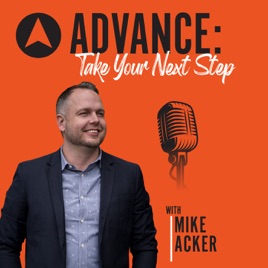
Advertise on podcast: ADVANCE: Take Your Next Step with Mike Acker
Rating
4.9from
This podcast has
63 episodes
Language
EnglishPublisher
Mike AckerExplicit
No
Date created
2020/11/12
Latest episode
2022/06/13
Average duration
38 min.
Release period
9 days
Description
Take Your Next Step in Leadership, Communication, and Life. Welcome to the ADVANCE Podcast by Mike Acker, a conversation designed to help entrepreneurs, business leaders, and other professionals break through barriers by improving their practical leadership skills and increasing confidence in speaking. Mike Acker is a bestselling author, executive coach, and founder of two companies aimed at providing an edge for leaders. For additional information or to book Mike Acker to work with your organization visit mikeacker.com.
Unlock ADVANCE: Take Your Next Step with Mike Acker podcast Email contact info,
Listeners & Audience details
Email contact information
Direct podcast contact details

Listeners
Audience numbers & engagement insights

Audience details
Podcast Insights

Podcast episodes
Check latest episodes from ADVANCE: Take Your Next Step with Mike Acker podcast
Ep 17 | Growing Confidently Amidst Doubt, Uncertainty, and Unease with Amy Wong [ Season 2 ]
2022/06/13
Many of us are living in fear: fear of something in the future or regret and resentment about things in the past. However, if we live in the present moment, we can achieve peace of mind despite any uncertainty.
Amy Wong joins Mike in this episode of the Advance Podcast to discuss how to live in the present and on purpose. Amy explains the cause of our dissatisfaction, resentment, and anxiety in life and shares some actionable insights on overcoming them, which she has also discussed in her book, Living On Purpose. Amy also talks about the link between our primary objective at any moment and fear. She explains how to live a fearless life by working on understanding and reinforcing your primary objective with compassion and dedication.
EPISODE 17 SUMMARY & HIGHLIGHTS
How prevalent is Imposter Syndrome in America?
1:35
Imposter Syndrome is more prevalent than most of us admit. There's so much shame wrapped around it that people find it hard to accept they've experienced something like that.
How can you find peace amid this time of uncertainty?
5:46
Anxiety lies in our thoughts about the future; it is not of the moment. We intend to be three steps ahead or replay what happened in the past that we forget to be in the moment. It takes practice to become present to reduce anxiety levels even during these times of uncertainty.
What can you do to live in the present?
09:42
One thing you can do is use mantras to pull you back to what you started with. Another thing is meditation. It helps you stay present throughout the day.
How can you find more purpose and meaning in life?
15:58
In the end, all that we want is a desired feeling. Finding meaning is about asking yourself how you want to feel about your job, role, or responsibilities.
How can people become more fearless in life, business, and relationships?
24:56
We all have a primary objective at any moment. Due to our psychology and neurobiology, that objective shifts to something that doesn't usually serve us sometimes. Nervousness is a symptom of an unintentional stance at any moment. If you're feeling scared or nervous at any moment, it's because of this shift in your primary objective. It takes a lot of compassion to claim that stance back. You've to channel your eloquence, innovation, and creativity in a productive way to live a bold, powerful life.
(Full show notes at https://connect.stepstoadvance.com)
RESOURCES MENTIONED ON THE PODCAST
Book: Living On Purpose by Amy Eliza WongCONNECT WITH AMY WONG
Website
CONNECT WITH MIKE
LinkedIn
Ep 15 | Resilience from Prison to PhD with Dr Stanley Andrisse [ Season 2 ]
2022/06/06
If you think you know enough about the power of resilience, you probably haven’t heard Stanley Andrisse’s story. After a series of wrong choices early on in life got him into prison – for 10 years, he knew it would take nothing but strong will, determination, and untethered resilience to succeed in his dream of becoming a doctor. Fast forward to today, Stanley is a Ph.D. and MBA holder, a doctor, author, and entrepreneur, who aims to change the lives of others with criminal convictions “through advocacy, mentoring, and policy change”.
Join Mike and Stanley in this episode as the latter explains his story of triumph through tough times and the indomitable power of resilience, hard work, and faith in transforming your life. Labeled a criminal at just 14 for selling drugs, Stanley explains the challenges he faced in keeping his dreams alive amid all the negative opinions people surrounded him with.
EPISODE 15 SUMMARY & HIGHLIGHTS
How do you understand your inner strength?
27:47
Do not let outside interference define or determine you. Do not let another person’s opinion harm you. Be a source of good.
How did Stanley manage to get his Ph.D. despite being in prison?
30:22
Stanley read research articles and papers day in and out in prison, dreaming and working hard to become a doctor. He then put together applications for education in multiple colleges; all except one were rejected. St. Louis University was the only university that accepted his admission after being released. He managed to complete his MBA and Ph.D. simultaneously, as the topper in class. He moved on later to Johns Hopkins University, where he became the number one in Endocrinology.
What do you do when the going gets tough?
39:02
Lean into your higher power. Hold onto your integrity. Do the right thing even if it brings you harm. Root into good beliefs and faith. Have patience and condition yourself to see multiple outcomes.
QUOTES
41:14-41:34
“For me, I kind of had plans, A, B, C, D, E, and so forth. Like, if I wasn't going to get A, I was going to be okay. And so I think that's one of the tough things like people having their eyes set on a prize and not getting that is considered a failure. And for me, I had multiple things that I was going towards.”
13:53-14:11
“For most people that go through incarceration, it's like it just beached you down in terms of psychologically mentally, emotionally, to where you no longer have any feeling of self-worth or self-value or purpose.”
RESOURCES MENTIONED ON THE PODCAST
Book: From Prison Cells To Ph.D. by Stanley Andrisse
CONNECT WITH STANLEY
Website
CONNECT WITH MIKE
LinkedIn
Ep 16 | Accept or Solve Conflict to do Better and Feel Better at Work With Liz-Kislik [ Season 2 ]
2022/05/31
It's not always easy to get things done, especially when people have different opinions or when they disagree on the organizational goals or processes. Most of us would rather avoid conflicts and arguments, but there are enough reasons you should sometimes not, which we're exploring today.
Join Mike in this episode of the Advance Podcast as he interviews Liz Kislik, a consultant, coach, speaker, facilitator, and contributor to Harvard Business Review, Forbes, and Entrepreneur. She speaks with Mike about the need for conflicts in the workplace and how to conduct them in a healthy way. She most importantly discusses how to have difficult conversations without patronizing any of the parties involved so you can come back to them later also. Conflicts, she shares, are necessary as they help represent different views and opinions. Often, the most worthy reasons and suggestions are revealed through them only. Listen in!
EPISODE 16 SUMMARY & HIGHLIGHTS
How can you explain our aversion to conflicts?
4:58
Firstly, any conflict generally brings some discomfort, which no person would want to invite into their life. Secondly, we fear hurting another person. We fear being seen as the bad person.
Why are conflicts sometimes necessary?
10:47
Despite the differences, you get to represent and acknowledge suggestions and opinions. Sometimes, getting to the worthy reasons too requires conflict.
How do you resolve conflicts in the workplace with someone senior to you?
19:23
Don’t just rely on the data, but use a good story to back it up. Data and story work hand in hand.
What are some deal-breakers in dealing with conflict?
26:12
Don’t insult anybody. Don’t speak to anyone in patronizing ways. Try to avoid such conversations until you’re ready to preserve the ability to go back.
What are the most common conflicts in workplaces?
31:56
The most common conflicts in workplaces are due to irreconcilable goals. This is when different departments have different goals and cannot resolve their differences together.
What are the three things you can do to handle conflicts healthily?
38:33
Just because you think it’s not fair doesn’t mean it actually isn’t.39:32
Manage yourself so that you can always go back to a conversation.39:44
If you find yourself in a conflict that is moral for you, where you know what’s happening is wrong but still hard to come to the surface, find someplace that’s better for you.
QUOTES
24:25-24:31
“Sometimes, the only thing you can do is preserve for yourself the right to come back again.”
35:30-35:46
“The other thing that can happen with pride or ego might be another way to call is that, sometimes, (when) people think it's not worth it, this person's pride or ego will be affected.”
CONNECT WITH LIZ
Website | LinkedIn | Twitter
CONNECT WITH MIKE
LinkedIn
Ep 14 | Strategy, Multiplication, and Breakthrough with Simon Severino [ Season 2 ]
2022/05/30
If your business is struggling to keep pace with the rapidly changing digital landscape, today's episode would teach you how the agile method of working was invented to help you overcome it.
Join Mike in this episode of the Advance Podcast as he interviews Simon Severino, a Business Strategy Advisor for SaaS or Services Businesses. Simon shares the common bottlenecks entrepreneurs experience in their journeys and how to overcome them using the methods explained in his book, Strategy Sprints: 12 Ways to Accelerate Growth for an Agile Business. Discussing first-hand the essential habits and methodologies for business growth, acceleration, and development, Simon helps you prepare for the highly volatile, high rate of change working environment using the modern agile ways of working.
EPISODE 14 SUMMARY & HIGHLIGHTS
What are some habits you can implement to overcome the common bottlenecks experienced by entrepreneurs in their journey?
06:55
Allocating time for the right thing - Have a daily habit, a weekly habit, and a monthly habit. Your daily habit reflects on how you're allocating your time.08:05
The weekly habit is reflecting on the information – creating a dashboard of marketing numbers, sales numbers, and others from different departments.10:10
The monthly habit is to be your strategy call. Think: Are you doing the right thing at the right pace? What are your competitors doing? What else can your customers do if they don't work with you? How do you distinguish speed and velocity?
13:08
Velocity means speed including direction. The distinction intends to ask: how many people have a clear vision of where they're heading in the next three years? Without vision, you might be running a super-fast marathon in the wrong direction. Have your vision written down for the next three years, ninety days.
What are the benefits of having your vision written down?
10:11
Simplification, de-risking, revenue increase, and increase in employee motivation are a few of the many benefits of writing down your vision for the next few weeks, months, and years.
How do you distinguish agile and rigid methods?
25:49
Agile methods help you combine or recombine the same elements whenever they are needed, and it's simple to do so. Agility means you have the same rate of change inside as outside.
If your rate of change inside is lower than the rate of change outside, then you are not agile; you are rigid. You'll encounter problems in the supply chain, geopolitics, market volatility, and the like, meaning you won't be able to navigate the business for longer.
How do you make the big decisions in life?
30:04
Stay in nature for as long as you want without a goal. Let the answer come to you in a moment of clarity. Center yourself; when you have clarity, you get to sprint from there.
QUOTES
05:19-05:29
“Sprint is a very specific method. It focuses on agility and resilience because that's what you need in tough times.”
RESOURCES MENTIONED ON THE PODCAST
Book: Strategy Sprints: 12 Ways to Accelerate Growth for an Agile Business by Simon Severino
CONNECT WITH SIMON
LinkedIn
CONNECT WITH MIKE
LinkedIn
Ep 13 | Schmooze Your Way to Success With Cody Lowry [ Season 2 ]
2022/05/16
At just 11 years old, Cody Lowry had learned to face rejections and discovered the power of persistence in transforming your life. Launching his career as a salesperson, Cody grew in knowledge and worth over the years, taking up multiple roles as an author, speaker, entrepreneur, consultant, and "schmoozer". The last one is also a concept we're breaking down in detail today that Cody also talks about in his book, SCHMOOZE - What they should teach at Harvard Business School.
In this episode, Mike talks to Cody about his life story, including starting in poverty and auditioning at Saturday Night Live. Mike and Cody talk about the lessons learned from the latter's personal and professional journeys, including discovering 'schmoozing' and making it a characteristic for success. The duo touches on building healthy professional relationships and how schmoozing helps with it.
Listen up now!
EPISODE 13 SUMMARY & HIGHLIGHTS
What does it mean to schmooze?
01:24
Schmooze means to chat idly in a friendly, persuasive manner to gain a friendship or advantage. Schmoozing is about that winning smile, the healthy first impression, and building relationships.
What are the keys to effective ‘schmoozing’?
Being genuine is the key to winning and influencing people, or ‘schmoozing’.
How to not get discouraged by rejections?
15:18
Realize that things will get better ultimately. Build relationships, get your clients to trust you, and never let them down.
Why is the practice of relationship-building often ignored?
25:17
The reason could be that we’re now totally ensconced in this whole social world, which is detrimental to the younger generations, who’re more at risk of suicide and other mental health issues. We’re more disconnected today than ever before.
What does it mean to develop yourself or be yourself?
28:18
By being more open than they are generally, seek out people, find out their stories, and learn from them. You don't get a second chance to make a first impression. Be more aggressive than you are now and ask pertinent questions that would affect your life and end up with a job.
QUOTES
15:56-16:04
“Sales is about perseverance. And it's about sticking with and it's about understanding that a lot of times, it's a numbers game.”
39:31-39:34
“May the schmooze be with you.”
CONNECT WITH CODY
LinkedIn | Book
CONNECT WITH MIKE
LinkedIn
Ep 12 | Purposeful Relationships and Meaningful Communication With Lisa Morton [ Season 2 ]
2022/05/02
The world has changed, and with it, the way people lead. The days of the commanding leader are over. Modern leaders need to be firm but kind, they need to build trust, be open to input from others, and support their team. In other words, they need to be value-driven and effective communicators. This is true of leaders at all levels, from business CEOs to first-time managers. It’s about being a leader for the 21st century.
Join in this episode with Mike and his guest Lisa Morton, who’s the Founder and CEO of Roland Dransfield, as they talk about the essential leadership skills for leaders of today’s times. They stress the importance of holding onto company values and implementing them externally and internally in your organization. They also talk about the importance of authenticity and how to lead yourself forward with it when building relationships.
Listen to today’s episode to learn more!
EPISODE 12 SUMMARY & HIGHLIGHTS
What is meant by “leaders create leaders”?
07:34
The "leaders great leaders" principle says that everybody can be a leader and that we're all leaders in some way. If you propagate the myth that you have to have a certain set of characteristics or personality to be a leader, you're blocking out all the great leaders around you.
No job is too small for a leader. If you allow your younger employees to lead, you'll realize that they wouldn't distinguish jobs – no job is too small for them.
How do you create leaders with both firmness and kindness of behavior?
11:32
By not compromising on your values for even the most well-paying of clients. Continual learning, learning from mistakes and not brooding over them, and imbibing the Japanese art of Kintsugi (you mend something broken with gold - it becomes more beautiful than it was before the accident) would help you become a leader who's both firm in principles and kind in behavior.
How do you communicate your company’s values internally and externally?
15:07
Firstly, it's important to understand that no employee would be able to enforce your company's values by mere rote learning - it takes time. The values have to become a part of the organization's DNA; the language used and the activities carried out should reflect them.
When working with clients, you would want to make sure your team is on board and has been part of the process. It's good to refresh those values.
What advice do you give your clients about relationship-building?
31:28
Being authentic. Associate your clients with how they show up in the world around their values. Reminding of legacy and heritage often helps people attune to their purpose and values.
(Full show notes at https://connect.stepstoadvance.com)
ABOUT LISA MORTON
Lisa Morton is the CEO and founder of Roland Dransfield, one of the most established communications agencies in Manchester, England. For the last 24 years, Lisa has worked to forge meaningful, lasting business relationships that create both business growth and social impact alongside her team of award-winning strategists, journalists, creatives, digital, and social media specialists. Now with a London office and a partnership with an LA-based agency, of which the founder is a former Roland Dransfield team member, Lisa is continuing to expand Roland Dransfield and explore new paths for growth.
CONNECT WITH LISA
LinkedIn
CONNECT WITH MIKE
LinkedIn
Ep 11 | Get Promoted and Get More of What You Want With Michael Wenderoth [ Season 2 ]
2022/04/25
Networking is a competence for every employee or entrepreneur looking to advance their career. The better you are at building relationships, the higher your chances of getting yourself promoted. Also, the expertise to build relationships can be learned. It's a skill you can develop, as will be discussed in this episode of the Advance podcast.
In this episode, Mike speaks with Michael about competence and incompetence in business. While many of us are looped in thought that repeatedly questions another's competence, we fail to notice how to use the thinking for the better and see what we can do better personally. Learn how to do that and how to also build the two most necessary competencies in the world today: communication and networking.
Listen up for Michael's 3-part framework and their take on whether networking is positive or negative!
EPISODE 11 SUMMARY & HIGHLIGHTS
What is meant when people say incompetence prevails?
04:12
A lot of it has to do with blaming. There are a lot of primary skills to be learned from it.
How can we pull this talk around incompetence for the better?
07:32
The first point is to be curious. Take a look at it and learn from those who’re called incompetent.07:56
Look at yourself. Think about what you could be doing better or the skills you could learn to improve yourself. What are some competencies that get you promoted?
10:11
Communication - It’s what goes into the making and sustaining of healthy relationships.
Networking - It’s what helps things happen. Your ability to navigate a company for its resources matters and happens in the form of networking.
How can you go about networking without coming across as unfair or negative?
12:16
If you use your networking to get your team the resources it needs or helps it grow by building meaningful relationships, you’re also given respect for your effort. Networking done in that manner or for that purpose isn’t remotely close to dirty.
What does it mean to develop your pathway to be promoted?
16:32
It’s about building healthy relationships and creating influence. Some people call it self-promoting, while some others call it internal marketing. Networking helps build relationships with key people. That could be called politics in some form, but what matters is how it helps you grow.
Can you talk a little about your 3-part framework?
24:20
In short, the 3-part framework says,
Rock - It’s all about getting real.Map - It’s about getting strategic.Snowball - It’s about getting done. Your endeavor starts snowballing only once you start doing.What is meant by power?
31:14
(Full show notes at https://connect.stepstoadvance.com)
ABOUT MICHAEL WENDEROTH
Michael Wenderoth is an Executive Coach that helps leaders ethically leverage power and politics to ascend. He has written for Harvard Business Review, Forbes and is the author of the book, Get Promoted: What You're Really Missing at Work That's Holding You Back. Prior to becoming an executive coach, Michael served 20 years in senior roles on break-through businesses in the U.S., China, and Europe. Michael holds an MBA from Stanford Business School and trained as an executive coach at Columbia University.
CONNECT WITH MICHAEL
LinkedIn
CONNECT WITH MIKE
LinkedIn
Ep 10 | The Art & Science of Effective Storytelling with Mark Carpenter [ Season 2 ]
2022/04/18
Do you believe that stories are the best way to get your message across? Maybe you should. Stories are more than just a craft; they're a fundamental part of how we communicate with each other and the world.
In this episode of Advance, we’re joined by author, speaker, and facilitator Mike Carpenter, who discusses all the power and scope of storytelling. They discuss what happens in people's minds when listening to stories and how to put your message across while engaging in storytelling by speaking as much as you have to - not less, not more.
If you think storytelling is only for businesses or brands, there's so much more you need to know about it. Tune in to this episode to have a look into it.
EPISODE 10 SUMMARY & HIGHLIGHTS
Who needs storytelling?
04:39
Stories are beneficial for anyone wanting to make real human connections. It helps people remember more information, more accurately.
Why do people love stories so much?
10:07
Storytelling induces three brain reactions:
Oxytocin increase:Storytelling increases what’s called the trust hormone production in you, helping them identify with the joy and the pain you describe.
Cortisol increase:An increase in cortisol means people pay more attention to what you say.
DopamineDopamine, or the feel-good hormone, is released when your audience gets a satisfactory resolution to the end of the story you tell. It helps them remember the information better and feel good about it.
How do you keep your stories just the right length?
18:54
By intentionally crafting your story. Your story is not just a complete narrative start-to-finish of what happened. It's about getting your point or message across to the people listening and engaging them through the story.
QUOTES
07:22-07:42
“Many people will just throw stories out there without really realizing what kind of impact they have. My approach is different. My approach is for a very specific context, I am not against storytelling – I think it's the greatest thing that humankind has created. What I am in favor of is being smarter about it. And that's why I say business storytelling 1.0, in the way we've traditionally used it, is kind of dead... And we have to realize that what we need is better alignment.”
25:04-25:10
“We love stories because we live stories. The stories are our life.”
ABOUT MARK CARPENTER
Mark Carpenter is an author, facilitator, consultant, speaker and serial storyteller. Telling stories since childhood, Mark leveraged his ability into a career in marketing communications and public relations and later as a college professor and corporate facilitator. His storytelling became even more purposeful and effective after researching and writing the best-selling book “Master Storytelling: How to Turn Your Experiences Into Stories that Teach, Lead, and Inspire.”
RESOURCES MENTIONED ON THE PODCAST
Book: Master Storytelling by Mark Carpenter Book: Will by Will Smith
CONNECT WITH MARK
LinkedIn
CONNECT WITH MIKE
LinkedIn
Ep 9 | Business Storytelling is Dead; Build a Strategic Narrative Instead Advance With Guiallaume Wiatr [ Season 2 ]
2022/04/11
Storytelling has, for the longest time, remained a fundamental component of business and culture. But in the last few years, it has undergone a transition to strategic narratives, as our guest Guiallaume Wiatr reveals today. What explains this change?
Join in this episode to know as Guiallaume Wiatr talks about it in great detail. Comparing business storytelling with strategic narratives, Guiallaume explains how companies are growing beyond the former way so that it doesn't only engage customers but can assign them a role to help them connect with you better.
Listen in to learn the differences, benefits, and importance of strategic narratives!
EPISODE 9 [SEASON 2] SUMMARY & HIGHLIGHTS
Why does Guiallaume believe business storytelling is dead, and why does he encourage building a strategic narrative instead?
04:10
The storytelling approach is great for companies selling a product already self-positioned. It assumes you know how people perceive you outside. But things are different when you are in uncharted territory – that's when it gets complicated. Your company could have many stories – customer stories, your personal story as a leader, your team stories, and what you do out there in the community can be a big network of stories. The difficulty is making sense of that system of stories: what’s the common denominator? That’s when you build a system of stories. And that’s what is meant by a strategic narrative.
What are the key differences between telling a story and then building a narrative?
11:51
A story aims at engagement. It wants to connect with people and draw them in. But if you look around, most companies do not just create stories and engage audiences, but rather as participants – they will find them a role. And they will bring them into what they're trying to achieve.
Why are strategic narratives so vital during this juncture in the business world?
16:56
Firstly, the way our society works has evolved quite a bit. People don't want just to be passive consumers of brands who throw a product at them. Secondly, people today pay for a story, for a narrative. They want to be associated with brands that serve a strong narrative.
How do you make sure your narrative sticks?
25:31
By constantly making the connection between the narrative and how it shows up, how you activate it and have scrutiny over how you talk.
QUOTES
07:22-07:42
“Many people will just throw stories out there without really realizing what kind of impact they have. So my approach is different. My approach is for a very specific context, I am not against storytelling – I think it's the greatest thing that humankind has created. What I am in favor of is being smarter about it. And that's why I say business storytelling 1.0, in the way we've traditionally used it, is kind of dead... And we have to realize that what we need is better alignment.
21:33-21:39
“Another difference between the story and narrative (is that) the story has happened already. It's past, it has occurred. And the narrative is still way more future-oriented.”
RESOURCES MENTIONED ON THE PODCAST
Book: Will by Will Smith Books by Patrick LencioniBook: Strategic Narrative by Guiallaume WiatrCONNECT WITH GUIALLAUME
LinkedIn
CONNECT WITH MIKE
LinkedIn
Ep 8 | Why Speaking Gives You Leverage As a Leader [ Season 2 ]
2022/04/04
A lot has been talked about the importance and power of public speaking. But do you know it has a marketing benefit too? With the right preparation and a few hacks, public speaking can be turned into a powerful marketing strategy that can help you get your business off the ground and make your name known in your industry.
Today, Mike interviews established public speaker and coach Odell Bizell. Odell shares his take on the marketing benefits of public speaking and the ways to become an effective public speaker, including the mistakes to avoid and the points to keep in mind. He shares 4 effective techniques to master the craft, explaining how to drive engagement and generate marketing benefits for people through public speaking. Learn also about Odell’s path to becoming a public speaker and what drew him towards the profession.
EPISODE 8 [SEASON 2] SUMMARY & HIGHLIGHTS
Explain the marketing aspect of speaking.
05:25
Most speakers are good talkers but not good listeners. Listening to your audience gets you content from them– the people you want to speak with, teach or sell. Another mistake people make is not speaking for the audience. You must consider your audience's demographics, interests, and expectations and deliver accordingly.
What are some mistakes people make when speaking to an audience?
08:29
Most speakers are good talkers, but not good listeners. Listening to your audience gets you content from your audience itself – the people you want to speak with, or teach, or sell. Another mistake people make is not speaking for the audience. You must consider the demographics, interests, and expectations of your audience and deliver accordingly.
What makes a great business professional great at speaking?
11:55
A great speaker can speak to the audience so well that the audience doesn't even have to say anything. This is an achievement one can reach in two ways:
12:44
Know your audience and insert yourself into their conversation.13:02
Practice more than you perform.What are some public speaking techniques you’d like to share?
29:54
Start well.The importance of a good starting presentation: It is best to create shock or excitement in your audience’s minds and draw them to the conversation when starting.
31:21
2. Start with a quote.
Start with a quote. Expand on something that makes them go ‘wow’.
32:03
3. Drive engagement.
Drive engagement. The more you get people to do something, the better they’re likely to buy. Ask them to sign up somewhere or perform an action when public speaking.
32:59
4. Be honest.
Practice complete and utter honesty. Give your audience a choice – to be engaged or not.
Closing thoughts by Odell.
36:59
If you want to scale your business and make more money than you ever thought you could, public speaking is a good option. Because it is the only skill that you can buy, rent, and sell.
QUOTES
17:27-17:36
“Public speaking is performative, but it's not like the performing arts. It's not like acting. It's not like athletics (and) all of those things.”
20:39-20:54
“Every market has industries that have associations, and everybody that hires a speaker usually is a professional in some form or fashion. All you have to do is find that association, and then you super-serve an underserved association.”
CONNECT WITH ODELL
Website
LinkedIn
CONNECT WITH MIKE
LinkedIn
Ep 7 | Keep your team focused through speaking & leadership [ Season 2 ]
2022/03/21
Having a vision — and being able to communicate that vision to your team — is key to being a great leader. There’s an undeniable link between speaking and leadership, knowing which is key to business success.
In this episode of the Advance Podcast, Mike talks to you about the 3 essential questions to ask yourself before attending a speaking event and how they help determine the purpose, importance, and effectiveness of your speaking. You’ll learn about why you must be led by a vision – be it in communication or leadership – and how having one helps your team stay focused too. You’ll also learn about Key Performance Indicators (KPIs), their benefits, and limitations. Listen in!
EPISODE 07 SUMMARY & HIGHLIGHTS
What are the three questions you must ask yourself every time you start to speak with people?
02:42
The three questions one must ask themselves before communicating to an audience are: ‘Who am I talking to?’, ‘What am I saying?’, and ‘Why am I doing this?’.
‘What am I saying’ is an important question to ask because many people get into some form of public speaking having no idea what they want to put across to people. They have a few points they have gathered, but they aren’t clear how or in which manner they can put it out for people to understand.
The ‘Why am I doing this’ question is even more important because it gives you clarity of purpose – it should ultimately come down to something personal, not something production-oriented. When it does, you’ll know why you need to communicate effectively.
What are KPIs? What are the benefits and downsides of it? How does it explain the parallel between communication and leadership?
18:53
KPIs are short for Key Performance Indicators, which was popularized when Dr. Kaplan and Dr. Norton created the balanced business scorecard. They are like the SMART goal for business and assess if an employee is performing well as they should be.
KPIs give you a lot of clarity by enabling you to measure the success, the direction, the activities, the outcomes and the productivity of the people that you lead.
The one limitation of KPIs is that they can’t measure the ‘why’ – why people are doing or not doing something. For instance, during these days of the Great Resignation (as many of us choose to call it), there’s a lot of talk about employees leaving companies, but the ‘why’ behind this remains uncertain. Knowing the ‘why’, whether it’s in communication or leadership, is essential to move forward.
KEY QUOTES:
04:58-05:15
“Knowing the why behind what you say gives purpose. So knowing that gives clarity and direction as to what you're going to say. And knowing the why gives you purpose, it gives you conviction, it gives you belief that what you're saying actually matters.”
06:20-06:32
“The difficulty with KPIs is that they can give direction but not purpose. They can tell people what to clearly do and goals, but it won't tell them why they're doing it.”
RESOURCES MENTIONED ON THE PODCAST
BOOK: Write To Speak by Mike Acker
https://www.amazon.com/dp/B081TVZZYX
CONNECT WITH MIKE
LinkedIn: https://www.linkedin.com/in/mikeackerdotcom
Ep 6 | Speak and Lead Team Members [ Season 2 ]
2022/03/15
What is the most effective way to communicate with your direct reports? Have you considered guiding them with questions, helping them figure out solutions and improvement ways by themselves, or do you still follow the traditional lead-with-answers methodology?
In this episode, Mike discusses why the former method is the most effective in leading your team with confidence while naturally instilling in them qualities of accountability and responsibility. You’ll learn the three Ps to asking questions to your direct reports and the four Cs to parenting levels and see how the two combine in effective leadership.
Learn to become a natural leader to your direct reports in this episode. Tune in now!
EPISODE 6 SUMMARY & HIGHLIGHTS
What must you keep in mind when speaking to direct reports?
04:52
Lead them through questions. You don’t have to tell your direct reports what to do because they can often figure it out themselves; maybe sometimes, you’ve to direct them towards it. The 3 Ps to asking questions helps include:
[05:38]
Psychology: When you’re being asked questions, your brain tries to get ready to respond to them. That means, even if the brain were in a passive state until then, it would jump to being active when asked questions.
[08:44]
Problem: Answering someone’s questions requires humility and time. Initially, a sense of pride may come over, which is a problem, but as humility gradually replaces your problem of pride, you’ll realize how beneficial it is to lead them through questions.
[11:17]
Process: Figure out how you must ask questions. When done properly, asking questions is a highly effective way of leading.
How do you lead people through questions the right way?
11:38
Go slow: If you’ve been the answer-teller all this while, it might take time for your people to adjust to this new attitude. Implement the practice slowly so that everyone is comfortable with the changes.
12:14
Go methodological: Have a flow of questions. Go from one point to the next. The four Cs of parenting: Commander, Coach, Counselor, Consultant, explain what the different parenting levels teach you about work and leadership.
What are the four Cs of parenting?
12:37
Commander: This is the stage where you're telling your children what to do. You're the boss in charge of their actions, helping them understand right and wrong.
13:21
Coach: After early middle school, your role with your child becomes that of a coach. You help them see the pros and cons, weigh the good and bad, and help them understand the implications of different choices. In this stage, you're helping them manage the outcome.
14:12
Counselor: As kids get older, you won't weigh the pros and cons of a situation with them. You help them process what they think is a good idea.
14:50
Consultant: The last stage is that of a consultant. This comes at the point where your kids have moved out of the house and ask your opinion about situations. They might take it or leave it, but your role as a consultant is to be a good advisor to them.
KEY QUOTES:
01:37-01:51
“If your speaking is higher, then people will assume that your leadership is equally as high. But if your speaking is lower, and even though you're a great leader able to get things done, then people will assume that your leadership is much lower.”
07:16-07:29
“When you ask a question, instead of just telling them what to do, start putting it back on them and leading them through a series of questions… What happens (then) is they start having to take ownership of the issue.”
CONNECT WITH MIKE
LinkedIn
Podcast reviews
Read ADVANCE: Take Your Next Step with Mike Acker podcast reviews
Marina Barayeva 2021/01/04
Great show!
Mike is a brilliant coach when it comes to public speaking. I like the episodes where he shares what he went through, like dealing with negative revie...
Rachelrichards92 2020/12/10
Love this
Awesome advice from an awesome speaking coach. I’ve learned so much from this podcast. Highly recommend!
Joeyhyoung 2020/11/19
I always tune in for Mike
After coaching with Mike I was finally able to get the traction I needed in my life. I’ll always be grateful. So glad he’s starting this podcast so I ...
m0690 2020/11/19
Highly Recommended
I read his books and it is easy to read and very practical. I have also done the coaching classes and this helped me a lot in improving my communicati...
Emily S 4444 2020/11/14
Awesome podcast!
I’ve read Mike Acker’s books (“Speak With No Fear” is in my top ten). Love that he has a podcast now, good stuff!
TM.A Podcast Listen 2020/11/13
Looking forward to more!
Excellent content on the connection between leadership and communication. I look forward to more!
Podcast sponsorship advertising
Start advertising on ADVANCE: Take Your Next Step with Mike Acker relevant audience podcasts
You may also like to advertise on these Podcasts

4.512175578
RedHanded
RedHanded

4.53341525
The FrogPants Studios Ultra Feed!
Scott Johnson

4.91254573
Joe DeFranco's Industrial Strength Show
Joe DeFranco

4.8243670
Happen To Your Career - Meaningful Work, Career Change, Career Design, & Job Search
Scott Anthony Barlow

4.8143106
Mundo in the Morning - KCMO Talk Radio 95.7FM & 710 AM
KCMO Talk Radio | Cumulus Media Kansas City

4.7629595
Werewolf Ambulance: A Horror Movie Comedy Podcast
Werewolf Ambulance

4.872165
The Rough Cut Golf Podcast
Finch Golf Media

4.9950305
Winged Wheel Podcast - A Detroit Red Wings Podcast
Winged Wheel Podcast

4.4622106
Second Date Update Podcasts
New Country 96-3 | Cumulus Media Dallas

4.11029106
PBS News Hour - Segments
PBS News