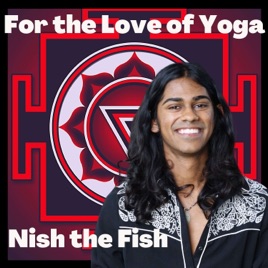
The world of Yoga is wide and varied. In this podcast, yogi Nish the Fish shares the deeper dimensions of Yoga, Vedanta and Tantra, asking the big questions: why do we practice? What is meditation? What is the purpose of a human life? What is Beauty? What is Death? Nishanth Selvalingam studied various South Asian philosophies with his Shaivite grandfather in an ashram in Kuala Lumpur, Malaysia and moved to Los Angeles to study philosophy, teach yoga and play guitar in a rock band. Join him and special guests as they explore Yoga, in all its splendours. For more episodes and instruction, and to support this humble offering of the heart, visit me on Patreon: patreon.com/yogawithnish
Advertise on For the Love of Yoga with Nish the Fish
Advertise on For the Love of Yoga with Nish the Fish to promote your brand to thousands of podcast listeners
Unlock For the Love of Yoga with Nish the Fish podcast Email contact info, Listeners & Audience details
Email contact information
Direct podcast contact details
Listeners
Audience numbers & engagement insights
Audience details
Podcast Insights
Podcast episodes
Check latest episodes from For the Love of Yoga with Nish the Fish podcast
Two Transmission of Tantra | Jñānā vs. Kriyā, Meditation vs. Ritual
2026/04/20
In Tantra, you find two separate transmissions that seem to be in tension with one another: one one hand, there are the Jñāna or contemplation oriented traditions (for example, the Vijñāna-Bhairava Tantra or Somānanda's śiva-drshti) that privilege subtle, interior practices involving the intellect and spacious, sky-like awareness (think: Dzogchen) and on the other hand, in the vast majority of instances, there is the kriyā approach which centers formal, external, often deity-oriented ritualistic/ceremonial practice. The former might dismiss the latter as gross or preliminary (like we see in the Verses 8-13 in the Vijñāna-Bhairava, for example or like we see with Abhinava Gupta and Somānanda re-interpreting external practices like pūjā, homa, yāga, japa etc. to be internal, contemplative modes).
In this talk, which we gave as part of our Denver 2026 retreat, I explain these two seemingly contradictory streams in the Tāntrik world with an appeal to Jñāna and Kriyā śaktis, the inherent powers of Consciousness, i.e God/Śiva to cognize and to act. More importantly, with an appeal to Icchā Śakti, which Somānanda prioritizes, we will reconcile the seeming dyad of Jñāna-Kriya or Knowledge/Action or Meditation/Ritual or Internal/External by subsuming in this third category, Icchā, the pure pre-cognitive, restful Desiring power of God!
This is a pretty subtle lecture and I enjoyed thinking about this out loud with you. Thank you for being there in person and online!
Support the show
Lectures happen live every Monday at 7pm PST and again at Friday 11am PST
Use this link and I will see you there:
https://www.zoom.us/j/7028380815
For more videos, guided meditations and instruction and for access to our lecture library, visit me at:
https://www.patreon.com/yogawithnish
To get in on the discussion and access various spiritual materials, join our Discord here: https://discord.gg/U8zKP8yMrM
Kali, Christ & Sticking It To The Man | Who Can Teach Tantra?
2026/04/19
After some ecstatic & triumphant kirtan (which you can watch in the last video here) at our second session at our second Denver retreat in April 2026, we take up our evening's lecture, an Easter special featuring some of my most inspired reflections on Tantra, gnostic Christianity and the politics of spirituality to answer the question:
Who has the right to teach & practice Tantra?
We reference some of Cynthia Bourgeault's and Elaine Pagel's academic work on the early history of Christianity to consider the politics around the resurrection of Christ (i.e Mary vs Peter, Gnostic Christianity vs Orthodox Christianity) which I'm going to argue mirrors the politics of Left-Hand Path vs Right Hand Path (read also: institutional) Tantra.
Much of this lecture is my loving middle finger to those who say we should not be doing what we're doing. Whatever such people may say and however good their intentions, with love and respect we say to them, like the Gnostics before us: we're going to do it anyway.
Support the show
Lectures happen live every Monday at 7pm PST and again at Friday 11am PST
Use this link and I will see you there:
https://www.zoom.us/j/7028380815
For more videos, guided meditations and instruction and for access to our lecture library, visit me at:
https://www.patreon.com/yogawithnish
To get in on the discussion and access various spiritual materials, join our Discord here: https://discord.gg/U8zKP8yMrM
How Meditation Works | Classical Yoga vs Tāntrik Yoga
2026/04/15
There are many ways to understand the word "meditation." Given that this is one of the central modalities of spiritual life and given the ever increasing interest in meditation, I felt a definition and discussion around meditation to clarify what it is and isn't in the Patañjali Yoga tradition would be helpful. More importantly, after we sketched out the basics of classical yogic meditation (i.e concentration practice), we then compared it to Tāntrik meditation to show how the Tāntrik tradition innovates and develops Patañjāla meditation to make for more visualization, dynamism, emotional cultivation (rasa) and aesthetic meaning. While it does sound like I'm positioning Tāntrik meditation as more appropriate, wholesome and complete here, in truth, the two traditions not only build off one another and depend on one another but are also both equally valid and equally effective modalities, each suited to practitioners of different temperaments. Neither is better or worse than the other, just different. And by understanding nuances such as these, we can be clear as to what meditation is and what is expected of us as aspirants!
If you're interested in starting up your Tantrik practice, you'll find some resources for you here.
Support the show
Lectures happen live every Monday at 7pm PST and again at Friday 11am PST
Use this link and I will see you there:
https://www.zoom.us/j/7028380815
For more videos, guided meditations and instruction and for access to our lecture library, visit me at:
https://www.patreon.com/yogawithnish
To get in on the discussion and access various spiritual materials, join our Discord here: https://discord.gg/U8zKP8yMrM
Śaiva Teachings in the Devī Māhātmyam
2026/03/30
Since it was Chaitra Navarātri last week, as part of our last Friday morning Abhinava Gupta Paramārthasāra class, we explored some key śaiva ideas that appear in the opening teaching of the Devī Māhātmyam.
In this talk, we first explain the mythic context in the Bhagavad Gītā, the Upanishads and of course, the Devī Māhātmyam and explain from a śaiva perspective, why all these aesthetic and poetic features of the teacher are central to our metaphysical and soteriological framework!
Also, we distinguish between soteriology, metaphysics, epistemology and of course, axiology/aesthetics. We explain how the latter is especially emphasized in the śaiva tradition, making śaiva tantra unique in its soteriological framework that embraces art, pleasure, relationships & engaging with the world at large.
You'll find a playlist of all our Navarātri themed lectures around the Devī Māhātmyam here:
https://www.patreon.com/collection/784368
and you'll find our previous classes on the Paramārthasāra of Abhinava Gupta (i.e Introduction to Tāntrik Śaiva Monism, Svatantrya Vada) here:
https://www.patreon.com/collection/106196
Support the show
Lectures happen live every Monday at 7pm PST and again at Friday 11am PST
Use this link and I will see you there:
https://www.zoom.us/j/7028380815
For more videos, guided meditations and instruction and for access to our lecture library, visit me at:
https://www.patreon.com/yogawithnish
To get in on the discussion and access various spiritual materials, join our Discord here: https://discord.gg/U8zKP8yMrM
How To Start Your Daily Tāntrik Pūjā Practice
2026/03/30
This is rather foundational discussion about the role of pūjā (ceremonial worship) in spiritual life in the modern age. As you know, the Tāntrik tradition is above all, when we consider the primary sources, about rituals and ceremonies. Now, these can often be very intimidating to learn given their technical and often elaborate nature. And this is especially a problem when you love pūjā but don't have the time and/or inclination to get all the materials and worship for 5 or 6 hours at a time, every single day! What then can you cut out in order to create your own personalized practice that makes sense for you? Is it even okay to personalize and customize the rituals presented in the texts? And if so, how do we make executive decisions like this at all on our own without compromising the efficacy of the complete system with our own idiosyncratic editing?
We also have a cool discussion in the beginning about how pūjā is the perfect spiritual practice for the modern digital age. I also introduce you to some pretty esoteric Kaula deities: Ānanda Bhairava & Ānanda Bhairavi and their yāmala, which forms the third deity in the trinity: Samvit Devī or often just Vijayā or Suvijayā in some of the Kaula texts. Naturally, we point out the obvious purvāmnaya flavor in this presented of the devi-traya, trinity of Kula deities!
All of this will probably whet your appetite to learn pūjā. As such, here's a step by step, mantra by mantra pūjā tutorial using several paddhathis (ritual manuals), classical and modern without copious (some might even say, gratuitous) exegesis:
https://www.patreon.com/collection/233799
Support the show
Lectures happen live every Monday at 7pm PST and again at Friday 11am PST
Use this link and I will see you there:
https://www.zoom.us/j/7028380815
For more videos, guided meditations and instruction and for access to our lecture library, visit me at:
https://www.patreon.com/yogawithnish
To get in on the discussion and access various spiritual materials, join our Discord here: https://discord.gg/U8zKP8yMrM
Dharma = Being Yourself & Following Your Heart | & Ways To Stay Accountable
2026/03/20
In our What Is Our Lineage, Actually? | Tradition vs. Innovation lecture, we started an inquiry into lineage, responsibility and accountability by taking into consideration all the subtleties and nuances of our tradition, from a historical and somewhat academic perspective. I offer a few stories from various sampradāyas (traditions) to show how multifaceted all of this can be to drive home the complexity of the Ramakrishna lineage and the ideals which we, across different interpretations, stand for.
All of that was part of my own personal reflection on how to responsibly share my enthusiasm and delight about this tradition, which is a delicate balancing act between honoring my own instincts, inspirations and interpretations with what we call ekavākyatā (lineage consistency).
In this talk, which acts as a sequel of sorts, I take a much more personal approach and using a reflection on svadhārma as per the Bhagavad-gītā, I articulate some of my most cherished ideas about being yourself & following your heart, as an expression of svatantrya, the innate playfulness of Reality. However, while I do just want to say what is in my heart to say, I also offer a few methods of accountability and means for calling me out on anything and everything!
For whom my ramblings have not been helpful and appropriate, I apologize sincerely and pray you'll find the traditions, interpretations and practices that do. Naturally, you will because Hinduism is nothing if not maximally diverse and inclusive! For those who my ramblings have been somewhat interesting at least, I am deeply grateful for your support and indebted for your kindness, patience & understanding.
On this sacred first day of Navaratri and Ugadi, the New Year, I offer you this from my heart to yours!
namah śīvāyah.
Support the show
Lectures happen live every Monday at 7pm PST and again at Friday 11am PST
Use this link and I will see you there:
https://www.zoom.us/j/7028380815
For more videos, guided meditations and instruction and for access to our lecture library, visit me at:
https://www.patreon.com/yogawithnish
To get in on the discussion and access various spiritual materials, join our Discord here: https://discord.gg/U8zKP8yMrM
What Is Our Lineage, Actually? | Tradition vs. Innovation
2026/03/11
Towards the end of 2024, we gave a talk called What's Our Lineage? and then in May of 2025, we presented a sequel called Our Tantrik Lineage. Both these talks are my attempt to reflect upon and understand the diverse influences that pour like so many streams into my lectures and spiritual life. These two talks are also a commentary on how complex and nuanced the lineage of Sri Ramakrishna is!
But even having presented these ideas over the course of the last three years, and even having given about 21 lectures on the the role of the guru in the Tāntrik tradition over the course of the last six years (they're all here in this playlist), there's still some confusion about who I am, whether or not I have the right to do what I do and whether or not my views are based.
And in the interest of having a broader discussion on responsibility, integrity and accountability in the spiritual world, especially on the internet, we present this talk "What is Our Lineage, Actually" to reflect upon the tension between sticking to tradition and innovating beyond it!
In this talk, our subtlest & most nuanced yet, we dicusss mīmāmsa, the reverential & yet critical reading of a sacred text with an appeal to Yāska's rules of grammar & etymology (Nirukta) before asking: are these still relevant and valuable today?
In other words, do the rules still apply when we read texts now in the modern era?
And more importantly, which texts should be read reverentially?
Is there a sense in which the texts that are considered authoritative and sacred back then no longer hold the same place in light of modernity?
And perhaps an even more cutting question is this: is there even a place for logic, grammar, etymology (i.e the analytical mind) in the study and practice of sacred texts like Vedas & Tantras?
And if we don't think there is, then, what tools are left for us when it comes to discernment in our study and practice?
More importantly, even if we accept Niruka (the rules of Sanskrit grammar and etymology), when we comment on a text is it ever exegetical (an unbiased attempt to explain what the text is saying) or is it necessarily, given the confirmation bias that we all carry, eisegesis (explaining a text to promote and support what we already believe).
Besides these questions above, we ask a series of 8 difficult questions about the tensions between sticking to tradition and innovating beyond it!
More importantly, I present a few different stories from our history to show some divergences between Gurus and their disciples:
1. Ramanuja & Yamunacarya
2. Chaitanya, Krishna Bharati & Ishvara Puri
and some more contemporary examples
3. Vivekananda & Ramakrishna
4. Chaitanyananda (Ayaji) & Amritananda Saraswati
5. Anakin Skywalker & Obi Wan Kenobi
to pose a few difficult questions about ekāvākyatā, sampradāyic consistency!
Support the show
Lectures happen live every Monday at 7pm PST and again at Friday 11am PST
Use this link and I will see you there:
https://www.zoom.us/j/7028380815
For more videos, guided meditations and instruction and for access to our lecture library, visit me at:
https://www.patreon.com/yogawithnish
To get in on the discussion and access various spiritual materials, join our Discord here: https://discord.gg/U8zKP8yMrM
Why Is Mantra So Important In Tantra?
2026/03/09
A rather foundational and exciting discussion about linguistic mysticism in both its psychological and metaphysical dimensions. We first sketch out the Sanskrit language system and then we make a case for how words sculpt our reality, on a psychological level. But then, we daringly go beyond mere linguistic mysticism to a far deeper insight on the inseparability of the world and language. The world IS language!
And so if Tantra is a tradition that promises to create change in the world through its application (which is to say, change in the mind since, having proven that world is only ever internal and never external, to change the mind is to fundamentally alter the "world" experienced within it), then naturally the main modality employed in tantra is language, or rather, the power of the Word.
Also, I was trying to share my wifi password but then accidentally turned off the wifi at the end so the video dropped. By I think that was a good place to end our discussion anyway!
Support the show
Lectures happen live every Monday at 7pm PST and again at Friday 11am PST
Use this link and I will see you there:
https://www.zoom.us/j/7028380815
For more videos, guided meditations and instruction and for access to our lecture library, visit me at:
https://www.patreon.com/yogawithnish
To get in on the discussion and access various spiritual materials, join our Discord here: https://discord.gg/U8zKP8yMrM
What Do We Mean by "Tantra"?
2026/03/05
Sanskrit words are multivalent: they mean many different things in many different contexts. And so understanding the context in which a charged word like "God" or "Tantra" is used is very important since almost all of our misunderstandings between one other might just come down to this: we assume we all mean the same thing and have the same experiences with terms that we use in common, like "God" and "Tantra." Because this is simply not the case, we take some time in this video to carefully specify and define just what we mean in our community when we use the word "Tantra"!
And just as Sanskrit words are complex, the Sanskritic traditions are doubly so. The world of Śaiva & Śākta Tantra is dizzying in its dazzling display of diversity and so approaching things with care, subtlety and nuance is doubly important! And for this, once again, we must define just what we mean when we say "Tantra"!
Support the show
Lectures happen live every Monday at 7pm PST and again at Friday 11am PST
Use this link and I will see you there:
https://www.zoom.us/j/7028380815
For more videos, guided meditations and instruction and for access to our lecture library, visit me at:
https://www.patreon.com/yogawithnish
To get in on the discussion and access various spiritual materials, join our Discord here: https://discord.gg/U8zKP8yMrM
Narasimha, Holi & The Essence of Shaivism
2026/03/05
Tonight is the eclipse full moon celebrating the birthday of Sri Chaitanya, the Incarnation of Divine Love (premāvatara) and commemorating both the burning of the demoness Holikā (as per the Vaishnava story of Prahlāda, the demon boy who loved Vishnu) as well as the burning of Kāmadeva, or Cupid (as per the Shaiva and Shakta Puranic stories of Shiva burning Kāmadeva and Lalitā defeating Bandhāsura).
Since many are already familiar with the celebration of Holi (pelting each other with colored powders) and since we gave a talk on it last year called What is Holi?, I thought this year, it would be nice to offer a few more esoteric reflections on the celebration with regards to Tantrik Non-Duality!
Find all our talks on Tāntrik Vaishnavism here.
Support the show
Lectures happen live every Monday at 7pm PST and again at Friday 11am PST
Use this link and I will see you there:
https://www.zoom.us/j/7028380815
For more videos, guided meditations and instruction and for access to our lecture library, visit me at:
https://www.patreon.com/yogawithnish
To get in on the discussion and access various spiritual materials, join our Discord here: https://discord.gg/U8zKP8yMrM
Krishna = Kali
2026/03/03
Besides the fact that Sri Krishna and Ma Kali share the same bīja mantra and besides the significant historical and cultural overlap between these two traditions in Bengal, there is a certain esoteric "bħāvic" connection between these two deities, one of madness and ecstasy that we see so perfectly expressed in Sri Ramakrishna. In this talk, we explore that bhāva of mad love, with some important digressions into the Tāntrik understanding of Deity and of Mantra.
Happy Holika/Kama Dahanam! Happy Chaitanya Purnima
Happy Vasant Purnima/ Spring Eclipse Full Moon!
You'll find all of our Tāntrik Vaishnavism lectures here & all our stuff on Mā Kālī here.
Support the show
Lectures happen live every Monday at 7pm PST and again at Friday 11am PST
Use this link and I will see you there:
https://www.zoom.us/j/7028380815
For more videos, guided meditations and instruction and for access to our lecture library, visit me at:
https://www.patreon.com/yogawithnish
To get in on the discussion and access various spiritual materials, join our Discord here: https://discord.gg/U8zKP8yMrM
Offering Meat & Alcohol to Hindu Deities | Vāmācara & Pañca-Makāras, The Left Hand Path of Tantra
2026/02/26
We start by explaining the pañca-makāras, the transgressive offerings in the context of Kālī pūjā in the Vāmācāra, the so-called "left-hand path" of Tantra, mainly to point out the "curse" that is on alcohol & meat with reference to King Parsokhit in the Bhāgavātam, and to Pauranic stories of Brahmā & Śukra who all have cursed alcohol. We explain also how meat is cursed also before offering some modern day examples to show how that curse plays out.
These remarks act as a sort of disclaimer for anyone who wants to experiment with Kaulācāra or Vāmācāra!
Mainly, we present he Vāmācāra strategy of mitigating the curse, with a reference to the Brahma-śāpa-vimocana stotram which is used to remove the curse on the Devī Māhātmyam. We explain also the logic of using the pañca-makāra to demonstrate how this approach could be spiritually nourishing for a certain kind of person. We also offer a short digression about the esoteric deities of Vāmācāra: Ānanda-Bhairava & Ānanda-Bhairavī in sexual union, i.e ārdhanarīśvara.
But very quickly we digress into a subtle discussion about the Big "I", pūrnahantā, my essential nature as the Self, Consciousness reflecting upon Herself through all beings sentient and insentient. This is the highest non-dual teaching of our tradition! As such, we present the pañca-makāras as a modality, an approach to co-opt intensely disturbing as well as intensely pleasurable experiences to "touch down" on my essential nature as blissful, ever-full consciousness!
You'll find all of our lectures on Vāmācara & the more transgressive aspects of our tradition here.
Support the show
Lectures happen live every Monday at 7pm PST and again at Friday 11am PST
Use this link and I will see you there:
https://www.zoom.us/j/7028380815
For more videos, guided meditations and instruction and for access to our lecture library, visit me at:
https://www.patreon.com/yogawithnish
To get in on the discussion and access various spiritual materials, join our Discord here: https://discord.gg/U8zKP8yMrM
Why is Śiva So Weird? | & Śaivism So Unique?
2026/02/25
Śiva is often described as "vicitra", strange and wonderful! Having touched upon this idea off Śiva's weirdness a little bit in our Shiva, Paradox Personified lecture, we go in with some finer brush strokes to make a point about how all the various depictions of Śiva in Pauranic literature might be pointing to a very unique, mind-boggling kind of theology that is wholly unlike anything else you might have heard in the world of comparative religion!
We gave this talk as part of our Śiva rātri celebrations up in our new retreat space in Oxnard. We paused the recording after the first section to go and do our Ganesh puja and then we recorded the second session, picking up where we left off later in the evening before the first prahara puja! Forgive me for the little discontinuity in the middle!
Support the show
Lectures happen live every Monday at 7pm PST and again at Friday 11am PST
Use this link and I will see you there:
https://www.zoom.us/j/7028380815
For more videos, guided meditations and instruction and for access to our lecture library, visit me at:
https://www.patreon.com/yogawithnish
To get in on the discussion and access various spiritual materials, join our Discord here: https://discord.gg/U8zKP8yMrM
Shiva, Paradox Personified
2026/02/19
Just a little riffing on the Puranic depictions of Shiva, as per or Shiva Ratri festivities this year! There's something very weird and wonderful (vicitra, in Sanskrit) about our Mahadeva, is there not?
Support the show
Lectures happen live every Monday at 7pm PST and again at Friday 11am PST
Use this link and I will see you there:
https://www.zoom.us/j/7028380815
For more videos, guided meditations and instruction and for access to our lecture library, visit me at:
https://www.patreon.com/yogawithnish
To get in on the discussion and access various spiritual materials, join our Discord here: https://discord.gg/U8zKP8yMrM
How To Shiva Ratri | Fasting, Vigil & Rituals of Hinduism
2026/02/19
I'm a little late on this video (I had meant to get it out before the festivities this year) but hey, maybe this is for next year and if you're particularly hardcore, for next month (since there's a śiva rātri every month the night before the new moon)!
In this talk, we go over some rituals and practices for observing śiva rātri for people asking questions like, "when/what is śiva rātri?", "what should I do all night?", "what is fasting and how to do it?" etc.
Here is a playlist of all our talks for śiva rātri.
Support the show
Lectures happen live every Monday at 7pm PST and again at Friday 11am PST
Use this link and I will see you there:
https://www.zoom.us/j/7028380815
For more videos, guided meditations and instruction and for access to our lecture library, visit me at:
https://www.patreon.com/yogawithnish
To get in on the discussion and access various spiritual materials, join our Discord here: https://discord.gg/U8zKP8yMrM
Podcast reviews
Read For the Love of Yoga with Nish the Fish podcast reviews
4.9 out of 5
64 reviews
★★★★★
purplegurple123 2025/08/21
So good
I’ve been following Nish on Instagram for a while now, but wow! His podcast is amazing. So glad something like this is out there.
★★★★★
Dhattura S 2025/08/17
Om Shanti
Nish is quite brilliant, even for his young age. He shines like a great guru of our era.
★★★★★
Kastout XX 2024/11/27
JAI MAAAAAAAAAA 🌺🌺🌺😌👅
✌🏾🙇 🦁🕉️🛐
★★★★★
SisterMoon❤️❤️❤️ 2022/12/24
🐚🐚❤️❤️🐚🐚
Came to your show for Christmas Eve listening
Thank you. I will be back
★★★★★
jackirea 2022/07/26
The Best!!
If i could choose only one podcast to listen to, it would be this one
★★★★★
SafetyPants 2022/06/30
Broad, Deep Understanding
As a Christian I began with the episode on Jesus. He gets it how once we appreciate spirituality at a mystical level the lines of exclusivity among re...
★★★★★
Lillace91 2021/08/03
Remembering
Nish. What a lovely remembering I feel listening to you. Thank you for reminding me that I am whole, I am Love, you are me, I am you, and you are Love...
★★★★★
ImKushcat 2021/01/11
Great talks
I love your lectures Nish thank you for your words. I also quite enjoy the questions and discussions after each lecture! Great work keep it up!