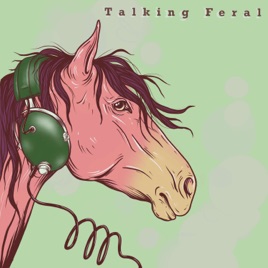
Advertise on podcast: Talking Feral
This podcast has
33 episodes
Language
EnglishPublisher
Paul BoyceExplicit
Yes
Date created
2020/11/20
Latest episode
2021/12/19
Average duration
74 min.
Release period
19 days
Description
Your host Paul Boyce, a biology PhD student, talks with guests about conservation, wildlife research, grad school and academia, science and policy and anything else in this conversation style podcast.
Unlock Talking Feral podcast Email contact info,
Listeners & Audience details
Email contact information
Direct podcast contact details

Listeners
Audience numbers & engagement insights

Audience details
Podcast Insights

Podcast episodes
Check latest episodes from Talking Feral podcast
Phillip Vannini - What, Where, and When is Wild?
2021/12/19
Phillip Vannini is a professor and ethnographer at Royal Roads School of Communication and Culture. His recent work includes the documentary film Life off Grid, and the book (and documentary film) Inhabited, Wildness and the Vitality of the Land. This recent work centers around concepts of wilderness, wildness, and wild, and how these mean different things depending on who you ask where, and when. We spoke about these concepts and what they mean for wildlife and resource management, and peoples relationship with the natural world. We also spoke about ethnographic work, and the role this plays in understanding our interactions with animals and ecosystems.
Check out more at www.talkingferal.com
Inhabited film
www.inhabitedfilm.ca
Sally Gepp - The Environment in the Eyes of the Law
2021/11/09
Sally Gepp is an environmental lawyer and has practises as a barrister sole in New Zealand. She worked for nine years with environmental NGO Forest & Bird specializing in environmental law, and since 2019 has been working in environmental law independently. She has appeared as counsel in a number of high profile cases including in relation to the Ruataniwha Dam and the proposed the East-West Link highway development in Auckland. Sally was also a trustee of the Biodiversity Collaborative Group tasked by the Minister for the Environment with developing a draft National Policy Statement for Indigenous Biodiversity, and she is a member of the New Zealand Conservation Authority, and is President of the Resource Management Law Association.
We talked today about Sally's entry and motivation to study law as a means to effect environmental change. We spoke about the connection between policy and enacting environmental law, and the high-level proclamations we all make about environmental change. We spoke about her past and current environmental hearings on freshwater policy , about feral and domestic cats and their impact on dolphins, and how a lack of political courage can explain a lot about environmental inaction.
Check out more at www.talkingferal.com !
Eric Eaton - Field Guide for a Career Entomologist
2021/10/12
Eric R. Eaton is a writer and is author of Wasps: The Astonishing Diversity of a Misunderstood Insect (Princeton University Press, 2021), and the forthcoming Insectpedia (Princeton University Press, 2022). He is also lead author of the Kaufman Field Guide to Insects of North America (Houghton Mifflin Company, 2007), and co-author of Insects Did It First (Xlibris, 2018) with Gregory S. Paulson. He has contributed to several other books including Wild in the City: a guide to Portland’s natural areas (Oregon Historical Society Press, 2000); and has written articles about insects and other animals for Natural History, Birds and Blooms, Ranger Rick, Missouri Conservationist, and other magazines. Eric studied entomology at Oregon State University, and has worked as an entomologist at the University of Massachusetts (Amherst), Cincinnati Zoo, and Chase Studio, Inc., as well as on private contract for the Smithsonian Institution, and West Virginia Division of Natural Resources. Eric writes the blogs Bug Eric and Sense of Misplaced and as "Bug Eric" he has built a loyal following on social media (Facebook, Twitter, iNaturalist).
We speak about Eric's career trajectory as an entomologist which doesn't follow the typical academic route, we spoke about some our shared frustrations with academia and how it can impact your love and motivation for science, and of course, we spoke about wasps - about how and why they make us feel they way they do, about how interesting and diverse they are outside of yellow-jackets and hornets, and how we can learn to appreciate what we've been trained not to.
Bram Büscher - Conservation & Capitalism
2021/08/30
Dr. Bram Büscher is Professor and Chair of the Sociology of Development and Change group at Wageningen University and holds visiting positions at the University of Johannesburg and Stellenbosch University. His research looks at the political economy of environment and development, including in the politics of conservation, energy and extraction, ecotourism, new media, violence and social theory. He is the author of ‘The Truth About Nature. Environmentalism in the Era of Post-Truth Politics and Platform Capitalism and co-author of ‘The Conservation Revolution: Radical Ideas for Saving Nature Beyond the Anthropocene’ . He is also a senior editor of the journal Conservation & Society.
In this conversation we talk about the interaction between capitalism and conservation, and how the neoliberal fascination with growth influences our relationship with the natural world. We discuss the historical context of this ideology, the supply and demand approach to natural commodities including the green energy transition, and alternative ways we might relate to nature and the economy.
Check out more at www.talkingferal.com where you can support the podcast and listen to more episodes.
Rachel Engler-Stringer - Industrial Food and Our Future
2021/07/29
Dr. Rachel Engler-Stringer is an Associate Professor in the Department of Community Health and Epidemiology in the College of Medicine at the University of Saskatchewan and a researcher with the Saskatchewan Population Health and Evaluation Research Unit. She is currently the chair of the Saskatoon Food Council, has a doctorate in nutrition and her research interests include community food security, food environments and food access, food system sustainability, health promotion, and community-based and participatory research. We talk about many things in this wide ranging conversation including global food systems and the upscaling of industrial, mechanized food production following the second world war. We talk about how the distance between ourselves and our food has increased with the commodification of a few food staples, and the impact this has had on human and environmental health. We talk about food sovereignty and how food was used as a weapon during colonization, and about how our current food systems faces significant challenges and vulnerabilities in the context of climate change. We also discuss Dr. Engler-Stringer's current research into school food programs and how these can helps us re-connect with producing food, and create more sustainable, local food systems.
To support the podcast, be sure to leave a 5-star rating and review!
Chris Todd Pt2 - The Laurentian Collapse and Money for Grad Students.
2021/07/23
This episode is part 2 of a conversation with Dr. Chris Todd. We discuss the collapse of Laurentian University, graduate student funding and the economics of tertiary education, and the breadth of expectations for academic positions. Check out www.talkingferal.com for more information and extra content!
Willow Talk - The Roles We Play
2021/07/02
A short episode where I chat with my dog, Willow, about defining our roles in society with qualifications, finding the time to think in a doctorate of philosophy, and mechanistic conservation.
Chris Todd - Graduating to Department Head at the Birth of Covid
2021/06/21
Chris Todd is a Professor and Head of the Department of Biology in the College of Arts and Science at the University of Saskatchewan. He is a plant molecular biologist with a research program focusing on molecular mechanisms driving plant responses to biotic and abiotic stresses. Chris has been with the University of Saskatchewan since 2005 and is a winner of the College of Arts and Science Distinguished Teacher Award and the Provost’s Award for Outstanding Innovation in Learning. We spoke about his role as department head, a position which he took on a few months before the Covid-19 pandemic hit, about the transition to remote learning at a department level, and about his academic journey from freezing his fingers off as a hammer-hand in the Canadian winter, to department head of biology.
Clara Superbie - How do they do it in France?
2021/06/14
Clara Superbie is a PhD student in the McLoughlin lab in Population Ecology (University of Saskatchewan) where she works on understanding how caribou respond to predation pressure and resource availability in an environment largely dominated by wildfires. Clara grew up in France where she completed an undergrad in Biology at the University Paris-Saclay, and a master's degree in behavioural ecology at the University of Burgundy. We talk about undertaking PhDs as international students here in Canada, and that experience during a pandemic. We talk about scientists and expertise and where advocacy and expert opinion fit into science, and about the costs and relative pay-off we are hoping to see from undertaking this behemoth of a degree.
Jessica Hogan - Energy Justice, Comprehensive Exams, and Research Boredom.
2021/06/07
Jessica Hogan is a PhD student at the University of St Andrews in Scotland. Her research focuses primarily on energy justice and what is called distributional justice. She researches how costs and benefits are shared in new energy developments, and specifically aims to investigate how different community benefits may change the experience of the communities living with onshore wind energy. We chat about her PhD experience in the UK, and how this compares with the NA experience, about expertise and the publish or perish fire in academia, and about enjoying the work you do in the face of extreme pressure and monotony. Enjoy!
Michael P. Nelson - The Ethics of Managing Wilderness. Grief, Fatigue, and Fallacy.
2021/05/31
Michael Paul Nelson is an environmental scholar and professor of environmental ethics and philosophy at Oregon State University. His research and teaching focus is environmental ethics and philosophy including concepts of wilderness, the philosophy of ecology, hunting ethics and theories of environmental education. His work also spans topics in wildlife ecology and conservation biology addressing questions about science and advocacy and the philosophical work of Aldo Leopold. We spoke about the ethical basis for certain animal management and conservation research approaches, about Aldo Leopold and early conservation philosophy, and about how Michael ended up in his field. We also spoke about concepts of grief in ecology, the absence, but critical role, of philosophy in conservation and the natural sciences, and how the paradigms and frameworks that we become embedded in influence our scientific practice.
Dave Hansford - 1080 Poison and Wildlife Triage.
2021/05/24
Dave Hansford is a freelance writer, blogger, editor and photographer from New Zealand. He appears regularly in New Zealand Geographic magazine, where he also pens a science column, Life, and blogs regularly at www.nzgeo.com and www.radionz.co.nz/news. We spoke about his 2016 book Protecting Paradise, which investigated the debate, science, and political controversy around the use of the mammalian poison 1080 in New Zealand. We also spoke about the ambitious Predator Free 2050 plan in New Zealand that aims to remove a suite of introduced predators, using 1080 and other methods.
Podcast reviews
Read Talking Feral podcast reviews
Podcast sponsorship advertising
Start advertising on Talking Feral relevant audience podcasts
You may also like to advertise on these Podcasts

4.5240197
Last Days
TMZ

4.8651103
Valentine In The Morning Replay
104.3 MYFM (KBIG-FM)

4.51180492
The Canadian Gothic
CanadianGothic / Curiouscast
4.850598
On The Sofa with Colson, Jack and Ben
Audio Always

562543
Future of Fitness
Eric Malzone
4.8355408
Church on the Move Podcast
Church on the Move
4.8158218
Dan Kennedy's Magnetic Marketing Podcast
Russell Brunson

4.4153101
Mike Gallagher Podcast
Salem Podcast Network
4.8266440
The Construction Leading Edge Podcast
Todd Dawalt
4.8105100
Jake Ducey's 2nd Mind Podcast
Jake Ducey