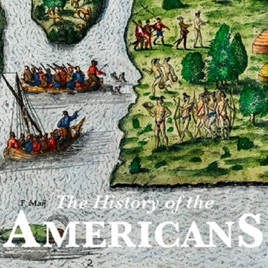
Advertise on podcast: The History of the Americans
Rating
4.9from
This podcast has
205 episodes
Language
EnglishPublisher
Jack HennemanExplicit
No
Date created
2021/01/01
Latest episode
2026/01/20
Average duration
45 min.
Release period
14 days
Description
The history of the people who live in the United States, from the beginning.
Unlock The History of the Americans podcast Email contact info,
Listeners & Audience details
Email contact information
Direct podcast contact details

Listeners
Audience numbers & engagement insights

Audience details
Podcast Insights

Podcast episodes
Check latest episodes from The History of the Americans podcast
Sidebar: Henry Knox and the Noble Train of Artillery Part 1
2026/01/20
Exactly 250 years ago, a rotund twenty-five year-old Boston bookseller named Henry Knox was riding his horse between Springfield and Worcester Massachusetts, on his way to George Washington’s headquarters in Cambridge. Washington’s ragtag, ill-equipped Continental Army had kept the British garrison under General Thomas Gage bottled up in Boston and Charlestown since the summer of 1675.
Washington had a whole load of problems, including insufficient arms for his men, many with expiring enlistments that threatened to shrink his force by half or more. He also had almost no artillery, just 12 small cannon that Henry Knox, among others, had learned to operate while training with the local militia.
Geographically, the Boston of that era was essentially a bubble of land connected to the mainland by an incredibly narrow neck at Roxbury. Two hills loomed over the city from across the water – Breed’s Hill in Charlestown to Boston’s north, which the British had captured at great cost in the summer, and Dorchester Heights, to Boston’s south, which the British had not captured.
This is why it was very important – world historically important – that Henry Knox, on that day exactly 250 years ago, was commanding a convoy of artillery comprising 58 pieces and weighing more than 60 tons, pulled on purpose-built sleds by teams of oxen and horses all the way from Fort Ticonderoga, 300 miles away, over rivers and the Berkshires, during the coldest winter in memory. Within just a few days those guns would be in Cambridge, and not long after that, on the sixth anniversary of the Boston Massacre, would be entrenched on Dorchester Heights and open fire on the city and ships below. Henry Knox’s big guns would drive the British from Boston, for good.
The tale of that “noble train” of artillery, as Knox famously referred to it, is one of the more astonishing stories of military innovation, indefatigable perseverance, and inspired leadership in a war that had more than its share of such moments. It was also among the most important, because it came at a desperate period when the Americans needed a victory or the entire project of the Revolution might have fallen apart.
Map of Boston in 1775:
Subscribe to my Substack!
X – @TheHistoryOfTh2 – https://x.com/TheHistoryOfTh2
Facebook – https://www.facebook.com/HistoryOfTheAmericans
Primary references for this episode (Commission earned for Amazon purchases through the episode notes on our website)
William Hazelgrove, Henry Knox’s Noble Train: The Story of a Boston Bookseller’s Heroic Expedition That Saved the American Revolution
Thomas M. Campeau, Major, U.S. Army, “The Noble Train of Artillery: A Study Comparison of Current Doctrinal Concepts of the Mission Command Philosophy in History.” (Master’s thesis, pdf)
Alexander C. Flick, “General Henry Knox’s Ticonderoga Expedition,” The Quarterly Journal of the New York State Historical Association, April 1928.
Bacon’s Aftermath 2: Restless Virginia and the Rise of Black Slavery
2026/01/06
In the last episode on the Timeline, “Bacon’s Aftermath 1: Diplomacy and Conspiracy 1677-1685,” we looked at the political and geopolitical aftermath of Bacon’s Rebellion. This time we tackle the changes inside Virginia’s society and economy in the years following Bacon’s Rebellion, some of which may have been because of the Rebellion, and others of which probably would have happened anyway.
The first half of the episode looks at the governorship of Thomas, Lord Culpeper, and his deft efforts to give effect to the Crown’s desire “to substitute the benevolent despotism of the king for the rapacious local despotism that had brought on one rebellion and threatened to bring on another.” In the second half, we consider the rise of Black slavery in Virginia and the decline of indentured servitude in the quarter century following Bacon’s Rebellion, the economic foundations of the shift, and the untended and somewhat surprising social consequence that by the early 18th century Virginia was a much more stable society than it had been when it had depended on English indentured servants.
My Substack
X – @TheHistoryOfTh2 – https://x.com/TheHistoryOfTh2
Facebook – https://www.facebook.com/HistoryOfTheAmericans
Primary references for this episode (Commission earned for Amazon purchases through the episode notes on our website)
Edmund S. Morgan, American Slavery, American Freedom
John C. Coombs, “The Phases of Conversion: A New Chronology for the Rise of Slavery in Early Virginia,” The William and Mary Quarterly, July 2011.
“An Act Concerning Servants and Slaves” (Virginia, 1705)
Sidebar Conversation: Matthew Restall on "The Nine Lives of Christopher Columbus"
2025/12/21
Matthew Restall is an historian and author of over forty books, focusing on the Spanish Conquest era in the Americas; on Aztec and Maya history; on the history of colonial Mesoamerica, primarily Yucatan but including Mexico, Guatemala, and Belize; on the historical African diaspora in the Americas; and on the history of popular music. Matthew is most recently the author of The Nine Lives of Christopher Columbus, the topic of and inspiration for this conversation. Finally, he is Edwin Erle Sparks Professor of History and Anthropology, and Director of Latin American Studies, at Pennsylvania State University.
We discussed the phenomenon of “Columbiana,” the vast mythology that has befogged the history and biography of Christopher Columbus, the man, almost entirely for purposes that he himself would not have understood. His book, which I quite recommend, addresses nine such “lives” and the historical mysteries around them. We touch on the four of those that I thought would most appeal to longstanding and attentive listeners – his early life and his pitching for the funding for the “Enterprise of the Indies” – which are the first two lives, and the curious resurrection of Columbus in the 19th century as the founding “grandfather” of the United States, followed by his last “life” – so far – as the great hero of Italian-Americans. This last leads to a discussion of the perception of Columbus today. Along the way we go down numerous rabbit holes, including that there is, even today, a direct descendant of Columbus who bears the title “Admiral of the Ocean Sea.”
Other relevant links
Matthew Restall, The Nine Lives of Christopher Columbus
History Impossible Podcast, “War for the Frontiers of History and America (w/ Jack Henneman of The History of the Americans)”: Apple and Spotify
Samuel Eliot Morison, Admiral of the Ocean Sea: A Life of Christopher Columbus
X – @TheHistoryOfTh2 – https://x.com/TheHistoryOfTh2
Facebook – https://www.facebook.com/HistoryOfTheAmericans
Bacon’s Aftermath 1: Diplomacy and Conspiracy 1677-1685
2025/12/05
This episode looks again at the causes of Bacon’s Rebellion in light of what we have now learned, before turning to the region of the Chesapeake in the years after the Rebellion.
There are two big themes in the post-Bacon Chesapeake. The first, the subject of this episode, is geopolitical. After Bacon, what changed in intercolonial affairs, in the relationship between the Chesapeake colonies and England, and between those colonies and the indigenous nations? The second theme, for part 2, is essentially domestic. How did Virginia itself change politically, economically, and socially, with a special emphasis on the terms of labor and the types of people performing it?
Along the way we look at the crazed conspiracy theories that roiled not only Virginia and Maryland, but England, how they affected the various protagonists, led to the negotiation of the “Covenant Chain” between the Iroquois and New York and the other English colonies of North America, and how the end of Bacon’s Rebellion unleashed explosive growth of the trade in enslaved Indians from the Carolinas and points south.
My Substack
Check out the new merch store!
X – @TheHistoryOfTh2 – https://x.com/TheHistoryOfTh2
Facebook – https://www.facebook.com/HistoryOfTheAmericans
Selected references for this episode (Commission earned for Amazon purchases through the episode notes on our website)
James D. Rice, Tales from a Revolution: Bacon’s Rebellion and the Transformation of Early America
Wilcomb E. Washburn, The Governor and the Rebel: A History of Bacon’s Rebellion in Virginia
Edmund S. Morgan, American Slavery, American Freedom
Josias (Josiah) Fendall
Other episodes mentioned
Notes on Virginia 1644-1675
The Free County of Albemarle
Rogues and Dogs and Fendall’s Rebellion
Bacon's Rebellion 6: Recriminations
2025/11/19
It is late January 1677 in Virginia. Loyalists under the command of Governor Sir William Berkeley had suppressed Bacon’s Rebellion just after New Year. Now Berkeley was prosecuting the surviving leaders of the rebellion, and loyalist units were looting the estates of wealthy Baconistas to recover losses they had suffered during the war.
Then a fleet from London materialized at the mouth of the James, carrying three royal commissioners and a thousand “red coats,” English regular infantry. Their mission, per Charles II, was to suppress the rebellion – which Berkeley and his supporters had already done – and to discover the root causes of the rebellion. They were not prepared to intervene in a peace they had not fought for, which peace Berkeley was determined to shape to the advantage of his faction. Berkeley’s first interest was in justice for himself and his allies, the loyalists who had defended the government of the Crown; the commissioners were focused on the fiscal priorities of the Crown, and were therefore intent on moving beyond the war – bygones – and getting Virginia back to the important work of growing tobacco.
There would be consequences.
My Substack
Check out the new merch store!
X – @TheHistoryOfTh2 – https://x.com/TheHistoryOfTh2
Facebook – https://www.facebook.com/HistoryOfTheAmericans
Selected references for this episode (Commission earned for Amazon purchases through the episode notes on our website)
James D. Rice, Tales from a Revolution: Bacon’s Rebellion and the Transformation of Early America
Wilcomb E. Washburn, The Governor and the Rebel: A History of Bacon’s Rebellion in Virginia
Charles McLean Andrews, Narratives of the Insurrections, 1675-1690
Edmund S. Morgan, American Slavery, American Freedom
Stephen Saunders Webb, 1676: The End of American Independence
Wilcomb E. Washburn, Review of Webb, 1676: The End of American Independence, Pacific Historical Review, May 1985.
John M. Murrin, Review of Webb, 1676: The End of American Independence, The William and Mary Quarterly, January 1986.
Bacon’s Rebellion 5: Bacon’s Lousy Luck
2025/10/24
Last episode ended with Sir William Berkeley, on the deck of a ship in the James, watching Jamestown burn to the ground in the wee hours of September 19, 1676. The rebels under Nathaniel Bacon were ascendant, and Berkeley resolved to return to his refuge on the Eastern Shore and plot the next phase of his increasingly desperate war. Little did he know that the tide of the war was about to turn again in his favor.
This episode begins in London in the summer of 1676, where Crown officials were just beginning to figure out what to do about the turmoil in Virginia, over which they had incomplete and very emotional news. Charles II made some decisions with long-term consequences for Virginia.
At about the same time, in a stroke of luck – good or bad, depending on one’s point of view – Bacon died rather horribly. He had done a good job building an organization with an orderly succession plan, but the rebellion had lost its most charismatic leader.
A few weeks before Bacon died, at the end of September, the first of several armed merchant ships arrived in the Chesapeake, and after learning about the revolt their captains pledged their service to Berkeley. They would provide crucial support in an amphibious war against rebels along the James and York rivers. One of the captains, Thomas Grantham of the powerful 500-ton Concord, emerged as a courageous and wise diplomat, and would do more than anyone to end the rebellion in early January, 1677.
At the end of the war, Berkeley mopped up, and prosecuted and executed most of the leaders of the rebellion. Richard Lawrence, however, disappeared, and was never seen again.
The episode ends with the arrival of royal commissioners and a thousand English regular infantry at the end of January, which would be more bad news for Sir William Berkeley.
My Substack
Check out the new merch store!
X – @TheHistoryOfTh2 – https://x.com/TheHistoryOfTh2
Facebook – https://www.facebook.com/HistoryOfTheAmericans
Selected references for this episode (Commission earned for Amazon purchases through the episode notes on our website)
James D. Rice, Tales from a Revolution: Bacon’s Rebellion and the Transformation of Early America
Wilcomb E. Washburn, The Governor and the Rebel: A History of Bacon’s Rebellion in Virginia
Charles McLean Andrews, Narratives of the Insurrections, 1675-1690
Robert Beverley, The History and Present State of Virginia
Bacon’s Rebellion 4: The Burning of Jamestown
2025/10/17
Virginia Governor Sir William Berkeley has fled to the Eastern Shore with a small group of loyalist planters and a detachment of perhaps only fifty armed men. Nathaniel Bacon has occupied Berkeley’s estate near Jamestown, and dispatched men to capture loyalist ships anchored there. Bacon’s “navy” has out in search of Berkeley, but Berkeley turned the tables in an audacious amphibious attack and grabbed control of the Bay and the rivers. While Bacon was mucking around in the Dragon Swamp hunting notionally allied Pamunkeys, Berkeley recaptured Jamestown. Loyalist victory seemed at hand, but Bacon forced Berkeley to retreat from Jamestown a second time in part by grabbing the wives of loyalist planters and using them as human shields, and this time the rebels burn it to the ground.
At the end of the episode, it appears that the rebels had the upper hand. Little did they understand that the loyalist cause was far from lost, and the rebellion was, unbeknownst to anybody, on the brink of disaster.
My Substack
Check out the new merch store!
X – @TheHistoryOfTh2 – https://x.com/TheHistoryOfTh2
Facebook – https://www.facebook.com/HistoryOfTheAmericans
Selected references for this episode (Commission earned for Amazon purchases through the episode notes on our website)
James D. Rice, Tales from a Revolution: Bacon’s Rebellion and the Transformation of Early America
Wilcomb E. Washburn, The Governor and the Rebel: A History of Bacon’s Rebellion in Virginia
Various authors, for the National Park Service, “Mapping the Dragon:
AN INDIGENOUS HISTORY OF BACON’S REBELLION” (pdf)
Charles McLean Andrews, Narratives of the Insurrections, 1675-1690
Bacon’s Rebellion 3: Go Ahead, Shoot!
2025/10/06
Nathaniel Bacon and his army of volunteers have returned from beating up on the friendly Occaneechees (Occaneechis) on the Roanoke River in southern Virginia. It is election day, and Henrico County will elect Bacon and his sidekick, James Crews, to the Virginia Assembly, which has been called into session on June 5, 1676. This episode describes the dramatic session of that Assembly, which began with Bacon’s arrest and ended with he and his army holding the Assembly at gunpoint. Sir William Berkeley, governor of Virginia, demonstrates his own flair for the dramatic along the way, but by the end of this episode has taken refuge with other loyalists on Virginia’s Eastern Shore.
Oh, and there is a “manifesto.” Never a good sign.
Check out the new merch store!
My Substack
X – @TheHistoryOfTh2 – https://x.com/TheHistoryOfTh2
Facebook – https://www.facebook.com/HistoryOfTheAmericans
Selected references for this episode (Commission earned for Amazon purchases through the episode notes on our website)
James D. Rice, Tales from a Revolution: Bacon’s Rebellion and the Transformation of Early America
Wilcomb E. Washburn, The Governor and the Rebel: A History of Bacon’s Rebellion in Virginia
Matthew Kruer, Time of Anarchy: Indigenous Power and the Crisis of Colonialism in Early America
Nathaniel Bacon, “Declaration of the People,” July 30, 1676
Nathaniel Bacon, “Bacon’s Manifesto,” July 1676
Bacon’s Rebellion 2: The Susquehannocks Strike Back
2025/09/25
The Susquehannocks, having successfully escaped from their beseiged fort on Piscataway Creek in Maryland, fled through the Virginia Piedmont to set up winter quarters on the James and Roanoke Rivers. In January 1676, they launched a measured counterattack. The settlers on the frontier panicked and evacuated. Rumors of war spread. The horrors of King Philip’s War loomed large, especially in the thinking of Sir William Berkeley, the governor. A fundamental debate over how to respond to those Susquehannock attacks set up the confrontation between Nathaniel Bacon and his populist – and it should be said, hard-drinking – frontiersmen on the one hand, and Berkeley and his loyalist supporters on the other. Along the way we consider Governor Berkeley’s background and the experiences that shaped him, and the political challenges that he now confronted. The episode ends with Bacon’s massacre of the Occaneechees (Occaneechis), heretofore allies of Virginia, on their island in the Roanoke River.
Check out the new merch store!
X – @TheHistoryOfTh2 – https://x.com/TheHistoryOfTh2
Facebook – https://www.facebook.com/HistoryOfTheAmericans
Selected references for this episode (Commission earned for Amazon purchases through the episode notes on our website)
Matthew Kruer, Time of Anarchy: Indigenous Power and the Crisis of Colonialism in Early America
Edmund S. Morgan, American Slavery, American Freedom
James D. Rice, Tales from a Revolution: Bacon’s Rebellion and the Transformation of Early America
Wilcomb E. Washburn, The Governor and the Rebel: A History of Bacon’s Rebellion in Virginia
Various authors, for the National Park Service, “Mapping the Dragon:
AN INDIGENOUS HISTORY OF BACON’S REBELLION” (pdf)
Bacon’s Rebellion 1: The Case of the Repossessed Hogs
2025/09/15
The year is 1675, and we are in Virginia. All kinds of social, demographic, fiscal, and economic pressures have been building for decades, and the common people are restive. There have been a string of small revolts and disruptions in the years since 1660, but they all failed for lack of effective leadership. The “masterless men” in the colony needed a leader, and the leader, when he arose, would need a cause.
Nathaniel Bacon, a ne’er do well son of a wealthy gentleman in English, would be that leader. He arrived in Virginia in 1674 with a fat bankroll, sent there by his father after he got in a scrape with the law. By 1675 he owned two plantations, one of them at the falls of the James River, just at the edge of Indian country.
The spark that would set off the chain of events that would lead to Nathaniel Bacon stepping forward as the leader of a rebellion would be the theft of some hogs by Indians in Northern Virginia who had been stiffed for payment in an ordinary trading transaction. The English colonials would blow their response, and blunder into war. Waging that war would be Nathaniel Bacon’s cause.
Check out the new merch store!
X – @TheHistoryOfTh2 – https://x.com/TheHistoryOfTh2
Facebook – https://www.facebook.com/HistoryOfTheAmericans
Map of relevant indigenous nations c. 1675 (Credit Matthew Kruer) :
Selected references for this episode (Commission earned for Amazon purchases through the episode notes on our website)
Matthew Kruer, Time of Anarchy: Indigenous Power and the Crisis of Colonialism in Early America
Edmund S. Morgan, American Slavery, American Freedom
James D. Rice, Tales from a Revolution: Bacon’s Rebellion and the Transformation of Early America
Wilcomb E. Washburn, The Governor and the Rebel: A History of Bacon’s Rebellion in Virginia
Charles McLean Andrews, Narratives of the Insurrections, 1675-1690
Notes on Virginia 1644-1675
2025/09/02
We are back in Virginia, finally! In my defense, offered in response to the many listeners who have asked for “more Virginia,” the thirty years before the Third Anglo-Powhatan War and Bacon’s Rebellion are almost blank spaces on published timelines of Virginia history, most noting only the legalization of slavery in 1661. Well, we are now on the brink of the civil war known as Bacon’s Rebellion, which was ramping up as the tide was turning in King Philip’s War in the spring of 1676. To understand that sorry state of affairs, however, we have to step back and look at the evolution of Virginia in the years between 1644, the onset of the last Anglo-Powhatan War, and 1675. How was it that civil war broke out among the English of Virginia during the tumultuous 1670s? This episode explores the root causes of the civil instability that led to Bacon’s Rebellion, and will therefore be more thematic than narrative. Along the way we consider the severe gender imbalance in Virginia, the sorry state of indentured servants, the persistance of a brutally high death rate into the second half of the century, the relentless efforts of Virginia’s great planters to control the growing population of “masterless men” who roamed the colony, and the arrival in the region of the Susquehannocks, much reduced from the peak of their power mid-century, but still a formidable military force.
Check out the new merch store!
X – @TheHistoryOfTh2 – https://x.com/TheHistoryOfTh2
Facebook – https://www.facebook.com/HistoryOfTheAmericans
Selected references for this episode (Commission earned for Amazon purchases through the episode notes on our website)
Edmund S. Morgan, American Slavery, American Freedom
Matthew Kruer, Time of Anarchy: Indigenous Power and the Crisis of Colonialism in Early America
“The Sadder But Wiser Girl For Me” (YouTube)
Augustine Herrman's Map
2025/08/08
I got the idea for this episode talking to a bartender in Prague. The place was empty, and the fellow was garrulous and quickly said he loved American history, which naturally prompted me to suggest a podcast where he could find some. The barkeep called my bluff – “did I know who Augustine Herrman was?” Uh, noooo.
It turns out he was a Bohemian – now we would say Czech – from Prague who became one of the wealthiest and most influential men in mid-17th century English and Dutch America, particularly in New Netherland and Maryland. He would live and trade in the early colonies for more than 40 years before his death in Maryland in 1686, and such diverse characters as Pieter Stuyvesant and Lord Baltimore would rely on him for their most sensitive diplomatic matters. Most famously, Herrman would draw the most detailed map of the Chesapeake Bay, at a time when maps were evidence in the settling of disputes between empires. Hermann’s map would, among other things, determine the border between Virginia and Maryland on the Eastern Shore, and – through twists and turns – play a role in the establishment of the colony of Delaware. The Czechs are understandably proud of Augustine Herrman, so in gratitude to that bartender and his surprising knowledge of 17th century America, this episode is about Herrman, through the story of his map.
Augustine Herrman’s Map:
Augustine Herrman’s woodcut of New Amsterdam, mid 1650s:
X – @TheHistoryOfTh2 – https://x.com/TheHistoryOfTh2
Facebook – https://www.facebook.com/HistoryOfTheAmericans
Selected references for this episode (Commission earned for Amazon purchases through the episode notes on our website)
Earl L. W. Heck, Augustine Herrman: Beginner of the Virginia Tobacco Trade, Merchant of New Amsterdam and First Lord of Bohemia Manor in Maryland
Christian J. Koot, “The Merchant, the Map, and Empire: Augustine Herrman’s Chesapeake and Interimperial Trade, 1644–73,” The William and Mary Quarterly, October 2010.
Sidebar Conversation: Phil Magness on The 1619 Project
2025/07/28
Listen on Apple Podcasts
Listen on Spotify
Dr. Phillip W. Magness is an economic historian and the David J. Theroux Chair in Political Economy at the Independent Institute. Magness’ research has appeared in multiple scholarly venues, including the Economic Journal, the Journal of Political Economy, the Journal of Business Ethics, the Southern Economic Journal, and Social Science Quarterly. He is the author of several books including, most recently, The 1619 Project Myth, which is the subject of this conversation.
Our conversation was wide-ranging, including an overview of the original 1619 Project of the New York Times, conceived of and edited by Nikole Hannah-Jones; how it was a departure from similar historical projects of the Times before it; the strengths of the 1619 Project; the particular shortcomings of the Project’s claims about the economic consequences of slavery; the attempt by the 1619 Project to tie slavery to capitalism; the actual anti-slavery origins of capitalist theory, starting with Adam Smith; the anti-capitalism ante-bellum arguments in the philosophical defense of slavery; the flawed scholarship of the “New History of Capitalism” school; the Project’s distortion of the importance of cotton to the American economy before the Civil War, and the strange rehabilitation of “King Cotton” theory; the criticisms of leading historians of the colonial and revolutionary era of Hannah-Jones’s claims about the importance of slavery to support for the American Revolution in the South; the status of the “20 and odd” enslaved Blacks who were brought to Jamestown in 1619; the varied influence of the Sommersett ruling in the colonies; Lord Dunmore’s famous declaration after the American Revolution had begun; Hannah-Jones’s dismissive response to academic criticisms of her claims; that Hannah-Jones was correct in her assessment of Abraham Lincoln’s advocacy of “colonization” as a solution to emancipation; the New York Times’s strange unwillingness to correct its 1619 Project errors transparently, as it would otherwise do in other contexts; the explicit political and policy agenda behind the 1619 Project; the slow walking-back of some of the Project’s most controversial claims via ghost-editing; the insertion of The 1619 Project in public school curricula; and how to develop a school history curriculum that does give a balanced treatment of the history of slavery and Reconstruction.
X – @TheHistoryOfTh2 – https://x.com/TheHistoryOfTh2
Facebook – https://www.facebook.com/HistoryOfTheAmericans
Selected references for this episode (Commission earned for Amazon purchases through the episode notes on our website)
Philip W. Magness, The 1619 Project Myth
Nikole Hannah-Jones and other authors, The 1619 Project: A New Origin Story
An interview with historian James McPherson on the New York Times’ 1619 Project
An interview with historian Gordon Wood on the New York Times’ 1619 Project
Philip W. Magness, “The 1619 Project Unrepentantly Pushes Junk History”
Jake Silverstein, New York Times Magazine, “We Respond to the Historians Who Critiqued The 1619 Project” (free link)
King Philip's War 9: Aftermath
2025/07/24
This is the last episode of our telling of King Philip’s War. We cover the fate of the last Algonquian sachems, including the daring capture of Annawon, and the consequences of the war for the Indians who fought it and the colonies of New England. We consider the wisdom of the war, and especially the morality, or lack thereof, in the fighting of it. Finally, we explore the fates of the main characters who were still alive at the end of the fighting.
[Errata: Sam from Marietta, Georgia points out that in referring to the marker on Benjamin Church’s gravestone I said it was a Ranger tag, and it should be a “tab.” Good correction, insofar as I don’t need a lot of Rangers rolling their eyes, or worse.]
X – @TheHistoryOfTh2 – https://x.com/TheHistoryOfTh2
Facebook – https://www.facebook.com/HistoryOfTheAmericans
Selected references for this episode (Commission earned for Amazon purchases through the episode notes on our website)
Lisa Brooks, Our Beloved Kin: A New History of King Philip’s War
James D. Drake, King Philip’s War: Civil War in New England, 1675-1676
Nathaniel Philbrick, Mayflower: Voyage, Community, War
Matthew J. Tuininga, The Wars of the Lord: The Puritan Conquest of America’s First People
Daniel Gookin (Wikipedia)
King Philip's War 8: The Defeat of the Algonquians
2025/07/14
Maps of New England during King Philip’s War
In May 1676 the tide of King Philip’s War had turned against the Algonquians of southern New England, but the New English settlers didn’t know it yet. They would soon. Suddenly, in a matter of a few weeks, the Algonquian resistance collapsed. This episode looks at that collapse through the eyes of Benjamin Church, whose men would finally catch and kill Metacom on August 12, 1676. Along the way, Church would persuade the Sakonnets, a Wampanoag group, to switch sides. They would teach him a new way of war, and Church would eventually be considered the “first American ranger,” at least by people who haven’t thought to give that credit to Nompash, the Sakonnet commander who taught Church.
X – @TheHistoryOfTh2 – https://x.com/TheHistoryOfTh2
Facebook – https://www.facebook.com/HistoryOfTheAmericans
Regicides on the Run!
Selected references for this episode (Commission earned for Amazon purchases through the episode notes on our website)
Thomas Church, The History of Philip’s War: Commonly Called the Great Indian War, of 1675 and 1676
Nathaniel Philbrick, Mayflower: Voyage, Community, War
Matthew J. Tuininga, The Wars of the Lord: The Puritan Conquest of America’s First People
Eric B. Schultz and Michael J. Tougias, King Philip’s War
Lisa Brooks, Our Beloved Kin: A New History of King Philip’s War
Podcast reviews
Read The History of the Americans podcast reviews
Ive & kiiikiii luvr 2026/01/14
Comprehensive, yet easy to digest while working or busy, host is amazing and love the subject matter
I knew in the intro ep, once I heard the host say he wanted to make an American version of the History of England podcast, that I would love this! His...
BiochemistryFan 2026/01/06
A Fascinating Journey!
Jack Henneman is a masterful storyteller with a great sense of humor and a tremendous gift for narrating history in a compelling and fascinating way. ...
jjr0505iii 2026/01/05
Just really well done
I don’t listen to podcasts. Except this one. Really a perfect listen if you want to learn about the country’s history and also be entertained. Than...
Dontdrinkbleach 2025/11/23
Amazing
Amazing
Highly recommend 787 2025/11/13
No presentism!
Love this podcast. Jack does an excellent job with his research and story telling. I appreciate he doesn’t try to judge people of the past as good ...
The7Expats 2025/11/10
“History always begins in the middle of something”
Having recently caught up on the podcast, I can now confidently comment as a long time and attentive listener.
Beginners can start from the beginnin...
BDG of Elko 2025/10/31
A true yeoman’s work
Thank you, oh thank you Jack Henneman! You are a credit to your guild.
I first learned about tHotA while listening to one of the many, marvelous, if ...
JCJDC 2025/10/25
Fantastic and engaging
Great podcast, intelligent and engaging host.
.r teco 2025/10/14
American History Deep Dive without presentism
Jack Henneman is doing the most absurdly engaging telling of American History. Jack is not himself a historian, the story is told based on (disclosed)...
JavaLavaJoe 2025/10/08
Exceptionally Engaging!
The mark of a great story teller is the ability to make the story come alive. Dusty history tomes don’t inspire curiosity…Jack does. I cannot more hig...
Podcast sponsorship advertising
Start advertising on The History of the Americans relevant audience podcasts
You may also like to advertise on these Podcasts

4.9231330
I'll Call You Right Back Podcast
Chad Medved

3.2147141
Tom Myers vs. the Rest of The World
Tom Myers

4.717948
Walk Softly Children
Jessica Fritz-Aguiar

4.93523
The PhD Mommy's Journey
Bridgette Ojo
4.717273
The Band: A History
The Band: A History

4.854525
JR SportBrief
Audacy
561166
The Yoga Heart Mind Podcast
Stuart and Jo
4.235496
Plodding Through The Presidents
Howard & Jessica Dorre

5210123
Who's Driving
Wesley Turner

4.7181200
Voices of VR
Kent Bye