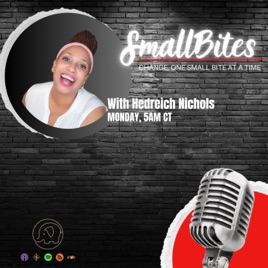
Advertise on podcast: #SmallBites
Rating
5from
This podcast has
120 episodes
Language
EnglishPublisher
Hedreich NicholsExplicit
No
Date created
2021/01/03
Latest episode
2023/11/13
Average duration
9 min.
Release period
19 days
Description
Start your week Mondays with 5 strategies in 5 minutes at 5AM central to help you become a more impactful educator. With these "small bite" strategies, author and educator Hedreich Nichols gives you actionable steps for creating better and more equitable learning experiences. If you have 5 minutes, you can do something NOW to become a better educator for all of your students. Don't try to do everything, just do something. How do you eat an elephant? One small bite at a time! Get the links at https://hedreich.com/. Support this podcast: https://podcasters.spotify.com/pod/show/hedreich/support
Unlock #SmallBites podcast Email contact info,
Listeners & Audience details
Email contact information
Direct podcast contact details

Listeners
Audience numbers & engagement insights

Audience details
Podcast Insights


Podcast episodes
Check latest episodes from #SmallBites podcast
AI Ain't The Enemy
2023/11/13
When most teachers I talk to about AI speak of it only as something to block or disallow to keep students from cheating, I understand this knee-jerk reaction. Every new technology is met with resistance...before it weaves its way into main stream use. Cars over buggies, planes over cars, search engines over encyclopedias and now AI over life as we've known it.
Thinking of using a machine to handle simpler tasks in education is a huge paradigm shift. However, it's a shift that has already been made. The question is, are we preparing our students for a future with AI tools, or are we preparing them for jobs that AI may replace by the time they hit the job market?
Do you want to be the teacher that keeps your students from mastering tools that competing college and job applicants will be using? Or do you want to be the one who ensures that your students have every tool possible at their disposal? Assuming the latter, this is your "start here":
Matt Miller's resources on AI
My Edutopia article on AI and similar tools.
Open a free Chat GPT account
AI is not the enemy. It is simply a tool that we can learn to use efficiently like any other tool. Yes, you can smash your thumb with a hammer or lose a finger with a table saw. But we don't avoid using them, we simply learn to use them with care. Happy AIing and SmallBites will see you in the new year!
---
Send in a voice message: https://podcasters.spotify.com/pod/show/hedreich/message
Support this podcast: https://podcasters.spotify.com/pod/show/hedreich/support
Educator Encouragement
2023/11/06
The saying goes, "there's no tired like teacher tired." Teachers have exhausting schedules, and if you've ever time stamped a teacher day, you'll know that a teacher day is simply impossible to get through in a day. That feeling is not confined to the classroom. For those of us who have deeply held beliefs about what a student-centered school environment looks like, feels like and ignites learning like, education can be tough, whatever the role.
I am humbled at how incremental the change is in the grand scheme of things. That humility makes me want to cry into a glass of milk. That humble place is also a place of remembering: “Define Your Why“, as author and educator Barbara Bray says. Either I believe that I can be an agent of change one small bite at a time, or I don’t. The system needs to change, that’s why I do what I do. And so, I’ll dry my tears and start over. Because futility and hopelessness are just not an option.
Care for a few ideas to help get you through? Read on.
Encouragement from @DorisASantoro – Rise up with strategies and information on burnout vs. teacher demoralization in this Edweek article that helps you understand what you’re dealing with and how to deal with it.
Encouragement from @PlanBookCom – Rise up, if you’ve decided that burnout is where you’re heading, with these strategies from PlanBook and don’t be afraid to reach out for help.
Encouragement from @Angela_Watson – Rise up and Say goodbye to Teacher Tired with this article and resources from Angela Watson. I learned about her 40 hour work week resources from Cult of Pedagogy. Some resources are paid, but even the free ones will revolutionize the way you spend your time.
Encouragement from @weareteachers – Rise up and giggle. Sometimes, laughter is the best medicine, and we teachers are a funny lot! Start here then follow them on Twitter and Instagram. Cause, when you run out of tears, sometimes all you can do is laugh.
Encouragement from M.L. Brown – If laughter and strategies no longer work, rise up with this Medium article from an educator who decided that enough was enough. For those who have made that decision, let’s be supportive, knowing that sometimes, enough really is enough.
Note: This episode is a rebroadcast of SmallBites LIVE: Fighting Feelings of Futility
---
Send in a voice message: https://podcasters.spotify.com/pod/show/hedreich/message
Support this podcast: https://podcasters.spotify.com/pod/show/hedreich/support
Be a Better Teacher in 45 Hours Weekly
2023/10/30
Wellness in educational spaces has become a trend that, while important, often falls flat in practice.That may be because teachers and administrators tend to forget that they have to actually make use of the time and tools given. Refilling your proverbial cup is the only way to ensure personal success and success for those in your
charge.
Good quality teaching is dependent on you being
consistently rested and regulated for the classroom day. Similarly for administrators who balance many different types of duties daily, being well-rested and well-regulated is key to building a campus culture conducive to academic, emotional, and social success.
Consider using the 8-8-8 rule and an Eisenhower matrix to prioritize tasks. The 8-8-8 rule divides your day into 8 hours of work, 8 hours of sleep and 8 hours of personal time spent on self-care, friends, family, hobbies, etc. An Eisenhower matrix can help you decide whether a task has to be done now, can be scheduled for later
or delegated. With practice, these tools will become a natural part of your daily planning.
Once you have a general idea of how you will prioritize your tasks, do these 5 things to ensure that you get the most out of your day without constantly working over a healthy capacity:
1. Decide how many hours you will work in a week. And then keep to it. My magic number was 45.
2. Delegate. Empower students. Have them manage the objective board, attendance, station timers and anything else that will give them a sense of ownership and responsibility.
3. Co-create with your students. For example, using student created review and test prep materials on Edpuzzle or Quizlet can build student confidence, skill, and capacity; and save you teacher time.
4. Stop using paper. Using an LMS like Google Classroom (or Canvas or Schoology if your district is so inclined) saves time and resources. Copier broken? Out of paper? No name papers? Make-up work? Put it all online. Create digital worksheets. Better yet, pay a niece, nephew or other older tech savvy student in your circle to do it for you. The time you take to do this ONCE will save you time all year so you can use you planning time to plan--and maybe even go to the restroom.
5. Go outside. This seems like a waste of time BUT research tells us that natural light boosts concentration, mood, energy and helps alleviate eye fatigue and headaches that come with florescent and computer screen lighting.
Putting in long hours can feel rewarding, but if you aren’t being smart about balancing that work time with other activities, you’ll suffer and so will the students and staff you serve. If you love what you do and love who you are doing it for, love them enough to practice work-life balance in earnest. Yes, some ‘important’ things may go undone, they sometimes do. But rest and recharging do not belong on the "do it tomorrow" list. Ever.
---
Send in a voice message: https://podcasters.spotify.com/pod/show/hedreich/message
Support this podcast: https://podcasters.spotify.com/pod/show/hedreich/support
Nostalgic Narratives and Native American History
2023/10/23
As we approach November when the country highlights the histories of Indigenous Peoples of North America, it's fitting that Martin Scorsese's Killers of the Flower Moon, based on the book by David Grann, calls our attention to the heinous crimes committed against the Native American Community. In contrast to the narratives many of us have grown up with that cast the "Injuns" and "Red Man" as savages and bad guys, this movie highlights the deception and murder, as well as the racial jealousy that we've begun to see in Black historical films, but that are still new themes in films about Native American Narratives.
The fact is, if you grew up learning "Columbus sailed the ocean blue..." or singing the famed Disney line, "Why does he ask you 'how'?" then there are probably a lot of nostalgic moments involving beloved relatives that are hard to let go of. And thinking of heroic leaders as the same people who forcibly removed and killed millions of people to get their land is difficult to process. But if we want to grow and be better as a nation, doing the next right thing starts with acknowledging and teaching the truth to the next generations.
Here are resources to help you further explore narratives that should have been amplified long ago.
Watch The Osage Murders from the 2022 PBS Short Film Festival to hear the story of the Osage murders told from the Osage perspective.
Explore and support cultural endeavors in Native American Communities by listening, watching reading or donating.
Watch movies and clips written and produced by indigenous voices.
https://native-land.ca/.
Join the Smithsonian's National Museum of the American Indian and Teaching for Change for a day of online conversation, curriculum highlights, and ideas exchange. If you can't, explore the other links and resources on Smithsonian's NMAI site.
It's never easy seeing the dark side of someone we esteem. But if we are truly to love our nation, it has to include loving all of her. In November, take the chance to get to know America's origin story. As usual, all the resources are filled with resources, so you have more than enough to discover with your team, your students or even your family. Finally, here's a short read from Edutopia that you can share in a newsletter or morning email.
I wish you a great month of discovery and learning.
---
Send in a voice message: https://podcasters.spotify.com/pod/show/hedreich/message
Support this podcast: https://podcasters.spotify.com/pod/show/hedreich/support
Wars and Rumors of Wars
2023/10/16
The emotional work of teaching can be heavy on a good day, when all is generally right with the world. But on a day when students have had a weekend filled with clips of children in wartorn countries and friends running from bullets at state fairs, your upbeat Monday morning "How was everybody's weekend?!" might devolve into a discussion that quickly takes you out of your depth.
Students are much more aware these days and with so many information outlets, older children with 24 hour access to phones can be confronted with more than just the latest dance videos on their "for you" page.
Nothing sells like bad news and today's youth are consumers of information they have very little context for. The same can be true for adults. How do we explain wars, murders, tragedies, especially those tragedies in which our inhumanity towards one another is on full display? And how do we convince young people that we are safe and the world is a great place when all the messages and media images say otherwise?
As a teacher, it can be almost impossible to know what to say to students struggling with the hard realities of life, when we can barely understand and process them ourselves. Still, when our students come to us, bothered by things beyond the classroom, we have to respond. Here are 5 small bites to support you this week and any time bad news lands on your classroom's proverbial doorstep:
1. If you're upset by events, don't be afraid to admit that you don't always understand why things happen the way they do and that you are bothered by them too.
2. Don't support laws (or politicians) that keep children from
trying to make sense of the world through current event conversations in the classroom. Civic education includes civil discourse.
3. Support teachers with neutral, unbiased talking points and conflict resolution strategies for when conversations get heated.
4. Make time in class and in pacing guides for journaling or
reflection. With older kids, talk about the messages from young people around the world telling their truths on social media about the war.
5. Teach media literacy. Use All Sides Media or look at
headlines from different countries to get a broad perspective and corroborate stories from popular news outlets.
Finally, you don't have to have all the answers. Listen, show empathy and above all, take care of your own mental health so that you can respond with equanimity. Trade late-night doom scrolling for other pastimes and be kind to yourself and others around you. We may not be able to change world events, but we can brighten our own corner of the world.
*Weltschmerz is the German word describing a kind of heaviness and hopelessness when confronted with evil and suffering in the world.
---
Send in a voice message: https://podcasters.spotify.com/pod/show/hedreich/message
Support this podcast: https://podcasters.spotify.com/pod/show/hedreich/support
Equity Is More Than an Initiative
2023/10/09
As the opposition to educational change grows, especially when talking about issues like learning gaps, teacher retention and inclusive environments, it's left to teachers in the trenches to help shape our future. That burden is immense, as seen in the droves of teachers experiencing burn-out and leaving the profession in years 1-5. The sector's lack of healthy, well supported and experienced teachers especially impacts our most vulnerable students, who often lack access to tenured, experienced teachers in the classroom.
Equity initiatives have pushed the thinking on what it means to create safe, inclusive spaces in schools. However, the impact of these initiatives has not yet shown up in the form of academic gains. My answer to this is to use SmallBites to provide more support for the classroom, which is where equitable access has never really been equitable.
Follow the podcast, connect with me on social media or host me for professional development on your campus. But mostly, listen and reflect on what 'equity in education' means. It's not another PD or training module. It's in how we show up for the students who need us most; and that starts with equitable access to good teaching.
Here are 5 learning links so you can dive deeper into today's topic.
1. Teacher Choice Boards from Edthena (They are a competitor, but the article is great, as is the template)
2. More Support, Less Gotcha, learn more in my interview with Kevin Leichtman.
3. Mentors Can Be Hired from companies like Edifying Teachers4. Provide Real Mental Health Support, this EdWeek article can help.
5. Restorative Practice Is Not Just "Keep 'Em In School Regardless". Learn more in part one of this 3 part SmallBites Series on restorative practice.
Find Links and Additional Resources on Hedreich.com
---
Send in a voice message: https://podcasters.spotify.com/pod/show/hedreich/message
Support this podcast: https://podcasters.spotify.com/pod/show/hedreich/support
SmallBites Summer Resources
2023/06/05
If you are reading this, whether you have a signed contract at your old school, a contract that signals new beginnings in a new position or even a new beginning that has nothing to do with education, you survived the year (or are at least nearing the finish line)! Students and staff have looked to you for guidance and gotten it. No matter what you forgot to do or even how you fell short; you spent your days trying to make the future a little better for us all.
I for one, am grateful for each and every person who has risked going into a school building to help serve the families of our communities. In case no one has told you, you are appreciated.
As you begin your summer break, I would like to extend my gratitude for your loyalty and provide you with a top 5 list for summer break. Each episode has its own resources, so don't forget to check out the show notes and share it with a friend or two:
The Lost Cause: The Original School Indoctrination
Three Things Districts Can Do to Promote Teacher Retention
SmallBites meets Cult of Pedagogy: An Exercise for Teachers
Bias helped Jeffrey Dahmer Kill
I Like What You Like, You Like What I Like; A SmallBites Video on Halo Bias
After summer, SmallBites will be concentrating on fundamental practices of classroom culture and teacher workload strategies. Educators who teach in underserved community often struggle in these two areas for a myriad of reasons. We will discuss those and look at supporting strategies in the coming school year as a part of a larger take on educational equity. Further, you'll have the opportunity to do some in depth learning in cohorts, so be on the lookout for that information on Twitter, Linkedin and wherever you get your social content.
Thank you again for being a part of the SmallBites Journey. We're in this together.
---
Send in a voice message: https://podcasters.spotify.com/pod/show/hedreich/message
Support this podcast: https://podcasters.spotify.com/pod/show/hedreich/support
The PI in AAPI with Kecia McDonald Pt. III
2023/05/22
In this final full week of #AAPIHeritage month, you still have time to learn about the PI in AAPI with your students, families or just for yourself. Read the part I blog, check out the resources in part II and add the resources below to your cache.
What you can listen to (beware, the Jawaiian sound is addictive).
What you can watch.
What you can read.
How you can 'vacation' virtually.
How you can support and conserve from where you are.
About our guest:
Kecia McDonald is not a PI, she is an EL resource teacher and longtime resident on the Big Island. You can follow her on Instagram, LinkedIn or Twitter.
---
Send in a voice message: https://podcasters.spotify.com/pod/show/hedreich/message
Support this podcast: https://podcasters.spotify.com/pod/show/hedreich/support
The PI in AAPI with Kecia McDonald Pt. II
2023/05/15
Listen to part one and get the show notes here.
Further Resources:
National Park Service AAPI History Site
Learn a few phrases in Hawaiian
Watch the Kealakehe Middle School May Day Production
About our guest:
Kecia McDonald is not a PI, she is an EL resource teacher and longtime resident on the Big Island. You can follow her on Instagram, LinkedIn or Twitter.
---
Send in a voice message: https://podcasters.spotify.com/pod/show/hedreich/message
Support this podcast: https://podcasters.spotify.com/pod/show/hedreich/support
The PI in AAPI with Kecia McDonald (Pt. 1)
2023/05/08
Although I hate the fact that we celebrate certain cultures only during certain months, I acknowledge that so much of the country sees diverse Americans as adjuncts, and with no group is that as profound as with Pacific Islanders. Admittedly, it is the group of Americans that I know least about, so I'm excited to learn, and to share my new knowledge with you.
As I talk with educator Kecia McDonald, I realize how little I know about our nation's 50th state. Let's start with the most famous word, Aloha. So much more than a salutation, the Aloha Spirit brings each person to the self and is the foundation for projecting positive feelings to others. Starting with the word Aloha, one can immediately see that what most Mainlanders know about Hawaii has been reduced to eliminate a depth, beauty and almost hallowedness that seems to flow throughout the island--if you're looking closely enough.
My next big line of inquiry--as a person of color--has been, "who are all the brown people?" So much diversity! Resisting the urge to run up to people asking, "what are you" (CRINGE), I could luckily rely on my friend Kecia to learn more about our nation's #1 most diverse county. What fun it was learning names of cultural groups I have never encountered. Polynesian peoples from Enewetak, Bikini, Rongelap, Kwajalein, Majuro, Yap, Chuuk, Pohnpei, and Kosrae enrich the culture of the Hawaiian islands. For me, learning these new words, a few new (for me) cultural hallmarks and traditions, as well as geography and migration stories has been an incredible way to spend time and further anchor my work.
As you listen, here are some resources to deepen your knowledge and to help you, your families and your students build cultural literacy, especially around the PI in AAPI.
Start Here
Frontline PBS Last generation (For Students)
Last Generation (For Educators)
Hawaiian Heritage
Kecia McDonald is not a PI, she is an EL resource teacher and longtime resident on the Big Island. You can follow her on Instagram, LinkedIn or Twitter.
---
Send in a voice message: https://podcasters.spotify.com/pod/show/hedreich/message
Support this podcast: https://podcasters.spotify.com/pod/show/hedreich/support
The Lost Cause: The Original School Indoctrination Plan
2023/05/01
After this week’s CrazyPLN Twitter Chat, led by the incredibly knowledgeable “Constitution Lady”, Linda R. Monk J.D., I began to look more closely at the verbiage in various state censorship and "anti-woke" laws and book bans. While researching the often vaguely worded laws, it occurred to me that the general consensus is that there is an attack on the way things have always been, based on a systematic point of view that grants "history" and "the way things have been" a pass on the kinds of scrutiny that books and courses adding diverse voices to our narratives are under today.
That pass has been given to a national narrative that deserves scrutiny. A good place to start would be the Lost Cause and the United Daughters of the Confederacy. These decedents of Confederate soldiers and officers wanted to build a narrative that cast their loved ones in a positive light. Understandable, as many agree that it's not proper to "speak ill of the dead". However, sometimes truth has to come out to validate the narratives of those harmed.
I was taught in elementary school that Slaves were happy and that they found Christianity because of their benevolent masters. I don't know any girl of 9 or 10, or any woman of any age who would happily be raped by and bear children for a man not of her own choosing, with no right of refusal. As a lighter skinned Black woman, this historical trauma is in my genes. And while I do not see myself as a victim, I do have a right to have my truth, the truth of my ancestors, told.
When those indoctrinated by the national narrative shaped by the desire to elevate a myth above truth, it is indoctrination. When laws seek to silence that truth, it is a harmful and cancerous core that will haunt us all until we finally deal with it openly, transparently.
This week, after you've listened, delve into the resources below. They present a picture of yesteryear's indoctrination and today's so-called indoctrination. I hope, even if you are skeptical, that this knowledge will help you see that indoctrination is in the eye of the beholder and that every American story deserves to be told as a part of our national narrative.
Learn more:
https://pen.org/report/banned-in-the-usa-state-laws-supercharge-book-suppression-in-schools/
https://news.gsu.edu/research-magazine/rewriting-history-civil-war-textbooks
https://www.atlantahistorycenter.com/blog/the-connection-between-the-united-daughters-of-the-confederacy-and-the-kkk/
https://docs.google.com/spreadsheets/d/1Tj5WQVBmB6SQg-zP_M8uZsQQGH09TxmBY73v23zpyr0/edit#gid=1505554870
https://www.linkedin.com/pulse/myth-happy-slave-reality-its-endurance-rodney-coates/
And because negotionism is not new,
https://crossworks.holycross.edu/cgi/viewcontent.cgi?article=1023&context=necj
---
Send in a voice message: https://podcasters.spotify.com/pod/show/hedreich/message
Support this podcast: https://podcasters.spotify.com/pod/show/hedreich/support
How Are Implicit Bias, Childhood 'Othering' and Shootings Connected?
2023/04/24
What do you think when you see a "big Black guy'? Do you immediately feel a sense of danger? When you see Hispanic Americans, do you immediately think they are 'bad actors'? And what about White people? Do you think of them as racist and uncaring, or maybe just top of the food chain? Depending on who you are, any of these messages could have been a part of your upbringing. The way those messages stealthily inform our interactions is called implicit bias. It's what we think about others when we aren't thinking about what we think about others. Tall blondes, jocks, men in suits; those are also groups of people we often have preconceived notions about. Preconceived notions could keep the tall blonde and the athlete out of AP classes, it could give the man in a suit access to privileges that may or may not be earned.
Preconceived notions got Ralph Yarl, a Black teenager, shot by an 85 year old who feared for his life "because of the boy's size". It should be noted that the boy was neither tall nor particularly large in stature. Yarl was at the wrong house to pick up his siblings and posed no threat. Still, he was shot in the head through a locked glass door. And then shot again.
This is what implicit bias does. It makes us react to threats that don't exist. It's the reason why Blacks die in traffic stops at a disproportionate rate. It's the reason George Floyd died--the officer said he was a big guy and they had to control him. It's the reason people with accents are assumed less academically able and the reason Helen Keller was assumed to be "dumb".
What do you think about others when you're not consciously aware of what you are thinking? What ideas do you have about social, cultural or religious groups that may prevent you reacting to people from those groups unfettered by preconceived notions? Here are 20 pages of Finding Your Blind Spots that will help you identify some of your own biases. Within those pages are also a few action steps.
Ralph Yarl could have been my son. Thankfully, he is still alive. But he won't be the last victim of implicit bias. What can you do? How can you help? Reflect, act. Reflect for all the kids that experience a more dangerous reality because of bias. Act because the world needs us to be better humans.
---
Send in a voice message: https://podcasters.spotify.com/pod/show/hedreich/message
Support this podcast: https://podcasters.spotify.com/pod/show/hedreich/support
Podcast reviews
Read #SmallBites podcast reviews
Lindsay Lyons 2023/02/14
Love this podcast!
You always have time for this short, podcast. The topics are critically important, and the host, Hedreich, is brilliant at succinctly explaining chall...
Jgargas 2021/01/17
Incredibly valuable.
Hedreich shares so much value, and so many pieces of action you can take right away. The “small bites” strategy allows you to take what you’re hearing...
Podcast sponsorship advertising
Start advertising on #SmallBites relevant audience podcasts
You may also like to advertise on these Podcasts

4.916161609
The Kristian Harloff Show
Kristian Harloff

4.917101543
DarrenDaily On-Demand
Darren Hardy LLC

4.549032000
The Daily Stoic
Daily Stoic | Backyard Ventures

4.737121980
The Eric Metaxas Show
Metaxas Media
4.682401276
The Daily Beast Podcast
The Daily Beast, Joanna Coles
4.834891999
Conservative Review with Daniel Horowitz
Blaze Podcast Network
4.87687824
Monsters Among Us
Derek Hayes | Audioboom Studios

4.827571695
Earn Your Happy
Lori Harder | YAP Media
4.89021965
Catholic Sprouts: Daily Podcast for Catholic Kids
Nancy Bandzuch

4.813252012
The Jeff Cameron Show ~ Warchant.com
Jeff Cameron Show