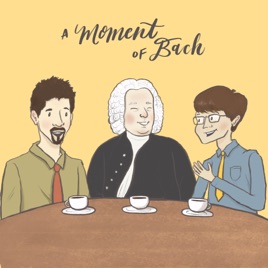
Advertise on podcast: A Moment of Bach
Rating
4.9from
This podcast has
176 episodes
Language
EnglishPublisher
Alex & Christian GuebertExplicit
No
Date created
2021/01/09
Latest episode
2025/10/06
Average duration
25 min.
Release period
7 days
Description
Welcome to A Moment of Bach, where we take our favorite moments from J. S Bach's vast output—just a minute's worth or even a few seconds—and show you why we think they are remarkable. Join hosts Alex Guebert and Christian Guebert for weekly moments! Check wherever podcasts are available and subscribe for upcoming episodes. Our recording samples are provided by the Netherlands Bach Society. Their monumental All of Bach project (to perform and record all of the works of J. S. Bach) serves as source material for our episodes. https://www.bachvereniging.nl/en https://www.bachvereniging.nl/en/allofbach Artwork by Sydney LaCom
Unlock A Moment of Bach podcast Email contact info,
Listeners & Audience details
Email contact information
Direct podcast contact details

Listeners
Audience numbers & engagement insights

Audience details
Podcast Insights

Podcast episodes
Check latest episodes from A Moment of Bach podcast
BACHTOBERFEST: Goldberg charcuterie (season 5 closer)
2025/10/06
It's time for Bachtoberfest! Tonight we treat ourselves to a wine & cheese spread, tailored to the different variations in this iconic piece.
We had so much fun with this that we think you should try it too. Just pair some of your favorite wines and cheeses and other snack items with the musical feast that is the Goldberg Variations. Then, let us know how it went!
And with that, season 5 of A Moment of Bach comes to a close. As always, we are so grateful to our listeners! Thank you for continuing to spread the word about our podcast! And, thanks to Netherlands Bach Society for the continued use of their excellent recordings.
CHRISTMAS CONCERT DETAILS in Southern California:
Christian's church: Christmas Carol Festival at Abiding Savior
Alex's church: Christmas Concerts at St. John's Orange, Dec 5, 6
Christian's Carnegie Hall invitation details here. Registration portal found here (if closed, email Christian at [email protected])
Der Herr denket an uns (BWV 196): closing chorus
2025/09/29
Unabashed joy describes this short and sweet cantata, which Bach wrote at age 23 for a wedding. In its sparkling finale, some mysteries hide. A curiously unexpected tonality sets off the happy declamation of "ihr seid" (you are), with emphasis on "seid"; according to Bach we ARE blessed by God, rather than "us" being special.
Then what do we make of the ending? Even in an early cantata which generally sounds like 1600s Lutheranism, some new special effects are hidden. Bach surprises us with his piano marking along with some Haydn/Mozart-like figurations. It's hard to listen to this level of happiness without cracking a smile.
Der Herr denket an uns (BWV 196) mvt. 5 "Ihr seid..." as performed by the Netherlands Bach Society
Song: Vergiss mein nicht (BWV 505)
2025/09/22
Today we talk "Men in Black", "Coco", "Futurama", and hear a slappin' bass line from an 80's funk song. Oh, and some Bach. Remember to stop and smell the forget-me-nots -- in other words, enjoy those moments.
In memoriam Fred Jacobs.
Charles Daniels (tenor), Meineke van der Velden (da gamba), and Fred Jacobs (theorbo) performing "Vergiss mein nicht" (BWV 505) for the Netherlands Bach Society
Video on the theorbo by Elizabeth Kenny for the Orchestra of the Age of Enlightenment
Goldberg Variations: 16. Ouverture
2025/09/15
Overtures belong at the beginning, introducing what is to come. So why is one found at Variation 16 of the giant Goldberg Aria and Variations?
Well, it is the beginning, but of the second half of 30 variations. Variation 15 takes us into fear and anguish with a mirrored canon in the (unheard of) key of G minor. After 45 minutes of bright G major since the opening aria, this change into the parallel minor key is stark, but not as stark and bare as the open fifth ending: a lone D string. Then follows a pause (in this performance by Jean Rondeau) of fully 35 seconds.
We start fresh, renewed with the joy of G major after this pause which literally divides the performance in half. The French "Ouverture" is a new beginning, replete with bright and shimmering baroque ornamentation. And yet it fits in the mold of the harmonic structure of the original Aria. While we think that there are beautiful performances of the Goldberg Variations on the modern piano, we lament the limitations of the low end of our big new instrument. Of all the 30 plus the Aria, this variation is the one which must be heard on the instrument for which it was intended -- harpsichord.
Aria mit 30 Veränderungen (Goldberg Variations) BWV 988: Jean Rondeau, Netherlands Bach Society
Nun danket alle Gott (BWV 192): closing chorus
2025/09/08
To play baroque music properly -- especially a bouncing jig like this one in 12/8 time -- you must "unlearn what you have learned", and rethink how you articulate music. Articulation is so important -- the music must feel and look light and airy. This performance by the Netherlands Bach Society fits this feeling perfectly -- the musicians look casual yet classy, showing that Baroque music can indeed be lighthearted and fun.
See this performance by the Netherlands Bach Society, directed by Shunske Sato
SOUTHERN CALIFORNIA LISTENERS! See a FREE performance of this cantata at Alex's church, by Cathedral Singers and orchestra, Sunday, November 2, at 4pm; details here.
Goldberg Variations: Aria
2025/09/03
The towering thirty Goldberg Variations combine into a masterwork of keyboard music. As all variation pieces, they were based on a relatively simple source material. But as is his way, Bach organized the variations with a complex and deliberate structure. But also unlike other composers of this form, he poured more into this source material itself.
The famous Aria could stand alone as a sublimely decorated Baroque keyboard piece, but it doesn't stand alone; its bass line and harmonic progression (not its gorgeous melody!) are the actual foundations of all thirty variations. Bach simply could not resist pouring this beauty into even this, the harmonic "template" for the next 90 minutes of music! And this foundation does hold up, all the way until the end, where we are told to play the Aria again, now as our ending.
Baroque ornamentation and performance practice takes this piece past its simple structure. We discuss this ornamentation and one particularly strange and almost inscrutable moment in the middle.
Aria mit 30 Veränderungen ("Goldberg Variations") BWV 988, as performed by Jean Rondeau for the Netherlands Bach Society
Cello Suite no. 6: Courante
2025/08/25
Listener HG drew our attention to a similarity between the Courante of this cello suite and the "Cum Sancto Spiritu" from the Mass in B minor. We talk about these dance forms and how they affect the affect, so to speak. Nowadays, it's easy to think of Bach as old-fashioned, and certainly some composers in the late 1700s thought the same; however he shows here that he was ahead of his time.
The "shoulder cello" (violoncello da spalla) makes another appearance here, smaller than the typical cello. The instrument sacrifices the deep warmth of the cello for nimbleness and an extra string which allows for higher notes.
Performance of Cello Suite no. 6 (BWV 1012) by Sergey Malov for the Netherlands Bach Society
Himmelskönig, sei willkommen: Sonata
2025/08/19
"An understated overture" is the description Christian arrives at to describe the humility of the micro-regal sonata which opens the Weimar cantata "Himmelskönig, sei willkommen." Is this thing, marked "adagio, grave," actually a triumphant French Overture? The performance suggests so, in some ways, and not in others. Experienced musicians of baroque music will know the subtleties, which we discuss in this episode. Indeed, it is a march of kingly victory, but not in pomp and circumstance; it is the small and gentle arrival of a humble king of Heaven and Earth, arriving to the world as a helpless baby, and arriving to Jerusalem on a donkey on Palm Sunday.
Also, featuring Rage Against the Machine and a very unsettling "Shepard Tone"!
BWV 182 cantata "Himmelskönig, sei willkommen" as performed by the Netherlands Bach Society, directed by Johanna Soller
Himmelskönig, sei willkommen: tenor aria
2025/08/11
This cantata has an unusual run of three arias in a row -- and the last one of the three is the most remarkable. In deleting a note, creating a rest where there should be music, Bach breaks all the rules -- and creates a stunning effect.
See the performance of BWV 182 by the Netherlands Bach Society, Johanna Soller, artistic director
Sonata for Violin and Harpsichord in G major (BWV 1019c)
2025/08/04
Bach used the materials for this sonata several times throughout his life. Each collection of parts is different, and there are three versions. This is version 1019c, as labeled by the BWV categorical system for Bach's works. There are five parts of this last of his six sonatas for violin and harpsichord. We discover the joys of rhythmic ambiguity, rhythmic complexity, and even a middle movement without the violin! (And yet sometimes this is called "Violin Sonata in G major," shirking the credit of the keyboardist.)
Christian focuses in on the end of the 4th movement, where a short ending extends and wanders into a surprising and somewhat tonally unclear ending. But it is made clear in the next moment, when the joyful key of G major returns in the jaunty final allegro.
Sonata for Violin and Harpsichord in G major (BWV 1019c) as performed by Shunske Sato and Diego Ares for the Netherlands Bach Society
Schauet doch und sehet (BWV 46): opening chorus
2025/07/28
When assembling his Mass in B minor, Bach drew from many of his older works. Here is one great example. If you, like us, have always been mesmerized by the haunting sound of the "Qui tollis" movement from the Mass in B minor, you absolutely must hear the opening chorus to the cantata Schauet doch und sehet, which is the full version of the material, and which concludes in a twirling, twisting fugue.
See the performance of Schauet doch und sehet (BWV 46) by the Netherlands Bach Society, conducted here by Hans-Christoph Rademann
Compare with the "Qui tollis" movement of the Mass in B minor, Netherlands Bach Society, led by Jos van Veldhoven
Ein feste Burg ist unser Gott (BWV 80): bass/soprano duet
2025/07/21
We return to the Mighty Fortress cantata to do a deeper analysis on the theological counterpoint of this movement. Bach combines two vocal parts -- one is Luther's hymn and the other is new poetry with Bach's own music -- and weaves both of those into a tapestry of staccato strings and marching bass. Bach's theological profundity is what separates him from the other composers; when Bach weaves two separate texts together, he adds meaning to both by connecting their core essences together.
Netherlands Bach Society performing BWV 80 mvt 2
Brandenburg Concerto No. 1: Polonaise
2025/07/16
What good is a centerpiece but to add to the pomp and pride and beauty of a ceremonial occasion? The Polonaise is historically such a centerpiece for such an elegant, lavish affair. Chopin is the natural figure for the Polonaise, a stately dance for pairs, but it was known much earlier to the Baroque composers. Bach was no stranger to Polish style, as shown in this centerpiece Polonaise to the Menuet of the Brandenburg Concerto No. 1.
When Bender the robot was driftless in space with his candelabra, he realized it belonged on a piano centerpiece. It was a shame that he couldn't manage to get his Chopin working before he got too frustrated.
Polonaise from the Menuet of Brandenburg Concerto No. 1
Brandenburg Concerto No. 1: Trios I and II
2025/07/07
Oboe talk today!
Mastering this instrument is almost unreasonably challenging, but the juice is worth the squeeze -- the baroque oboe, when played truly well, is one of the most rewardingly beautiful instruments.
Musical examples, as always, are courtesy of the Netherlands Bach Society. Check out their "All of Bach" project.
Referenced in today's episode:
Brandenburg Concerto No. 1: Trio I (2 oboes and bassoon) - performance by Netherlands Bach Society
Brandenburg Concerto No. 1: Trio II (2 horns and 3 unison oboes) - performance by Netherlands Bach Society
Short documentary video on the baroque oboe, featuring NBS oboist Katharina Verhaar
Another cantata we referenced today: Vergnügte Ruh (BWV 170)
Scott Leger horn - youtube short - excerpt from Brandenburg 1 trio II
Brandenburg Concerto No. 1: Menuet
2025/06/30
The three instrument families in this big baroque orchestra leads us to speculate that Bach represented three social classes: the royal elite (elegant strings, one leader), the aristocratic nobles (horns, for upper-class hunting expeditions), and the common people (reeds, as for outdoor bands or shepherding). Bach concludes the concerto with the elegant and grand menuet (note his spelling; not "minuet"). The French dance exudes class and status, though in this case, the hunters and even the common townsfolk are invited to participate in the great dance of strings, reeds, and horns.
In this episode we discuss the repeating refrain section, called the "menuet" section. There are three other parts of the complete structure to be discussed in our next two episodes.
Audio note: at 20:55-21:15, we recommend stereo listening, so that you can hear the two pitches/beats separated to the left (bottom pitch; slower beating) and right (higher pitch by perfect fifth interval; faster beating). The respective ratio is 2:3. As it gets slower, listen for two clicks on the left for every three on the right.
Menuet of Brandenburg Concerto No. 1
Podcast reviews
Read A Moment of Bach podcast reviews
scriabin9 2026/01/14
Best Bach masterclass out there!
These two brothers offer up everything I could hope for in a podcast,
in terms of an entertaining, educated, & unpretentious look at so many of Bach’...
jeff.hoening 2025/06/12
Herr Bach Approves
Entertaining, educational and beautifully produced show. This is always a fun and informative listen! As a CTSFW seminarian, I particularly appreciate...
Thevbeatles 2024/05/02
Remarkable
Like the moments that Alex and Christian choose, this series is remarkable. I am willing to bet that all Bach enthusiasts—not to mention scholars—will...
Torbac 2023/07/07
Bachophilia
Bach = good. Podcast = good. Bach podcast = GOOD.
dwightk 2023/05/03
I’ve dreamt of a podcast this perfect
My only negative is that they are just Bach… Not that there isn’t enough material, but someone needs to start a sister podcast for each of the greats!
kat_mccoy. 2022/04/15
Great Resource
This is a great resource for people who don’t have extensive musical background to learn some of the technicalities that make Bach so great. Really we...
Dark*Mark 2022/03/12
Bach Rocks and so does this podcast!
Great for people who know nothing about music or Bach and great for people that have studied Bach in music classes!
charieraasch 2021/08/30
A moment of peace
It’s always nice listening to this podcast on Monday morning on the way to a job I’m not fond of. It’s a moment of peace narrated by two knowledgeable...
Linda West Brown 2021/03/29
Saint Matthew Passion
Very informative and beautifully crafted podcast. Thank you for your fine work!
törbâćk 2021/03/23
Bach twins = Bach wins
Not unbiased but do like the pod so it’s honest.
Podcast sponsorship advertising
Start advertising on A Moment of Bach relevant audience podcasts
You may also like to advertise on these Podcasts

4.8161214
Lash Boss Radio
Shelby Tarleton
4.816538
Star Wars: Old Canon Book Club
Star Wars: Old Canon Book Club
4.4162284
8AM Podcast with Arlin Moore
Arlin

4.8187163
The Logan Bartlett Show
by Redpoint Ventures

4.571197
The Mental Health Today Show
John Cordray
52277
One Shots a Live-Play Mini Series Podcast
Dumb-Dumbs & Dice
4.955210
Trusty Hogs
Audio Always
5236
Einschlafen mit Weltall
Schønlein Media & Stiftung Planetarium Berlin
4.9207331
She and I
Barrett and India

4.41776607
I Am Athlete
Brandon Marshall