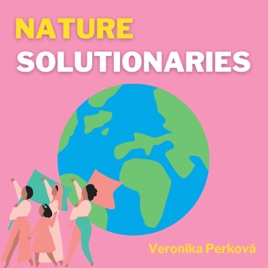
Advertise on podcast: Nature Solutionaries
Rating
5from
This podcast has
24 episodes
Language
EnglishPublisher
Veronika PerkovaExplicit
No
Date created
2021/01/13
Latest episode
2024/02/01
Average duration
42 min.
Release period
62 days
Description
Hello and welcome to Nature Solutionaries, a podcast that brings reproductive justice & conservation together. My name is Veronika Perková. I’m a journalist investigating how women’s reproductive health and rights, the conservation of nature, and sustainable life on the planet are all interconnected. Every month I interview people who are fighting to provide quality reproductive healthcare for women, to protect the planet’s biodiversity and to ensure the wellbeing of future generations. If you support women's rights, love nature, and care about humankind, this podcast is for you.
Unlock Nature Solutionaries podcast Email contact info,
Listeners & Audience details
Email contact information
Direct podcast contact details

Listeners
Audience numbers & engagement insights

Audience details
Podcast Insights

Podcast episodes
Check latest episodes from Nature Solutionaries podcast
Meet the Nigerian Teacher Who Advocates for Smaller Families
2024/02/01
To have a large family, and at least one son, are such strong cultural and religious norms in Nigeria that when women don’t meet them they’re often considered failures. Not only is this unfair to women, it’s also becoming nearly impossible to provide for a big family in Nigeria, where poverty is rampant and the cost of living has recently tripled.
Chidera Benoit, a teacher and Executive Director of Population Explosion Awareness Initiative, explains why it’s essential to change harmful patriarchal norms, broaden access to voluntary family planning and open up a conversation about sustainable population in Nigeria whose population is expected to double in the next two decades.
The Catalyst for Change in Pakistan: Women’s Empowerment
2024/01/01
Imagine that you were a 14-year old girl, and instead of chatting with friends or monitoring Instagram, you’d be married off to an elderly man and expected to run a household.
Imagine that you gave birth to your first child, a cute baby girl, and instead of receiving cheerful reactions, people would start crying and feeling sorry for you.
Imagine that throughout your lifetime you would have to give birth to 9 children, undergo several miscarriages and see a few of your children die.
THIS is not just a bad dream. It’s a daily reality for many girls and women in the northwestern region of Pakistan where men rule with an iron fist and where women aren’t even aware of their rights. In this revealing interview, two human rights activists from The Awakening, Erfaan Hussein Babak and Neelum Rahim, share their experiences of breaking taboos and empowering women in a strictly patriarchal society.
800,000 Seeds of Hope Planted in Brazil’s Atlantic Forest
2023/12/01
800,000 native trees. This is how many seeds of hope conservationists from Brazilian nonprofit REGUA have planted on degraded lands in the Atlantic Forest over the last two decades – one of the biologically richest forests in the world. And that’s not all!
The dedicated team managed to buy land that once used to be a farm and patch up fragmented pieces of forests to create an 11,000 hectare nature reserve. In this interview, Micaela Locke, the Research and Communications Coordinator at REGUA, talks about land restoration, native tree reforestation, building
corridors for wildlife, reintroducing tapirs, and safeguarding a vital watershed for 2.5 million people in Rio de Janeiro.
Should a Vocal Minority Dictate Women’s Futures?
2023/11/01
Being able to make decisions about when or whether to have children is among the most fundamental human rights.
Yet when it comes to women and their bodies, suddenly so many people – complete strangers – feel they have the right to tell women what to do, like, “Contraceptive use is against our religion! “Abortion is a sin!” And so on.
And even though having bodily autonomy makes women healthier, happier, and wealthier, we’re still living in a world where we deny 44% of women autonomy over their options related to having sex, using contraceptives and seeking reproductive healthcare.
An alarming number for sure!
In this interview with Nabeeha Kazi Hutchins, the CEO and President of PAI, we speak about the whole-societal benefits of providing women reproductive rights, the impacts of repressive reproductive policies and the impetus to join the sisterhood fight.
What Every Conservationist Should Know: A Lesson From Madagascar
2023/10/01
In Madagascar, where people depend on natural resources to survive, yet 75% live in extreme poverty, protecting nature is a big challenge. That's why conservation organizations are starting to realize that they can't only protect animals but must also address the well-being and health of communities living nearby protected areas.
Durrell Wildlife Conservation Trust provides a wonderful example of the holistic approach to conservation. By improving food security, financial independence and reproductive health in local communities, Durrell achieved more widespread support for conservation and now, the populations of bamboo lemurs and Madagascar pochards (a rare duck species) are on the rise!
Listen to my interview with Hanitra Rakotojaona (from Durrell) and Nantenaina Andriamalala (from the PHE Madagascar Network) about building powerful partnerships and integrated approaches to conservation.
4 Steps to Empowering Women Everywhere: A Lesson From Venezuela
2023/08/31
Getting access to birth control — or any reproductive healthcare in a country in shambles — is harder than you can imagine. And that is especially true for families that live hand to mouth. But nothing is impossible, especially when there’s good will and a great team. Turimiquire Foundation has been able to help low-income women in northeastern Venezuela get better access to family planning as well as education and sustainable livelihoods. Steven Bloomstein, the co-founder, president, and only man in a fully women-run organization, talks about the needs of Venezuelan women and the global fight for women’s empowerment.
The Fight for Girls' Education and Family Planning in Niger
2023/07/31
It’s not easy being a woman in Niger. The odds are especially high for women to drop out of high school, get married young (17 is the average age), or be displaced due to climate change, insecurity or humanitarian crisis! What happens to women in Niger, though, doesn’t stay in Niger alone. It impacts the whole region and ultimately, the global fight for women’s rights and climate justice.
Together with Sani Ayouba Abdou (Director of Young Volunteers for the Environment in Niger) and Lou Compernolle (Advocacy Program Lead at Oasis), we talk about the solutions that will help women overcome barriers and live secure and healthy lives.
More info about our guests:
Lou Compernolle is a Sexual and Reproductive Health and Rights expert with over two decades of experience. She currently works as Advocacy Program Lead at OASIS, a nonprofit promoting education and choice for women and girls in the Sahel.
Sani Ayouba Abdou is a program manager with more than ten years of experience working with communities on education, youth development, and environmental issues. He’s the Executive Director of Young Volunteers for the Environment in Niger, a nonprofit focusing on sustainable development, climate change and youth leadership.
Here’s Why Mountain Gorillas in Uganda Are Thriving
2023/07/01
Uganda’s first wildlife vet and award-winning conservationist, Gladys Kalema-Zikusoka, shares her personal story about how her organization “Conservation Through Public Health“ has contributed to a steady growth of mountain gorillas in the Bwindi Impenetrable National Park in Uganda. That’s in addition to a major improvement in community health, a threefold increase in family planning use, and new opportunities for people living around the park to thrive in coexistence with gorillas and other wildlife.
In this 30-minute interview, we touch on:
How the nonprofit incorporates public health and family planning into conservation
How to prevent the spread of diseases between humans and gorillas
Why improving public health and hygiene helps communities and gorillas thrive
How they achieved an increase of contraception from 22% to 67%
Why ecotourism is great for local livelihoods but can’t be the only option
Gladys Kalema-Zikusoka (1970) is one of the leading conservationists and scientists working to save the endangered mountain gorillas of East Africa. Her NGO Conservation Through Public Health promotes coexistence of gorillas, other wildlife, humans, and livestock. For her outstanding environmental and humanitarian work, Gladys has received a number of awards from the United Nations, Sierra Club and Edinburgh International Science Festival. Her memoir “Walking With Gorillas: The Journey of an African Wildlife Vet” came out in March 2023.
Links:
Conservation Through Public Health
Walking With Gorillas: The Journey of an African Vet
How Filipino NGO preserves nature and improves people’s lives
2023/05/31
Natural conservation and making improvements in the health and livelihoods of our communities are not at odds, although sometimes it feels this way. In reality, they are inherently connected. For example, in many rural communities where access to quality health services is low and jobs are few and far between, poverty-stricken people depend on exploiting natural resources to survive, which actually harms their quality of life long-term. Luckily, there is a better way of doing things that doesn't force communities to choose between their livelihoods and local flora and fauna.
The Population, Health and Environment approach proposes a way to improve access to reproductive health, while also helping people find alternative livelihoods, sustainably manage natural resources and preserve ecosystems. The nonprofit PATH Foundation Philippines, which has reached hundreds of thousands of Filipinos with its programs, is one of the pioneers of this approach.
Joan Castro, the Executive Vice President of this organization, talks about:
How sexually transmitted diseases, poverty, natural degradation and population growth are interconnected
Why it makes more sense to address all the issues through an integrated approach rather than individually
How PATH Philippines tackled food insecurity problems and resource depletion in two biodiversity spots
How they made family planning services accessible 24/7 by using small convenience stores instead of only village clinics
How they addressed harmful social norms and misconceptions about contraception
How they helped to improve management of close to 2,000 hectares and to establish 44 marine protected areas
Where else the PHE approach is applied
Joan Castro is a licensed physician, who has more than 20 years of experience in sustainable and community development initiatives in rural and urban settings in the Philippines. Joan serves as the Executive Vice President of PATH Foundation Philippines.
Links:
PATH Foundation Philippines
Population, Health, and Environment online course
How anyone can become a solutionary for systemic change
2022/06/23
Many people feel desperate about the state of the world today. It’s no wonder because the number of negative news we hear is endless – biodiversity loss, resource depletion, increasing inequality, wars, and so on. The more informed we are, the more helpless we feel, thinking, “How can I make a difference?”
It turns out that all of us can make a difference if we take a solutionary approach to our work. No matter what you do - a biologist, a teacher, a gardener - you can tackle big issues and change your field so it is more just, humane and sustainable.
In this episode, Zoe Weil, the co-founder of the Institute for Humane Education, explains:
Why it’s important to cultivate the culture of service in our communities
What can local organizations do to involve young people
Why it’s more important to change the system rather than individuals within it
How you can solve pressing global issues locally
How you can find a meaningful career by answering only three questions
What a solutionary is and how you can become one yourself
Links:
Institute for Humane Education
The Solutionary Guidebook
How to be a Solutionary: A Guide for People Who Want to Make a Positive Difference
Zoe Weil is the co-founder and president of the Institute for Humane Education and author of seven books and multiple TEDx talks. Zoe speaks at universities, conferences, and schools globally about how our education should go far beyond just having good grades and a diploma. She’s convinced that in today’s world with so many pressing global problems, we should give people the knowledge, tools and motivation to become change-makers for a healthy and humane world for all.
How PMC's hot soap operas improved the lives of more than 500 million people
2022/04/27
When soap operas are designed in a way that they not only entertain people but also educate about social issues, they can have a huge positive impact on society and the environment. This type of approach is called entertainment education and is at the core of what Population Media Center does.
Through hot TV soaps and radio dramas, this non-profit draws attention to family planning, gender equality, domestic violence, girls’ education, children’s health and education, and conservation. Since 1998, their 40 shows have helped more than 500 million people live healthier lives in more than 50 countries.
In this episode, Bill Ryerson, Population Media Center’s founder, talks about:
why just raising awareness about environmental or health care issues does not make people change their behavior
why storytelling and role modeling are extremely powerful tools for social change
how soap operas helped Mexico achieve the most dramatic decline in fertility rates in the 20th century
how TV soaps and radio dramas that address contemporary social issues are made
why audiences fall in love with transitional characters rather than positive ones
how long it takes to bring change to a community
why effective communication is central to human progress and why we should fight misinformation
Links:
Population Media Center
Why freshwater fish need as much or more attention than rhinos
2022/03/22
Even though people mostly view fish as tasty food on their plates, freshwater fish species are in desperate need of our attention and action. They are the world’s most threatened taxon, due to pollution, aquatic habitat loss, invasive species, overharvesting and water flow changes. Fish are at risk worldwide, but Southeast Asia is one of the key areas where fish are suffering with more than 80 different fish species currently on the brink of extinction.
In this episode, Nerissa Chao (a conservation biologist who has been leading the IUCN SSC Asian Species Action Partnership), Mike Baltzer (founder of Shoal, an organization that strives to protect freshwater species) and Nathaniel Ng Shengrong (a fish conservation expert from Mandai Nature) talk about:
why freshwater fish are important for the ecosystem
what happens when fish go extinct
why fish are neglected and overlooked
how the ASAP Action Plan will help protect fish in Southeast Asia
how local communities, governments and hobbyists can help
successful fish conservation initiatives
Links:
Asian Species Action Partnership
Shoal
Mandai Nature
Podcast reviews
Read Nature Solutionaries podcast reviews
Stuart Pimm 2021/11/21
There’s so much we can do
Veronika’s podcasts are about solutions to the harm we cause the planet. Those she interviews are inspiring in their passion and what they can achiev...
Chlohemian 2021/11/16
A podcast that perks you up
Veronika is a passionate interviewer dedicated to uncovering the little-known success stories of conservation and nature preservation in our modern wo...
Podcast sponsorship advertising
Start advertising on Nature Solutionaries relevant audience podcasts
You may also like to advertise on these Podcasts
4.4371061566
The Megyn Kelly Show
SiriusXM
4.888901269
Fearless with Jason Whitlock
Blaze Podcast Network

4.8118931000
Mind Pump: Raw Fitness Truth
Sal Di Stefano, Adam Schafer, Justin Andrews, Doug Egge
4.8102131585
Tara Brach
Tara Brach

4.541561215
Something You Should Know
Mike Carruthers | OmniCast Media

4.513841343
Strictly Anonymous Confessions
Kathy Kay

4.8292781897
Fantasy Footballers - Fantasy Football Podcast
Fantasy Football

4.62382612
Football Weekly
The Guardian

4.45387666
Two Judgey Girls
Two Judgey Girls

3.8258501152
The Viall Files
Nick Viall