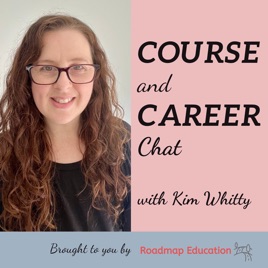
Advertise on podcast: Course and Career Chat
Rating
5from
This podcast has
110 episodes
Language
EnglishPublisher
Kim WhittyExplicit
No
Date created
2021/02/24
Latest episode
2025/12/09
Average duration
16 min.
Release period
20 days
Description
Listen up as Kim, a passionate careers teacher, chats to current tertiary students and staff to find out everything you need to know about university and TAFE courses, the careers they can lead to and the transition from high school to further study.
Unlock Course and Career Chat podcast Email contact info,
Listeners & Audience details
Email contact information
Direct podcast contact details

Listeners
Audience numbers & engagement insights

Audience details
Podcast Insights

Podcast episodes
Check latest episodes from Course and Career Chat podcast
VCE Results Are Coming: Understanding Your ATAR and Finding the Right Pathway
2025/12/09
VCE results are released tomorrow, and whether you're feeling excited, nervous, or a mix of both, this episode is here to support you. Even though we all know ATARs aren't the most important thing in the long run, they do feel important right now — and that's completely normal.
In this short pep talk, I explain why your ATAR is simply a piece of data that helps you make your next step, not a measure of your worth, potential, or future success. You're allowed to celebrate if you're proud of your results, and you're allowed to feel disappointed if they're not what you expected.
I also walk you through the wide range of pathways available through VTAC, including vocational courses, UniLink programs, starting at a different university with lower entry requirements, or choosing a similar course at your dream uni and applying to transfer after 6 or 12 months (often with credit!).
No matter what number appears on your screen tomorrow, you still have options — so many options.
What Year 12 Students Should Do Before VCE Results: How to Finalise VTAC Preferences
2025/12/02
Now that VCE exams are finished, it's time for Year 12 students to prepare their VTAC preference list before results are released next week. In this episode, I explain why finalising preferences early leads to better choices, how to set up your list with dream courses and pathways, and what to do if you still have no idea what you want to study next year.
Timestamps:
1:30 — What to do after VCE exams
4:45 — Why you should finalise VTAC preferences before results
8:30 — What to do if you don't know what you want to study
Links:
Work with me: https://www.roadmapeducation.com/services
VTAC dates: https://vtac.edu.au/dates
Why ATAR Goals Can Backfire — A Healthier Way to Approach VCE Goal Setting
2025/11/25
In this episode, I share why setting goals around a specific ATAR or study score can actually increase stress, reduce motivation and lead to burnout. Inspired by Dr Emily on The Imperfects Podcast, we explore a healthier approach to VCE goal setting — one that focuses on future pathways, not numbers students can't fully control.
Timestamps:
1:48 — Why I've never liked ATAR-based goals
3:55 — Dr Emily's take on goal setting
5:20 — Why students burn out when they chase a number
8:20 — How to create healthier, more meaningful VCE goals
Links:
Work with me: https://www.roadmapeducation.com/services
The Imperfects Podcast episode: https://podcasts.apple.com/au/podcast/the-imperfects/id1476501557?i=1000731475926
Why VCE Feels So Confusing for Parents — And How to Get the Information You Actually Need
2025/11/18
In this episode, I share how trying to navigate my son's cricket club with zero information helped me understand exactly how parents feel when their child starts VCE.
You'll hear why VCE feels so overwhelming, why schools often don't communicate clearly, and how understanding the system helps you make better decisions about VCE subjects, tertiary pathways and supporting your teen through Year 11 and 12.
Timestamps:
0:45 — Trying to start cricket with no information
6:11 — Why VCE parents feel lost
10:24 — How I support families through VCE
Links:
Work with me: https://www.roadmapeducation.com/services
The Parents' Guide to VCE: https://www.roadmapeducation.com/podcast/95
How to Choose the Right VCE Subjects, Tertiary Courses and Career Pathways (and Stop Cutting Off Your Options)
2025/11/11
Choosing VCE subjects and planning a tertiary pathway can feel overwhelming — especially when you're worried about closing off future options.
In this episode of Course and Career Chat, I share stories of four students who were unintentionally limiting their choices because of assumptions about what they could or couldn't do. You'll hear how, once they had the right information, they were able to make informed decisions about their VCE subjects, courses, and career pathways — and feel confident about their next steps.
Timestamps:
1:00 – Penny's story: Exploring creative careers and overcoming self-doubt
5:30 – Hailey's story: Finding health and medicine pathways that work
10:50 – Two more stories: Deciding between Year 12 and trade pathways
Links mentioned:
Work with me → roadmapeducation.com/services
The Truth About ATAR Focused Tutoring Ads: Why They Feed VCE Anxiety (and What Really Helps)
2025/11/04
You've seen the tutoring ads — the ones bragging about all their tutors getting ATARs over 99, studying medicine or law, or being dux of their schools. These ads drive me crazy because they completely miss the point.
In this episode, I explain why high ATARs don't make someone a good tutor, how tutoring companies lean into a broken VCE system, and why they make promises they can't keep. Most importantly, I'll share how students can actually beat ATAR anxiety by finding their own path — no matter what results they get.
4:02 – Doing well in school doesn't make someone a good tutor
9:04 – The VCE system is broken, and tutoring companies lean into it
10:28 – The tutoring companies are making promises they cannot keep
11:53 – How to actually beat ATAR anxiety
Links mentioned:
Work with me – Career counselling for high school students in Melbourne: https://www.roadmapeducation.com/services
Do You Need a Tutor or a Career Counsellor: https://www.roadmapeducation.com/podcast/76
Listen to more Course and Career Chat episodes: https://www.roadmapeducation.com/podcast
Becoming a Counsellor: Tamara's Journey from a Bachelor of Arts to a Master of Counselling at Deakin University
2025/10/30
In this episode of Course and Career Chat, I talk with Tamara, who is currently studying a Master of Counselling at Deakin University. She shares her journey from completing a Bachelor of Arts (majoring in Psychology and History) to discovering her passion for supporting others through counselling.
We discuss what it's really like to study counselling at postgraduate level, the difference between counselling and psychology, and the career opportunities available after a Master of Counselling in Australia.
If you're thinking about a career change into counselling, or wondering how to become a counsellor in Australia, this episode will give you a realistic and inspiring insight.
4:50 – Tamara's high school experience and early career interests
9:40 – Why she chose a Bachelor of Arts (Psychology and History)
13:48 – Honours in History: research and learning
16:54 – First full-time role and transferable skills
19:30 – Studying the Master of Counselling at Deakin University
Links mentioned:
Work with me – Career counselling for high school students in Melbourne: https://www.roadmapeducation.com/services
Learn more about the Master of Counselling at Deakin University: https://www.deakin.edu.au/course/master-counselling
Listen to more Course and Career Chat episodes: https://www.roadmapeducation.com/podcast
Should You Drop a VCE Subject?
2025/05/28
What we're talking about: It's nearly the end of Term 2, and I've had a lot of conversations with students lately where they've been trying to decide whether or not to drop a VCE subject that they're studying. To make an informed decision, there's a few things you need to consider - do you know what you want to do when you finish school? Is this subject a prerequisite for that course? Can you support yourself to feel more confident in the subject with some extra help? Could you look at similar courses that don't need it as a prerequisite? Is not liking the subject a clue that maybe your dream course isn't really the one you want after all?
Listen up so you can consider your options and decide what will be best for you and your future.
Links mentioned: Work with me: https://www.roadmapeducation.com/services
VTAC CourseSearch: https://delta.vtac.edu.au/coursesearch/#/search
How to Feel Confident About VCE and Choosing Tertiary Courses Part 3 [What Are You Really Good At?]
2025/05/20
What we're talking about: In this third part of my mini series "How to Feel Confident About VCE and Choosing Tertiary Courses" I'm diving into another question that I'd love for you to consider - What are you good at? I don't mean what subject you're good at (although I did talk about that in episode 102), but instead what is something that comes naturally to you that you use in your everyday life that could be applied to any career you choose?
Knowing this can help you see how you can bring key parts of yourself to any role you choose to take in the future.
Links mentioned: Work with me: https://www.roadmapeducation.com/services
How to Feel Confident About VCE and Choosing Tertiary Courses Part 2 [What's Your Favourite Subject and What Do You Like About It?]
2025/05/13
What we're talking about: In this episode, I continue the mini-series on feeling confident about VCE and choosing tertiary courses. Instead of jumping straight to career titles, I encourage you to reflect on your favourite subjects and, more importantly, what you enjoy about them. This approach can provide valuable insights into courses and careers that will allow you to do more of what you actually like.
0:45 – Recap of Episode 100 and the importance of understanding VCE
In the last episode I shared some episodes where I explain key aspects of VCE so that you can really understand the system you're working in. If you're stressed at all about VCE, I encourage you to go back and listen to that episode first.
2:27 – The significance of identifying your favourite subject
I discuss why pinpointing your favourite subject—and what you like about it—can guide your decisions about future studies and careers.
6:00 – My personal experience with subject preferences and career choices
I share my journey of loving maths but not feeling great about the typical career paths everyone was suggesting, like engineering or accounting.
9:50 – The importance of understanding what you enjoy in a subject
I delve into how recognising the specific topics or skills within a subject you enjoy can open up a broader range of course and career options that will actually suit you better. I encourage you to take time to reflect on your favourite subjects and what you really like about them so that you can find courses and careers that will allow you to do more of what you like.
Links mentioned: Work with me: https://www.roadmapeducation.com/services
How to Feel Confident About VCE and Choosing Tertiary Courses Part 1 [Understanding How VCE Works]
2025/05/06
What we're talking about: Thanks for joining me for the 100th episode of Course and Career Chat!
This episode is Part 1 in a series I'm calling How to Feel Confident About VCE and Choosing Tertiary Courses, and in this episode I want you to think about what is stressing you out about VCE so that you can get your questions answered. I've created a list of past episodes of Course and Career Chat where you can find the answers to common questions I get when I'm working with my students and their parents, and if I haven't answered your question yet, please send me a DM on Instagram to let me know - I'm happy to help!
Links mentioned: VCE Subjects: 5 Things to Consider When Choosing Yours: https://www.roadmapeducation.com/podcast/56
How Are ATARs Calculated?: https://www.roadmapeducation.com/podcast/58
ATAR Myths and Misconceptions: https://www.roadmapeducation.com/podcast/70
Should You Accelerate in VCE?: https://www.roadmapeducation.com/podcast/78
What Happens If You Do An Unscored VCE or VCE-VM?: https://www.roadmapeducation.com/podcast/87
All About the GAT (Updated for 2024): https://www.roadmapeducation.com/podcast/85
How Do SACs Work in VCE?: https://www.roadmapeducation.com/podcast/96
What is your VCE subject ranking?: https://www.roadmapeducation.com/podcast/79
Send me a DM with any other questions you have on Instagram @roadmap_ed: https://www.instagram.com/roadmap_ed/?hl=en
Work with me: https://www.roadmapeducation.com/services
How Will AI Affect Your Career Choices?
2025/04/01
What we're talking about: AI is everywhere at the moment, and there's a lot of discussion about how it will change jobs and career pathways. Many students (and parents) are wondering—will AI replace certain jobs? Will the careers that seem like a great option now still be relevant in 5 or 10 years? In this episode, I break down what AI actually is, the ways it's already affecting different industries, and how students can make career choices that will set them up for success in an AI-driven world.
2:40 – What is AI, and why is it such a big deal?
AI is already part of our daily lives, even if we don't always realize it. I explain some of the ways we're all using AI right now (like how your phone suggests words when you text) and why it's suddenly getting so much attention in conversations about work and careers.
5:15 – My first experience using AI in my work
The first time I properly used AI was to help with my podcast show notes, and I was surprised by how useful it was. It didn't replace what I do—it just made the process easier. This is exactly how AI will work in many careers: not replacing workers, but supporting them.
9:00 – AI is changing jobs, but that's nothing new
Every time there's a big technological shift—whether it's the internet, automation, or now AI—some jobs change or disappear, but new ones are created. I talk about why it's important to keep an open mind and focus on developing skills that will always be valuable.
11:24 – Will AI take over jobs?
This is a big worry for a lot of students, but it's important to remember that AI can handle tasks, not entire careers. The most valuable jobs in the future will be the ones that involve creativity, critical thinking, and human connection—things AI can't replicate.
15:30 – Choosing a career in an AI-driven world
Instead of worrying about what jobs might disappear, students should focus on what they enjoy, what industries interest them, and where they can develop transferable skills. Universities and TAFEs are already adapting their courses to include AI, so there will be plenty of opportunities to learn how to work with it rather than against it.
19:30 – Why human skills will always matter
AI might be great at processing information, but it can't replace human creativity, problem-solving, and emotional intelligence. I share why these skills will always be in demand and how students can future-proof their careers by focusing on what makes them unique.
Links mentioned: Work with me: https://www.roadmapeducation.com/services
Should You Take a Gap Year After Year 12?
2025/03/25
What we're talking about: Should you take a gap year after Year 12? It's a big decision, and in this episode, I break down the benefits and drawbacks of taking a year off before further study. I also share practical advice on how to keep your options open, even if you're unsure about your next steps.
1:09 Common concerns about taking a gap year
I've had a lot of conversations with parents recently about whether a gap year is the right choice for their child. Many students don't know whether they should still apply for courses through VTAC, or if taking a gap year will impact their future plans. In this episode, I share my thoughts on how to approach this decision.
3:28 The benefits of taking a gap year
There are plenty of good reasons to take a gap year, including:
Taking a break – After 13 years of school, it makes sense to want some time off before starting further study.
Travel opportunities – Exploring new places and cultures, or working overseas through programs like Camp America.
Earning money – Getting a full-time job to save for university, travel, or other goals.
Career exploration – Using the year to try jobs in industries you're interested in, so you get a feel for what you might want to study.
5:39 The drawbacks of taking a gap year
Some students worry that if they take a gap year, they'll never go back to study. While that's not always true, there are some things to consider:
Losing the study habits you've built over the years.
Feeling like you're behind your friends who go straight to university.
Starting uni with students who are younger and still in a "VCE mindset."
9:54 How to keep your options open
Even if you're planning to take a gap year, I strongly recommend applying for VTAC courses now and securing a spot. Most courses allow deferral, so you can take your gap year with peace of mind, knowing you have a place waiting for you. It's also much easier to do this while you still have access to school resources like career counselors and scholarship applications.
13:23 Final advice: Plan now, decide later
There's no right or wrong answer when it comes to taking a gap year—it's a personal choice. But having a plan in place (even if you're unsure) will make your gap year experience smoother and more enjoyable.
Links mentioned: Work with me: https://www.roadmapeducation.com/services
How To Motivate Yourself To Study in VCE
2025/03/18
What we're talking about: 1:43 My observations around motivation as a Maths teacher
I share my experience of teaching a particular class who were really focused, willing to learn, with high aspirations for their VCE results. Most people would assume that there's not much a teacher of a class like that needs to do to in terms of motivation, but what I actually found was that in the second half of the year, these students were feeling really stressed and losing motivation despite the fact that they were doing everything "right" and still doing well on their SACs. I found that by helping them have some perspective around VCE and looking ahead to something fun that they were planning for the future, I could see that it really helped them get their heads out of VCE and visibly reduced their stress.
9:58 The podcast that helped me understand the science behind my theory
I happened to listen to The Imperfects podcast episode with their regular guest, Dr Emily, teaching listeners about hope. She talked about hope being made up of 3 parts - the goal, pathways (including overcoming obstacles) and agency (or the motivation to follow through to reach your goal). The way she explained it helped me understand why for many students, having a goal linked to results (eg I want to get an ATAR over 90) can be really hard to maintain. So many students with goals like that find it hard to keep going when they hit a topic they find really difficult or have a bad day on a SAC. They could no longer see how they could reach their goal, they'd lose motivation because they no longer thought just working hard would help them achieve the results they wanted, and they'd lose hope.
16:43 A Better Way to Motivate Yourself in VCE
I know that working with students to help them discover what they want to do beyond school in terms of courses and careers is truly motivating. I see it with the students I work with all the time. What Dr Emily was saying about hope helped me understand why. It makes sense to me that by finding a course or career that a student is excited about, you've found a goal. The next step is to find out how they can get there, and the reality is that there are so many pathways you can take to get into any course or career. Because there are so many pathways, it makes sense that if one falls over (ie you don't get the ATAR you need), you can immediately see the next pathway. So now not getting the ATAR you need is an obstacle that can be overcome. Students can still have hope of reaching their goal because they can change the pathway and still achieve it.
Links mentioned: Work with me: https://www.roadmapeducation.com/services
The Imperfects Podcast with Dr Emily on Hope: https://theresilienceproject.com.au/at-home/podcasts/dr-emily-hope/
How Do SACs Work in VCE?
2025/03/11
What we're talking about: Let's talk about how SACs work in VCE so that you know what they are, how they're used, and to bust some of the misconceptions around them that often come up throughout the year so that you can feel really confident as you move through VCE.
1:32 What is a SAC?
Throughout your time at school from prep through to Year 12, you do different types of assessment. SAC stands for School Assessed Coursework and it's called that because it is one of the assessment types that is used to calculate your study score for your VCE subjects, but it is written by your teachers and completed through your school (as opposed to the external exams at the end of Unit 3&4 subjects written by VCAA). You can find out how many SACs you'll do for each subject and how each SAC will look by looking at the study design for the subject on the VCAA website.
4:35 How do you find out your SAC results?
Different schools will report back differently. Some schools will give you an actual percentage mark for each SAC. Others might use a grade or a descriptor to give you an idea of how well you've done. These marks are not what is submitted to VCAA - your teachers will rank all the students for a subject based on their results in their SACs, and then these will be scaled up or down depending on how your cohort of students do on the external exam at the end of the year. The most important part of your SAC if you're aiming to do really well in VCE is to make sure you understand where you didn't get some of the marks and what you needed to do differently to get full marks on those questions. That will help you prepare for the next SAC and also for your end of year exams.
7:47 How are SAC results used?
When you get your study scores at the end of the year, you'll be able to see the grades you got for your overall SAC results (which might be split into Unit 3 and Unit 4, or might be put together as one SAC result) and then a grade or grades for your end of year exam(s) for that subject. Your SAC result may be higher or lower than you expected based on the feedback you got from your school throughout the year. This is because of the scaling that happens, and it has to happen to make sure that the SACs at one school are treated as being equivalent in difficulty to the SACs at another school. This is why you shouldn't get too focused on your SAC results throughout the year other than learning from them - see the podcast episode "What is Your VCE Subject Ranking?" linked below for more information.
Links mentioned: Work with me: https://www.roadmapeducation.com/services
Free Download - The Parents' Guide to VCE: https://www.roadmapeducation.com/parents-guide
How are ATARs Calculated? https://www.roadmapeducation.com/podcast/58
What is Your VCE Subject Ranking? https://www.roadmapeducation.com/podcast/79
Podcast sponsorship advertising
Start advertising on Course and Career Chat relevant audience podcasts
You may also like to advertise on these Podcasts

4.513841343
Strictly Anonymous Confessions
Kathy Kay

4.62382612
Football Weekly
The Guardian

3.8258501152
The Viall Files
Nick Viall
4.91329684
The Learning Leader Show With Ryan Hawk
Ryan Hawk

4.9497742102
The MeidasTouch Podcast
MeidasTouch Network

4.6612652000
The Dan Bongino Show
Cumulus Podcast Network | Dan Bongino

4.9326341342
REAL AF with Andy Frisella
Andy Frisella

4.6300041129
Wow in the World
Tinkercast

4.717141101
The Shotgun Start
The Fried Egg
4.74087423
Sean Carroll's Mindscape: Science, Society, Philosophy, Culture, Arts, and Ideas
Sean Carroll