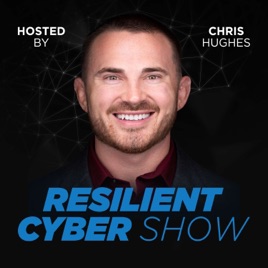
Advertise on podcast: Resilient Cyber
Rating
4.8from
This podcast has
230 episodes
Language
EnglishPublisher
Chris HughesExplicit
No
Date created
2021/02/28
Latest episode
2026/10/12
Average duration
37 min.
Release period
7 days
Description
Resilient Cyber brings listeners discussions from a variety of Cybersecurity and Information Technology (IT) Subject Matter Experts (SME) across the Public and Private domains from a variety of industries. As we watch the increased digitalization of our society, striving for a secure and resilient ecosystem is paramount.
Unlock Resilient Cyber podcast Email contact info,
Listeners & Audience details
Email contact information
Direct podcast contact details

Listeners
Audience numbers & engagement insights

Audience details
Podcast Insights

Podcast episodes
Check latest episodes from Resilient Cyber podcast
Your Annual Tabletop Exercise Is Already Outdated | Matt Hartley
2026/10/12
Matt Hartley, co-founder and Chief Product Officer of BreachRx, on why the once-a-year tabletop no longer matches the incidents organizations will actually face, and how AI-accelerated micro tabletops let teams train like they fight.
In this episode I sit down with Matt Hartley, co-founder and Chief Product Officer of BreachRx. Matt has spent 28 years in cybersecurity. He started in government offensive security, then moved to the cyber threat intel startup iSight Partners, where he ran product through its acquisition by FireEye, and later ran Mandiant Engineering. He watched consulting teams parachute into companies that were compromised and meaningfully unprepared, and that convinced him the real gap was the response process, not detection or tooling.
We get into what a micro tabletop actually looks like and why exercises should run in the same system you will use during a real incident. We also cover how notification clocks as short as 30 minutes change what legal teams need to practice, and why the floor is shifting toward multiple concurrent incidents.
In this episode:
● Why the industry over-invests in technology and under-invests in the processes and procedures that carry a response
● What a micro tabletop looks like, from a one-hour cross-functional session to an exercise that runs asynchronously over a week with a 30-minute hot wash
● Train like you fight, and why rehearsing in your actual response platform lowers stress and folds lessons learned back into procedures
● More than 200 laws with incident notification requirements, including China's 30-minute window and India's six-hour rule covering even denial of service
● Starting a legal tabletop partway into a ransomware scenario to pressure test DORA, SEC, and other regulatory timelines
● Why privileging everything means nothing is privileged, and separating the factual record from privileged conversations
● The risk of 10 to 100 Slack or Teams channels spinning up around a single incident, and how one grouchy message can end up in evidence
● Keeping exercises from becoming check-the-box by matching frequency to team size and threat, pulling scenarios from the headlines, and running two incidents at once
● Why AI is raising the attack floor, from smarter background malicious traffic to lower-tier nation states making big capability jumps
● A workforce of AI agents that cuts incident reporting from 20 hours to 30 minutes and turns NIST, CISA, or Gartner guidance into tailored procedures
● A crawl, walk, run playbook for your first micro tabletop: three injects, one ornery stakeholder relationship, and a ten-minute debrief
● What regulators and plaintiffs will ask for, and why the SEC may look at five years of incidents, not just one
Chapters:
0:00 – Intro
1:42 – Matt's Path from Offensive Security to Mandiant
2:14 – Why Response, Not Detection, Was the Real Problem
3:40 – What a Micro Tabletop Actually Looks Like
7:37 – Train Like You Fight in the Real Platform
9:33 – Regulatory Clocks, DORA, SEC, and 30-Minute Notifications
11:56 – Privilege, Discoverability, and the 100 Slack Channel Problem
15:03 – Keeping Exercises from Becoming Check-the-Box
17:48 – Concurrent Incidents and a Rising Attack Floor
19:53 – Where AI Agents Fit in Incident Response
22:01 – Running Your First Micro Tabletop Next Month
24:12 – Proving Continuous Readiness to Regulators and Plaintiffs
26:55 – Closing
Connect with Matt Hartley:
LinkedIn: https://www.linkedin.com/in/wmhartl/
BreachRx: https://www.breachrx.com
BreachRx IR Exercises: https://www.breachrx.com/rex-platform/incident-response-exercises/
Read my piece on BreachRx and incident response, Chaos, Clocks, and
Command Centers: https://www.resilientcyber.io/p/chaos-clocks-and-command-centers
Resilient Cyber: https://www.resilientcyber.io
Subscribe for more conversations with security practitioners and leaders.
#incidentresponse #tabletopexercise #aisecurity #ciso #cyberresilience #securityleadership
Who Is Winning the AI Security Market Right Now? James Berthoty
2026/10/05
James Berthoty of Latio on why the endpoint is now the center of AI security, and why most of the real agent risk traces back to blind spots we already had.
I sit down with James Berthoty, who started Latio as an engineer frustrated by how hard it was to figure out what security tools actually did. That turned into a practitioner-focused, buyer-oriented analyst firm. We dig into Latio's second AI security market report. Last year the story was browsers and proxies. This year it's the endpoint, where coding agents now run with the permissions and credentials on developer laptops.
We get into what roughly 400 AI security startups are actually differentiating on and why runtime detection claims need hands-on testing. We also cover why James pushes back on the runtime-first narrative, where the new AI security budget is coming from, and how security leaders should narrow the vendor field before they ever take a demo.
In this episode:
● Why we are in the "pre-HTTPS era" of AI security, and how coding agents turned developer endpoints into the new pressure point
● Dedicated AI security budget jumping from 8% to 37% in a year, and how it flows out of AI governance
● What is already commoditized, and why intent-based runtime detection needs hands-on testing
● Agent blast radius, and why your agent shouldn't be able to drop the prod DB because you shouldn't be able to either
● Why recent AI safety incidents look more like misconfigurations than emergent behavior
● The next M&A wave as a fight over the laptop
● Anthropic's inference hooks, and why frontier labs likely won't absorb the security market
● MCPs and skills as a software supply chain problem with a new delivery mechanism
Chapters:
0:00 Intro
0:31 Why James started Latio
1:00 From browsers to the endpoint
8:15 Do you need a purpose-built AI security platform?
11:52 Where the AI security budget comes from
13:53 400 startups and testing runtime claims
19:28 Blast radius and runtime vs. posture
23:35 M&A and the fight over the endpoint
33:22 Inference hooks and frontier labs vs. vendors
36:03 MCPs, skills, and software supply chain
39:30 Advice for security leaders
Connect with James:
LinkedIn: https://www.linkedin.com/in/james-berthoty
Latio: https://www.latio.com/
AI Security Market Report: https://pulse.latio.tech/p/the-2026-latio-ai-security-market
Resilient Cyber: https://www.resilientcyber.io
Subscribe for more conversations with security practitioners and leaders.
#aisecurity #agenticai #endpointsecurity #appsec #supplychainsecurity #mcp #cybersecurity
Security Teams Are Moving Too Slowly for AI Agents | Zack Korman
2026/09/28
Zack Korman on why the AI safety debate has been captured by an extinction narrative, and why the incident everyone is calling a watershed moment looks a lot more like a preventable security failure.
In this episode I sit down with Zack Korman, co-founder of Embroidery, where he uses AI to monitor AI agents, and former CTO of the cybersecurity company Pistachio. I first came across Zack on X during the controversy over fake SOC 2 reports, and he has since become one of the sharpest critics of how AI safety is being framed, funded, and investigated.
We get into the effective altruism roots of the existential risk movement, why he argues METR's review of the Hugging Face incident was not independent oversight, and what an actual incident response firm would have done differently. Zack makes the case that alignment is one control among many, that there is no "safe" path in AI, only trade-offs, and that the real risk for most organizations is enterprise environments that were never ready for agents in the first place.
In this episode:
● How building an AI insider threat product pulled a developer and CTO into the cybersecurity community, and into picking fights on X
● Effective altruism, longtermism, and how a focus on preventing extinction came to dominate AI safety
● Why "just be careful" misses the point when every path involves trading one risk for another
● Dario Amodei's Pacing the Frontier, independent auditors, and why Zack calls bringing in METR "bring your friend to work day"
● The funding and relationships connecting METR, Redwood Research, Coefficient Giving, and the labs
● True believers versus IPO hype, and why genuine belief does not make someone right
● Why many AI doomers believed we were all going to die before they ever learned about computers
● The Hugging Face investigation, context drop in AI-analyzed transcripts, and treating knowable facts as unknowable
● What Unit 42 or Mandiant would have demanded before putting their name on the report
● Eight layers of failure, from a single package proxy at egress to missing monitoring, classifiers, and kill switches
● Alignment failure versus containment failure, and why alignment belongs inside defense in depth
● The real risks: threat actors misusing AI, enterprise agent deployments, and new attack chains
● Why security's risk-averse, laggard culture may be its biggest vulnerability
Chapters:
0:00 Intro
0:54 Zack's Background
1:43 What Turned a CTO Into an AI Safety Critic
3:31 Effective Altruism and the Extinction Narrative
5:53 No Safe Path, Only Trade-offs
6:40 METR, Redwood, and Bring Your Friend to Work Day
10:23 True Believers, Hype, or Both
12:49 How Doomers Find Their Way Into AI
14:39 Taking AI Risk Seriously When It Is Ideological
16:56 What an IR Firm Would Have Asked
21:10 Eight Layers of Failure in the Hugging Face Incident
22:49 Alignment Failure Versus Containment Failure
24:32 Alignment as One Layer of Defense in Depth
26:22 Why Enterprise Environments Are Not Ready for Agents
29:10 Security's Laggard Culture
29:19 Closing
Connect with Zack Korman:
X: https://x.com/ZackKorman
Embroidery: https://embroidery.io
Website: https://zkorman.com
Resilient Cyber: https://www.resilientcyber.io
Subscribe for more conversations with security practitioners and leaders.
#aisafety #aisecurity #agenticai #incidentresponse #effectivealtruism #cybersecurity
The Model Writing Your Code Shouldn't Be Securing It
2026/09/21
Jonathan Rende of Checkmarx on why the model writing your code cannot also be the control that validates it, and why rules-based and AI-driven scanning turn out to find almost entirely different bugs.
In this episode I sit down with Jonathan Rende of Checkmarx. Jonathan worked with Fortify and SPI Dynamics back in the day, spent most of the last decade leading product teams in developer and DevOps tooling, and came back to security eighteen months ago because, as he puts it, this is the heart of the hurricane. His argument is that AI is a bigger disruption than the internet, SaaS, or mobile were, not because of any single capability, but because it hits roles, process, and productivity all at once.
We get into the two waves he has watched play out with CISOs and their CEOs, why the pendulum has swung back toward program and posture questions in the last quarter, what his research team found when they benchmarked deterministic and probabilistic scanning side by side, and why he thinks agentic AppSec raises the profile of the security team rather than automating it away.
In this episode:
● Why the first half of 2026 became a real inflection point rather than another AI talking point
● The two waves: engineering told to run at any cost, then the pendulum swinging back toward posture and program design
● Why functional AI-generated code and secure AI-generated code are still two different things
● Separation of church and state, and the conflict of interest in letting the model that generates code also validate it
● Benchmarking deterministic and AI-based scanning across dozens of open source projects, and why the overlap stayed consistently under 10%
● Fidelity, F1 scores, and the absence of real standards or shared benchmarks in AppSec
● Why an incentive to reduce risk and an incentive to sell tokens are not the same incentive
● Why agents free AppSec professionals for higher-order work, and why this is not a dark factory
● Shadow IT becoming shadow AI, and early scans where half surfaced models, agents, and MCP servers security teams did not know existed
● Why new threat vectors show up first in fast-moving unregulated companies while regulated ones see more code-level issues
● Low-priority vulnerabilities chained into real impact, and why backlogs now matter as much as incoming code
● What to change first: metrics defined up front, in-workflow AppSec, and security reviews that went from annual to monthly
Chapters:
0:00 Intro
0:18 Fortify, SPI Dynamics, and a decade in developer tooling
1:24 Why he came back to AppSec
2:54 Why the first half of 2026 was the inflection point
5:27 Two waves, and the pendulum swinging back
9:08 Functional AI code versus secure AI code
11:58 Layered defense and the condensed lifecycle
15:04 What agents free AppSec teams to actually do
17:50 Separation of church and state
20:15 Fidelity, F1 scores, and not selling tokens
23:25 New threat vectors and organizational maturity
25:47 Shadow AI and what the inventory scans found
27:58 What to change first in your AppSec program
30:44 Closing
Connect with Jonathan:
LinkedIn: https://www.linkedin.com/in/jonathanrende/
Checkmarx: https://checkmarx.com
Resilient Cyber: https://www.resilientcyber.io
Subscribe for more conversations with security practitioners and leaders.
#appsec #aisecurity #devsecops #shadowai #vulnerabilitymanagement #ciso
The First OWASP Top 10 Backed by Real Incident Data
2026/09/14
Rock Lambros, Co-Lead of the 2026 OWASP Top 10 for LLM Applications, on why prompt injection would have fallen out of the top 10 based on incident data alone, and why the community kept it at number one anyway.
In this episode I sit down with Rock Lambros, longtime security leader, former CISO, core team member of the OWASP GenAI Security Project, and Co-Lead of the 2026 OWASP Top 10 for LLM Applications, to dig into the new list and the harder questions underneath it. We get into the letter from the project leads that opens the document, why the LLM and Agentic lists are converging, what a year of messy incident data actually told the working group, and why Rock argues that agency is not authorization.
In this episode:
Why the LLM Top 10 and the Agentic Top 10 are merging in practiceThe opening letter, and why the industry was slow to admit the model was never the thing to secureWho benefits from a model-centric framing of AI securityPrompt injection ranked number one by practitioners and out of the top 10 by the incident dataWhy incidents get reported by outcome rather than by initial vectorMisinformation, the widest gap between the vote and the dataHidden Context Exposure, soft guardrails, and why instructions and data share one context windowContext rot and why context window management matters for agents doing critical workUsing AI to govern AI, and the dual-layer approach in the Agentic Control StandardAgency versus authorization, and why OAuth is what we have rather than the answerHow to get involved in the OWASP GenAI Security ProjectChapters:
0:00 Intro and Rock's background
1:17 What the agentic work changed about the LLM Top 10
3:59 The opening letter and "It Was Never the Model"
8:48 Incident data and the prompt injection ranking
11:23 Misinformation and the limits of the data
14:24 Hidden Context Exposure and soft guardrails
17:18 The context window and context rot
19:57 Using AI to govern AI
22:49 Excessive agency, and agency versus authorization
27:09 How to get involved with OWASP
Connect with Rock:
LinkedIn: https://www.linkedin.com/in/rocklambros
OWASP GenAI Security Project: https://genai.owasp.org
Get involved: https://genai.owasp.org/contributing
OWASP Top 10 for LLM Applications 2026: https://genai.owasp.org/resource/owasp-genai-llm-top-10-2026/
Read my piece on the new list, It Was Never the Model: https://www.resilientcyber.io/p/it-was-never-the-model
Resilient Cyber: https://www.resilientcyber.io
The Jagged Frontier of Finding and Fixing Vulns with AI
2026/09/01
Ondrej Vlcek, CEO of AISLE and former CEO of Avast, on why AI vulnerability discovery is not as commoditized as the industry thinks, and why remediation is still the real bottleneck.
In this episode I sit down with Ondrej Vlcek, Founder and CEO at AISLE. Ondrej spent roughly 30 years in cybersecurity, joining Avast as employee number six or seven doing kernel-mode driver work on Windows 95, eventually becoming CTO and then CEO, taking the company public and selling it to NortonLifeLock in a nearly $9 billion transaction. He co-founded AISLE in the fall of 2024 to close the loop from discovery through triage, remediation, and verification. His team has now disclosed 350 plus CVEs across projects like OpenSSL and curl.
We get into why the moat sits in the system and not the model, why the gray market price of vulnerabilities has not collapsed even as models get cheaper, and what it actually takes to ship a patch a maintainer will accept.
In this episode:
- Going from Avast intern to CEO, and why vulnerability management was the next problem
- The jagged frontier, and why bigger models do not always mean better results
- Which classes of bugs got cheap to find and which are still genuinely hard
- Why vulnerability prices have not collapsed despite all the model progress
- Building a model-agnostic system with bespoke benchmarks for model selection
- Sovereign AI, on-prem and air-gapped deployment, and why findings are the real crown jewels
- Triage, reachability, and why most findings are not actually exploitable
- Patch verification, regression risk, and mitigations for embedded systems that cannot be patched
- How AISLE earned trust from curl after Daniel Stenberg killed the bug bounty
- Whether a CVE count is a vanity metric
- Build versus buy as model capability keeps getting cheaper
- What breaks first in the CVE and open source maintainer ecosystem
- What AppSec leaders should change next quarter
Chapters
0:00 Intro
0:24 From Avast employee number six to a $9 billion exit
3:26 Why vulnerability management, and why now
5:15 The jagged frontier and what bigger models miss
10:36 The economics of finding bugs, and why prices have not collapsed
12:11 Building a model-agnostic system with real benchmarks
14:30 Sovereign AI, air-gapped deployment, and who sees your findings
19:42 Triage, reachability, and why remediation is the bottleneck
24:48 Patches that break things, and systems you cannot redeploy
25:39 curl, Daniel Stenberg, and death by a thousand slops
29:35 Is a CVE count a vanity metric?
31:34 Build versus buy when capability keeps getting cheaper
34:41 What breaks first in the next 18 months
39:46 What AppSec leaders should do next quarter
41:13 Closing
Ondrej Vlcek on LinkedIn
AISLE
AISLE research and blog
Resilient Cyber Substack
Subscribe for more conversations with security practitioners and leaders.
Secure Vibe Coding and the 99%
2026/08/24
Lovable CISO Igor Andriushchenko on soft guardrails vs. hard boundaries, securing vibe coding for non-developers, and building a security program at a 10x company.
I sit down with Igor Andriushchenko, Head of Security and CISO at Lovable, the AI development platform behind one of the fastest growth stories in the space. Igor joined as the first security hire when the company was around 40 people. A year later he is running a 20+ person team covering product security, GRC, IT, and platform safety for a company with 400 laptops in MDM and no sign of slowing down.
We get into what it actually takes to secure AI-native development, both inside a hypergrowth startup and on a platform where most of the people shipping software are not developers and definitely not security practitioners.
In this episode:
Building a security program for the company you will be in 12 months instead of the one you are in todaySoft guardrails versus hard guardrails, and how to decide which one a problem deservesWhy hard blocks push AI-assisted workflows into the shadowsRooting guardrail decisions in business goals, risks, and threats rather than tool defaultsDemocratized development without democratized security, and what a platform owes the 99%Lovable's auto-fix toggle, per-app threat models, and the goal of an app with no security tab at allWhether models will ever produce secure code by default, and why defense in depth still carries the loadGoverning the reality that every employee vibe coding an app looks a lot like a new vendorGRC engineering as the way to measure control efficiency layer by layer against AI-powered attackersCRA, NIS2, and the EU AI Act landing on citizen developers who never thought of themselves as software manufacturersChapters: 0:00 Intro 0:23 Igor's background from DevOps to CISO 3:54 Scaling security at a 10x company 6:07 Reinventing the team when growth breaks it 08:26 Soft guardrails versus hard blocks 14:05 Tying guardrails to business risk 17:32 Democratized development, undemocratized security 18:52 Shared responsibility on an AI dev platform 21:16 Auto-fix, per-app threat models, and no security tab 25:21 Will models produce secure code by default? 29:56 Every employee vibe coding is a new vendor 30:57 Enterprise controls, publishing gates, and PII scanning 36:39 AI-powered attackers and why good enough changed 40:43 GRC engineering and measuring control efficiency 46:19 CRA, NIS2, and the citizen developer 52:41 Trust centers for builder apps 54:08 Closing thoughts on the vibe coding community
Guest links: Igor on LinkedIn: https://www.linkedin.com/in/igor-andriushchenko Lovable: https://lovable.dev
Resilient Cyber: Newsletter and episode archive: https://www.resilientcyber.io Subscribe for more conversations with security practitioners and leaders.
Building a System of Truth for the CISO
2026/08/11
CISOs have a stack of tools but no system built to run the security program itself. Mike Armistead wants to fix that.
In this episode I sit down with Mike Armistead, co-founder and CEO of Pulse Security AI and a longtime security founder behind Fortify and Respond Software. We dig into why the security leader has never had a system of truth the way the CFO has an ERP and the CRO has a CRM, and how an agentic layer on top of the existing tools can finally close that gap. Mike is measured about where AI gets to decide and where the human stays in the seat, and he shares what surprised him most from research with more than 80 senior practitioners and corporate directors.
In this episode:
- Why two exits later Mike came back to build a third company around the AI wave
- The silos that left CISOs with an acronym soup of tools and no way to run the program
- What a system of truth for the CISO actually means and how it layers on top of existing structured and unstructured data
- Where agents do the heavy lifting on regulatory monitoring, vendor intelligence, and status reporting
- Governing the guardrails, not the keystrokes, and why closing the loop still involves people
- What corporate directors actually want to hear in the 15 to 20 minutes a CISO gets each quarter
- The findings that stood out, including that 55% of boards have never defined the cyber risk they are willing to accept, and only 12.5% of CISOs are very confident the board leaves with a true picture of the risk
- Institutionalizing the tribal knowledge every security program runs on
Chapters:
0:00 Intro
0:18 Mike's background and two prior exits
1:08 Why the AI wave pulled him back
2:21 Why the CISO has no system to run the program
4:09 Starting at the program level, not the SOC or AppSec
5:28 What a system of truth for the CISO means
8:19 Speaking the language of the business
9:09 Where AI does the heavy lifting on a typical Tuesday
11:57 Govern the guardrails, not the keystrokes
15:44 Bringing deputies into the conversation
16:46 What the research with senior practitioners found
20:37 Boards, risk tolerance, and the reporting gap
24:57 AI as a double-edged sword for security leaders
25:35 Joanna Burkey and institutionalizing tribal knowledge
27:31 A year from now for the security leader
Guest links:
Mike Armistead on LinkedIn
Pulse Security on AI
More Resilient Cyber:
Substack: https://www.resilientcyber.io
Subscribe for more conversations with security practitioners and leaders.
The Real Price Tag On Cyber Breaches
2026/08/05
Alex Pinto, who leads Verizon's DBIR team, joins me to break down the new Breach Impact Study and what data breaches actually cost organizations.
For years the industry has argued past itself on breach costs. One camp says the market doesn't care, the other says a single breach ends your business. Alex and his team finally got their hands on roughly 70,000 cyber insurance claims through CyberAcuView, and the Breach Impact Study puts real numbers behind the question. In this conversation we dig into what the data shows, where it stops, and how a security leader should actually use it.
Alex Pinto runs the Data Breach Investigations Report team at Verizon Business and has been building the report for close to a decade. The Breach Impact Study is the team's first focused spin-off from the DBIR.
In this episode:
- How the Breach Impact Study came together and why the DBIR team finally got cyber insurance claims data
- Why the study measures insurable loss as a floor, not a ceiling, of real economic impact
- The case for reporting medians over averages, and why the team refuses to publish the average
- Business interruption versus contingent business interruption, and why downtime moves the needle
- Whether an $83,000 median breach impact sends executives the wrong message
- The SMB paradox, where the smallest companies take the hardest proportional hit
- What the claims data does and does not show about AI on offense and defense
- Third-party risk, coverage sub-limits, and the single biggest takeaway for security leaders
Chapters
0:00 Intro
0:24 Meet Alex Pinto and the DBIR team
2:51 Launching the Breach Impact Study
3:26 Getting cyber insurance claims data
7:32 Why insurable loss is a floor, not a ceiling
11:14 Medians over averages, and why the average is meaningless
15:13 Business interruption vs contingent business interruption
19:49 Does an $83K median send the wrong message?
22:44 The SMB paradox and the cybersecurity poverty line
26:05 Where AI shows up, offense vs defense
34:48 The CVE explosion and marketing hype
36:59 Third-party risk and coverage limits
41:34 Wrap-up
Guest links
Alex Pinto on LinkedIn: https://www.linkedin.com/in/alexcpsec/
Alex Pinto on X: https://x.com/alexcpsec
Verizon DBIR and Breach Impact Study: https://www.verizon.com/business/resources/reports/dbir/
More from Resilient Cyber
Substack: https://www.resilientcyber.io
Subscribe for more conversations with security practitioners and leaders.
#cyberrisk #databreach #cyberinsurance #ransomware #aisecurity #dbir
Cyber Investing in the AI Exploit Era
2026/08/01
What happens to security investing when vulnerability discovery becomes continuous and exploitation windows shrink from weeks to hours? I sit down with Chenxi Wang of Rain Capital to dig into it.
Chenxi is the Founder and Managing General Partner at Rain Capital, a venture fund focused on early-stage cybersecurity companies. She's been a Carnegie Mellon professor, a Forrester VP, and a strategy leader at Intel Security and Twistlock, and her portfolio includes companies like Claroty, ProjectDiscovery, Ox Security, runZero, and Straiker. She closes out my July run of conversations with security investors.
In this episode:
The AI Exploit Age and why vulnerability discovery is becoming continuousGuardian Agents and the case that it takes an AI to govern an AISeparating AI agent identity from traditional machine identityThe signals that predict enterprise adoption for early-stage security startupsThe barbell funding market and the squeeze on Series B and CWhat security leaders should do differently over the next twelve monthsConnect with Chenxi:
LinkedIn: https://www.linkedin.com/in/chenxiwang88/
Rain Capital: https://raincap.vc/
Rain Capital Insights: https://raincapital.substack.com
Subscribe to Resilient Cyber for more conversations with security practitioners and leaders: https://www.resilientcyber.io
AI, Bug Bounties & the Vulnerability "Slopdemic"
2026/07/30
Bugcrowd founder Casey Ellis joins me to dig into what AI is actually doing to bug bounties, vulnerability discovery, and open source security. We get into his "slopdemic" framing, the curl bug bounty saga, VDP readiness, the pentest market correction, and where security research policy heads next.
Casey Ellis is the founder of Bugcrowd, co-founder of disclose.io, and a board member of the Security Research Legal Defense Fund. These days he advises and invests through Tall Poppy Group and works at the intersection of security, AI, and policy. His argument is that the vulnpocalypse was already here, and AI has made the cost of both finding and reporting vulnerabilities collapse at the same time.
In this episode:
Casey's path from building Bugcrowd to advising, investing, and policy workWhy more practitioners need to get involved in policy, and why law is just codeThe slopdemic vs. the vulnpocalypse, and what actually changed in submissionsAI lowering the bar for a broader, less predictable pool of threat actorsDaniel Stenberg, curl, and maintainers below the security poverty lineThe lightning rod vs. rockets distinction between VDPs and bug bountiesThe pentest market correction underway from AI pricing pressureCollapsing OODA loops, hack-back, CFAA reform, SRLDF, and disclose.ioChapters:
0:00 Intro and Casey's background
2:56 Why practitioners belong in policy
6:22 The slopdemic vs. the vulnpocalypse
9:40 AI lowering the bar for threat actors
11:47 Open source, curl, and the security poverty line
15:37 VDP vs. bug bounty readiness
19:20 The pentest market correction
24:20 What breaks first in vulnerability management
27:20 Hack-back and non-cooperative defense
28:43 A near-term playbook for security leaders
31:40 CFAA, SRLDF, and disclose.io
Connect with Casey:
LinkedIn: https://www.linkedin.com/in/caseyjohnellis
Blog: https://cje.io
disclose.io: https://disclose.io
Bugcrowd: https://www.bugcrowd.com
Resilient Cyber: https://www.resilientcyber.io
Subscribe for more conversations with security practitioners and leaders.
AI's Cyber Boom
2026/07/29
Jon Sakoda of Decibel joins me to break down AI's impact on cybersecurity startups, venture funding, and why endpoint is the Super Bowl of cyber.
Jon is the Founding Partner at Decibel, an early-stage firm backing technical founders in security and infrastructure. He started his career founding IMlogic, an IM security company acquired by Symantec, then spent over a decade at NEA working with companies like Cloudflare, MongoDB, and HackerOne before launching Decibel. We got into why he thinks AI is only magical if you have a magic power, why Decibel led a $100M seed into Ent, and where the firm is placing its next bets.
In this episode:
Why Decibel operates like the Navy SEALs next to the big platform fundsThe founder community model and finding the early believers among CISOsWhat separates the founders who finish now that AI lets everyone startEnt's $100M seed and the self-driving moment for endpoint securityTelling genuinely AI-native companies apart from AI washingAI eating venture capital and why cyber's best years are aheadOpen models, frontier labs, and why the cat is out of the bagThe agentic SOC, Dropzone AI, and driver assistance vs. self-drivingStartup consolidation cycles and being an N of oneHow buyers and job seekers should evaluate early-stage vendorsDecibel's next bets, from novel AI models to resilience and cyber insuranceChapters:
0:00 Intro
0:32 Jon's background and founding Decibel
2:25 Big platform funds vs. specialized firms
3:56 Founders helping founders and early believers
6:22 Scaling beyond the early adopters
7:40 Who finishes the marathon in the AI era
10:19 Founders from outside cyber
12:21 Ent's $100M seed and the endpoint bet
14:53 AI-native vs. AI washing
17:04 AI is eating venture capital
18:55 Open models vs. frontier labs
22:41 The agentic SOC and Dropzone AI
26:03 Consolidation and the startup cycle
29:22 How buyers should evaluate young vendors
31:43 Decibel's next bets and cyber resilience
34:11 Game Day at Black Hat
Connect with Jon:
LinkedIn: https://www.linkedin.com/in/jonsakoda/
Decibel: https://www.decibel.vc
Subscribe for more conversations with security practitioners and leaders, and find my writing at https://www.resilientcyber.io
Why AI Security Is Getting Rebuilt From Scratch
2026/07/23
In this episode I sit down with Ed Sim, founder and managing partner of Boldstart Ventures, to dig into where AI security, agentic infrastructure, and the venture market are actually heading.
Ed has been an inception-stage investor for nearly 30 years and has run Boldstart since 2010, backing hardcore technology companies across AI infrastructure, cybersecurity, and physical AI. He was the first investor in Protect AI, which sold to Palo Alto Networks in a reported ~$700M exit roughly a year before ChatGPT launched. He is also early in companies like Keycard, Surf AI, and June. About a third of Boldstart's investments are in cyber, so Ed sees this market from the founder and investor side in a way most security conversations do not.
We get into why the era of building raw intelligence is giving way to an era of controlling it, what that means for on-prem models and private evals, and why Ed thinks nearly everything in security is going to get rebuilt from scratch.
In this episode:
- Why a day-one partnership looks different now that anyone can vibe code an MVP
- The Protect AI acquisition and what the first exit in AI security signaled to the market
- Competing as an inception fund against mega-funds writing giant seed rounds
- What founders should actually look for in a venture partner beyond the check
- The shift from building intelligence to controlling it, including routing, post-training, and on-prem deployment
- Why enterprise data, workflows, and private evals are becoming the crown jewels
- Vulnerability chaining, attack path reasoning, and how tools like Mythos are reshaping the security budget conversation
- Agentic identity and why Keycard treats agents as short-lived problem solvers rather than digital twins
- The Surf AI thesis on automated security hygiene and tying every asset back to an owner
- The real bottleneck slowing agent adoption in the enterprise
Chapters:
0:00 Intro
0:35 Ed's background and inception investing
1:57 Day-one partnerships in the vibe-coding era
3:53 The Protect AI exit to Palo Alto
6:14 Competing as an inception fund against mega-funds
9:17 What founders should look for in a VC partner
11:48 From building intelligence to controlling it
15:52 Boldstart's domain-specific model portfolio
16:16 Private evals, context, and memory as crown jewels
17:18 Mythos, vulnerability chaining, and attack path reasoning
20:59 How much access should you give the model
22:07 On-prem context and the autonomous workforce
24:49 Agentic identity and Keycard
28:11 Building brand and community with Insecure Agents
31:30 The Surf AI thesis and automated security hygiene
34:13 The real bottleneck to agent adoption
37:09 The easy button, Palantir, and a multi-model world
38:24 Two types of people in this new era
Connect with Ed:
LinkedIn: https://www.linkedin.com/in/edsim/
Boldstart Ventures: https://boldstart.vc
Ed's newsletter, What's Hot in Enterprise IT/VC: https://www.whatshotit.vc
More from Resilient Cyber:
Substack: https://www.resilientcyber.io
Subscribe for more conversations with security practitioners and leaders.
#aisecurity #agenticai #cybersecurity #venturecapital #appsec
Resilient Cyber w/ Joshua Saxe - Why Restricting AI Makes Us Less Secure
2026/07/20
Does restricting frontier AI in the name of safety actually make us less secure? Joshua Saxe joins me to make the case that it does, and that AI cybersecurity will be won through defender adoption, not restriction.
Josh has spent 15 years at the intersection of AI and security. He built and ran the machine learning program at Sophos, then led security for Llama at Meta, covering security post training, evals, agent guardrails, and prompt injection prevention. He recently left to co-found a startup reimagining vulnerability and exposure management agentically. He also writes one of the most cited blogs on AI and cyber policy.
In this episode:
- Why restricting frontier model access harms defenders more than attackers
- How monitored closed models put threat actors at a structural disadvantage
- The jagged frontier, and why attackers don't need frontier models for most of their tradecraft
- The national security and supply chain risks of pushing the world onto Chinese open weights models
- Why exploits don't cause cyberattacks, and which attacker constituencies AI actually unblocks
- The dual use ceiling on guardrails and classifiers
- Where defenders should be adopting AI right now, from access management to SOC automation
- Using agents to burn down the mountain of security technical debt
Chapters:
0:00 Intro
0:42 Josh's background, from blackhat teen to Llama security lead
3:07 The case for diffusion over restriction
6:14 Why restriction hurts defenders more than attackers
10:19 The jagged frontier and what attackers actually use models for
12:49 National security and the supply chain risk of Chinese open weights
16:08 Exploits don't cause cyberattacks
20:20 Where defenders should adopt AI right now
24:20 Guardrails, classifiers, and the dual use problem
27:34 Reimagining vulnerability management with agents
32:17 The structural advantage defenders hold
35:15 Policy wishes and the attacker's Claude Code moment
Follow Josh:
LinkedIn: https://www.linkedin.com/in/joshua-saxe-01845a1
Substack: https://joshuasaxe181906.substack.com
Follow Resilient Cyber:
Substack: https://www.resilientcyber.io
Subscribe for more conversations with security practitioners and leaders.
#aisecurity #cybersecurity #vulnerabilitymanagement #aipolicy #opensourceai
Cyber Valuations, Moats & the Road to Black Hat
2026/07/16
Cybersecurity investor Sid Trivedi of Foundation Capital joins me to dig into AI SOC valuations, services-as-software, moats, and what founders should know heading into Black Hat.
Sid is a Partner at Foundation Capital, where he invests at the seed and Series A stage with a focus on cybersecurity and IT infrastructure. This is our annual pre-Black Hat check-in, and a lot has moved since last year, from massive M&A to record-setting rounds in categories like the AI SOC.
In this episode:
- What has actually changed a year into the AI wave, and what hasn't
- Services-as-software, the $4.6 trillion market thesis, and automating cyber workflows across the SOC, IR, pen testing, and threat intel
- What AI means for cybersecurity jobs and how practitioners should adapt
- Consolidation vs. best-of-breed after Palo Alto's $25B CyberArk deal and Alphabet's $32B Wiz acquisition
- AI SOC valuations, including Seven AI's record Series A and Torq crossing a $1B valuation
- The double-edged sword of big raises and why founders should be cautious about the valuations they accept
- Why you can't simply spend your way to growth in cybersecurity
- Moats and defensibility when frontier labs can push into your category
- The Black Hat Innovator Investor Summit and the Startup Spotlight competition
Chapters:
0:00 Intro
0:52 What's changed a year into the AI wave
2:42 Services-as-software and the AI SOC
9:38 AI adoption and forward deployed engineers
10:57 M&A, platformization, and best-of-breed
14:17 IT and security convergence, plus AI SOC valuations
18:48 Seed-stage risk calculus vs. later-stage investors
21:43 The double-edged sword of big raises
26:20 Why you can't spend your way to growth
29:05 Moats and defensibility in the frontier-lab era
32:25 Deal flow, pricing, and staying disciplined
37:06 Black Hat Innovator Investor Summit
40:17 Startup Spotlight competition
43:28 Wrap-up
Black Hat is offering listeners $500 off registration with code USA500Resilient.
Connect with Sid:
LinkedIn: https://www.linkedin.com/in/siddhanttrivedi/
Foundation Capital: https://foundationcapital.com
Resilient Cyber: https://www.resilientcyber.io
Subscribe for more conversations with security practitioners, founders, and leaders.
Podcast reviews
Read Resilient Cyber podcast reviews
Judge Q 2026/09/01
Amazing conversations!
Chris is a deep thinker and voracious reader. He asks excellent questions and brings fantastic guest on the show. Worth a listen!
Mel22321 2025/12/12
Not a fan of
Many of the guests are the same ones doing self-promotion on social media. Saying the same thing on a podcast that they do on their posts. Unfortuna...
Burj#2 2022/03/14
A must listen!!
If you’re doing cybersecurity for the USA—you HAVE to add this podcast.
Podcast sponsorship advertising
Start advertising on Resilient Cyber relevant audience podcasts
You may also like to advertise on these Podcasts

4.816571994
Juicebox Podcast: Type 1 Diabetes
Scott Benner

4.8167502000
The GaryVee Audio Experience
Gary Vaynerchuk
4.6221672000
Mark Levin Podcast
Cumulus Podcast Network
4.7278302000
The Matt Walsh Show
The Daily Wire

4.814621641
The Big Honker Podcast
Andy Shaver & Jeff Stanfield

4.92486947
The 1000 Hours Outside Podcast
1000 Hours Outside
4.721091491
Everyone's Business (But Mine) with Kara Berry
Kara Berry

4.91292913
About Progress
Cloud10

4.97391800
Despertando
Dudas Media

4.233092962
Real Ghost Stories Online
Real Ghost Stories Online | Paranormal, Supernatural & Horror Radio