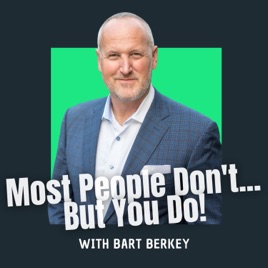
Advertise on podcast: Most People Don't... But You Do!
Rating
5from
This podcast has
265 episodes
Language
EnglishPublisher
Bart BerkeyExplicit
No
Date created
2021/03/01
Latest episode
2026/10/07
Average duration
36 min.
Release period
6 days
Description
A journey into the extraordinary. Stories of individuals who have gone above and beyond in their lives and careers. Those who defined excellence & achieved remarkable success. Join Bart Berkey, former Global Executive for the Ritz-Carlton as he sits down with influential leaders, innovators, and visionaries to uncover the key decisions, early influences, and acts of kindness that have shaped their paths. From hospitality legends like Horst Schulze, Founder of the Ritz-Carlton to entrepreneurial trailblazers like Kara Goldin, these conversations reveal the insights and lessons that inspire.
Unlock Most People Don't... But You Do! podcast Email contact info,
Listeners & Audience details
Email contact information
Direct podcast contact details

Listeners
Audience numbers & engagement insights

Audience details
Podcast Insights

Podcast episodes
Check latest episodes from Most People Don't... But You Do! podcast
You Are Not Listening. You Are Waiting To Talk. | Jeff Borman, Virgin Hotels' Head of Sales
2026/10/07
Jeff Borman is Global Head of Sales, Revenue and Distribution for Virgin Hotels Collection, and he and Bart Berkey have known each other for more than twenty years, since the days when Jeff ran revenue for The Ritz-Carlton Pentagon City and Bart was there.
Which makes the first thing Jeff says about that period surprising. He thinks he did it badly.
His explanation is not modesty. He had come from the Marriott side of the business, he was technically right about everything, and he did not understand the room he was in. The general manager pulled him aside and told him that running a Ritz-Carlton like a Courtyard might be defensible on the numbers and was the wrong thing to say out loud, because the people in that building needed to believe nothing was like the Ritz-Carlton. Jeff left, and came back to the brand years later to do it properly.
That pattern runs through the whole conversation. He asked an AI to describe him and it told him he is someone who builds a thing, breaks it, and builds it again, which he had not noticed about himself. He traces it to two fathers, an artist and a corporate finance lawyer, one who taught him to see from a hundred thousand feet and one who taught him what a semicolon costs.
The part he says shaped him most is his mother. She never went to church. Asked why, she looked up at the trees and said, "This is my temple." It took him until well into adulthood to understand that she was not being idle, and that there is work happening in that stillness.
Bart matches him with a story from his own first day at The Ritz-Carlton, when a housekeeper greeted him by name and he was so determined to respond perfectly that he said nothing at all.
Then Bart asks the question the show is named for, and Jeff takes his time before answering it.
In this episode:
The mentor who blocked half of every Friday, and why ten percent of a week is enough
Why a quarter of your inbox never needed you
Why the trust had to come before the title
The job he thinks he did poorly, and what the general manager taught him
What an AI noticed about him that he had not
Two fathers, and being made of both of them
This is my temple
Forty things by forty, written down rather than thought about
What a be yourself culture looks like when it is real
The one thing he does that Most People Don't
ABOUT JEFF BORMAN
Global Head of Sales, Revenue and Distribution for Virgin Hotels Collection. More than twenty-five years in hospitality, with senior roles at Ashford, Hilton, Marriott and The Ritz-Carlton. Founder and host of the No Show podcast, with more than one hundred episodes.
Podcast: https://noshowpod.co
Most People Don't... But YOU Do! is hosted by Bart Berkey, who spent 16 years as a global executive with The Ritz-Carlton and now builds HUMANALITY™, a system for making people feel cared for, valued, seen and heard rather than processed.
CONNECT WITH BART
Connect with me on LinkedIn: https://www.linkedin.com/in/bartberkey/
Subscribe to my newsletter: https://www.bartaberkey.com/join-the-newsletter
Book me for a keynote presentation: https://www.bartaberkey.com/booking-engagement-page
Listen, subscribe and share: https://www.bartaberkey.com/podcast
Sometimes You Should Be Late: Alex Snider on Forced Pauses | Alex Snider, Author of "Sometimes You Should Be Late"
2026/10/01
Alex Snider spent fifteen years inside federal work, in domestic policy, at the State Department, at the World Bank and in the Senate. Then a bicycle accident stopped him, and he came out of it having written a book arguing that you should sometimes be late on purpose.
He is careful about what that does and does not mean. He is not a productivity guest, he does not do tips, and when Bart asks him for the one thing people should do to slow down, he says he cannot answer that and will not try. His argument is that how you receive an idea is so different from how anyone else does that handing out instructions is the problem rather than the fix.
What he offers instead is a distinction. Speed is not the enemy and slowness is not the goal. The question is whether you slow down enough to notice which one a moment is actually asking for. He calls the other half of it emotional punctuality: the difference between having shown up for the meeting on time and having actually been present for the person in it.
The most useful thing he says is also the most uncomfortable. He says he is not a good person when he is rushing, and that the book is about the kind of people all of us become under a sense of scarcity and urgency. Then he says the part most authors leave out, which is that he still loses to it. He names another writer whose success makes him feel behind, by name, and says he gets dragged into comparison every single day.
Bart matches him, with a story about scrolling LinkedIn on a family holiday in Hawaii, seeing another speaker with more bookings than he had, and his daughter asking him why he was even looking at that now.
In this episode:
Why he turned down the show's signature question before answering it
Learning to skip things rather than add them
Why he refuses to tell anyone how to slow down
What he noticed about the way Bart filled in, and did not fill in, his own preparation
His brother at the train station, and a phrase worth stealing about tangled nets
Emotional punctuality, and what it costs to confuse it with being on time
Where he politely disagrees with being where your feet are
Fifteen years in government, and why none of it was mindful
The bike accident, and what a forced pause actually is
The gap between the person we say we want to be and the person we are
ABOUT ALEX SNIDER
Writer, facilitator and meditation teacher, and a former government strategist. Author of Sometimes You Should Be Late: The quiet rebellion of slowing down in a world obsessed with speed, published by Practical Inspiration Publishing with a foreword by Diana Winston. Co-founder of Mindful Fed, the first government-wide mindfulness community. He writes the Human Bureaucracy column for Psychology Today.
Website: https://www.slowmindfulness.com
Most People Don't... But YOU Do! is hosted by Bart Berkey, who spent 16 years as a global executive with The Ritz-Carlton and now builds HUMANALITY(tm), a system for making people feel cared for, valued, seen and heard rather than processed.
Listen, subscribe and share: https://www.bartaberkey.com/podcast
You Are One Action Away From The Whole Thing Changing. He Proved It Twice | Mark Pattison, NFL Veteran & Seven Summit Mountaineer
2026/09/24
Mark Pattison was drafted by the Raiders in the seventh round, played five years in the NFL, and will not use the word retired. His words for what happened are that he got kicked out and not let back in.
What came next is the part of his story he has told least. For two years he had no purpose and no skill he could name other than catching a football. He was in the University of Washington Hall of Fame. He had been in a locker room with Howie Long, Marcus Allen and Jim Plunkett. When it ended he expected his phone to ring off the hook, and not one person called. He took a job waiting tables at the Chart House, where his old teammates came in to eat, and he lasted six months before he decided he hated it enough to do something else.
That decision became the sentence he now builds everything on. Action creates reaction. It carried him into a marketing company, then into twelve years at Sports Illustrated, where the business he built went from number 17 in its category to number 1, and then up the Seven Summits, the highest peak on each continent, which he is the only NFL player ever to complete.
In this conversation with Bart Berkey, Mark talks about the freshman year that ended his belief that talent was enough, when he was 181 pounds and could not bench his own weight. He talks about the valleys behind the shiny things, including the one made of a divorce and his father's death. He explains the discipline that got him up Everest and the Matterhorn, which is not looking at the mountain at all, only at the next ten steps.
Then Bart asks him what he is most proud of that is not shiny, and Mark answers in one line about his two daughters, and it reframes everything he said before it.
In this episode:
Stepping into the fear, and his own answer to the question this show is named for
Why he says retired is the wrong word
181 pounds, and the freshman year that woke him up
Two years without purpose, and the phone that never rang
Waiting tables at the Chart House while his old teammates came in
Action creates reaction, the sentence he built a second career on
Sports Illustrated, from number 17 to number 1
Ten more steps, and why he never looks at the summit
The one accomplishment he does not consider shiny
The one thing he does that Most People Don't
ABOUT MARK PATTISON
NFL veteran, and the only NFL player to climb the Seven Summits. Winner of a 2022 Sports Emmy for Best Short Documentary for Searching for the Summit. Author of Finding Your Summit: How to Build Resilience and Faith to Conquer Life's Peaks, and host of the Finding Your Summit podcast.
Website: https://markpattisonnfl.com
Most People Don't... But YOU Do! is hosted by Bart Berkey, who spent 16 years as a global executive with The Ritz-Carlton and now builds HUMANALITY™, a system for making people feel cared for, valued, seen and heard rather than processed.
Listen, subscribe and share: https://www.bartaberkey.com/podcast
Alive At The Right Time | Caitlin Weis, Ambassador of Cystic Fibrosis
2026/09/18
Caitlin Weis was diagnosed with cystic fibrosis at three months old. She has been admitted to hospital 96 times. For twenty five years almost nobody outside her family knew, because her mother used to walk her out of the room before the talks began so she would not hear how long people thought she had.
What makes that strange is that she was never actually hiding. She has been an ambassador for the Cystic Fibrosis Foundation for as long as she can remember. She was five years old selling raffle tickets at their fundraisers, working a room for a cause that was her own life, and saying nothing about herself.
In this conversation with Bart Berkey, recorded in Cancun, Caitlin talks about what ended that. Her mentor, a woman who also had cystic fibrosis and who happened to share her name, died in her twenties. Caitlin used to call her for everything. She decided she did not want it to be in vain, so she started speaking.
She explains what CF actually is, a genetic disease that affects every organ and that you cannot see from the outside. She talks about being denied a new medication three times because she was in borderline liver failure, about starting a bucket list instead, and about the phone call that changed it. One week after starting the medication she went from 50 percent lung function to over 100 percent.
She also says the line the episode turns on. She will most likely never see a cure, and she is okay with that, because the people she is fighting for are the children being born now.
In this episode:
The invisible backpack, and what she wrote on hers
What her mother said instead of you are different
Why she says being kind is the cheaper option
Two gene therapies that failed, and the third she almost refused
50 percent lung function to over 100 percent in one week
The grandmother at a walkathon who had never met anyone with CF over 30
Fighting for a cure she does not expect to use
The one thing she does that Most People Don't
IF CYSTIC FIBROSIS IS PART OF YOUR LIFE
Cystic Fibrosis Foundation: https://www.cff.org
CF Foundation Compass, free and confidential help with insurance, costs, care and referrals: 1-844-COMPASS
Most People Don't... But YOU Do! is hosted by Bart Berkey, who spent 16 years as a global executive with The Ritz-Carlton and now builds HUMANALITY, a system for making people feel cared for, valued, seen and heard rather than processed.
Listen, subscribe and share: https://www.bartaberkey.com/podcast
The Version of You That Got You Here Cannot Get You There | Josh Zolin, CEO of Windy City Equipment Service
2026/09/10
Josh Zolin was a Hollywood stunt man before he became a CEO. He walked away from the film business, started at the bottom of his father's restaurant equipment company as a field technician on minimum wage, and now runs it as President and CEO of Windy City Equipment.
In this conversation with Bart Berkey, Josh explains the thing that made all of it possible. Every level of success he reached required a different version of him to show up, and confronting the old version was the hardest work he has ever done.
He talks about why he left the stunt world, and it was not about credit or money. It was that he did not like the person he was becoming in order to succeed. He talks about the ten years he spent in the field, getting up at 4:30 in the morning and working a second job because his father refused to pay him more than minimum wage, and about the line that explains why he stayed: he did not like the work, but he liked who he was when he was working.
Then he gets practical. Josh handwrites three notebooks every single day. A wins notebook built on four filters, freedom, presence, impact and love. A universal questions notebook that teaches him how to think. And an excavation notebook, where he writes the hard question, the unfiltered answer, the sentence that starts with "the lie I'm telling myself is," and finally "I am the man who." His claim is simple. Do that for a year and you will not be the same person.
He also answers the question the show is named for. Why don't most people do this work? Because they mistake uncertainty for something they need to know, and anxiety comes from two things: what we are uncertain about, and what we feel powerless against.
Josh is the author of Blue Is The New White, a case for purpose and real earning in the skilled trades, and the host of Everything They Don't Tell You. Find everything at joshzolin.com.
In this episode:
The one thing Josh does that Most People Don't
Why he left the stunt business, and the moment in the mirror
Starting as a technician with no silver spoons and no handouts
Why fair and the same are not the same thing in a company culture
What it means to give someone your present instead of your attention
The three notebooks, and the four parts of every excavation entry
Why uncertainty and powerlessness are the recipe for intrusive thoughts
Blue Is The New White, and the case for the skilled trades
Most People Don't... But YOU Do! is hosted by Bart Berkey, who spent 16 years as a global executive with The Ritz-Carlton and now builds HUMANALITY™, a system for making people feel cared for rather than processed.
Listen, subscribe and share: https://www.bartaberkey.com/podcast
At All Costs. No Matter What. How Ryan Bartlett Built a $100M Brand on Service. | Ryan Bartlett, Co-Founder of True Classic
2026/09/03
SEASON 4, EP. 248
Guest: Ryan Bartlett | Co-Founder & Chairman, True Classic | Los Angeles, California
Web: trueclassictees.com
LinkedIn: Ryan Bartlett (30,000+ follow
EPISODE SUMMARY AND KEY TAKEAWAYS
Ryan Bartlett flunked out of Michigan State, went broke trying to make it as a poker pro in Vegas, worked nightclub VIP rooms in Orlando and LA, and then spent a year quietly researching the most saturated, commoditized category in fashion before deciding to shoot his shot. That company is True Classic, now one of the fastest-growing D2C apparel brands in the world.
But this episode is not really about T-shirts. It is about what happens when a founder with a service heart builds a company around the belief that the customer experience matters more than the money. Ryan and Bart connect over Ritz Carlton-level service, the Humanality framework, and a story that started with two canceled orders, a TikTok live comment, and ended with five brand new True Classic shirts showing up at Bart's door unannounced.
Ryan talks about the parents who believed in him through every pivot, the stepbrother who reminded him of a promise he made at 19 in the Bahamas, the co-founder who ran with the culture from day one, and why he tells his customer service team to throw the 30-day return window out the window. Every time. No exceptions. At all costs.
What You Will Walk Away With
At all costs means exactly that. Ryan's customer service mantra is simple: the customer needs to have a good experience, period. Even if True Classic loses money on the transaction. The word of mouth from one bad experience costs far more than the refund. His team knows this without being told twice.
Ritz Carlton service is not a hospitality concept. It is a business model. Ryan built True Classic's culture around the same standard Bart learned at the Ritz. Surprise and delight. Notice, anticipate, over-deliver. CSAT score of 4.97 at all times. These were not aspirational goals. They were the baseline.
Parents who believe in you change everything. Ryan credits his parents more than any business school, course, or mentor. They backed every instrument, every idea, every pivot. That unconditional belief became the confidence that let him walk into the most saturated category in fashion and know he was going to crush it.
Most people get into businesses they do not love. Ryan's fill-in-the-blank answer is the throughline of his entire story: most people start businesses for the opportunity, not the passion. And when year two or three gets brutal, the opportunity is not enough to keep you going. The love is what keeps you going.
It was never about the T-shirt. It was about giving 6 million guys the confidence to leave the house feeling good about themselves. That was always the North Star. The revenue followed the mission, not the other way around.
Optimization never stops. Ryan lives in what he calls optimization mode — constantly scanning for things that are a 7 out of 10 and figuring out how to make them a 10. His next chapter is not another product. It is teaching the next generation of D2C founders how to build and scale a brand using what he actually learned from doing it, not from repackaging other people's advice.
He crashed two cars at 16. Built a $3 billion company fixing everyone else's | Matt Ebert, CEO and Founder of Crash Champions
2026/08/28
At 16, Matt Ebert wrecked his car twice. The first one was totaled. The second time, he was too afraid to file an insurance claim, certain it would cost him his coverage and with it his newfound freedom to drive. So he found a man in town who worked a day job and fixed cars at night in his garage, and asked to be taught.
He has been in collision repair ever since. Today he is the founder and CEO of Crash Champions, with more than 650 locations, 11,000 employees, 60,000 cars repaired every month, and $3 billion in revenue. He calls that 5 percent of his market and says it is nowhere near enough.
In this episode, recorded at PodCrash Studios in Chicago, Bart Berkey asks Matt the question this show is built on: what do you do that most people don't? What follows is the conversation most CEO interviews never reach. Kmart clothes and split kids' meals. A paper route that taught him to collect, hold, pay, and keep the difference. One hundred thousand dollars cash advanced on credit cards for four Subway franchises that never made money, and a return to the body shop floor to cover the bills. A mind that has never once treated quitting as an option.
Matt is candid about the parts that do not fit on a highlight reel. Why he is most comfortable at the bottom of the rollercoaster and most nervous at the top. Why he still cannot sleep. What the drive has cost his wife and his kids, and why he measures the quality of his time with them rather than the quantity. And why, at Crash Champions, repairing the car is only the ante. The real work is trust, delivered to people on the worst day of their week, across 650 locations he cannot personally stand in.
His answer to the closing question is one word longer than you expect, and it reframes everything before it: most people don't get curious enough.
Most people fix what is broken and move on. Matt Ebert built a company around leaving things better than he found them.
Key takeaways
Think bigger than the room you are in. Matt's answer to "what do you do that most people don't" was immediate: he thinks bigger, and he pushes the people around him to do the same. It was not there at 16. It got built.
The wreck was the doorway. Two crashes at 16 and a fear of losing his driving freedom sent him into a neighbor's garage to learn collision repair. The problem he was trying to avoid became the career.
He is not naturally good at anything, and that is the advantage. "I can't sing, I can't dance, I don't have athletic ability." What he learned instead was that he can figure almost anything out if he reads about it, asks about it, and practices it.
Better is the whole business. Landscaping, construction, collision repair, all of it is transformation. "I want people to think their life has been better for having me involved in it." Bart's frame for it: easy to be, but better to become.
Learn more at mattebert.com and crashchampion.com
Listen to PodCrash with Matt Ebert wherever you get your podcasts Follow Matt: LinkedIn, Instagram @mattebertcc, X @MattEbertCC, Facebook @MattEbertCC
You Don't Have to Carry It Anymore: Tia Crystal on Healing the Inner Child, Mental Health, and Feeling Safe Again | Guest: Tia Crystal, Author & Founder of Be Wellness Mind
2026/08/20
Episode Summary
Some people you meet feel less like new acquaintances and more like a reunion. That's how Bart Berkey describes meeting Tia Crystal — an internationally recognized artist, author, wellness advocate, clinical hypnotherapist, and founder of Be Wellness Mind — whose work has been shown at the United Nations in Geneva. In this warm, wide-ranging conversation, Tia opens up about growing up with severe dyslexia and the self-worth struggles it fed, a message she received at age ten that she wouldn't understand her purpose until forty, and how she became "the living embodiment" of what she now teaches.
Key Takeaways
You are the success today. Whatever happened before, you go back to old patterns as the empowered adult you already are — not as the wounded child.Safety is the foundation of everything. "If you feel safe inside you, you can do anything." Real change starts by helping your younger self feel safe.Strong is muscle; power is knowing. Strength is effort; power is the quiet certainty of who you already are.Become the observer. ~60,000 thoughts a day, ~90% repetitive, ~80% negative. See a negative thought as a "gremlin" outside you — name the feeling, and it loosens its grip.Stop rereading chapter one. Most people replay the same story to the end, then start it over. It's time to give yourself permission to write a new one.Make peace with worry. You may never delete it — but you can breathe, put your arms around yourself, and lessen its grip instead of numbing it away.
Quotable Moments (pull-quotes for the newsletter / social)
"Strong is muscle. Power is knowing."
"You are the success today, regardless of what happened to you before."
"It's time to write a new story. What do you give yourself permission to write?"
"The more you run from something, the more it runs after you."
"You are the microcosm of the macrocosm. The only way to change the world is to change your little corner of it."
Quotable Moments (pull-quotes for the newsletter / social)
"Strong is muscle. Power is knowing."
"You are the success today, regardless of what happened to you before."
"It's time to write a new story. What do you give yourself permission to write?"
"The more you run from something, the more it runs after you."
"You are the microcosm of the macrocosm. The only way to change the world is to change your little corner of it."
Episode Details:
Show: Most People Don't… But You Do!Season 4, Episode 246Host: Bart BerkeyGuest: Tia Crystal, Artist, Author, Wellness Advocate, Clinical Hypnotherapist & Founder of Be Wellness MindBook: The Paintbrush (Amazon & Audible)Also: Creator of the animated children's mindfulness series E Me UniConnect: tiacrystal.com · bewellnessmind.com · bewellnesstravel.com
The Answer Is Always Yes: How Kaye Gitibin built Go Rentals into hospitality on wheels. | Guest: Kaye Gitibin, CEO & Founder of Go Rentals
2026/08/14
Guest: Kaye Gitibin, CEO and Founder of Go RentalsCompany: Go Rentals (elite mobility rental serving private aviation, 300+ locations, the only rental company recognized by the Forbes Travel Guide)Host: Bart BerkeyEpisode details: Season 4, Ep. 245
Thirty years ago, Kaye Gitibin and his brother Habbas started with seven vans and an idea nobody else in the industry was chasing: what if renting a car felt like checking into a five-star hotel? They called it hospitality on wheels. Today, Go Rentals serves private aviation and luxury travelers across more than 300 locations nationwide, it is the only elite car rental company recognized by the Forbes Travel Guide, and it has never spent a single dollar on advertising. Every bit of growth has come from relationships and referrals.
In this conversation with host Bart Berkey, Kaye traces his servant heart back to his mother, who rolled out the red carpet for every guest and cooked what the guest wanted rather than what was convenient. He explains why the answer to every legal and ethical guest request is "yes" (yes, his team once bought a Van Cleef bracelet and sourced an orange G-Wagon on request), why he hires for a "hospitality bone" instead of a resume, and how AI can enhance service by anticipating a guest's needs but can never replace the human touch. Kaye and Bart, a 16-year Ritz-Carlton veteran, connect over a shared belief: in an uncertain, increasingly automated world, the companies that win are the ones that make people feel genuinely cared for. It is a masterclass in noticing, anticipating, and over-delivering, and in taking a client from impressed to obsessed.
Key Takeaways
Service is the product, not the car. Go Rentals hand-picks its vehicles and keeps every car under 15,000 miles, but Kaye is blunt: guests come for the experience, not the vehicle. A $2,000 hotel room and a $125 room both have a bed. The differentiator is always the service around the thing.The answer is always yes. If a request is legal and ethical, the answer at Go Rentals is yes. That single rule turned a surprise Van Cleef bracelet and an orange G-Wagon into legendary surprise-and-delight moments and lifelong fans.You cannot insert a servant heart, so hire for it. Kaye hires for hospitality instinct over experience. Half the interview is how a candidate treats the receptionist and carries themselves in the lobby. Skills can be trained; a servant heart cannot.Notice, anticipate, over-deliver. Remembering a guest likes red M&Ms, warming the seats before arrival, tracking the plane so the car is already waiting. Small anticipations create outsized loyalty. Their slogan: if the guest has to wait for us, the car is complimentary.Relationships beat advertising. In 30 years, Go Rentals has spent nothing on marketing. Growth has come entirely from referrals and from becoming part of guests' lifestyles, not just their travel day.
Learn more about Kaye Gitibin at gorentals.com and follow Go Rentals on LinkedIn.
They Said Surgery Was the Only Option. He Built a Company to Prove Them Wrong | Seth Berge, Regenerative Revival
2026/08/06
Seth Berge spent his 30s being comfortable. Good at making money, better than his friend group, never quite pushing past good enough. Then he hit 40, got around the right rooms, and asked himself a question that changed everything: if other people built something great, why not me?
Seth is the founder of two regenerative medicine companies: Regenerative Revival, a concierge in-home stem cell therapy service operating in all 50 states, and Precision Biologics, the distribution and contract manufacturing company behind it. He spent eight and a half years giving over 2,000 dinner seminars educating people about regenerative medicine, built a team of 25, and is now scaling both companies after years of finally deciding to go all in.
Bart and Seth go deep on what it actually takes to stop half-assing entrepreneurship, what stem cell therapy is and where it actually comes from, why your 43-year-old stem cells are not as good as a newborn's, and how Seth's entire business model is built around three things most people in his industry skip: education, access, and affordability. Bart uses his own neck surgery and ongoing pain management as a real-time case study, and Seth walks him through exactly what a treatment would look like, what it costs, and why the recovery time is almost nothing compared to surgery.
This episode is equal parts mindset conversation and health education, and it delivers on both.
What You Will Walk Away With
Most people don't go for it. That is the whole problem. Seth spent a decade being comfortable before he realized comfortable was a choice, not a ceiling. The only thing separating him from the entrepreneurs he admired was discipline and experience. One of those he could buy with mentorship. The other he had to earn by showing up.
Get in rooms where you are not the smartest person. Seth credits this shift more than any strategy. Paying for coaches, attending David Meltzer events, surrounding himself with people who had done more than him. David Meltzer's line landed hard: be interested, not interesting.
Business is a sport. Play it like one. Seth is an ex-athlete who played every sport to win. When he finally brought that same intensity to entrepreneurship, everything changed. He now has 25 people relying on his company. That weight is heavy and motivating at the same time.
Your body already knows how to heal. It just needs the right tools. Regenerative medicine is not magic. Stem cells and exosomes from umbilical cord tissue after a C-section birth give the body the youngest, most active healing agents available, ones your own body stopped producing at full capacity decades ago. The science is real, the FDA guidelines are strict, and the results for soft tissue repair are documented.
Education, access, and affordability are the three things the industry skips. Most people have heard of stem cell therapy but have no idea what it is, where to get it, or what it costs. Seth built Regenerative Revival around solving all three. Concierge in-home service. All 50 states. Packages starting at $5,000, significantly less than most clinics because Seth controls the manufacturing.
The goal is to fix the root cause, not manage the symptom. Cortisone injections mask pain. Surgery replaces parts. Regenerative therapy, at its best, repairs the actual tissue defect so the problem does not come back. One treatment. No brick-and-mortar overhead. A nurse practitioner comes to your home in two to three weeks.
Guest: Seth Berge | Founder, Regenerative Revival & Precision Biologics | Minneapolis, Minnesota
Web: regenerativerevival.com or gutstemcells.com
LinkedIn: Seth Berge
Learn more about Seth Berge and Regenerative Revival at regenerativerevival.com or gutstemcells.com and connect with Seth Berge on LinkedIn.
Most People Don't. But You DO!
Stop Waiting for the Right Room. Stacey Lauren Built One | Stacey Lauren, Founder of Do The Thing Collab Network
2026/08/06
When Stacey Lauren was eight years old, a girl who was deaf came to her house and fell in love with her Smurf collection. Stacey gave it away. All of it. Every last Smurf. Her mom was stunned. Stacey did not think twice.
That instinct, giving without being asked, never left her. It drove 20 years of running a staffing company with 1,260 combined employees. It drove the identity crisis she fell into when she exited. And it drove the question she could not stop asking: why do so many people know what they want to do and still not do it?
The answer she found was not about motivation or mindset. It was about rooms. The right rooms, full of people chasing the same goal, change everything. Not your friends. Not your family. People who are doing the thing alongside you. That discovery became a podcast, a methodology, a movement, and now the Do The Thing Collab Network, a platform connecting people around shared goals, community engagement, and fundraising that ties it all together.
Bart and Stacey talk through her Comfort Circles framework live, using Bart's real-life event that evening in Washington DC as the case study. They unpack why most communities think people are connecting when they are not, why vulnerability in a Senate building hallway can outlast the meeting that sparked it, and why the person who needs your message does not care about your shower cap.
This episode is for anyone who has been doing the thing alone and wondering why it feels so hard.
What You Will Walk Away With
You need people with the same goal, not just people who love you. Friends and family will cheer for you. But the people who are doing the same hard thing you are doing right now are the ones who will keep you from quitting. Stacey calls it Like Gold. Find your rooms.
Horse mode is not failure. It is the first step. The Comfort Circles framework begins with the horse: non-verbal, not yet engaging, camera off or hanging near the bathroom at the networking event. Knowing you are in horse mode means you stay in the room. That is the whole win.
Most communities are connecting at the surface. That is the problem. Showing up to events, doing the activities, checking the boxes does not mean people are actually connecting. Real engagement requires a shared goal inside the community, not just shared attendance.
Stop doing it for other people. Stacey went live for 80 episodes with her camera off because she was scared of how she looked. The shift happened when she realized the person who needs your message does not care what you look like. Get your voice out. That is the whole job.
Education by contribution is the secret to community. When people share their ideas out loud in a room, not just receive information, the room transforms. Stacey calls it the E in her I'm Game framework. Bart saw it live in a Senate hallway when 99 out of 100 people stayed after the panel ended because someone was finally being real.
Doing the thing and having your voice in it are two different things. Stacey always did the thing: sold books door to door, co-founded a company at 25, scaled it for two decades. But she did it without her voice for most of it, doing what she thought others needed instead of what she was actually built for. That gap is where most people live. Closing it is the work.
Learn more about Stacey Lauren and Do The Thing Collab Network at dothethingcollaboration.com. Connect with Stacey Lauren on LinkedIn and find the Do The Thing podcast on all major podcast platforms.
Most People Don't. But You DO!
Reinvent Yourself Before Life Forces You To | Guest: Craig Siegel, Founder of CLS
2026/07/30
Episode Description
For 13 years, Craig Siegel measured his life in external wins, the number in the bank account, the apartment in New York City, the next goal. And none of it made him feel like enough. In this episode, the Wall Street Journal bestselling author, TEDx speaker, and founder of CLS (Cultivate Lasting Symphony) tells Bart Berkey how a "dark night of the soul" and a global pandemic forced the pause that changed everything, and why he now trusts "invisible progress" over the visible kind.
Craig and Bart who found his own forced pause through a heart attack, dig into a truth most people avoid: we wait until life pauses us instead of pausing on purpose. Craig shares the exact practices that rebuilt his life from the inside out: starting the day with "the most important meeting of your day," flipping the script from consume to create, reframing challenging days as the greatest opportunities for growth, and reinventing yourself before life forces you to. It's a fast, quote-packed conversation about trading the exhausting chase for alignment, where success becomes an expression of who you are instead of something you're constantly chasing.
Key Takeaways
Peace creates success — not the reverse. Craig spent years believing success would create peace. The breakthrough was realizing it's the other way around.Trust invisible progress. Track the internal metrics — Am I calmer? more generous? less reactive? more present? Focus on the roots and the fruits follow.Chasing external wins is a losing game. Like a drug, it's a high, then a "bye." It never fills you, because it doesn't measure fulfillment.Most people don't pause voluntarily. They wait until life pauses them — a heart attack, a pandemic, a rock bottom. Don't wait for the crash to reevaluate.Start with the most important meeting of your day. A 10-minute morning check-in sets the tone so you lead the day proactively instead of reacting to everyone else's noise.Before you consume, create. Reaching for the phone first thing asks "World, tell me who I need to be today." Flip it: create before you consume, reflect before you react.Challenging days are the opportunity. Reframed through Kabbalah, the hardest days are where the soul grows, ascends, and transforms.Reinvent before life forces you to. Reinvention isn't becoming someone else — it's becoming more of who you really are. The world needs more aligned people, not more successful ones.
The Cure for "Not Enough-ness” | Guest: Brett Kaufman, Founder of Inner Space
2026/07/30
You climb the mountain, the money, the awards, the deals, and then you look around and realize it's not filling you up anymore. So what does?
In this episode, Bart Berkey sits down with Brett Kaufman - entrepreneur, advisor, investor, and founder of Inner Space. After nearly 30 years in business and building, managing, and selling billions of dollars of real estate (including The Gravity Project in Columbus, Ohio, described as the world's largest conscious community), Brett hit the wall that so many high performers hit: "not enough-ness." The belief that more money and more things would finally make him feel like enough, and the hard-won discovery that they never do.
Brett shares why the real work isn't out there but inside, how his simple framework - awaken, align, expand - helps founders let go of what no longer serves them, and why the people who most need this are often the ones who look most successful from the outside. It's a short, rich first conversation (with a deeper one already promised).
Bart welcomes Brett Kaufman, founder and CEO of a real estate development company and the founder and host of Inner Space, for a candid conversation about what happens after you "make it." Brett draws on nearly three decades as a founder, employer, husband, and father, and 15+ years building intentional mixed-use communities, to explain why he now devotes himself to helping high-performing founders and executives navigate life's hard transitions.
Key Takeaways:
More doesn't make you happier. Brett's pursuit of "more" came from "not enough-ness" — a belief he needed external validation to feel worthy. Accumulation has a diminishing return.The real work is inward. It's called Inner Space, not outer space, on purpose. Clearing out old conditioning and inner chatter is where real growth happens.Money is a tool, not the goal. Brett enjoys money for the freedom, security, generosity, and ease it creates — but it's not what fills him up. Being of service is.
Episode Details
Show: Most People Don't… But You Do!Season 4, Episode 241Host: Bart BerkeyGuest: Brett Kaufman — Entrepreneur, Advisor & Investor; Founder & CEO of a real estate development company; Founder & Host of Inner Space (and the Inner Space Podcast)Notable: Developed The Gravity Project in Columbus, Ohio — described as the world's largest conscious communityConnect with Brett: joininnerspace.com · brettkauffman.comNote: A shorter first conversation — Bart and Brett agreed to record a deeper follow-up.
Magic Socks, Dirty Truth The Work Was Always his Superpower | C.J. Watson, 10 year NBA Veteran, Philanthropist, Entrepreneur, Children’s Author, Angel Investor
2026/07/23
EPISODE SUMMARY AND KEY TAKEAWAYS
Ten years in the NBA. Golden State Warriors, Chicago Bulls, Brooklyn Nets, Indiana Pacers, Orlando Magic. Games overseas in Italy, Greece, Turkey. And when it was all over, CJ Watson sat on his couch and asked himself one question: how do I keep giving back?
That question became children's books. A foundation. Free basketball camps. A Black history essay contest with laptops and 529 plans as prizes. And now, a conversation with Bart about what it actually means to be a great human being, not just a great athlete.
CJ grew up in Las Vegas with Southern hospitality baked into his bones. Yes sir. No ma'am. Look people in the eye. Give them your name and ask for theirs. He never got drafted, went overseas first, and spent every NBA season knowing it could be his last. That perspective shaped everything. He never saw himself as a celebrity. He saw himself as someone who got lucky enough to do the work.
Bart and CJ unpack humanality through the lens of sports, autographs, fatherhood, and the moment a kid at a camp says "we love the book." They talk about what it means to be present, why consistency beats talent most of the time, and how a pair of unwashed orange socks from the University of Tennessee became a lesson about preparation over superstition.
This one is warm, grounded, and full of the kind of humanity that makes the MPD audience forward episodes to people they love.
What You Will Walk Away With
Consistency beats talent. Every time. CJ's fill-in-the-blank answer came fast: most people don't be consistent. Show up on good days and bad days. Do the work when no one is watching. That is what separates the people who make it from the people who almost did.
Humanality on the court. When a fan waits hours to meet you, that moment is not about you. It is about them. Look them in the eye. Ask their name. Use it. CJ named all three steps of Humanality without being asked: I see you, be where your feet are, and just ask.
Legacy is not what you keep. It is what you give away. CJ gave away his first NBA jersey. He gave away his time, his stories, his books. He started a foundation so that kids growing up in Las Vegas have resources his family had to figure out alone. You cannot take it with you. That is the whole point.
The magic was never in the socks. CJ wore the same pair of unwashed orange socks every time he played well in college. But the real lesson from his children's book is the one he figured out later: it was never the socks. It was the preparation, the film study, the discipline, the showing up. The socks just gave him permission to believe in himself.
Your parents are your first coaches. CJ's parents talked him out of quitting overseas. They showed up to games in college, flew to NBA cities, and built the foundation underneath him before he ever knew he needed one. His whole message to his own three daughters comes from the same place: look people in the eye, say please, say thank you, and never stop.
Great dads make great leaders. The greatest feeling CJ described had nothing to do with the NBA. It was watching his daughter block a volleyball. Legacy is not built on a court. It is built in the stands.
Learn more about CJ Watson and his foundation at quietstormfoundation.org and connect with CJ Watson on LinkedIn.
Most People Don't. But You DO!
She Fasted For 36 Days and This is What She Learned | Jaclyn Orent, Co-founder & CEO of the Cultural Catalyst Network™
2026/07/23
EPISODE SUMMARY AND KEY TAKEAWAYS
What does a 36-day water fast, a decade of rebuilding, and 60 years of change research have in common? They are all part of how Jaclyn Orent became one of the most uncommon leaders Bart has ever had on the show.
Jaclyn is the co-founder and CEO of the Cultural Catalyst Network, the first infrastructure built for societal-level change, connecting leaders across organizations to create the kind of cultural shift none of them could pull off alone. She joins Bart live from Boulder, Colorado for a conversation that moves fast, goes deep, and does not stay in the comfort zone.
They unpack the difference between leading from power and leading from force, why the leaders who have achieved the most are often the loneliest in the room, and what it actually takes to stop performing success and start becoming who you were built to be. Bart opens up about his own story, from panic attacks to a podcast in the top 2 to 5% globally, and Jaclyn reflects back what she hears in a way that reframes the whole journey.
This episode is for the leaders who have done everything right and still feel like there is something left undiscovered.
What You Will Walk Away With
Power vs. force is not just philosophy. It is a leadership system. The leaders who give to life produce results that grow over time. The leaders who take from life produce results that cost everyone around them. Jaclyn has spent seven years building a research-backed framework to help leaders move from one to the other.
The loneliest leaders are often the most successful ones. When you reach a certain level, everyone around you needs something from you. Peers become rare. That isolation is not personal. It is structural. And it is a problem worth solving intentionally.
Change happens through resonance, not information. Most organizations try to change culture by rolling out new strategies. But research from intentional change theory tells us that real change requires three things: shared vision, shared compassion, and shared energy. Without all three, the initiative stalls.
Most people are comfortable. That is the whole problem. Jaclyn's fill-in-the-blank moment lands hard: most people do not take the level of risk required to find out who they really are. Even high achievers stop short of discovering the greatness still inside them.
Transmutation is the real work. Bart shared his story of a botched surgery at 12, years of panic attacks, and the fear of losing control. Jaclyn named it clearly: he transmuted trauma into a platform for empowerment. That is not accidental. That is the work. And it is available to every leader willing to go there.
It is easy to be. It is better to become. Bart's line, and it is the throughline of the whole conversation. Staying who you are is comfortable. Becoming who you are meant to be requires action, risk, and the willingness to keep launching off the bridge even when it does not make sense to anyone around you.
Learn more about the Cultural Catalyst Network at culturalcatalystnetwork.com and connect with Jaclyn Orent on LinkedIn.
Podcast reviews
Read Most People Don't... But You Do! podcast reviews
Podcast sponsorship advertising
Start advertising on Most People Don't... But You Do! relevant audience podcasts
You may also like to advertise on these Podcasts
4.913551954
Wholesaling Inc with Brent Daniels
Find distressed properties for pennies on the dollar and turn them for huge profits!
4.6137771974
The Rubin Report
Dave Rubin
4.7278012000
The Matt Walsh Show
The Daily Wire
4.732631937
The President's Daily Brief
The First TV

4.819462000
Football Ramble
Stak
4.735971300
The Bonfire with Big Jay Oakerson and Robert Kelly
SiriusXM
4.827591699
Earn Your Happy
Lori Harder | YAP Media

4.816561992
Juicebox Podcast: Type 1 Diabetes
Scott Benner

4.682431282
The Daily Beast Podcast
The Daily Beast, Joanna Coles
4.8121021000
Mind Pump: Raw Fitness Truth
Sal Di Stefano, Adam Schafer, Justin Andrews, Doug Egge