1559292153
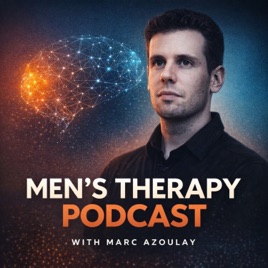
Men’s Therapy Podcast

Advertise on podcast: Men’s Therapy Podcast

Rating
★★★★★
4.9
from
27 reviews
This podcast has
100 episodes
Language
English
Publisher
Marc Azoulay
Explicit
Yes
Date created
2021/03/19
Latest episode
2026/04/23
Average duration
55 min.
Release period
7 days

Description

This is the ultimate podcast for men. The most pressing topics relating to men, covered in one podcast by Marc Azoulay, a psychotherapist with over a decade of experience. Using Neuroscience, Jungian Psychology, and Buddhist Philosophy, we explore, Men’s Mental Health Modern Masculinity, Authentic Leadership, and Shadow Work. Welcome to “Men’s Therapy Podcast” where we tackle essential questions like “How can I be a good man?” “What do leaders need to succeed?” “How do we break childhood wounding and generational trauma?” We also cover addiction recovery, mindfulness, coparenting strategies, spiritual development and more! Whether you’re seeking to understand emotional intelligence for leaders, improve executive functioning, or incorporate mindfulness into daily life, this podcast is for you. Join us as we uncover how childhood conditioning impacts our actions and discover pathways to self-improvement and personal development. Tune in to the Men’s Therapy Podcast and start your journey towards becoming a better father, leader, husband, and man today!

Unlock Men’s Therapy Podcast podcast Email contact info,
Listeners & Audience details

Email contact information

Direct podcast contact details

Listeners

Audience numbers & engagement insights

Audience details

Podcast Insights

Social media

Check Men’s Therapy Podcast social media presence


Podcast episodes

Check latest episodes from Men’s Therapy Podcast podcast


Why You Feel "Dead" Inside (It's Not Depression)
2026/04/23
Emotional numbness does not always look like a crisis. For many men, it is quieter, a steady flatness, a sense of static that will not lift no matter how much they push. In this solo episode of the Men's Therapy Online Podcast, Marc Azoulay, therapist, coach, and founder of Men's Therapy Online, is breaking down one of the most common yet least understood struggles facing modern men: the feeling of being emotionally switched off. Marc argues that what most men are experiencing is not a mindset problem, not laziness, and not something that will pass if they keep grinding harder. It’s a neurological issue rooted in a depleted opioid system, the part of the brain responsible for deep satisfaction, contentment, and enoughness. When that system goes quiet, a man stops feeling alive. He covers anhedonia (the inability to feel pleasure), and alexithymia symptoms (difficulty identifying and naming emotions),  that quietly accumulate when a man is always seeking but never arriving. He also walks through the mental fog causes that keep men stuck, chronic overstimulation, dopamine hijacking, and the fear of slowing down. "Before I got into therapy and coaching and self-improvement, I was dead," Marc says. "I was doing all the things right,  the gym, dating, building a business, but I just felt completely empty." The fix, he explains, requires going inward: starving the dopamine system through deliberate stillness, then learning to feel the body again through somatic awareness. On the other side of the discomfort — the fear, the pain, the noise — is what Marc calls enoughness. A felt sense of safety. Of being present on the earth. For more podcasts, blogs, and to get involved in the Men's Therapy Online Community, visit www.menstherapy.online. Follow us on social media: https://mtr.bio/mens-therapy-online.
The Most Dangerous Men Look Nice
2026/04/20
The fawn response is one of the most misunderstood patterns in men’s psychology. It doesn’t look like weakness. It looks like generosity, agreeableness, and keeping the peace. But underneath it, there’s usually a man who is terrified of being rejected, disconnected from his own needs, and slowly building resentment he has no healthy outlet for. That’s exactly where this conversation goes. In this episode of the Men’s Therapy Podcast, host Marc Azoulay sits down with Nima Rahmany — ex-chiropractor turned men’s coach and founder of the Becoming Trigger Proof framework — to unpack why so many high-performing men are secretly running a fawn response in their relationships, and why no amount of mindset work or personal development fixes it. The episode is honest, direct, and at times uncomfortable, exactly the kind of conversation most men have never had. Nima opens with a personal story of becoming physically violent in a relationship, tracing it back not to anger, but to years of fawning: people-pleasing, self-abandoning, and suppressing his truth out of fear. That moment of violence, he explains, was the explosion that follows years of suffocation. “Fawning is saying yes when the body is saying no.” And for many men, it is so ingrained it doesn’t even register as a choice. The episode covers: How the fawn response develops as a childhood survival strategy Why nice guy syndrome is not about being kind, it’s about avoiding guilt and rejection How trauma is stored in the body and what nervous system regulation actually looks like The role of shadow work and attachment theory in breaking the cycle How to stop people pleasing without overcorrecting into dominance or detachment What it means to become the “loving patriarch” — boundaried, grounded, and open-hearted Nima is direct, personal, and deeply knowledgeable. He isn’t offering a theory. He lived it. And the result is a framework that’s changing how men relate to themselves and the people they love. For more podcasts, blogs, and to get involved in the Men's Therapy Online Community, visit www.menstherapy.online. Follow us on social media: https://mtr.bio/mens-therapy-online.
Most Men Don’t Recover From Divorce… Here’s Why
2026/04/13
Divorce recovery is rarely just about legal paperwork and splitting assets. For most men, it’s one of the most disorienting experiences of their adult lives, and for those going through a high-conflict divorce, the chaos can stretch on for years. That’s exactly what this episode unpacks. In this episode of the Men’s Therapy Podcast, Marc Azoulay talks with Karen McMahon, a divorce coach, host of the Journey Beyond Divorce Podcast, and author of Stepping Out of Chaos: Turning Pain Into Possibility. Karen has fifteen years of coaching experience and a three-and-a-half-year high-conflict divorce behind her. This conversation is equal parts honest and practical. “Death is first, divorce is second,” she says, before noting that many of her clients would argue the order should be flipped. Grief is one thing. Divorce is something else. You’re dealing with your own emotions, your ex’s reactions, your children’s confusion, money, and where everyone is going to live, often all at the same time. Karen describes her own divorce as “an absolute living hell”, and the greatest gift she’s ever received. What the pain gave her was a mirror. What causes divorce, she argues, is rarely one dramatic event. It’s a slow breakdown of respect and communication in relationships, small problems swept under the rug until there is, as she puts it, “a mountain in the middle of the living room.” Every upset, she tells her clients, is a setup: a chance to look inward rather than blame the other person. Codependency in relationships, the martyr dynamic, self-abandonment dressed up as love, these are the patterns she helps men work through. And most of them go back to childhood. Her core message on how to survive divorce and how to cope with divorce is the same: use the pain. If you get through the legal process without doing the inner work, you’ll re-create the same relationship with a different face. The episode covers the key terrain of real divorce recovery:     Divorce advice for men on co-parenting: Protect children from adult conflict, say nothing negative about the other parent, and stay available as they grow, because the divorce impact on children plays out over years, not weeks.     How to tell kids about divorce: No universal script, but clear principles — tell them together when possible, keep it age-appropriate, and let their needs, not adult emotion, guide the conversation.     Dating after divorce: Get emotionally naked before you get physically naked. Know your non-negotiables. Date by design, not by default. The episode closes on generational trauma. “Addiction stops here. Abuse stops here. Codependence stops here.” Real divorce recovery, Karen argues, isn’t just a fresh start for one person, it’s a chance to break a cycle that may have run for generations. For more podcasts, blogs, and to get involved in the Men's Therapy Online Community, visit www.menstherapy.online. Follow us on social media: https://mtr.bio/mens-therapy-online.
Why We Can’t Stop Working: Inside a Workaholic’s Mind
2026/04/07
Workaholics rarely see themselves coming. The long hours feel necessary. The grind feels justified. And the people closest to them - a spouse, a child, a close friend — are left standing at the edge of a life that keeps getting smaller while the work keeps getting bigger. That’s where this conversation begins. In this episode of the Men’s Therapy Podcast, Marc Azoulay is sitting down with performance coach and therapist Michael Ceely, who specializes in working with high-achieving men, workaholics, and driven professionals. Together, they’re unpacking why so many successful men are using work not as a tool, but as a drug, and what it’s actually costing them. The episode is making one thing very clear: workaholism is not about ambition. It’s about avoidance. Michael is explaining that the modern workaholic is not grinding because he loves the work. He is grinding because stopping feels unbearable. The work is serving as a coping mechanism, a way to self-soothe anxiety, sidestep difficult emotions, and outrun an inner critic that is never satisfied. “You know that you’re a workaholic if you are really actually addicted to work, you’re using it as a way to self-soothe. Maybe you had an argument with your spouse. What do you do? You go work for five hours and you feel better.” It is showing up when a man:     Escapes conflict at home by disappearing into his laptop     Measures his worth entirely by his output and income     Can’t take a day off without spiraling into guilt or anxiety     Closes a seven-figure deal and feels absolutely nothing Hustle culture is making all of it worse. The relentless glorification of overwork on social media is creating an environment where being a workaholic is not just accepted, it’s celebrated. Comparison syndrome is doing the rest of the damage, turning a highlight reel of other people’s success into a personal failure narrative that keeps men chained to their desks. Marc and Michael are walking through what it looks like to break the cycle, covering perfectionism and anxiety, the ROI framework for real-life decisions, the psychology of fear-driven productivity, and what active recovery looks like for men who can’t sit still. For more podcasts, blogs, and to get involved in the Men's Therapy Online Community, visit www.menstherapy.online. Follow us on social media: https://mtr.bio/mens-therapy-online.
If You Had To Listen To One Conversation As A Man, This Is It
2026/03/30
Writing a book is one of the most revealing things a man can do. It forces you to sit with yourself, confront your insecurities, and commit to a process with no guaranteed payoff. For most men, that is exactly where the growth is, and it’s exactly where this conversation begins. In this episode of the Men’s Therapy Podcast, Marc Azoulay sits down with Magnus Johnson. He’s a former Green Beret, founder of Mission 22, and author of The Men We Make. Magnus talks about what writing a book taught him about men’s mental health, healthy masculinity, emotional intelligence, and what it really means to raise a son today. Magnus grew up in a van, was homeschooled on the road, and struggled with dyslexia and dysgraphia. Writing was never supposed to be his thing. But at 44, something shifted. He stopped caring what people thought and started writing anyway. The result is a novel told twice: the same story, two different outcomes. It explores how the small choices of the people around us shape the course of a life. The conversation covers:     What writing a book reveals about ego, vulnerability, and mastery     How empathy becomes a creative and entrepreneurial superpower     The male loneliness epidemic and why so many men are stuck on an outdated model     What healthy masculinity actually looks like beyond fake alpha culture     Fatherhood, discipline, and raising a son with intention     Why men need spiritual orientation, not just self-improvement hacks Writing a book, Magnus argues, forces a man out of strategy and into honesty. You can’t fake your way through 500 words a day for four months. You either show up or you don’t. For more podcasts, blogs, and to get involved in the Men's Therapy Online Community, visit www.menstherapy.online. Follow us on social media: https://mtr.bio/mens-therapy-online.
The Lie That’s Destroying Young Men
2026/03/23
Therapy for men has a problem, and it starts long before a man ever walks into a session. In this episode of the Men’s Therapy Podcast, Marc Azoulay is sitting down with Timothy Wienecke. Tim is a therapist, educator, air force veteran, and host of the American Masculinity Podcast. Together, they dig into how the mental health industry’s falling short when it comes to serving men, what counselor training’s missing, and what better care actually looks like. Tim’s drawing on years of clinical work and guest lecturing in graduate programs to make the case that men are not simply harder to reach, they’re a demographic the system hasn’t been properly trained to serve. The conversation is covering: Why counselor training still relies on modalities that are three or four generations old How the shortage of male clinicians is affecting the quality of care men receive What emotional intelligence and emotional expression look like in therapy for men  How to find the right therapist for men  “The field in general is almost always 10 years behind,” Tim’s explaining. “And if you put in men’s issues, tack another generation on that.” For more podcasts, blogs, and to get involved in the Men's Therapy Online Community, visit www.menstherapy.online. Follow us on social media: https://mtr.bio/mens-therapy-online.
The Most Powerful Tool You Have: Energy Awareness
2026/03/16
Spirituality is not the first word most men reach for when they are trying to fix their lives. But according to Dr. Dain Heer, it might be the most important one. That’s the question Dr. Dain Heer is bringing to this episode of the Men's Therapy Podcast. Dr. Heer is the co-creator of Access Consciousness, author of Being You, Changing the World and Return of the Gentleman. He’s one of the most compelling voices at the intersection of spirituality and modern masculinity. In his conversation with Marc Azoulay, he’s presenting a fundamentally different way for men to navigate their lives — one built on energetic awareness, intuition, and spiritual practice rather than judgment and control. The episode’s covering a lot: why men's emotional intelligence gets suppressed early, how people-pleasing and control are two sides of the same coin, what the access consciousness clearing statement actually does, and why the most powerful move a man can make is to stop trying to be right. "Energy is our first language," Dr. Heer is explaining. "It's the one that we've been so far distanced from because we've grown up in a world where we value thinking, we value judgments." The result, he’s arguing, is a generation of men who have done everything right on paper and still feel profoundly empty. Not because something is wrong with them. But because they are living inside a framework of judgment that has no room for what is actually true. That’s what this conversation is trying to change.
50 Minutes of Badass Grandad's Advice to Young Men
2026/03/09
How to become a mentor? What does it take to go from a self-described adrenaline junkie who sought his masculine identity in war zones and deadly mountain climbs, to one of the most thoughtful mentors for young men alive today? That is the question at the heart of this episode of the Men’s Therapy Podcast. That is where this conversation goes. In this episode, Marc Azoulay talks with John Graham, former US Foreign Service diplomat, founder of the Giraffe Heroes Project, and creator of the wildly popular Badass Granddad video series, about what it really means to be a man, and how older men can step up and lead younger ones. The episode makes clear that for much of Graham’s early life, redefining masculinity was the last thing on his mind. He was too busy living what he thought manhood looked like: freighter ships in the Far East, hitchhiking through an active war in Algeria, climbing the deadly north face of Denali, and filing dispatches from the early days of Vietnam. John Wayne was his idol. Danger was his compass. “I became an adrenaline junkie. The meaning of my life was to become a man, and I found that in violent adventure.” And that strategy got expensive. It shows up when a man:     Mistakes recklessness for strength     Suppresses compassion to appear tough     Chases adrenaline instead of meaning     And then finds himself, at nearly 30, ordering executions in a war he didn’t believe in, and finally weeping at the emptiness of it all Not because he lacked courage, but because he had built his whole identity around being feared instead of being known. That is the deeper problem here. When your whole sense of self is anchored in physical dominance and risk-taking, you lose contact with the rest of yourself. You stop feeling. You stop connecting. You start expecting the world to reward your self-abandonment. And when it doesn’t, something breaks. Marc and John talk through what it looks like to break that pattern, touching on emotional risk-taking, mentorship for young men, masculine identity, the power of small acts of service, and what it truly means to ask: what is a real man? One kind of strength is about proving yourself. The other is about giving yourself. For more podcasts, blogs, and to get involved in the Men's Therapy Online Community, visit www.menstherapy.online. Follow us on social media: https://mtr.bio/mens-therapy-online.
Stop Being a "Nice Guy" if You Want Respect (The Brutal Truth) w/ Kelvin Davis
2026/03/02
Nice guy syndrome is at the center of a quiet crisis in modern masculinity. It is shaping how men date, relate, suppress their needs, and carry resentment into adulthood. In this episode of the Men’s Therapy Podcast, host Marc Azoulay is sitting down with Kelvin Davis. He is a men’s therapist and coach specializing in male emotional development and relational health. He's the author of the book "Be a Good Man, Not a Nice Guy". His work is focusing on helping men move from approval-seeking patterns into grounded integrity. Kelvin approaches nice guy syndrome not as a flaw to shame. He is seeing it as a learned survival strategy, one many men adopt early in life to avoid rejection and conflict. Rather than asking what is a nice guy in superficial terms, he is exploring the deeper emotional drivers behind the behavior. “A lot of men confuse niceness with goodness,” Kelvin explains. “But niceness is often a strategy. It’s about trying to control how you’re perceived.” He is describing men who overextend in dating, struggle with porn addiction, and feel chronically misunderstood in relationships. Kelvin is emphasizing that the issue is not effort. It is authenticity. Marc is guiding the discussion toward solutions, examining how men’s therapy, boundaries, and emotional resilience are reshaping modern masculinity. For more podcasts, blogs, and to get involved in the Men's Therapy Online Community, visit www.menstherapy.online. Follow us on social media: https://mtr.bio/mens-therapy-online.
MASTERCLASS: Relationship Advice for Men: Attachment, Intimacy & Communication
2026/02/23
Most relationship advice for men sticks to basic tips on communication or attraction. But it misses the deeper problems. In this roundtable episode of the Men’s Therapy Podcast, host Marc Azoulay leads a straightforward talk. They discuss why relationships fail. They cover what men truly need in a relationship. They explain how avoidant and anxious attachment patterns shape men and their relationships. Guests include Shana James, a relationship coach and author. There's also Melissa Ryan, a licensed professional counselor who specializes in couples therapy. Jack Lambert joins too. He is a licensed mental health counselor focused on men’s therapy.  The group looks at emotional intimacy in relationships. They show how unconscious attachment dynamics can strengthen it or tear it down. This includes avoidant men who struggle to balance independence and closeness. Shana stresses that real connection needs visibility. "You can’t have deep connection without being seen," she says. She adds that vulnerability is not weakness. It is a strength in relationships. Melissa describes how relationships break down slowly. It is not always explosive. Small ruptures happen. They often go unrepaired. Over time, distance grows where closeness once was. Jack points out male loneliness and men’s mental health. Many men want intimacy. But they fear rejection or humiliation. Marc keeps the talk focused on growth, not blame. The episode skips quick fixes. Instead, it offers relationship advice for men. It centers on emotional awareness. It covers interdependence versus codependence. It builds courage for intimacy that lasts. For more podcasts, blogs, and to get involved in the Men's Therapy Online Community, visit www.menstherapy.online. Follow us on social media: https://mtr.bio/mens-therapy-online.
A 40-Year Real Estate Veteran’s Warning to Ambitious Men w/ Joe Kavanagh
2026/02/16
For many men, business resiliency doesn’t begin with strategy or spreadsheets. It begins with pressure, uncertainty, and the slow realization that working harder is no longer enough. It often arrives alongside emotional exhaustion, strained relationships, and the sense that something beneath the surface is asking to be addressed. It is not in the market, but within the man himself. In this episode of the Men’s Therapy Podcast, host Marc Azoulay is guiding a grounded and revealing conversation with Joe Kavanagh. He is a veteran entrepreneur. His career spans more than forty years across real estate, valuation, and leadership development. Joe is speaking openly about a life chapter that reshaped his understanding of success. After decades of professional momentum, the 2008 real estate crash upended not only his portfolio but his sense of identity. “I owned and managed nineteen properties,” Joe explains, “and when the crash hit, I lost nearly half of them.” What followed was not just financial stress. There was emotional unraveling that exposed deeper patterns around control, avoidance, and overwork. At the same time, Joe was navigating family struggles and an eventual divorce. He doesn't frame these events as isolated failures. He describes them as interconnected signals that something fundamental needed to change. “I realized I was living the life I thought I was supposed to live,” he says, “not the one that was actually aligned with who I was.” Through this reckoning, Joe begins shifting from external achievement toward self-discovery. Coaching, meditation, and men’s therapy are becoming central to his personal development. As Marc guides the discussion, Joe’s story unfolds as a case study in business resiliency. Not as grit or hustle, but as emotional intelligence, honest communication, and the willingness to rebuild from the inside out. For more podcasts, blogs, and to get involved in the Men's Therapy Online Community, visit www.menstherapy.online. Follow us on social media: https://mtr.bio/mens-therapy-online.
Rites of Passage as a Path to Healthy Masculinity w/ Paul Marcinkowski
2026/02/10
Rites of Passage have quietly faded from many modern communities. This leaves boys to navigate adulthood by themselves. Without clear markers of growth, responsibility, or belonging. In this episode of the Men’s Therapy Podcast, host Marc Azoulay speaks with Paul Marcinkowski. Paul is a counselor with the Becoming a Man Program working inside Chicago public schools. Paul brings decades of experience in youth mentorship, men’s work, and school-based intervention. Together, they explore what masculinity and mental health really look like on the ground. Paul explains that the Becoming a Man Program is not built around lectures or discipline. Instead, it is structured around consistent group circles, experiential activities, and emotional skill-building. It meets boys where they are. Weekly sessions are embedded into the school day. These sessions help young men learn how to recognize emotions, regulate anger, and take accountability for their actions. Paul describes how many students initially attend for social reasons. Gradually, the group becomes something deeper. It becomes a place of support and reflection. Drawing from his background in camp leadership and men’s initiation work, Paul sees masculinity as a process, not a performance. Rites are not about proving toughness. They are about guiding boys into responsibility with the support of a community. Marc broadens the conversation to the bigger picture. What happens to men’s mental health when we leave boys without initiation? What does leadership look like when no one teaches young men how to grow into it? For more podcasts, blogs, and to get involved in the Men's Therapy Online Community, visit www.menstherapy.online. Follow us on social media: https://mtr.bio/mens-therapy-online.
Social Media Addiction and the Crisis Facing Young Men w/ Peter Lear
2026/02/02
Social media addiction sits at the center of a growing mental health crisis among young men. In this episode of the Men’s Therapy Podcast, host Marc Azoulay is joined by Peter Lear. He is a licensed clinical social worker and addiction counselor based in Boulder, Colorado. Lear has spent decades working with men and adolescents. His work navigates addiction, trauma, and identity development in an increasingly digital world. Peter speaks from lived experience, not just theory. He grew up without stable male role models. Addiction surrounded him. He searched for guidance early on. Therapy introduced him to a man who was emotionally present. This man showed genuine curiosity. “I remember being 15 and thinking, what’s this guy’s angle? Why does he care what I think and feel?” Lear recalls. That experience shaped his understanding of masculinity. It guides his work today with Gen Z men. Men who are deeply skeptical of authority, disconnected from real-world relationships, and heavily influenced by technology and social media. Throughout the episode, Marc and Peter discuss key issues. Social media addiction, marijuana addiction, and lost mentorship converge. This creates a masculinity crisis. It starts in adolescence but lingers into adulthood as anxiety, disengagement, and lost purpose.  For more podcasts, blogs, and to get involved in the Men's Therapy Online Community, visit www.menstherapy.online. Follow us on social media: https://mtr.bio/mens-therapy-online.
The Crisis No One Wants to Admit Men Are In w/ Josh Tomeoni
2026/01/26
Masculine energy isn’t about dominance or detachment. It’s about how men face loss, responsibility, and the slow work of becoming whole. It is at the centre of Josh Tomeoni’s work, who is our guest today. Josh is a men’s coach specializing in divorce recovery and the host of The Derelict Podcast. In his podcast, he speaks candidly about men’s mental health, emotional growth, and the challenges men face when navigating relationships, addiction, and identity. His perspective is shaped not by abstract theory. It is years of lived experience mentoring men, participating in recovery communities, and walking through his own divorce. From an early age, Josh demonstrates an instinct to bring men back into connection. One of his earliest memories is noticing a boy being excluded and deliberately pulling him into the group. That same instinct, to see men, support them, and challenge them, continues to guide his work today. Yet the model of masculinity he grew up with offers little room for emotional awareness. As Josh recalls, men are expected to “figure it out,” push forward, and avoid talking about feelings altogether. Therapy, he says, is viewed as “a complete waste of time” for men. Divorce becomes a turning point that forces a deeper reckoning. Josh begins to see how suppressed emotion, unresolved attachment, and unexamined masculine identity quietly shape men’s lives. “Having somebody that could coach me through these things just made a world of difference,” he explains. Through coaching, recovery work, and self-reflection, Josh develops a vision of masculine energy. It is grounded, accountable, and emotionally intelligent. It is the one that aligns strength with calm rather than avoidance or aggression. This conversation explores how men can move beyond outdated models of manhood and step into healthy masculinity—a form of masculine energy that supports growth, purpose, and connection. For more podcasts, blogs, and to get involved in the Men's Therapy Online Community, visit www.menstherapy.online. Follow us on social media: https://mtr.bio/mens-therapy-online.
How to Properly Channel PAIN into Discipline & Success w/ Brett Zachman
2026/01/19
Learn what it means to be a man in 2025, as ideas around masculinity, emotional intelligence, and personal growth continue to evolve in today’s world. In this episode of the Men’s Therapy Podcast, host Marc Azoulay sits down with Brett Zachman to explore these shifts in depth. Zachman is the founder of BeMen. It is a Colorado-based nonprofit dedicated to men’s wellness, personal growth, and brotherhood. Zachman is not a therapist by trade. But his work comes from real life, especially after divorce, emotional breakdown, and searching for meaning. Zachman says his journey starts with pain. “Out of pain comes purpose,” he shares. After divorce, career changes, and feeling alone, he asks a key question. Many men carry it silently: What happens when life falls apart? He finds a sad truth. Men often turn inward. Or they have nowhere to go. “Most men don’t talk about what they’re going through, we isolate, we bury it, we try to muscle through.” Zachman explains. That silence, he notes, often leads to anxiety, broken relationships, and disconnection from self and others. From this, BeMen is born. It’s not a business. It’s a brotherhood. Men can speak honestly here. They grow emotionally. They healthily redefine masculinity. Through summits, gatherings, and talks, Zachman helps men learn how to be a man today. No shame. No ego. No old expectations. For more podcasts, blogs, and to get involved in the Men's Therapy Online Community, visit www.menstherapy.online. Follow us on social media: https://mtr.bio/mens-therapy-online.  

Podcast reviews

Read Men’s Therapy Podcast podcast reviews


4.9 out of 5
27 reviews
★★★★★
MaestroTrane 2025/07/08
Audio levels need fix
Interview audio levels are too low and then a commercial comes on and audio levels are too high.
★★★★★
rpen7447 2024/03/20
Man Up. Sober Up. 10/10
What a great experience! This show is top notch. Tons of insight and professionalism. Thank you!
★★★★★
BP Writer 2023/11/16
Great podcast, content, and guests!
Recently found the Men's Therapy podcast and really appreciate it! The guests and topics are so interesting and informative! Enjoyed your conversation...
★★★★★
Jlitrow 2023/11/08
real and knowledgeable
Marc doesn’t shy away from the hard and more taboo topics relating to men’s mental health and trauma, appreciate his contributions to the field with t...
★★★★★
Fannsl 2023/06/26
Great host
Marc is an incredible host. He brings such intention to the conversation for his audience greatest benefit.
★★★★★
Ann Hince 2022/10/05
Excellent podcast host!
Marc and I had a great conversation. Marc clearly knows his audience and subject and can navigate a deep conversation with ease. ✨
★★★★★
Gregory Wieting 2022/09/26
Insightful and real
I appreciate Marc’s authenticity and wisdom and his willingness to explore the depths of the human experience
★★★★★
Mrossgemme 2022/02/22
Deep and thought provoking
Marc has interviewed a myriad of people from all walks of life. His shows are intelligent and deeply meaningful getting at the heart of transformation...
check all reviews on apple podcasts

Podcast sponsorship advertising

Start advertising on Men’s Therapy Podcast relevant audience podcasts


What do you want to promote?