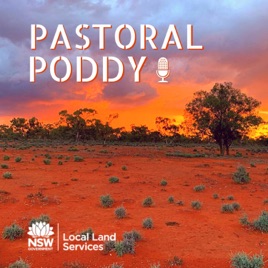
Advertise on podcast: Pastoral Poddy - Australian Farming
This podcast has
45 episodes
Language
EnglishPublisher
Western Local Land ServicesExplicit
No
Date created
2021/03/20
Latest episode
2026/08/28
Average duration
32 min.
Release period
31 days
Description
Pastoral Poddy – your go-to podcast for managing the rangelands of Western NSW. Real-world stories, expert insights and the latest research from farmers and grazing specialists, covering sheep, goats and extensive pastoral systems in arid and semi-arid country. Whether you're tackling grazing pressure, rangeland rehabilitation or livestock productivity, each episode brings practical takeaways tailored for the pastoral industry. Listen to 'Pastoral Poddy' on your usual podcast platform, hit subscribe and share with a mate Produced by the Grow Love Project for NSW Western LLS Australia
Unlock Pastoral Poddy - Australian Farming podcast Email contact info,
Listeners & Audience details
Email contact information
Direct podcast contact details

Listeners
Audience numbers & engagement insights

Audience details
Podcast Insights

Podcast episodes
Check latest episodes from Pastoral Poddy - Australian Farming podcast
The story beneath our feet: understanding rangeland soils
2026/08/28
What can your soil tell you about how your country is functioning?
In this episode of the Pastoral Poddy, host Edgars Greste speaks with soil scientist Karl Anderson about what makes rangeland soils unique and how rainfall, landscape position and soil type influence productivity.
Karl explores the role of carbon and organic matter, explains common constraints such as salinity and sodicity, and shares practical insights into groundcover, water infiltration and managing highly variable country.
It’s a conversation about looking beneath the surface, understanding how soil systems function, and recognising what happens across the landscape when the rain finally arrives.
EPISODE TIMESTAMPS
● (00:00) Why rangeland soils are different
● (02:40) Why organic matter matters
● (08:35) The soil tells a story of time and place
● (10:50) Reading the landscape after rain
● (13:40) Salinity and sodicity explained
● (16:55) Practical tools to rebuild productive country
● (19:00) Managing for variability and climate extremes
Resource links
https://www.dpird.nsw.gov.au/dpi/about-us/research-and-development/projects/soil-and-water-research/rangelands-living-skin
The Pastoral Poddy is proudly brought to you by Western Local Land Services in partnership with the New South Wales Department of Climate Change, Energy, the Environment and Water under the Primary Industries Productivity and Abatement program.
This episode was mixed and produced by Grow Love Project.
Sheep emissions: less is more for breeding an efficient flock
2026/08/20
Can sheep be bred to produce less methane without sacrificing productivity?
In this episode of the Pastoral Poddy, host Edgars Greste speaks with Ed Clayton, Livestock Research Officer with the NSW Department of Primary Industries and Regional Development, about the science and practical realities behind low methane sheep.
Together they explore how methane is produced in ruminants, why emissions have become an important focus for the livestock industry, and how researchers are measuring methane production in individual sheep. The conversation also examines the NSW DPIRD Low Methane Sheep project, emerging opportunities in genetics and feed efficiency, research into pasture systems, and practical steps producers can take today to improve productivity while reducing emissions intensity.
Whether you're curious about the science or looking for practical on-farm insights, this episode offers a grounded discussion on one of the biggest conversations shaping the future of livestock production.
Episode timestamps
(00:00) Why methane matters and the role sheep play in the emissions conversation.
(06:30) Understanding how ruminants produce methane and its link to productivity.
(14:15) Inside the NSW DPIRD Low Methane Sheep project.
(23:45) Genetics, feed efficiency and opportunities for lower methane flocks.
(34:00) Practical steps producers can take to improve productivity and reduce emissions intensity.
Useful links
NSW DPIRD Low Emissions Agriculture Programhttps://www.dpi.nsw.gov.au/climate-and-emergencies/climate-change/primary-industries-and-climate-change/low-emissions-agriculture
NSW DPIRD Emissions Researchhttps://www.dpi.nsw.gov.au/climate-and-emergencies/climate-change/primary-industries-and-climate-change/low-emissions-agriculture/emissions-research
NSW On-Farm Carbon Advice Programhttps://www.dpi.nsw.gov.au/climate-and-emergencies/climate-change/primary-industries-and-climate-change/low-emissions-agriculture/on-farm-carbon-advice
NSW Department of Primary Industries and Regional Developmenthttps://www.dpi.nsw.gov.au
The Pastoral Poddy is proudly brought to you by Western Local Land Services in partnership with the New South Wales Department of Climate Change, Energy, the Environment and Water under the Primary Industries Productivity and Abatement program. This episode was mixed and produced by Grow Love Project.
Good Neighbours EP 4: The Good Neighbours effect: Tackling pests, weeds, and building resilience
2026/07/26
In this episode of The Pastoral Potty, host Edgar Greste sits down with Brendan Cullen, who manages a 60,000 hectare sheep and cattle station southeast of Broken Hill, alongside Matt Kennedy from the Good Neighbours Program.
Together, they explore the importance of coordinated pest and weed management across far western New South Wales, from tackling Hudson pear and wild dogs to building stronger communication and collaboration between neighbours. Brendan shares powerful reflections on mental health, vulnerability, and the parallels between asking for help personally and asking for support with biosecurity challenges on the land.
This episode is a story of resilience, practical action, and the power of community in the bush.
Key Moments
[00:01:20] Brendan introduces the challenges facing far western properties.
[00:02:00] Why coordinated baiting programs are essential for pest control.
[00:03:00] How neighbours worked together to dramatically reduce fox numbers.
[00:05:00] Brendan explains why collaboration is the only way large-scale control works.
[00:06:10] Native wildlife returns and the emotional reward of seeing change.
[00:07:30] How support networks and relationships help landholders feel less alone.
[00:10:45] Brendan shares his mental health journey and lessons about vulnerability.
[00:13:00] Final takeaways: collaboration, confidence and asking for help.
For more information:
Good Neighbours Program - nsw.gov.au/good-neighbours
More about Brendan Cullen - brendancullen.com.au
Need advice on pest animals and weeds?
For pest animals, contact your Local Land Services Biosecurity Officer on 1300 795 299.
For weeds, contact your local council Weeds Officer.
For a transcript of this episode:
https://docs.google.com/document/d/1ZAEH9ZnVmukv_DNcQ4QO-Ds7PZESht-s/edit?usp=drive_link&ouid=103831811474414598304&rtpof=true&sd=true
This podcast series is produced by Grow Love Project and hosted by Western Local Land Services, supported through funding from the NSW Government as part of the Good Neighbours Program.
Good Neighbours EP 3: Beyond the fence line: Pest animal control and the power of FeralScan
2026/07/19
How do you manage animals that don't recognise fence lines or property boundaries? Across New South Wales, vertebrate pests like feral pigs, deer, rabbits and foxes are causing millions of dollars in damage to agriculture every year, destroying crops, competing with livestock and impacting fragile ecosystems.
In this episode we'll unpack what integrated pest management actually looks like on the ground and explore the power of monitoring using a digital tool called FeralScan.
Episode key moments
[00:00] Welcome and Overview
[01:12] NSW pest threats
[03:09] Pest resilience
[09:07] FeralScan explained
[13:16] Collaboration successes
[14:57] Getting help from LLS
[16:16] Future of biosecurity
[17:31] Wrap up and credits
For more information:
Good Neighbours Program - nsw.gov.au/good-neighbours
FeralScan - feralscan.org.au
Previous Feral Scan podcast episode https://creators.spotify.com/pod/profile/the-big-shift/episodes/Managing-animal-pests-on-farm-e10n27h/a-a5rht0m
For a transcript of this episode:
https://docs.google.com/document/d/1xTyJHmwOs0-OaRWY6IOSjeu9ir55Lmu6/edit?usp=drive_link&ouid=103831811474414598304&rtpof=true&sd=true
This podcast series is produced by Grow Love Project and hosted by Western Local Land Services, supported through funding from the NSW Government as part of the Good Neighbours Program.
Good Neighbours EP 2: Smarter weed control beyond spraying
2026/07/12
Herbicides have long been the go-to for weed control, but what happens when they’re no longer enough? In this episode, we explore biological control and how it works alongside traditional methods to create more sustainable, long-term solutions. Featuring insights from NSW DPIRD and Local Land Services, we unpack real-world examples, the science behind biocontrol, and why collaboration across property boundaries is key to managing weeds effectively.
Key Moments
[00:00:00] Australia ranks high for herbicide resistance risk.
[00:02:00] What biological control is and how it works.
[00:04:00] Why integrated weed management is essential.
[00:06:00] Prickly pear success story with cochineal insects.
[00:08:00] Rigorous testing ensures safe biocontrol release.
[00:10:00] Biocontrol and herbicides work best together.
[00:13:00] Collaboration across landholders drives outcomes.
[00:16:00] Future tools like gene tech may shape weed control.
For a transcript of this episode:
https://docs.google.com/document/d/1rmv2C3SaTXfTpsz_lMdAXRkKhgbFTnN_/edit?usp=drive_link&ouid=103831811474414598304&rtpof=true&sd=true
Useful Links for Show Notes
Good Neighbours Program https://www.lls.nsw.gov.au/regions/western/projects/good-neighbours-program
NSW DPIRD Weed Biocontrol Best Practice Guide https://www.dpird.nsw.gov.au/dpi/biosecurity/invasive-plants-and-animals/weeds/identification-and-control/weeds-biocontrol
WeedWise App (NSW WeedWise) https://weeds.dpi.nsw.gov.au/WeedWise
The Pastoral Poddy is proudly brought to you by Western Local Land Services and is supported through funding from New South Wales Government as part of the Good Neighbours Program.
Good Neighbours EP 1: Tackling invasive species together
2026/07/06
Are you concerned about invasive weeds or pests on your place? This four-part series focuses on working with neighbours to manage weeds and pests across boundaries in the rangelands.
This episode features Local Land Services’ Dale Kirby and Matt Kennedy, from the NSW Government’s Good Neighbours Program.
00:00 Welcome to The Pastoral Poddy + Why ‘Good Neighbours’ Matter
01:17 Good Neighbours Program origin story and the 4 pillars
02:54 On-the-ground example: Tackling boxing glove cactus at Tibooburra
04:30 Real-world challenges: Timing, scale, reinvasion and coordination
08:23 The human side: Isolation, stress and getting support
10:54 Behavioural insights: Different landholder ‘types’ and how to engage
14:25 Shifting biosecurity thinking: From fence lines to landscape scale
17:23 Call to action + Wrap-up and credits
For a transcript of this episode:
https://docs.google.com/document/d/1bfyMCAASS70VV1q35omrU8ltkCH2mgom/edit?usp=drive_link&ouid=103831811474414598304&rtpof=true&sd=true
For more information:
Good Neighbours Program - nsw.gov.au/good-neighboursBehavioural insights - nsw.gov.au/departments-and-agencies/local-land-services/resource-library/improving-landholder-participation-invasive-species-programs-recommendations-report
Need advice on pest animals and weeds?
For pest animals, contact your Local Land Services Biosecurity Officer on 1300 795 299. For weeds, contact your local council Weeds Officer
This podcast series is produced by Grow Love Project and hosted by Western Local Land Services, supported through funding from the NSW Government as part of the Good Neighbours Program.
Good Neighbours Series Trailer
2026/07/06
Are you concerned about invasive weeds or pests on your place? This four-part series focuses on working with neighbours to manage weeds and pests across boundaries in the rangelands as part of the NSW Government’s Good Neighbours Program.
Where Do Goats Really Graze? Inside a Western NSW Research Project
2026/06/29
Where do goats really spend their time in a paddock, and what can technology tell us about their behaviour?
In this episode of the Pastoral Poddy, Kieran Smith speaks with Dr Jamie Barwick from the University of New England about a research project tracking goat movements across Western New South Wales.
Using GPS collars and movement sensors, the project explored how far goats travel, how they use water points, where they graze, and how their behaviour changes over time.
The episode also explores the challenges of conducting research in large-scale grazing systems and what these findings could mean for future goat management and livestock decision-making.
Episode Guide
(00:00) Meet Dr Jamie Barwick and precision agriculture research
(02:00) The rise of virtual fencing technology
(05:00) Why track goat movement patterns?
(09:00) GPS collars and research methods explained
(13:00) Discovering how far goats travel daily
(18:00) What the tracking data revealed
(31:00) Choosing the right ag technology
For a transcript of this episode:
hhttps://docs.google.com/document/d/1pQ5KL9kq-8zmLNUHGfOZF1hR-RwTanbK/editusp=drive_link&ouid=103831811474414598304&rtpof=true&sd=true
This podcast series is produced by Grow Love Project and hosted by Western LocalLand Services, supported through funding from the NSW Government as part of the Going Ahead with Goats project.
Goat Reproduction Under the Microscope: New Research from Western NSW
2026/06/25
What diseases are quietly impacting goat reproduction in Australia, and what should producers be watching for? Veterinarian and researcher Lauren Eggins joins host Kieran Smith to discuss groundbreaking research into reproductive performance and disease exposure in managed rangeland goats across western New South Wales. The conversation explores body condition, pregnancy rates, biosecurity risks, zoonotic diseases and several world-first findings that could shape the future of goat production in Australia.
(00:00) A world-first discovery reveals hidden biosecurity risks in Australian goat herds.
(01:30) Lauren shares her dream goat enterprise and the breeding system she'd use to maximise productivity.
(06:35) Inside the research project tracking 2,500 does across Western NSW to improve reproductive performance.
(08:50) The body condition and liveweight "sweet spot" that delivered the best pregnancy results.
(12:20) Why diseases shared between goats, sheep and cattle make biosecurity everyone's business.
(14:20) The zoonotic diseases producers need to know about, including Q Fever and leptospirosis.
(17:00) Disease prevalence results reveal several first-time detections in Australian rangeland goats.
(27:10) Lauren explains the major findings and what they could mean for future goat management and research.
Turning Sheep Data Into Decisions: eID Technology and Productivity
2026/06/17
What if every sheep could tell you more about its performance, profitability and potential?
Electronic Identification (eID) tags are becoming a major focus for Australian sheep producers, but the opportunities go well beyond meeting regulatory requirements.
In this episode of The Pastoral Poddy, we explore how producers can use eID technology, data collection and on-farm equipment to make better management decisions. Host Kieran Smith is joined by sheep producer Will MCalpine from Salisbury near Marra, and veterinarian and sheep production advisor Tim Gole from For Flocks Sake.
They discuss how Will has integrated eID into his Merino enterprise to improve fertility, selection decisions and weight gain monitoring, as well as how technologies like automated drafting and in-field weighing can support more targeted management.
Tim shares insights from working with sheep producers across Australia, including where the biggest productivity gains may come from, what data is worth collecting, and practical advice for avoiding common technology headaches.
Whether you’re new to eID or looking to get more value from your existing system, this episode explores how turning individual animal data into decisions can help build more productive and resilient sheep businesses.
Episode Guide
(00:00) Why eID technology is changing sheep production(02:00) Will’s Merino operation and farming journey(04:00) Tim’s pathway into sheep data and eID(07:00) Using eID for breeding and selection decisions(10:00) Real-time weight data and better decisions(14:00) Finding productivity gains through data(18:00) What sheep producers should start collecting(22:00) Lessons learned implementing eID technology(25:00) Advice for producers starting their eID journey(28:00) Setting yourself up for technology success(35:00) Managing large datasets and making decisions(40:00) Final thoughts on the future of eID
For a transcript of this episode:
https://docs.google.com/document/d/13V5LCrjsmNuec17j6ojGHKKKsonIKinP/edit?usp=drive_link&ouid=103831811474414598304&rtpof=true&sd=true
This podcast series is produced by Grow Love Project and hosted by Western Local Land Services, supported through funding from the NSW Government.
The Silent Thief: Ovine Brucellosis & Smarter Ram Management with vet Scott Parry
2026/04/28
Ovine brucellosis is often called the “silent thief” of sheep production—and for good reason. In this episode of The Pastoral Poddy, host Kieran Smith sits down with Western LLS veterinarian Scott Parry to unpack how this bacterial disease quietly impacts ram fertility, lambing percentages, and overall profitability.
Scott shares practical insights from years in the field, including how to identify the signs, when to test, and what producers can do to manage or eradicate the disease. The conversation also explores broader ram health, biosecurity risks, and the exciting new Ram Power Project aimed at improving reproductive performance in western systems.
Whether you’re running a controlled joining program or a continuous system, this episode is packed with grounded, practical advice to help you lift productivity and stay ahead of hidden risks.
Timestamps
[00:07:00] What ovine brucellosis is — a bacterial disease that reduces ram fertility and lamb numbers.
[00:11:00] Best timing for ram checks — check rams 4–8 weeks before joining, or earlier if brucellosis is suspected.
[00:15:00] How brucellosis spreads — most commonly introduced by infected rams entering the flock.
[00:19:00] Continuous mating challenges — rolling joining systems make detection and control much harder.
[00:24:00] Predation impact — longer lambing periods increase losses to foxes, pigs, and wild dogs.
[00:28:00] Ram Power Project — research into which rams are the best lamb-getters.
[00:35:00] Dry season warning — producers should assess agistment and biosecurity risks carefully.
[00:38:00] Final advice — focus on basics like nutrition, water, and biosecurity first.
For more information:
Ovine brucellosis - dpi.nsw.gov.au/animals-and-livestock/sheep/health/ovine-brucellosis/ovine-brucellosis
Livestock health and diseases | NSW Government - nsw.gov.au/regional-and-primary-industries/livestock/health-diseases
For a transcript of this episode:
http://tiny.cc/brucellosis-transcript
This podcast series is produced by Grow Love Project and hosted by Western Local Land Services, supported through funding from the NSW Government as part of the Ruminants in the Rangelands project.
Goats Series Ep 13 - Meat Science and meeting customer needs with Prof. Pete McGilchrist
2026/02/04
In this episode, host Kieran Smith from Western Local Land Services talks with Professor Pete McGilchrist from the University of New England about recent insights from the world’s largest goat meat science research project conducted in NSW.
They discuss the challenges and opportunities within the goat meat industry, intrinsic and extrinsic factors affecting meat quality and what can be learned from the lamb and beef meat industries.
Professor McGilchrist provides actionable insights on how farmers can improve the quality of their goat meat and some simple changes that the supply chain can also implement to transform the perception of goat meat both locally and globally.
The episode also touches on the importance of reducing stress in animals pre-slaughter, the impact of diet and genetics on meat quality, and the potential for market differentiation based on meat traits.
(00:00) Intro to High Production Costs in Red Meat
(05:48) Public Perception of Red Meat
(10:06) Factors Influencing Meat Quality
(16:31) Impact of Stress and Handling on Meat Quality
(20:39) Challenges in the Livestock Selling System
(24:05) Introduction to the Goat Meat Science Trial
(29:19) Findings from the Goat Meat Science Trial
(38:10) Choosing the Right Animals Within Breeds
(42:07) Improving Meat Tenderness Through Aging
(45:53) Genetic Selection for Better Production
(50:07) Flavor Profiles and Consumer Perception
(53:06) Future Research and Industry Improvements
(01:02:05) Predictions for the Goat Industry's Future
For more information:
Follow Dr. Pete McGilchrist on LinkedIn - linkedin.com/in/peter-mcgilchrist-71a8ba285/
Going Ahead with Goats Project - lls.nsw.gov.au/what-we-do/our-major-projects/going-ahead-with-goats-project
KIDPLAN - sheepgenetics.org.au/resources/kidplan/
For a transcript of this episode:
https://docs.google.com/document/d/1l3e986t7J-Qjr-BIE7XtTb3hqQAOXmhxiJlOWfRnlec/edit?usp=drive_link
This podcast series is produced by Grow Love Project and hosted by Western Local Land Services, supported through funding from the NSW Government as part of the Going Ahead with Goats project.
Goat Series: Ep 12 - Embracing Opportunities through Goat Trading with Jack Hammond
2025/07/21
In this episode of the Going Ahead with Goats podcast, host Kieren Smith interviews Jack Hammond, who entered the goat industry five years ago after purchasing Ashleigh Downs Station. They discuss Jack’s journey from mustering to managing a 52,000-acre station, trading, and finishing smaller goats alongside a meat sheep enterprise. Jack shares insights into infrastructure, labor strategies, and market fluctuations. He also emphasises learning from experience, utilising available resources, and the benefits of working with both sheep and goats. Key topics include rotational grazing, handling techniques, and preparing for the evolving goat industry.
Thank you to our guest featured in this episode:
Jack Hammond
For more information:
Going ahead with goats Project - Local Land Services - https://www.lls.nsw.gov.au/what-we-do/our-major-projects/going-ahead-with-goats-project
The Going into Goats guide | Meat & Livestock Australia
For a transcript of this episode: https://drive.google.com/file/d/11QRTme3XtB7F5-H7QW5cN4EFMcUrVFAo/view?usp=sharing
This podcast series is produced by Grow Love Project and hosted by Western Local Land Services, supported through funding from the NSW Government as part of the Going Ahead with Goats project.
Emissions in the Rangelands
2025/07/07
This episode looks at what carbon emissions means for landholders in the rangelands. We learn about how it affects market access, what ways you could see a premium, and how it affects agricultural productivity. There are many questions in the region about rangeland carbon emissions, listen in to hear expert insights into how carbon is cycled in Western NSW.
Thank you to our guests who featured in this episode:
John Gavin – Director, Remarkable NRM
Jessica Rigg – Biotechnology and Partnership Lead – Select Carbon
Steven Hobbs – Farmer and Director, Yarrock Bioenergy
For more information:
For further information about Natural Capital - https://www.lls.nsw.gov.au/help-and-advice/natural-capital
and On Farm Carbon Advice: https://www.dpi.nsw.gov.au/dpi/climate/Low-emissions-agriculture
John Gavin – Remarkable NRM website - https://remarkablenrm.com.au/about-john/
Steven Hobbs - Yarrock Website - https://www.yarrock.com/
AIA Environmental Accounting Platform - https://www.aiaeap.com/
This podcast is produced by Grow Love Project and hosted by Western Local Land Services, supported through funding from the NSW Government.
Natural Capital in the NSW Rangelands
2025/06/26
This episode looks at natural capital and what it means for landholders in the rangelands. We learn about the new Nature Repair Market, ways to measure natural capital, and what some of the drivers for investment are. Tune in to learn more about expert insights into the benefits and challenges of natural capital.
Thank you to our guests who featured in this episode:
John Gavin – Director, Remarkable NRM
Debbie Dowden – Director, Challa Pastoral
For more information:
For further information about Natural Capital - https://www.lls.nsw.gov.au/help-and-advice/natural-capital
and access to the Natural Capital Service Finder: https://www.lls.nsw.gov.au/help-and-advice/natural-capital/natural-capital-service-finder
John Gavin - NRM website - https://remarkablenrm.com.au/about-john/
Debbie Dowden - Challa Station Website - https://challastation.com/
This podcast is produced by Grow Love Project and hosted by Western Local Land Services, supported through funding from the NSW Government.
Podcast reviews
Read Pastoral Poddy - Australian Farming podcast reviews
Podcast sponsorship advertising
Start advertising on Pastoral Poddy - Australian Farming relevant audience podcasts
You may also like to advertise on these Podcasts

4.616125357
Giggly Squad
Hannah Berner & Paige DeSorbo
4.8219787
Imperfect Action
Steph Taylor

4.727499587
This Past Weekend w/ Theo Von
Theo Von

4.713009375
The Tim Dillon Show
The Tim Dillon Show
4.115956456
The Tucker Carlson Show
Tucker Carlson Network
4.828036451
Huberman Lab
Scicomm Media

4.240683
To Be The Man
Podcast Heat | Cumulus Podcast Network

4.41511292000
The Ben Shapiro Show
The Daily Wire
4.2155648
TENNIS.com Podcast
TENNIS.com Podcast/Tennis Channel Podcast Network
4.510846771
The Joe Budden Podcast
The Joe Budden Network