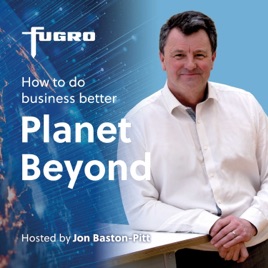
Advertise on podcast: Planet Beyond
Rating
5from
This podcast has
97 episodes
Language
EnglishPublisher
FugroExplicit
No
Date created
2021/03/22
Latest episode
2025/09/25
Average duration
33 min.
Release period
23 days
Description
Welcome to the Planet Beyond podcast. Brought to you by Fugro, the leading partner in uncovering geo-data from the greatest subsea depths right to outer space and hosted by Jon Baston-Pitt. Planet Beyond is about doing business better in our fast changing, and acutely delicate, yet exquisite, world. Together we will explore issues beyond the day-to-day challenges; listen to those who should be listened to; seek out what needs to be done and get aligned around the new tomorrow our children deserve and that we have a responsibility to deliver.
Unlock Planet Beyond podcast Email contact info,
Listeners & Audience details
Email contact information
Direct podcast contact details

Listeners
Audience numbers & engagement insights

Audience details
Podcast Insights

Podcast episodes
Check latest episodes from Planet Beyond podcast
Episode 50: Mangroves, Drones, and Data
2025/09/25
In a few week’s time the 30th UN Climate Change Conference will take place in Belém, Brazil. While the world is making progress on cutting the carbon emissions that cause climate change, there is much work still to be done.Even if the world were to meet the goals put in place ten years ago in the Paris Agreement, we would continue to face the impacts of climate change. We will also need to focus on adaptation.
One adaptation that could both build resilience and absorb carbon dioxide emissions from the atmosphere is the development of mangrove forests. In this episode, first aired in February 2024, and focused on the outcomes of COP 28, Jon Baston-Pitt was joined by two guests who have been using cutting edge technology to plant new mangroves.
Jane Glavan is the co-founder of Distant Imagery. The company combines cutting edge technologies with locally available techniques and materials, to develop drones, balloons and kites that can be used to bring us closer to Net Zero. In Abu Dhabi, their drones are reforesting mangrove swamps, propelling thousands of seedlings into the ground, in every eight minute drone flight.
This is a long-term project. Mangroves can take decades to reach maturity. Distant Imagery needed more access to data to track, refine, and share their approach. That has been Fugro’s focus. David Millar shared the importance of the UN Ocean Decade Corporate Data Group, which we first looked at in a February 2023 shortcast. The group is working to make available ocean data from some of the world’s most important private-sector collectors, and share it with potential users, such as Distant Imagery.
Host
Jon Baston-Pitt
Guests
Jane Glavan, Co-Founder, Distant Imagery
David Millar, Government Accounts Director, Americas, Fugro
Episode 49: Adding Autonomy to ROVs
2025/08/28
Artificial Intelligence is developing at a dizzying pace. One day soon, its proponents promise, it will revolutionise the way we work.
The growth of AI could lead to the birth of ‘cobots’, robots able to collaborate safely with humans in shared spaces. But the development of machine autonomy and remote operations has much deeper roots.
The goal of robotics has been described as replacing humans in roles that are dirty, dangerous, or dull. Offshore work can often meet all of these criteria. Bringing surveyors to offshore sites on a fossil fuelled vessel is, in carbon terms, dirty. These expert personnel will spend at least some part of the voyage on dull tasks, in between the work they are trained for. And any work offshore carries some level of danger that must be managed carefully.
Fugro has developed remotely operated vehicles, or ROVs, that can be launched from uncrewed surface vessels. This eliminates dull and dangerous working offshore, and makes a move away from dirty carbon emissions possible.
But remotely operated vehicles face challenges at sea. They must react quickly to changing conditions, and data transmission limits underwater restrict the ability of remote operators to respond in time.
In this episode, first aired in March 2023, Jon Baston-Pitt is joined by Fugro’s Mark Bruce, and the National Robotarium’s Yvan Petillot. The conversation took place shortly after a first successful test of remotely operated systems, that will allow ROVs to work efficiently, responding to changes in their environment without human intervention.
Host
Jon Baston-Pitt
Guests
Yvan Petillot, Professor of Robotics and Autonomous Systems, Heriot Watt University; joint academic lead, The National Robotarium.
Mark Bruce, Product Owner, Next Generation ROVs, Fugro
Episode 48: Remote Operations in Commercial Space
2025/07/31
Some time ago, in an office quite far away, Tim Crain, vice president of R&D at Intuitive Machines, joined Jon Baston-Pitt for an episode of Planet Beyond, alongside Fugro’s Dawn McIntosh and Sam Forbes.
In that episode, first aired in November 2022, our guests discussed Intuitive Machine’s plans for the first commercial soft landing on the moon. The mission, which took place in February 2024 didn’t quite go to plan, but did successfully achieve a soft landing with all equipment functional.
The work at Fugro’s Space Automation, Artificial Intelligence and Robotics Control Complex, or SpAARC continues. This January, 2025, Sam Forbes joined the Engineering Matters podcast, alongside guests from around the world, to trace the development of the Remote Operations Centres. Like the SpAARC, these purpose built facilities allow for control of equipment, without the risks and costs associated with working offshore, or in space.
Commercial space activity remains at the top of many nations’ agendas. At the UK Space Conference this month, July 2025, the UK government highlighted the role that space will play in the economy, highlighting areas that will be part of the core focus of a new 10 year industrial strategy. Earlier this year, the European Space Agency reported that it had grown its ESA Investor Network to include 80 members, investing around €1bn in space-related activities.
The commercial space sector doubled in size in the decade before this episode first aired. In this episode we are joined by one of the most promising commercial space contractors, and a new control centre based in Australia that will support this and future endeavours to the Moon and beyond.
Host
Jon Baston-Pitt
Guests
Tim Crain, Vice President, Intuitive Machines
Dawn McIntosh, Space Systems Director, Fugro
Sam Forbes, Director, SpAARC, Fugro
Introduced by
Alex Conacher
Episode 47: Innovation in Offshore Wind Biodiversity
2025/06/26
Over three episodes, we’ve been learning about ways to maintain, and even improve, biodiversity around offshore wind farms. We’ve heard how the industry is helping to shape biodiversity policy. We’ve talked to researchers who are developing ways to monitor the interactions of birds and turbines. And in this final episode, we’re going to discover innovative ways to monitor biodiversity across marine ecosystems more efficiently, and less invasively.
Umberto Binetti is a marine biodiversity expert, working for developer RWE. He explains that current monitoring requirements focus on construction, when the most disruption is expected. Some wind turbines are now reaching the end of their design life, and face mandatory removal. This could see foundations that have become a biodiversity hotspot being dismantled, at great expense and risk to offshore workers, with a negative impact on marine life.
RWE’s SeaMe project at the Kaskasi windfarm in Germany, supported by the German Alliance for Marine Research (DAM), is using a suite of innovative technologies, including drones, autonomous underwater vehicles, eDNA, and machine vision to provide holistic monitoring of wind farms.
Fugro’s Dan Smith is working on the BeWild project at the CrossWind wind farm in the Danish North Sea, in collaboration with Wageningen University, Mecal, Seekable and the Rich North Sea. The project uses Fugro’s uncrewed surface vessels and remotely operated vehicles, alongside other equipment, to collect high resolution images for three-dimensional photogrammetry, and eDNA.
These innovations will help develop holistic ecosystem-wide monitoring, allow wind farm owners, regulators, and other stakeholders to understand the most effective means to ensure wind farms have a positive impact on nature, as well as on climate change.
Host
Jon Baston-Pitt
Guests
Umberto Binetti, Marine Biodiversity Expert, RWE
Daniel Smith, Offshore Wind Biodiversity Solution Owner, Fugro
Episode 46: Best Practice for Offshore Wind Farm Biodiversity
2025/05/29
Offshore wind farms promise to provide much of the clean power needed for the energy transition. But in their construction and operation, they interact with wildlife above and below the water. In this episode, the second of three on biodiversity and offshore wind, we learn how scientists are developing best practices for protecting birds and enhancing biodiversity underwater.
Jesper Kyed Larsen is a bioscience expert working with Vattenfall, and focused on how we can measure interactions between birds and wind turbines. His work explores how vision systems and machine learning can be used to track birds as they fly around wind farms, and will help shape mitigation measures to reduce collisions.
Isaac de Boer Ferrier is project manager for the Rich North Sea programme at the North Sea Foundation. His organisation has been conducting research on how to encourage the formation of oyster beds around wind farms, which will boost biodiversity on the seabed around turbine foundations and anchoring systems. These projects, and more, are shared through the Rich North Sea Toolbox, a guide to enhancing biodiversity around wind farms.
Host
Jon Baston-Pitt, Fugro
Guests
Jasper Kyed Larsen, Bioscience Expert, VattenfallIsaac de Boer Ferrier, Project Manager, The Rich North Sea, The North Sea Foundation
Image credit
The Rich North Sea
Episode 45: The Future of Carbon Capture
2025/04/24
Decarbonisation is vital to maintaining a safe and liveable world. Much of the carbon that human industry emits can be avoided through the use of renewable energy and other new technologies. But not all carbon can be handled in this way.
Some industries generate carbon emissions not just from their energy use, but as a result of inherent processes: a good example of this is cement manufacture, which releases carbon dioxide as a chemical byproduct, and also requires kiln temperatures which cannot be achieved using electricity. Other sectors would see commercial challenges and unnecessary job losses in a rush to renewables. And we were emitting large amounts of carbon dioxide for two centuries before we understood the impacts it would have on our environment.
Carbon capture promises to fill the gaps in climate change mitigation that decarbonisation can’t reach. Carbon can be captured at source from those facilities that can’t eliminate emissions, or directly from the air.
The question then is what to do with the carbon captured? That’s what our guests in this episode have been addressing. Dr Camelia Knapp is a professor of geology who has been exploring suitable sites for its storage. Fernando C Hernandez is global chairman at the Society for Low Carbon Technologies, whose work focuses on promoting commercial applications for captured carbon and promoting policies that will make carbon capture a viable proposition.
Host
Jon Baston-Pitt, Fugro
Guests
Dr Camelia Knapp, Professor of Geophysics, Boone Pickens School of Geology, Oklahoma State University
Fernando C Hernandez, Global Chairman, Society for Low Carbon Technologies
Episode 44: Biodiversity and Policy Setting in Offshore Wind
2025/03/27
Offshore wind farms are key to supplying the energy the world needs, sustainably and reliably. We know they are vital to meeting our decarbonisation goals; but we don’t fully understand their impact on ecosystems. With thousands of turbines due to be installed over the next decade, we must build our knowledge of their interactions with marine life, and develop systems to ensure a positive impact on biodiversity.
Over three episodes, we’ll cover different topics from policy to practice, to innovative technologies and hear how wind farm developers and NGOs are working together to deliver more biodiversity around wind farms. In this first episode, Cristina Simioli and Emma Hospes join host Jon Baston-Pitt to share the work the sector has been doing to establish a common understanding of biodiversity, best practices for its protection and a need for a common policy.
Cristina is Director for Offshore Energy and Nature, at the Renewables Grid Initiative, and lead of the Offshore Coalition for Energy and Nature (OCEaN). OCEaN is split into two regions, North Sea & Baltic, and Mediterranean & Atlantic. As Cristina explains, the lessons learned about biodiversity by early movers in the north of Europe, are now being shared with those getting to work in the very different environment of the Mediterranean.
Emma leads the biodiversity programme at Ørsted, the Danish renewables operator. The operator primarily works across Northern Europe and Emma shares how there is still a long road ahead before a common consensus on what good likes in terms of biodiversity is reached. And explains how the company is working to share lessons learned, and what is needed to build the required consensus.
Host
Jon Baston-Pitt, Fugro
Guests
Cristina Simioli, Director, Offshore Energy and Nature, the Renewables Grid Initiative (RGI)
Emma Hospes, Head of Biodiversity Programme, Ørsted
Short: Leon Koning – Back on Dry Land
2025/03/13
In December, Planet Beyond talked to Leon Koning about his ambitious plans to cross the Atlantic with three teammates as Team Row4Cancer, part of the World’s Toughest Row. He set out with four goals: getting to the finish line, beating the rest of the teams, beating the world record, and remaining friends with his fellow rowers.
In this short, Leon returns to Planet Beyond, following his arrival back on dry land. The team achieved three of their four goals, he tells host Jon Baston-Pitt. He shares the physical and emotional challenges of the row and we learn how the team kept themselves motivated, through the headwinds of their 5,000km journey.
As their row reached its final days, the team looked forward to their return to their friends and families, and to fresh food. Leon tells us about enjoying the world’s best burger, and about a key lesson he learned from the voyage: whatever goals you have on your list, the best time to do them is now.
Host
Jon Baston-Pitt, Fugro
Guest
Leon Koning, Legal Counsel, Europe and Africa, Fugro
Episode 43: The Mental Groundwork of Infrastructure
2025/02/27
Infrastructure projects transform our world. Our ability to travel and to work, our individual health and our community cohesion, are all built upon the successes of infrastructural engineering. But these projects routinely underperform. They are delivered late, and over budget. Around the world, we consistently see projects delayed by unexpected ground conditions.
In this episode, Jon Baston-Pitt is joined by an old friend and colleague, Rod Eddies. Rod has spent his life investigating what is happening in the ground below our feet. His experience on infrastructure projects has led him to a new area of study: what is going on at the foundations of our thinking, as we set about planning infrastructure projects?
Rod believes that we should pay attention to the findings of behavioural science and economic geography, which show how unseen voids in our thinking—cognitive biases, overreliance on heuristics—can turn into sinkholes of time and cost. The only firm foundation for any project, Rod believes, is to reject unjustified assumptions, engage early on and reduce uncertainty in the subsurface, before a final investment decision is made. This tried and tested approach reduces wasted cost and enables a project to be delivered on time and on budget.
Host
Jon Baston-Pitt, Fugro
Guest
Rod Eddies, Solution Director for Land Site Characterisation Fugro
Short: Dan Smith – A Career with Impact
2025/02/13
How can you build a career with impact? Dan Smith has a simple rule: ‘Follow your interests—when you look back, it will look like you had a plan’. Dan’s first interest was in cooking, and he started his career as a chef. But when he realised that he would not reach the Michelin-starred heights of that highly competitive field, he turned to a new interest: engineering.
He wanted to have a practical impact, so after his undergraduate degree, started by volunteering with Engineers Without Borders in Africa. In his work in Ghana and Uganda, he sought to support local engineers as they brought their skills to their own communities.He looked for more ways he could use his skills impactfully. Qualifying for a masters scholarship, on the basis of his volunteer experience, he turned to the private sector. With Royal HaskoningDHV, and then with Fugro, he developed a career using data to monitor and improve biodiversity around offshore wind farms.
Dan sees three main ways to have an impact. One can take a hands-on approach, fixing practical problems—but the scope of this work is often limited to a particular community. Or one can take a role setting impactful policy or corporate strategy—but this work can feel alienated from its outcomes. Dan proposes a middle way that has worked for him: developing specialist skills that can be impactful across projects, as part of a collaborative team. In this episode, he shares how following our interests can help us develop those skills.
Host
Jon Baston-Pitt
Guest
Dan Smith, Offshore Wind Biodiversity Solution Owner, Fugro
Episode 42: Samsø’s Community-Led Energy Transition
2025/01/30
Samsø, a small Danish island, with a population of just 3,700, has revolutionised its energy landscape. Chosen in 1997 by the Danish government as a social innovation project, the Samsø community has since developed wind farms, solar panels and home grown biofuels that have allowed the island to achieve 100% energy independence, powered entirely by renewable resources, the first island to do so. But how did a small and isolated rural community accomplish such an extraordinary feat?
Joining host Jon Baston-Pitt to explore this fascinating transformation are two remarkable guests: Søren Hermansen is the head of the Samsø Energy Academy, recognised by Time magazine as one of the top 10 environmental heroes and is a Samsø local, and Peter Brooke the Regional Director for Strategic Sales and Marketing at Fugro. Their paths crossed at an event dedicated to sustainability, igniting a conversation about the power of collaboration and the role of businesses in supporting community-driven green initiatives.
Together they discuss how communities can take charge of their own energy futures, overcoming political, financial, and social barriers to build a more sustainable world. Søren and Peter share their perspectives on the importance of collective action, the challenges of transitioning from fossil fuels, and what the rest of the world can learn from the small island of Samsø.
Host
Jon Baston-Pitt, Fugro
Guests
Soren Hermansen, Director, Samsø Energy Academy
Peter Brooke, Regional Director, Strategic Sales and Marketing, Fugro.
Picture credit
Samsø Energy Academy
Short: Jessica Pacifico — Bringing Out the Best in People
2025/01/16
Throughout her career, Jessica Pacifico has always chosen the hardest path: learning Latin at high school, achieving a master’s degree in chemical engineering, then switching to IP law and studying, initially, in Dutch, a language that she did not, at that time, speak. With a life course like that, some failures are inevitable. But Jessica views failure not as the end of the story, but as an opportunity to learn.
Jessica builds on her own life experience in her people management. In her day-to-day working life, she encourages colleagues to identify their own solutions to business challenges. She has learned to recognise that each member of the team has their own working style and personality, and to shape the working environment to their strengths, rather than trying to bend them to fit the working environment.
In this conversation, Jessica shares how she has developed her approach to team management, with a focus on each individual’s potential. She explains how important it is to consider this potential not just in the day-to-day, but during recruitment. Here, she says, it is not enough just to consider how a candidate might fill the current role, but how she can help them shape their career progression, and what their next role might be.
Host
Jon Baston-Pitt
Guest
Jessica Pacifico, Global Head of Intellectual Property, Fugro
Short: Leon Koning – Rowing for a World Record
2024/12/12
What does it mean to reach for a dream? 18 months ago Leon Koning, a keen cyclist, got to know Mark Slats. Slats was training to complete 10 Ironman triathlons in 10 days. He needed a training buddy as he prepared, and Leon agreed to help. As they trained, the two decided on their next unique challenge: to row across the Atlantic and competitive as they are, set a new world record.
Today, as this episode airs, Leon and Mark embark on their race across the Atlantic with teammates, Maarten Diepeveen and Tom Rijnders. Their team, Row4Cancer, is competing in The World’s Toughest Row, a 4,800 km extreme row that starts in the Canary Islands and finishes in Antigua while raising funds for the Prinses Máxima Centrum, a children’s cancer hospital in the Netherlands.
In this episode, Leon talks to Jon Baston-Pitt about the intense training needed to go from being a rowing novice, to having a realistic dream of setting a world record. We learn what life will be like on board their tiny vessel and Leon shares the personal goals he has set himself.
Host
Jon Baston-Pitt, Fugro
Guest
Leon Koning, Legal Counsel, Europe and Africa, Fugro
Episode 41: Coral Reefs, Data, and Decision Making
2024/11/28
A wave of change has swept through the world of coral reef science, as scientists develop new ways to collect, collate and analyse data. The reefs are vital to the health of the planet, and humanity: while they cover only 0.2% of the seafloor, they support at least 25% of marine species. And they play a role in the lives of around 1 billion people around the world.
MERMAID (Marine Ecological Research Management AID), developed by the Wildlife Conservation Service or WCS, allows marine scientists to collect data in a structured way. This is then shared with and analysed by the Global Coral Reef Monitoring Network, or GCRMN, to identify global trends.
As an online/offline tool, MERMAID can be used to share data with local communities, as soon as it is collected,helping inform decision making, as they balance resource use and biodiversity management.
National governments and other organisations can use data collected in MERMAID and collated in the GCRMN report, Status of Coral Reefs of the World, as they develop coral reef conservation and climate mitigation plans. The data is helping scientists and national bodies identify where corals are most resilient, and to ensure the survival of these important and biodiverse ecosystems.
In this episode, Jon Baston-Pitt is joined by two scientists who have played a key role in developing these platforms, the WCS’s Emily Darling, and the GCRMN’s Jérémy Wicquart. They explain how these platforms came into being, and the benefits they offer to scientists, stakeholders, and policymakers. Their work demonstrates the importance of creating standardised ways of collecting data, and of making scientific data widely accessible.
Host
Jon Baston-Pitt, Fugro
Guests
Emily Darling, Director of Coral Reef Conservation, WCS
Jérémy Wicquart, Technical Coordinator, GCRMN
Resource
Status of Coral Reefs of the World 2025– Call for data and guide for scientists
Status of Coral Reefs of the World 2020– Latest report
Photo credit
Julien Wickel
Short: Olga Nefedova – Embracing Strategic Curiosity
2024/11/14
Olga Nefedova’s career has taken her from the oilfields of Western Siberia, and across continents, to the most senior roles of Fugro, via a role at famed management consultants McKinsey. Along the way, she has developed an approach to strategy that fosters a childlike delight in fearless experimentation and the ‘heart filling joy’ of problem solving.
Olga shares her vision of what good strategy entails – asking the right questions, analysing efficiently, and adapting through continuous feedback. Strategy, she explains, is less about complex theories and more about a logical, practical process. It is a journey of curiosity and resilience.
As Olga describes it “…Our plans should not work regularly… that’s how we build our learning, our capabilities.”
Host Jon Baston-Pitt and Olga explore the importance of adaptability, curiosity and failure in achieving strategic goals. Olga urges leaders to embrace the unknown and avoid over-analysis: strategy is not about having all the answers upfront, but about discovering them through a process of exploration and continual improvement.
Another remarkable leader making a remarkable difference.
Host
Jon Baston-Pitt, Fugro
Guest
Olga Nefedova, Global Director of Corporate Strategy, Fugro
Podcast reviews
Read Planet Beyond podcast reviews
north star joy 2024/11/21
Awesome combination of geeky and common sense
If you want to know how infrastructure gets built, energy gets developed, environment gets mapped, no better cross section of facts and fun.
Podcast sponsorship advertising
Start advertising on Planet Beyond relevant audience podcasts
You may also like to advertise on these Podcasts
4.4371061566
The Megyn Kelly Show
SiriusXM
4.888901269
Fearless with Jason Whitlock
Blaze Podcast Network
4.8118931000
Mind Pump: Raw Fitness Truth
Sal Di Stefano, Adam Schafer, Justin Andrews, Doug Egge
4.8102131585
Tara Brach
Tara Brach

4.541561215
Something You Should Know
Mike Carruthers | OmniCast Media

4.513841343
Strictly Anonymous Confessions
Kathy Kay

4.8292781897
Fantasy Footballers - Fantasy Football Podcast
Fantasy Football

4.62382612
Football Weekly
The Guardian

4.45387666
Two Judgey Girls
Two Judgey Girls

3.8258501152
The Viall Files
Nick Viall