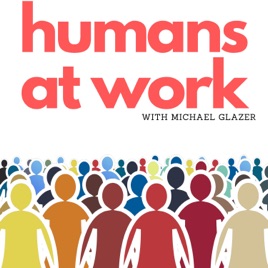
Advertise on podcast: Humans at Work with Michael Glazer
Rating
5from
This podcast has
100 episodes
Language
EnglishPublisher
Michael GlazerExplicit
No
Date created
2021/03/28
Latest episode
2024/02/19
Average duration
47 min.
Release period
15 days
Description
In today’s world of work, it’s too easy to forget that Human Resource are actually Human People. This podcast gives you fresh perspectives on leadership, teams, change, diversity and values, as well as actionable ideas to make working with other humans better for everyone, because I believe that well-being at work is a basic human right.
Unlock Humans at Work with Michael Glazer podcast Email contact info,
Listeners & Audience details
Email contact information
Direct podcast contact details

Listeners
Audience numbers & engagement insights

Audience details
Podcast Insights

Podcast episodes
Check latest episodes from Humans at Work with Michael Glazer podcast
Reverse Mentoring
2024/02/19
Ever wondered what happens when we flip traditional corporate hierarchies, allowing the young to mentor the old? This episode zeroes in on reverse mentoring, showcasing its power to drive innovation and foster understanding across generations. Patrice Gordon, a pioneer at Virgin Atlantic and author of the book “Reverse Mentoring: Removing Barriers and Building Belonging in the Workplace.”
Patrice explains how embracing uncomfortable moments and challenging our assumptions can lead to growth for both people and organizations. She also shares advice for setting up and running reserve mentoring programs and strategies for bringing more humanity into our organizations. Tune in to discover how you can harness the potential of reverse mentoring to not only enhance leadership but also create a more inclusive, dynamic workplace.
If you enjoy the show, please rate it on iTunes or Spotify. Your ratings help more people like you discover the podcast!
Episode Highlights
Explore reverse mentoring's role in driving innovation and understanding between generations. Gain insights from Patrice Gordon on fostering inclusive leadership and authentic self-expression at work. Learn strategies from Virgin Atlantic's reverse mentoring for cultivating an inclusive culture. Steps to implement effective reverse mentoring programs for organizational change. Tackle misconceptions and challenges in reverse mentoring and DEI for better outcomes. The role of trust in reverse mentoring success and how to assess and build it. Criteria for selecting the right participants for pilot mentoring programs. Establishing psychological safety for impactful mentorship relationships. Enhancing workplace communication and connection through reverse mentoring. Keeping reverse mentoring programs alive and impactful with leadership commitment.
Patrice’s view on the greatest unmet wellbeing need at work today
“I think it's about connection. So post-pandemic, like, you know, you've got better up service talks about like people who don't feel connected at work, people who would rather not be connected with the people at work, and people who really want to be connected with people at work.
And so for me, well-being is about connection. Especially when we're talking about in a hybrid world, when we're talking about, you know, a lot of the work that I do is with the Gent with Gen Z and it's about them entering the workforce properly for the first time, and how things that we maybe took for granted being like seasoned, seasoned corporate employees.
But what does that look like now especially being like digital natives, and now heading into a space where it may not actually be the Digital First, it's more people first. But really that connection and building authentic connection within an organization where people are more like people's opinions or views are more polarized than ever.
And now we're living our lives at work as well. So, historically, we maybe didn't have the opportunity to bring all of our viewpoints and opinions to the office. But now we have no option but to write because it's just weaved into every part of our being now.
And so connecting at a deeper level, from a pace of like honesty and transparency, but also with respect, that all feeds into that connection piece for me.”
What "working with humans" means to Patrice
“Be more human. Like, bring as much of yourself to work as you feel comfortable in doing I always say, and, but it's recognizing people's individuality and respecting that and acknowledging that you have these wide policies.
But actually, the one-on-one interaction those conversations…just will mean so much more to people to feel like seen and heard and valued. And I think everyone just needs to create bit more time to do that.”
Resources
Follow: Patrice on LinkedIn
Visit: Eminere
Read: Reverse Mentoring: Removing Barriers and Building Belonging in the Workplace
Watch: How reverse mentor
Empowerment After 50
2024/02/05
Facing gender bias is tough. Add ageism to the mix, and the workplace becomes a whole different challenge. This episode examines the landscape for women over 50 in the workplace, spotlighted through Dr. Lucy Ryan's insights from her book, "Revolting Women." Addressing the dual hurdles of ageism and gender bias, Dr. Ryan explains how societal expectations shape professional experiences. She shares compelling stories about navigating menopause and caregiving, alongside strategies for midlife women. The discussion includes advice for employers, such as having midlife check-ins, to create a more inclusive and equitable environment.
If you enjoy the show, please rate it on iTunes or Spotify. Your ratings help more people like you discover the podcast!
Episode Highlights
Understand the fusion of ageism and sexism affecting workplace dynamics for women. Strategies for managing age and gender perceptions in professional settings. Practical tips for addressing menopause impacts in the workplace. Advice for navigating the compound challenges of caregiving, menopause, and mental health. Innovative approaches to combat workplace discrimination and bias. Steps to create menopause-friendly and supportive environments for midlife women. Key strategies for organizational adaptation to support midlife women’s needs. Lucy's view on the greatest unmet wellbeing need at work today
"I'm a leadership coach, and one of the things that happens with almost every single client I coach is they don't have enough space to reflect. And it's not built into the workplace. It's as if people are going from call to call to call to call...So where do we reflect? Where do we get space to breathe? So, I would really like that to happen?"
What "working with humans" means to Lucy
We forget often that we are working with humans…But I think the organization is so busy with processes. We have jargon for everything. We have all the process going on change processes, target operating models, we have more jargon than you can throw at a person every single day. And we forget that we've just got human beings with their own lives, difficulties, joys going on every day. And that means that we need to build compassionate conversations into our workplace.”
Resources:
Follow: Lucy on LinkedIn
Visit: Lucy’s website
Read: Revolting Women: Why midlife women are walking out, and what to do about it
For a full transcript of this episode and for more episodes that give you fresh perspectives and actionable ideas for making working with other humans better for everyone, visit our website at https://en.peoplefocusconsulting.com/resources/podcast/
©Michael Glazer
Are You Leading With Your Right Brain?
2024/01/22
Do you excel in analytical, strategic and goal-oriented tasks yet often get bogged down in thinking through how to unstick yourself from complicated situations or challenges? This episode focuses on how tapping into the power of your right brain can help you move forward through seemingly intractable challenges.
The right brain is our gateway to seeing the big picture, infusing fresh ideas and deeper understanding into your life. It’s the part of our brain that helps us interpret the world through our senses and is vital for empathy, enabling us to forge genuine connections with others.
Our guest is Yda Bouvier, and she has a unique mix of business expertise and physics knowledge, which includes over a decade working in senior roles at Boston Consulting Group. She’s also an accomplished executive coach and the author of the recent book, “Leading with the Right Brain”.
If you enjoy the show, please take a moment to rate it on Spotify. Your ratings hep more people like you discover the podcast!
Episode Highlights
· An exploration of the unique functions of the left and right brain in life and decision-making.
· A revealing look at the brain's ability to simplify complex information.
· An examination of the evolutionary reasons for the predominance of left-brain thinking.
· A discussion on effective strategies to engage the right brain for holistic problem-solving.
· Insights into using metaphors in coaching to unlock deeper understanding and solutions.
· Practical advice for using right-brain thinking techniques to tackle complex challenges.
· A unique perspective on integrating business, physics, and executive coaching expertise.
Yda’s view on the greatest unmet wellbeing need at work today
"I think the [greatest] unmet need in the workplace is still for people to feel really seen, seen and heard, and acknowledged for just simply who they are and what they bring. I feel that we’re just as a we’re not good at…making others the other feel seen and heard.”
What "working with humans" means to Yda
“When I think about working with humans, I immediately think about the transition we’re all in at the moment. Part of it is trying to figure out how to work with increasingly intelligent machines. And, you know, I’m facing that as an individual, but if you’re running an organization, this is something that is absolutely top of mind.
Now, when I think about working with humans, it seems to me that because machines are developing so fast, we need to develop quickly and cultivate the unique human advantages that we bring. It’s not hard to argue that computers and AI compete more easily with the qualities of the left side of your brain, and that the right side of your brain allows for a uniquely human advantage. So, we can really leverage that.
But also, when we work with the right side [of the brain], AI is just another team member we can collaborate with. Working with humans then also means working with machines because you can see AI as a team member. This may be a funny twist you haven’t thought about yet.
But when I think about working with humans, I think about us really using our human advantage to also be able to work with intelligent machines.”
Resources:
Follow: Yda on LinkedIn
Visit: Yda’s website
Read: Leading with the Right Brain
For more episodes that give you fresh perspectives and actionable ideas for making working with other humans better for everyone, visit our website at https://en.peoplefocusconsulting.com/resources/podcast/
©Michael Glazer
A Conversation with Nobel Laureate Dr. Robert Lefkowitz (Rebroadcast)
2024/01/01
Dr. Robert Lefkowitz shares anecdotes and wisdom from his extraordinary career. This episode delves into the power of storytelling and narratives, building a legacy based on mentorship, overcoming harsh criticism, and using personal values at work.
Lefkowitz won the Nobel Prize in Chemistry in 2012 for “for studies of G-protein-coupled receptors.” His memoir is titled “A Funny Thing Happened on the Way to Stockholm”. Today, more than half of all prescription drug sales are of drugs that target either directly or indirectly the receptors discovered by Dr. Lefkowitz and his trainees.
If you enjoy the show, please rate it on Spotify. Your rating helps more people like you discover the podcast!
Episode Highlights The importance of crafting and telling stories How revising an old story we tell ourselves can pay off professionally Coping with challenges and setbacks Constructively decoding rejection Why learning to say no to career opportunities matters Bob's criteria for making career decisions Advice for making life's most important decisions Bob's first rule of mentoring: tailor it for each and every person How Bob wants to be remembered Bob’s view on the greatest unmet wellbeing need at work today "You're coming to turf that's very near and dear to my heart...Both my parents had premature heart attacks. My father died of his fourth heart attack at 63. He had his first one when he was 50. So there were clearly strong genetic factors favoring heart disease in my family...I developed angina and had quadruple bypass surgery. That was 30 years ago, and I'm still here and still kicking.
So how did that come to be? Because I, as a cardiologist, paid meticulous attention to risk factors that I can alter. The one I can't alter, of course, is my genetics. But there are lots of others that you can. So in the workplace, if I could focus on two things, one would be the food that people are eating. [Addressing] the vending machines, and the crap that they serve in the cafeteria. So healthier eating.
The other is exercise. Okay, I'm a nut about both subjects. So, for most of my career, I would go out, and about noon time with a very close friend of mine who's a faculty member. And we would go for a run at lunchtime. And I wish there were more emphasis on that facilities that were conveniently available, and ways to structure the work day so that people are given breaks to go out and exercise.
I think wellness is very, very important. And then of course, you know that there's the whole stress business, which there are various ways to handle. But I think an emphasis on wellness is extremely important. It has been for me, the fact that I'm still here 30 years later, I work full time at 80 [years old]. I'm still full time, and I just renewed my grants for another five years. I'm still at it!"
What “working with humans” means to Bob “One of my most closely held core values is human dignity. And to me, one of the most important things about working with people is to show everybody the same level of respect.
I don't care if a Nobel laureates coming into my office, or -- I have a great relationship with the guy who picks up the trash every day, he comes in. And I'll say, "Hey, I got some great stuff for you here!" You know, I'll hand in my trash can. I say, "be careful with it!" as I banter with him. I don't care if you're picking up the trash or you're a Nobel Laureate. I want to show you the respect that, to me, every human being deserves.
Now there's a balance. One of the things I learned when I was in Hebrew school as a kid that I remember to this day is there was a there's an ancient Jewish texts, called Pirkei Avot, which means Stories of the Fathers. These are sage pieces of advice passed down for centuries and centuries. One of them is attributed to him ancient rabbi whose name was Hillel.
Hillel had this saying, it goes something like this. "If I am not for me, who will be for me? If I am only for me, who am I?
Coaching That Really Works (Rebroadcast)
2023/12/18
With employee disengagement at alarming levels despite significant investments in training leaders in coaching skills, there's a pressing need to reevaluate and get practical about making coaching truly effective for people in managerial roles. This episode zeroes in on how to address this gap, introducing insights and tools for leaders to genuinely engage and empower their teams.
Dominic Ashley-Timms, CEO of Notion, has firsthand experience across 37 countries, providing a fresh and nuanced perspective on leadership, culture, and organizational transformation. Having co-authored "The Answer Is a Question", Dominic brings an innovative approach to everyday coaching, rooted in the STAR® model he co-created.
If you enjoy the show, please rate it on Spotify or iTunes. Your ratings help more people like you discover the podcast!
Episode Highlights The vital role of questions and their effectiveness. Crafting questions that stimulate constructive thought processes. Advanced questioning techniques for seasoned managers. External cues (also called triggers) and their role in influencing behavioral shifts. Molding triggers to fit seamlessly into a manager’s coaching approach. Pinpointing moments ripe for coaching interventions. Addressing the knowledge gap in framing effective questions. The strategy behind intentional questioning. Exploring question facets: their classification, delivery, and timing. Varied question styles for clarity, comparison, and an outward focus. Emphasizing the need for pause, reflection, and then ask the right question. Dominic's view on the greatest unmet wellbeing need at work today "The issue is not so much about how we're being taught well-being; it's more about adapting our behavior and changing our mental models. We need to redefine what our roles are as managers. This is not just an individual conversation but also an organizational one. Within my company, we're facilitating discussions with leadership teams of major organizations to explore what they expect from their managerial layers. Unfortunately, many organizations aren't having this crucial dialogue.
The goal should be to create an engaged, contributing workforce where people can operate at their highest level and feel valued for it. To achieve this, managers need to be skilled in fostering such an environment. When it comes to well-being, we all need to feel seen, acknowledged, and respected. Most management training programs focus on transactional skills; they're episodic and don't foster a continuous mindset shift.
We need to move away from the traditional role of the manager as the "problem solver" or the one who "keeps the lights on." Instead, managers should enable their team members to give their best, inviting and valuing their contributions. This shift in behavior can lead to more trusting and engaging relationships with team members. When we started this work 15 years ago, we were often measured by improvements in engagement scores. It's not complicated—if you want to improve engagement, then engage more.
However, many managers are so preoccupied with their task lists that they neglect the people-engagement aspect of their roles.
We argue that reversing this trend has significant benefits, not just for teams, but also for managers. Adopting an operational coaching approach to management has been reported to reduce stress and create a more balanced work week.
Recent research has even shown that the relationship with one's line manager has a greater impact on mental well-being than relationships with a spouse, pastor, or doctor. Considering the number of hours spent at work, it's easy to understand why a relationship with a manager can have such a significant impact on mental well-being.
So, we are at an inflection point. If you are a line manager responsible for people, it's time to consider how you will engage differently in the next phase of your career."
What “working with humans” means to Dominic “The te
Tech-Driven Human Work Experience
2023/12/04
How is the intersection of technology and human experience reshaping our workplaces? In this episode, we explore the dynamic evolution of work environments, where technology and human-centric practices are becoming increasingly intertwined. You’ll hear about leveraging technology to create more inclusive and equitable workplaces, simplifying work processes through AI, and shifting the focus from productivity to impact.
Stela Lupushor is the founder of Reframe.Work Inc. She is also Program Director for the Strategic Workforce Planning and Talent Management Councils, as well as the Human Capital Analytics Institute Senior Fellow shaping the research agenda of the Conference Board. She offers a unique blend of expertise in her latest co-authored book, "Humans at Work: The Art and Practice of Creating the Hybrid Workplace."
If you enjoy the show, please rate it on Spotify or iTunes. Your ratings help more people like you discover the podcast!
Episode Highlights
Insights on technology's immediate impact in today's work environment. Strategies for effective, real-time workplace measurements. Tips on reducing workplace friction to boost productivity and well-being. Understanding the importance of everyday moments in employee retention. Recognizing the power of addressing small, individual workplace challenges. Balancing employee privacy with organizational needs. Redesigning workspaces for mental health and improved focus. Stela's view on the greatest unmet wellbeing need at work today
“From a well-being perspective, [it’s] the need to interact with an organization that is not designed to work around us. We look at the technology stack as something that IT managers manage, and it's all about cost containment and making it secure. And that comes at a cost of a lot of compliance training, not to say that none of that is necessary; it's very important. But it's more compliance-driven than experience-driven.
When we think about the physical workspace, it's again designed to minimize the costs and maximize the number of people that can fit within a square foot. And not necessarily designed to have the environment work around us for what we need, whether we have a permanent or temporary disability, whether we need quiet space at that specific time of the day. And with the combination of both digital world and physical world, we increasingly live in that in-between, regardless of what work you do, there's bound to be technology involved.
So, redesigning that experience, to allow us to seamlessly move through it without having context switching and friction points and forgotten passwords, inaccessible devices, will reduce the mental health impact, mental taxing in dramatic ways and really leave space for us to do the focused work or whatever it is that makes sense for us as humans at that time.”
What "working with humans" means to Stela
“It is about creating the environment where people can truly maximize their human potential at work. I don't believe that there are bad people for jobs. I don't believe there are bad jobs for people; I believe there's a mismatch. So, the more we can think through the lens of what are the superpowers of this individual, or what are the superpowers they would like to have, and how we can create that environment for them to thrive? I think that's when organizations succeed. That's when individuals are loyal and bring their full potential. That's when the economy benefits, and that's when families at home benefit as well. So, it's a net positive.”
Resources
Follow: Stela on LinkedIn
Read: Humans at Work: The Art and Practice of Creating the Hybrid Workplace
For more episodes that give you fresh perspectives and actionable ideas for making working with other humans better for everyone, visit our website at https://en.peoplefocusconsulting.com/resources/podcast/
©Michael Glazer
The Art of Spontaneous Communication
2023/11/20
We've all been there: put on the spot during a meeting and found ourselves tongue-tied. In this episode, we tackle the challenge of spontaneous communication head-on. I'm joined by Matt Abrahams, who is a Lecturer at Stanford University's Graduate School of Business and the host of the “Think Fast, Talk Smart,” which draws in millions of listeners per episode. His TEDx Talk has captivated a global audience, and his latest book is titled, “Think Faster, Talk Smarter: How to Speak Successfully When You're Put on the Spot.”
Today, Matt shares his insights into preparing for those unscripted moments, managing speaking anxiety, and mastering the mindset shifts critical for effective communication. We'll cover practical strategies for nailing Q&A sessions and confidently handling challenging conversations.
If you enjoy the show, please rate it on Spotify or iTunes. Your ratings help more people like you discover the podcast!
Episode Highlights
· How preparation paradoxically improves your ability to speak spontaneously
· Making your message resonate and be memorable
· Creating a personalized anxiety management plan to reduce speaking anxiety
· A critical mindset shift that improves communication quality and effectiveness
· Reframing errors as learning opportunities to improve communication skills
· How improving our listening skills can make spontaneous speaking more effective
· Mastering Q&A sessions by engaging with people who are opposed to your ideas
· Methods for handling difficult questions in tricky scenarios
Matt’s view on the greatest unmet wellbeing need at work today
“I think we saw with the pandemic, just how raw some people can be. It exposed that and put a light on it. And it's important that we respect it and that we connect with it. As a teacher, I see it in my students, I see it my colleagues. So, I believe all of us have to take a step back and remind ourselves that first and foremost, we're humans, we have challenges and issues, both in inside ourselves and in the relationships we have. And I think we need to spend more time respecting that in offering to help those who are struggling.”
What “working with humans” means to Matt
“To me, it is a reminder that communication is relational and about connection, not about transactions. We work with others, others who have their own existence, their own ideas, their own belief, and we need to remember that it's all about the relationship and the connection that we have and I think that is very powerful and very important.”
Resources
Follow: Matt on LinkedIn
Visit: Matt’s website
Read: Think Faster, Talk Smarter: How to Speak Successfully When You're Put on the Spot
For more episodes that give you fresh perspectives and actionable ideas for making working with other humans better for everyone, visit our website at https://en.peoplefocusconsulting.com/resources/podcast/
©Michael Glazer
Transforming Work Through Creativity
2023/11/06
Have you hit a creative roadblock at work? You’re not alone. In this episode, we explore how creativity becomes the cornerstone for innovation, helping businesses to thrive amidst rapidly changing trends and disruptions. It’s not about wild ideas. It’s about building an environment where creativity thrives at every desk.
This episode features Adam Kingl, an expert in reshaping how we think about leadership and strategy in the business world. Adam has influenced the minds of business leaders at prestigious institutions such as London Business School, Hult International Business School, and Imperial College Business School. He also regularly contributes as a writer and expert interviewee to The Financial Times, Sunday Times, Forbes, Fortune, The Guardian and Fast Company.
Drawing on and his latest book "Sparking Success", we explore strategies that can help leaders remove the creativity blockers and spark a cultural shift towards continuous innovation. From rethinking entrenched company practices to empowering teams to think differently, Adam offers a roadmap for people who want to lead with creativity at the forefront.
If you enjoy the show, please rate it on Spotify or iTunes. Your ratings help more people like you discover the podcast!
Episode Highlights
· Leadership’s pivotal role in igniting organizational creativity.
· Challenging dated assumptions that hinder management innovation.
· The linguistic insight into “to manage” and its cultural impact on creativity.
· Identifying organizational habits that dampen innovation.
· Striking a balance between productivity and creative growth.
· Tactics for leaders to build creativity-focused workspaces.
· Debunking the myth that creativity is limited to certain sectors.
· Concrete steps for managers to inspire team creativity.
· Lessons from creative companies and industries applicable across all sectors.
· Examining barriers to creativity in conventional settings.
· Adopting ‘micro habits’ for team-wide innovative thinking.
Adam’s view on the greatest unmet wellbeing need at work today
"Every organization is struggling with hybrid work right now, right? When do you bring people into the office, or when do you work from home? And I think part of what I've discovered is the answer is: if you're going to ask people to come into the office, give them a reason, provide a creative focus. "I want everyone in the office on Wednesday because we're going to meet with our senior-most clients talking about their biggest pain points." If you just say, "Come in because it's everyone in the office Wednesday," like Taco Tuesday, it's arbitrary, and everyone's just going to probably sit at their desk with headphones in, tapping away at their keyboard; they may as well be at home."
What “working with humans” means to Adam
"Working with humans is about encouraging them to find and express those qualities that make them human: curiosity, adaptability, inspiration, innovation. Surely, any organization that encourages an abundance of those qualities in their people is one that I want to work for or invest in."
Resources
Follow: Adam on LinkedIn and X
Visit: Adam’s website
Read: Sparking Success: Why Every Leader Needs to Develop a Creative Mindset
For more episodes that give you fresh perspectives and actionable ideas for making working with other humans better for everyone, visit our website at https://en.peoplefocusconsulting.com/resources/podcast/
©Michael Glazer
Meaningful Career Conversations
2023/10/23
Looking to improve the quality of your career conversations at work? This episode dives into practical topics like the role of managers in employee development, common challenges like fear of feedback, and actionable insights to overcome challenges that often come up.
My guest, Antoinette Oglethorpe, brings a wealth of experience to the conversation, having worked with organizations such as Accenture, the World Health Organization, and the NHS. She's also the author of the book "Confident Career Conversations," which serves as a comprehensive guide for enhancing employee development through meaningful dialogue.
You'll walk away with practical advice and strategies for making career conversations a valuable part of your organization’s culture.
If you enjoy the show, please rate it on Spotify or iTunes. Your ratings help more people like you discover the podcast!
Episode Highlights
How focusing on "employability" and "enjoyability" improves the quality of the career conversation. How managers can initiate and guide career conversations. Addressing the common challenges managers face, such as lack of time or fear of giving feedback. Ways HR can support managers and employees in having meaningful conversations. Strategies for incorporating career conversations into performance reviews and employee onboarding. Strategies to tackle the fear of feedback from both managers and employees. How to navigate sensitive topics like job security and career transitions. Simple techniques to implement immediately for improving communication. How career conversations contribute to employee wellbeing and organizational health. Antoinette's view on the greatest unmet wellbeing need at work today
"This new world of hybrid working is now becoming the way forward. As you say, I think that during COVID we took great steps to connect with people even though we were working remotely. I think that focus has gone away now. And yet hybrid working seems as though it's here to stay. So, I think that's potentially a risky area where there's a lack of connection, a lack of visibility of employees, and a lack of conversation about what's going on for them as individuals. And I think that's something we all need to think about."
What “working with humans” means to Antoinette
“It's about navigating the human side of business. Business and organizations rely on people, and that involves communication, relationships, and collaboration. It's often complicated, but it's important to recognize that these aren't just human resources or human capital, as they have been called, or a parcel of human assets. They are humans. So, actually connecting to that human element of those individuals is crucial.”
Resources
Follow: Antoinette on LinkedIn
Visit: Antoinette’s company website
Read: Confident Career Conversations: Empower your employees for career growth and retention
©Michael Glazer
Decoding and Dealing with Toxic Behaviors (Rebroadcast)
2023/10/09
Why do toxic behaviors persist in workplaces despite efforts for a healthier work culture? Find out how to discern healthy behaviors from toxic ones and learn what you can do to cope successfully with toxic relationships and environments.
Anna Eliatamby is a clinical psychologist and workplace well-being expert who has played a pivotal role in developing mental health, responsible leadership and well-being strategies for global organizations, including the UN, International Red Cross and Red Crescent, and PwC. She is the Director of HealthyLeadership CIC, a collective that encourages individuals and organizations to foster decency and make positive changes. Anna is also the author of the Decency Journey Series, a collection of compact and practical pocketbooks designed to help individuals flourish in their careers and workplaces.
Originally aired as episode 96.
If you enjoy the show, please rate it on Spotify or iTunes. Your ratings help more people like you discover the podcast!
Episode Highlights
2:56 Why do people engage in toxic behavior?
6:22 The combination of toxic behavior and positive intent
9:37 Impacts of toxic behavior
12:32 Toxic behaviors can cause inadvertent self-sabotage
14:44 The difference between holding someone accountable and blaming
17:31 The mindset behind toxic behaviors
19:55 Assessing our own toxic tendencies
26:08 Critical skills and expectations for confronting toxic behaviors
30:14 More techniques for coping with toxic behaviors
33:10 The importance of self-care when coping with toxic behavior
34:28 Practical considerations, and pitfalls, for deciding on a coping strategy
39:14 Key ingredient for outgrowing our own toxic attendances
Anna's view on the greatest unmet wellbeing need at work today
"I think the greatest unmet need is that we must address the negative the toxicity at the same time as we're adding to the positive and teaching people about things like compassion, both are necessary."
What “working with humans” means to Anna
“It's a lovely phrase, and I think it is just that to remember that we are human beings, we all are. And that should be the center from which we work. So if we're human we work with compassion, with respect, with decency -- with ourselves and with other people.”
Resources
Follow: Anna on LinkedIn
Visit: Healthy Leadership CIC
Read: the Decency Journey series of books
©Michael Glazer
©Michael Glazer
Cults, Corporates, and Breaking the Burnout Cycle
2023/09/25
Ever questioned if your office vibes feel a bit too 'cultish'? Or maybe you think burnout is just an individual failing? Petra Velzeboer, a psychotherapist, CEO, and author of "Begin With You," who was born into a notorious cult, brings clarity to the gray areas of workplace dynamics, exploring the fine line between a demanding job and a toxic work culture.
This episode examines both organizational and individual sources of workplace toxicity. It includes discussions on hard-hitting topics such as the role of leadership in employee burnout, the importance of setting explicit boundaries in hybrid work environments, and the need for open dialogues about mental health to prevent larger issues down the line. This episode is not just a discussion but a call to action, offering practical steps for individual and organizational change.
Episode Highlights
The uncanny similarities between cult dynamics and toxic workplace cultures. The role of leadership in either preventing or fueling employee burnout. Exploring the complexities of "burnout" beyond just workload, including its ties to personal history and societal norms. Unpacking the psychological toll of conforming to toxic workplace cultures, and how to break free. Why focusing solely on mental health symptoms is a missed opportunity, and what conversations we should be having instead. The nuanced approach to setting boundaries in a world increasingly blending work and home. What it really means to be "fully present" for your colleagues, and why it's more critical than ever. Tips for fostering mental well-being in hybrid and remote work environments, and why it's not just an HR issue. How a leader's openness about personal struggles can pave the way for a more supportive work environment. The hidden pitfalls of following society's blueprint for success, and what you could consider doing differently. For more episodes that give you fresh perspectives and actionable ideas for making working with other humans better for everyone, visit our website at https://en.peoplefocusconsulting.com/resources/podcast/
©Michael Glazer
Coaching That Really Works
2023/09/11
With employee disengagement at alarming levels despite significant investments in training leaders in coaching skills, there's a pressing need to reevaluate and get practical about making coaching truly effective for people in managerial roles. This episode zeroes in on how to address this gap, introducing insights and tools for leaders to genuinely engage and empower their teams.
Dominic Ashley-Timms, CEO of Notion, has firsthand experience across 37 countries, providing a fresh and nuanced perspective on leadership, culture, and organizational transformation. Having co-authored "The Answer Is a Question", Dominic brings an innovative approach to everyday coaching, rooted in the STAR® model he co-created.
Episode Highlights
The vital role of questions and their effectiveness. Crafting questions that stimulate constructive thought processes. Advanced questioning techniques for seasoned managers. External cues (also called triggers) and their role in influencing behavioral shifts. Molding triggers to fit seamlessly into a manager’s coaching approach. Pinpointing moments ripe for coaching interventions. Addressing the knowledge gap in framing effective questions. The strategy behind intentional questioning. Exploring question facets: their classification, delivery, and timing. Varied question styles for clarity, comparison, and an outward focus. Emphasizing the need for pause, reflection, and then ask the right question.
For more episodes that give you fresh perspectives and actionable ideas for making working with other humans better for everyone, visit our website at https://en.peoplefocusconsulting.com/resources/podcast/
©Michael Glazer
Podcast reviews
Read Humans at Work with Michael Glazer podcast reviews
John A Davis 2022/06/15
Everyone NEEDS the Humans at Work Podcast
Michael Glazer is a fantastic host and he brings outstanding guests to his program. His own international experience living and working in Japan is pa...
Nicole M Bianchi 2022/05/09
Packed full of tools, frameworks and practice tips!
Each episode is filled with learnings and take-aways. I love the powerful conversations and essential leadership topics.
Jinny Uppal 2022/01/12
Why well-being matters as much as productivity and profit
This is a great perspective on why well-being in the workplace is as important as other strategies which drive productivity and success, perhaps more ...
Podcast sponsorship advertising
Start advertising on Humans at Work with Michael Glazer relevant audience podcasts
You may also like to advertise on these Podcasts

4.7173269
Let Me Tell You About...
Tad Becker
4.88751
The Ronan Levy Podcast
Ronan Levy
4.830391
Welcome to the Poddy
WelcomeToThePoddy
4.94301328
Manifestation Babe
Kathrin Zenkina

4.8190125
Anesthesia Guidebook
Jon Lowrance

4.714710
Dr. R. Albert Mohler, Jr. on SermonAudio
Unknown

4.9161141
The Mighty Oregon Podcast
Oregon Ducks

4.8214200
Radio Harambe
jamboeveryone.com

4.723259
The Backbench
CANADALAND
![[Abridged] Presidential Histories](https://api.podvertise.fm/uploads/podcast-abridged-presidential-histories-mza_9242966899254280573.jpg)
4.7249133
[Abridged] Presidential Histories
Kenny Ryan Austin