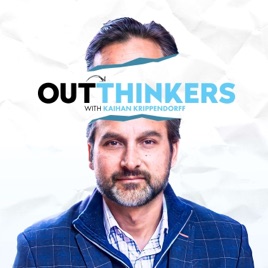
Advertise on podcast: Outthinkers
Rating
5from
This podcast has
163 episodes
Language
EnglishPublisher
OutthinkerExplicit
No
Date created
2021/04/05
Latest episode
2026/02/03
Average duration
43 min.
Release period
15 days
Description
The Outthinkers podcast is a growth strategy podcast hosted by Kaihan Krippendorff. Each week, Kaihan talks with forward-looking strategists and innovators that are challenging the status quo, leading the future of business, and shaping our world.Chief strategy officers and executives can learn more and join the Outthinker community at https://outthinkernetwork.com/.
Unlock Outthinkers podcast Email contact info,
Listeners & Audience details
Email contact information
Direct podcast contact details

Listeners
Audience numbers & engagement insights

Audience details
Podcast Insights

Podcast episodes
Check latest episodes from Outthinkers podcast
#159 — Dr. Brent Ridge: The Kindness Operating System for Hiring, Culture, and Growth
2026/02/03
Dr. Brent Ridge is the co-founder of Beekman 1802, a skin health brand that began with goat milk soap made at a dining room table and scaled into a nationally recognized business with a devoted community. Brent trained in medicine (geriatrics), built his career in New York City, and even helped launch Martha Stewart’s Healthy Living division—before a recession, a rundown farm, and a herd of goats rewrote his path. He’s also the co-author of G.O.A.T. Wisdom, a new book that distills Beekman’s hard-won lessons into practical principles for entrepreneurs who want to build something that lasts.
In this conversation, you’ll learn how to spot real trends before they’re named, build a brand identity customers can feel in seconds, and turn a purpose like kindness into a measurable operating system—not just marketing.
In this episode we cover:
Why “the true measure of authenticity is longevity” (and how brands lose trust chasing viral moments)The Beekman origin story: layoffs, a farm, goats—and turning constraints into a strategy advantageA simple but powerful strategic question: “Where does this not exist?” (and how it opened the luxury door)Trend sensing without getting trapped by algorithms: building your own daily “signal system”How defining your company as “skin health” (not “beauty”) changes everything—from product to positioningTurning kindness into culture, community, and commercial momentum (inside the company and out)
00:00 Introduction to Out Thinkers Podcast
00:30 Defining Authenticity in Business
01:23 Meet Dr. Brent Ridge: From Medicine to Entrepreneurship
02:01 The Birth of Beekman 1802
02:36 Building a Brand with Kindness
04:56 Early Life and Career of Dr. Brent Ridge
07:02 Strategic Moves: From Medicine to Martha Stewart
08:26 Launching the Martha Stewart Center for Living
18:08 The Power of Personal Branding and Sales
21:22 Navigating Trends and Building Legacy
25:01 Seeing Trends in Unlikely Places
26:30 The Birth of Beekman 1802
28:26 The Science Behind Goat Milk
30:32 Rebranding as a Skin Health Company
31:35 The Power of Brand Identity
37:57 Building a Culture of Kindness
40:43 The Kindness Ecosystem
48:22 Conclusion and Final Thoughts
Additional Resources
Book: G.O.A.T. Wisdom (Brent Ridge)Beekman 1802: https://beekman1802.com/Brent Ridge on LinkedIn: https://www.linkedin.com/in/brent-ridge-md-0641791/Kindness Research Foundation: https://www.kindness.orgThank you to our guest, our executive producer Zach Ness, our editor James Pearce, and the Outthinker team. If you enjoyed this episode, please follow, download, and subscribe. I’m your host, Kaihan Krippendorff—thank you for listening.
Follow us at outthinker.com/podcast
#158 — Jana Werner & Phil Le-Brun: How to Build an Organization That Learns and Adapts Fast
2026/01/20
Jana Werner is a global executive advisor and Executive in Residence at Amazon Web Services, where she works with Fortune 500 leadership teams on organizational transformation and enterprise strategy. She holds a PhD in uncertainty dynamics in projects and has contributed to academic research and teaching at institutions including Oxford and the London School of Economics.
Phil Le-Brun spent 31 years at McDonald’s, serving as International CIO and leading technology delivery across more than 120 countries. He is now an Executive in Residence at AWS, serving as an enterprise strategist and evangelist, with advanced degrees in systems thinking.
Together, they are the authors of The Octopus Organization: A Guide to Thriving in a World of Continuous Transformation.
Most large companies still operate like machines. Rigid hierarchies, tight controls, and permission-based decision making may deliver predictability, but they quietly kill ownership, learning, and innovation.
By contrast, the most adaptive organizations operate more like living systems, distributing intelligence, empowering teams, and enabling continuous transformation. Companies like Amazon demonstrate how decentralization, clarity, and ownership can create alignment rather than chaos.
This episode explores how leaders can replace command-and-control structures with environments where innovation becomes everyone’s job.
In this episode we cover
Why the “organization as a machine” model is breaking downThe Octopus Organization metaphor and distributed intelligence in actionHow clarity and context enable decentralized decision-makingOwnership vs permission and the pigs-and-chickens lessonWhy real innovation must be embedded across every layer of the organizationHow curiosity and intelligent failure drive continuous transformation
Episode Timeline
00:00 Highlight and introduction to the Octopus Organization
02:00 Guest introductions and background
04:30 If you really know me… personal stories from Jana and Phil
07:40 Defining strategy as choice and what not to do
10:00 Tin Man vs Octopus organizations
13:30 How decentralization increases alignment
16:00 Ownership, permission, and single-threaded leadership
20:00 Amazon leadership principles and disagree-and-commit
22:30 Creating organizational clarity at scale
26:00 Focus, subtraction, and the mountaineering story
28:30 Durable needs and strategy at Amazon
30:30 Complicated vs complex systems in transformation
33:00 Curiosity, experimentation, and intelligent failure
36:00 The monkey-on-a-pedestal lesson
38:00 Centralized vs decentralized innovation
41:00 Lighting a thousand fires and continuous transformation
44:00 Why this model outperforms traditional change programs
45:30 Where to learn more and connect with the authors
Additional Resources
Book: The Octopus Organization
Website: https://www.theoctopusorganization.com
Jana Werner LinkedIn: https://www.linkedin.com/in/janawerner1/
Phil LeBrun LinkedIn: https://www.linkedin.com/in/phillebrun/
Watch now on Youtube: https://youtu.be/qcD2GmX5uUI
Thank you to our guest, our executive producer Zach Ness, our editor James Pearce, and the Outthinker team. If you enjoyed this episode, please follow, download, and subscribe. I’m your host, Kaihan Krippendorff—thank you for listening.
Follow us at outthinker.com/podcast
#157 — Mark Thompson: What Boards Really Look for When Choosing a CEO
2026/01/06
Mark Thompson is a CEO coach and author of CEO Ready. Born and raised in Silicon Valley and now working across emerging tech hubs, Mark prepares leaders for the leap from elite operator to enterprise chief. He’s worked with CEOs ranging from Richard Branson and Evan Sharp (co-founder of Pinterest) to Dr. Jim Yong Kim (former president of the World Bank) and Dave Chang (founder of Momofuku).
Most executives assume the CEO seat is the natural “next step” for the highest performer. But Mark argues you earn readiness twice: first by delivering results, and then by winning belief outside your swim lane. In other words, performance gets you shortlisted—but it doesn’t get you selected.
In this episode, Mark lays out the seven stakeholders who decide your fate as a CEO candidate (the board, investors/owners, peers, employees, customers, the current CEO, and you). We talk about what each group actually wants, how to build trust across the enterprise, and why the best CEO candidates develop “conversational fluency” across functions so they can lead beyond their lane.
In this episode we cover:
•Why “elite performance” only gets you halfway to CEO—and what earns belief the second time
•The seven stakeholders who decide CEO readiness (and how to build a plan for each one)
•How to show up to the board as more than a functional expert
•Turning peers into partners (before the role forces the shift)
•Building fluency across functions so you can lead the whole enterprise—not just your function
Episode Timeline:
00:00 Introduction to Outthinkers Podcast
01:23 Meet Mark Thompson: CEO Coach and Author
02:06 The Seven Stakeholders of CEO Success
02:42 Mark's Unique Coaching Methods
04:10 Personal Insights and Strategy Definition
06:30 The Reality of Becoming a CEO
08:58 Navigating Board Dynamics
20:57 Interacting with the Board: Key Strategies for Aspiring CEOs
21:28 Listening and Broadening Your Perspective
22:44 Understanding the Role of Strategy Officers
26:36 Navigating Peer Dynamics and Leadership Transition
33:03 Building Relationships with the CEO
35:44 Engaging with Investors and Owners
39:56 The Importance of Customer Influence
44:17 Final Thoughts and Resources for Aspiring CEOs
Additional Resources:
•Mark Thompson: Chief Executive Alliance — https://chieexecutivealliance.com
Watch now on Youtube: https://youtu.be/wuh4Rn7erxU
Thank you to our guest, our executive producer Zach Ness, our editor James Pearce, and the Outthinker team. If you enjoyed this episode, please follow, download, and subscribe. I’m your host, Kaihan Krippendorff—thank you for listening.
Follow us at outthinker.com/podcast
#156 — Bill George: Authentic Leadership, Purpose & Performance
2025/12/16
Bill George is one of the most influential leadership thinkers of our time. A former CEO of Medtronic and long-time Harvard Business School professor, he’s served on the boards of Goldman Sachs, ExxonMobil, Novartis, and the Mayo Clinic. His books including True North and True North: Emerging Leader Edition—have shaped how thousands of leaders approach purpose, values, and character.
When performance pressure rises, it’s easy for leaders to drift from their values chasing quarterly metrics, external validation, and “style” over substance. Bill argues the opposite: sustainable performance springs from purpose, self-awareness, and a culture people believe in. We explore how to stay grounded as expectations, visibility, and success scale.
You’ll learn how authentic leaders make the hard calls without becoming “nice at the expense of necessary,” choose metrics that drive meaning (not gaming), and build teams that keep you honest, learning, and aligned.
In this episode we cover:
•Authentic leadership: what it is and isn’t
•Purpose-first strategy
•The Medtronic metric: measuring outcomes people feel, not just inputs
•Making tough people & portfolio decisions without losing your values
•Building your leadership circle for honest feedback & growth
•Short-term vs. long-term: preventing KPI gaming and hollow wins
Episode Timeline
00:00 Introduction to Outthinkers Podcast
00:35 Bill George on Medtronic's Impact
01:40 Bill George's Leadership Journey
05:00 Defining Strategy and Purpose
10:32 Authentic Leadership Explained
12:45 Challenges and Examples of Leadership
16:04 Personal Growth and Leadership
20:53 Developing Self-Awareness as a Leader
22:15 Facing Crucibles: Overcoming Tough Times
23:47 Exercises for Self-Discovery
25:33 The Power of Small Groups
27:32 Long-Standing Support Systems
29:28 Assessing Leadership Values
33:01 Effective Metrics for Leadership
39:56 Engaging with Bill George
Additional Resources
•Bill George — Website: https://www.billgeorge.org
•LinkedIn: https://www.linkedin.com/in/williamwgeorge/
•Book: True North: Emerging Leader Edition
•Book: True North
•Kaihan Krippendorff: https://www.outthinker.com
Thank you to our guest, our executive producer Zach Ness, our editor James Pearce, and the Outthinker team. If you enjoyed this episode, please follow, download, and subscribe. I’m your host, Kaihan Krippendorff—thank you for listening.
Follow us at outthinker.com/podcast
#155 — Jon Levy: Team Intelligence, Glue Players, and the Culture That Executes Strategy
2025/12/02
Meet Jon Levy — behavioral scientist and author of Team Intelligence: How Brilliant Leaders Unlock Collective Genius and the NYT/WSJ bestseller You’re Invited. Jon has spent years studying human behavior and leadership mechanics, advising companies on how to build teams that actually perform—beyond leadership myths and buzzwords.
We often hire “A-players,” roll out values, and assume great leadership traits will carry us. Then reality hits: strategy doesn’t execute itself—teams do. Jon explains why the smallest unit of performance is the team, why stacking stars backfires, and how culture and language shape what people actually do. If you’re trying to align leaders who don’t buy the data, this one’s for you.
You’ll learn how to engineer collective intelligence—the practical habits, roles, and rituals that raise a team’s game, how to recruit and empower “glue players,” and how to make strategy felt when spreadsheets won’t persuade.
In this episode we cover:
Culture as operating system: the sayings, status cues, and rituals that drive behavior (Apple’s “surprise and delight,” LEGO’s “fireside”).Bursty communication: why teams should “work together, then work apart” to boost problem-solving.Glue players: high-EQ, team-first multipliers (and why too many stars tank performance).Make the implicit explicit: roles, skills, and “player cards” that speed decisions.Trust, not traits: honesty, competence, benevolence—and dealing with the dark tetrad at work.When data won’t convince: crafting a narrative that makes people feel the better future.
Episode Timeline
00:00 Introduction
00:36 Coming Up...
01:47 Unpacking Team Intelligence with John Levy
02:47 Insights on Leadership and Team Dynamics
05:13 The Role of Culture in Organizations
13:49 The Impact of Language on Behavior
16:54 The Concept of Glue Players
18:14 The Key to Predicting Success in Basketball
19:02 Characteristics of Glue Players
21:25 The Importance of Team Dynamics
23:49 The Antwerp Diamond Heist: A Lesson in Teamwork
27:52 Making Implicit Knowledge Explicit
29:36 The Dark Side of Team Dynamics
31:29 Understanding Trust in Teams
34:06 The Role of Emotion in Strategy
35:02 Conclusion and Final Thoughts
Additional Resources
Jon Levy — Website: https://www.jonlevy.comBook: https://www.jonlevy.com/team-intelligenceLinkedIn: https://www.linkedin.com/in/jonlevytlbThank you to our guest, our executive producer Zach Ness, our editor James Pearce, and the Outthinker team. If you enjoyed this episode, please follow, download, and subscribe. I’m your host, Kaihan Krippendorff—thank you for listening.
Follow us at outthinker.com/podcast
#154 — Christina Farr: The Storyteller’s Advantage for Strategy and Growth
2025/11/20
Christina Farr is an investor, startup advisor, and former health-tech journalist. She’s the author of The Storyteller’s Advantage: How Powerful Narratives Make Businesses Thrive and the creator of the Second Opinion newsletter, where she decodes healthcare and technology for leaders.
Most leaders try to move markets with features, roadmaps, and metrics. But the winners often move them with narrative—stories that rally investors, customers, and teams to build the future with them. Christina unpacks how great storytellers create belief that becomes momentum.
You’ll learn a simple framework to make your strategy legible and compelling, how to pick the right plot for your message, and practical ways to craft origin stories, pitch decks, and CEO communications that persuade.
In this episode we cover:
The SOAP framework: Surprise, Openness, Authenticity, PathosSeven classic plots for business (from David vs. Goliath to Rebirth) and when to use eachCase studies: PillPack vs. incumbents; Apple’s comeback; Microsoft’s reinvention; WeWork’s cautionary taleFundraising and sales: decks that move capital and customersLeading in tense moments: speaking to charged issues without fracturing culture
Episode Timeline:
00:00 – Highlight from today’s episode
01:05 – Introducing Christina + the power of narrative in business
03:05 – “If you really know me…”
04:20 – What is strategy? Story as prognostication
07:10 – Why story beats data alone in pitches, sales, and retention
10:55 – The SOAP framework (Surprise, Openness, Authenticity, Pathos)
18:40 – Engineering surprise; calibrating vulnerability
22:00 – Seven plots leaders can borrow (with modern brand examples)
28:45 – Case study: PillPack’s David vs. Goliath playbook
32:40 – Rebirths and tragedies: Apple, Microsoft, WeWork
36:10 – Origin stories that travel (and ones that don’t)
38:10 – CEO comms on divisive topics, without breaking culture
39:20 – Where to learn more from Christina
Additional Resources:
Book: The Storyteller’s Advantage — Christina Farr (Basic Venture) -https://basic-venture.com/titles/christina-farr/the-storytellers-advantage/9781541704299/Newsletter: Second Opinion - https://secondopinion.media/Christina Farr on LinkedIn - https://www.linkedin.com/in/christinafarr/Thank you to our guest, our executive producer Zach Ness, our editor James Pearce, and the Outthinker team. If you enjoyed this episode, please follow, download, and subscribe. I’m your host, Kaihan Krippendorff—thank you for listening.
Follow us at outthinker.com/podcast
#153 – Malte Bernholz of Adobe (Part 1): AI & The Creative Future
2025/11/17
In this special in-person conversation recorded at Adobe’s global headquarters, host Kaihan Krippendorff sits down with Malte Bernholz, Vice President of Strategy and Incubation at Adobe.
Malte brings a unique lens, combining years of experience in consulting and technology leadership, to unpack what might be the most significant technological shift of our lifetime. Together, Kaihan and Malte explore:
The macro forces and creative trends redefining industries in the age of AIWhy this moment rivals—and perhaps surpasses—the dot-com boom in its impactHow AI is both lowering the floor of creativity, making it easier for anyone to create, and raising the ceiling, expanding what’s possible for professionalsHow personalization at scale is transforming customer experiencesAnd what this means for the future of brands, creativity, and human originalityIt’s a conversation about courage, imagination, and leadership at the edge of technological change.
And for the first time, you can watch this conversation as well as listen—check out the video version on Outthinker.com or YouTube.
Thank you to our guest, our executive producer Zach Ness, our editor James Pearce, and the Outthinker team. If you enjoyed this episode, please follow, download, and subscribe. I’m your host, Kaihan Krippendorff—thank you for listening.
Follow us at outthinker.com/podcast
#152 — Mark Crowley: Lead From The Heart, Build Belonging, And Boost Performance
2025/11/04
Mark Crowley is a longtime financial services leader who led consistently top-performing teams over a 25-year career. He’s the author of Lead From the Heart and the newly released The Power of Employee Well-being, a frequent contributor to Fast Company, and host of the Lead From the Heart podcast. In 2013, Mark was the first to publicize Gallup’s finding that only 30% of U.S. employees were engaged—helping ignite a decade-long debate about what truly drives performance.
In this conversation, we explore why feelings and emotions—not dashboards—drive behavior, how the heart–brain connection shapes decisions at work, and why belonging outperforms “boss quality” as a predictor of retention. Mark connects lived leadership to research—from Oxford’s wellbeing–productivity link to HeartMath’s work on coherence—and shows how caring (not coddling) creates the conditions for sustained results.
Whether you lead a business unit, a project team, or a transformation office, this episode will reframe how you raise performance by raising wellbeing—with specific, near-term moves any leader can make this week.
In this episode we cover:
Why traditional engagement efforts flatline—and why wellbeing is the more powerful lever for performanceThe Oxford evidence: how self-reported wellbeing maps directly to productivity in real workBelonging > boss quality as a driver of retention—and how leaders actually build itCaring vs. being nice: creating psychological and emotional safety without lowering the barA practical definition of strategy: know where you’re going, plan with rigor, pivot fast when reality disagrees
Episode Timeline:
00:00 – Introduction
01:10 – Guest introduction and the case for feelings over dashboards
03:05 – “If you really know me…” and how Mark learned to lead from the heart
06:45 – Managing differently: proof from 25 years of top-performing teams
09:30 – Mark’s definition of strategy: plan hard, pivot faster
12:20 – Why wellbeing (not satisfaction) sets the stage for peak performance
15:10 – What wellbeing actually is—and why managers determine most of it
18:05 – Up to 95% of behavior is emotion-driven: implications for leaders
20:30 – Engagement stalled; the Oxford call-center study on wellbeing → productivity
25:40 – Caring vs. nice; HeartMath and the science of coherence
31:00 – Selecting and developing leaders who elevate others (not just individual stars)
36:10 – Belonging as the #1 driver of retention—and how to create it
39:20 – Where to start: know yourself, clarify values, design team-first systems
42:15 – Reward the team first (then individuals) to eliminate zero-sum competition
44:10 – How to keep learning from Mark + close
Additional Resources:
Website: https://markccrowley.comLinkedIn: https://www.linkedin.com/in/markccrowleyBooks: Lead From the Heart; The Power of Employee WellbeingPodcast: Lead From the Heart
Thank you to our guest, our executive producer Zach Ness, our editor James Pearce, and the Outthinker team. If you enjoyed this episode, please follow, download, and subscribe. I’m your host, Kaihan Krippendorff—thank you for listening.
Follow us at outthinker.com/podcast
#151 — Eddie Fishman: Choke Points and the Hidden Levers of Power
2025/10/21
Eddie Fishman is a senior research scholar at Columbia University’s Center on Global Energy Policy, adjunct professor of International & Public Affairs, and author of Choke Points: How the Global Economy Became a Weapon of War. A former U.S. State Department strategist, he served on the Secretary of State’s Policy Planning Staff and Foreign Affairs Policy Board, and led Russia/Europe sanctions policy—bringing a rare, in-the-room perspective to how economic power really works.
In this conversation, we trace how “choke points”—where one nation dominates and substitutes are scarce—have turned minerals, microchips, and money flows into the quiet weapons of great-power rivalry. Eddie unpacks the geo-economic “impossible trinity”—why you can’t maximize interdependence, economic security, and geopolitical calm all at once—and what that trade-off means for leaders making bets on AI, batteries, and supply chains.
Whether you’re steering strategy, procurement, or policy, this episode will change how you spot fragile dependencies, anticipate where pressure will build next, and engage policymakers before the rules harden around you.
In this episode we cover:
Why a true “choke point” = dominance plus low substitutability The geo-economic impossible trinity and its implications for business strategyWhere the next choke points may emerge: AI compute, batteries/EVs, and the energy transitionThe firm’s role: don’t just adapt to policy—shape it (how to engage upstream, practically)Industrial policy realities: U.S. moves on rare earths and semis—benefits, risks, and tolerance for failure
Episode Timeline:
00:00 – Cold open: rare earths and leverage
02:00 – Guest introduction and Eddie’s background
05:45 - Strategy as “winning tomorrow,” not just today
07:02 - Defining choke points (dominance + substitution)
11:20 - The “impossible trinity” explained with historical arcs
27:05 - Should firms adapt or shape policy?
30:05 - Emerging choke points: AI chips, batteries, EVs
38:05 - U.S. industrial policy (MP Materials, Intel) and what comes next
Additional Resources:
Book: https://www.penguinrandomhouse.com/books/726149/chokepoints-by-edward-fishman/
X (Twitter): https://x.com/edwardfishman?lang=en
LinkedIn: https://www.linkedin.com/in/edward-fishman
Thank you to our guest, our executive producer Zach Ness, our editor James Pearce, and the Outthinker team. If you enjoyed this episode, please follow, download, and subscribe. I’m your host, Kaihan Krippendorff—thank you for listening.
Follow us at outthinker.com/podcast
#150 — Scott Anthony: Disruptions and the Patterns That Shape Innovation
2025/10/14
Today we’re welcoming back our first-ever guest on the Outthinker Podcast, Scott Anthony—Senior Lecturer at Dartmouth’s Tuck School of Business and one of the world’s leading voices on innovation and transformation. Formerly a senior partner at Innosight, the consultancy founded by Clayton Christensen, Scott has spent decades helping global organizations navigate disruption, build strategic resilience, and create new engines of growth. He’s also the author of eight acclaimed books, including The First Mile, Dual Transformation, and his newest work, Epic Disruptions: 11 Innovations That Shaped Our Modern World.
In this discussion, we uncover how disruption has driven human progress for centuries—long before the dawn of Silicon Valley. From the cannon fire that toppled ancient empires to the printing press that democratized knowledge, Scott shows that the forces behind disruption are anything but new. Through stories spanning from gunpowder to generative AI, he reveals how these enduring patterns continue to reshape industries, technologies, and societies today.
Listeners will walk away with a richer understanding of how to spot and harness disruption rather than fear it. Scott explains how leaders can use history as a practical playbook—learning to make bold, informed decisions in fast‑changing environments. Whether you’re scaling a business or steering an enterprise through transformation, this is a conversation about seeing beyond the moment to shape what comes next.
In this episode we cover:
What Clayton Christensen really meant by “disruptive innovation”Why the term is so often misused—and how to tell sustaining vs disruptive innovation apartThe “ghosts” that haunt incumbents: past trauma, rigid habits, and identity fears that block changeWhat leaders can learn from the printing press, steel mini mills, and the iPhoneHow to use history as a lens for seeing disruption before it strikesEpisode Timeline:
00:00 — Highlight from today’s episode
01:10 — Introducing Scott Anthony and today’s topic
04:00 — From consulting to academia: finding no “safe spaces” in the era of AI
09:00 — Defining strategy: “a set of choices to achieve a designed aim”
10:00 — Setting the record straight on Clayton Christensen’s theory
16:30 — Bethlehem Steel, emotional ghosts, and leadership through disruption
21:00 — From gunpowder to AI: how patterns keep repeating
25:00 — The printing press and the unintended consequences of innovation
30:00 — The hero’s journey of innovation—from Julia Child to Steve Jobs
37:00 — Spotting modern disruptors: AI, robotics, and additive manufacturing
41:00 — Where to learn more from Scott Anthony
Additional Resources:
Book Website: https://www.epicdisruptions.com
Scott Anthony’s LinkedIn: https://www.linkedin.com/in/scottdanthony/
Thank you to our guest, our executive producer Zach Ness, our editor James Pearce, and the Outthinker team. If you enjoyed this episode, please follow, download, and subscribe. I’m your host, Kaihan Krippendorff—thank you for listening.
Follow us at outthinker.com/podcast
#149 — Adam Brotman: Building the Mindset of an AI‑First CEO
2025/10/07
Adam Brotman is the former Chief Digital Officer of Starbucks and Co-CEO of J.Crew, and co‑author of the e‑book AI‑First: The Playbook for a Future‑Proof Business and Brand. At Starbucks, he helped create one of the most admired digital customer experiences in the world and was named Chief Digital Officer of the Year. Today, as co‑founder of Forum3, Adam helps executives navigate the next era of business transformation—one where AI is no longer optional, but foundational.
Over the past two years, Adam has interviewed some of the most influential voices shaping artificial intelligence—Bill Gates, Sam Altman, Reid Hoffman, and Ethan Mollick, among others. Through those conversations, he’s uncovered what separates companies that simply experiment with AI from those that truly transform.
In this episode, we unpack what it really means to become an AI‑first leader—someone who doesn’t need to code or build models, but who develops the instinct and conviction to guide their teams into this new frontier.
In this episode we cover:
What it means to be an AI‑first CEO and why it starts with an authentic “aha moment.”Bill Gates’ perspective on AI as a tool for qualitative uplift, not just productivity.The idea of the “middle era” of AI—why it feels messy, and how visionary leaders navigate it.Lessons from Starbucks’ shift from digital‑first to AI‑first thinking.Why the real ROI of AI lies in better decisions, faster, across every function.Episode Timeline:
00:00 — Highlight from today’s episode
01:15 — Introducing Adam + today’s topic
02:30 — The AI‑first mindset: where transformation really begins
06:00 — Bill Gates on why AI is bigger than any past tech shift
10:00 — Quantitative vs. qualitative productivity
12:00 — Inside “the middle era” of AI
16:00 — Defining the AI‑first company and leader
25:00 — Beyond ROI: reframing AI’s value
28:00 — Research insights: why AI improves decision quality
31:00 — From skepticism to the CEO’s “aha” moment
33:00 — What’s next after the middle era
38:00 — Closing reflections + how to keep learning from Adam
Additional Resources:
LinkedIn: https://www.linkedin.com/in/adambrotman
Book & Company: https://www.forum3.com/ai-first-book
Thank you to our guest, our executive producer Zach Ness, our editor James Pearce, and the Outthinker team. If you enjoyed this episode, please follow, download, and subscribe. I’m your host, Kaihan Krippendorff—thank you for listening.
Follow us at outthinker.com/podcast
#148—Julia Austin: How Startups and Big Companies Turn Sparks Into Scale
2025/09/16
Our guest today is Julia Austin—former senior leader at Akamai, VMware, and DigitalOcean, with decades of experience helping organizations make the leap from startup to scale. She’s also studied and guided countless founders as a professor at Harvard Business School. Julia now distills those lessons in her new book, After the Idea: What It Really Takes to Create and Scale a Startup.
In this conversation you’ll discover what separates ventures that thrive from those that stall. Every company begins with a spark, but too often innovators fall in love with ideas, overbuild too soon, or underestimate the hard realities of scaling and culture. Julia draws from experience spanning tech giants and countless startups to reveal how leaders can move from inspiration to momentum—and sustain innovation even as complexity grows.
You’ll learn practical frameworks and stories for transforming early insights into long-term impact. Whether you’re a founder, strategist, or innovator inside an established business, this conversation offers tools for approaching discovery, scaling, and culture design.
In this episode we cover:
Four types of scrappy experiments every innovator should run: ethnographic, “be the bot,” Wizard of Oz, and low fidelity prototypesHow to know if there’s really a there there in your marketBalancing beachheads and total addressable markets while keeping unit economics in checkBuilding competitive advantages through team, domain expertise, and partnershipsHow to design org structures and cultures that reward experimentation and embrace productive failureEpisode Timeline:
00:00 — Highlight from today’s episode
01:18 — Introducing Julia Austin and today’s topic
04:45 — “If you really know me…” Julia’s art background
06:30 — Julia’s definition of strategy as a “living, breathing map”
09:15 — Lessons from Akamai and VMware on scaling from startup to global enterprise
14:50 — The importance of discovery: why slowing down helps you go faster
21:05 — Four types of experiments: ethnographic, be the bot, Wizard of Oz, low fidelity
33:40 — Testing markets: TAM, beachheads, and unit economics
42:20 — Building competitive advantage beyond the idea
49:15 — Designing cultures that keep innovation alive at scale
55:45 — Why celebrating failure fuels long-term breakthroughs
01:02:10 — Julia’s book After the Idea and how to connect with her
Additional Resources:
Book Website: https://www.aftertheideabook.com/ Julia Austin's LinkedIn: https://www.linkedin.com/in/juliaaustin
Thank you to our guest, our executive producer Zach Ness, our editor James Pearce, and the Outthinker team. If you enjoyed this episode, please follow, download, and subscribe. I’m your host, Kaihan Krippendorff—thank you for listening.
Follow us at outthinker.com/podcast
#147—Martin Reeves: The Like Button That Changed the World
2025/09/04
Martin Reeves is Chairman of the BCG Henderson Institute and author of The Imagination Machine and his newest book, Like: The Button That Changed the World. A prolific strategist and researcher, Martin is known for uncovering practical lessons from unexpected places and helping leaders rethink innovation for the real world.
In this conversation, we trace the surprising story of the “like” button—how a few lines of JavaScript, cultural quirks, and serendipitous accidents reshaped business models, advertising, and even human behavior. Martin reveals why most groundbreaking ideas don’t emerge from lone geniuses, but from messy communities, chance encounters, and recombinations of old ideas into something new.
Whether you’re leading innovation at scale or just curious about the unintended consequences of technology, this episode will change how you think about creativity, feedback, and the ripple effects of small decisions.
In this episode we cover:
Why the “like” button is the ultimate case study in serendipitous innovationHow social signals scale beyond social media into CX, commerce, and B2B servicesThe role of culture, language, and naming in shaping adoption and meaningWhy second-order effects of innovation often matter more than first-order onesA practical lens for spotting and leveraging serendipity inside organizationsEpisode Timeline:
00:00 – Introduction
02:00 – Guest Introduction
03:45 – Toaster Projects and Innovation
06:13 - Origins of the Like Button
08:25 - Cultural History of the Thumbs Up Gesture
14:31 - Multiple Inventors and Facebook's Role
34:27 - Inside the Code: How Likes Work
36:11 - Future Implications of Like Technology
Additional Resources:
Book Website: LikeBook.orgMartin’s LinkedIn: https://www.linkedin.com/in/martin-reevesBook: Like: The Button That Changed the World
Thank you to our guest, our executive producer Zach Ness, our editor James Pearce, and the Outthinker team. If you enjoyed this episode, please follow, download, and subscribe. I’m your host, Kaihan Krippendorff—thank you for listening.
Follow us at outthinker.com/podcast
#146—Kurt Miscinski: Architecting a Firm that Lasts: Strategy, Culture, and Ownership at Cerity Partners
2025/07/15
Kurt Miscinski is the co-founder, CEO, and President of Cerity Partners, one of the fastest-growing firms in the wealth management space. Today, Cerity manages over $130 billion in client assets—but it started with a different vision: to create the first truly global, enduring professional services firm in wealth, drawing inspiration from firms like McKinsey and Deloitte, but applying it in a field that historically hasn’t operated that way.
In this conversation, Kurt shares how that vision came to life—not through consolidation, but through a partnership ethos and a language shift that reframed everything from equity to culture. This is a story of architecture: how to build a firm that scales without losing its soul, and how to align incentives, ownership, and strategy to fuel long-term value.
In this episode, we discuss:
How Kurt went from being a CPA and Deutsche Bank executive to founder of a firm redefining wealth advisory Why Cerity’s operating model borrows more from McKinsey than Morgan Stanley—and how that unlocks scale The strategic philosophy behind reinvesting 100% of profits and how it shaped the firm’s culture of ownership How they use mergers to create a better firm, not just a bigger one—and why that distinction matters The role of language in shaping culture, from avoiding the word “employee” to framing every merger as a partnership Episode Timeline:
00:00—Highlight from today's episode
00:55—Introducing Kurt + the topic of today’s episode
02:42—If you really know me, you know that...
05:30—What's your definition of strategy?
06:19—Creating Cerity—the founding story
08:57—Deutsche Bank and McKinsey as inspirations for a services-based business model
16:33—How has Cerity created a culture of partnership within the firm?
26:34—What is Cerity's model for capital allocation?
30:21—Where does the strategy office sit within the organization?
33:33—What are some of the principles that form your competitive differentiators?
37:03—How do you balance and maintain the coordination of the various services offered, as your clients evolve and grow?
41:03—What is your process for reevaluating and expanding your client services?
45:08—Closing
______________________________________________________________
Additional Resources:
LinkedIn: https://www.linkedin.com/in/kurtmiscinski
Cerity website: https://ceritypartners.com/
Thank you to our guest, our executive producer Zach Ness, our editor James Pearce, and the Outthinker team. If you enjoyed this episode, please follow, download, and subscribe. I’m your host, Kaihan Krippendorff—thank you for listening.
Follow us at outthinker.com/podcast
OUTTHINKERS LIVE! Embracing Transformation and Leading Through Disruption
2025/07/14
This special episode of Outthinkers was recorded in front of a live audience in NYC and made possible by our friends at LHH, a global leader in HR advisory and talent solutions, trusted by executives around the world to navigate change and lead with confidence. With deep expertise in executive search, leadership development, workforce transformation, and career transition, LHH empowers organizations and their leaders to thrive in an ever-evolving business landscape.
Our guest is none other than Oscar Munoz—former CEO and Chairman of United Airlines, who guided the airline through one of the most significant turnarounds in corporate history. He’s also the author of the acclaimed memoir Turnaround Time, which offers a behind-the-scenes look at the human side of executive leadership.
In this candid conversation, Oscar shares deeply personal lessons on leading through crisis, building trust from the ground up, and the enduring power of authenticity. Whether you're leading your organization through change or navigating a career transition, this conversation offers wisdom and inspiration for every step of the journey.
Thank you to our guest, our executive producer Zach Ness, our editor James Pearce, and the Outthinker team. If you enjoyed this episode, please follow, download, and subscribe. I’m your host, Kaihan Krippendorff—thank you for listening.
Follow us at outthinker.com/podcast
Podcast reviews
Read Outthinkers podcast reviews
Robyn Bolton, MileZero 2024/11/04
Innovative Thinking Unleashed
Kaihan Krippendorff's "TheOutthinkers" podcast is a treasure trove for forward-thinking leaders. The episode featuring Bruce Vojak on "Decoding the Mi...
JJ CEO Medtech 2022/06/16
Strategy officers
This is one of the best podcasts on strategy. Kaihan interview style is superb and the content and learnings valuable for anyone interested in strateg...
Podcast sponsorship advertising
Start advertising on Outthinkers relevant audience podcasts
You may also like to advertise on these Podcasts
4.4371061566
The Megyn Kelly Show
SiriusXM
4.888901269
Fearless with Jason Whitlock
Blaze Podcast Network
4.8118931000
Mind Pump: Raw Fitness Truth
Sal Di Stefano, Adam Schafer, Justin Andrews, Doug Egge
4.8102131585
Tara Brach
Tara Brach

4.541561215
Something You Should Know
Mike Carruthers | OmniCast Media

4.513841343
Strictly Anonymous Confessions
Kathy Kay

4.8292781897
Fantasy Footballers - Fantasy Football Podcast
Fantasy Football

4.62382612
Football Weekly
The Guardian

4.45387666
Two Judgey Girls
Two Judgey Girls

3.8258501152
The Viall Files
Nick Viall