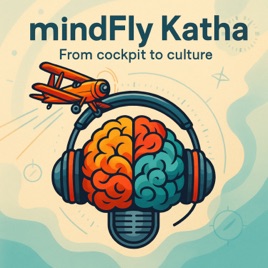
Advertise on podcast: mindFly Katha, From cockpit to culture — one podcast, many flight paths.
This podcast has
59 episodes
Language
EnglishPublisher
Capt. Amit SinghExplicit
No
Date created
2021/04/13
Latest episode
2026/04/17
Average duration
14 min.
Release period
21 days
Description
Where Aviation, Safety, and Forgotten History Intersect Explore the minds behind the machines — and the legacy behind the lives. mindFully Human is a podcast about Human Factors, aviation decision-making, and the untold stories that shape our skies and our culture. Presented by mindFly, an Indian non-governmental initiative founded by Capt. Amit Singh FRAeS, dedicated to enhancing aviation safety, cognitive performance, and preserving ignored Indian legacies. ✈️ From pilot errors to cognitive traps... 🛕 From cockpit checklists to erased dynasties... This podcast travels where others don’t.
Unlock mindFly Katha, From cockpit to culture — one podcast, many flight paths. podcast Email contact info,
Listeners & Audience details
Email contact information
Direct podcast contact details

Listeners
Audience numbers & engagement insights

Audience details
Podcast Insights

Podcast episodes
Check latest episodes from mindFly Katha, From cockpit to culture — one podcast, many flight paths. podcast
Kegworth: The Wrong Engine
2026/04/17
On the evening of 8 January 1989, British Midland Flight 092 fell out of the sky onto the M1 motorway near Kegworth, Leicestershire. Forty-seven people died. The crew had shut down the wrong engine. In this episode, Capt. Amit Singh FRAeS examines the cognitive mechanism that made a skilled, experienced flight crew certain of the wrong answer — and stay certain until it was too late. Premature cognitive closure, satisficing, and the authority gradient that silenced everyone who knew the truth.
Fatal Deviations: The In-Flight Breakup of Air Ambulance VT-AJV
2026/04/08
On February 23, 2026, a Redbird Airways Beechcraft King Air C-90A operating as an air ambulance from Ranchi to New Delhi crashed in Jharkhand, tragically claiming the lives of all seven people on board, including two pilots, medical personnel, and a patient. Minutes after takeoff, the aircraft encountered a severe thunderstorm and suffered a catastrophic in-flight structural breakup, scattering its engines, tail, and fuselage across a kilometer of forested terrain.In this episode, we dive into the official Aircraft Accident Investigation Bureau (AAIB) preliminary report and independent safety analyses to understand how this tragedy unfolded. We explore:
The Weather Trap: How escalating cumulonimbus (CB) clouds and a violent gust front forced the crew into progressive, reactive heading changes—relying on visual avoidance rather than radar—which ultimately led them directly into the core of the storm.The Radar Mystery: Why the aircraft's 1987-vintage magnetron-based weather radar may have provided a false sense of security. We discuss the dangers of radar attenuation, where moderate rain hides severe weather behind it, and the limitations of manual tilt management.The Wreckage Evidence: What the widely scattered distribution of the heavy engines and the violently separated empennage tells us about the extreme aerodynamic overstress the aircraft endured before hitting the ground.Human Factors: The critical role of crew experience—the 25-year-old Captain was flying with a First Officer who had zero Pilot-in-Command hours on this aircraft type—and the dangerous impact of "mission-completion bias" that often pressures air ambulance crews to accept severe risks.Join us as we unpack the final 12 minutes of flight VT-AJV, the forensic wreckage analysis, and the urgent safety recommendations needed to protect future flights from the deadly forces of convective weather
Willie in Wonderland: India's Expat CEO Obsession
2026/04/02
In this episode, we dive into IndiGo’s recent decision to appoint Willie Walsh—former CEO of British Airways and IAG—as its new Chief Executive. While the market reacted with a euphoric 9% jump in share prices, veteran airline captain Amit Singh argues that this hiring pattern demands deeper scrutiny.Why does India export its finest managerial minds to lead global giants like Google, Microsoft, and the World Bank, yet consistently import Western executives to run its own airlines? We explore the deep-seated psychological mechanisms driving these boardroom decisions, including "colonial mentality," the need for "legitimacy signalling" to foreign investors, and "superstitious learning".Finally, we analyze what this means for IndiGo's future. While Walsh—famously nicknamed "Slasher Walsh" for his aggressive cost-cutting at Aer Lingus—might be the right leader to stabilize operations in the short term, is he equipped to handle IndiGo's long-haul ambitions, unique technological challenges, and the complex dynamics of the Indian workforce? Join us as we examine the unfinished business of decolonizing India's corporate imagination.
LaGuardia Runway Incursion Explained | Why Red REL Lights Can Be Missed at Night
2026/03/24
Have you ever wondered why a ground vehicle at LaGuardia Airport drove right past illuminated red Runway Entrance Lights (REL)? The system didn't fail, but the driver's perception was severely compromised.In this video, we dive into the fascinating world of aviation safety, human factors, and visual physiology to explain why the color red might actually be a safety hazard at night.Due to a physiological phenomenon known as the "Purkinje Shift," our eyes use different cells in the dark, causing our sensitivity to shift away from red and toward shorter wavelengths like blue and green. This makes red objects appear significantly darker or even disappear entirely at night. At an airport, this night vision shift combines with a "sea of blue" from taxiway edge lights and wet reflective surfaces, physiologically disadvantaging the most critical "STOP" signals.This visibility issue isn't limited to aviation. It is the exact same scientific reason why many fire departments and the FAA have transitioned from traditional red fire engines to highly visible lime-yellow emergency vehicles, which have been proven to reduce visibility-related accidents.We also explore the cognitive traps that lead to runway incursions:
Foveal Tunneling: How the intense task load of navigating an airport narrows a driver's attention, causing them to miss low-profile, in-pavement peripheral lights.Auditory Masking: How loud vehicle engines and sirens mask critical ATC communications.The Temporal Reinforcement Trap: How predictive runway light systems extinguish shortly after a vehicle crosses, creating a false feedback loop that validates the driver's error.Finally, we discuss how the actual shape and color of signs can save lives. While standard runway holding signs are red with sharp edges, experts argue that changing them to yellow with rounded edges would allow the human brain to process the warnings significantly faster.Watch to understand how the mismatch between system design and human perception causes runway incursions, and what actionable mitigations can prevent the next major accident!#AviationSafety #HumanFactors #RunwayIncursion #PurkinjeShift #Aviation #LaGuardia
LEAKED: Air India Safety Scandal – Flying Passengers with EXPIRED Certificates
2026/02/15
In this episode, we expose a serious safety violation at Air India involving the operation of an Airbus A320 (VT-TQN) without a valid Airworthiness Review Certificate (ARC). Based on leaked internal investigation reports, we break down how an aircraft flew eight revenue flights carrying passengers while illegally undocumented.
In this episode:• The Incident: How VT-TQN operated a test flight and 8 passenger flights in November 2025 despite its safety certificate expiring days earlier.
• The Failure: Why the Engineering team incorrectly informed Flight Ops that the "ARC is valid" and how pilots failed to perform mandatory document checks.
• The Root Cause: A "Swiss Cheese" failure of communication between the ARC Cell, Continuing Airworthiness Manager (CAM), and Engineering Planning.
• The Fallout: The internal scramble to fix "systemic failures" and the disciplinary actions recommended against staff.#AirIndia #AviationSafety #Whistleblower #AviationNews #AirbusA320
Deciphering EAFR Data: "Maximum Recorded Airspeed" vs. "As Per EAFR"
2026/02/14
Why do preliminary aviation reports sometimes distinguish between milestones occurring "as per EAFR" and specific statistics like "maximum recorded airspeed"? In this episode, we analyze the technical nuance behind these terms, using the example of a 180 KIAS peak to illustrate the difference between procedural events (like V1 or Vr) and peak values captured in a data trace. We also dive into the architecture of the 787's Enhanced Airborne Flight Recorder (EAFR) and the Recorder Independent Power Supply (RIPS), explaining how a recorder can continue operating even if specific inputs—like air data from the ADR—stop updating or become invalid
The Acoustic Anomaly: Was the RAT Already Deployed?
2026/02/11
In this episode, we deconstruct the preliminary acoustic evidence surrounding the infamous cockpit exchange: “Why did you cut off?” — “I didn’t do it.”.
While media reports suggest the CVR audio needed to be "cleaned up" to identify these voices, this necessity for heavy post-processing reveals a critical forensic clue. It suggests investigators were forced to rely on the Cockpit Area Microphone (CAM) rather than the typically clear individual headset channels.
Key Analysis Points:• The Acoustic Deduction: Heavy background noise and the need for "cleanup" points to a recording dominated by the Area Mic (CAM).
• The Electrical Implication: A CAM-only recording signature is consistent with the aircraft operating on backup power or in an abnormal electrical configuration, such as the deployment of the Ram Air Turbine (RAT). Technical schematics of the Recorder Independent Power Supply (RIPS) confirm that in the event of usual power failure, the RIPS sends battery power specifically to the Flight Deck Area Mic and the Forward Flight Recorder.
• The Timeline Conflict: The simplistic timeline suggests a Flight Control System (FCS) cutoff led to power loss and subsequent RAT deployment. However, if the audio recording of the voices already exhibits the "heavy noise" signature of backup power, the aircraft may have been in the RAT/backup configuration before the verbal exchange occurred.This evidence challenges the linear sequence of events and raises physics-based questions about the latency between control inputs and hydraulic pressure changes.
Sources:• Acoustic Evidence and the RAT Deployment Timeline• Acoustic_Forensics_Timeline_Revision• Flight Recorder System Schematics (RIPS/EAFR)
The 100-Tonne Mistake: How Cognitive Traps Led to the Milan B777 Tail Strike
2026/02/08
On July 9, 2024, a LATAM Boeing 777-300ER dragged its tail along the runway at Milan Malpensa for over 700 meters. How does a modern cockpit with an Instructor Captain and a Relief Captain fail to notice that their takeoff speeds are dangerously low?
In this episode, we break down the preliminary report and apply a "cognitive view" to understand how a "100-tonne class" error slipped through the safety net.
Key Topics Covered:✈️ The Incident: Reviewing the takeoff of flight LA8073. The aircraft rotated at 149 knots, despite needing speeds calculated for a 328-tonne takeoff weight. The result was a 6cm deep furrow in the runway and a fuel-dumping emergency return.
Math The "Plausibility" Math: We look at the simple math that suggests the crew likely used performance data for a weight around 223 tonnes—roughly 100 tonnes lighter than their actual weight.
🧠 The Cognitive Traps: Why do good crews make gross errors?• Echo-Checking: Replacing independent verification with "Do we match?".
• Learned Carelessness: How daily repetition reduces mental effort.
• The "Commitment Tunnel": Why pilots lock up and try to "make it fly" even when the data feels wrong.
🛡️ The Solution - "Do They Belong?": Moving beyond checking for matching numbers to checking for sense. We discuss the "2-breath gross-error trap" and how to empower the jump-seat pilot to speak up
.Sources: Based on "Cognitive Traps and Performance Errors in the Milan Tail Strike" by Amit Singh (Safety Matters Foundation).
Mind the Gap: AI132, Fuel Switches, and the "Mess Hall" Problem in Aviation Safety
2026/02/05
In this podcast, we analyse the critical gap between written Standard Operating Procedures (SOP) and the tactile reality of cockpit practice, using the AI132 fuel control switch incident as a key case study.1. The "Mess Hall" Problem We begin with an analogy from A Few Good Men: just because the procedure to get to the mess hall isn’t in the book, it doesn’t mean the Marines don’t eat. Similarly, in aviation, you can do the job safely every day even when the manual doesn’t describe every micro-step. SOP provides the documented minimum for compliance, but "practice" is the unwritten discipline—the tactile method of moving a switch or the habit of verifying detents—that actually prevents accidents,.2. The AI132 Case Study: A Safety-Critical Mismatch In the AI132 narrative, a mismatch emerged between the pilot’s report of "slight vertical pressure" causing a switch to unlatch, and a technical explanation focusing on incorrect force vectors,. We discuss why resolving this mismatch is vital to avoid "premature closure"—a human factors trap where the system decides what happened (pilot error) before proving the mechanism.3. The Questions We Must Ask If the issue was simply "incorrect handling," why did it occur only on the left switch and not the right?. We explore potential engineering factors that a robust investigation must consider:• Hardware asymmetry: Differences in micro-wear or detent spring fatigue between left and right switches,.• Ergonomics: Why humans are unreliable sensors of force vectors.• Repeatability: Why the failure wasn't seen on every start.4. The Real Lesson for Pilots and Safety Managers Issuing a "strict SOP compliance" order is an immediate barrier, but the mature safety response is to reinforce control-handling discipline—like the "hands off unless required" rule and deliberate latch verification,.Key Takeaway: SOP is necessary but never sufficient for every tactile nuance. True safety culture improves when we ask, "What made this easy to do?" rather than just "Who did what?".Chapters: 0:00 - The "Mess Hall" Problem: SOP vs. Practice 1:45 - What is "Practice" in the Cockpit? 3:10 - The AI132 Mismatch: Vertical Pressure vs. Force Vector 5:30 - The Unanswered Questions: Why Left Only? 7:20 - Avoiding Premature Closure in Investigations 9:00 - Cockpit Takeaways: Hands Off & Verify#AviationSafety #AI132 #HumanFactors #PilotTraining #AviationMaintenance #SafetyCulture #SOP
The VIP Crash: When Facts are "Managed"
2026/02/02
On September 30, 2001, a King Air C-90 carrying former Aviation Minister from the sky, killing all eight onboard. The official report blamed heavy rains and pilot error—a "convenient story" for a high-profile disaster. But 25 years later, a new forensic analysis suggests the investigation was filled with comforting lies rather than hard truths.In this episode, we explore the dangerous intersection of VIP pressure and aviation safety, asking the questions the original investigators ignored:
• The Weather Deception: Why did the report claim "heavy thunderstorms" when satellite archives show zero rain and clear skies at cruising altitude?
• The Impossible Wind: Did investigators falsify wind direction data to explain away burn marks on the fuselage?
• Silent Evidence: The pilot’s trachea contained soot—proof he was breathing during a fire—yet the report ruled out an in-flight blaze.
Join us as we uncover how "vested interests" can shape the narrative when the influential can't defend themselves.
From Locked Doors to Smart Security: The Fire Safety Crisis at Chennai Airport
2026/01/24
re passengers at Chennai International Airport safe? In this video, we investigate the alarming reports regarding fire safety violations at the newly commissioned terminal and the urgent remedial measures taken by the Airports Authority of India (AAI).🚨 The Allegations: Sealed Exits & Fire Risks Aviation safety experts, led by Capt. Amit Singh of the Safety Matters Foundation, raised a red flag regarding the New Integrated Terminal Building (Phase-1). Photographic evidence revealed that while "EXIT" signs were installed, the emergency access doors they led to were sealed with sheets, making them unusable.Key concerns raised included:• The "Uphaar" Warning: Experts compared the sealed exits to the tragic 1997 Uphaar Cinema fire, warning that locked exits could lead to mass casualties due to smoke inhalation.• Hidden Dangers: There were no signs indicating the exits were closed, nor were alternative routes marked.• Operational Approval: Questions were raised about how the building received operational approval despite these visible safety lapses.✅ The Fix: Major Upgrades Announced Following safety audits and complaints, significant changes have been reported as of January 2026:• New Hardware: The Chennai Airport has replaced nearly 140 emergency exit doors in domestic terminals T1 and T4.• Smart Monitoring: The new doors are equipped with electronic security and monitoring systems, replacing old chains and locks, allowing staff to control them effectively during emergencies.👇 Hashtags: #ChennaiAirport #AviationSafety #FireSafety #AAI #TravelUpdate #SafetyMatters #ChennaiNews
Unseen Toxins: The Systemic Failure of AI-171 Safety Protocols
2026/01/18
When the AI-171 crash occurred, the public saw flames, wreckage, and the heroism of those who rushed in to help. But beneath the narrative of bravery lies a "real safety scandal": a system that allowed responders and civilians to enter a toxic environment unaware and unprotected.In this episode, we uncover the "unseen toxins" that turn modern aircraft accidents into "invisible fibre events". We explore why the smoke from composite materials is not just smoke, but a "incapacitation weapon" loaded with Hydrogen Cyanide—a systemic asphyxiant that can block the body's ability to use oxygen.We breakdown the critical failure of doctrine at the crash site, centering on a terrifying fact from the ARFF industry: there is no meter designed to measure dangerous fibre dispersion, meaning full respiratory protection (SCBA) is the only safe default—yet it was absent
वराह राजपूत: भारत के भूले-बिसरे राजा
2025/12/02
नमस्ते दोस्तों! इस वीडियो में हम वराह (Varaha) कुल के अद्भुत इतिहास और उनकी वंशावली के वैज्ञानिक प्रमाणों पर चर्चा करेंगे। जानिए कैसे पुरातात्विक, आनुवंशिक और ऐतिहासिक रिकॉर्ड इस बात की पुष्टि करते हैं कि वराह राजपूतों की जड़ें मध्य एशिया में थीं और उन्होंने भारतीय इतिहास में एक महत्वपूर्ण भूमिका निभाई।
🔍 वीडियो के मुख्य बिंदु:
आनुवंशिक प्रमाण (Genetic Evidence):
डीएनए विश्लेषण से यह साबित हुआ है कि वराह कुल का डीएनए मंगोलिया की प्राचीन 'योंगजू' (Xiongnu) जनजाति से मेल खाता है,।लेखक का वाई-डीएनए (Y-DNA) हैप्लोग्रुप 'Q1b (L275)' है, जो मध्य एशिया और साइबेरिया में अपनी उत्पत्ति का संकेत देता है,। यह आनुवंशिक लिंक वराह राजपूतों के वंश को लेकर चल रही बहसों को समाप्त करता है।ऐतिहासिक प्रवास (Historical Migration):
वराह कबीले की उत्पत्ति मंगोलिया में हुई, जहाँ से वे मध्य एशिया और ईरान (जहाँ उन्हें 'वराज' या 'हेफ्थलाइट्स' कहा जाता था) होते हुए 5वीं शताब्दी ईस्वी के आसपास भारत आए,,।'वराह' शब्द का अर्थ संस्कृत और प्राचीन ईरानी भाषाओं (जैसे Waraz) में 'सूअर' (Boar) होता है, जो शक्ति का प्रतीक है,।पुरातात्विक पुष्टि (Archaeological Confirmation):
मध्य भारत के एरण (Eran) में वराह की मूर्ति पर हूण शासक 'तोरमाण' (Toramana) का अभिलेख मिला है, जो भारत में उनके शासन और स्थानीय संस्कृति के साथ उनके जुड़ाव का प्रत्यक्ष प्रमाण है,।कांगड़ा किले के प्रवेश द्वार पर रिबन पहने हुए हिरण की मूर्ति यूरेशियन 'फ़र' (Farr) अवधारणा और अल्खन (Alkhan) हूणों के प्रभाव को दर्शाती है,।भारतीय निरंतरता (Indian Continuity):
गांधार और पंजाब में वराह कबीले को 'तुर्क शाही' और बाद में 'हिंदू शाही' राजवंश के रूप में जाना गया,।ऐतिहासिक रिकॉर्ड और स्थानीय कहावतें पुष्टि करती हैं कि भटिंडा (Bhatinda) वराह शासक राजा विनयपाल की राजधानी थी। अंततः, यह कबीला हिमाचल प्रदेश के अंबोटा (Ambota) गाँव में बस गया,।इस वीडियो को देखें और जानें कि कैसे विज्ञान और इतिहास मिलकर एक योद्धा कबीले की खोई हुई कहानी को उजागर करते हैं।
#VarahaHistory #AncientIndia #Genetics #Archaeology #Huns #RajputHistory #IndianHistory
Varaha Rajput - Migraration, Shahis & rulers of Punjab
2025/08/26
“Varaha uncovers how the Varaha Rajputs—traced to the Xiongnu—migrated via Central Asia into India and defended Bharat’s northern borders for centuries. Using Persian and Chinese sources, Indian records, and DNA insights, the book rebuilds a story mainstream history forgot, including the rise of the Hindu Shahis. It’s rigor, not romance—a reclamation of truth and a restoration of honour.”
Rediscovery of the Forgotten Dynasty: The Forgotten Clan
2025/07/08
🕯️ Buried by time. Erased from memory. But not from truth.
They ruled the hills. They fought empires. They left behind temples, coins, and stories… but no one remembers their name.
Who were the Varaha Rajputs?Why were they written out of history?
In this opening episode, we peel back the layers of forgotten chronicles and uncover a warrior clan whose legacy was deliberately silenced. Before the Mughals, before the British, before even the Rajputs of Rajasthan — there was Varaha.
This isn’t just history.It’s a resurrection.
📜 Forgotten by design.🩸 Remembered in blood.🔥 The rediscovery begins now.
Podcast reviews
Read mindFly Katha, From cockpit to culture — one podcast, many flight paths. podcast reviews
Podcast sponsorship advertising
Start advertising on mindFly Katha, From cockpit to culture — one podcast, many flight paths. relevant audience podcasts
You may also like to advertise on these Podcasts

4.6652312197
The Charlie Kirk Show
Charlie Kirk
4.736011303
The Bonfire with Big Jay Oakerson and Robert Kelly
SiriusXM
4.723151954
Timeless Wisdom with Dennis Prager
Salem Podcast Network

4.92471943
The 1000 Hours Outside Podcast
1000 Hours Outside

4.6253402000
The Glenn Beck Program
Mercury Radio Arts

4.922321830
The Ten Minute Bible Hour Podcast
Matt Whitman
4.916151617
The Kristian Harloff Show
Kristian Harloff

4.853512000
Men In Blazers
Men In Blazers
4.847052000
Pat Gray Unleashed
Blaze Podcast Network
4.920391996
Brant & Sherri Oddcast
Brant Hansen