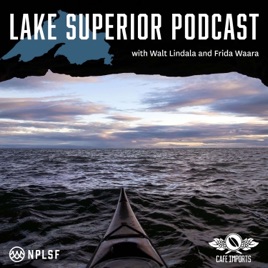
We are made stronger by story and there’s no better source than the continent's largest body of freshwater, Lake Superior. Join hosts Walt Lindala and Frida Waara as they highlight the five National Parks that ring this Greatest of the Great Lakes - meeting the people, touring the places and learning about the projects that make these parks and body of water so remarkable. Join our podcast community! Please share your own stories, comments and podcast episode suggestions (www.nplsf.org/community).
Brought to you by The National Parks of Lake Superior Foundation (www.nplsf.org).
Theme song: King Whirl by David Huckfelt (www.davidhuckfelt.com).
Photo Credit: David Guttenfelder.
Podcast sponsored by Café Imports, a Minneapolis-based importers of fine, specialty green coffees.
Advertise on Lake Superior Podcast
Advertise on Lake Superior Podcast to promote your brand to thousands of podcast listeners
Unlock Lake Superior Podcast podcast Email contact info, Listeners & Audience details
Check latest episodes from Lake Superior Podcast podcast
S8 E2: Exploring Lake Superior’s Deepest Waters: The Mystery of the “Zombie Fish” — with Shawn Sitar
2026/09/30
More than 1,300 feet below the surface of Lake Superior, scientists are investigating a fisheries mystery: siscowet lake trout that should be fat and robust are turning up strikingly thin. Researchers call them “zombie fish,” but the real story is less sensational—and still unresolved.
In this episode of the Lake Superior Podcast, Walt Lindala and Frida Waara talk with returning guest Shawn Sitar, a Michigan DNR fisheries research biologist and science officer aboard the RV Lake Char, about what the team is learning from Lake Superior’s deepest waters. From possible food shortages and disease testing to lake trout recovery and long-term monitoring, Shawn takes us into the science behind one of Lake Superior’s most unusual recent findings and how long-term fisheries research helps scientists track the health of the lake.
Notable quotes:
“There’s a famine event going on out there…they actually kind of look like zombies.”“We’re not alarmed, we’re concerned.”“Overall, Lake Superior is in a really good place…We have abundant populations of fish. We have a lot of biodiversity also.”“Recently we declared that lean lake trout, the one that’s utilized by humans, has been recovered or in a rehabilitated state. That’s a good sign.”“I’m glad to work on a system that is basically the most natural of the Great Lakes. Things are in good shape.”“Part of my duty is to communicate the science to everyone so that they have a better understanding and appreciation of everything around us.”Helpful links:
Michigan DNR – Researchers Head to Superior Maximus to Investigate “Zombie” Fish
https://www.michigan.gov/dnr/about/newsroom/releases/2026/06/08/researchers-head-to-superior-maximus-to-investigate-zombie-fishMichigan DNR – Fisheries Research
https://www.michigan.gov/dnr/managing-resources/fisheries/researchThe Fish Thief: A Great Lakes Mystery
https://www.thefishthief.com/Lake Superior Podcast – Shawn Sitar’s previous lake trout recovery episode
https://podcast.nplsf.org/1756982/episodes/16661302-s6-e3-the-lake-trout-resurgence-in-lake-superior-a-conservation-success-story-an-interview-with-shawn-sitarConnect with us:
Lake Superior Podcast Page: https://nplsf.org/podcastFacebook: https://www.facebook.com/NationalParksOfLakeSuperiorFoundationSponsors:
Cafe Imports – Minneapolis-based importers of specialty green coffees since 1993, focused on sustainability. Learn more: cafeimports.comNational Parks of Lake Superior Foundation – Donate to protect Lake Superior’s five national parks: nplsf.org/donate
S8 E1: Carrying Big Annie Clemenc’s Story Forward: From the 1913 Copper Strike to Calumet’s New Statue — with Vada Riederich
2026/09/16
More than a century after the 1913–14 Copper Country Strike, one of its most prominent leaders now has a permanent place in downtown Calumet, Michigan. Anna Klobuchar Clemenc, better known as “Big Annie,” was born in Calumet to Slovenian immigrant parents and became a leader in the strike, founding and serving as president of the Women’s Auxiliary No. 15 of the Western Federation of Miners.
In this episode of the Lake Superior Podcast, Walt Lindala and Frida Waara talk with Team Big Annie chairperson Vada Riederich about the years-long community effort to raise $150,000 to create a bronze statue honoring her legacy and the August 2026 unveiling. Vada about how a Facebook post grew into a years-long campaign, the people who helped make the monument possible, and what Big Annie’s legacy can teach new generations about labor history in Michigan’s Keweenaw Peninsula.
Notable Quotes:
“She was driven and she would not give up on what should be fair and right.”“At that time when women had no voice and no vote, that's quite an undertaking for a young woman of 25 years old.”“I hope that young people will be inspired to learn more about our amazing history and be proud to share it.”“We're still a young nation and we're still growing and learning from our mistakes…history gives you that information so we can figure a path to correct those mistakes”“So she spoke up at that time, and it led to good things in the future.”
Helpful links:
Big Annie Statue Project
https://www.biganniestatue.com/
Keweenaw National Historical Park
https://www.nps.gov/kewe/
Coppertown Mining Museum
https://www.nps.gov/places/coppertown-mining-museum.htm
Keweenaw Community Foundation – Big Annie Statue Fund
https://www.keweenawcommunityfoundation.org/big-annie-statue-fund
Connect with us:
Lake Superior Podcast Page: https://nplsf.org/podcastFacebook: https://www.facebook.com/NationalParksOfLakeSuperiorFoundation
Sponsors:
Cafe Imports – Minneapolis-based importers of specialty green coffees since 1993, focused on sustainability. Learn more: cafeimports.comNational Parks of Lake Superior Foundation – Donate to protect Lake Superior’s five national parks: nplsf.org/donate
S7 E12: A New Life for Abandoned Mines: Energy, History and Innovation — with Timothy Scarlett
2026/08/05
For generations, the mines of Michigan's Copper Country have been woven into the history of the Lake Superior region. While many of those mines closed decades ago, their stories — and the underground landscapes they created — continue to leave their mark on the communities above them. Today, researchers are combining archaeology, historic records, and emerging technologies to better understand the region's mining history, improve public safety, and explore how these underground landscapes may serve future generations.
In this episode of the Lake Superior Podcast, Walt Lindala and Frida Waara talk with Tim Scarlett, Associate Professor of Archaeology at Michigan Technological University. They explore the challenges of mapping abandoned mines, why understanding these underground landscapes matters, and what they can teach us about the past and perhaps the future.
Connect with us:
Lake Superior Podcast Page: https://nplsf.org/podcastFacebook: https://www.facebook.com/NationalParksOfLakeSuperiorFoundation
Sponsors:
Cafe Imports – Minneapolis-based importers of specialty green coffees since 1993, focused on sustainability. Learn more: cafeimports.comNational Parks of Lake Superior Foundation – Donate to protect Lake Superior’s five national parks: nplsf.org/donate
S7 E11: Moosewatch, Wilderness Learning and the Lasting Pull of Isle Royale — with Karen Bacula
2026/07/15
Isle Royale is one of the least visited of America’s National Parks. Located in the northwest corner of Lake Superior, it’s a tough place to get to. Access is only by seaplane, ferry or private boat. But once visitors do come, they are likely to return. Karen Bacula has been coming to this remote island since 1997. As a teacher, she also brought students to explore this unique archipelago of islands. Now, retired, she volunteers as director of Michigan Tech’s Isle Royale Institute and coordinates Moosewatch volunteers, helping people take part in fieldwork that supports the world’s longest-running predator-prey study. In this episode of the Lake Superior Podcast, Walt Lindala and Frida Waara talk with Karen about citizen science, wilderness learning and the lasting pull of Isle Royale.
Quotes:
“What connected me and made me want to just keep coming back was the beauty, the quiet, the simplicity, but yet incredibly complex whole area of what was there being surrounded by the lake. And many of the people I met were just absolutely wonderful.”“The power of the island, the power of the lake, the serenity, but also realizing that at the drop of a hat, the weather can change. So there's predictability and uncertainty in every step that you take. And I like that feeling.”“There's something special and new about it each time and getting to see the changes.”“We’re looking for dead moose and looking for the condition of the skeleton to see what the moose age-wise, health-wise was like, potentially how it died.”“It becomes very cross-curricular at all different grade levels. But they all come out with the big excitement being to learn how the study's done and to learn the field techniques for collecting data for this study.”“Two things I tell them to pack that are not necessarily on the gear list is their patience and sense of humor.”“Work to bring some of what you just felt right now with the people you met and living as close to the earth as you can live, bring some of that back with you and hold on to that.”
Helpful links:
Learn more about the Wolf-Moose Project:
isleroyalewolf.orgLearn more about joining a Moosewatch expedition:
isleroyalewolf.org/volunteer-moosewatchLearn more about Moosewatch for Educators:
isleroyalewolf.org/moosewatch-for-educatorsLearn more about Isle Royale wolf-moose population dynamics:
isleroyalewolf.org/population-dynamicsLearn more about supporting the research through the Wolf-Moose Foundation:
wolfmoosefoundation.orgLearn more about the Northern Moose Alliance: moosealliance.org Plan a visit to Isle Royale National Park:
nps.gov/isro/planyourvisit/index.htm
Connect with us:
Lake Superior Podcast Page: https://nplsf.org/podcastFacebook: https://www.facebook.com/NationalParksOfLakeSuperiorFoundation
Sponsors:
Cafe Imports – Minneapolis-based importers of specialty green coffees since 1993, focused on sustainability. Learn more: cafeimports.comNational Parks of Lake Superior Foundation – Donate to protect Lake Superior’s five national parks: nplsf.org/donate
S7 E10: From Rare Sight to Remarkable Recovery: Bald Eagles and the National Eagle Center — with Ed Hahn
2026/07/01
The bald eagle has been the patriotic symbol of America for 250 years. Most folks can remember the first time they saw this majestic bird soaring in the wild. There was a time when sighting them, even on Lake Superior, was rare, but today these birds of prey are making a comeback. Their return represents one of America’s most visible conservation successes. In this episode of the Lake Superior Podcast, Walt Lindala and Frida Waara talk with Ed Hahn, Director of Advancement and Marketing Communications at the National Eagle Center in Wabasha, Minnesota, about the bald eagle’s recovery, how to recognize young eagles and what visitors can learn by meeting an eagle ambassador face to face.
Quotes
Ed Hahn says the species has made "a complete and total recovery" and calls that "a truly incredible accomplishment for Americans to take some pride in," adding, "We accomplished that through public action."“But just like everyone else, we truly do wish that they could be living their full lives as intended as wild eagles out in the wild.”“We have to work with them to educate the public and we have to be sharing those birds with the public.”“Bald eagles are covered in approximately 7,000 feathers.”“There's always new things to learn about eagles.”Helpful Links
Learn more about the National Eagle Center:
https://www.nationaleaglecenter.org/
Plan a visit to the National Eagle Center:
https://www.nationaleaglecenter.org/visit/
Meet the National Eagle Center’s eagle and raptor ambassadors:
https://www.nationaleaglecenter.org/the-ambassadors/
Watch the EagleWatch Cam overlooking the Mississippi River:
https://www.nationaleaglecenter.org/eaglewatch-cam/
Learn what to do if you find an injured bird:
https://www.nationaleaglecenter.org/found-an-injured-bird/
Learn about bald eagle recovery and management from the U.S. Fish and Wildlife Service:
https://www.fws.gov/program/eagle-management
Connect With Us:
Lake Superior Podcast Page – https://nplsf.org/podcastFacebook – https://www.facebook.com/NationalParksOfLakeSuperiorFoundationSponsors:
Cafe Imports – Minneapolis-based importers of specialty green coffees since 1993, focused on sustainability. Learn more: cafeimports.comNational Parks of Lake Superior Foundation – Donate to protect Lake Superior’s five national parks: nplsf.org/donate
S7 E9: Life Aboard The Blue Heron: Lake Superior’s Floating Science Lab — with Rual Lee
2026/05/13
Sailing Season on Lake Superior is busy. Approximately 4,500 ships travel through the Soo Locks. One boat, the Blue Heron, docked in Duluth, Minnesota, spends the summer season as a Research Vessel for the University of Minnesota’s Large Lakes Observatory. Captain Rual Lee has been at the helm of the 87’ vessel since 2014. In this episode of the Lake Superior Podcast, Walt Lindala and Frida Waara talk with him about what it takes to operate a floating science lab on the Greatest of the Great Lakes.
Quotes:
“We're still working on the boat, trying to make it a better tool for science.” “The lake is humbling. It really doesn't matter what boat you're on. It will put you in your place as it were.” “One of the great parts of my job is that the crew and I get to hang around with some really smart people doing some really clever research, looking at different parts of the lake.” “The science comes and goes according to the individual projects. So we're the platform. We're a useful tool to get the science done.” “Out in the middle of Lake Superior, you can see the results of a policy change that showed up in the mid-70s. And that's really a great thing I think.”
Helpful links:
Learn more about the R/V Blue Heron:
https://scse.d.umn.edu/large-lakes-observatory/vessels/blue-heron Learn more about the Large Lakes Observatory:
https://scse.d.umn.edu/large-lakes-observatory Learn more about Science on Deck events:
https://scse.d.umn.edu/large-lakes-observatory/news-events/science-deck Track Great Lakes vessels with BoatNerd AIS:
https://ais.boatnerd.com/ Learn more about “The Freshwater Everest” / Superior Shoal livestream:
https://inspiredplanet.ca/live/
Connect With Us:
Lake Superior Podcast Page – https://nplsf.org/podcast Facebook – https://www.facebook.com/NationalParksOfLakeSuperiorFoundation
Sponsors:
Cafe Imports – Minneapolis-based importers of specialty green coffees since 1993, focused on sustainability. Learn more: cafeimports.com National Parks of Lake Superior Foundation – Donate to protect Lake Superior’s five national parks: nplsf.org/donate
S7 E8: Big Lake, Small World: Three Decades Of Lake Superior Stories — With Konnie LeMay
2026/04/30
There’s nothing like sitting around a camp fire telling Lake Superior stories. Imagine the tales you could collect spending almost three decades gathering the news, features and photographs for the region’s most popular magazine. In this episode of the Lake Superior Podcast, Walt Lindala and Frida Waara talk with Konnie LeMay, long time editor of Lake Superior Magazine, published in her home town of Duluth, MInnesota, to find out more about her career-long favorites.
5 Episode Quotes
“Lake Superior has always been part of my horizon.”
“It has given me one of my frequently noted phrases, which is big lake, small world.”
“There isn't one place that I've been around the lake that I wouldn't want to visit again.”
“Our bodies are more than 50% water, and my body happens to be probably about all Lake Superior water, so I carry Lake Superior with me wherever I go.”
“It is a resource not just of the moment, but a resource of the future.”
Helpful links:
Learn more about Lake Superior Magazine:
https://lakesuperior.com/Learn more about Lake Superior Writers:
https://lakesuperiorwriters.org/
Connect With Us:
Lake Superior Podcast Page – https://nplsf.org/podcastFacebook – https://www.facebook.com/NationalParksOfLakeSuperiorFoundation
Sponsors:
Cafe Imports – Minneapolis-based importers of specialty green coffees since 1993, focused on sustainability. Learn more: cafeimports.comNational Parks of Lake Superior Foundation – Donate to protect Lake Superior’s five national parks: nplsf.org/donate
S7 E7: The Future of Moose in Minnesota: What a New Study of Young Moose Could Reveal — with Michelle Carstensen
2026/04/08
No mammal represents Minnesota’s north shore better than the moose. The winter of 2026 has been busy and significant for these majestic animals. Through the Northern Moose Alliance (www.moosealliance.org), a joint effort between Minnesota Department of Natural Resources, 1854 Treaty Authority, Grand Portage Band of Lake Superior Chippewa, and the National Parks of Lake Superior Foundation, 60 juvenile moose were collared to launch a study on why the moose population has seen a 60% decline in recent years. In this episode of the Lake Superior Podcast, Walt Lindala and Frida Waara talk with Michelle Carstensen, Wildlife Health Group Leader for the Minnesota’s DNR about the project and the partnerships that have come together to better learn about the region’s moose.
We’d love to keep you updated as this work evolves and share ways you can help protect moose as opportunities arise.
Join the Northern Moose Alliance’s quarterly newsletter for exclusive updates, expert moose insights, and actions you can take: https://moosealliance.org/subscribe/
Quotes
“It's been a very moose-filled winter for us, which, if you ask me, is a great way to spend the winter.”
“What we want to know is how many can survive over winter and at what age they become reproductively contributing to the population.”
“We were missing that middle cohort of animals, which is a huge driver if you want to have a population that’s going to grow.”
“We’re trying to understand why the moose population has been kind of stagnant.”
“It’s our role as stewards to try to help this population thrive.”
Connect With Us:
Northern Moose Alliance Website – https://moosealliance.org Lake Superior Podcast Page – https://nplsf.org/podcastFacebook – https://www.facebook.com/NationalParksOfLakeSuperiorFoundationSponsors:
Cafe Imports – Minneapolis-based importers of specialty green coffees since 1993, focused on sustainability. Learn more: cafeimports.comNational Parks of Lake Superior Foundation – Donate to protect Lake Superior’s five national parks: nplsf.org/donate
S7 E6: One Lake, Five Parks, Twenty Years: The NPLSF Story — with Carol Brady
2026/03/25
What started on March 1, 1872, when Yellowstone became the first National Park in the world, has grown to over 433 units covering over 85 million acres in America. Tagged "America’s Best Idea," we celebrate National Parks Week every year in April. Roughly 20,000 people work either full-time or seasonally with the National Park Service but the system also relies on over 130,000 volunteers. The National Parks of Lake Superior Foundation--sponsor of this podcast--is one of those volunteer organizations.
In this episode of the Lake Superior Podcast, Walt Lindala and Frida Waara talk with Carol Brady, founding board member and long-time Chairman of NPLSF, about the organization’s mission and projects that have developed over the last two decades.
5 Quotes
“In 2026, this will be 20 years since we became an actual official 501(c)(3) nonprofit foundation.”“National Park Service unbelievably has over 400 units in the country, and the government budget for the National Park Service is a finite number.”“There’s only so much budget to go around. In order to keep all of these places as special as folks expect them to be when you go there, they need help. They need outside help.”“That is an ongoing thing that will last much longer than I will, I’m quite sure.”“You’re not going to really notice that this is not the coast of an ocean. The lake could be calm, it can be just wild, but the best thing is it’s clear and cold. You dip it in there and take a drink, it’s just great. It’s fresh water. It’s just amazing. People think it’s going to just look like a big lake, and then when they realize it looks like the ocean, they forget that it’s clear and cold and fresh.”
Connect With Us:
Lake Superior Podcast Page – https://nplsf.org/podcastFacebook – https://www.facebook.com/NationalParksOfLakeSuperiorFoundationSponsors:
Cafe Imports – Minneapolis-based importers of specialty green coffees since 1993, focused on sustainability. Learn more: cafeimports.comNational Parks of Lake Superior Foundation – Donate to protect Lake Superior’s five national parks: nplsf.org/donate
S7 E5: Keweenaw’s Legendary Snowfall: Winter Recreation and Traditions in the Upper Peninsula’s Snow Capital — with Jesse Wiederhold
2026/03/13
While some parts of the country can count on crocus and daffodils to signal spring in March, Michigan’s Keweenaw Peninsula is still measuring snowbanks. Over 300” has fallen across the region and more is expected, possibly into May. From the looks of future forecasts, the area is sure to surpass last year’s total of 315.25” and may be on track for the all-time high of 390.4” set back in the winter of 1978-79. What do you do with over 32’ of snow in a season? In this episode of the Lake Superior Podcast, Walt Lindala and Frida Waara talk with Jesse Wiederhold, Managing Director of Visit Keweenaw, about what makes this area of Michigan’s Upper Peninsula such a mecca for snow lovers and tips on how they survive cabin fever.
5 Key Takeaways
Extraordinary Snowfall Totals In The Keweenaw Peninsula: Jesse Wiederhold says the Keweenaw had already passed 200 inches of snowfall by early January and notes that the historical snowfall record in Keweenaw County is about 390 inches in a single season recorded in the late 1970s. Lake Superior Drives The Region’s Heavy Snowfall: Wiederhold explains that Lake Superior acts as a “snow machine,” producing lake-effect snow because the Keweenaw Peninsula is surrounded by the lake on multiple sides. Winter Recreation Draws Visitors To The Keweenaw: Visitors come to the region for winter activities including skiing, snowmobiling, cross-country skiing, snowshoeing, and snow biking, with ski areas such as Mount Ripley and Mount Bohemia operating during the winter season and drawing large numbers of visitors, including days when more than a thousand people ski at Mount Bohemia. Groomed Trail Systems Support Winter Sports In The Region: Wiederhold highlights several groomed trail networks located within about a 30-minute radius of Houghton and Hancock, including the Michigan Tech trails in Houghton, the Maasto Hiihto and Churning Rapids trails in Hancock, the Swedetown trails in Calumet, and the East Bluff trails in Copper Harbor. Finnish Heritage And Sauna Culture Remain Strong In The Keweenaw: Wiederhold notes that about one in three people in Houghton County are Finnish and explains that sauna culture remains an important part of local life, with both home saunas and public sauna experiences such as those at Mount Bohemia and Taka Saunas available in the region.
Helpful Links:
Visit Keweenaw – https://visitkeweenaw.comMount Bohemia – https://mtbohemia.comCopperDog 150 – https://copperdog.orgMichigan Tech Trails – https://www.mtu.edu/recreation/outdoor/trails/
Connect With Us:
Lake Superior Podcast Page – https://nplsf.org/podcastFacebook – https://www.facebook.com/NationalParksOfLakeSuperiorFoundation
Sponsors:
Cafe Imports – Minneapolis-based importers of specialty green coffees since 1993, focused on sustainability. Learn more: cafeimports.comNational Parks of Lake Superior Foundation – Donate to protect Lake Superior’s five national parks: nplsf.org/donate
S7 E4: Bat Science and Survival: Lake Superior’s Night Flyers — with Dr. Winifred Frick
2026/01/14
Bats have been called the “Invisible Mammal” primarily because they fly silently and mostly at night. They also roost in dark places, caves or abandoned mines, making them hard to find even in the daylight. For humans, bats aren’t only hard to see, they are hard to understand, yet they play a vital role in our world’s ecosystems and an equally important roll in our agricultural economy. Yet 200 species of bats are nearing extinction. In this episode of the Lake Superior Podcast, Walt Lindala and Frida Waara talk with Winifred Frick, Chief Scientist at Bat Conservation International, to learn more about what is threatening bat populations around Lake Superior.
5 Key Takeaways
Bats Are More Diverse — And Longer-Lived — Than Most People Realize
Winifred Frick notes that bats are “the only mammals that can fly,” and that scientists have “just celebrated the discovery of the 1,500 bat species.” In the U.S. and Canada, she says there are “about 47 different bat species.”
White-Nose Syndrome Has Devastated Bats Around Lake Superior
Frick explains that white-nose syndrome is caused by a fungal pathogen — Pseudogymnoascus destructans (“PD”) — and says it “first emerged…in the winter of 2006, 2007.” She adds that it “has killed millions of bats in its wake” and highlights a “99% decline” in the northern long-eared bat population.
The Fungus Spreads Through Hibernation Sites — Not Just Bat-to-Bat Contact
Frick describes how the fungus grows on bats’ skin (including wings, ears, and muzzle) and can also persist on cave and mine surfaces. She explains bats can pick it up “either by coming in contact with each other” or by contacting “the surfaces where they roost.”
“Fat Bat Project” — A Practical Experiment To Help Bats Survive
Frick explains how white-nose causes bats to burn through fat reserves by arousing too often during hibernation, leading them to “starve to death before spring.” In Michigan’s Upper Peninsula, her team tested using UV lights near mines (including near the Delaware Mine area) to attract insects and boost foraging — what Frick calls “our fat bat project.”
You Can Help Bats By Supporting Habitat, Native Insects, And Conservation Work
Frick points to Bat Conservation International’s “bat gardens program,” encouraging people to plant native plants that support moths and beetles. She also emphasizes advocating for nature protection and supporting organizations funding bat research and conservation actions.
Helpful Links:
Bat Conservation International - batcon.org
The Invisible Mammal Film - doclands.com/film/the-invisible-mammal
Connect With Us:
Lake Superior Podcast Page – https://nplsf.org/podcast
Facebook – https://www.facebook.com/NationalParksOfLakeSuperiorFoundation
Sponsors:
Cafe Imports – Minneapolis-based importers of specialty green coffees since 1993, focused on sustainability. Learn more: cafeimports.com
National Parks of Lake Superior Foundation – Donate to protect Lake Superior’s five national parks: nplsf.org/donate
S7 E3: Lake Superior’s Lasting Hold: The Story Behind A Is for Agates: A Lake Superior Alphabet Book — with Patti Baraks
2025/12/10
For some, growing up on Lake Superior carves a deep connection to place, and no matter where life leads, the pull to return to that rugged shoreline never leaves. Patti Baraks knows too well that hold Superior creates. She grew up in Superior, Wisconsin, and although she has lived, worked and raised a family in Texas, she admits, her internal compass always points north toward that mighty lake. As an early childhood education teacher with a passion for poetry, she used that lure to write a children’s book, “A is for Agates, A Lake Superior Alphabet Book”.
In this episode of the Lake Superior Podcast, Walt Lindala and Frida Waara talk with Patti not only about her time in Wisconsin, but also about the motivation and process of producing a children’s book.
If you’d like a copy, or need a perfect Lake Superior–themed Christmas gift, she shares that you can find the book at independent bookstores and libraries around the Lake Superior region. It’s also available online at Itasca Books:
https://itascabooks.com/products/a-is-for-agates-a-lake-superior-alphabet-book-1
Key takeaways
Patti’s Deep Connection to Lake Superior Has Never Faded
Patti Baraks grew up in Superior, Wisconsin, a city she describes as “one of the greatest port cities on Lake Superior.” She explains that Lake Superior shaped every part of daily life — the economy, recreation, and weather — and says the lake “has always had a hold over me that I can’t quite explain.” Even after moving to Texas, she shares that her “internal compass points north” and draws her back every summer.
The Passing of Her Father Motivated Her to Finally Write a Book
Patti says she had “always wanted to be a writer,” but it wasn’t until her father passed away about a year and a half before the interview that she decided she didn’t want “a cloud of regret” about never pursuing that dream. This loss gave her the push to “get out of [her] comfort zone and just go for it.”
Collaboration With Illustrator Lisa Perrin Cosmo Was Central to the Book’s Success
Patti selected illustrator Lisa Perrin Cosmo after seeing an agate painting in her portfolio and feeling immediately drawn to her work. She says Lisa is “local to the North Shore,” “really knows the lake,” and seemed able to “read my mind” when creating the illustrations. Patti calls her artwork “breathtaking” and says the illustrator “paints the best moose.”
Patti Believes Nature-Based Literature Helps Children Explore and Learn
As a former teacher, Patti says that nature-based books encourage kids to get outside, reduce stress, and learn through observation. She describes the outdoors as “the original classroom,” where children discover things independently, ask questions, and engage their natural curiosity.
Connect With Us:
Lake Superior Podcast Page – https://nplsf.org/podcast
Facebook – https://www.facebook.com/NationalParksOfLakeSuperiorFoundation
Sponsors:
Cafe Imports – Minneapolis-based importers of specialty green coffees since 1993, focused on sustainability. Learn more: https://cafeimports.com
National Parks of Lake Superior Foundation – Donate to protect Lake Superior’s five national parks: https://nplsf.org/donate
S7 E2: Mapping the Seen and Unseen: USGS Earth MRI’s Work in the Lake Superior Region - with Jamey Jones
2025/11/26
The first known map of Lake Superior was drawn by Virginian John Mitchell in 1755. Over the centuries, countless records of the shoreline, depths, lighthouses and communities have been published. But now, there’s another map in the works. This one by the United States Geological Survey. In this episode of the Lake Superior Podcast, Walt Lindala and Frida Waara talk with Jamey Jones, Science Coordinator for the USGS’s Earth Mapping Resources Initiatives, or Earth MRI. He shares what this project hopes to accomplish, particularly when it comes to locating the area’s rare earth minerals and contributing to the publicly available data on metals deposits in the Lake Superior region. Tune in to learn more!
Webpage
USGS Earth Mapping Resources Initiative – https://www.usgs.gov/earth-mapping-resources-initiative-earth-mri Connect With Us:
Lake Superior Podcast Page – https://nplsf.org/podcastFacebook – https://www.facebook.com/NationalParksOfLakeSuperiorFoundationLinkedIn – https://www.linkedin.com/company/national-parks-of-lake-superior-foundation
S7 E1: The Edmund Fitzgerald Story and Legacy: 50 Years Beneath the Waves — with Fred Stonehouse
2025/11/05
The Gales of November is very real on the Great Lakes, known as the “Month of Storms.”
Some 550 wrecks lie on the bottom of Lake Superior, at least 200 along Superior’s Shipwreck Coast, a treacherous 80-Mile stretch with no safe harbor between Munising and Whitefish Point.
On November 10, 1975, the Edmund Fitzgerald, a 728 foot freighter went down in a storm described as both blizzard and hurricane taking all 29 crew members to their grave. Made famous by the Gordon Lightfoot song, the wreck has remained a mystery for fifty years.
In this episode of the Lake Superior Podcast, Walt Lindala and Frida Waara talk with maritime historian, author and lecturer Fred Stonehouse about that tragic night and what we have learned since her sinking and how her legacy has shaped maritime safety.
Key Takeaways
The Edmund Fitzgerald Sank Fifty Years Ago — But Its Mystery Endures
Maritime historian Fred Stonehouse recounts how the 729-foot freighter Edmund Fitzgerald sank on November 10, 1975, about 15 miles northwest of Whitefish Point. The ship went down without a distress signal, and all 29 crew members were lost—leaving one of the Great Lakes’ most haunting mysteries.A Storm Described as Both a Blizzard and a Hurricane
The night the Fitzgerald went down, Lake Superior raged with winds exceeding 75 miles per hour—stronger than a Category 1 hurricane. As Fred explains, the storm “exceeded 75 miles an hour in wind, and a cat one hurricane’s only 74.”Hubris and Hard Lessons on the Great Lakes
“This was a time when ships had the attitude that they can’t sink.”
Fred reflects on how the culture of Great Lakes shipping in the 1970s—driven by confidence and schedules—left little room for caution. The Fitzgerald’s loss changed that mindset forever, ushering in a new era of safety, respect, and humility toward Lake Superior.The Edmund Fitzgerald at 50: A Tragedy That Changed Everything
“The world had changed in that instance when the Fitzgerald disappeared.”
The tragedy sparked widespread reforms—from new navigation technology and onboard stress monitoring systems to emergency response protocols. The Ship That Became a Legend
“She has sailed from fact into legend of the Great Lakes.”
Fred explains how the Edmund Fitzgerald became immortalized through Gordon Lightfoot’s ballad, cultural memory, and even merchandise—from ornaments to craft beer. The ship’s story transcended history, turning into one of the most iconic Great Lakes legends.An Underwater Graveyard and a Place of Reverence
Fred describes the Fitzgerald’s final resting place, protected by the Canadian government and closed to divers since 1989. It remains a solemn memorial to the men who perished that night and a reminder of Lake Superior’s power.Connect With Us:
Lake Superior Podcast Page – https://nplsf.org/podcast
Facebook – https://www.facebook.com/NationalParksOfLakeSuperiorFoundation
LinkedIn – https://www.linkedin.com/company/national-parks-of-lake-superior-foundation
Sponsors:
Cafe Imports – Minneapolis-based importers of specialty green coffees since 1993, focused on sustainability. Learn more: https://cafeimports.com
National Parks of Lake Superior Foundation – Donate to protect Lake Superior’s five national parks: https://nplsf.org/donate
S6 E11: The Road Less Paved: Biking the Wild North — with Josh Rizzo
2025/08/06
Biking in the Superior Country is more than just a way to get around—it’s a way of life. From gravel roads to rugged trails to family bike packing along Big Blue’s shoreline, the region offers two-wheeled adventure in every season. In this episode of the Lake Superior Podcast, Walt Lindala and Frida Waara talk with Josh Rizzo, founder of thenxrth.com—an adventure site dedicated to unpaved cycling across three states--Minnesota, Wisconsin and Michigan’s Upper Peninsula. Josh shares how biking became a lifelong passion, and how he’s started bringing his kids along for multi-day trips. He tells what makes this corner of the world such a rich landscape for two-wheeled travel. Whether you’re a road, gravel, mountain or fat biker, or even just curious about the lure of riding, Josh’s stories are sure to inspire you to hop in the saddle.
Key Takeaways + Notable Quotes:
-A Lifelong Love of Cycling Sparked by Childhood Adventures
“My earliest memories in life were on a bike.”
Josh Rizzo’s biking journey began with childhood rides along the Chippewa River State Trail with his dad and sisters—memories that shaped his passion for exploration and outdoor adventures.
-Why the Lake Superior Region Is a Cyclist’s Paradise
Josh highlights the appeal of the Lake Superior region for cyclists: scenic towns, abundant water routes, and endless opportunities for gravel biking, mountain biking, and bikepacking.
-Bikepacking as a Family Tradition—Even With a 10-Month-Old
Josh and his family embrace adventure by bike—proving that even toddlers can be part of meaningful, challenging, and memorable outdoor experiences.
-Fat Biking Brings All Cyclists Together in Winter
Regardless of their summer biking style, winter unites all cyclists—making fat biking a special part of the community and culture in the Northwoods.
-Thenxrth.com Is a Home for Off-Road Cycling Adventure
Josh created the site to help others explore the region he loves, offering route guides, event listings, and community storytelling for all kinds of cyclists.
-Which State Is Best for Biking? It Depends.
“I think Minnesota has the best gravel biking... Wisconsin owns the crown for fat biking... the Upper Peninsula is the adventure capital.”
Resources:
TheNxrth – Gravel, Fat, Mountain & Bikepacking Routes – https://www.thenxrth.com
Instagram – https://www.instagram.com/the_nxrth/
Facebook – https://www.facebook.com/thenxrth
Connect With Us:
Lake Superior Podcast Page – https://nplsf.org/podcast
Facebook – https://www.facebook.com/NationalParksOfLakeSuperiorFoundation
LinkedIn – https://www.linkedin.com/company/national-parks-of-lake-superior-foundation
Sponsors:
Cafe Imports – Minneapolis-based importers of specialty green coffees since 1993, focused on sustainability.
Learn more: https://cafeimports.com
National Parks of Lake Superior Foundation – Donate to protect Lake Superior’s five national parks: https://nplsf.org/donate
Be sure to tune in to this episode of the Lake Superior Podcast to hear Josh Rizzo share his lifelong passion for biking, what makes the Lake Superior region a cyclist’s dream, and how families of all ages can embrace adventure on two wheels.
Podcast reviews
Read Lake Superior Podcast podcast reviews
4.7 out of 5
42 reviews
★★★★★
Ttomco 2021/05/14
The Lake, The Parks, Oh My!!
Who knew there were 5 National Parks on Lake Superior? Great back stories on these national treasures.
★★★★★
MicTienken 2021/05/12
Great Kayaking Advice
If you even want to think about Kayaking Lake Superior, you need to listen to this podcast! Maddy’s stories are charming and frightening!