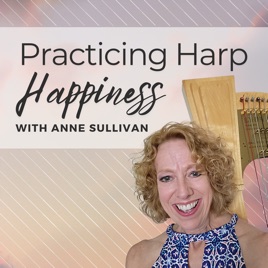
Advertise on podcast: Practicing Harp Happiness
Rating
4.8from
This podcast has
100 episodes
Language
EnglishPublisher
Anne SulllivanExplicit
No
Date created
2021/05/11
Latest episode
2026/04/20
Average duration
36 min.
Release period
7 days
Description
Is playing the harp harder than you thought it would be? Ever wish you knew the secrets to learning music that only the experts and the eight year old YouTube stars seem to know? Want to finally finish the pieces you start and play them with ease, confidence and joy? Harp Mastery founder and Harp Happiness expert Anne Sullivan believes every harp player can learn to play the music they want the way they want. Tune in as she clears the confusion around topics like fingering, technique, sight reading and practice skills and shares the insider tips that help her students make music beautifully. Whether you're playing the harp for fun or you're ready to take your playing to the next level, each Practicing Harp Happiness episode will reveal the strategies and insight you need to fire your imagination, enjoy your practice and love your harp playing.
Unlock Practicing Harp Happiness podcast Email contact info,
Listeners & Audience details
Email contact information
Direct podcast contact details

Listeners
Audience numbers & engagement insights

Audience details
Podcast Insights

Social media
Check Practicing Harp Happiness social media presence


Podcast episodes
Check latest episodes from Practicing Harp Happiness podcast
7 Ways to Place Chords: Beyond the Rules
2026/04/20
When was the last time you took a moment to just play some chords on your harp and let yourself simply enjoy them? When you hear that rich, resonant sound, you know that this was what your harp was meant to sound like. Perhaps hearing someone else play chords like that was why you decided to play the harp. It's goosebump territory, for sure. You can feel it in your bones, in your core.
I don't know that there is a more beautiful sonority than a big beautiful harp chord, perhaps lushly rolled. But, I also know that there isn't a day goes by that I don't have to stop in my practice to check my chord placing to make sure I can play those chords the way I want. Just because they're beautiful, doesn't mean they're easy, but you already know that.
One of the first things we harpists learn about chords is that the key to a well-played chord is in the placing. Getting the right fingers on the right strings at the right time is the biggest hurdle we face. I'm reminded of a famous quote of J. S. Bach: "There's nothing remarkable about it. All one has to do is hit the right keys at the right time and the instrument plays itself." This seems to me to reveal an over-developed sense of humility on Bach's part. Playing an instrument is definitely not that simple, but when it comes to playing - and placing - chords, getting our fingers on the right strings at the right time is certainly a good place to start.
Today's show is indeed about placing chords, but I want to offer you a different perspective, one that is less about the technique of placing chords and more about the musical situations that may call for strategic changes in the way we think about how and when to get our fingers on those right strings. In other words, I'm going to talk about when the usual "right time" isn't the right time, when you should consider breaking those rules I know you worked so hard to learn in order to make your chords sound the way you want. So get ready to break or at least bend some rules today.
Links to things I think you might be interested in that were mentioned in the podcast episode:
Podcast Episode #205: Placing Chords: How to Find the Right Strings the First Time For extra clarity on placing techniques: How to Play Four Note Chords Without Finger Fumbles blog post in the archives. Experience the freedom of faster learning, more expressive playing, and the confidence to play like the harpist you know you can be with a My Harp Mastery membership. Harpmastery.com Get involved in the show! Send your questions and suggestions for future podcast episodes to me at [email protected]
Looking for a transcript for this episode? Did you know that if you subscribe to this podcast on Apple Podcasts you will have access to their transcripts of each episode?
LINKS NOT WORKING FOR YOU? FInd all the show resources here: https://www.harpmastery.com/blog/Episode-258
Creating Your Secondary Practice Style: A New Look at Your Practice Breed
2026/04/13
A number of years ago, I wrote a blog post comparing practice styles to two breeds of dogs: a German Shepherd and a Greyhound. This was my metaphor for discussing a topic I found really hard to address with my students, the fact that their natural practice style was a determining factor in the speed of their progress. Let me explain.
I had some students who were committed to doing everything correctly and as a consequence learned carefully and thoroughly, but rather slowly. I had other students who wanted to play the music right away. Their enthusiasm and energy got them to the finish line quickly, but we often had to go back to pick up some important points they had missed along the way. Both learning styles were good, to a certain point. But at that certain point, each style needed to incorporate the strengths of the other one in order to get the music to the finish line.
So to help my students understand this better, I chose two wonderful dog breeds as representations of the two learning styles, a German shepherd and a greyhound, both wonderful dogs with very different characteristics. While the German shepherds maintain order and discipline, the greyhounds race to the finish. My goal was to give my students a non-judgmental way to think about the way they liked to learn and inspire them to step outside their comfort zone a little so that they could make more predictable progress and enjoy the process a little more.
It seemed to work, to capture the imagination of harpists who had felt they were missing something but weren't sure exactly what it was. A few years later, when I started this podcast, I added a third breed of dog, the beagle, the joyful investigator, into the mix. In fact, that podcast episode was the very first episode of the show, and you'll find the link to that in today's show notes.
What I want to do today is to talk about what to do when your practice style needs to shift, or when you find yourself drawn to a new way of practicing that's different from your usual style. Of course, I'll review the traits of all three breeds of practice styles and I'd like to add a fourth, too, the golden retriever.
By the end of our show today, you should have a pretty clear idea of your primary practice style and why it works for you, when it doesn't work for you, and how to step into the shoes, or should I say, paws, of another breed when you need to. It's a different lighthearted look at your practice today. Oh, yes…I'll share my own practice breed with you too, although maybe you can guess. We'll see if you're right!
Links to things I think you might be interested in that were mentioned in the podcast episode:
Episode 1 of the podcast: Find Your Practice Style: Style No. 3 "The Beagle" My Harp Mastery member resource: Practice Routine Refresh class Harpmastery.com Get involved in the show! Send your questions and suggestions for future podcast episodes to me at [email protected]
Looking for a transcript for this episode? Did you know that if you subscribe to this podcast on Apple Podcasts you will have access to their transcripts of each episode?
LINKS NOT WORKING FOR YOU? FInd all the show resources here: https://www.harpmastery.com/blog/Episode-257
Moving Up: The Intermediate Level Skills You Need
2026/04/06
I think one of the biggest challenges in music study is that it is very difficult to really measure our progress. It's so easy to lose track of what we've accomplished when we're faced with new challenges that often seem to be more of the same ones we've been struggling with all along. The notes are still hard. Our fingers still aren't moving fast enough. We still can't make our music flow.
The reality of music study is that we will continue to face the same challenges at every stage of our harp journey. At the same time that we find new levels of facility or expression, we find new levels that we want to attain. It can feel as if we aren't getting anywhere, even when we truly are making significant progress. I like to think of it as a spiral staircase, where we are dealing with the same skills but at increasingly higher levels.
Naturally, there are ways we can remind ourselves of the strides we have made. Reviewing pieces we played long ago or reading old practice journals can be powerful evidence that what was hard for us then isn't hard for us now. Participating in exam systems can give us the stamp of approval from an objective source that in effect certifies our progress.
But it can be frustrating to feel like you're not progressing, even if you actually are. And it can be more frustrating to wonder if you will be always stuck playing beginner level music, even advanced beginner level music. Or course, we know that these levels aren't standardized in any way, and we must recognize that our own skills have strengths and weaknesses that make some pieces easier than others for us. Even so, it would be nice to know what skills really mark the step up from beginner to intermediate. That's what I want to help you clarify today.
I've talked before about skills that I consider "level up" skills, but today I want to look at a wider range of skills and show you how they translate to that important, if ill-defined, jump from advanced beginner to intermediate music. And if you're a solid intermediate level player and you'd like to push yourself to a more advanced playing level, this will show you how to move up that skill ladder too.
Links to things I think you might be interested in that were mentioned in the podcast episode:
For My Harp Mastery members: Climb the Scale of Success. Related resource: The Line Between Difficult and Too Difficult blog post Harpmastery.com Get involved in the show! Send your questions and suggestions for future podcast episodes to me at [email protected]
Looking for a transcript for this episode? Did you know that if you subscribe to this podcast on Apple Podcasts you will have access to their transcripts of each episode?
LINKS NOT WORKING FOR YOU? FInd all the show resources here: https://www.harpmastery.com/blog/Episode-256
Simplify and Renew: How to Spring Clean Your Harp Playing
2026/03/30
Spring is finally settling in where I live. You might be weeks ahead of me or behind me or in a totally different hemisphere, but in the spirit of sharing what's on my mind and what's happening in my world, I want to talk about spring cleaning today. Naturally, though, I'm not talking about cleaning windows and carpets and closets. I want to talk about spring cleaning your harp life.
When I first decided to focus on spring cleaning for this podcast, I didn't want to take the easy way out. It would be easy to talk about harp care - changing strings, cleaning your harp, the right products to use, etc. But I wanted to go deeper and look at what matters to your harp playing even more than new strings or polish. I want to talk about your playing, your practice, your music.
We all get into a practice routine, and in general, having a routine is a good thing. It helps us stay on track more easily by creating a habit that can be nearly effortless to follow. But those same habits that support our playing can become ineffective when they go from being effortless to being mindless, and sometimes we aren't even aware of It happening.
Here's a simple example. Maybe you like to warmup with a particular scale or arpeggio pattern or perhaps a favorite short piece. There's nothing wrong with that at all, unless you find yourself playing it so automatically that you aren't paying attention to those things we want to watch in a warm-up: our posture, our relaxation, our finger action, and so on. Sure, we're still warming up our fingers, but our focus is really elsewhere.
This is where we can decide to do a little spring cleaning. We can try a different warm-up, or rotate between several warm-ups. We could play our warm-up in different keys. There are a million things we could do, but the refresh is the point.
So in our spring cleaning planning today, I want to focus on two big objectives. One is refreshing or renewing some of what we are doing, whether it's part of our practice routine or maybe the music we're playing. We want to spruce things up a bit.
The other objective is to simplify, to investigate what's working for us and what isn't, to eliminate extra work so that we can do more of the playing we love. Think of it as decluttering your harp playing. We will start by simplifying and then we'll get on to the renew and refresh part. And it's going to be fun.
Links to things I think you might be interested in that were mentioned in the podcast episode:
Check out this blog post from the archives: Spring Clean Your Technique: 5 Days to Fresher Fingers
A five day guide to understanding music at a deeper level: Playing More Musically: 5 Days of Discovery
Harpmastery.com
Get involved in the show! Send your questions and suggestions for future podcast episodes to me at [email protected]
Looking for a transcript for this episode? Did you know that if you subscribe to this podcast on Apple Podcasts you will have access to their transcripts of each episode?
LINKS NOT WORKING FOR YOU? FInd all the show resources here: https://www.harpmastery.com/blog/Episode-255
Music Theory Starts Here
2026/03/23
If you came to me for a lesson and said you wanted to work on music theory, my first reaction would be to do my happy dance. I admit it - I am a theory geek. I love talking about the building blocks of music and exploring the way composers use them to create the kaleidoscopic variety of music we love to play.
But after my happy dance, I would ask you this question: why do you want to learn music theory? It's not a test question; there is no wrong answer. But I have often found that harpists make assumptions about what theory knowledge will do for them, and those assumptions, if they aren't completely wrong, aren't always on the mark.
Knowing more abut the inner workings of music, the nuts and bolts of it, is undoubtedly important for any musician. It is also certainly true that some elements of music theory are immediately applicable to our playing. Most harpists, for example, realize that if they understood more about how chords work, they would be able to learn their music more quickly, sight read more easily and memorize faster. That sounds like a superfood for your playing, and lots of harpists are ready, willing and eager to add that to their practice diet.
But before chords will make sense to you, before they will be really useful, before you can become fluent with them, you need to know your major and minor keys. You need to know them cold, not have to figure them out, just know them as well as you know your alphabet. This is a step that too many harpists fail to take. They try to jump right into learning about chords without the foundation that makes their construction and sequences inevitable and logical.
So that's where we are starting today. I want to be sure that whatever your goals are with music theory, you have the knowledge that everything else in our system of music springs from: scales and keys.
One caveat - don't think this is going to be basic baby stuff. I promise unless you're a complete theory geek like me, you'll learn something today that you didn't know before.
Links to things I think you might be interested in that were mentioned in the podcast episode:
Blog post Musical Understanding Starts with Key Signatures Podcast Episode 6: Minor Keys [A Scale of a Different Color] Join us in My Harp Mastery. Harpmastery.com Get involved in the show! Send your questions and suggestions for future podcast episodes to me at [email protected]
Looking for a transcript for this episode? Did you know that if you subscribe to this podcast on Apple Podcasts you will have access to their transcripts of each episode?
LINKS NOT WORKING FOR YOU? FInd all the show resources here: https://www.harpmastery.com/blog/Episode-254
Your Ultimate Guide to Practice Journaling
2026/03/16
I was recently at the home of a harpist friend, and she showed me her stack of diaries, her appointment books from past years. There were decades of them. She was deciding it was time to get rid of them, but she wasn't quite ready to do it. I had to admit that I pitched mine long ago, and that occasionally I have wished that I still had them. They would be fun to look through.
Those entries, even the most prosaic ones, recall so many memories. They bring to mind places, people and events that you have nearly forgotten. Suddenly, you are transported to a different time and place, even a different version of you, and this can give you a different perspective on where you are, and even who you are, now.
But we aren't talking about calendars or diaries today; we're talking about practice journals, and the variety of ways that you can use them. Right off the bat, I will say that some of those ways are more impactful than others, in terms of promoting your progress and growth. For instance, if you've been using your practice journal as a simple way to keep track of what you've done, I think you're underutilizing your journal. It can be an engine for forward momentum, not just a log of today's practice. And we're going to explore some of those ways today.
One disclaimer here: I am not one of those people who are natural journalers. Although many of my friends in our teen years kept diaries of all kinds, I was never able to. It always seemed like a good idea, but I didn't really enjoy it. I appreciate that some people are very good at this and enjoy it, and I wanted to be clear, in case you're more like me, that I am not one of those people.
However, I do use a practice journal and so I know firsthand how valuable it can be. So if you're a journal-lover, you're going to find some new ideas for journaling today, at least I hope you will, and if you're a little reluctant to dive into this journaling thing, be patient because I understand where you're coming from, and I have some key tips for you too.
Links to things I think you might be interested in that were mentioned in the podcast episode:
Try the Spark Practice Journal, available in print or PDF versions Practice: A New Definition blog post Harpmastery.com Get involved in the show! Send your questions and suggestions for future podcast episodes to me at [email protected]
Looking for a transcript for this episode? Did you know that if you subscribe to this podcast on Apple Podcasts you will have access to their transcripts of each episode?
LINKS NOT WORKING FOR YOU? FInd all the show resources here: https://www.harpmastery.com/blog/Episode-253
Learning to Play By Ear: a First Steps Seminar
2026/03/09
Playing by ear is one of those things that musicians either know they can do or think they'll never be able to do. Those who are practiced at it seem to have endless tunes at their fingertips. Name a tune, and if they know it, they can play it. To those who can't do it - at least not yet - it seems nothing short of magical.
But ask someone to explain how they work this magic, and you will likely get an answer that isn't much of an explanation. They might talk about understanding and learning to hear chords. Or they might say they learned by trial and error, trying to play along with songs they liked. Or they might simply shrug and tell you they have no idea. But it's only rarely that you encounter someone who will actually attempt to explain their process.
Notice that I said, "When you meet someone who is practiced at it." Playing by ear is something you can learn. Like so many other apparent feats of magic, there's no real trick to it once you learn how it's done. I'm not saying it's easy, but it's certainly doable. Even better, if you decide to experiment with the practice ideas we're going to talk about today, you'll find that you will begin to notice things in your music that you never paid attention to before, things that help you learn and understand your music at a deeper level. That's why playing by ear is really not a magic trick, but a serious musicianship skill, and that's why I wanted to talk with you about it today.
What you're going to hear is a part of a live seminar I gave a while back for our My Harp Mastery members. This call was followed by a workshop where I guided them through the practice techniques from the seminar so they knew how to continue developing their skill in playing by ear.
This is the kind of thing we do inside the My Harp Mastery community. We have a live call each week where my coaches and I guide you through every aspect of playing the harp, whether it's learning new music together, or learning how to learn a piece of music, or working on technique or working through our Scale of Success curriculum. If you like learning about topics like this and getting expert instruction on how to be a better harpist and musician, I strongly suggest you check out everything that we include in our My Harp Mastery membership and join us.
Links to things I think you might be interested in that were mentioned in the podcast episode:
Become a My Harp Mastery member. Harpmastery.com Get involved in the show! Send your questions and suggestions for future podcast episodes to me at [email protected]
Looking for a transcript for this episode? Did you know that if you subscribe to this podcast on Apple Podcasts you will he access to their transcripts of each episode?
LINKS NOT WORKING FOR YOU? FInd all the show resources here: https://www.harpmastery.com/blog/Episode-252
Creating Your Harp Life with Dr. Kristina Finch
2026/03/02
I know it's cliché, but when I was a young harpist, I wanted to be just like my teacher, the same way children want to be just like their parents. Specifically, that meant to me that I was going to play in a big orchestra someday. It was years later when I discovered that not only were there other paths harpists could pursue, but that some of those paths actually suited me better. I've certainly done my share of orchestral playing, and I enjoy it, but I have always found more scope and more musical opportunity in chamber music and solo performances.
When I was still in high school, I began to freelance, to play a variety of music in various settings to earn my living. Don't get the wrong impression; I didn't have to earn my living in high school. My freelance playing at that age set me up very well to earn a good living freelancing in college and beyond. I reveled in the variety, in the unusual experiences I had, in the interesting places my playing took me. I still do some of that kind of playing, albeit less than I used to, and I still enjoy it.
On today's call, I am speaking with harpist Dr. Kristina Finch. Some of you may know her as one of our Harp Mastery® Certified Coaches. She has an extremely busy freelance career which has taken her all over the world. And now, she has a new harp path, in addition to playing and teaching; she and her husband are the new owners of the Harp Centers in Atlanta, Virginia and New Jersey.
I asked Kristina to join me on the podcast, because I wanted you to hear her story about change, about refocusing her harp career and the insights that she has gained in the process. Our conversation was fun – it's always fun talking with Kristina – but I think it will give you some insight as well, and perhaps some takeaways about realizing your passion and balancing your own harp life.
Links to things I think you might be interested in that were mentioned in the podcast episode:
Register now for the Atlanta Harp Center Festival
Visit the Atlanta Harp Center
Visit the Virginia Harp Center
Harpmastery.com
Get involved in the show! Send your questions and suggestions for future podcast episodes to me at [email protected]
Looking for a transcript for this episode? Did you know that if you subscribe to this podcast on Apple Podcasts you will have access to their transcripts of each episode?
LINKS NOT WORKING FOR YOU? FInd all the show resources here: https://www.harpmastery.com/blog/Episode-251
Masterclass: Making an Etude Out Of Your Piece
2026/02/23
Today's show is a masterclass, a show where I get to dig in to how to do something. We aren't just talking big picture concepts; we're going to get down to the nitty gritty.
I have to say this is my favorite kind of show to do, because it feels like teaching, almost like we're right here together in the same room, and I'm sharing what I've learned to help you learn too. I love that.
And I really enjoy this topic too.
Our topic is how to make an etude from a piece you're trying to learn. Let's say you're working on a piece and most of the piece is ready to go, but there's one part that just won't come together. You could take that section and make an etude out of it. Or perhaps the piece you're learning is really a little above your head, and you're not really stuck, but the going is very slow. There are etude possibilities there too.
I'm sure many of you already do something like this, whether it's playing that section in different rhythms or just keeping the tempo slow while your fingers get used to the patterns.
But today, I'm going to show you a different way of doing it, a way that I have found to be more effective and one that will help you get to the music faster. We're going to look behind the notes to what's really going on, so that we can find the key to unlocking that passage or technique for you. So grab a pen and paper so you can take some notes and we'll get started with our masterclass.
Links to things I think you might be interested in that were mentioned in the podcast episode:
Renie, Au bord du ruisseau on IMSLP.
Study with Harp Mastery® Certified Coach. Start here.
Related resource: Etudes: The Case For and Against blog post
Harpmastery.com
Get involved in the show! Send your questions and suggestions for future podcast episodes to me at [email protected]
Looking for a transcript for this episode? Did you know that if you subscribe to this podcast on Apple Podcasts you will have access to their transcripts of each episode?
LINKS NOT WORKING FOR YOU? FInd all the show resources here: https://www.harpmastery.com/blog/Episode-250
How to Make Panic-free Page Turns
2026/02/16
Are you ready to talk about page turns? I realize that page turns may not seem like a captivating topic, However, if you've ever had a page turn go wrong in a moment when you don't want to have anything go wrong, you know how important page turns are. Even in the age of bluetooth pedals, poorly prepared page turns can mar an otherwise lovely performance.
I'm warning you right now that page turning is a subject that I am liable to rant about, just ask my students. At our harp camp, Harp Quest Summer Live, the evening before our closing concert is spent making sure that all the students who have forgotten to prepare their pages take care of them. The mantra they hear from me is this: "No loose pages!" And then I usually tell them this story:
I was fourteen years old and accompanying our high school choir in a performance of Bernstein's Chichester Psalms. This is a difficult work for chorus, and we were doing the version that is accompanied only by harp, organ and percussion. In the orchestral version there are two harp parts, and they are combined into just one part for this version, so you can imagine that the part is challenging.
This performance was a big deal for me, because I was still in junior high, and for this concert, actually two performances, I was accompanying the big kids. It felt really important. The first of the two performances went well. The second one was at a church. They provided a music stand for me, and it was one of those folding metal stands that are commonly referred to as wire stands.
Here's where the page turns come into play. We were at the beginning of the third movement, and I went to turn my page and the music stand collapsed. That alone would have been a moment to remember, no matter how much I would want to forget it, but it was worse than that. The choir director had given me a photocopy of the original part to practice from, and that's what I was using for the concert. Here's the rub: I had never taped the pages together. So when my music stand collapsed, the pages went everywhere.
A good samaritan in the audience jumped up and gathered my pages and then I had to find the right ones and jump back in to play. While I wasn't scarred for life, I did learn a powerful lesson about how to prepare and prevent page disasters in a performance.
Over the years, I learned a lot about the art of turning pages, not just taping them together, and I want to be sure you know them too. So trust me, you actually need to know how to manage, prepare and practice your page turns, whether you're using paper or a pedal. And yes, you ned to practice them too.
Links to things I think you might be interested in that were mentioned in the podcast episode:
Last call for the Harpist's Breakthrough Blueprint Plan ahead for your young harpist! Harp Quest Summer Live Harpmastery.com Get involved in the show! Send your questions and suggestions for future podcast episodes to me at [email protected]
Looking for a transcript for this episode? Did you know that if you subscribe to this podcast on Apple Podcasts you will have access to their transcripts of each episode?
LINKS NOT WORKING FOR YOU? FInd all the show resources here: https://www.harpmastery.com/blog/Episode-249
Answers to Your Questions: Relaxed Playing and Tuning By Ear - PHH 248
2026/02/09
It's time for another "Answers to Your Questions" episode. I love these episodes because I get to speak to topics that are on your mind, rather than just talking about topics I think you want to know more about. And we have two really great questions to talk about today.
Before I tell you what those questions are, I want to say that my personal criteria for choosing these questions is when I have been asked the same question by three or more people in a relatively short time frame. Usually the questions come in response to something I've talked about in the podcast, like our first question today, or something we discussed on one of the Live Monday Warm-Ups. Today's second question came up on a recent warm-up.
My feeling is that when three people have asked it, there are a bunch more harpists who would have liked to ask it but didn't. And so I know that there are lots of harpists who really would like to have the answer, even if they let someone else ask the question. So if you're one of those who asked the question, I thank you, and so do your fellow harpists who let you ask for them. If you're not one of those who asked the question but want to know the answer, remember that next time you can be the brave one and do the asking. If you're on a live call with me, I can tell you that I always pay attention to the questions that arise. But if you haven't been on a live call with me, you can always email me here at the podcast, and I'll register your question or comment that way. The email is [email protected].
So what are our questions today? The first has to do with tuning by ear and why I feel it is so essential, not just because your harp needs to be in tune, but because it's an easy way to intentionally focus on your aural skills, which are key to your learning music faster and playing with more security.
The second question brings up a really vital point about playing without tension. It's this: being relaxed before you begin playing is one thing, but staying relaxed while you play is another, more difficult one. How do you keep relaxed and keep tension away while you're playing? It's a topic that is so important to all of us; aren't you glad those three people asked?
Links to things I think you might be interested in that were mentioned in the podcast episode:
Don't miss the webinar, Your Breakthrough Year Let's plan the rest of this year together in the Harpist's Breakthrough Blueprint Intensive Live Monday Warm-Up from February 2, 2026 where I talk about sticky placing, tone and tension. View it on the Harp Mastery® YouTube Channel Harpmastery.com Get involved in the show! Send your questions and suggestions for future podcast episodes to me at [email protected]
Looking for a transcript for this episode? Did you know that if you subscribe to this podcast on Apple Podcasts you will have access to their transcripts of each episode?
LINKS NOT WORKING FOR YOU? FInd all the show resources here: https://www.harpmastery.com/blog/Episode-248
How Not to be a Control Freak Harpist
2026/02/02
Today we're talking about control. Control is a word that comes up a lot in our harp playing, whether it's about controlling our fingers, our dynamics, tempo, tone, focus, or a hundred other relevant things. It feels like we're always trying to gain control over something in our playing, or over ourselves.
But the path to mastery isn't about asserting control; it's actually about letting go of control.
If you search, you can easily find dozens of books that explore the idea of control in music, and nearly all of them start out with the idea - sometimes it's even written in the title - that we gain control by letting go. It's a simple enough concept, but it comes with a big paradox: letting go of control essentially requires us not to do what we've been training ourselves to do. For example, we train ourselves to play the right notes, which usually requires a lot of focus, concentration and sometimes sheer willpower, in other words, control. But if we don't let go of that control, our music doesn't flow.
Another example is our technique. We work hard to teach our fingers to play the right way, and we want to make sure that they behave themselves. So we keep paying attention to them; we keep them in our control. Of course, this means that we don't have the attention to spend on making the music expressive, and we don't let our fingers play naturally, because we want to make sure they play correctly.
Perhaps the best example is when we try to play faster. We want to stay in control, and the challenge of playing a passage or a piece faster, creates chaos. We resist the chaos, with the result that we never achieve that faster tempo.
The crux of the dilemma is this: we need to control many different elements in our playing, but if don't let go of control, we can't achieve the expressive, fluid musical playing we want. And practicing not controlling these things feels uncomfortable and even wrong.
But today, I'm going to show you how to let go of control without the fear and without feeling like you're on the brink of disaster in your playing. I'll teach you a three-step system for keeping your controlling instincts in check, to allow them to serve your music instead of hold it back.
Links to things I think you might be interested in that were mentioned in the podcast episode:
Register for my free webinar, Your Breakthrough Year Let me help you create your personalized Breakthrough plan on the Harpist's Breakthrough Blueprint Intensive Learn control practice techniques in my Kaleidoscope Practice e-book. [LINK to shop] Harpmastery.com Get involved in the show! Send your questions and suggestions for future podcast episodes to me at [email protected]
Looking for a transcript for this episode? Did you know that if you subscribe to this podcast on Apple Podcasts you will have access to their transcripts of each episode?
LINKS NOT WORKING FOR YOU? FInd all the show resources here: https://www.harpmastery.com/blog/Episode-247
Next Level Repertoire: Turning Baby Steps into Giant Strides
2026/01/26
Have you ever started learning a piece that seemed like it should be relatively easy to learn, and then discovered it was actually much harder than you thought? Of course you have; it happens to all of us.
In this situation, we have a choice. We could persist, digging our heels in and fighting our way through the piece anyway. Or we could put the piece aside for the time when we are ready for it. (By the way, that time only comes when we are very focused on leveling up our skills.)
Neither choice feels good, mainly because we feel like we aren't growing. We feel like our playing is staying at the same level. In fact, one of the reactions I see from harpists in this situation is that they choose to put aside the challenging piece and play another piece by a composer or arranger whose works they know they can play easily. Unfortunately, this can mean that the music they're playing and the finger patterns they are learning don't stretch them at all, but actually keep them stuck in the same place.
Obviously, there's a gap we need to bridge. It's the gap between our actual skill level and our perception of our skill level. It isn't that we think we're better than we are; it's not a case of inflated ego. It's just that we can't see the holes we need to fill before we are actually ready to learn the piece. Sometimes the holes are missing technical skills, like independence of the hands that makes playing hands together fluid and easy. Sometimes it's a musicianship skill, maybe fluency with a rhythmic pattern or quick chord recognition.
My point is this: you shouldn't have to take baby steps with your music. It's important that you play the music you truly want to play, not feel trapped playing music that isn't what you really aspire to. But you don't have to take such a giant step that you're struggling to learn a piece in a reasonable amount of time.
If you've ever ridden the Underground in London, you may remember the signs and announcements alerting you to "mind the gap" as you step from the platform onto the train. That's my idea for today; I'm going to show you how to mind the gap between the music you can play and the music you want to play so your journey will be faster and easier.
Links to things I think you might be interested in that were mentioned in the podcast episode:
Plan your growth with The Harpist's Breakthrough Blueprint. Register now!
Last call for the Getaway Retreat.
Harpmastery.com
Get involved in the show! Send your questions and suggestions for future podcast episodes to me at [email protected]
Looking for a transcript for this episode? Did you know that if you subscribe to this podcast on Apple Podcasts you will have access to their transcripts of each episode?
LINKS NOT WORKING FOR YOU? FInd all the show resources here: https://www.harpmastery.com/blog/Episode-246
Next Level Musicianship: The Sensory Triangle
2026/01/19
If you've listened to me for a while or taken any of my classes or workshops, you know that I love finding the solutions to problems we harpists face and creating the step by step plans to take action to solve them. I've discovered over my years of teaching that it's not hard to define the problem, at least the surface problem. For instance, if your left hand can't play the notes in two specific measures of your piece, then that's the problem, and the solution is easy: drill the notes.
Sometimes, however, the real issue lies a few layers down. Maybe the reason the left hand can't play those measures isn't the notes. Perhaps there is a technical issue, or maybe reading bass clef is the sticking point. It could be a counting issue or even not quite understanding what the meaning of the music is at that moment. So when I'm working with my Gold Circle students, we often spend some time digging a little deeper to see where the real issue is. Then we can define the proper steps to address it.
I'm mentioning this, not because we're going to talk about solving problems today, at least not exactly. What I want to point out is that music study isn't as linear as we would like it to be. It would be terrific if we could practice a piece, put extra time on the hard spots, polish it up and play it, but we all know that it doesn't always work that way. That's because when we play music, we are using a very complex set of skills that involves much more than just playing with our best technique or learning the notes. This is the skill set that comes under the heading "musicianship."
In today's podcast episode, I want to talk about the specific musicianship skills we use everyday in our playing and how to keep them growing and developing. These skills are truly key to your growth as a harpist. I'll help you understand how they connect to each other and to your playing, and we'll talk about how to integrate more intentional musicianship skill development into your daily practice. And we'll do that using a concept I developed called the Sensory Triangle.
Links to things I think you might be interested in that were mentioned in the podcast episode:
Get organized with The Harpist's Breakthrough Blueprint Intensive - register now!
Cracking the Code: The Better Way to Read Music blog post
Harpmastery.com
Get involved in the show! Send your questions and suggestions for future podcast episodes to me at [email protected]
Looking for a transcript for this episode? Did you know that if you subscribe to this podcast on Apple Podcasts you will have access to their transcripts of each episode?
LINKS NOT WORKING FOR YOU? FInd all the show resources here: https://www.harpmastery.com/blog/Episode-245
Next Level Technique: 3 Myths You Need to Bust
2026/01/12
If you heard last week's podcast, you may remember that this month's podcast episodes are all about growth, your growth as a harpist and the systems and skills that are necessary for that growth.
Last week, we talked about three key systems that you need to have in place for growth. This week is all about technique. I know it may sound like a dry as dust topic to some of you. Harpists generally fall into two distinct camps: those who hate doing technique exercises and those who love them. So if you love your Grossi and LaRiviere or whatever exercise book you use, this podcast is going to be right up your alley. We'll dive into how you can use what you're doing now to get to that next level of technical proficiency.
If you're in the other camp, one of those who feels like exercises are torture when all you want to do is play pretty pieces, I hear you. I'm talking to you as a convert. Granted it was many years ago when I finally realized that exercises weren't just for solving problems, that they were more like the gas in my harp-playing engine. I totally understand just wanting to play music. What I want you to get from today's podcast episode is that a consistent plan for strengthening your technique will take your playing further faster than just about anything else. And this plan doesn't have to be all exercises either. We're all about harp happiness here, and that includes when you're practicing your technique.
Links to things I think you might be interested in that were mentioned in the podcast episode:
Register for The Harpist's Breakthrough Blueprint Intensive
Podcast episode #243: Architect Your Harp Playing Growth with 3 Key Systems
Harpmastery.com
Get involved in the show! Send your questions and suggestions for future podcast episodes to me at [email protected]
Looking for a transcript for this episode? Did you know that if you subscribe to this podcast on Apple Podcasts you will have access to their transcripts of each episode?
LINKS NOT WORKING FOR YOU? FInd all the show resources here: https://www.harpmastery.com/blog/Episode-244
Podcast reviews
Read Practicing Harp Happiness podcast reviews
Jojo Bean 123 2023/04/21
What a gift!
I teach and perform on the harp regularly and am so happy to have found this wonderful resource! Ms. Sullivan’s experience and insight help me improve...
DailyKindleReader7458 2022/01/08
Thank you!
I’m fairly new to the harp and as an adult learner I find your podcast helpful and uplifting. I especially enjoyed the episodes on confidence and on t...
Podcast sponsorship advertising
Start advertising on Practicing Harp Happiness relevant audience podcasts
You may also like to advertise on these Podcasts

4.9187301
No More Whoppers
Ray Barnholt and Alex Fraioli
5202129
Allison Park Leadership Podcast
Jeff and Dave Leake

52317
The Beckler and Seanna Podcast
X92.9

4.7196259
We Know The Amazing Race
Reality TV RHAPups

4.8158251
Unleash Your Greatness Within
TJ Hoisington
4.9228186
Noteworthy with Nathan French
Nathan French

52518
Smart Medicine
Veradigm

4.2565109
Solvable
Pushkin Industries

4.914799
Just Say This! How to talk with ALL kids about sex!
Amy Lang, M.A.

4.820201
PaddyTalksGolf
PaddyTalks Golf