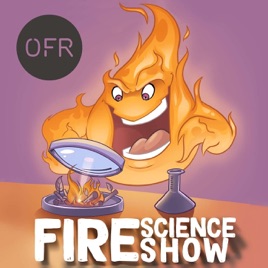
Advertise on podcast: Fire Science Show
Rating
4.8from
This podcast has
281 episodes
Language
EnglishPublisher
Wojciech WegrzynskiExplicit
No
Date created
2021/05/24
Latest episode
2026/10/07
Average duration
63 min.
Release period
8 days
Description
Fire Science Show is connecting fire researchers and practitioners with a society of fire engineers, firefighters, architects, designers and all others, who are genuinely interested in creating a fire-safe future. Through interviews with a diverse group of experts, we present the history of our field as well as the most novel advancements. We hope the Fire Science Show becomes your weekly source of fire science knowledge and entertainment. Produced in partnership with the Diamond Sponsor of the show - OFR Consultants
Unlock Fire Science Show podcast Email contact info,
Listeners & Audience details
Email contact information
Direct podcast contact details

Listeners
Audience numbers & engagement insights

Audience details
Podcast Insights

Podcast episodes
Check latest episodes from Fire Science Show podcast
272 - How to add wind to fire CFD analysis?
2026/10/07
In this episode I take you into practicality of introducing wind into fire safety engineering considerations, and focus on it's implementation as a part of fire oriented CFD analyses. In here, we dig into why wind is tied to so many catastrophic fires, why firefighter safety is often shaped by sudden wind shifts, and why designing for calm air can quietly turn fire safety into a coin toss.
I walk through what wind actually is from a fire engineering perspective: an atmospheric, turbulent phenomenon full of vortices and gusts, not a tidy uniform flow. We talk about the trap of modeling only the average wind speed, why gusts matter so much for smoke movement and vent performance, and how the wind profile changes with height and terrain roughness. From there, I connect the dots to computational wind engineering and the messy reality of cities, where nearby buildings, parks, towers, and “urban canyons” can completely reshape the local wind field right at your façade openings.
Then we get practical about CFD. I share the domain and mesh decisions that keep results honest (including blockage and downstream wake space), how to handle wind direction, and what turbulence modeling choices mean when you’re trying to couple wind and fire. Finally, I lay out when the hassle is worth it: constrained historic roofs, atria with limited openings, exposed natural smoke ventilators, high-rise mechanical floors, complex tunnel portals, architected natural vents with uncertain discharge coefficients, and roof features where vortex shedding can damage photovoltaics.
The key resource to implement what has been said in the episode:
- Wind and Fire Coupled Modelling—Part I: Literature Review
- Wind and Fire Coupled Modelling—Part II: Good Practice Guidelines
- Fire and Smoke Modelling Chapter
----
The Fire Science Show is produced by the Fire Science Media in collaboration with OFR Consultants. Thank you to the podcast sponsor for their continuous support towards our mission.
271 - pyFDS-Evac with Mohcine Chraibi
2026/09/30
Smoke does not just slow people down, it changes what they believe is even possible. That simple idea is why we get so excited about pyFDS-Evac, an open source workflow that connects Fire Dynamics Simulator (FDS) results directly to modern evacuation modeling with JuPedSim. When the fire environment can remove an exit from view, reduce walking speed through extinction and soot exposure, or even incapacitate an agent, you stop “post-processing evacuation” and start modeling decisions that respond to conditions.
We sit down with Mohcine Chraibi from Forschungszentrum Jülich to unpack how their team builds pedestrian dynamics software that researchers can actually extend. We talk candidly about why legacy tools like FDS-Evac faded, why commercial evacuation software can feel like a black box when you need to publish and validate new ideas, and what it takes to keep an academic codebase alive. Mohcine walks us through the modular pipeline: run FDS as normal, read outputs through FDS Reader, compute sight lines and smoke effects with FDS VisMap, and drive agents with JuPedSim while pyFDS-Evac applies fire-driven behavior changes.
Then we go deeper into routing and wayfinding. You will hear how graphs and A-star pathfinding evolve toward flow-field methods, why “familiarity” and cognitive maps matter when occupants do not know the building, and what JuPedSim 2.0 aims to deliver next, including stairs, 2.5D to 3D buildings, and switching movement models by location.
If you care about fire safety engineering, evacuation simulation, pedestrian dynamics, or visibility in smoke, subscribe, share this with a colleague, and leave a review so more researchers and practitioners can find the tools and the ideas. What would you test first with an open FDS to evacuation pipeline?
Links to the good stuff:
Jupedsim the engine: https://www.jupedsim.org/
its webapp: https://app.jupedsim.org/
Youtube-playlist for jupedsim: https://www.youtube.com/watch?v=ekbvCdy1P3w&list=PLYiH62IDwy5fdFJRiGky0Hdq88xKwjayL
pyFDS-Evac: https://pedestriandynamics.org/pyFDS-Evac/
pyFDS-evac presentation from the visbility seminar https://pedestriandynamics.org/pyFDS-Evac/talks/visibility-seminar-2026/#/1
Cover image comes from the 1st video on the JuPedSim playlist - the Galton Board Walked by Pedestrians in JuPedSim, by Pedestrian and Fire Dynamics Channel on youtube.
----
The Fire Science Show is produced by the Fire Science Media in collaboration with OFR Consultants. Thank you to the podcast sponsor for their continuous support towards our mission.
270 - How the Cone Calorimeter took over with Marc Janssens
2026/09/23
A tool doesn’t become a global workhorse because it’s clever. It becomes a workhorse when different labs can run it, calibrate it, compare it, and trust it. It is a very long road from the invention to widespread use. And I got the chance to discuss the path of how the Cone took off with Dr. Marc Janssens, who is a key figure in this story - he was even jointly co-awarded the Phillip DiNenno Prize together with dr Vyto Babrauskas, for his efforts on developing, standardizing and promoting the Cone.
Marc takes us back to the early days of reaction-to-fire testing, when heat release rate measurement was messy, methods differed by country, and oxygen consumption calorimetry still had to prove itself. He was sent on a mission to find a heat measuring device, and shares on what was available back then.
Later in the episode we dig into the questions raised: is a 10 by 10 cm specimen too small, what does “scaling” really mean, and how do you avoid fooling yourself when you try to turn cone calorimeter curves into real-fire predictions. We also get into why the cone’s controlled heat flux and feedback control mattered so much, and how interlaboratory round robin studies turned uncertainty into precision statements that standards could stand on.
From there, the conversation opens up into what cone calorimetry enabled: faster R&D for products, smarter screening ahead of costly room corner testing, and a path to modeling. Marc shares how cone calorimeter data supports fire modeling efforts, including flame spread approaches in FDS, and why validation at larger scales still matters. The episode lands with a powerful case study: performance-based, risk-informed nuclear power plant fire safety, where cable tray fire spread scenarios depend on models fueled by cone calorimeter measurements of cable insulation.
If you are a daily user of a Cone, an engineer who depends on high quality models and data, or simply want to hear about the history of our discipline... this one is for you.
----
The Fire Science Show is produced by the Fire Science Media in collaboration with OFR Consultants. Thank you to the podcast sponsor for their continuous support towards our mission.
269 - Fire investigations and the scientific method with Vincent Brannigan
2026/09/16
A fire scene looks like a puzzle, but it’s a puzzle where the pieces melt, burn, and get hauled away before anyone can measure them. On the 25th anniversary of 9/11, I sit down with Professor Vincent Brannigan to ask a questions - does a fire investigation truly use the scientific method, or are we doing something else and calling it science?
Vincent brings a rare mix of experience as a fire protection engineer, a lawyer who has seen cases up close, and a historian of science who cares deeply about how we justify knowledge in court. We talk about the World Trade Center collapse, what made investigation so difficult, and how code and design assumptions (like fireproofing priorities and sprinklers) shape outcomes long before any investigator arrives. From there, we get precise about language: what a hypothesis is, what makes a scientific hypothesis testable, why a theory is not a casual idea, and why “proof” is the wrong word in most scientific and forensic contexts.
Then we take the discussion into the context of NFPA 921 directly. We explore why much of forensic fire reasoning is abductive inference (the Sherlock Holmes style of “best explanation”), why that can be useful, and why it becomes dangerous when it’s presented as if it carries the repeatability of lab science. We dig into witness statements, models and simulations, experiments that actually help, and the uncomfortable gap between “possible,” “probable,” and “true” when the courtroom demands answers.
If you care about fire investigation, forensic fire science, expert testimony, and how fire engineering knowledge becomes evidence or a foundation of new code recommendations, this conversation will sharpen how you think and how you write.
----
The Fire Science Show is produced by the Fire Science Media in collaboration with OFR Consultants. Thank you to the podcast sponsor for their continuous support towards our mission.
268 - Is critical velocity that critical?
2026/09/09
Critical velocity is supposed to be the clean moment when tunnel smoke control flips from unsafe to safe. But after too many real projects and too many review battles, I am very sure that such a single number cannot be a sole proxy of what is safe or unsafe... So why it has so much power over my design?
In this solo episode I walk through why critical velocity became the world's favorite proxy for tunnel fire safety: it’s simple, it’s calculable, and it gives verifiers something rigid to check. But what is simple at first glance, can become quite messy in projects. Different code editions, different assumptions for hydraulic diameter or slope, and different approaches like hand calculations vs CFD can push the “right” value around. And the value becomes what we argue about, not the safety. In a tunnel, smoke movement is not one-dimensional either. Ceiling jets, momentum exchange, and the timing of fan activation can all change what it takes to control back-layering.
From there, I share project realities that don’t fit the checkbox. Reversible ventilation where slope fights you, station-to-tunnel transitions where uniform velocity is physically impossible, and very wide rail spaces where applying small-tunnel models can imply absurd power demands. We also talk about what happens when you miss critical velocity: back-layering isn’t automatically system failure, and the distance and conditions matter far more than a binary pass/fail.
Finally, we dig into the hidden conservatism inside typical tunnel ventilation design scenarios and the real-world cost of “just adding jet fans” once cabling, inverters, power supply, redundancy, and maintenance hit the full design. If you care about tunnel fire engineering, smoke control, CFD modeling, and practical fire safety design, this one is for you.
Did you like it? Subscribe for more, share it with a colleague who reviews tunnel designs, and leave a review with your take: should tunnel fire safety rely less on one number and more on performance outcomes?
Origins of the critical velocity are in this highly recommended episode: https://www.firescienceshow.com/157-revising-critical-velocity-with-conrad-stacey-and-michael-bayer/
----
The Fire Science Show is produced by the Fire Science Media in collaboration with OFR Consultants. Thank you to the podcast sponsor for their continuous support towards our mission.
267 - Modelling Fire Growth with Stephen Welch
2026/09/02
Pretty CFD flames are something we got used to, but they usually are a product of our design assumptions - the design fire. While they give us a lovely illusion of being "real" fires, predicting real compartment fire growth is a completely different game. We’re joined by Dr. Stephen Welch (University of Edinburgh) to get honest about what “modeling fire spread” actually means, how quickly results can become believable but wrong, and why validation has to be the foundation of any serious CFD fire modeling workflow.
We walk through the path his group has taken from traveling fires in large compartments to timber-lined compartment behavior, using FDS and detailed pyrolysis models. Along the way we talk about scaling up from cone and crib experiments, why wood sticks burn differently than flat timber, and why calibrated kinetics are often engineering tools rather than universal material truths. We also dig into the uncomfortable reality of scenario uncertainty: moisture, stick variability, crib deformation, and tiny geometric changes can meaningfully shift predictions.
One of the most practical takeaways is how opening location and ventilation momentum reshape fire spread, sometimes in ways classic simplified models won’t anticipate. We explore entrainment height, hot layer effects, soot and radiative fraction, and what it might take to credibly predict burnout and post-burner behavior in timber-lined compartments. If you care about structural fire design, traveling fire exposure, and the future of validated predictive modeling, this one is for you.
After this one, you will have a lot of reading... Start with these:
Liu, C., Dai, X., Ming, X.M. & Welch, S. (2026) Exploring fire dynamics of travelling fires in large open compartments with CFD, Fire Safety Journal 104663 (special issue IAFSS2026) doi:10.1016/j.firesaf.2026.104663Liu, C., Dai, X., Ming, X.M. & Welch, S. (2025) CFD predictions of fire spread over wood cribs in large open-plan compartments: new insights, Fire Safety Journal special issue 156: 104443 doi:10.1016/j.firesaf.2025.104443 Dai, X., Alam, N., Liu, C., Nadjai, A., Rush, D. & Welch, S. (2024) “Scaling-up” fire spread on wood cribs to predict a large-scale travelling fire test using CFD, Advances in Engineering Software 189: 103589 doi: 10.1016/j.advengsoft.2023.103589Dai, X., Gamba, A., Liu, C., Anderson, J., Charlier, M., Rush, D. & Welch, S. (2022) An engineering CFD model for fire spread on wood cribs for travelling fires, Advances in Engineering Software 173:103213 doi: 10.1016/j.advengsoft.2022.103213 And the cover image comes from the image in paper [2], Fig. 17. Stephens papers are full of beautiful images. Another reason to check them out.
----
The Fire Science Show is produced by the Fire Science Media in collaboration with OFR Consultants. Thank you to the podcast sponsor for their continuous support towards our mission.
266 - Compartment fire framework with Vinny Gupta
2026/08/26
A compartment fire is more than just “a fire in a room.” The moment flames, smoke, and heat are trapped by walls and fed through openings, the physics changes and so do the hazards we design for. We sit down with Dr. Vinny Gupta (University of Waterloo) to rebuild compartment fire thinking from the ground up, from what the enclosure does to airflow and smoke layers to why those effects still anchor modern structural fire safety.
We trace the roots of today’s design tools through post World War II research and the foundational work of Kunio Kawagoe and Philip Thomas. That takes us straight into the ventilation factor, opening factor, and energy balance logic that underpins so much of compartment fire modeling, including parametric fires and many “golden number” rules engineers carry from project to project. Then we get honest about the fine print: the assumptions, the limits, and what gets lost when we remember the solution but forget the context it came from.
From there, the conversation shifts to modern buildings that refuse to behave like classic small rooms: open-plan compartments, changing ventilation conditions, nonuniform smoke layers, and traveling fires that move across a floor plate instead of involving everything at once. We also dig into why fuel type can matter even when theory says it should not, especially once mass timber and CLT linings enter the compartment and amplify sensitivity to radiation, flow, and ventilation.
If you would like to dig further, my recommendations are:
Kawagoe's summary of compartment fire researchJose Torero's revisiting compartment fire Vinny's paper on mechanisms of flame spread in large compartmentsVinny's paper on different fuels and compartment fires----
The Fire Science Show is produced by the Fire Science Media in collaboration with OFR Consultants. Thank you to the podcast sponsor for their continuous support towards our mission.
265 - How fires can lead to a nuclear winter? with Stephen Welch
2026/08/19
As a kid of 80s and 90s, a lot of the pop culture was around the post-apocalyptic scenarios following a nuclear exchange. I always thought a nuclear winter is a consequence of atomic bombs falling down, but now as a fire researcher I've learnt it is mostly about fires, after all. Today I sit down with Dr Stephen Welch (University of Edinburgh) to trace the fire-engineering-heavy pathway from mass urban ignitions to firestorms, through soot production and its injection into the stratosphere, up to global climate impacts. The uncomfortable twist is that the energy release from the fires can dominate the scenario, and the climate outcome depends on whether a fraction of that smoke gets high enough and stays there long enough to matter.
We dig into what makes a firestorm different from a big fire: the burned-area thresholds, the requirement for many structures burning at once, and the extreme winds a firestorm can generate on its own. Then we connect urban firestorms to what we’ve learned from megafires and satellite observations, including measured, non-zero global cooling effects, tracing reference datapoints that allow us to approximate the scale needed for a considerable climate impacts. That modern data from wildfires or volcanic eruptions becomes a rare validation anchor for a problem that historically relied on older assumptions and is inherently limited in terms of potential validation.
From there, we go straight into the messy details fire engineers care about: fuel load density, modern plastics, under-ventilated compartment fires, glazing failure, and why soot yields taken from small, well-ventilated tests can be misleading when soot mass is the whole point. All of those, but considering large city fire at once. We also talk modeling options, from CFD to coupled atmosphere simulations, and why “consistent engineering crudeness” is sometimes the only honest starting point. In fact, we dive pretty deep into soot formation and modelling, as the classic "yield" approach we use for everyday fire engineering breaks down at scale of fires discussed here. At the same time, the exact amount of carbon injected into stratosphere is the number deciding of the final impact, therefore it requires a better justification.
I am sure you will enjoy this conversation, as it ties multiple important aspects of fire engineering, tied all into a challenging and interesting research question. How do fires lead to a nuclear winter?
If you would like to read more, try out the thesis of Abhas Adhikari on the subject:
https://imfse.be/s/Abhas-Adhikari_Thesis.pdf
----
The Fire Science Show is produced by the Fire Science Media in collaboration with OFR Consultants. Thank you to the podcast sponsor for their continuous support towards our mission.
264 - Engineering Firebrand Showers with Samuel L. Manzello
2026/08/12
A wind-driven ember shower is a key wildfire exposures a building can face, but we have not yet fully understood or accounted for them in making our communities wildfire resilient. Today we sit down with Samuel L. Manzello of Tohoku University and Reax Engineering to unpack how in the last 20 years the firebrand science went from not being able to characterize the features of them well to being able to procur controlled experiments and standardized generators that can actually shape building codes and product design.
We dig into what firebrands really are, why vegetation embers and structure-generated embers behave differently, and why lab tests with single particles often fail to explain the ignitions seen after major WUI disasters. From there, we follow the chain reaction that led to the Dragon firebrand generator: the need for wind, the lack of suitable facilities, and the breakthrough of creating a continuously feedable device that can produce repeatable firebrand showers. Samuel explains how airflow settings can shift firebrands from glowing to flaming, and why that control is essential for meaningful wildfire exposure testing.
The second half moves into standardization and real-world impact. Samuel breaks down ISO TC 92 and the work of the IAFSS LOFBE group on large outdoor fires in the built environment, including why the "Baby Dragon" became an ISO methodology and what it unlocks next: better roof tests, vent penetration tests, facade and opening vulnerabilities, and more consistent ways to compare hazards across regions and vegetation types. If you care about wildfire resilience, WUI fire safety, ember intrusion, and the future of practical standards, this conversation maps the path forward.
As promised, here are some links:
The world is burning: What exactly are firebrands and why should anyone care?Progress in creating international standardsExperimentally producing various firebrandsNIST - Dragon firebrand generator (2014)Samuel's classic paper from 2006 - on ignition of mulch with firebrandsBut there is much, much more in the literature on the firebrands! I recommend going to Scopus or Google Scholar and looking for Samuel's record there: https://scholar.google.com/citations?user=4oAvxXMAAAAJ&hl=pl&oi=ao
----
The Fire Science Show is produced by the Fire Science Media in collaboration with OFR Consultants. Thank you to the podcast sponsor for their continuous support towards our mission.
263 - Developments in modelling WUI fires with Arnaud Trouvé
2026/08/05
Wildland-Urban Interface fires are a class of fires that deserves own models, own studies and a lot of research focus. This is what I discuss today with prof. Arnaud Trouvé from the University of Maryland, shortly before he has given his plenary talk at the recent Combustion Symposium in Kyoto. In this interview, Arnaud explains what makes wildland urban interface (WUI) fires and urban conflagrations so hard to predict, also with a focus on the combustion phenomena.
Arnaud is interested in how the fires spread from the wildlife into the urban areas, and how to model this spread. The state of the art models for fire spread are lacking in here, due to how they perceive a fire front as a "line", whereas in cities we are looking at collection of compartment-household fires that may last for hours, and create a burning area kilometre wide. Therefore, we need new modelling approaches, and we need them at three scales - the scale of vulnerabilities of a parcel, a parcel-to-parcel setups and whole community scales.
To improve the state of the art, he breaks the problem into the scales that matter: indoor fire dynamics (where CFD can estimate structure burning), parcel-level exposure (where fire penetration is the missing link), and community-scale fire spread (where reduced order models dominate because fuel and building maps are often coarse). We dig into the practical modeling mechanics behind WUI simulators: 2D spread on gridded maps, simplified radiation and flame shape models, probabilistic firebrand transport, and the limits of one-way coupling where wind is prescribed but not influenced by the fire.
We also discuss an important bottleneck: the data. Satellite observations often arrive with poor temporal resolution, and controlled full-scale experiments are rare, which makes validation and scenario selection painfully uncertain. We also discuss why windows and near-structure fuels can be a universal pathway for loss, and why the field needs stronger shared infrastructure and collaboration to move faster.
Congratulations on your plenary talk and thank you Arnaud for representing the fire community at the Combustion Symposium. Link to the paper is here: https://www.sciencedirect.com/science/article/pii/S1540748926003317
----
The Fire Science Show is produced by the Fire Science Media in collaboration with OFR Consultants. Thank you to the podcast sponsor for their continuous support towards our mission.
262 - Fire Fundamentals pt. 22 - Optical diagnostics in fire with Elizabeth Weckman
2026/07/29
In todays episode of fire fundamentals we talk with Professor Elizabeth Weckman from University of Waterloo about advanced optical diagnostics that let fire researchers read temperature, chemistry, soot, and velocity from light without relying only on probes. We break down what cameras, infrared imaging, spectroscopy, lasers, and PIV can reveal, plus the calibration and interpretation pitfalls that can quietly ruin your data.
Things covered in this episode:
• why optical diagnostics are “non-intrusive” in practice and where they still perturb the flow
• limits of probe-based measurements in fire including spatial resolution and radiation errors
• using basic photography and video as a first diagnostic and as a planning tool
• calibration habits for cameras and why cheap, robust cameras are often a better choice for a fire laboratory
• infrared thermography for surface heating plus emissivity problems and practical coatings
• Schlieren imaging for density and temperature gradients and what it can and cannot imply
• point vs planar vs line-of-sight vs tomographic measurements and how “smearing” happens
• FTIR and absorption spectroscopy for pyrolysis gases, emissions, and toxic species
• chemiluminescence and laser-induced fluorescence to mark combustion and flame fronts
• Raman and CARS for temperature and concentration and why they are technically demanding
• soot diagnostics from light extinction to laser-induced incandescence and aging effects
• PIV basics, seeding challenges in fire, and what velocity fields unlock for validation
The episode is best enjoyed along Beth's paper from the IAFSS: Unravelling the mysteries of fire
----
The Fire Science Show is produced by the Fire Science Media in collaboration with OFR Consultants. Thank you to the podcast sponsor for their continuous support towards our mission.
261 - The story of the Cone Calorimeter with Vyto Babrauskas
2026/07/22
The cone calorimeter sits in thousands of labs, shaping what we know about flammability, smoke production, and heat release rate. This essential piece of equipment comes with quite a story of how it was engineered or why its “obvious” design choices were anything but obvious. We wanted that history from the source, so we invited Professor Vyto Babrauskas to walk us through the decisions, constraints, and small breakthroughs that turned an idea into the most practical bench-scale fire test in common use today.
We dig into the 1970s research environment at NIST (then NBS), including the plastics-focused push that created funding, talent density, and the freedom to build new measurement tools. Vyto explains how the field moved from qualitative “widget tests” toward combustion-science thinking, and why oxygen consumption calorimetry was the turning point. We also talk about terminology and standardization, including how “heat release rate” became the key engineering variable for “how big is the fire,” and why that framing still guides modern fire modeling and performance-based design.
Then we get concrete: why the specimen is 100 by 100 mm, how the cone heater geometry was modified to keep combustion products flowing where they should, why adding feedback control was so important, and how ignition and smoke measurement evolved into the robust setup many of us take for granted under ASTM E1354 and ISO 5660. We also cover heat flux selection for realism, horizontal versus vertical orientation, and why some promising variants like controlled-atmosphere attachments never became widespread. The closing brings it back to today, including Vyto's critique of fire research (mainly in Li-ON batteries) that stops at plotting heat release rate curves without answering the deeper engineering and forensic questions.
If you would like to read more about the cone, I got you covered:
https://www.nist.gov/nist-museum/cone-calorimeter-most-important-tool-fire-safety-science from the NIST Museumhttps://www.nist.gov/news-events/news/2022/03/happy-retirement-cone-calorimeter - a NIST note on the history of the conehttps://www.jstage.jst.go.jp/article/fst/41/1/41_21/_article paper by Vyto Babrauskas on the early history of the cone.Cover image credit: NIST, from the https://www.nist.gov/news-events/news/2022/03/happy-retirement-cone-calorimeter
----
The Fire Science Show is produced by the Fire Science Media in collaboration with OFR Consultants. Thank you to the podcast sponsor for their continuous support towards our mission.
260 - Fire safety in a carbon budget with Cecilia Wetterqvist and Axel Mossberg
2026/07/15
A carbon budget can feel like a hard wall in modern building design, and once you treat CO2 as currency, everything starts competing for a slice of it. The problem is that fire safety systems often show up in those spreadsheets only as a penalty: extra embodied carbon for sprinklers, alarms, and protection. What gets ignored is the payoff. A serious fire can erase years of “sustainable” choices through demolition, replacement materials, repair labor, and lost building value, all with a very real carbon footprint.
We sit down with Swedish researchers Cecilia Wetterqvist (Lund University and Bengt Dahlgren Fire Research) and Axel Mossberg (Bengt Dahlgren Fire Research) to connect fire safety engineering with life cycle assessment (LCA), climate declarations, and green building certification thinking. We talk honestly about system boundaries, early design lock-in, why “50-year” assumptions can be misleading, and how reuse projects can be both a climate win and a detailing challenge that changes maintenance and risk.
The heart of the conversation is a translation tool: turning fire risk into the same unit sustainability teams already use, kilograms of CO2e per square meter. Using incident statistics and damage categories, the method estimates expected fire-related emissions, including the big driver most models miss: replacement. The result can flip decisions on their head, especially for larger commercial buildings where sprinklers may reduce expected lifecycle carbon rather than increase it.
If you are looking here for more resources, you know I got your back:
Mossberg A. et al., A methodology for the integration of fire risk in building life cycle analysisWetterqvist C. et al., Sustainability and fire safety decisions in the design process: Overview and two Swedish building projects McNamee M. et al., Challenges and opportunities for reuse of products and materials with fire safety requirements – A Swedish perspective
----
The Fire Science Show is produced by the Fire Science Media in collaboration with OFR Consultants. Thank you to the podcast sponsor for their continuous support towards our mission.
259 - Communicating fire science with politicians with Birgitte Messerschmidt
2026/07/08
Fire safety is a tough “product” to sell because the best outcome looks like nothing happened. That’s exactly why we sat down with Birgitte Messerschmidt (NFPA) to talk about communicating fire science to politicians, regulators, grant bodies, and other people in positions of power who can approve policies, permits, and funding, often with only a few minutes to spare. We share what changes when your audience is nontechnical, busy, and sometimes driven by incentives that do not neatly match engineering logic.
We get practical about preparation: mapping who actually holds the decision power, building an elevator speech, and using storytelling so your message sticks. We also unpack the role of media and “sensation” in shaping political priorities, using electric vehicle fire headlines as a real example. Instead of amplifying fear, we talk about framing the issue as a changing fire landscape: new materials, tighter buildings, batteries, and evolving hazards that demand updated fire safety engineering.
Then we go into the hard parts: how experts can get pulled into political fights, how soundbites get cherry-picked, and when the right move is to say less, not more. We also tackle ethical communication after tragedies, focusing on respect for victims and clear intent to prevent repeat losses. Finally, we wrestle with risk communication, why “it could happen” derails risk-based design, and how to acknowledge emotion while bringing people back to facts.
----
The Fire Science Show is produced by the Fire Science Media in collaboration with OFR Consultants. Thank you to the podcast sponsor for their continuous support towards our mission.
258 - e-mobility fires in trains with Adam Barowy
2026/07/01
A battery fire on a train is not “just another small fire.” When a lithium-ion battery in an e-scooter or e-bike fails, the rail car can behave like a long pipe that moves smoke fast, limits escape options, and compresses decision-making into minutes.
We sit down with Adam Barowy from UL Research Institutes FSRI to unpack new full-scale passenger rail car burn tests using real micro-mobility devices and realistic storage locations. We talk through what thermal runaway looks like before flames, why that venting phase is a crucial warning sign, and what changes once flaming ignition starts. Adam shares the data that surprised even seasoned fire researchers: smoke can spread from one end of the car to the other in about 30 seconds after flaming ignition, floor-level visibility can collapse in roughly two to three minutes, and toxic exposure can become a serious egress limiter on the same timescale as train stopping and evacuation.
We also zoom out to the operational and societal reality. Rail operators want to support first mile last mile travel and riders who depend on e-mobility for work, yet they need policies that actually reduce risk. We cover practical options like limiting device size, avoiding carriage in the first or last car when exits are constrained, improving passenger education, requiring battery safety certifications, and exploring segregation strategies that keep devices away from passengers without pushing the problem underground.
I promised you links, so here they are:
Summary of the research on trains and batteries The full report Li-Ion battery safety guide Cover image created from pictures from their report linked above! Following Adam's recommendation and taking your resources for a creative spin :)
----
The Fire Science Show is produced by the Fire Science Media in collaboration with OFR Consultants. Thank you to the podcast sponsor for their continuous support towards our mission.
Podcast reviews
Read Fire Science Show podcast reviews
RunningCzar 2026/01/25
Layperson here- love it!
I am just an ordinary person- I have almost no understanding of physics and firefighting. Seriously, it’s an embarrassment.
And yet! This podcast is...
SteppDavid 2022/09/18
Firefighter
Enjoy listening to the professional guests and how they think.
Firefighter602 2022/06/16
Great podcast
I am a firefighter in the Unites States and I have a passion for fire behavior and fire dynamics. This is an outstanding podcast! I enjoy listening to...
Podcast sponsorship advertising
Start advertising on Fire Science Show relevant audience podcasts
You may also like to advertise on these Podcasts
4.89101310
The Why Files: Operation Podcast
The Why Files: Operation Podcast
51088171
Middle Children
Jessie Jolles and Chris Burns
4.8265052000
Morning Wire
The Daily Wire
4.518774374
American Scandal
Audible

4.689351210
Get Sleepy: Sleep meditation and stories
Slumber Studios
4.79026375
Life is Short with Justin Long
Audible
4.714114348
Bad Friends
Bobby Lee & Andrew Santino

4.7127870
10 to Life
Annie Elise
4.76754463
Criminology
Emash Digital & Mike Ferguson, Mike Morford
4.87505975
The Dr. John Delony Show
Ramsey Network