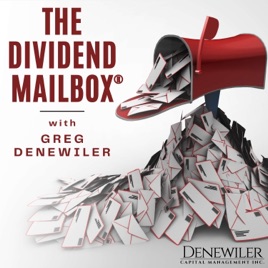
Advertise on podcast: The Dividend Mailbox®
Rating
5from
This podcast has
57 episodes
Language
EnglishPublisher
Greg DenewilerExplicit
No
Date created
2021/06/14
Latest episode
2026/01/24
Average duration
35 min.
Release period
27 days
Description
We want to stuff your mailbox with dividends! Our goal is to show you the power of dividend growth investing, and for each year's check to be larger than the last. We analyze specific companies and look at the mindset this strategy requires to be successful long-term. Come explore this not-so-boring world and watch your portfolio's value compound.
Unlock The Dividend Mailbox® podcast Email contact info,
Listeners & Audience details
Email contact information
Direct podcast contact details

Listeners
Audience numbers & engagement insights

Audience details
Podcast Insights

Podcast episodes
Check latest episodes from The Dividend Mailbox® podcast
The One Number That Drives Long-Term Returns
2026/01/24
Dividend Growth: The Quiet Engine of Wealth
Dividend growth investing sounds simple, but doing it well for decades is not. Markets get noisy. Numbers get confusing. That’s why we wrote Dividend Growth: The Quiet Engine of Wealth—a practical guide to building a framework you can stick with when things get uncomfortable. You can get a free copy here.
Plus, join our market newsletter for more on dividend growth investing.
________
If you could only look at one number to judge whether a dividend can keep growing for decades, what would it be?
In this episode, we strip investing back to first principles. Greg talks about why investors get overwhelmed with data and how focusing on the wrong metrics can quietly lead you off track. Using a simple hot dog stand analogy, he explains why familiar numbers like return on equity (ROE) and return on assets (ROA) can distort reality, especially when leverage enters the picture.
From there, he introduces return on invested capital (ROIC) and shows why it does a better job connecting business quality to long-term dividend growth. Later, Greg addresses what ROIC can’t tell you and why context always matters.
Along the way, he walks through real-world examples, including Kraft Heinz ($KHC), Southern Company ($SO), Williams-Sonoma ($WSM), and Microsoft ($MSFT), to show how capital allocation decisions compound over time.
[00:11] Introduction
[02:50] Information overload and the danger of focusing on the wrong numbers
[04:40] The hot dog stand: ROA vs. ROE and the role of leverage
[08:15] Why both ROA and ROE can mislead dividend investors
[09:35] Return on invested capital (ROIC) explained in plain English
[13:30] ROIC, cost of capital, and long-term value creation
[14:55] Case study: Kraft Heinz and why high yield can be a trap
[18:30] Case study: Southern Company and when low returns still “work”
[22:10] Case study: Williams-Sonoma and disciplined capital allocation
[24:55] Case study: Microsoft and the power of long-term compounding
[29:10] The limits of ROIC and why incremental returns matter
[31:25] Final takeaway: one number, long time horizons, evolving businesses
Send us a text
Disclaimer: Past performance does not guarantee future results. This episode is for educational purposes only and is not investment advice.
If you enjoy the show, we'd greatly appreciate it if you subscribe and leave a review
RESOURCES:
Schedule a meeting with us -> Financial Planning & Portfolio Management
Getting into the weeds -> DCM Investment Reports & Models
Visit our website to learn more about our investment strategy and wealth management services.
Follow us on:
Instagram | Facebook | LinkedIn | X
Dividend Growth vs. Distraction: A Reset for Long-Term Investors
2025/12/23
📘Free Short Book: Dividend Growth, the Quiet Engine of Wealth
If today’s market feels noisy, this short book lays out a calmer framework.
Dividend Growth: The Quiet Engine of Wealth explains the same principles discussed in this episode—discipline, compounding, sustainable income growth, and staying focused when markets distract.
It’s a quick read (about 90 minutes) and walks through how dividend growth works across full market cycles, including bull and bear markets.
👉 Download the free eBook:
growmydollar.com/dividend-growth-book
Plus, join our market newsletter for more on dividend growth investing.
________
Dividend growth investing can feel uncomfortable when a handful of growth stocks dominate headlines and performance. When value lags and momentum strategies seem unstoppable, it’s easy to wonder whether patience and discipline still make sense.
To round out 2025, Greg steps back from the noise to revisit foundational principles of dividend growth investing and explain why they remain intact, even in today’s market. He walks through why distraction is one of the biggest risks investors face, how compounding quietly does the heavy lifting, and why tying income growth to long-term economic growth creates a durable framework that doesn’t depend on short-term cycles
From the “Vitamin C” concept to classic compounding examples like the penny story and the Rule of 72, this episode reinforces how small, consistent decisions compound into meaningful income over time. Greg also revisits dividend growth targets, yield “sweet spots,” and the practical levers investors can pull to sustain income growth. The episode culminates in a real-world look at the model portfolio, which has been running since 2010.
From all of us here at The Dividend Mailbox®, Happy Holidays!
Topics covered:
00:00 – Introduction and why this is a good time to revisit first principles
01:10 – Market distractions, information overload, and staying focused
03:20 – Introducing the new book: Dividend Growth: The Quiet Engine of Wealth
04:20 – The “Vitamin C” concept and daily discipline
05:40 – The penny story and how compounding really works
09:40 – The Rule of 72 and the long-term cost of short-term decisions
11:10 – “The line”: GDP growth, earnings growth, and dividend growth
14:30 – Targeting 7% dividend income growth
16:30 – The 2–4% dividend yield sweet spot
17:55 – Income growth levers: reinvesting, reallocating, and dividend increases
20:4
Send us a text
Disclaimer: Past performance does not guarantee future results. This episode is for educational purposes only and is not investment advice.
If you enjoy the show, we'd greatly appreciate it if you subscribe and leave a review
RESOURCES:
Schedule a meeting with us -> Financial Planning & Portfolio Management
Getting into the weeds -> DCM Investment Reports & Models
Visit our website to learn more about our investment strategy and wealth management services.
Follow us on:
Instagram | Facebook | LinkedIn | X
No Revenue Growth, No Dividend Growth
2025/11/19
How strong is your dividend growth portfolio? Send it to us for a free evaluation at [email protected]. Plus, join our market newsletter for more on dividend growth investing.
________
Consumer staples look reliable with strong brands, steady cash flow, and good yields. But dividends can’t outrun revenue forever, and across this sector the growth engine has stalled.
In this episode, Greg begins with a quick recap of how 2025 has unfolded so far, highlighting strong income growth for the model portfolio, a handful of growth names driving market performance, and value strategies continuing to lag. From that backdrop, he digs into the disconnect between the appearance of safety in consumer staples and the underlying fundamentals that truly support dividend growth.
Using Kimberly-Clark ($KMB), General Mills ($GIS), Colgate ($CL), Procter & Gamble ($PG), and Church & Dwight ($CHD) as case studies, Greg shows how companies with high ROIC and defensive business models can still become no-growth traps. These companies were once consistent outperformers with impressive dividend histories, but the economy evolves and so have their growth profiles.
Topics Covered:
03:05 – Comparing dividend growth to the S&P 500
05:43 – Investing styles cycle and chasing rarely works
07:07 – Surface numbers can be misleading
11:00 – Kimberly-Clark: attractive metrics masking zero growth
16:42 – General Mills: high yield but barely growing
18:36 – Colgate: excellent margins, slow dividend progression
19:58 – Procter & Gamble: financial strength, but limited growth
21:03 – Church & Dwight: a past outlier that doesn’t meet our targets
23:57 – Kimberly-Clark’s planned Kenvue acquisition
29:36 – The mosaic of evidence investors should pay attention to
Have questions or want a second opinion on your dividend strategy?
Email us anytime at [email protected] for a free portfolio review and ongoing dividend insights.
Send us a text
Disclaimer: Past performance does not guarantee future results. This episode is for educational purposes only and is not investment advice.
If you enjoy the show, we'd greatly appreciate it if you subscribe and leave a review
RESOURCES:
Schedule a meeting with us -> Financial Planning & Portfolio Management
Getting into the weeds -> DCM Investment Reports & Models
Visit our website to learn more about our investment strategy and wealth management services.
Follow us on:
Instagram | Facebook | LinkedIn | X
The Free Lunch Illusion: How Fear and FOMO Feed Wall Street
2025/10/15
How strong is your dividend growth portfolio? Send it to us for a free evaluation at [email protected]. Plus, join our market newsletter for more on dividend growth investing.
________
Wall Street’s creativity knows no bounds, especially when it comes to selling safety or income. In this episode, Greg revisits Warren Buffett’s timeless wisdom to uncover who’s “swimming naked” in today’s market.
Drawing on Rob Arnott and Edward McQuarrie’s recent CFA research on risk and investor psychology, he explains how both fear of loss and fear of missing out drive market behavior far more than models admit. Greg dissects several headline-grabbing products, from “high income” S&P 500 ETFs and 77% yielding Nvidia options funds to the Dual Directional Buffer ETF and the “Magnificent Seven Snowball,” revealing how they offer the illusion of safety or income while eroding long-term returns. He closes with a Buffett-style case study on Occidental Petroleum and Berkshire Hathaway’s recent deal, underscoring the power of simple, steady cash flow over engineered complexity.
As Leonardo da Vinci said, “Simplicity is the ultimate sophistication,” and it is also one of the surest ways to compound wealth.
Topics Covered
[00:00:41] – Who’s swimming naked? The illusion of risk-free returns
[00:02:31] – Understanding risk and fear in markets: Rob Arnott’s research
[00:06:22] – How fear of loss and FOMO distort risk premiums
[00:09:19] – The rise of high-income ETFs: chasing yield in disguise
[00:12:32] – The Nvidia ($NVDA) income strategy ETF: 77% yield, but at what cost?
[00:16:09] – Dual Directional Buffer ETF: the illusion of protection
[00:21:14] – The “Mag 7 Snowball” structured note: Wall Street’s creative packaging
[00:25:47] – Why these structures guarantee Wall Street wins
[00:26:45] – Buffett, Occidental ($OXY), and the value of consistent cash flow
[00:32:20] – Simplicity, cash flow, and the sophistication of staying patient
For more on dividend growth investing or to request a free portfolio review, email [email protected].
Past performance does not guarantee future results. This episode is for educational purposes only and is not investment advice.
Send us a text
Disclaimer: Past performance does not guarantee future results. This episode is for educational purposes only and is not investment advice.
If you enjoy the show, we'd greatly appreciate it if you subscribe and leave a review
RESOURCES:
Schedule a meeting with us -> Financial Planning & Portfolio Management
Getting into the weeds -> DCM Investment Reports & Models
Visit our website to learn more about our investment strategy and wealth management services.
Follow us on:
Instagram | Facebook | LinkedIn | X
UPS Stock: Can It Still Deliver for Dividend Investors?
2025/09/23
How strong is your dividend growth portfolio? Send it to us for a free evaluation at [email protected]. Plus, join our market newsletter for more on dividend growth investing.
________
When a stock’s price is falling, its yield is sky-high, and there’s plenty of doubt, it looks like a classic value trap. Does it ever make sense for dividend growth investors to walk into that trap? Sometimes, what’s under the hood tells a very different story.
In Episode 51, Greg revisits UPS ($UPS), a company we last covered years ago but is now back on our radar for entirely new reasons. Rising wages, Amazon contract changes, and global trade tariffs have cut the stock price in half since 2022, sending its dividend yield toward 8%. At first glance, it looks like the market is pricing it for a dividend cut.
But step behind the headlines, and the story gets more compelling: UPS continues to post solid margins, generates strong cash flow, and has the scale and efficiency to remain a leader in global logistics. Even if a dividend cut occurs, investors may still come out ahead with sustainable yields and renewed dividend growth potential. Greg breaks down the scenarios, risks, and catalysts that make UPS a compelling story to consider.
Topics Covered:
[00:03:32] Why UPS looks like a high-yield “problem child” but may still be a dividend growth play[00:06:20] UPS’s history: growth in revenue, profits, and dividends since 1999[00:09:58] The “trifecta” of headwinds—union wage hikes, Amazon contract cuts, and tariffs[00:12:36] Comparing UPS vs. FedEx ($FDX), Amazon ($AMZN), USPS, and DHL in market share and profitability[00:19:57] How AI could improve delivery efficiency[00:21:12] Business metrics, profitability, debt profile, and why UPS’s financing signals investor confidence[00:25:27] The dividend dilemma: can UPS sustain its payout, or is a cut coming?[00:27:44] Three scenarios: steady dividend, improved valuation, or a cut that resets growth[00:31:47] Long-term catalysts: tariffs, Amazon shifts, and global trade recovery[00:33:37] What research firms (Morningstar, Value Line) are projecting for UPS[00:34:56] Final take: UPS as a value play that still pays you to wait
Send us a text
Disclaimer: Past performance does not guarantee future results. This episode is for educational purposes only and is not investment advice.
If you enjoy the show, we'd greatly appreciate it if you subscribe and leave a review
RESOURCES:
Schedule a meeting with us -> Financial Planning & Portfolio Management
Getting into the weeds -> DCM Investment Reports & Models
Visit our website to learn more about our investment strategy and wealth management services.
Follow us on:
Instagram | Facebook | LinkedIn | X
ACN Deep Dive: AI Isn’t Killing Consulting, It’s Reinventing It
2025/08/20
How strong is your dividend growth portfolio? Send it to us for a free evaluation at [email protected]. Plus, join our market newsletter for more on dividend growth investing.
Dividend investing isn’t about settling for slow growth. To grow your income, you need to own growing companies, and the real wins come when you find them at a discount. The trick is seeing past the headlines and recognizing value even in businesses the market assumes are at risk of disruption.
In this milestone 50th episode, Greg kicks things off with a Wall Street Journal investor quiz that highlights the timeless power of compounding. From there, the focus shifts to Accenture ($ACN), the world’s largest consulting firm. Despite short-term headwinds from government budget cuts and fears of AI disruption, Accenture’s strong balance sheet, growing dividend, and unique position in the consulting landscape make it a compelling candidate for long-term dividend growth investors. Greg breaks down the numbers, the risks, and the upside scenario if Accenture turns AI into an accelerant for its business model.
Topics Covered:
03:13 – The century-long compounding lesson: Coca-Cola, Nvidia, Altria, and Apple
05:15 – Berkshire Hathaway’s glitch and 60 years of outperformance
07:26 – Introducing Accenture ($ACN): A long-held but renewed idea
08:48 – Why the stock has fallen from $400 to the mid-$200s
10:39 – AI disruption fears: risk or opportunity?
11:33 – Morningstar and Value Line’s perspectives on Accenture
14:34 – Historical dividend, earnings, and revenue track record
16:25 – Margins, balance sheet strength, and net debt position
19:03 – Return on invested capital: consistent discipline over decades
20:08 – Acquisition strategy: why Accenture has succeeded where others fail
21:59 – Conservative debt issuance and bond market confidence
24:56 – Profitability metrics: margins remain steady through cycles
26:14 – Accounts receivable and customer credit strength
27:41 – Why the federal contract risk looks like a buying opportunity
28:10 – The 10-year dividend model and forward growth scenarios
30:01 – Potential upside if AI becomes a growth driver
31:45 – Valuation: PE, price-to-sales, and free cash flow yield at decade lows
32:48 – Risks: client concentration, acquisitions, regulation, and AI disruption
34:04 – Final thoughts
📩 Want your dividend portfolio reviewed?
Email a list of your holdings (no dollar amounts necessary) to [email protected].
We’ll rate it from 1 to 5 and include a few helpful bullet points to show h
Send us a text
Disclaimer: Past performance does not guarantee future results. This episode is for educational purposes only and is not investment advice.
If you enjoy the show, we'd greatly appreciate it if you subscribe and leave a review
RESOURCES:
Schedule a meeting with us -> Financial Planning & Portfolio Management
Getting into the weeds -> DCM Investment Reports & Models
Visit our website to learn more about our investment strategy and wealth management services.
Follow us on:
Instagram | Facebook | LinkedIn | X
EXPRESS MAIL: Union Pacific’s Surprise Merger Bid
2025/08/01
How strong is your dividend growth portfolio? Send it to us for a free evaluation at [email protected]. Plus, join our market newsletter for more on dividend growth investing.
In what may be the largest M&A deal of 2025 so far, Union Pacific ($UNP) has made a formal bid to merge with Norfolk Southern ($NSC). The proposed merger not only furthers the consolidation of the quasi-monopolistic railroad industry but also raises important questions about what it means for investors. Given the time we’ve spent highlighting Union Pacific as a model of dividend growth, we believe this surprise announcement warrants an early-stage analysis.
In this Express Mail episode, Greg covers:
[01:12] Merger Details
Union Pacific makes a surprise $20B bid for Norfolk Southern—despite their past capital discipline.
[03:54] Financial Analysis: Debt, EBIT, and Credit Ratings
How the merger affects profitability, interest coverage, and debt loads.
[10:29] Lessons from Canadian Pacific’s Kansas City Merger
A similar deal that didn’t go quite as planned—and what it might signal for UNP.
[15:36] Dividend Outlook: What Now?
We break down whether the combined railroad can still deliver 7% dividend growth.
[17:59] Final Thoughts
Is Union Pacific now a total return story, not a dividend growth story? Why we’re holding through the uncertainty.
📩 Want your dividend portfolio reviewed?
Email a list of your holdings (no dollar amounts necessary) to [email protected].
We’ll rate it from 1 to 5 and include a few helpful bullet points to show how well you're aligned with long-term dividend growth principles.
Send us a text
Disclaimer: Past performance does not guarantee future results. This episode is for educational purposes only and is not investment advice.
If you enjoy the show, we'd greatly appreciate it if you subscribe and leave a review
RESOURCES:
Schedule a meeting with us -> Financial Planning & Portfolio Management
Getting into the weeds -> DCM Investment Reports & Models
Visit our website to learn more about our investment strategy and wealth management services.
Follow us on:
Instagram | Facebook | LinkedIn | X
Dividend Growth Is a Mindset, Not a Yield
2025/07/23
How strong is your dividend growth portfolio? Send it to us for a free evaluation at [email protected]. Plus, join our market newsletter for more on dividend growth investing.
If you’ve ever struggled to stay disciplined in a world chasing growth or yield at all costs, this episode is for you. Whether you’re a seasoned dividend investor or new to the strategy, clarity, intention, and long-term thinking are essential to compounding your wealth over time.
In this month’s episode, Greg reflects on a personal story about trying to sell his daughter’s old Honda CR-V. What begins with a frustrating lowball offer turns into an unexpected reminder of the core principles behind successful dividend investing. It’s a story that sets the stage for a broader discussion on the power of focus and the cost of distraction.
Greg then connects this lesson to recent decisions within the portfolio:
Why we sold Emerson Electric ($EMR), even after years of ownership and recent price gains.A quick update on Rémy Cointreau ($REMYY) and why the story has improved.Whether Stanley Black & Decker ($SWK) is a value play or a value trap.
📩 Want your dividend portfolio reviewed?
Email a list of your holdings (no dollar amounts necessary) to [email protected].
We’ll rate it from 1 to 5 and include a few helpful bullet points to show how well you're aligned with long-term dividend growth principles.
Topics Covered:
00:41 - Core theme of the episode: Clarity in investing, in mindset, and in strategy
02:01 - New offer: Get your dividend portfolio rated 1–5 by our team
03:17 - The $400 CR-V story and what it reveals about opportunity cost
11:32 - Applying the lesson: Compounding capital vs. chasing small gains
12:46 - Why clarity matters when dividend-based strategies lag
15:08 - Three paths: Pure growth, high yield, and dividend growth
16:08 - Why we sold Emerson: Weak dividend growth, poor capital efficiency
21:49 - Rémy update: Positive developments in the China tariff situation
23:23 - Stanley Black & Decker review: Great yield, but fading margins
30:21 - Dividend growth math: What would it take for Stanley to meet our hurdle?
34:32 - The truck analogy: Growth vs. yield vs. the dividend growth “sweet spot”
36:03 - Final thoughts: Clarity and discipline are non-negotiable
Send us a text
Disclaimer: Past performance does not guarantee future results. This episode is for educational purposes only and is not investment advice.
If you enjoy the show, we'd greatly appreciate it if you subscribe and leave a review
RESOURCES:
Schedule a meeting with us -> Financial Planning & Portfolio Management
Getting into the weeds -> DCM Investment Reports & Models
Visit our website to learn more about our investment strategy and wealth management services.
Follow us on:
Instagram | Facebook | LinkedIn | X
The Value Play Hiding Behind a 300-Year-Old Luxury Brand
2025/06/18
More on dividend growth investing -> Join our market newsletter!
The argument has long been made that venturing beyond America’s borders will offer investors higher yields. Many foreign companies do pay attractive dividends, but they lack consistency and predictable growth—factors that have kept us from investing overseas.
But in this episode, we break the mold and head to the vineyards of France. Greg explores the under-the-radar story of Rémy Cointreau ($REMYY), the cognac maker behind the iconic Rémy Martin brand. What makes this story remarkable isn’t just the 3% dividend yield or the potential for earnings to normalize. It’s the value hiding in plain sight: aging inventory that becomes more valuable with time. With a wide moat and one of the most unique inventory structures we’ve seen, Rémy stands out as a compelling value play with rare downside protection. Markets are mostly efficient—but every now and then, a story slips through the cracks.
Topics Covered:
01:46 Exploring Foreign Dividend Opportunities
02:40 Discovering Remy: A Value Play
03:31 A First Look at Rémy’s Dividend and Valuation
06:01 Performance History and the Power of Modest Growth
08:11 Understanding the Cognac Market
11:29 How Cognac Is Made and Why It Matters
16:07 What Is Wrong with Remy?
18:38 Cash Flow, EBIT History, and Financial Strength
22:28 The Inventory Advantage
25:18 Future Growth Potential and Valuation Scenarios
27:49 Three Catalysts for Re-Rating
33:32 Final Thoughts and Takeaways
Send us a text
Disclaimer: Past performance does not guarantee future results. This episode is for educational purposes only and is not investment advice.
If you enjoy the show, we'd greatly appreciate it if you subscribe and leave a review
RESOURCES:
Schedule a meeting with us -> Financial Planning & Portfolio Management
Getting into the weeds -> DCM Investment Reports & Models
Visit our website to learn more about our investment strategy and wealth management services.
Follow us on:
Instagram | Facebook | LinkedIn | X
Two Paths to Value: Short-Term Yield vs. Long-Term Growth in Distressed Markets
2025/05/16
More on dividend growth investing -> Join our market newsletter!
While dividend growth remains the core of what we do, it’s not the only path to building an income stream. In times of market distress, opportunities emerge that are simply too compelling to ignore. When venturing into troubled waters, the key is to stay disciplined and unemotional. Volatility may test you, but the potential rewards can be worth it.
In this episode, Greg explores two distinct approaches to finding value from an income perspective. In the first half, he discusses business development corporations (BDCs), which often offer eye-catching yields north of 10%. Using Oaktree Specialty Lending Corp. ($OCSL) as a case study, he unpacks how BDCs are structured, where their income potential comes from, and why they carry above-average risk. More importantly, he shares why patience and preparation are key to capturing value when these high-yield opportunities go on sale.
In the second half, we shift gears back to a more traditional name for dividend growth investors. Greg introduces Sysco Corp. ($SYY), a 50-year dividend payer in the essential world of food distribution. Unlike the high-yield, high-volatility world of BDCs, Sysco represents steady, well-managed growth with consistent operations. Even though the stock appears to have been in a holding pattern over the past few years, it fits squarely into our 10-year framework.
In both cases, price discipline is essential.
Topics Covered:
01:46 – Introduction to BDCs (Business Development Corporations)
05:18 – Oaktree Specialty Lending Corp Case Study
14:57 – Knowing What You Own: Risk and Return in Distressed Markets
16:23 – When and How to Buy BDCs
19:22 – Total Return Recap from a Past Investment in Oaktree
24:37 – Transition to Traditional Dividend Growth: Enter Sysco Corp
28:17 – The 10-Year Model: Can Sysco Double?
30:08 – Margin & Capital Efficiency Strengths
32:52 – Comparison to Competitors
35:05 – Valuation and Price-to-Sales History
35:29 – Risks: Cyclicality & Debt Load
38:58 – Why a “Boring” Food Distributor Might Outperform
41:39 – Wrapping Up: Patience, Price, and Knowing What You Own
Send us a text
Disclaimer: Past performance does not guarantee future results. This episode is for educational purposes only and is not investment advice.
If you enjoy the show, we'd greatly appreciate it if you subscribe and leave a review
RESOURCES:
Schedule a meeting with us -> Financial Planning & Portfolio Management
Getting into the weeds -> DCM Investment Reports & Models
Visit our website to learn more about our investment strategy and wealth management services.
Follow us on:
Instagram | Facebook | LinkedIn | X
Buying in the Storm: How Bear Markets Lead to Higher Dividends and Returns
2025/04/15
More on dividend growth investing -> Join our market newsletter!
Schedule a meeting with us -> Financial Planning & Portfolio Management
Almost everyone knows that tariffs and trade wars have sent global markets spiraling, with the Dow down 17% and the S&P 500 down 20% from their highs, based on our recording date. While technically that implies we have entered a bear market, it also means better prices for long-term cash flow. It is human nature to get nervous when markets seem to be on the brink of panic, but dividend growth investors should see times like these as a gift.
In this episode, Greg tackles the tough headlines and sinking sentiment in today’s markets. As recession fears grow and the market experiences significant volatility, Greg explains why focusing on sustainable cash flow and quality companies provides stability for long-term investors. From investor psychology to long-term GDP trends, Greg discusses how disciplined dividend investing turns market panic into wealth creation. Later, he highlights our recent purchase of Union Pacific ($UNP) as proof of concept.
EDIT: In the episode, Greg mentions that paying $30 for $1 of earnings is about a 2.5% earnings yield. This comment was made in error; the correct number is a 3.33% earnings yield.
Topics Covered:
[01:00] Why focusing on cash flow provides clarity in a chaotic market[02:48] First quarter portfolio performance and the power of staying invested[05:00] Reframing a bear market: buying cash flow at a discount[06:55] How GDP and earnings trends support long-term optimism[10:17] Why market corrections test your investment mindset[11:50] Comparing stock ownership to rental property — and why we forget it's the same[16:33] Real numbers that contradict the media narrative (household debt, corporate cash, etc.)[24:52] New position: Why we bought Union Pacific and what makes it a dividend powerhouse[28:40] The case for quality, patience, and diversification during uncertainty[31:33] Index funds, dividend ETFs, and staying positioned for the rebound[34:01] The most dangerous investing phrase: "It's different this time"
Send us a text
Disclaimer: Past performance does not guarantee future results. This episode is for educational purposes only and is not investment advice.
If you enjoy the show, we'd greatly appreciate it if you subscribe and leave a review
RESOURCES:
Schedule a meeting with us -> Financial Planning & Portfolio Management
Getting into the weeds -> DCM Investment Reports & Models
Visit our website to learn more about our investment strategy and wealth management services.
Follow us on:
Instagram | Facebook | LinkedIn | X
EXPRESS MAIL: Williams-Sonoma's Earnings Results and Dividend Increase
2025/03/21
More on dividend growth investing -> Join our market newsletter!
Schedule a meeting with us -> Financial Planning & Portfolio Management
After Williams Sonoma reported earnings before market open on March 19th, 2025, we saw their results as an excellent example of how to execute a dividend growth strategy on a day-to-day basis. While we have covered $WSM in several previous episodes, it is a case study on dividend growth investing. In what normally takes 10+ years to deliver to investors, Williams Sonoma has provided us with attractive dividend growth and total return in less than 3 years.
In this "express mail" episode, Greg looks at Williams-Sonoma's latest earnings and how recent weakness in the stock price could be a long-term positive for total return. He analyzes how if the stock goes lower, there is room for more share repurchases, which boosts dividend growth and earnings growth. Additionally, he points out that if the stock turns around and goes much higher again, we may consider selling more of the stock. As we stand somewhere in the middle, Greg concludes by looking at where he would buy into the stock again.
00:55 Special Episode: Williams Sonoma Earnings Update
01:24 Williams Sonoma: A Case Study in Dividend Growth
02:33 Strategic Decisions and Market Reactions
05:22 Evaluating Dividend Growth and Future Prospects
12:27 Conclusion and Investment Strategy
Send us a text
Disclaimer: Past performance does not guarantee future results. This episode is for educational purposes only and is not investment advice.
If you enjoy the show, we'd greatly appreciate it if you subscribe and leave a review
RESOURCES:
Schedule a meeting with us -> Financial Planning & Portfolio Management
Getting into the weeds -> DCM Investment Reports & Models
Visit our website to learn more about our investment strategy and wealth management services.
Follow us on:
Instagram | Facebook | LinkedIn | X
What Does a 'Fat Pitch' Look Like?
2025/03/15
More on dividend growth investing -> Join our market newsletter!
Schedule a meeting with us -> Financial Planning & Portfolio Management
While it may be a somewhat misused paraphrase of Warren Buffett's famous baseball analogy, 'fat pitch' is a term often thrown around in investing circles. In most settings, it implies that an investment opportunity is extremely lucrative with a high probability of success—but they are rare. Beyond having the discipline to patiently wait for these opportunities, what does a 'fat pitch' actually look like?
In this episode, Greg discusses the concept of 'fat pitches' by exploring the extraordinary long-term performance of Altria (formerly Philip Morris), despite numerous industry challenges and negative headlines. Through a detailed analysis of Altria's historical performance, including its high dividend yield and impressive cash flow management, he emphasizes the timeless principles of dividend growth, patient investing, and compounding.
00:00 Introduction to The Dividend Mailbox Podcast
02:34 Review of Current Dividend Growth Performance and Market Observations
06:13 Case Study: The Success of Philip Morris
15:58 Key Takeaways from Philip Morris's Performance
24:51 Lessons on Dividend Growth and Compounding
32:14 Conclusion and Final Thoughts
Send us a text
Disclaimer: Past performance does not guarantee future results. This episode is for educational purposes only and is not investment advice.
If you enjoy the show, we'd greatly appreciate it if you subscribe and leave a review
RESOURCES:
Schedule a meeting with us -> Financial Planning & Portfolio Management
Getting into the weeds -> DCM Investment Reports & Models
Visit our website to learn more about our investment strategy and wealth management services.
Follow us on:
Instagram | Facebook | LinkedIn | X
Revisiting Hershey: The Market Pays What the Market Bears
2025/02/19
More on dividend growth investing -> Join our market newsletter!
Schedule a meeting with us -> Financial Planning & Portfolio Management
Following brief upward momentum after we first bought Hershey, the stock proceeded to slide downward. Cocoa prices remain elevated, and there is significant uncertainty surrounding the short-term impacts on the company's operations. However, Hershey's recent earnings report shows that the company is more resilient than it may appear.
Despite a 20% stock decline, Greg emphasizes that there are still many things to like about Hershey. Simply put, there is much more to the story than the current price of cocoa. Going a bit deeper, Greg examines the cocoa supply chain, specifically the impact of weather and geopolitical issues on production in major countries like Ivory Coast, Ecuador, and Ghana, highlighting several factors that suggest a possible future drop in cocoa prices. He further discusses Hershey's superb hedging strategies, strong balance sheet, and potential for high returns through dividends and stock growth within the next decade. Ultimately, Hershey's attractive valuation, dividend yield, and potential dividend growth allow investors to start with an advantage. In closing, Greg presents a Suber Bowl analogy to underscore the patience required for long-term investing, contrasting it with the short-term focus prevalent in current market analysis.
00:00 Introduction to The Dividend Mailbox
02:16 Revisiting the Hershey Story
05:37 Hershey's Market Position and Challenges
07:36 Cocoa Market Dynamics
12:04 Hershey's Financial Health and Strategy
15:29 Investment Strategies and Long-Term Outlook
25:50 Rant on Market Commentary and Short-Term Thinking
31:14 Super Bowl Analogy and Final Thoughts
37:50 Conclusion and Contact Information
Send us a text
Disclaimer: Past performance does not guarantee future results. This episode is for educational purposes only and is not investment advice.
If you enjoy the show, we'd greatly appreciate it if you subscribe and leave a review
RESOURCES:
Schedule a meeting with us -> Financial Planning & Portfolio Management
Getting into the weeds -> DCM Investment Reports & Models
Visit our website to learn more about our investment strategy and wealth management services.
Follow us on:
Instagram | Facebook | LinkedIn | X
Predictive Power Lies in Understanding What You Own
2025/01/18
More on dividend growth investing -> Join our market newsletter!
Is there anything predictable about the stock market? If so, how much power or truth does it hold? Do sophisticated models and strategies have a predictive edge? Even if you’re an investor with limited experience, the odds are at least one of these questions has piqued your interest at some point in your investing career.
In episode 43, Greg discusses predictability in ETF income and dividend growth. He examines various ETFs tracking the S&P 500, such as SPY, IVV, and VOO, highlighting discrepancies in their dividend growth rates from year to year. Greg emphasizes the importance of not making investment decisions based solely on headline numbers, as these may not tell the full story. The episode also explores the limitations of discounted cash flow models, touching on the challenges of long-term forecasts and the uncertainties of market competition. Ultimately, he advises investors to focus on understanding what they own and cautions against overly sophisticated financial models that may introduce more risk and uncertainty.
00:00 Introduction to The Dividend Mailbox
00:46 Understanding ETF Predictability
01:46 Analyzing S&P 500 Dividend Growth
04:09 Comparing Different S&P 500 ETFs
10:49 Exploring the S&P 100 and Other Indexes
16:57 The Complexity of Enhanced Income ETFs
24:27 The Power and Pitfalls of Predictability
25:46 Diving into Discounted Cash Flow Models
31:13 The Terminal Value Trap
38:53 Conclusion and Final Thoughts
Send us a text
Disclaimer: Past performance does not guarantee future results. This episode is for educational purposes only and is not investment advice.
If you enjoy the show, we'd greatly appreciate it if you subscribe and leave a review
RESOURCES:
Schedule a meeting with us -> Financial Planning & Portfolio Management
Getting into the weeds -> DCM Investment Reports & Models
Visit our website to learn more about our investment strategy and wealth management services.
Follow us on:
Instagram | Facebook | LinkedIn | X
Podcast reviews
Read The Dividend Mailbox® podcast reviews
Trippers12 2025/08/02
One of the Best Financial Podcasts
Unlike other financial podcasts he explicitly states their approach to specific companies and gives very detailed in-depth analysis. It’s not speculat...
Dixonlite 2023/12/17
Great podcast!
The siren song podcast sums up everything I love about dividend growth investing. I loved how we are given different scenarios and how things play ou...
AnonymousAndrewPodcast 2023/08/09
Educational!
I know nothing about stocks, and while I recently dabbled in the stock market, I had no idea what I was doing. This podcast has taught me more about s...
scottwyden 2023/08/09
Money talks
This is one of my least favorite topics. Heck, I have a financial planner so I don’t have to think about it. But I stumbled on this show and it is a ...
MB Conaway 2023/01/07
Solid Information to Keep You Focused on Dividends
Greg presents great information and analyzes good companies. He’s got a great framework for analyzing stocks and a philosophy of investing I wish all ...
G-Maaaannnn 2022/10/26
Awesome insight
The ideas presented here are based in reality not theory. Sound practical information.
Destroyalkaline 2022/10/16
Great podcast about dividend investing
Simple, clear, easy to understand concepts about dividend investing. I really appreciate these, thanks for putting them out there.
DivDad10 2022/09/20
Just what I’ve been looking for…
Great podcast! In-depth dividend, growth analysis with out a lot of hype. Good lessons to be learned here.
KarleeStar333 2021/11/01
💸💸💸
I learn something new and something relevant after listening to each podcast. Being a beginner in the stock market, this podcast has helped me grow my...
Yamatransy 2021/06/14
Great Start
This podcast looks like its going to have a lot of really good info! Keep up the good work, and keep those podcasts coming!
Podcast sponsorship advertising
Start advertising on The Dividend Mailbox® relevant audience podcasts
You may also like to advertise on these Podcasts
4.4371061566
The Megyn Kelly Show
SiriusXM

4.888901269
Fearless with Jason Whitlock
Blaze Podcast Network

4.8118931000
Mind Pump: Raw Fitness Truth
Sal Di Stefano, Adam Schafer, Justin Andrews, Doug Egge

4.8102131585
Tara Brach
Tara Brach

4.541561215
Something You Should Know
Mike Carruthers | OmniCast Media

4.513841343
Strictly Anonymous Confessions
Kathy Kay

4.8292781897
Fantasy Footballers - Fantasy Football Podcast
Fantasy Football

4.62382612
Football Weekly
The Guardian

4.45387666
Two Judgey Girls
Two Judgey Girls

3.8258501152
The Viall Files
Nick Viall