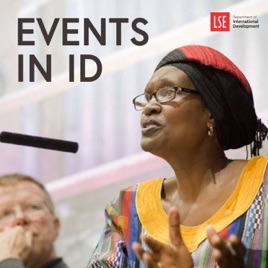
Advertise on podcast: Events in ID
This podcast has
10 episodes
Language
EnglishExplicit
No
Date created
2021/06/25
Latest episode
2025/04/08
Average duration
88 min.
Release period
211 days
Description
Welcome to the Department of International Development at LSE events podcast. Tune in for recordings from a range of events in the Department, including lectures and panel discussions on vital subjects in the world of development. The podcasts include the Great Development Dialogue from 2020, an event on development in Asia with Deepak Nayyar and a coversation around Islamic Extremism in West Africa.
Unlock Events in ID podcast Email contact info,
Listeners & Audience details
Email contact information
Direct podcast contact details

Listeners
Audience numbers & engagement insights

Audience details
Podcast Insights

Podcast episodes
Check latest episodes from Events in ID podcast
The looming global financial crisis: time to re-think development and democracy 2.0
2025/04/08
The looming global financial crisis: time to re-think development and democracy 2.0
This event took place on Tuesday 01 April 2025, 7.00pm to 8.30pm at LSEIn 2006 Professor Bienefeld gave a public lecture at LSE by the very same title, anticipating the global financial crisis of 2007. In that lecture he argued that this crisis would (should?) finally persuade people and policy makers that the neoliberal mantras of "free trade" and of the single-minded empowerment of global market actors, was not a recipe for "development," if only because it eroded the capacity of governments to manage their economies in accordance with the values and priorities of their citizens.
Unfortunately, although there was some talk of a renewed focus on national sovereignty shortly after that crisis, this was soon forgotten as the main focus shifted to the urgent need to manage the debt mountains accumulated in the course of bailing out the financial institutions that had caused the crisis - and then again, in the course of forestalling the economic collapse threatened by the Covid disruptions. And so now, as a new global financial crisis threatens, the same contradictions cry out for resolution, only this time more urgently and more critically.
Indeed, globally the emergence of the BRICS signals a recognition of the need for a new international order with renewed respect for national sovereignties, while in almost all of the developed world political balances are being disrupted by nationalist sentiments that are increasingly difficult to manage, or even to understand. Unless one understands that democracy is not even conceivable unless it pertains to "a society" whose members identify as such, and believe that they share sufficient common interests to allow them to negotiate their remaining differences peacefully through the ballot box.
About the speakerManfred Bienefeld is Professor Emeritus, School of Public Policy and Administration, Carleton University, Ottawa. Early critic of IMF/World Bank structural adjustment and exponent of dependency theory and the developmental state. Author of 1994 TWQ paper warning that the end of the Cold War would not lead to a peace dividend in a multipolar world, but to a unipolar world, hell bent on globalizing a neoliberal economic model that was so divisive and unsustainable that its imposition would require increasingly militaristic methods - by an increasingly "imperialistic" power.
About the discussantRadhika Desai is Professor at the Department of Political Studies, University of Manitoba, Visiting Professor, Department of International Development, LSE. Her work ranges over international political economy, comparative politics and political theory. Her most recent book is Capitalism, Coronavirus and War: A Geopolitical Economy (2023, Open Access, Knowledge Unlatched)
About the ChairRobert Wade is Professor of Political Economy and Development in Department of International Development at LSE. Professor Wade worked at Institute of Development Studies, Sussex, 1972-95, World Bank, 1984-88, Princeton Woodrow Wilson School 1989/90, MIT Sloan School 1992, Brown University 1996-2000. Fieldwork in Pitcairn Is, Italy, India, Korea, Taiwan.
Growth, innovation and singularities: are we sustainable?
2025/04/08
Growth, innovation and singularities: are we sustainable?Tuesday 18 March 2025 7pm to 8.30pm, Hong Kong Theatre.
Speaker: Professor Geoffrey West, Distinguished Professor and former President of the Santa Fe InstituteChair: Professor Jean-Paul Faguet, Professor Political Economy of Development, LSE
Why do people and companies stop growing, age and then die, whereas cities keep growing with the pace of life continuing to accelerate? And how about the planet? Can the super-exponential growth of the anthroposphere be sustained or are we on the edge of some major transition? Is "the end of the world nigh”? And how is all of this related to the dynamics of innovation, wealth creation, social networks and urbanisation?
These are among the questions that will be explored in this lecture. Although life is the most complex and diverse phenomenon in the Universe, almost all its characteristics from cells to cities obey surprisingly simple, “universal” scaling laws which constrain much of the organisation and dynamics of biological, ecological and socio-economic life. These include metabolism, growth, development, lifespans, energy, patents, pollution, roads, crime and disease. These coarse-grained laws originate in the generic underlying mathematical properties of social, infrastructural, resource and information networks that sustain life across all scales. They lead to dramatic consequences for long-term growth, development and sustainability, including the emergence of impending singularities and tipping points.
Can the resulting open-ended super-exponential growth, fueled by innovation and wealth creation, be sustained or does it sow the seeds for eventual collapse?
Hosted by the Department of International Development and the Global School of Sustainability
Is Development an Art or a Science?
2022/11/09
International development is a field in which expert knowledge, drawn primarily from the social and natural sciences, has long been dominant. We know that complex global problems require multidisciplinary approaches and solutions, but how and where do the arts and humanities fit in?
In their new open access book New Mediums, Better Messages: How Innovations in Translation, Engagement & Advocacy are Changing International Development (OUP), co-editors David Lewis, Dennis Rodgers and Michael Woolcock present twelve wide ranging contributions that suggest that we need to further broaden our ideas about what constitutes valid development knowledge. Themes include alternative media such as literary fiction, films, theatre, radio, photography, blogging, and music. Not only do we need to widen our frame of reference about what constitutes valid knowledge, but we also should question how that knowledge is created and valued, and by whom.
Speakers: Dennis Rodgers (Graduate Institute of International and Development Studies, Geneva), Michael Woolcock (World Bank), Emily LeRoux-Rutledge (UWE Bristol)Discussant: Mariz Tadros (IDS Sussex)Chair: David Lewis (LSE)
Self in the World: connecting life's extremes
2022/05/10
Eminent anthropologist Keith Hart draws on the humanities, popular culture and his own experiences to help us explore our own place in history.
We each embark on two life journeys – one out into the world, the other inward to the self. With these journeys in mind, anthropologist, amateur economist and globetrotter Keith Hart reflects on a life of learning, sharing and remembering to offer readers the means of connecting life’s extremes – individual and society, local and global, personal and impersonal dimensions of existence and explores what it is that makes us fully human.
Humanitarian implications of the Ukraine war
2022/03/30
The crisis in Ukraine is a rapidly growing humanitarian emergency. How is the humanitarian community responding to this crisis, and what are the implications for humanitarian studies more broadly? Gathering together a range of researchers and practitioners with experience across the breadth of humanitarian assistance, this panel seeks to explore the implications of the Ukraine crisis on the principles, policies, and practices of humanitarianism.
Please note that this is a recording of a live event, so the sound quality may be slightly compromised.
Speakers: Sir Mark Lowcock, Professor in Practice, LSE ID, Previously Under-Secretary-General for Humanitarian Affairs and Emergency Relief Coordinator for the United Nations (2017-2021) and Permanent Secretary of the UK Department for International Development (2011-2017) Dr Stuart Gordon, Associate Professorial Lecturer in Managing Humanitarianism and Programme Co-Director International Development and Humanitarian Emergencies, Department for International Development, LSEDr Eiko Thielemann, Associate Professor in Political Science and Public Policy, Department of Government and European Institute, LSEAnna Landre, The Partnership’s for Inclusive Disaster Strategies' Ukraine Crisis Focal Point and Disability Justice Activist, Department for International Development, LSE
Chair: Dr Ian Madison, LSE Fellow and Programme Co-Director International Development and Humanitarian Emergencies, Department for International Development, LSE
More Than Money? How Anthropology Can Offer Richer Analysis For Economists
2021/10/08
A recording of the event, 'More Than Money? How Anthropology Can Offer Richer Analysis For Economists' at LSE, Thursday 07 October 2021.
Anthropology has often been seen as an academic version of Indiana Jones – namely a discipline devoted to exotic travel that does not have much relevance for the modern world.
However, anthropology-trained Financial Times journalist and author Gillian Tett argues that this image is completely wrong today, and anthropology can make a vital contribution to public policy, corporate and financial life, as well as our communities as we try to 'build back better' after COVID-19. Indeed, she argues that a world drowning in artificial intelligence and other digital innovations desperately needs a second type of 'AI' – Anthropology Intelligence – to enable us to flourish.
But what does this mean for the economics profession? Could economists benefit by embracing this new type of AI? Gillian Tett explores this question in this talk, and her new book Anthro-Vision; A New Way To See In Business And Life. Deborah Rowland, a leading global thinker, speaker, writer, and coach in the field of leading big complex change also shares her perspective on an anthropological approaches to business and other complex systems.
You can also watch the video recording of the event on YouTube here: https://www.youtube.com/watch?v=6xCVwhaCfS4.
Decolonizing Development Studies
2021/08/03
This podcast is a recording from a panel discussion on Tuesday 27 July hosted by the Firoz Lalji Institute for Africa and the Department of International Development on 'Decolonising development studies: Practical steps in course designing, reading selections and classroom discussions'. The event was chaired by ID's Dr Eyob Balcha Gebremariam and featured panelists Dr Rosalba Icaza, Associate Professor, Institute of Social Studies, Erasmus University; Dr Yirga Gelaw Woldeyes, Curtin University, Centre for Human Rights Education; Dr. Althea-Maria Rivas, Department of Development Studies, SOAS.
The discussion covered many complex questions around how to decolonise development studies, considering the various layers of this debate which address epistemological questions, methodological issues, diversity of authors, curriculum designing, and classroom discussions with and among students. The event built on the lessons and challenges of teaching African Development using decolonial perspectives in the current academic year at the LSE, International Development Department, and what this may mean for other disciplines.
For related podcasts, you can check out the Citing Africa podcast, hosted by the Firoz Lalji Institute for Africa, which explores the global construction and imbalances of knowledge production, taking a critical look at the wider context affecting the African continent.
Overcoming Boko Haram: A Book and a Conversation on Islamic Extremism in West Africa
2020/03/11
This event celebrated the launch of Overcoming Boko Haram: Faith, Society & Islamic Radicalization in Northern Nigeria. The book looks beyond the details of the insurgency to examine the wider social and political processes that explain why Boko Haram emerged when and where it did, and what forces exist within society to contain it. Drawing on the detailed fieldwork of specialist Nigerian and Nigerianist scholars from Nigeria, connecting the worst of Boko Haram violence to the wider realities of the present, the book offers new insights into the drivers of Islamic extremism in Nigeria - poverty, regional inequality, environmental stress, migration, youth unemployment, and state corruption and human rights abuses - with a view to charting more sustainable paths out of the conflict. #LSEbokoharam Speakers: Dr Kate Meagher, Co-Author and Associate Professor in Development Studies Professor Funmi Olonisakin, Professor of Security, Leadership and Development at King's College London Aoife McCullough, PhD candidate and Former Research Fellow at ODI Chair: Professor Catherine Boone, Professor of International Development
Deepak Nayyar on development in Asia over the last 50 years
2020/03/05
The lecture analyzes the phenomenal transformation of Asia, which would have been difficult to imagine, let alone predict, fifty years ago. In doing so, it provides an analytical narrative of this remarkable story of economic development, situated in the wider context of historical, political and social factors, and an economic analysis of the underlying factors, with a focus on critical issues in the process of, and outcomes in, development. The analytical conclusions drawn contribute to contemporary debates on development, and highlight some lessons from the Asian experience for countries elsewhere. Deepak Nayyar is Emeritus Professor of Economics at Jawaharlal Nehru University, New Delhi, and an Honorary Fellow of Balliol College, Oxford.
The Great Development Dialogue 24 Jan 2020
2020/01/27
Speakers: Maitreesh Ghatak, Dr Gharad Bryan, Deoborah James, David Graeber and Kathryn Hochstetler * Chair: Professor Jean-Paul Faguet The Great Development Dialogue is a yearly event sponsored by the LSE’s Department of International Development, with two purposes: (1) to explore some of the deepest and most vexing questions in development from an explicitly cross-disciplinary perspective; and (2) to shine a light on what the disciplines can and cannot tell us about economic and social development. Past dialogues have featured speakers like Ha-Joon Chang, John Sutton, Danny Quah, and Robert Wade. This year’s event began with the political economy of land, and then moved onto broader issues of what economics, anthropology and political science can and cannot teach us about development. The event featured more speakers from more varied perspectives than in the past: Deoborah James and David Graeber (anthropology), Maitreesh Ghatak and Gharad Bryan (economics), and Kathryn Hochstetler (international development). Join the discussion on Twitter here: #LSEDevDialogue
Podcast reviews
Read Events in ID podcast reviews
Podcast sponsorship advertising
Start advertising on Events in ID relevant audience podcasts
You may also like to advertise on these Podcasts

4.8238292
Big Orange Couch: The 90s Nickelodeon Podcast
Big Orange Couch

4.9105193
The Offensive
Stak

4.427118
Pow Wow Life - PowWows.com
PowWows.com
4.94651000
Pat and JT Podcast
Hurrdat Media
4.511494
High Road to Humanity
Nancy Yearout

4.4883
The Cricket Library
Matt Ellis

4.7190207
Where Do We Go From Here?
Jessica Van Der Wyngaard

32255
Inn To His Word
Inspiration
4.8204164
The Green Blueprint
Latitude Media
4.9201173
You Might Know Her From
Anne Rodeman & Damian Bellino